REVIEW 3 major objections 6 minor 34 references
Towards nucleon structure function moments and parton momentum fractions from lattice QCD
T0 review · 3 major / 6 minor · reviewed 2026-08-15 · deepseek-v4-flash
Pith's one-line read This paper reports a direct lattice QCD determination of the isovector parton momentum fraction, $\langle x\rangle_{u-d}=0.141(8)$ at 4 GeV$^2$, obtained from the Feynman-Hellmann Compton amplitude.
desk verdict New Feynman-Hellmann moments at lighter pion masses; the PDF-moment extraction rests on an untested higher-twist ansatz, so the <x> result is provisional. read the letter →
The pith
A machine-rendered reading of the paper's core claim, the machinery that carries it, and where it could break.
The reading
What carries the argument
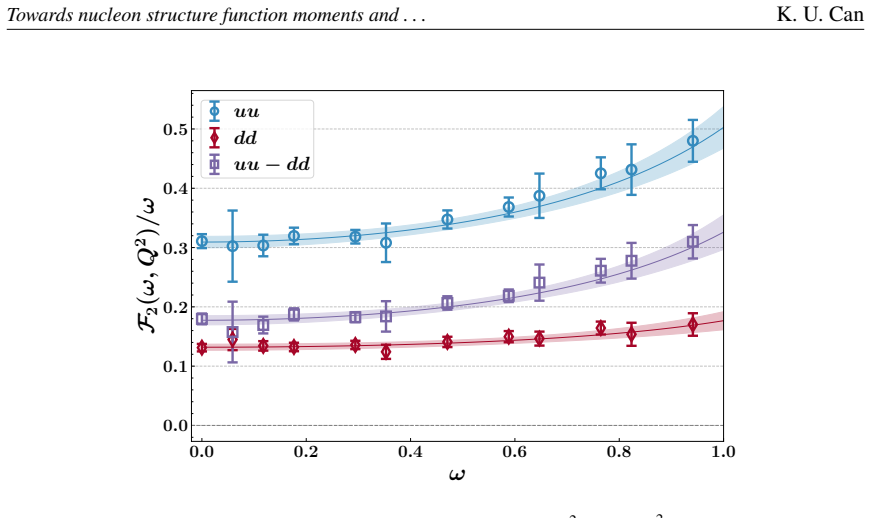
The load-bearing object is the second-order Feynman-Hellmann theorem for the forward Compton amplitude: perturbing the fermion action by a background electromagnetic current $S(\lambda)=S_0 + \lambda \int d^4z\,(e^{iq\cdot z}+e^{-iq\cdot z})J_\mu(z)$ shifts the nucleon energy, and the second derivative of that energy at $\lambda=0$ is the Compton tensor (Eq. 15). The extraction chain is: form the ratio of perturbed to unperturbed two-point functions to isolate the even-order energy shift; reconstruct $F_2/\omega$ from the $T_{00}+T_{33}$ combination at $\omega=0$; fit the $\omega$-expansion truncated at $n=6$ with Bayesian positivity priors to obtain the Mellin moments; then fit the $Q^2$-dependence through the OPE form $M = C\,[v_2 + A_2/Q^2]$ to separate leading and higher twist. The method avoids the power-divergent operator mixing that affects quasi- and pseudo-PDF moment calculations.
What would settle it
Repeat the leading/higher-twist separation at the SU(3)-symmetric point with a different model for the power correction, for example letting $A_2$ run independently or including a $1/Q^4$ term; if the extracted $v_2$ moves by more than its 0.008 uncertainty, the quoted $\langle x\rangle_{u-d}=0.141(8)$ is model-dependent rather than determined. A second check is to repeat the full $Q^2$ analysis on the $m_\pi\approx300$ MeV ensemble, where the physical-point extrapolation is no longer required.
Extended reading notes
Core claim
The central claim is that the physical, quark-mass-dependent lowest even isovector moment of $F_2$ can be obtained directly from the Compton amplitude, and that its $Q^2$ dependence can be used to disentangle the leading-twist PDF moment from higher-twist power corrections. The calculation, performed on 2+1-flavour ensembles at $m_\pi \approx 410, 360, 300$ MeV with a single lattice spacing $a = 0.068(3)$ fm, gives $M^{(2)}_{2,uu-dd}(Q^2\sim5\,\mathrm{GeV}^2)=0.177(22)$ after a linear fit in $(a m_\pi)^2$. Fitting the $Q^2$ dependence of the moments at the SU(3)-symmetric point to $M = C(Q^2/\mu^2,g)\,[v_2(\mu) + A_2(\mu)/Q^2]$ with an NNLO Wilson coefficient yields $v_2 = \langle x\rangle_{u-d} = 0.141(8)$ at $\mu^2=4\,\mathrm{GeV}^2$. The same fit indicates that the power correction is sizable: about 30% of the leading-twist moment at $Q^2=4$ GeV$^2$ and about 10% at $Q^2=10$ GeV$^2$.
Load-bearing premise
The paper's headline momentum fraction rests on a specific model of the $Q^2$-dependence of non-leading corrections: one power-suppressed term of the form $A_2/Q^2$ sharing the same short-distance coefficient as the leading term, with no alternative parameterization tested.
Editorial extensions
If this is right
- The physical isovector $F_2$ moment is determined to about 10% precision at a fixed scale, $Q^2\sim5$ GeV$^2$, from lattice QCD alone.
- The leading-twist momentum fraction $\langle x\rangle_{u-d}=0.141(8)$ at 4 GeV$^2$ is consistent with the 2+1-flavour lattice average, providing an independent cross-check of existing PDF-moment determinations.
- Power corrections are not negligible in the studied range: the higher-twist term is roughly 30% of the leading-twist moment at $Q^2=4$ GeV$^2$ and still about 10% at $Q^2=10$ GeV$^2$.
- Because the method accesses the physical Compton amplitude directly, it bypasses the renormalization and mixing issues that complicate quasi- and pseudo-PDF calculations of moments.
- The extracted moment shows only mild quark-mass dependence between $m_\pi\approx300$ and 410 MeV, supporting the linear extrapolation to the physical point used in the analysis.
Reading between the lines
- The paper does not test alternative parameterizations of the power correction; allowing $A_2$ to run with scale, or adding a $1/Q^4$ term, could shift $\langle x\rangle_{u-d}$ and is the most direct check of the quoted value.
- If the reported higher-twist size holds, global QCD fits that quote PDFs at $Q^2\sim4$ GeV$^2$ and neglect power corrections may carry a small but non-negligible bias.
- The same analysis machinery could be applied to other $\omega$ moments and to polarised structure functions, where the paper only reports the lowest $F_2$ isovector moment.
- A natural extension is to repeat the $Q^2$-dependence fit on the lighter-mass ensembles rather than only at the SU(3)-symmetric point; agreement would test the quark-mass independence of the higher-twist term.
Signed reviews
Editorial analysis
A structured set of objections, weighed in public.
Referee Report
Summary. This manuscript reports a lattice QCD computation of the lowest even isovector Mellin moment of the F2 structure function using the Feynman-Hellmann approach. The authors compute second-order energy shifts from perturbed nucleon correlators on three 2+1-flavour ensembles with m_pi ≈ 410, 360, and 300 MeV at fixed volume and lattice spacing, extract moments from the omega-dependence of the Compton structure function, and extrapolate the lowest moment to the physical pion mass at Q^2 ~ 5 GeV^2, obtaining M^{(2)}_{2,uu-dd}(Q^2~5 GeV^2) = 0.177(22). They then use the Q^2 dependence of the moments at the SU(3) symmetric point in the range 1 ≲ Q^2 ≲ 7.5 GeV^2, together with an NNLO Wilson coefficient and an assumed 1/Q^2 higher-twist term, to extract the isovector parton momentum fraction <x>_{u-d} = 0.141(8) at mu^2 = 4 GeV^2, which agrees with the FLAG 2+1-flavour average.
Significance. The method is attractive because it accesses physical structure function moments through the Compton amplitude without operator mixing and the power-divergent renormalisation that complicate quasi-PDF and pseudo-PDF approaches. The isovector combination is constructed from correlated uu and dd samples, so disconnected contributions cancel, and the direct extraction of the lowest F2 moment at omega=0 avoids a polynomial extrapolation in omega for that moment. The weighted fit-window averaging is clearly described, and the agreement with FLAG is a useful cross-check. If the quoted <x>_{u-d} survives a more robust treatment of higher-twist contamination and quark-mass dependence, this would be a valuable first-principles constraint on a nucleon PDF moment. However, the headline comparison with FLAG rests on the Q^2-dependence fit of Eq. (25), whose higher-twist ansatz and quark-mass identification are currently not fully tested; the significance is therefore conditional.
major comments (3)
- [Sec. 5, Eq. (25)] The extraction of <x>_{u-d} is the load-bearing step for the paper's headline comparison with FLAG, but the higher-twist model in Eq. (25) is an untested assumption. The text states that the power correction 'shares the leading-twist Wilson coefficient'; this is not the generic OPE form, where a twist-4 operator has its own Wilson coefficient and scale dependence. The two-parameter fit is performed over 1 ≲ Q^2 ≲ 7.5 GeV^2, and the higher-twist term is reported to be about 30% of the leading-twist term at Q^2 = 4 GeV^2, so the extracted v_2 is not a small correction. No alternative parameterisation, no 1/Q^4 term, and no Q^2_min stability test are reported. The quoted 0.141(8) therefore does not include the model dependence of the twist separation. I would like to see a systematic study of this model dependence, for example by varying Q^2_min, adding a 1/Q^4 term, and using an additive higher-twist form, before this number is presented as a determination.
- [Sec. 5, Eq. (24)] The physical-point value in Eq. (24) is quoted as 0.177(22) and described as having '~10% uncertainty', but the text says this quantifies only statistical and one source of systematic uncertainty. Finite-volume and discretisation errors are explicitly left to future work, and the linear (a m_pi)^2 extrapolation from 410-300 MeV to the physical point is not tested against a curvature term or an alternative functional form. Since this value is one of the two main results and is used to argue for a mild quark-mass dependence, the abstract and the result should state exactly which systematics are included in the quoted 22, and the missing contributions should be estimated or clearly flagged as unquantified.
- [Sec. 5, Fig. 3] The value <x>_{u-d} = 0.141(8) in Eq. (27) is extracted at the SU(3) symmetric point (m_pi ≈ 410 MeV) and is then compared directly with the FLAG average at the physical point. The argument that the isovector moment has mild quark-mass dependence is based on Fig. 3, which shows the finite-Q^2 physical moment M^{(2)}_2 at Q^2 ~ 5 GeV^2, not the leading-twist matrix element v_2 at fixed mu. These are different quantities because of the higher-twist term in Eq. (25). Please either extrapolate v_2 to the physical point or present Eq. (27) as a value at m_pi ≈ 410 MeV, with the mass-dependence uncertainty made explicit in the comparison with FLAG.
minor comments (6)
- [Abstract and Sec. 5] The statement of '~10% uncertainty' for Eq. (24) is not consistent with 22/177 ≈ 12%; please harmonize the wording.
- [Fig. 4 and Sec. 5] Please tabulate the Q^2 values, the extracted moments with their total uncertainties, and the fit parameters v_2 and A_2 with a goodness-of-fit measure; currently this information is only in Ref. [15].
- [Sec. 4] The choice of the single fit window used for propagation after the weighted averaging should be justified more explicitly, since the final uncertainty appears to depend on that choice.
- [Eq. (26)] The notation in Eq. (26) should specify the scheme and flavour number for the constants 158.07 and 58411.28, and state how a_s(Q^2) is evolved; this would improve reproducibility.
- [Sec. 4, Fig. 1] The omega-dependence fits truncate the series at n=6 with positivity and monotonicity priors; a short sensitivity check of M^{(2)}_2 to the truncation order and prior widths would be useful.
- [Fig. 1] The outer uncertainty band in Fig. 1 is described as barely visible; please increase the contrast or use a different representation.
Circularity Check
No significant circularity: the reported moments and <x> are extracted from lattice data using external NNLO coefficients; the higher-twist model is explicit and not an input-output identity.
full rationale
The paper's central quantities, the physical Compton amplitude moments M^(2)_{2,uu-dd}(Q^2), are obtained from lattice correlation functions via the Feynman-Hellmann relation (Eqs. (15)-(20)) and a Bayesian fit to the omega-dependence (Eq. (23)); neither step reuses the reported final values as inputs. The leading-twist extraction <x>_{u-d}=0.141(8) is a two-parameter fit (v2, A2) to these independently computed moments using Eq. (25), with the NNLO Wilson coefficient C^(2) taken from an external source [31] and alpha_s from the PDG/FLAG value of Lambda_MS; the FLAG <x> average is used only for comparison, not as a constraint. The higher-twist ansatz in Eq. (25) is an explicit modeling assumption stated in Sec. 5, not a hidden circular definition, and any concern about its correctness belongs to systematic uncertainty rather than circularity. Self-citations to Refs. [13-16,28] are methodological (derivation of the FH theorem, previous correlator datasets, and quark-mass dependence) and do not smuggle in the target result: the quoted moment and PDF moment are new outputs from lattice data, not consequences of those citations alone.
Assumptions & free parameters
free parameters (5)
- A2 (twist-4 amplitude) =
not quoted
- c (chiral extrapolation slope) =
not quoted
- M^(2)_{2n} for n=2..6 (higher moments) =
not quoted
- v2 = <x>_{u-d} (PDF moment) =
0.141(8) at mu^2 = 4 GeV^2
- Renormalization scale mu^2 =
4 GeV^2
assumptions (6)
- standard math The Compton structure functions satisfy the dispersion relations (3)-(4) and the moment expansions (5)-(6) via analyticity, crossing symmetry, and the optical theorem.
- domain assumption The second-order Feynman-Hellmann relation (15) with O(lambda^4) terms neglected is valid for the applied perturbation.
- ad hoc to paper The moment series (6) can be truncated at n=6 with positive, monotonically decreasing uu and dd moments for the fitted omega range.
- ad hoc to paper The higher-twist contribution takes the multiplicative form A2/Q^2 times the leading-twist Wilson coefficient.
- ad hoc to paper The isovector moment is linear in (a m_pi)^2 over the range 300-410 MeV, and the m=constant trajectory makes the extrapolation to the physical point valid.
- domain assumption The SU(3)-symmetric-point value of <x>_{u-d} approximates the physical-quark-mass value, so comparison with the FLAG physical-point average is meaningful.
Cite this review
Pith. "Pith review of Towards nucleon structure function moments and parton momentum fractions from lattice QCD." pith.science (2026). https://pith.science/paper/X4WN3N5N
@misc{pith2026250504033,
  author       = {Pith},
  title        = {Pith review of: Towards nucleon structure function moments and parton momentum fractions from lattice QCD},
  year         = {2026},
  howpublished = {\url{https://pith.science/paper/X4WN3N5N}},
  note         = {Machine review of arXiv:2505.04033}
}
abstract
We calculate the lowest even isovector moment of the $F_2$ structure function in $2+1$-flavour lattice QCD with varying quark masses corresponding to $m_\pi \approx [410, 360, 300] \; {\rm MeV}$, at a fixed volume of $V = 48^3 \times 96$ and coupling $\beta = 5.65$ ($a = 0.068(3) \, {\rm fm}$). We directly compute the physical Compton amplitude using the Feynman-Hellmann approach and extract moments of the physical structure function. We report on the quark-mass dependence of the lowest isovector moment and estimate its value at the physical quark-mass point with $\sim 10\%$ uncertainty at fixed $Q^2$. By analysing the $Q^2$ dependence of the moments at the $SU(3)$ symmetric point ($m_\pi \approx 410 \; {\rm MeV}$), we separate the leading- and higher-twist contributions and estimate the parton momentum fraction, $\langle x \rangle_{u-d}$, which agrees with existing results.
Figures


Figures from the paper (1 more)

Reference graph
Works this paper leans on
-
[15]
M. Batelaan, K.U. Can, A. Hannaford-Gunn, R. Horsley, Y. Nakamura, H. Perlt, P.E.L. Rakow, G. Schierholz, H. Stüben, R.D. Young, J.M. Zanotti,Moments and power correctionsoflongitudinalandtransverseprotonstructurefunctionsfromlatticeQCD ,Phys. Rev. D107 (2023) 054503 [2209.04141]
arXiv 2023
-
[1]
On The Difficulty of Computing Higher-Twist Corrections
G. Martinelli and C.T. Sachrajda,On the difficulty of computing higher twist corrections, Nucl. Phys. B478(1996) 660 [hep-ph/9605336]
work page Pith review arXiv 1996
- [2]
-
[3]
G. Martinelli and C.T. Sachrajda,A Lattice Study of Nucleon Structure, Nucl. Phys. B316 (1989) 355
work page 1989
-
[4]
M. Göckeler, R. Horsley, E.-M. Ilgenfritz, H. Perlt, P.E. Rakow, G. Schierholz and A. Schiller,Polarized and unpolarized nucleon structure functions from lattice QCD,Phys. Rev. D53(1996) 2317 [hep-lat/9508004]
arXiv 1996
-
[5]
M. Göckeler, R. Horsley, E.-M. Ilgenfritz, H. Perlt, P.E. Rakow, G. Schierholz and A. Schiller,Lattice operators for moments of the structure functions and their transformation under the hypercubic group,Phys. Rev. D54(1996) 5705 [hep-lat/9602029]
arXiv 1996
-
[6]
M. Gockeler, R. Horsley, H. Oelrich, H. Perlt, D. Petters, P.E.L. Rakow, A. Schafer, G. Schierholz, A. Schiller,Nonperturbative renormalization of composite operators in lattice QCD, Nucl. Phys. B544 (1999) 699 [hep-lat/9807044]
arXiv 1999
-
[7]
Ji,Parton Physics on a Euclidean Lattice,Phys
X. Ji,Parton Physics on a Euclidean Lattice,Phys. Rev. Lett.110 (2013) 262002 [1305.1539]
arXiv 2013
Show all 34 references
-
[8]
Radyushkin,Quasi-parton distribution functions, momentum distributions, and pseudo-parton distribution functions, Phys
A.V. Radyushkin,Quasi-parton distribution functions, momentum distributions, and pseudo-parton distribution functions, Phys. Rev. D96(2017) 034025 [1705.01488]
2017 arXiv
-
[9]
Lin, E.R
H.-W. Lin, E.R. Nocera, F. Olness, K. Orginos, J. Rojo, A. Accardi et al.,Parton distributions and lattice qcd calculations: A community white paper, Progress in Particle and Nuclear Physics100 (2018) 107
2018
- [10]
-
[11]
Rossi and M
G.C. Rossi and M. Testa,Note on lattice regularization and equal-time correlators for parton distribution functions, Phys. Rev. D96 (2017) 014507 [1706.04428]
2017 arXiv
-
[12]
Braun, A
V.M. Braun, A. Vladimirov and J.-H. Zhang,Power corrections and renormalons in parton quasidistributions,Phys. Rev. D99(2019) 014013 [1810.00048]
2019 arXiv
-
[13]
Chambers, R
A. Chambers, R. Horsley, Y. Nakamura, H. Perlt, P. Rakow, G. Schierholz, A. Schiller, K. Somfleth, R.D. Young, J.M. Zanotti,Nucleon Structure Functions from Operator Product Expansion on the Lattice, Phys. Rev. Lett.118 (2017) 242001 [1703.01153]
2017 arXiv
-
[14]
K.U. Can, A. Hannaford-Gunn, R. Horsley, Y. Nakamura, H. Perlt, P.E.L. Rakow, G. Schierholz, K.Y. Somfleth, H. Stüben, R.D. Young, J.M. Zanotti,Lattice QCD evaluation of the Compton amplitude employing the Feynman-Hellmann theorem, Phys. Rev. D102 (2020) 114505 [2007.01523]. 1...
2020 arXiv
-
[16]
Can, J.A
K.U. Can, J.A. Crawford, R. Horsley, P.E.L. Rakow, T.G. Schar, G. Schierholz, H. Stüben, R.D. Young, J.M. Zanotti,The Gross-Llewellyn Smith sum rule from lattice QCD, 2502.19704
-
[17]
Can,The Compton amplitude and nucleon structure functions,PoS LATTICE2022 (2023) 237 [2212.09197]
K.U. Can,The Compton amplitude and nucleon structure functions,PoS LATTICE2022 (2023) 237 [2212.09197]
2023 arXiv
-
[18]
Hannaford-Gunn, K.U
A. Hannaford-Gunn, K.U. Can, R. Horsley, Y. Nakamura, H. Perlt, P.E.L. Rakow, H. Stüben, G. Schierholz, R.D. Young, J.M. Zanotti,Generalized parton distributions from the off-forward Compton amplitude in lattice QCD, Phys. Rev. D105 (2022) 014502 [2110.11532]
2022 arXiv
-
[19]
Hannaford-Gunn, K.U
A. Hannaford-Gunn, K.U. Can, J.A. Crawford, R. Horsley, P.E.L. Rakow, G. Schierholz, H. Stüben, R.D. Young, J.M. Zanotti,Reconstructing generalized parton distributions from the lattice off-forward Compton amplitude, Phys. Rev. D110 (2024) 014509 [2405.06256]
2024 arXiv
-
[20]
Drechsel, B
D. Drechsel, B. Pasquini and M. Vanderhaeghen,Dispersion relations in real and virtual Compton scattering,Phys. Rept.378(2003) 99 [hep-ph/0212124]
2003 arXiv
-
[21]
Constantinou, R
M. Constantinou, R. Horsley, H. Panagopoulos, H. Perlt, P.E.L. Rakow, G. Schierholz, A. Schiller, J.M. Zanotti,Renormalization of local quark-bilinear operators for𝑁𝑓 = 3 flavors of stout link nonperturbative clover fermions,Phys. Rev. D91(2015) 014502 [1408.6047]
2015 arXiv
-
[22]
Chambers, R
A. Chambers, R. Horsley, Y. Nakamura, H. Perlt, D. Pleiter, P.E.L. Rakow, G. Schierholz, A. Schiller, H. Stüben, R.D. Young, J.M. Zanotti,Disconnected contributions to the spin of the nucleon, Phys. Rev. D92 (2015) 114517 [1508.06856]
2015 arXiv
-
[23]
Cundy, M
N. Cundy, M. Göckeler, R. Horsley, T. Kaltenbrunner, A.D. Kennedy, Y. Nakamura, H. Perlt, D. Pleiter, P.E.L. Rakow, A. Schäfer and G. Schierholz, A. Schiller, H. Stüben, J.M. Zanotti, Non-perturbative improvement of stout-smeared three flavour clover fermions, Phys. Rev. D 79(...
2009 arXiv
-
[24]
Bietenholz., V
W. Bietenholz., V. Bornyakov, N. Cundy, M. Göckeler, R. Horsley, A.D. Kennedy, W.G. Lockhart, Y. Nakamura, H. Perlt, D. Pleiter, P.E.L. Rakow, A. Schäfer, G. Schierholz, A. Schiller, H. Stüben, J.M. Zanotti,Tuning the strange quark mass in lattice simulations, Phys. Lett.B690(...
2010 arXiv
-
[25]
Bietenholz, V
W. Bietenholz, V. Bornyakov, M. Göckeler, R. Horsley, W.G. Lockhart, Y. Nakamura, H. Perlt, D. Pleiter, P.E.L. Rakow, G. Schierholz, A. Schiller, T. Streuer, H. Stüben, J.M. Zanotti,Flavour blindness and patterns of flavour symmetry breaking in lattice simulations of up, down ...
2011 arXiv
-
[26]
Allton, C.T
C.R. Allton, C.T. Sachrajda, R.M. Baxter, S.P. Booth, K.C. Bowler, S. Collins, D.S. Henty, R.D. Kenway, B.J. Pendleton, D.G. Richards, J.N. Simone, A.D. Simpson, B.E. Wilkes, C. Michael,Gauge invariant smearing and matrix correlators using Wilson fermions at Beta = 6.2, Phys. ...
1993 arXiv
-
[27]
Beane, W
S.R. Beane, W. Detmold, R. Horsley, M. Illa, M. Jafry, D.J. Murphy, Y. Nakamura, H. Perlt, P.E.L. Rakow, G. Schierholz, P.E. Shanahan, H. Stüben, M.L. Wagman, F. Winter, R.D. Young, J.M. Zanotti,Charged multihadron systems in lattice QCD+QED, Phys. Rev. D 103 (2021) 054504 [20...
2021 arXiv
-
[28]
J. M. Bickerton, R. Horsley, Y. Nakamura, H. Perlt, D. Pleiter, P. E. L. Rakow, G. Schierholz, H. Stüben, R. D. Young and J. M. Zanotti,Patterns of flavor symmetry breaking in hadron matrix elements involving𝑢 ,𝑑 , and𝑠 quarks, Phys. Rev. D100 (2019) no.11, 114516 [1909.02521]
2019 arXiv
-
[29]
Mondal, R
S. Mondal, R. Gupta, S. Park, B. Yoon, T. Bhattacharya, B. Joó, F. Winter,Nucleon momentum fraction, helicity and transversity from2+ 1-flavor lattice QCD,JHEP 21(2020) 004 [2011.12787]
2020 arXiv
-
[30]
Djukanovic, G
D. Djukanovic, G. von Hippel, H.B. Meyer, K. Ottnad and H. Wittig,Improved analysis of isovector nucleon matrix elements with𝑁𝑓 = 2+ 1flavors of O(a) improved Wilson fermions, Phys. Rev. D109(2024) 074507 [2402.03024]
2024 arXiv
-
[31]
Larin, T
S.A. Larin, T. van Ritbergen and J.A.M. Vermaseren,The next-next-to-leading QCD approximation for non-singlet moments of deep inelastic structure functions,Nucl. Phys. B 427 (1994) 41
1994
-
[32]
Navas et al.,Review of particle physics, Phys
S. Navas et al.,Review of particle physics, Phys. Rev. D110 (2024) 030001
2024
-
[33]
T.R. Haar, Y. Nakamura and H. Stüben,An update on the BQCD Hybrid Monte Carlo program, EPJ Web Conf.175(2018) 14011 [1711.03836]
2018 arXiv
-
[34]
Edwards (SciDAC and LHPC Collaboration) and B
R.G. Edwards (SciDAC and LHPC Collaboration) and B. Joó (UKQCD Collaboration),The Chroma software system for lattice QCD, Nucl.Phys.Proc.Suppl. 140 (2005) 832 [hep-lat/0409003]. 14
2005 arXiv
Reviewed August 15, 2026 · model on record in the stance chip above.
Discussion (0). Continue with ORCID to comment.