REVIEW 5 major objections 5 minor 71 references
Energy-Based Flow Matching for Generating 3D Molecular Structure
T0 review · 5 major / 5 minor · reviewed 2026-08-05 · deepseek-v4-flash
Pith's one-line read Training a flow map to refine its own predicted structure — the paper's 'idempotent flow map' — improves 3D molecular generation for docking and protein design at equal compute.
desk verdict A cheap, plausible booster for molecular flow matching, but the headline protein gains are likely inflated by checkpoint selection on the test metric, and the convergence proof is circular. read the letter →
The pith
A machine-rendered reading of the paper's core claim, the machinery that carries it, and where it could break.
The reading
What carries the argument
The idempotent refinement objective L_R (Eq. 21) is the load-bearing mechanism: a detached-gradient loss that trains the flow map to map its own prediction ˆx1 onto the true structure x1. It is built on the reconstruction-error energy E(ˆx1) = ||f_θ(ˆx1) − ˆx1||², an energy architecture borrowed from energy-based learning, so that contrastive samples generated by the model itself — not only the interpolated trajectory points — shape the loss landscape. Because the same network serves as sampler and refiner, inference becomes a predictor-refiner sampler: each ODE step makes a prediction and refines it once, and the single extra hyperparameter K_max controls how many refinement iterations are
What would settle it
Take a trained IDFlow model and a CFM-only control on the same docking split; iterate each model on its own outputs and audit the fixed points — do outputs stabilize, and are the stable outputs valid structures (low RMSD to training data, or passing designability)? If many fixed points are junk geometries, or if the CFM-only model is already idempotent, the mechanism the paper attributes to the new loss is called into question even if the headline gaps (35.6 vs 30.1, 34.7 vs 28.3 at RMSD<2) reproduce.
Extended reading notes
Core claim
The central claim is that an x1-parameterized flow map can be made approximately idempotent — f_θ(f_θ(x)) ≈ f_θ(x) — by adding the detached-gradient refinement loss L_R = E||f_θ(ˆx1.detach()) − x1||², where ˆx1 is the network's own prediction. With the reconstruction error read as an energy function, E(ˆx1) = ||f_θ(ˆx1) − ˆx1||², this shapes the loss landscape with the model's own contrastive samples: off-manifold predictions are pushed toward the data while the standard conditional flow matching loss anchors the trajectory. Training alternates between the CFM and refinement objectives (up to K_max iterations); inference runs one prediction plus one refinement per Euler step. The empirical c
Load-bearing premise
The theoretical guarantee that iterating the refiner lands on true structures assumes the network's fixed points coincide exactly with the data manifold — that every structure the refiner leaves unchanged is a genuine molecular structure, which no training step explicitly enforces.
Editorial extensions
If this is right
- On single-ligand docking, IDFlow beats HarmonicFlow and product-space diffusion at matched inference budget, with RMSD<2 gains of 5.5 and 6.4 percentage points on the hardest PDBBind splits; on multi-ligand docking (Binding MOAD) it raises RMSD<5 success from 75.0% to 83.1%.
- On protein backbone generation, IDFlow lifts designability from 0.824 (FrameFlow) to 0.927 at 200 function evaluations, approaching FoldFlow2 (0.94) while retaining mixed alpha-helix and beta-strand content rather than collapsing to all-helix structures.
- The framework works in both Euclidean coordinate space (docking) and Riemannian SE(3) frame space (backbones), indicating that idempotent self-refinement is a geometry-agnostic component of x1-parameterized flow matching.
- IDFlow degrades less than FrameFlow when the sampling budget shrinks (SCOPe experiments at 30 NFEs), so the objective also stabilizes short sampling trajectories, not only long ones.
- The predictor-refiner loop draws a direct line from generative flow matching to iterative structure refinement as used in AlphaFold, casting refinement as an in-model ingredient rather than a post-hoc relaxation step.
Reading between the lines
- The residual ||f_θ(x) − x|| of the trained map is a built-in confidence score: the generator could rank its own samples at inference, replacing the separately trained confidence models that docking pipelines currently use. The paper draws the analogy to confidence models but never turns it into an operating procedure.
- Because the objective assumes only an x1-parameterization and a differentiable refiner, it should transfer as a drop-in booster to other generative tasks built on the same parameterization — small-molecule conformer generation, point clouds, or any learned denoiser — not just molecular geometry.
- A missing control: whether a CFM-only model is already approximately idempotent. If it is, the reported gains would come from the detached-gradient anchoring to the true x1 rather than from idempotency itself, and future work should target the anchoring mechanism instead.
- The fixed points of the trained network are never audited. If a meaningful fraction of stable outputs are junk geometries, the convergence-to-manifold interpretation (Eq. 17) fails while the benchmarks still improve; auditing fixed-point validity would separate mechanism from metric.
Editorial analysis
A structured set of objections, weighed in public.
Referee Report
Summary. The paper proposes IDFlow, an energy-based refinement technique for x1-parameterized flow matching on 3D molecular structure generation. The reconstruction error E(x)=||f_theta(x)-x||^2 is used as an energy function, and training alternates the standard conditional flow matching loss with a detached-gradient idempotent loss L_R (Eq. 21) that iteratively refines the model's own predictions. At inference, one refinement is inserted per Euler step (Algorithm 2). Experiments cover single- and multi-ligand docking on PDBBind and BindingMOAD, and protein backbone generation on SCOPe and PDB, with matched NFE budgets against HarmonicFlow, FrameFlow, and diffusion baselines. The paper reports consistent improvements, most notably designability 0.927 vs. 0.824 for PDB backbones at 200 NFEs, and claims a convergence guarantee for the iterated flow map (Eq. 17).
Significance. If the empirical claim holds, IDFlow is a simple, largely orthogonal booster for x1-parameterized flow matching on molecular geometry, applicable to both Euclidean and Riemannian settings, and the public code release is a practical strength. The designability gains on protein backbones and the docking gains at matched NFE are potentially useful for practitioners. However, the theoretical framing is substantially overstated: the convergence guarantee in Sec. 3.2 is not derived, and the Appendix derivation is circular. More importantly, the checkpoint-selection protocol for the protein backbone experiments may inflate the headline designability number. The empirical contribution is plausible but currently not rigorously established for the strongest claims.
major comments (5)
- [Sec. 3.2, Eq. (17)] The convergence claim f_infinity(x) in {x : grad E(x)=0} = M does not follow from the nonnegativity of E. Iterating the learned network f_theta is not the same as following the gradient flow of E, and the critical points of E need not coincide with the data manifold. Moreover, spurious fixed points of f are not data points. The statement that 'the convergence of the flow map is further guaranteed' is unsupported. Please either provide a rigorous argument (including conditions on f_theta, e.g., contractivity or an explicit gradient-flow construction) or explicitly reframe Eq. (17) as a motivation/heuristic rather than a guarantee.
- [App. B.4, Eq. (29)] This derivation is circular. The equation sets G(hat_x1) = x' and then evaluates grad E at x' with G(hat_x1)=x1; substituting G(hat_x1)=x1 into the final expression makes it vanish by assumption, not by optimization. This does not show that the refinement loss L_R is the gradient of the negative log-likelihood energy. Please rewrite this passage so that the relationship between Eq. (28), Eq. (29), and the proposed L_R (Eq. 21) is stated as an analogy or design choice, not a proof.
- [App. E.2.2, Table 3] The checkpoint-selection protocol selects the checkpoint with the highest designability on the model's own generated samples, with no held-out validation split. The reported IDFlow designability (0.927 +/- 0.020) is therefore a maximum over checkpoints, while the FrameFlow baseline (0.824) is taken from Wagner et al. (2024) and was likely not selected by the same sweeping protocol. This makes the 10.3-point gap potentially inflated. Please report the epoch at which the selected checkpoint was obtained, provide the mean/standard error obtained by fixing the checkpoint by a validation criterion (e.g., a separate validation set or a fixed training epoch), and, if feasible, apply the same checkpoint sweep to the baseline.
- [Table 1] The docking results are stated to be averaged over three runs, but no standard deviations or confidence intervals are reported. The headline improvements (%<2 of 5.5 and 6.4 percentage points) are within a range where run-to-run variance could be material. Please add per-cell standard deviations (or confidence intervals) for Tables 1, 2, and 6, and state whether the three runs differ only in seed or in data subsampling. Without this, the statistical significance of the reported docking gains cannot be assessed.
- [App. B.3, Eq. (25)] The idempotency claim f(f(x)) = E[E[x1 | x_t=x]] = E[x1 | x_t=x] is not justified. Iterating the function corresponds to conditioning on a new, different random variable; the equality would require a nested sigma-field or a self-consistency condition that is not established. This is another instance where idempotency is asserted rather than derived. Please remove or replace with a clearly stated heuristic or a proof under explicit assumptions.
minor comments (5)
- [Sec. 2.2, Eq. (10)] Typo: 'Euclidian' should be 'Euclidean'.
- [Table 2] The baseline name is rendered as 'EIGEN FOLD DIFFUSION'; the intended model appears to be EigenFold (Jing et al., 2024). Please correct the naming for consistency with the references.
- [Sec. 3.4] The description of the training-time refinement loop says 'only K-1 outputs need to be stored' but Algorithm 1 appends all k+1 predictions to x1_list. Please clarify the memory claim and align the pseudocode with the text.
- [App. F, Fig. 5] The caption states IDFlow uses 10 steps while HarmonicFlow uses 20 steps. If the comparison is intended to be at matched NFE, please state explicitly that the energy is computed after refinement in both cases, and clarify why a different number of ODE steps is used.
- [Sec. 4.2] The novelty metric is reported as '0.72 +/- 0.01' for IDFlow(200) but the definition in App. E.2.1 states that novelty is the TM score to the closest natural protein, with lower being better (consistent with Table 3's arrow). The text says 'competitive at diversity and novelty'; please make the direction of all metrics explicit in the table caption.
Circularity Check
The empirical IDFlow gains are independent, but the paper's theoretical convergence/idempotency derivation is circular: the energy is defined through the very network being trained, and the gradient-zero condition is obtained by assuming the refiner already outputs the target data.
-
self definitional
[Section 3.2, Eq. 13 and Eq. 17]
"Assuming G is a function that perfectly maps any ˆx1 to x1 on the data manifold, Eq. 13 will assign high energy (larger reconstruction error) to ‘bad’ ˆx1 and low energy (smaller reconstruction error) to ‘good’ ˆx1. ... Interestingly, as the energy in Eq. 13 is lower bounded by 0, the convergence of the flow map is further guaranteed as: f∞(x) ∈ {x ∈ Rn | ∇xE(x) = 0} = M, (17)"
The energy is E(ˆx1) = ||G(ˆx1) − ˆx1||^2, and later G is identified with the trained flow map fθ (Eqs. 18, 21). Thus the set {x : ∇xE(x) = 0} is, by construction, the fixed-point set of the network being trained, not an independently characterized data manifold M. The conclusion f∞(x) ∈ M assumes G already maps arbitrary points onto the data manifold—the exact property the idempotent training objective is supposed to create. Lower boundedness of E does not imply convergence to a zero-gradient point, and even if it did, such points need not be data.
-
self definitional
[Appendix B.4, Eq. 29]
"G(ˆx1) = x′ ∇E(ˆx1) = ∇( 1 2σ2 1 (x′ − x1)⊤(x′ − x1)) = −∇log p(ˆx1|x1) = 1 σ2 1 (∇G(ˆx1))(G(ˆx1) − x1) = 0 (29). Observing Eq. 29, the term could be optimized if the neural refiner G approximates the x1, which aligns with the proposed idempotent objective 21."
The equality to zero in Eq. 29 holds only if G(ˆx1) = x1, i.e. if the neural refiner already outputs the ground-truth target. That is precisely the property the idempotent objective LR = ||G(ˆx1) − x1||^2 is meant to learn. The derivation therefore assumes its conclusion; it provides no independent argument that a trained G reaches the data manifold. The paper even states the term could be optimized if G approximates x1, which is the training target, not a consequence.
full rationale
The headline empirical claim—adding the detached-gradient refinement loss L_R (Eq. 21) improves docking and protein-backbone generation over HarmonicFlow, FrameFlow, and product-space diffusion—is a genuine experiment: the reported gains in Tables 1–3 are not entailed by the loss definition, and the comparisons are made against external baselines at matched NFE budgets. That part is self-contained and not circular. However, the paper's theoretical framing is circular in two explicit places. The energy E in Eq. 13 is defined through the network being trained (G = fθ), so the claimed convergence guarantee f∞(x) ∈ {x : ∇E = 0} = M (Eq. 17) merely restates the training objective's fixed-point condition, not an independent property of the data manifold. Appendix B.4's Eq. 29 is even more directly circular: it substitutes G(ˆx1) = x1 to obtain ∇E = 0, which is the very property to be established. Thus the 'theoretically justified' convergence/idempotency result reduces by construction to the loss being optimized. I also note App. E.2.2's checkpoint selection on the designability metric and the lack of error bars in Table 1; these are evaluation-bias concerns, not circularity, but they should be weighed when interpreting the numerical headline. The self-citations (Sprague et al. 2024; Wagner et al. 2024 with overlapping authors) are used only as related-work or baseline context, not to justify the circular steps. Overall, the central empirical result remains independent, but the paper's own derivation chain contains a partial circularity in its theoretical claims, giving a score of 6.
Assumptions & free parameters
free parameters (4)
- Kmax (max refinement iterations during training) =
2 (docking), 1 (backbone)
- Inference refinement count k per step =
1
- Training alternation probability m =
0.5
- Conditional path noise scale sigma_t =
0.5 (constant, docking)
assumptions (7)
- domain assumption The learned flow map approximates the conditional expectation E[X1|Xt=x] (Eq. 9).
- ad hoc to paper Critical points of the reconstruction energy E(x) = ||f(x) - x||^2 coincide with the data manifold M (Eq. 17).
- ad hoc to paper Iterating the trained network equals gradient flow of E, so f_infinity lands on the data manifold (Eqs. 16-17).
- domain assumption Training on the model's own detached predictions is distributionally matched to inference, so one refinement per Euler step improves the trajectory.
- standard math Boltzmann conversion p(x) = exp(-E(x))/Z (Eq. 14) and score = -grad E (Eq. 15).
- standard math Riemannian exponential/log maps on SO(3) via Rodrigues formula (Eqs. 32-33) and SE(3) geodesic as the product of SO(3) and R3.
- ad hoc to paper App. B.4 derives the refinement gradient by assuming G(hat_x1) = x1 (Eq. 29).
Cite this review
Pith. "Pith review of Energy-Based Flow Matching for Generating 3D Molecular Structure." pith.science (2026). https://pith.science/paper/XAXW34I3
@misc{pith2026250818949,
  author       = {Pith},
  title        = {Pith review of: Energy-Based Flow Matching for Generating 3D Molecular Structure},
  year         = {2026},
  howpublished = {\url{https://pith.science/paper/XAXW34I3}},
  note         = {Machine review of arXiv:2508.18949}
}
read the original abstract
Molecular structure generation is a fundamental problem that involves determining the 3D positions of molecules' constituents. It has crucial biological applications, such as molecular docking, protein folding, and molecular design. Recent advances in generative modeling, such as diffusion models and flow matching, have made great progress on these tasks by modeling molecular conformations as a distribution. In this work, we focus on flow matching and adopt an energy-based perspective to improve training and inference of structure generation models. Our view results in a mapping function, represented by a deep network, that is directly learned to \textit{iteratively} map random configurations, i.e. samples from the source distribution, to target structures, i.e. points in the data manifold. This yields a conceptually simple and empirically effective flow matching setup that is theoretically justified and has interesting connections to fundamental properties such as idempotency and stability, as well as the empirically useful techniques such as structure refinement in AlphaFold. Experiments on protein docking as well as protein backbone generation consistently demonstrate the method's effectiveness, where it outperforms recent baselines of task-associated flow matching and diffusion models, using a similar computational budget.
Figures


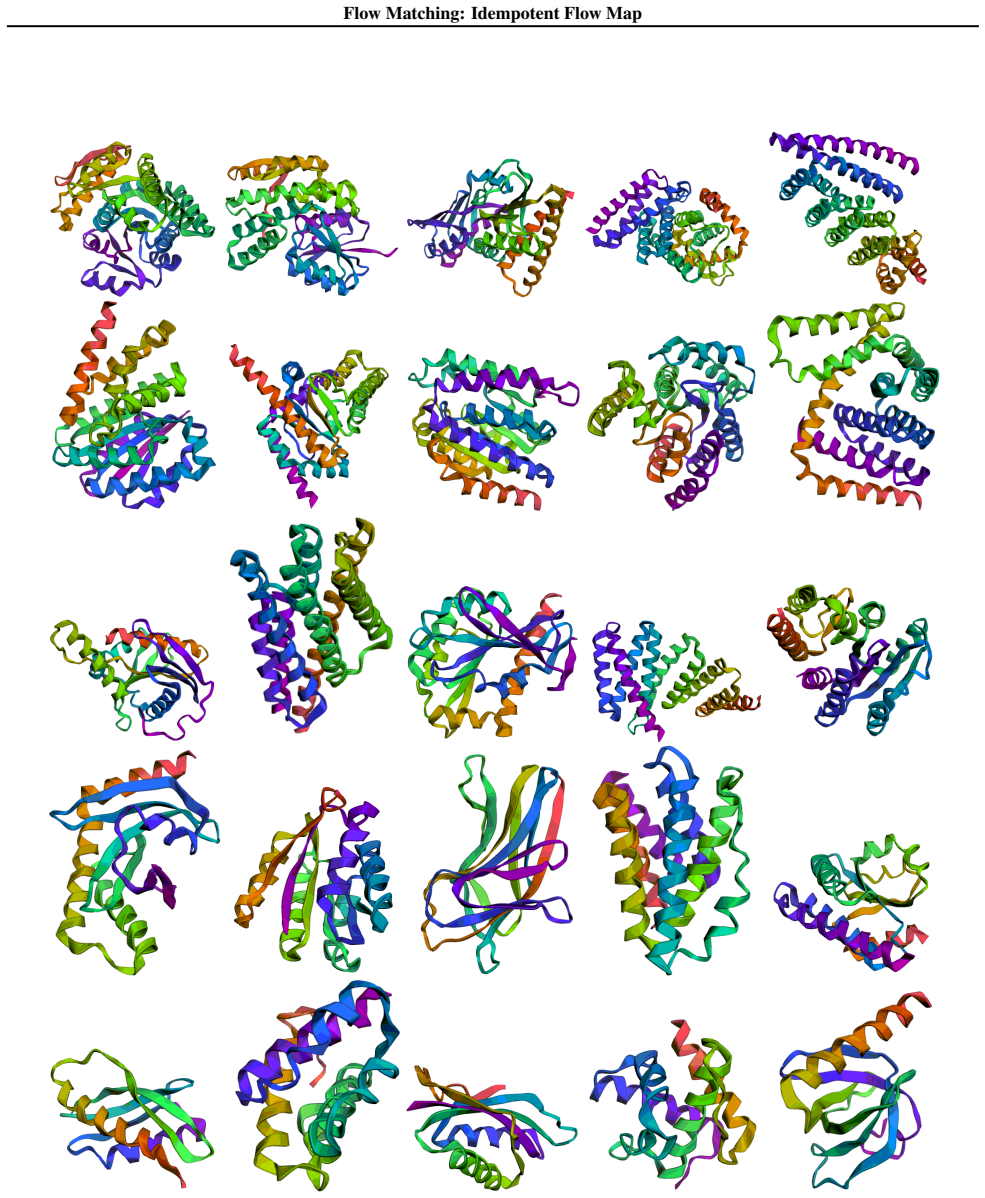
Figures from the paper (5 more)


Reference graph
Works this paper leans on
-
[1]
Albergo, M. S. and Vanden-Eijnden, E. Building normalizing flows with stochastic interpolants. In The Eleventh International Conference on Learning Representations, 2023. URL https://openreview.net/forum?id=li7qeBbCR1t
work page 2023
-
[2]
R., Wang, J., Cong, Q., Kinch, L
Baek, M., DiMaio, F., Anishchenko, I., Dauparas, J., Ovchinnikov, S., Lee, G. R., Wang, J., Cong, Q., Kinch, L. N., Schaeffer, R. D., et al. Accurate prediction of protein structures and interactions using a three-track neural network. Science, 373 0 (6557): 0 871--876, 2021
work page 2021
-
[3]
D-flow: Differentiating through flows for controlled generation
Ben-Hamu, H., Puny, O., Gat, I., Karrer, B., Singer, U., and Lipman, Y. D-flow: Differentiating through flows for controlled generation. arXiv preprint arXiv:2402.14017, 2024
arXiv 2024
-
[4]
C., Korablyov, M., Bronstein, M
Bose, J., Akhound-Sadegh, T., Huguet, G., FATRAS, K., Rector-Brooks, J., Liu, C.-H., Nica, A. C., Korablyov, M., Bronstein, M. M., and Tong, A. SE (3)-stochastic flow matching for protein backbone generation. In The Twelfth International Conference on Learning Representations, 2024. URL https://openreview.net/forum?id=kJFIH23hXb
work page 2024
-
[5]
Riemannian flow matching policy for robot motion learning
Braun, M., Jaquier, N., Rozo, L., and Asfour, T. Riemannian flow matching policy for robot motion learning. arXiv preprint arXiv:2403.10672, 2024
arXiv 2024
-
[6]
Buttenschoen, M., Morris, G. M., and Deane, C. M. Posebusters: Ai-based docking methods fail to generate physically valid poses or generalise to novel sequences. Chemical Science, 15 0 (9): 0 3130--3139, 2024
work page 2024
-
[7]
Campbell, A., Yim, J., Barzilay, R., Rainforth, T., and Jaakkola, T. Generative flows on discrete state-spaces: Enabling multimodal flows with applications to protein co-design. arXiv preprint arXiv:2402.04997, 2024
arXiv 2024
-
[8]
Chandonia, J.-M., Guan, L., Lin, S., Yu, C., Fox, N. K., and Brenner, S. E. Scope: improvements to the structural classification of proteins--extended database to facilitate variant interpretation and machine learning. Nucleic acids research, 50 0 (D1): 0 D553--D559, 2022
work page 2022
Show all 71 references
-
[9]
T., Rubanova, Y., Bettencourt, J., and Duvenaud, D
Chen, R. T., Rubanova, Y., Bettencourt, J., and Duvenaud, D. K. Neural ordinary differential equations. Advances in neural information processing systems, 31, 2018
2018
-
[10]
Chen, R. T. Q. and Lipman, Y. Flow matching on general geometries. In The Twelfth International Conference on Learning Representations, 2024. URL https://openreview.net/forum?id=g7ohDlTITL
2024
-
[11]
Analog bits: Generating discrete data using diffusion models with self-conditioning
Chen, T., ZHANG, R., and Hinton, G. Analog bits: Generating discrete data using diffusion models with self-conditioning. In The Eleventh International Conference on Learning Representations, 2023. URL https://openreview.net/forum?id=3itjR9QxFw
2023
-
[12]
Cheng, A., Lo, A., Lee, K. L. K., Miret, S., and Aspuru-Guzik, A. Stiefel flow matching for moment-constrained structure elucidation. arXiv preprint arXiv:2412.12540, 2024
2024 arXiv
-
[13]
Corso, G., St \"a rk, H., Jing, B., Barzilay, R., and Jaakkola, T. S. Diffdock: Diffusion steps, twists, and turns for molecular docking. In The Eleventh International Conference on Learning Representations, 2023. URL https://openreview.net/forum?id=kKF8_K-mBbS
2023
-
[14]
Corso, G., Deng, A., Polizzi, N., Barzilay, R., and Jaakkola, T. S. Deep confident steps to new pockets: Strategies for docking generalization. In The Twelfth International Conference on Learning Representations, 2024. URL https://openreview.net/forum?id=UfBIxpTK10
2024
-
[15]
R., Getz, N., Barzilay, R., Jaakkola, T., and Krause, A
Corso, G., Somnath, V. R., Getz, N., Barzilay, R., Jaakkola, T., and Krause, A. Composing unbalanced flows for flexible docking and relaxation. In The Thirteenth International Conference on Learning Representations, 2025. URL https://openreview.net/forum?id=gHLWTzKiZV
2025
-
[16]
J., Milles, L
Dauparas, J., Anishchenko, I., Bennett, N., Bai, H., Ragotte, R. J., Milles, L. F., Wicky, B. I. M., Courbet, A., de Haas, R. J., Bethel, N., Leung, P. J. Y., Huddy, T. F., Pellock, S., Tischer, D., Chan, F., Koepnick, B., Nguyen, H., Kang, A., Sankaran, B., Bera, A. K., King,...
2022
-
[17]
C., Xiong, G., Zhang, W., Yang, R., Cieplak, P., Luo, R., Lee, T., et al
Duan, Y., Wu, C., Chowdhury, S., Lee, M. C., Xiong, G., Zhang, W., Yang, R., Cieplak, P., Luo, R., Lee, T., et al. A point-charge force field for molecular mechanics simulations of proteins based on condensed-phase quantum mechanical calculations. Journal of computational chem...
1999
-
[18]
and Huber, R
Engh, R. and Huber, R. Structure quality and target parameters. 2012
2012
-
[19]
K., Brenner, S
Fox, N. K., Brenner, S. E., and Chandonia, J.-M. Scope: Structural classification of proteins—extended, integrating scop and astral data and classification of new structures. Nucleic acids research, 42 0 (D1): 0 D304--D309, 2014
2014
-
[20]
and Smidt, T
Geiger, M. and Smidt, T. e3nn: Euclidean neural networks. arXiv preprint arXiv:2207.09453, 2022
2022 arXiv
-
[21]
J., Pouget-Abadie, J., Mirza, M., Xu, B., Warde-Farley, D., Ozair, S., Courville, A., and Bengio, Y
Goodfellow, I. J., Pouget-Abadie, J., Mirza, M., Xu, B., Warde-Farley, D., Ozair, S., Courville, A., and Bengio, Y. Generative adversarial networks, 2014. URL https://arxiv.org/abs/1406.2661
2014 arXiv
-
[22]
Et-flow: Equivariant flow-matching for molecular conformer generation
Hassan, M., Shenoy, N., Lee, J., Stark, H., Thaler, S., and Beaini, D. Et-flow: Equivariant flow-matching for molecular conformer generation. arXiv preprint arXiv:2410.22388, 2024
2024 arXiv
-
[23]
Denoising diffusion probabilistic models
Ho, J., Jain, A., and Abbeel, P. Denoising diffusion probabilistic models. Advances in neural information processing systems, 33: 0 6840--6851, 2020
2020
-
[24]
G., Vignac, C., and Welling, M
Hoogeboom, E., Satorras, V. G., Vignac, C., and Welling, M. Equivariant diffusion for molecule generation in 3d. In International conference on machine learning, pp.\ 8867--8887. PMLR, 2022
2022
-
[25]
L., Smith, R
Hu, L., Benson, M. L., Smith, R. D., Lerner, M. G., and Carlson, H. A. Binding moad (mother of all databases). Proteins: Structure, Function, and Bioinformatics, 60 0 (3): 0 333--340, 2005
2005
-
[26]
Re-dock: Towards flexible and realistic molecular docking with diffusion bridge
Huang, Y., Zhang, O., Wu, L., Tan, C., Lin, H., Gao, Z., Li, S., Li, S., et al. Re-dock: Towards flexible and realistic molecular docking with diffusion bridge. arXiv preprint arXiv:2402.11459, 2024
2024 arXiv
-
[27]
Sequence-augmented se (3)-flow matching for conditional protein backbone generation
Huguet, G., Vuckovic, J., Fatras, K., Thibodeau-Laufer, E., Lemos, P., Islam, R., Liu, C.-H., Rector-Brooks, J., Akhound-Sadegh, T., Bronstein, M., et al. Sequence-augmented se (3)-flow matching for conditional protein backbone generation. Advances in neural information proces...
2024
-
[28]
Torsional diffusion for molecular conformer generation
Jing, B., Corso, G., Chang, J., Barzilay, R., and Jaakkola, T. Torsional diffusion for molecular conformer generation. Advances in Neural Information Processing Systems, 35: 0 24240--24253, 2022
2022
-
[29]
Alphafold meets flow matching for generating protein ensembles
Jing, B., Berger, B., and Jaakkola, T. Alphafold meets flow matching for generating protein ensembles. arXiv preprint arXiv:2402.04845, 2024
2024 arXiv
-
[30]
Highly accurate protein structure prediction with alphafold
Jumper, J., Evans, R., Pritzel, A., Green, T., Figurnov, M., Ronneberger, O., Tunyasuvunakool, K., Bates, R., Z \' dek, A., Potapenko, A., et al. Highly accurate protein structure prediction with alphafold. nature, 596 0 (7873): 0 583--589, 2021
2021
-
[31]
and Ben-Tal, N
Kessel, A. and Ben-Tal, N. Introduction to proteins: structure, function, and motion. Chapman and Hall/CRC, 2018
2018
-
[32]
Kingma, D. P. and Ba, J. Adam: A method for stochastic optimization. arXiv preprint arXiv:1412.6980, 2014
2014 arXiv
-
[33]
Kingma, D. P. and Welling, M. Auto-encoding variational bayes, 2013
2013
-
[34]
From machine learning to autonomous intelligence: Lecture 2, 2022
LeCun, Y. From machine learning to autonomous intelligence: Lecture 2, 2022. URL https://leshouches2022.github.io/SLIDES/lecun-20220720-leshouches-02.pdf. Accessed: 2024-10-02
2022
-
[35]
A tutorial on energy-based learning
LeCun, Y., Chopra, S., Hadsell, R., Ranzato, M., Huang, F., et al. A tutorial on energy-based learning. Predicting structured data, 1 0 (0), 2006
2006
-
[36]
Evolutionary-scale prediction of atomic-level protein structure with a language model
Lin, Z., Akin, H., Rao, R., Hie, B., Zhu, Z., Lu, W., Smetanin, N., Verkuil, R., Kabeli, O., Shmueli, Y., et al. Evolutionary-scale prediction of atomic-level protein structure with a language model. Science, 379 0 (6637): 0 1123--1130, 2023
2023
-
[37]
Lipman, Y., Chen, R. T. Q., Ben-Hamu, H., Nickel, M., and Le, M. Flow matching for generative modeling. In The Eleventh International Conference on Learning Representations, 2023. URL https://openreview.net/forum?id=PqvMRDCJT9t
2023
-
[38]
T., Lopez-Paz, D., Ben-Hamu, H., and Gat, I
Lipman, Y., Havasi, M., Holderrieth, P., Shaul, N., Le, M., Karrer, B., Chen, R. T., Lopez-Paz, D., Ben-Hamu, H., and Gat, I. Flow matching guide and code. arXiv preprint arXiv:2412.06264, 2024
2024 arXiv
-
[39]
Flow straight and fast: Learning to generate and transfer data with rectified flow
Liu, X., Gong, C., and Liu, Q. Flow straight and fast: Learning to generate and transfer data with rectified flow. arXiv preprint arXiv:2209.03003, 2022
2022 arXiv
-
[40]
Forging the basis for developing protein--ligand interaction scoring functions
Liu, Z., Su, M., Han, L., Liu, J., Yang, Q., Li, Y., and Wang, R. Forging the basis for developing protein--ligand interaction scoring functions. Accounts of chemical research, 50 0 (2): 0 302--309, 2017
2017
-
[41]
TANKB ind: Trigonometry-aware neural networks for drug-protein binding structure prediction
Lu, W., Wu, Q., Zhang, J., Rao, J., Li, C., and Zheng, S. TANKB ind: Trigonometry-aware neural networks for drug-protein binding structure prediction. In Oh, A. H., Agarwal, A., Belgrave, D., and Cho, K. (eds.), Advances in Neural Information Processing Systems, 2022. URL http...
2022
-
[42]
G., and Zheng, S
Lu, W., Zhang, J., Huang, W., Zhang, Z., Jia, X., Wang, Z., Shi, L., Li, C., Wolynes, P. G., and Zheng, S. Dynamicbind: predicting ligand-specific protein-ligand complex structure with a deep equivariant generative model. Nature Communications, 15 0 (1): 0 1071, 2024
2024
-
[43]
A., and Wegner, J
M \'e ndez-Lucio, O., Ahmad, M., del Rio-Chanona, E. A., and Wegner, J. K. A geometric deep learning approach to predict binding conformations of bioactive molecules. Nature Machine Intelligence, 3 0 (12): 0 1033--1039, 2021
2021
-
[44]
Fabind: Fast and accurate protein-ligand binding
Pei, Q., Gao, K., Wu, L., Zhu, J., Xia, Y., Xie, S., Qin, T., He, K., Liu, T.-Y., and Yan, R. Fabind: Fast and accurate protein-ligand binding. Advances in Neural Information Processing Systems, 36, 2024
2024
-
[45]
DiffDock-Pocket : Diffusion for pocket-level docking with sidechain flexibility
Plainer, M., Toth, M., Dobers, S., St \"a rk, H., Corso, G., Marquet, C., and Barzilay, R. DiffDock-Pocket : Diffusion for pocket-level docking with sidechain flexibility. 2023
2023
-
[46]
Pooladian, A.-A., Ben-Hamu, H., Domingo-Enrich, C., Amos, B., Lipman, Y., and Chen, R. T. Multisample flow matching: Straightening flows with minibatch couplings. arXiv preprint arXiv:2304.14772, 2023
2023 arXiv
-
[47]
F., and Anandkumar, A
Qiao, Z., Nie, W., Vahdat, A., Miller III, T. F., and Anandkumar, A. State-specific protein--ligand complex structure prediction with a multiscale deep generative model. Nature Machine Intelligence, 6 0 (2): 0 195--208, 2024
2024
-
[48]
W., Evans, R., Jumper, J., Kirkpatrick, J., Sifre, L., Green, T., Qin, C., Z \' dek, A., Nelson, A
Senior, A. W., Evans, R., Jumper, J., Kirkpatrick, J., Sifre, L., Green, T., Qin, C., Z \' dek, A., Nelson, A. W., Bridgland, A., et al. Improved protein structure prediction using potentials from deep learning. Nature, 577 0 (7792): 0 706--710, 2020
2020
-
[49]
V., Gandelsman, Y., Mosseri, I., Rubinstein, M., and Efros, A
Shocher, A., Dravid, A. V., Gandelsman, Y., Mosseri, I., Rubinstein, M., and Efros, A. A. Idempotent generative network. In The Twelfth International Conference on Learning Representations, 2024. URL https://openreview.net/forum?id=XIaS66XkNA
2024
-
[50]
and Ermon, S
Song, Y. and Ermon, S. Generative modeling by estimating gradients of the data distribution. Advances in neural information processing systems, 32, 2019
2019
-
[51]
P., Kumar, A., Ermon, S., and Poole, B
Song, Y., Sohl-Dickstein, J., Kingma, D. P., Kumar, A., Ermon, S., and Poole, B. Score-based generative modeling through stochastic differential equations. In International Conference on Learning Representations, 2021. URL https://openreview.net/forum?id=PxTIG12RRHS
2021
-
[52]
Consistency models
Song, Y., Dhariwal, P., Chen, M., and Sutskever, I. Consistency models. In International Conference on Machine Learning, pp.\ 32211--32252. PMLR, 2023
2023
-
[53]
I., Elofsson, A., and Azizpour, H
Sprague, C. I., Elofsson, A., and Azizpour, H. Incorporating stability into flow matching. In ICML 2024 Workshop on Structured Probabilistic Inference & Generative Modeling , 2024. URL https://openreview.net/forum?id=FLRlzO5jcv
2024
-
[54]
Equibind: Geometric deep learning for drug binding structure prediction
St \"a rk, H., Ganea, O., Pattanaik, L., Barzilay, R., and Jaakkola, T. Equibind: Geometric deep learning for drug binding structure prediction. In International conference on machine learning, pp.\ 20503--20521. PMLR, 2022
2022
-
[55]
Harmonic self-conditioned flow matching for multi-ligand docking and binding site design
St \"a rk, H., Jing, B., Barzilay, R., and Jaakkola, T. Harmonic self-conditioned flow matching for multi-ligand docking and binding site design. arXiv preprint arXiv:2310.05764, 2023
2023 arXiv
-
[56]
Tensor field networks: Rotation-and translation-equivariant neural networks for 3d point clouds
Thomas, N., Smidt, T., Kearnes, S., Yang, L., Li, L., Kohlhoff, K., and Riley, P. Tensor field networks: Rotation-and translation-equivariant neural networks for 3d point clouds. arXiv preprint arXiv:1802.08219, 2018
2018 arXiv
-
[57]
Improving and generalizing flow-based generative models with minibatch optimal transport
Tong, A., FATRAS, K., Malkin, N., Huguet, G., Zhang, Y., Rector-Brooks, J., Wolf, G., and Bengio, Y. Improving and generalizing flow-based generative models with minibatch optimal transport. Transactions on Machine Learning Research, 2024. ISSN 2835-8856. URL https://openrevie...
2024
-
[58]
L., Yim, J., Tischer, D., Baker, D., Broderick, T., Barzilay, R., and Jaakkola, T
Trippe, B. L., Yim, J., Tischer, D., Baker, D., Broderick, T., Barzilay, R., and Jaakkola, T. Diffusion probabilistic modeling of protein backbones in 3d for the motif-scaffolding problem. arXiv preprint arXiv:2206.04119, 2022
2022 arXiv
-
[59]
S., Tumescheit, C., Mirdita, M., Lee, J., Gilchrist, C
Van Kempen, M., Kim, S. S., Tumescheit, C., Mirdita, M., Lee, J., Gilchrist, C. L., S \"o ding, J., and Steinegger, M. Fast and accurate protein structure search with foldseek. Nature biotechnology, 42 0 (2): 0 243--246, 2024
2024
-
[60]
Generating highly designable proteins with geometric algebra flow matching
Wagner, S., Seute, L., Viliuga, V., Wolf, N., Gr \"a ter, F., and Stuehmer, J. Generating highly designable proteins with geometric algebra flow matching. In The Thirty-eighth Annual Conference on Neural Information Processing Systems, 2024. URL https://openreview.net/forum?id...
2024
-
[61]
A., Jaitly, N., Susskind, J
Wang, Y., Elhag, A. A., Jaitly, N., Susskind, J. M., and Bautista, M. \'A . Swallowing the bitter pill: Simplified scalable conformer generation. In Forty-first International Conference on Machine Learning, 2024
2024
-
[62]
L., Juergens, D., Bennett, N
Watson, J. L., Juergens, D., Bennett, N. R., Trippe, B. L., Yim, J., Eisenach, H. E., Ahern, W., Borst, A. J., Ragotte, R. J., Milles, L. F., et al. De novo design of protein structure and function with rfdiffusion. Nature, 620 0 (7976): 0 1089--1100, 2023
2023
-
[63]
E., Yang, K
Wu, K. E., Yang, K. K., van den Berg, R., Alamdari, S., Zou, J. Y., Lu, A. X., and Amini, A. P. Protein structure generation via folding diffusion. Nature communications, 15 0 (1): 0 1059, 2024
2024
-
[64]
Geodiff: A geometric diffusion model for molecular conformation generation
Xu, M., Yu, L., Song, Y., Shi, C., Ermon, S., and Tang, J. Geodiff: A geometric diffusion model for molecular conformation generation. In International Conference on Learning Representations, 2022 a . URL https://openreview.net/forum?id=PzcvxEMzvQC
2022
-
[65]
Poisson flow generative models
Xu, Y., Liu, Z., Tegmark, M., and Jaakkola, T. Poisson flow generative models. Advances in Neural Information Processing Systems, 35: 0 16782--16795, 2022 b
2022
-
[66]
Pfgm++: Unlocking the potential of physics-inspired generative models
Xu, Y., Liu, Z., Tian, Y., Tong, S., Tegmark, M., and Jaakkola, T. Pfgm++: Unlocking the potential of physics-inspired generative models. In International Conference on Machine Learning, pp.\ 38566--38591. PMLR, 2023
2023
-
[67]
Y., Gastegger, M., Jim \'e nez-Luna, J., Lewis, S., Satorras, V
Yim, J., Campbell, A., Foong, A. Y., Gastegger, M., Jim \'e nez-Luna, J., Lewis, S., Satorras, V. G., Veeling, B. S., Barzilay, R., Jaakkola, T., et al. Fast protein backbone generation with se (3) flow matching. arXiv preprint arXiv:2310.05297, 2023 a
2023 arXiv
-
[68]
L., De Bortoli, V., Mathieu, E., Doucet, A., Barzilay, R., and Jaakkola, T
Yim, J., Trippe, B. L., De Bortoli, V., Mathieu, E., Doucet, A., Barzilay, R., and Jaakkola, T. Se (3) diffusion model with application to protein backbone generation. arXiv preprint arXiv:2302.02277, 2023 b
2023 arXiv
-
[69]
E3bind: An end-to-end equivariant network for protein-ligand docking
Zhang, Y., Cai, H., Shi, C., and Tang, J. E3bind: An end-to-end equivariant network for protein-ligand docking. In The Eleventh International Conference on Learning Representations, 2023. URL https://openreview.net/forum?id=sO1QiAftQFv
2023
-
[70]
Energy-based generative adversarial networks
Zhao, J., Mathieu, M., and LeCun, Y. Energy-based generative adversarial networks. In International Conference on Learning Representations, 2017. URL https://openreview.net/forum?id=ryh9pmcee
2017
-
[71]
write newline
" write newline "" before.all 'output.state := FUNCTION n.dashify 't := "" t empty not t #1 #1 substring "-" = t #1 #2 substring "--" = not "--" * t #2 global.max substring 't := t #1 #1 substring "-" = "-" * t #2 global.max substring 't := while if t #1 #1 substring * t #2 gl...
Reviewed August 5, 2026 · model on record in the stance chip above.
Discussion (0). Sign in to comment.