REVIEW 2 major objections 5 minor 58 references
A Full Quantum Eigensolver for Quantum Chemistry Simulations
T0 review · 2 major / 5 minor · reviewed 2026-08-14 · deepseek-v4-flash
Pith's one-line read The paper proposes FQE, a fully quantum gradient-descent eigensolver that finds molecular ground states without a classical optimizer.
desk verdict The algorithm is a repackaged power method that converges in the small-molecule examples, but the paper's main complexity proof rests on a false spectral assumption and the perturbation shortcut is conceptually muddled. read the letter →
The pith
A machine-rendered reading of the paper's core claim, the machinery that carries it, and where it could break.
The reading
What carries the argument
The load-bearing object is the shifted Hamiltonian $H_g = I - \gamma H$, a sum of Pauli unitaries whose repeated application performs gradient descent on the energy landscape. It is implemented by the linear-combination-of-unitaries (LCU) trick: an ancilla register is prepared in a superposition weighted by the coefficients $\beta_i$, controlled unitaries $H_i^g$ entangle the ancilla with the work register, Hadamard gates recombine the branches, and postselection on the ancilla state $|0\rangle$ projects the work system onto $H_g|x(t)\rangle$. The convergence proof rests on the ratio $(1-\gamma\lambda_2)/(1-\gamma\lambda_1)$, kept below one by choosing the learning rate $\gamma$; the iteration depth then scales as $O(\log(N/\epsilon))$.
What would settle it
Run the FQE iteration on a small Hamiltonian with a known zero or positive excited eigenvalue, starting from a mean-field state, and check whether the final energy equals the exact ground-state energy after $O(\log(N/\epsilon))$ steps; a concrete instance is the vacuum state, whose energy is zero, appearing in the spectrum. If the iteration selects that level or oscillates instead of reaching the ground state, the convergence proof's all-negative-eigenvalue assumption is load-bearing.
Extended reading notes
Core claim
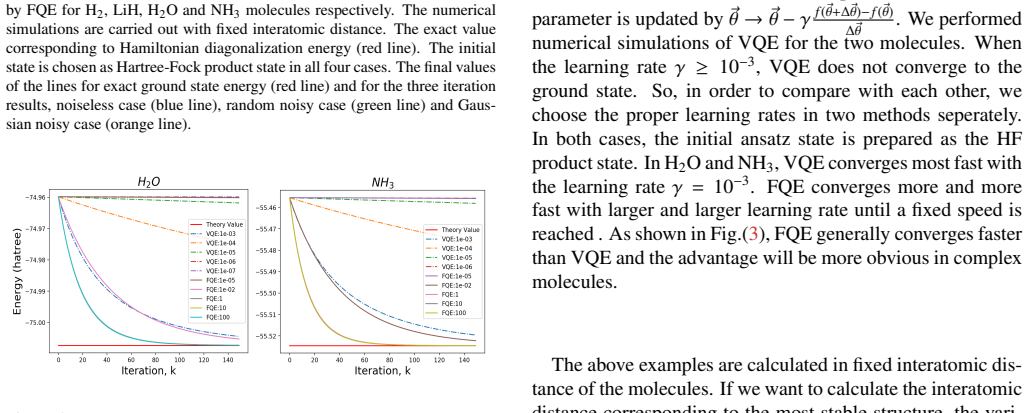
On the paper's own terms, the discovery is that quantum gradient descent can serve as a complete eigensolver for molecular Hamiltonians. Starting from a product state $|x(0)\rangle$ with good overlap with the ground state, each iteration applies $|x(t+1)\rangle = H_g|x(t)\rangle$ with $H_g = I - \gamma H$, implemented as a linear combination of the Pauli terms of $H$. Because the iteration is a power method on $H_g$, the error after $k$ steps is bounded in terms of $((1-\gamma\lambda_2)/(1-\gamma\lambda_1))^k$, giving $k = O(\log(N/\epsilon))$; the paper's simulations show convergence to the diagonalized ground-state energy for $H_2$, LiH, $H_2O$, and $NH_3$ within chemical precision, with FQE converging before VQE for comparable learning rates. The algorithm is called 'full' because, unlike VQE, it does not outsource the optimization step to a classical computer.
Load-bearing premise
The proof assumes that every eigenvalue of the molecular Hamiltonian is negative, so the ratio $(1-\gamma\lambda_2)/(1-\gamma\lambda_1)$ stays below one; in a real finite basis the vacuum state sits at energy zero and excited levels can be positive, and if that happens the iteration can converge to an excited state or fail to converge.
Editorial extensions
If this is right
- No classical optimizer is needed: parameter updates are generated by repeated quantum operations, so the hybrid VQE loop can be replaced by a single quantum procedure.
- The iteration depth needed for a target precision grows logarithmically with the number of basis states and inversely with the error threshold, so the main per-iteration cost is the circuit for the linear combination of unitaries rather than the number of iterations.
- Energy expectation values do not have to be measured during the iteration, which avoids the state-destroying measurements that slow VQE; the depth can be preset from the error bound.
- The perturbation-theory route computes first- and second-order corrections from one pass through the same circuit and reaches chemical precision for the four molecules tested, so a single iteration can suffice on noisy hardware.
- Under small random or Gaussian noise the simulated energies still converge to chemical precision, while under ten-fold larger noise convergence degrades or oscillates, indicating where the method's noise tolerance ends.
Reading between the lines
- Because FQE is a power iteration on $I - \gamma H$, a natural continuation is to use it as a subroutine inside a larger algorithm, for instance to refine a state prepared by another method or to update a variational ansatz in the final iterations where gradient signals are small.
- The perturbation version suggests a testable near-term protocol: run one LCU iteration on hardware, read off the off-diagonal matrix elements of $H'$, and compare the second-order energy with full diagonalization; the four molecules here provide the numerical baseline.
- The same circuit can be applied to any Hamiltonian expressed as a Pauli sum, not only fermionic chemical systems, so the scheme could be tested directly on spin-model ground-state problems of comparable dimension.
- If one wants the same convergence guarantee for spectra with zero or positive eigenvalues, a constant shift of the Hamiltonian before defining $H_g$ would restore the all-negative-spectrum condition without changing eigenstates; this adjustment is not analyzed in the paper.
Editorial analysis
A structured set of objections, weighed in public.
Referee Report
Summary. The paper proposes a full quantum eigensolver (FQE) for molecular ground-state chemistry. The method replaces the classical optimizer of VQE with a quantum gradient descent: it repeatedly applies the non-unitary operator Hg = I - γH, implemented via linear combination of unitaries (LCU), to a Hartree-Fock initial state, and claims that the number of iterations needed to reach precision ε is O(log(N/ε)). The authors present numerical simulations for H2, LiH, H2O, and NH3 in STO-3G and STO-6G bases, a noise robustness study, an extension based on perturbation theory, and a comparison with VQE.
Significance. If the complexity claim were rigorously established, FQE would offer a fully quantum alternative to VQE that avoids classical optimization loops and potentially converges in depth logarithmic in system size. The paper's numerical results are consistent with the intended power iteration and are compared against exact diagonalization, which is a strength. The explicit LCU circuit and the perturbation-theory shortcut are useful contributions. However, the central convergence proof contains a false spectral assumption, so the logarithmic-depth claim is not currently supported.
major comments (2)
- [Supplemental Material A and Section II.B] The convergence proof in the Supplemental Material assumes that 'all of the eigenvalues are less than 0' for the molecular Hamiltonian. This assumption is not generally true: in the Jordan-Wigner representation the vacuum state has eigenvalue 0, and excited states in a finite basis can have positive eigenvalues. The convergence condition for the iteration Hg = I - γH is max_{i≥2} |1 - γλ_i| < |1 - γλ_1|, not |λ_1| > |λ_2| as stated. If some λ_i > 2/γ - λ_1 (with λ_1 < 0), the amplification factor for that excited component exceeds that of the ground state, and the iteration may converge to an excited state or diverge. The error bound and the iteration depth k = O(log(N/ε)) in Eq. (13) therefore do not follow from the proof as written. The authors should either prove the result under the correct spectral condition or shift the Hamiltonian by a constant cI so that all eigenvalues of the shifted Hamiltonian are negative, and then correct the reported energies accordingly.
- [Section II.B] The paper claims that FQE 'does not need to make measurements of the expectation values of Hamiltonian during each iteration procedure,' yet the stopping criterion introduced in the same section is ε = |⟨x_t|H|x_t⟩ - ⟨x_{t+1}|H|x_{t+1}⟩|/⟨x_t|H|x_t⟩. Checking this criterion requires energy measurements at successive iterations, and measuring the energy destroys the iteration state, so it is unclear how the criterion can be applied without restarting the computation. In addition, setting the number of iterations k in advance requires knowledge of the spectral gap (through the ratio (1 - γλ_2)/(1 - γλ_1)), which is not generally known. The paper should clarify how k is chosen in practice and reconcile the claim about energy measurements with the proposed stopping rule.
minor comments (5)
- [Supplemental Material A] The error bound expression contains typographical issues: the ratio (1 - γλ_i)/(1 - γλ_1) should appear squared (because the expansion involves (1 - γλ_i)^{2k}), and the coefficients should be |a_i|^2 rather than a_i; the current expression is dimensionally inconsistent, although the logarithmic scaling in k is unchanged.
- [Section II.C] The statement 'we let H′ be equal to Hg' conflicts with the earlier definition of H′ as containing only σ_x and σ_y Pauli terms; since Hg = I - γH includes the identity and σ_z terms, the perturbation expansions in Eqs. (15)-(18) need to be clarified.
- [Table I] In Table I, the H2O second-order value is listed as '75.0032' without a minus sign, inconsistent with the other negative energy entries.
- [Section III.A] The comparison with VQE in Fig. 3 is not persuasive: only two molecules are shown, and the VQE learning rate is fixed at γ = 10^{-3} without evidence that this is a fair or optimal choice; the conclusion that 'FQE generally converges faster than VQE' is broader than the data support.
- [Section III.A] The noise model is described too vaguely: the state noise term |δx⟩ added to |x_k⟩ and the subsequent renormalization is not tied to a realistic error model, and the amplitudes for H2O/NH3 are stated without explaining how they were chosen.
Circularity Check
No significant circularity: the FQE iteration and its numerical benchmarks are self-contained; the spectral assumption in the convergence proof is a correctness gap, not a circular reduction.
full rationale
The derivation chain is self-contained: the update |X(t+1)> = Hg|X(t)> with Hg = I - gamma H, Eq. (9), is implemented through the LCU circuit in Fig. 1, and the convergence analysis in the Supplemental Material is a power-iteration argument whose error bound follows algebraically from the spectral expansion of H. The numerical ground-state energies are compared against independent exact diagonalization (Figs. 2 and 4, Table I), so the central quantitative claims are externally benchmarked rather than inferred from the algorithm's own outputs. The self-citations to G.L. Long's earlier LCU work [45, 47-49, 52] supply a standard circuit primitive, not a load-bearing uniqueness theorem, and the iteration itself is traceable to the cited iterative-eigensolver literature [58]. No fitted parameter is relabeled as a prediction: gamma is fixed (gamma = 1) and no data from exact ground states is used to tune the iteration. The one serious difficulty is a correctness gap, not a circularity: the Supplemental Material's assertion 'In the case of molecule Hamiltonian H, all of the eigenvalues are less than 0' is unproven and generally false (e.g., the vacuum has eigenvalue zero), and the main-text convergence bound k = O(log(N/epsilon)) depends on the unstated spectral condition |1 - gamma*lambda_i| < |1 - gamma*lambda_1| for i >= 2. That affects the soundness of the logarithmic-depth claim, but it is not a circular reduction: the claimed result does not follow by construction from the inputs, and no equation is defined in terms of the result it is supposed to predict. Hence the circularity score is 0.
Assumptions & free parameters
free parameters (2)
- Learning rate gamma =
1
- Noise amplitudes for robustness test =
random amplitude 0.01 (H2, LiH) and 0.02 (H2O, NH3); Gaussian sigma = amplitude/3
assumptions (6)
- domain assumption Born-Oppenheimer approximation and second-quantized molecular Hamiltonian in a finite basis (STO-3G/STO-6G).
- standard math Jordan-Wigner transformation maps fermionic operators to Pauli operators.
- ad hoc to paper All eigenvalues of the molecular Hamiltonian are real, distinct, and less than zero.
- domain assumption The Hartree-Fock initial state has a large overlap a1 with the true ground state.
- standard math The LCU circuit with controlled unitaries and amplitude amplification can be implemented with the stated complexity.
- domain assumption In perturbation theory, H0 (diagonal Pauli terms) is the unperturbed Hamiltonian and H' (sigma-x and sigma-y terms) is small enough for second-order perturbation theory to reach chemical accuracy.
Cite this review
Pith. "Pith review of A Full Quantum Eigensolver for Quantum Chemistry Simulations." pith.science (2026). https://pith.science/paper/XF5BYEV3
@misc{pith2026190807927,
  author       = {Pith},
  title        = {Pith review of: A Full Quantum Eigensolver for Quantum Chemistry Simulations},
  year         = {2026},
  howpublished = {\url{https://pith.science/paper/XF5BYEV3}},
  note         = {Machine review of arXiv:1908.07927}
}
read the original abstract
Quantum simulation of quantum chemistry is one of the most compelling applications of quantum computing. It is of particular importance in areas ranging from materials science, biochemistry and condensed matter physics. Here, we propose a full quantum eigensolver (FQE) algorithm to calculate the molecular ground energies and electronic structures using quantum gradient descent. Compared to existing classical-quantum hybrid methods such as variational quantum eigensolver (VQE), our method removes the classical optimizer and performs all the calculations on a quantum computer with faster convergence. The gradient descent iteration depth has a favorable complexity that is logarithmically dependent on the system size and inverse of the precision. Moreover, the FQE can be further simplified by exploiting perturbation theory for the calculations of intermediate matrix elements, and obtain results with a precision that satisfies the requirement of chemistry application. The full quantum eigensolver can be implemented on a near-term quantum computer. With the rapid development of quantum computing hardware, FQE provides an efficient and powerful tool to solve quantum chemistry problems.
Figures


Figures from the paper (3 more)


Reference graph
Works this paper leans on
-
[1]
Paul Benioff. The computer as a physical system: A micro- scopic quantum mechanical hamiltonian model of computers as 7 represented by turing machines. Journal of Statistical Physics, 22(5):563–591, 1980
work page 1980
-
[2]
Ivanovich Manin. Vychislimoe i nevychislimoe . Sov. Radio, 1980
work page 1980
-
[3]
Simulating physics with computers
Richard P Feynman. Simulating physics with computers. Inter- national Journal of Theoretical Physics, 21(6):467–488, 1982
work page 1982
-
[4]
Universal quantum simulators
Seth Lloyd. Universal quantum simulators. Science, 273(5278):1073–1078, 1996
1996
-
[5]
Simulation of many-body fermi systems on a universal quantum computer
Daniel S Abrams and Seth Lloyd. Simulation of many-body fermi systems on a universal quantum computer. Physical Re- view Letters, 79(13):2586, 1997
work page 1997
-
[6]
Quantum measurements and the abelian stabilizer problem
A Yu Kitaev. Quantum measurements and the abelian stabilizer problem. arXiv preprint quant-ph/9511026, 1995
arXiv 1995
-
[7]
Simulated quantum computation of molecu- lar energies
Al ´an Aspuru-Guzik, Anthony D Dutoi, Peter J Love, and Mar- tin Head-Gordon. Simulated quantum computation of molecu- lar energies. Science, 309(5741):1704–1707, 2005
work page 2005
-
[8]
Adia- batic quantum simulation of quantum chemistry
Ryan Babbush, Peter J Love, and Al ´an Aspuru-Guzik. Adia- batic quantum simulation of quantum chemistry. Scientific Re- ports, 4:6603, 2014
work page 2014
Show all 58 references
-
[9]
Experimental simulation of quantum tunneling in small systems
Guan-Ru Feng, Yao Lu, Liang Hao, Fei-Hao Zhang, and Gui- Lu Long. Experimental simulation of quantum tunneling in small systems. Scientific Reports, 3:2232, 2013
2013
-
[10]
Exper- imental digital quantum simulation of temporal–spatial dynam- ics of interacting fermion system
Yao Lu, Guan-Ru Feng, Yan-Song Li, and Gui-Lu Long. Exper- imental digital quantum simulation of temporal–spatial dynam- ics of interacting fermion system. Science Bulletin, 60(2):241– 248, 2015
2015
-
[11]
Chemical basis of trotter-suzuki errors in quantum chemistry simulation
Ryan Babbush, Jarrod McClean, Dave Wecker, Al ´an Aspuru- Guzik, and Nathan Wiebe. Chemical basis of trotter-suzuki errors in quantum chemistry simulation. Physical Review A , 91(2):022311, 2015
2015
-
[12]
Duality quantum algorithm efficiently simulates open quantum systems
Shi-Jie Wei, Dong Ruan, and Gui-Lu Long. Duality quantum algorithm efficiently simulates open quantum systems. Sci- entific Reports, 6:30727, 2016
2016
-
[13]
Exponentially more precise quantum simulation of fermions in second quantization
Ryan Babbush, Dominic W Berry, Ian D Kivlichan, Annie Y Wei, Peter J Love, and Al´an Aspuru-Guzik. Exponentially more precise quantum simulation of fermions in second quantization. New Journal of Physics, 18(3):033032, 2016
2016
-
[14]
Exponentially more precise quantum simula- tion of fermions in the configuration interaction representation
Ryan Babbush, Dominic W Berry, Yuval R Sanders, Ian D Kiv- lichan, Artur Scherer, Annie Y Wei, Peter J Love, and Al ´an Aspuru-Guzik. Exponentially more precise quantum simula- tion of fermions in the configuration interaction representation. Quantum Science and Technology, 3(1...
2017
-
[15]
Polynomial-time quantum algorithm for the simulation of chemical dynamics
Ivan Kassal, Stephen P Jordan, Peter J Love, Masoud Mohseni, and Al´an Aspuru-Guzik. Polynomial-time quantum algorithm for the simulation of chemical dynamics. Proceedings of the National Academy of Sciences, 105(48):18681–18686, 2008
2008
-
[16]
Bounding the costs of quantum simulation of many-body physics in real space
Ian D Kivlichan, Nathan Wiebe, Ryan Babbush, and Al ´an Aspuru-Guzik. Bounding the costs of quantum simulation of many-body physics in real space. Journal of Physics A: Math- ematical and Theoretical, 50(30):305301, 2017
2017
-
[17]
Quantum algorithms for quantum chemistry based on the sparsity of the ci-matrix.arXiv preprint arXiv:1312.2579, 2013
Borzu Toloui and Peter J Love. Quantum algorithms for quantum chemistry based on the sparsity of the ci-matrix.arXiv preprint arXiv:1312.2579, 2013
2013 arXiv
-
[18]
A variational eigenvalue solver on a photonic quantum processor
Alberto Peruzzo, Jarrod McClean, Peter Shadbolt, Man-Hong Yung, Xiao-Qi Zhou, Peter J Love, Al ´an Aspuru-Guzik, and Jeremy L Obrien. A variational eigenvalue solver on a photonic quantum processor. Nature Communications, 5:4213, 2014
2014
-
[19]
The theory of variational hybrid quantum- classical algorithms
Jarrod R McClean, Jonathan Romero, Ryan Babbush, and Al´an Aspuru-Guzik. The theory of variational hybrid quantum- classical algorithms. New Journal of Physics , 18(2):023023, 2016
2016
-
[20]
Exploiting locality in quantum computation for quantum chemistry
Jarrod R McClean, Ryan Babbush, Peter J Love, and Al ´an Aspuru-Guzik. Exploiting locality in quantum computation for quantum chemistry. The journal of Physical Chemistry Letters, 5(24):4368–4380, 2014
2014
-
[21]
Simulation of electronic structure hamiltonians using quantum computers
James D Whitfield, Jacob Biamonte, and Al ´an Aspuru-Guzik. Simulation of electronic structure hamiltonians using quantum computers. Molecular Physics, 109(5):735–750, 2011
2011
-
[22]
Pro- gress towards practical quantum variational algorithms
Dave Wecker, Matthew B Hastings, and Matthias Troyer. Pro- gress towards practical quantum variational algorithms. Phys- ical Review A, 92(4):042303, 2015
2015
-
[23]
Improving quantum algorithms for quantum chemistry
Matthew B Hastings, Dave Wecker, Bela Bauer, and Matthias Troyer. Improving quantum algorithms for quantum chemistry. Quantum Information & Computation, 15(1-2):1–21, 2015
2015
-
[24]
Quantum inverse iteration algorithm for near-term quantum devices
Oleksandr Kyriienko. Quantum inverse iteration algorithm for near-term quantum devices. arXiv preprint arXiv:1901.09988, 2019
1901 arXiv
-
[25]
About the pauli exclusion principle
Pascual Jordan and Eugene P Wigner. About the pauli exclusion principle. Z. Phys., 47:631–651, 1928
1928
-
[26]
Fermionic quantum computation
Sergey B Bravyi and Alexei Yu Kitaev. Fermionic quantum computation. Annals of Physics, 298(1):210–226, 2002
2002
-
[27]
The bravyi- kitaev transformation for quantum computation of electronic structure
Jacob T Seeley, Martin J Richard, and Peter J Love. The bravyi- kitaev transformation for quantum computation of electronic structure. The Journal of Chemical Physics , 137(22):224109, 2012
2012
-
[28]
The bravyi-kitaev trans- formation: Properties and applications
Andrew Tranter, Sarah Sofia, Jake Seeley, Michael Kaicher, Jar- rod McClean, Ryan Babbush, Peter V Coveney, Florian Min- tert, Frank Wilhelm, and Peter J Love. The bravyi-kitaev trans- formation: Properties and applications. International Journal of Quantum Chemistry, 115(19):1...
2015
-
[29]
Tapering off qubits to simulate fermionic hamiltonians
Sergey Bravyi, Jay M Gambetta, Antonio Mezzacapo, and Kristan Temme. Tapering off qubits to simulate fermionic hamiltonians. arXiv preprint arXiv:1701.08213, 2017
2017 arXiv
-
[30]
Low- depth quantum simulation of materials
Ryan Babbush, Nathan Wiebe, Jarrod McClean, James Mc- Clain, Hartmut Neven, and Garnet Kin-Lic Chan. Low- depth quantum simulation of materials. Physical Review X , 8(1):011044, 2018
2018
-
[31]
From transistor to trapped-ion computers for quantum chem- istry
M-H Yung, Jorge Casanova, Antonio Mezzacapo, Jarrod Mc- clean, Lucas Lamata, Alan Aspuru-Guzik, and Enrique Solano. From transistor to trapped-ion computers for quantum chem- istry. Scientific Reports, 4:3589, 2014
2014
-
[32]
Nmr implementation of a molecular hydrogen quantum simulation with adiabatic state preparation
Jiangfeng Du, Nanyang Xu, Xinhua Peng, Pengfei Wang, San- feng Wu, and Dawei Lu. Nmr implementation of a molecular hydrogen quantum simulation with adiabatic state preparation. Physical Review Letters, 104(3):030502, 2010
2010
-
[33]
Quantum simulation of resonant transitions for solving the eigenproblem of an effective water hamiltonian
Zhaokai Li, Xiaomei Liu, Hefeng Wang, Sahel Ashhab, Jiangyu Cui, Hongwei Chen, Xinhua Peng, and Jiangfeng Du. Quantum simulation of resonant transitions for solving the eigenproblem of an effective water hamiltonian. Physical Review Letters , 122(9):090504, 2019
2019
-
[34]
Chiral ground-state currents of interacting photons in a synthetic magnetic field
Pedram Roushan, Charles Neill, Anthony Megrant, Yu Chen, Ryan Babbush, Rami Barends, Brooks Campbell, Zijun Chen, Ben Chiaro, Andrew Dunsworth, et al. Chiral ground-state currents of interacting photons in a synthetic magnetic field. Nature Physics, 13(2):146, 2017
2017
-
[35]
Towards quantum chemistry on a quantum computer
Benjamin P Lanyon, James D Whitfield, Geoff G Gillett, Mi- chael E Goggin, Marcelo P Almeida, Ivan Kassal, Jacob D Bia- monte, Masoud Mohseni, Ben J Powell, Marco Barbieri, et al. Towards quantum chemistry on a quantum computer. Nature Chemistry, 2(2):106, 2010
2010
-
[36]
Experimental bayesian quantum phase es- timation on a silicon photonic chip
Stefano Paesani, Andreas A Gentile, Raffaele Santagati, Jian- wei Wang, Nathan Wiebe, David P Tew, Jeremy L OBrien, and Mark G Thompson. Experimental bayesian quantum phase es- timation on a silicon photonic chip. Physical Review Letters , 118(10):100503, 2017
2017
-
[37]
Quantum simulation 8 of helium hydride cation in a solid-state spin register.ACS nano, 9(8):7769–7774, 2015
Ya Wang, Florian Dolde, Jacob Biamonte, Ryan Babbush, Ville Bergholm, Sen Yang, Ingmar Jakobi, Philipp Neumann, Al ´an Aspuru-Guzik, James D Whitfield, et al. Quantum simulation 8 of helium hydride cation in a solid-state spin register.ACS nano, 9(8):7769–7774, 2015
2015
-
[38]
Quantum imple- mentation of the unitary coupled cluster for simulating mo- lecular electronic structure
Yangchao Shen, Xiang Zhang, Shuaining Zhang, Jing-Ning Zhang, Man-Hong Yung, and Kihwan Kim. Quantum imple- mentation of the unitary coupled cluster for simulating mo- lecular electronic structure. Physical Review A, 95(2):020501, 2017
2017
-
[39]
Quantum chemistry calculations on a trapped-ion quantum simulator
Cornelius Hempel, Christine Maier, Jonathan Romero, Jarrod McClean, Thomas Monz, Heng Shen, Petar Jurcevic, Ben P Lanyon, Peter Love, Ryan Babbush, et al. Quantum chemistry calculations on a trapped-ion quantum simulator. Physical Re- view X, 8(3):031022, 2018
2018
-
[40]
Scalable quantum simulation of molecular energies
Peter JJ OMalley, Ryan Babbush, Ian D Kivlichan, Jonathan Romero, Jarrod R McClean, Rami Barends, Julian Kelly, Pe- dram Roushan, Andrew Tranter, Nan Ding, et al. Scalable quantum simulation of molecular energies. Physical Review X, 6(3):031007, 2016
2016
-
[41]
Hardware-efficient variational quantum eigensolver for small molecules and quantum magnets.Nature, 549(7671):242, 2017
Abhinav Kandala, Antonio Mezzacapo, Kristan Temme, Maika Takita, Markus Brink, Jerry M Chow, and Jay M Gambetta. Hardware-efficient variational quantum eigensolver for small molecules and quantum magnets.Nature, 549(7671):242, 2017
2017
-
[42]
Gate-efficient simulation of molecular ei- genstates on a quantum computer
Marc Ganzhorn, Daniel J Egger, P Barkoutsos, Pauline Ol- litrault, Gian Salis, Nikolaj Moll, M Roth, A Fuhrer, P Mueller, S Woerner, et al. Gate-efficient simulation of molecular ei- genstates on a quantum computer. Physical Review Applied , 11(4):044092, 2019
2019
-
[43]
Commercialize quantum technolo- gies in five years
Masoud Mohseni, Peter Read, Hartmut Neven, Sergio Boixo, Vasil Denchev, Ryan Babbush, Austin Fowler, Vadim Smely- anskiy, and John Martinis. Commercialize quantum technolo- gies in five years. Nature News, 543(7644):171, 2017
2017
-
[44]
Quantum reform
Leonie Mueck. Quantum reform. Nature Chemistry, 7(5):361, 2015
2015
-
[45]
General quantum interference principle and duality computer
Long Gui-Lu. General quantum interference principle and duality computer. Communications in Theoretical Physics , 45(5):825, 2006
2006
-
[46]
Mathematical theory of duality quantum com- puters
Stan Gudder. Mathematical theory of duality quantum com- puters. Quantum Information Processing, 6(1):37–48, 2007
2007
-
[47]
Duality computing in quantum computers
LONG Gui-Lu and Liu Yang. Duality computing in quantum computers. Communications in Theoretical Physics , 50(6):1303, 2008
2008
-
[48]
Allowable gener- alized quantum gates
Long Gui-Lu, Liu Yang, and Wang Chuan. Allowable gener- alized quantum gates. Communications in Theoretical Physics, 51(1):65, 2009
2009
-
[49]
Duality quantum computing and duality quantum information processing
Gui Lu Long. Duality quantum computing and duality quantum information processing. International Journal of Theoretical Physics, 50(4):1305–1318, 2011
2011
-
[50]
Hamiltonian simulation using linear combinations of unitary operations
Andrew M Childs and Nathan Wiebe. Hamiltonian simulation using linear combinations of unitary operations. arXiv preprint arXiv:1202.5822, 2012
2012 arXiv
-
[51]
Simulating hamiltonian dy- namics with a truncated taylor series
Dominic W Berry, Andrew M Childs, Richard Cleve, Robin Kothari, and Rolando D Somma. Simulating hamiltonian dy- namics with a truncated taylor series. Physical Review Letters, 114(9):090502, 2015
2015
-
[52]
Duality quantum computer and the efficient quantum simulations
Shi-Jie Wei and Gui-Lu Long. Duality quantum computer and the efficient quantum simulations. Quantum Information Pro- cessing, 15(3):1189–1212, 2016
2016
-
[53]
Restricted allowable generalized quantum gates
HuaiXin Cao, Li Li, ZhengLi Chen, Ye Zhang, and ZhiHua Guo. Restricted allowable generalized quantum gates. Chinese Science Bulletin, 55(20):2122–2125, 2010
2010
-
[54]
Efficient scheme for initializing a quantum register with an arbitrary superposed state
Gui-Lu Long and Yang Sun. Efficient scheme for initializing a quantum register with an arbitrary superposed state. Physical Review A, 64(1):014303, 2001
2001
-
[55]
Quantum gradient descent and newtons method for constrained polynomial optimization
Patrick Rebentrost, Maria Schuld, Leonard Wossnig, Francesco Petruccione, and Seth Lloyd. Quantum gradient descent and newtons method for constrained polynomial optimization. New Journal of Physics, 21(7):073023, 2019
2019
-
[56]
Quantum simulation of quantum channels in nuclear magnetic resonance
Tao Xin, Shi-Jie Wei, Julen S Pedernales, Enrique Solano, and Gui-Lu Long. Quantum simulation of quantum channels in nuclear magnetic resonance. Physical Review A, 96(6):062303, 2017
2017
-
[57]
Efficient univer- sal quantum channel simulation in ibms cloud quantum com- puter
Shi-Jie Wei, Tao Xin, and Gui-Lu Long. Efficient univer- sal quantum channel simulation in ibms cloud quantum com- puter. SCIENCE CHINA Physics, Mechanics & Astronomy , 61(7):70311, 2018
2018
-
[58]
Iterative methods for computing eigenvalues and eigenvectors
Maysum Panju. Iterative methods for computing eigenvalues and eigenvectors. arXiv preprint arXiv:1105.1185, 2011. V . SUPPLEMENTAL MATERIAL A. Error estimation and iteration complexity We analyse FQE’s convergence and estimate the approx- imation error and iteration complexity...
2011 arXiv
Reviewed August 14, 2026 · model on record in the stance chip above.
Discussion (0). Continue with ORCID to comment.