REVIEW 3 major objections 5 minor 4 cited by
Effects of sub-nucleonic fluctuations on the longitudinal structure of heavy-ion collisions
T0 review · 3 major / 5 minor · reviewed 2026-08-10 · deepseek-v4-flash
Pith's one-line read Sub-nucleonic fluctuations reshape longitudinal flow and baryon stopping in heavy-ion collisions.
desk verdict Solid new McDipper+CLVisc machinery with an honest but unproven central claim, confounded by per-scenario K_g re-tuning. read the letter →
The pith
A machine-rendered reading of the paper's core claim, the machinery that carries it, and where it could break.
The reading
What carries the argument
The working machinery is the 3D resolved McDipper initial-state model, a kT-factorized Color Glass Condensate formulation in which gluon production comes from dipole amplitudes and quark production from valence-quark stopping, extended with sub-nucleonic fluctuations: each nucleon is a weighted superposition of Gaussian hotspots whose weights carry log-normal thickness fluctuations. These energy and net-baryon densities are matched onto the 3+1D viscous hydrodynamics code CLVisc, which evolves the fireball including baryon diffusion, and the longitudinal decorrelation observable rn is computed from the forward/backward ratio of flow vectors. The hotspot granularity is the ingredient that breaks the fireball into steeper density gradients, while thickness fluctuations add event-by-event weight variations; together they shape the rapidity dependence of vn and the decorrelation rate.
What would settle it
Run the same McDipper+CLVisc setup with event-by-event fluctuating valence and sea quark distributions, as in the prescription of Ref. [87], and recompute r2 in 30-50% central Pb-Pb collisions; if the longitudinal decorrelation still falls short of the CMS data, the missing-fluctuations-in-the-quark-sector explanation is ruled out.
Extended reading notes
Core claim
The central claim, stated in Sec. IV, is that sub-nucleonic fluctuations in the initial state measurably change the longitudinal structure of heavy-ion collisions: including three hotspots and log-normal thickness fluctuations per nucleon suppresses baryon stopping, increases anisotropic flow, and strengthens longitudinal decorrelation, especially in central collisions. The paper further claims that the residual underprediction of the longitudinal decorrelation ratio r2 in mid-central and peripheral collisions points to a missing source of fluctuations in the quark sector, because at forward rapidity a growing share of the deposited energy comes from quark stopping and the current implementation uses only averaged collinear quark parton distributions.
Load-bearing premise
The paper's interpretation rests on the assumption that the longitudinal structure of the initial state is faithfully described by the kT-factorized CGC formulas with smooth, averaged collinear quark parton distributions, and that the omitted pre-equilibrium evolution and hadronic afterburner do not account for the remaining decorrelation deficit.
Editorial extensions
If this is right
- Sub-nucleonic fluctuations must be included in initial-state models if rapidity-dependent observables such as v2(η), v3(η), and r2 are to be described quantitatively.
- Baryon stopping is sensitive to the granularity of the initial state, so baryon-number transport measurements can constrain the number and width of hotspots.
- Because sub-nucleonic fluctuations mostly enhance flow in central collisions and suppress it in peripheral ones, the centrality dependence of vn serves as a clean diagnostic of initial-state granularity.
- The underprediction of r2 in mid-central and peripheral collisions motivates a statistical treatment of quark parton distributions in saturation-based initial conditions.
- Longitudinal decorrelation at large rapidity receives a growing contribution from quark stopping, so forward measurements and mid-rapidity references are needed to disentangle gluon and quark deposition mechanisms.
Reading between the lines
- If quark-sector fluctuations do close the r2 gap, the same mechanism should also affect net-proton cumulants and charge-balance observables at forward rapidity, giving independent tests beyond flow decorrelations.
- The hotspot prescription could be tested by varying the number of hotspots Nq and their width Bq separately to see whether r2 constrains them individually or only in combination.
- A quantitative match to the CMS data will likely require adding pre-equilibrium dynamics and a hadronic afterburner, so the attribution of the deficit to quark fluctuations should be revisited once those stages are included.
Editorial analysis
A structured set of objections, weighed in public.
Referee Report
Summary. This paper couples the 3D resolved McDipper initial-state model, extended with sub-nucleonic fluctuations (hotspots and thickness fluctuations), to the 3+1D viscous hydrodynamics code CLVisc, and studies Pb+Pb collisions at sqrt(s_NN)=2.76 TeV. The authors compare five initial-state scenarios (smooth nucleons, hotspots, nucleon thickness fluctuations, and hotspot plus thickness fluctuations with two fluctuation strengths) and present results for charged-hadron and net-proton rapidity distributions, pT spectra, directed flow v1, elliptic and triangular flow v2/v3, and the longitudinal decorrelation observable r2 across centrality classes. Their central finding is that sub-nucleonic fluctuations reduce baryon stopping and enhance anisotropic flow and longitudinal decorrelation, especially in central collisions, while the model still underestimates decorrelation in mid-central and peripheral collisions, which they attribute to missing quark-sector fluctuations.
Significance. If the central claim holds, the paper provides a valuable step toward a more complete 3D description of heavy-ion collisions, showing that sub-nucleonic degrees of freedom leave an imprint on rapidity-dependent observables and should be included in initial-state models. The main strengths are the first coupling of the resolved McDipper initial state to 3+1D viscous hydrodynamics, the breadth of observables compared with ALICE and CMS data, and the public availability of the McDipper code (Ref. [55]). The paper is also honest about its limitations, explicitly noting the absence of a hadronic afterburner, the lack of a 3+1D pre-equilibrium stage, and the need for further tuning. However, the causal interpretation is weakened by the scenario-dependent re-tuning of K_g, which changes the quark/gluon energy partition and is therefore entangled with the geometric effects that the paper aims to isolate.
major comments (3)
- [Sec. II D and Sec. III A] The central scenario comparisons are not at fixed physics content because K_g is re-tuned for each scenario (Sec. II D: K_g = 2.23, 2.34, 2.61, 2.71, 3.20). Since K_g multiplies only the gluon term in Eq. (1), increasing K_g does more than change the overall normalization: it increases the gluon energy share and decreases the quark energy share. The authors themselves note in Sec. III A that the energy carried by gluons increases due to the increase of K_g and tends to concentrate at mid-rapidity while the quark energy decreases. Consequently, the reported reduction of baryon stopping and the enhanced v2(eta), v3(eta), and r2 in the hotspot runs could be driven by the altered quark/gluon partition rather than by the geometric non-overlap of hotspots. A control calculation at fixed K_g, or a decomposition separating geometry effects from energy-sharing effects, is needed before the causal statements in Sec. IV can be supported.
- [Sec. III E and Sec. IV] The attribution of the remaining longitudinal-decorrelation deficit to missing quark-sector fluctuations is an interpretation, not a demonstrated result. The same deficit could receive significant contributions from the neglected 3+1D pre-equilibrium evolution (which the authors flag as desirable in Secs. III E and IV), from the omitted hadronic afterburner (whose absence they already connect to the too-hard pT spectra and overestimated flow in Secs. III B and III D), or from hydrodynamic thermal fluctuations, which they cite in Sec. III E as essential (Refs. [88, 89]). Since quark fluctuations are nowhere implemented in the model (Eq. (4) uses averaged collinear quark PDFs), the statement that the disagreement 'should be attributed to missing sources of fluctuations in the initial condition, most likely in the quark sector' goes beyond the evidence presented in this work. Please rephrase this as one candidate explanation among several, or perform a dedicated test that isolates the quark sector (e.g., sampling quark positions according to the local PDF density).
- [Sec. III D and Figs. 9-12] The model overestimates the magnitudes of v2 and v3 in several centrality classes, and the authors attribute this to the too-hard pT spectra. Because the longitudinal decorrelation r2 is defined through ratios of flow vectors, the quantitative agreement with the CMS r2 data is affected by this same model deficiency. The claim that the inclusion of sub-nucleonic fluctuations 'brings the shape of the rapidity dependence of elliptic flow closer to experimental data' is therefore only qualitative; the paper would benefit from a quantitative goodness-of-fit comparison, or from an explicit statement that the r2 comparison is illustrative rather than a quantitative validation of the missing-fluctuation hypothesis.
minor comments (5)
- [Abstract and Sec. II A] In the abstract and Sec. II A, 'resolvedMcDipper' should be written as 'resolved McDipper' with a space.
- [Fig. 2 and Sec. II B] The p+p multiplicity comparison in Fig. 2 uses K_g values tuned to Pb+Pb collisions and parameters in Eq. (12) from 5.02 TeV pp data, while the ALICE data shown are at 7 TeV; the authors acknowledge this, but the caption should state it explicitly to avoid misleading readers.
- [Eq. (12)] The function a_J in Eq. (12) is not defined; please define it or provide a reference.
- [Sec. III D] In the text below Fig. 9, 'the integrated McDipper+CLVisc model generally works well at low pT' is too strong given that the v2{2} and v2{4} curves visibly overshoot the data; consider using 'gives a reasonable description' or similar.
- [Ref. [55]] The GitHub reference for McDipper is cited without a version tag or commit identifier; since the paper describes 'McDipper v1.2', please provide a versioned DOI or a specific release tag to ensure reproducibility.
Circularity Check
No significant circularity: the central observables are genuine forward predictions, and the scenario-dependent K_g tuning is a modeling confound rather than a reduction by construction.
full rationale
The paper's central claims about baryon stopping, anisotropic flow, and longitudinal decorrelation are not derived from the fitted parameter: the only tuned quantity is the gluon normalization K_g, fixed per scenario to reproduce the mid-rapidity charged-hadron multiplicity in 0-5% central Pb+Pb collisions (Sec. II D). The observables v_2, v_3, and r_2 are computed forward through the McDipper+CLVisc chain and are never used in the tuning, so they are genuine predictions. The paper itself notes in Sec. III A that the increase of K_g with added fluctuations makes gluon energy deposition more dominant and quark-stopping energy less dominant, so the cross-scenario comparisons are not fully controlled; however, this is a model-selection confound, not a case where a predicted quantity is forced by construction. The self-citations (Refs. [34], [55], [86], [90]) point to the public McDipper model and the authors' prior work, but the hotspot ansatz comes from external references [35, 36], and no uniqueness theorem is invoked to forbid alternatives. The quark-sector-fluctuation explanation in Sec. III E is explicitly framed as a hypothesis ('We believe that this disagreement ... should be attributed to missing sources of fluctuations'), corroborated by an external reference [87], rather than presented as a derived result. Accordingly, the derivation chain is not circular, and the score is 0.
Assumptions & free parameters
free parameters (7)
- K_g (gluon production normalization) =
2.23, 2.34, 2.61, 2.71, 3.20 for the five scenarios
- N_q (number of hotspots per nucleon) =
3
- B_q (hotspot width) =
0.04 fm^2
- B_G (nucleon width) =
0.156 fm^2
- sigma (thickness fluctuation width) =
0.637 or 1.2
- C_eta and C_zeta (specific shear and bulk viscosity coefficients) =
Temperature-dependent from Duke Bayesian analysis (Ref. [66]); C_B=0.4
- Freeze-out energy density and initial time =
epsilon_frz=0.266477 GeV/fm^3, tau0=0.6 fm
assumptions (5)
- domain assumption LO kT-factorization CGC formulas (Eqs. 3 and 4) adequately describe initial gluon and quark production in the longitudinal direction.
- domain assumption IP-Sat dipole model with Gaussian local color correlations, so D_adj = D_fun^(CA/CF).
- ad hoc to paper Instant thermalization at tau0=0.6 fm with Landau matching and no pre-equilibrium longitudinal dynamics.
- domain assumption Quark stopping is described by smooth collinear PDFs without event-by-event quark fluctuations.
- domain assumption Transport coefficients and equation of state from prior Bayesian analyses apply unchanged to this initial-state model.
Cite this review
Pith. "Pith review of Effects of sub-nucleonic fluctuations on the longitudinal structure of heavy-ion collisions." pith.science (2026). https://pith.science/paper/XGH7Z5GT
@misc{pith2026250114872,
  author       = {Pith},
  title        = {Pith review of: Effects of sub-nucleonic fluctuations on the longitudinal structure of heavy-ion collisions},
  year         = {2026},
  howpublished = {\url{https://pith.science/paper/XGH7Z5GT}},
  note         = {Machine review of arXiv:2501.14872}
}
read the original abstract
Sub-nuclear fluctuations in the initial state of heavy-ion collisions impact not only transverse long-range correlations of small systems, but also the creation of longitudinal structures, seen in particle detectors as longitudinal decorrelation observables. In this work, we study the emergence of long-range rapidity correlations in nuclear collisions based on the 3D resolved McDIPPER initial state model, and for the first time, connect it to experimental observables using the 3+1D viscous hydrodynamics framework CLVisc. We include different sources of fluctuations at the nucleon and subnucleon level and study the effects of these additional fluctuation sources on the longitudinal structure of relevant observables, such as the flow decorrelations and directed flow.
Figures


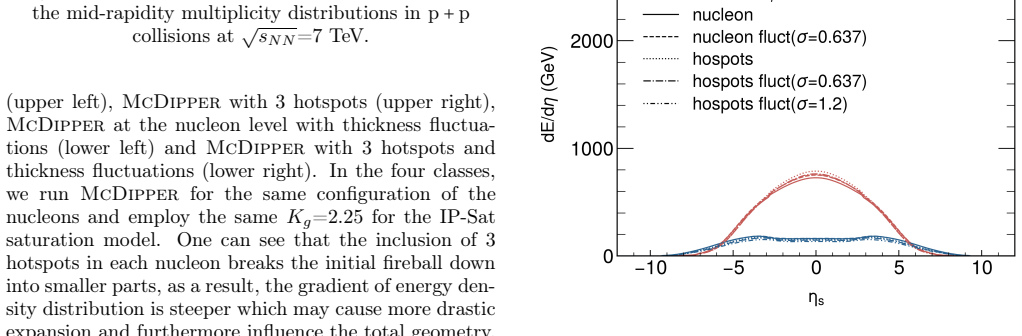
Figures from the paper (16 more)


Forward citations
Cited by 4 Pith papers
-
Saturation effects in exclusive vector meson production in DIS
A dense-limit CGC hotspot calculation shows saturation mildly suppresses exclusive vector meson cross sections in ep, with suppression growing at higher color-charge density.
-
Left-right splitting of elliptic flow in heavy ion collisions: TRENTo-3D initialization and CLVisc hydrodynamic simulations
For 5-40% Au+Au at 200 GeV, the model predicts Δv2/v2 has a 4.4% slope in pseudorapidity and crosses zero at pT≈1.5 GeV, with v3 dominating the pT dependence.
-
Effective theories for nuclei at high energies
This paper reviews the Color Glass Condensate effective theory, covering its foundations, its role in deep inelastic scattering, and its use in setting initial conditions for heavy-ion collisions.
-
Theory Summary
A conference summary paper reports selected theory results from Quark Matter 2025 in heavy-ion physics, with no new original research.
Reference graph
Works this paper leans on
-
[55]
McDIP- PER,
O. Garcia-Montero, H. Roch, and J. Zhu, “ McDIP- PER,” https://github.com/Non-Equilibrium-QCD/ McDipper (2024), accessed: 2024-10-18
2024
-
[1]
B. V. Jacak and B. Muller, Science337, 310 (2012)
2012
-
[2]
A. Adare et al. (PHENIX), Phys. Rev. Lett.98, 162301 (2007), arXiv:nucl-ex/0608033
arXiv 2007
- [3]
- [4]
-
[5]
U. W. Heinz, J. Phys. Conf. Ser.455, 012044 (2013), arXiv:1304.3634 [nucl-th]
arXiv 2013
-
[6]
B. Schenke, S. Jeon, and C. Gale, Phys. Rev. C 82, 014903 (2010), arXiv:1004.1408 [hep-ph]
arXiv 2010
- [7]
Show all 95 references
-
[8]
L.-G. Pang, H. Petersen, and X.-N. Wang, Phys. Rev. C 97, 064918 (2018), arXiv:1802.04449 [nucl-th]
2018 arXiv
-
[9]
Weilet al
J. Weilet al. (SMASH), Phys. Rev. C94, 054905 (2016), arXiv:1606.06642 [nucl-th]
2016 arXiv
-
[10]
Bleicheret al., J
M. Bleicheret al., J. Phys. G25, 1859 (1999), arXiv:hep- ph/9909407
1999
-
[11]
Schenke, P
B. Schenke, P. Tribedy, and R. Venugopalan, Phys. Rev. Lett. 108, 252301 (2012), arXiv:1202.6646 [nucl-th]
2012 arXiv
-
[12]
Schenke, P
B. Schenke, P. Tribedy, and R. Venugopalan, Phys. Rev. C 86, 034908 (2012), arXiv:1206.6805 [hep-ph]
2012 arXiv
-
[13]
Mäntysaari, B
H. Mäntysaari, B. Schenke, C. Shen, and P. Tribedy, Phys. Lett. B772, 681 (2017), arXiv:1705.03177 [nucl- th]
2017 arXiv
-
[14]
Kurkela, A
A. Kurkela, A. Mazeliauskas, J.-F. Paquet, S. Schlicht- ing, and D. Teaney, Phys. Rev. Lett.122, 122302 (2019), arXiv:1805.01604 [hep-ph]
2019 arXiv
-
[15]
Kurkela, A
A. Kurkela, A. Mazeliauskas, J.-F. Paquet, S. Schlicht- ing, and D. Teaney, Phys. Rev. C 99, 034910 (2019), arXiv:1805.00961 [hep-ph]
2019 arXiv
-
[16]
Videbaek (BRAHMS), Nucl
F. Videbaek (BRAHMS), Nucl. Phys. A830, 43C (2009), arXiv:0907.4742 [nucl-ex]
2009 arXiv
-
[17]
Adamet al
J. Adamet al. (ALICE), Phys. Lett. B762, 376 (2016), arXiv:1605.02035 [nucl-ex]
2016 arXiv
-
[18]
Khachatryan et al
V. Khachatryan et al. (CMS), Phys. Rev. C92, 034911 (2015), arXiv:1503.01692 [nucl-ex]
2015 arXiv
-
[19]
W. Ke, J. S. Moreland, J. E. Bernhard, and S. A. Bass, Phys. Rev. C96, 044912 (2017), arXiv:1610.08490 [nucl- th]
2017 arXiv
-
[20]
Soeder, W
D. Soeder, W. Ke, J. F. Paquet, and S. A. Bass, (2023), arXiv:2306.08665 [nucl-th]
2023 arXiv
-
[21]
Z.-W. Lin, C. M. Ko, B.-A. Li, B. Zhang, and S. Pal, Phys. Rev. C72, 064901 (2005), arXiv:nucl-th/0411110
2005 arXiv
-
[22]
Matsuda and X.-G
H. Matsuda and X.-G. Huang, Entropy26, 167 (2024), arXiv:2401.04296 [physics.plasm-ph]
2024 arXiv
-
[23]
Matsuda and X.-G
H. Matsuda and X.-G. Huang, Phys. Rev. D110, 114032 (2024), arXiv:2409.08742 [hep-ph]
2024 arXiv
- [24]
-
[25]
Gelfand, A
D. Gelfand, A. Ipp, and D. Müller, Phys. Rev. D94, 014020 (2016), arXiv:1605.07184 [hep-ph]. 15
2016 arXiv
-
[26]
Schlichting and P
S. Schlichting and P. Singh, Phys. Rev. D103, 014003 (2021), arXiv:2010.11172 [hep-ph]
2021 arXiv
-
[27]
A. Ipp, M. Leuthner, D. I. Müller, S. Schlichting, K. Schmidt, and P. Singh, Phys. Rev. D109, 094040 (2024), arXiv:2401.10320 [hep-ph]
2024 arXiv
-
[28]
A. Ipp, D. I. Müller, S. Schlichting, and P. Singh, Phys. Rev. D104, 114040 (2021), arXiv:2109.05028 [hep-ph]
2021 arXiv
-
[29]
McDonald, S
S. McDonald, S. Jeon, and C. Gale, Nucl. Phys. A1005, 121771 (2021), arXiv:2001.08636 [nucl-th]
2021 arXiv
-
[30]
Schenke, S
B. Schenke, S. Schlichting, and P. Singh, Acta Phys. Polon. Supp.16, 1 (2023), arXiv:2212.02278 [hep-ph]
2023 arXiv
-
[31]
J. E. Bernhard, J. S. Moreland, and S. A. Bass, Nature Phys. 15, 1113 (2019)
2019
- [32]
-
[33]
Bozek and I
P. Bozek and I. Wyskiel-Piekarska, Phys. Rev. C 83, 024910 (2011), arXiv:1009.0701 [nucl-th]
2011 arXiv
-
[34]
Garcia-Montero, H
O. Garcia-Montero, H. Elfner, and S. Schlichting, Phys. Rev. C109, 044916 (2024), arXiv:2308.11713 [hep-ph]
2024 arXiv
-
[35]
Mäntysaari and B
H. Mäntysaari and B. Schenke, Phys. Rev. D94, 034042 (2016), arXiv:1607.01711 [hep-ph]
2016 arXiv
-
[36]
Mäntysaari and B
H. Mäntysaari and B. Schenke, Phys. Rev. Lett.117, 052301 (2016), arXiv:1603.04349 [hep-ph]
2016 arXiv
-
[37]
C.E.Aguiar, Y.Hama, T.Kodama, andT.Osada,Nucl. Phys. A698, 639 (2002), arXiv:hep-ph/0106266
2002 arXiv
-
[38]
Schenke, S
B. Schenke, S. Jeon, and C. Gale, Phys. Rev. Lett.106, 042301 (2011), arXiv:1009.3244 [hep-ph]
2011 arXiv
-
[39]
Schenke, S
B. Schenke, S. Jeon, and C. Gale, Phys. Rev. C 85, 024901 (2012), arXiv:1109.6289 [hep-ph]
2012 arXiv
-
[40]
Zhao, H.-j
W. Zhao, H.-j. Xu, and H. Song, Eur. Phys. J. C77, 645 (2017), arXiv:1703.10792 [nucl-th]
2017 arXiv
-
[41]
Bialas, W
A. Bialas, W. Czyz, and W. Furmanski, Acta Phys. Polon. B8, 585 (1977)
1977
-
[42]
Bialas and W
A. Bialas and W. Czyz, Acta Phys. Polon. B10, 831 (1979)
1979
-
[43]
Zheng and Z
L. Zheng and Z. Yin, Eur. Phys. J. A 52, 45 (2016), arXiv:1603.02515 [nucl-th]
2016 arXiv
-
[44]
Aidala et al
C. Aidala et al. (PHENIX), Phys. Rev. C 95, 034910 (2017), arXiv:1609.02894 [nucl-ex]
2017
-
[45]
Schenke and R
B. Schenke and R. Venugopalan, Phys. Rev. Lett.113, 102301 (2014), arXiv:1405.3605 [nucl-th]
2014 arXiv
-
[46]
J. P. Blaizot, F. Gelis, and R. Venugopalan, Nucl. Phys. A 743, 57 (2004), arXiv:hep-ph/0402257
2004 arXiv
- [47]
- [48]
-
[49]
Dumitru and L
A. Dumitru and L. D. McLerran, Nucl. Phys. A700, 492 (2002), arXiv:hep-ph/0105268
2002 arXiv
-
[50]
Lappi and S
T. Lappi and S. Schlichting, Phys. Rev. D97, 034034 (2018), arXiv:1708.08625 [hep-ph]
2018 arXiv
-
[51]
Dumitru and J
A. Dumitru and J. Jalilian-Marian, Phys. Rev. Lett.89, 022301 (2002), arXiv:hep-ph/0204028
2002 arXiv
-
[52]
Dumitru, A
A. Dumitru, A. Hayashigaki, and J. Jalilian-Marian, Nucl. Phys. A765, 464 (2006), arXiv:hep-ph/0506308
2006 arXiv
-
[53]
Kowalski, L
H. Kowalski, L. Motyka, and G. Watt, Phys. Rev. D74, 074016 (2006), arXiv:hep-ph/0606272
2006 arXiv
-
[54]
Kowalski and D
H. Kowalski and D. Teaney, Phys. Rev. D68, 114005 (2003), arXiv:hep-ph/0304189
2003 arXiv
-
[56]
J. S. Moreland, J. E. Bernhard, and S. A. Bass, Phys. Rev. C101, 024911 (2020), arXiv:1808.02106 [nucl-th]
2020 arXiv
-
[57]
Acharya et al
S. Acharya et al. (ALICE), Phys. Lett. B845, 137730 (2023), arXiv:2204.10210 [nucl-ex]
2023 arXiv
-
[58]
Aamodt et al
K. Aamodt et al. (ALICE), Eur. Phys. J. C 68, 345 (2010), arXiv:1004.3514 [hep-ex]
2010 arXiv
-
[59]
Greif, C
M. Greif, C. Greiner, S. Plätzer, B. Schenke, and S. Schlichting, Phys. Rev. D 103, 054011 (2021), arXiv:2012.08493 [hep-ph]
2021 arXiv
-
[60]
Giacalone, A
G. Giacalone, A. Mazeliauskas, and S. Schlichting, Phys. Rev. Lett. 123, 262301 (2019), arXiv:1908.02866 [hep- ph]
2019 arXiv
-
[61]
Ding, W.-Y
C. Ding, W.-Y. Ke, L.-G. Pang, and X.-N. Wang, Chin. Phys. C45, 074102 (2021), arXiv:2101.02356 [nucl-th]
2021 arXiv
-
[62]
Wu, L.-G
X.-Y. Wu, L.-G. Pang, G.-Y. Qin, and X.-N. Wang, Phys. Rev. C98, 024913 (2018), arXiv:1805.03762 [nucl- th]
2018 arXiv
-
[63]
Chen, X.-Y
X. Chen, X.-Y. Wu, S. Cao, and G.-Y. Qin, Phys. Rev. C 109, 064915 (2024), arXiv:2402.02348 [nucl-th]
2024 arXiv
-
[64]
G. S. Denicol, C. Gale, S. Jeon, A. Monnai, B. Schenke, and C. Shen, Phys. Rev. C 98, 034916 (2018), arXiv:1804.10557 [nucl-th]
2018 arXiv
-
[65]
G. S. Denicol, S. Jeon, and C. Gale, Phys. Rev. C90, 024912 (2014), arXiv:1403.0962 [nucl-th]
2014 arXiv
-
[66]
J. E. Bernhard, J. S. Moreland, S. A. Bass, J. Liu, and U. Heinz, Phys. Rev. C 94, 024907 (2016), arXiv:1605.03954 [nucl-th]
2016 arXiv
-
[67]
Monnai, B
A. Monnai, B. Schenke, and C. Shen, Phys. Rev. C100, 024907 (2019), arXiv:1902.05095 [nucl-th]
2019 arXiv
-
[68]
Everett et al
D. Everett et al. (JETSCAPE), Phys. Rev. C 103, 054904 (2021), arXiv:2011.01430 [hep-ph]
2021 arXiv
-
[69]
Everett et al
D. Everett et al. (JETSCAPE), Phys. Rev. Lett.126, 242301 (2021), arXiv:2010.03928 [hep-ph]
2021 arXiv
-
[70]
Adamet al
J. Adamet al. (ALICE), Phys. Lett. B754, 373 (2016), arXiv:1509.07299 [nucl-ex]
2016 arXiv
-
[71]
Abbaset al
E. Abbaset al. (ALICE), Phys. Lett. B726, 610 (2013), arXiv:1304.0347 [nucl-ex]
2013 arXiv
-
[72]
Abelev et al
B. Abelev et al. (ALICE), Phys. Rev. C 88, 044910 (2013), arXiv:1303.0737 [hep-ex]
2013 arXiv
-
[73]
Noronha-Hostler, J
J. Noronha-Hostler, J. Noronha, and M. Gyulassy, Phys. Rev. C93, 024909 (2016), arXiv:1508.02455 [nucl-th]
2016 arXiv
-
[74]
R. P. G. Andrade, F. Grassi, Y. Hama, T. Kodama, and W. L. Qian, Phys. Rev. Lett.101, 112301 (2008), arXiv:0805.0018 [hep-ph]
2008 arXiv
-
[75]
Nonaka and S
C. Nonaka and S. A. Bass, Phys. Rev. C 75, 014902 (2007), arXiv:nucl-th/0607018
2007 arXiv
-
[76]
H. Song, S. A. Bass, and U. Heinz, Phys. Rev. C83, 024912 (2011), arXiv:1012.0555 [nucl-th]
2011 arXiv
-
[77]
Abelev et al
B. Abelev et al. (ALICE), Phys. Rev. Lett.111, 232302 (2013), arXiv:1306.4145 [nucl-ex]
2013 arXiv
-
[78]
Bozek and I
P. Bozek and I. Wyskiel, Phys. Rev. C81, 054902 (2010), arXiv:1002.4999 [nucl-th]
2010 arXiv
- [79]
-
[80]
Luzum and J.-Y
M. Luzum and J.-Y. Ollitrault, Phys. Rev. Lett.106, 102301 (2011), arXiv:1011.6361 [nucl-ex]
2011 arXiv
-
[81]
Chatrchyan et al
S. Chatrchyan et al. (CMS), Phys. Rev. C87, 014902 (2013), arXiv:1204.1409 [nucl-ex]
2013 arXiv
-
[82]
Borghini, P
N. Borghini, P. M. Dinh, and J.-Y. Ollitrault, Phys. Rev. C 64, 054901 (2001), arXiv:nucl-th/0105040
2001 arXiv
-
[83]
Borghini, P
N. Borghini, P. M. Dinh, and J.-Y. Ollitrault, Phys. Rev. C 63, 054906 (2001), arXiv:nucl-th/0007063
2001 arXiv
-
[84]
Bilandzic, R
A. Bilandzic, R. Snellings, and S. Voloshin, Phys. Rev. C 83, 044913 (2011), arXiv:1010.0233 [nucl-ex]
2011 arXiv
-
[85]
McDonald, S
S. McDonald, S. Jeon, and C. Gale, Phys. Rev. C108, 064910 (2023), arXiv:2306.04896 [hep-ph]. 16
2023 arXiv
-
[86]
Garcia-Montero, H
O. Garcia-Montero, H. Elfner, and S. Schlichting, PoS HardProbes2023, 054 (2024), arXiv:2311.03125 [hep- ph]
2024 arXiv
-
[87]
Shen and B
C. Shen and B. Schenke, Phys. Rev. C 105, 064905 (2022), arXiv:2203.04685 [nucl-th]
2022 arXiv
-
[88]
Sakai, K
A. Sakai, K. Murase, and T. Hirano, Phys. Lett. B829, 137053 (2022), arXiv:2111.08963 [nucl-th]
2022 arXiv
-
[89]
Sakai, K
A. Sakai, K. Murase, and T. Hirano, Phys. Rev. C102, 064903 (2020), arXiv:2003.13496 [nucl-th]
2020 arXiv
-
[90]
Garcia-Montero and S
O. Garcia-Montero and S. Schlichting, (2024), arXiv:2409.06788 [hep-ph]
2024 arXiv
-
[91]
A. M. Poskanzer and S. A. Voloshin, Phys. Rev. C58, 1671 (1998), arXiv:nucl-ex/9805001
1998 arXiv
-
[92]
S. Ryu, J. F. Paquet, C. Shen, G. S. Denicol, B. Schenke, S. Jeon, and C. Gale, Phys. Rev. Lett. 115, 132301 (2015), arXiv:1502.01675 [nucl-th]
2015 arXiv
-
[93]
Ryu, J.-F
S. Ryu, J.-F. Paquet, C. Shen, G. Denicol, B. Schenke, S. Jeon, and C. Gale, Phys. Rev. C97, 034910 (2018), arXiv:1704.04216 [nucl-th]
2018 arXiv
-
[94]
Teaney, J
D. Teaney, J. Lauret, and E. V. Shuryak, Phys. Rev. Lett. 86, 4783 (2001), arXiv:nucl-th/0011058
2001 arXiv
-
[95]
S. A. Bass and A. Dumitru, Phys. Rev. C61, 064909 (2000), arXiv:nucl-th/0001033. Appendix A: Initial longitudinal distributions In Fig. 15 and 16, we present the initial energy den- sity and net-baryon number distributions in longitudinal direction at x=0 fm with four differen...
2000 arXiv
Reviewed August 10, 2026 · model on record in the stance chip above.
Discussion (0). Continue with ORCID to comment.