REVIEW 5 major objections 6 minor 105 references
Primordial blackhole formation: Exploring chaotic potential with a sharp step via the GLMS perspective
T0 review · 5 major / 6 minor · reviewed 2026-08-12 · deepseek-v4-flash
Pith's one-line read A sharp step on a chaotic inflationary potential can form primordial black holes that could be all dark matter in two mass windows.
desk verdict A competent parameter-scan demonstration of the known sharp-step chaotic inflation mechanism, whose headline f_PBH≈1 is exponentially sensitive to an untested threshold choice; deserves review but needs a sensitivity scan before the dark-matter claim can be used. read the letter →
The pith
A machine-rendered reading of the paper's core claim, the machinery that carries it, and where it could break.
The reading
What carries the argument
The load-bearing object is the step potential $V(\phi)=\frac{1}{2}m^2\phi^2[1+c\tanh((\phi-\phi_{\rm step})/d)]$, where the dimensionless height $c$, width $d$, and position $\phi_{\rm step}$ are tuned to create a brief ultra-slow-roll phase that spikes the power spectrum at a chosen small scale. The abundance calculation then rests on the GLMS approximation to peak theory, specifically the analytic expression $\beta(M_{\rm PBH}) = \frac{1}{\sqrt{2\pi}}\left(\frac{R\sigma_1}{\sqrt{3}\sigma_0}\right)^3(\nu_{\rm th}^2-1)\exp(-\nu_{\rm th}^2/2)$, which replaces the full ten-dimensional peak statistics with two spectral moments $\sigma_0=\sigma_\delta$ and $\sigma_1$ of the smoothed density contrast. The smoothing is done with a Gaussian window function $W(k,R)=\exp(-k^2R^2/2)$ on the scale $R=1/k_{\rm PBH}$. Everything downstream depends exponentially on $\nu_{\rm th}^2=\delta_{\rm th}^2/\sigma_0^2$, which is why the choice $\delta_{\rm th}=0.414$ and the Gaussian assumption for the density field carry the argument.
What would settle it
Recompute $f_{\rm PBH}$ for the four parameter sets using $\delta_{\rm th}=0.33$ and $\delta_{\rm th}=0.66$ (or include the non-Gaussian corrections expected from the step) and check whether the near-unity abundances for the two lightest mass windows survive; because of the exponential dependence, a fractional change in $\nu_{\rm th}$ of order ten percent shifts $f_{\rm PBH}$ by orders of magnitude.
Extended reading notes
Core claim
The central claim is that the potential $V(\phi)=\frac{1}{2}m^2\phi^2[1+c\tanh((\phi-\phi_{\rm step})/d)]$ with a sharp step can generate a peak in the primordial scalar power spectrum of order $10^{-2}$ at small scales, while the power spectrum on CMB scales remains nearly scale invariant with $n_s=0.96$ and $r=0.02$. Solving the Mukhanov-Sasaki equation numerically for four parameter sets, the paper finds peaks at wavenumbers corresponding to PBH masses $10^{-13}M_\odot$, $10^{-11}M_\odot$, $1M_\odot$, and $6M_\odot$. The fractional abundance is then computed with the GLMS formula $\beta(M_{\rm PBH}) = \frac{1}{\sqrt{2\pi}}\left(\frac{R\sigma_1}{\sqrt{3}\sigma_0}\right)^3(\nu_{\rm th}^2-1)\exp(-\nu_{\rm th}^2/2)$, with $\nu_{\rm th}=\delta_{\rm th}/\sigma_0$ and $\delta_{\rm th}=0.414$. The result is $f_{\rm PBH}\approx 1$ for the two lightest windows and $0.01$, $0.001$ for the heavier ones, while the Press-Schechter formalism gives values two to three orders of magnitude smaller. The paper presents the GLMS values as consistent with current observational constraints.
Load-bearing premise
The abundances assume that the smoothed density contrast is a Gaussian random field with a fixed collapse threshold $\delta_{\rm th}=0.414$; the result depends exponentially on this threshold and on the amplitude of the tail of the distribution.
Editorial extensions
If this is right
- The same single potential produces PBHs in four distinct mass windows, from $10^{-13}M_\odot$ to $6M_\odot$, by moving the step position $\phi_{\rm step}$.
- The step leaves the CMB observables $n_s$ and $r$ unchanged, so small-scale PBH physics can be tuned independently of large-scale cosmological parameters.
- In the GLMS approximation, the two lightest mass windows have $f_{\rm PBH}\approx 1$, meaning PBHs could constitute the entirety of the dark matter in those windows.
- The heavier windows, $1M_\odot$ and $6M_\odot$, yield $f_{\rm PBH}\approx 0.01$ and $0.001$, consistent with LIGO/Virgo merger-rate constraints.
- The Press-Schechter formalism underestimates $f_{\rm PBH}$ by two to three orders of magnitude relative to the GLMS peak-theory calculation, so the choice of abundance estimator is decisive here.
Reading between the lines
- If the step-induced non-Gaussianity is significant, the Gaussian GLMS estimate likely overstates the high-density tail; a calculation using the step-generated bispectrum or a numerical collapse simulation would bracket the true $f_{\rm PBH}$.
- The same small-scale power enhancement that forms PBHs necessarily sources a stochastic gravitational-wave background at second order; the paper does not compute this, but it is a testable corollary for PTA and LISA observations.
- Because $f_{\rm PBH}$ depends so steeply on $\delta_{\rm th}$, the 'PBH as all dark matter' conclusion should be read as contingent on the threshold and Gaussianity assumptions rather than as a robust prediction of the potential alone.
- The decoupling of CMB-scale from small-scale parameters suggests the step parameters could be pinned down independently by future measurements of the scalar power spectrum at small scales, such as 21-cm observations.
Editorial analysis
A structured set of objections, weighed in public.
Referee Report
Summary. This paper studies single-field chaotic inflation with a hyperbolic-tangent sharp step in the potential. The authors solve the Mukhanov-Sasaki equation numerically, present four tuned parameter sets for which the scalar power spectrum is enhanced to O(10^-2) at small scales while the CMB-scale values of n_s and r are claimed to remain unchanged, and compute PBH abundances with the GLMS approximation of peak theory and with the Press-Schechter formalism. They report f_PBH ≈ 1 for the 10^-13 M_sun and 10^-11 M_sun mass windows and f_PBH ≈ 0.01 and 0.001 for the 1 M_sun and 6 M_sun windows, respectively. The central route—tuning a step to enhance P(k) and then applying the GLMS/PS abundance formulas—is standard, but the manuscript omits the numerical pipeline and the required sensitivity analysis, and it contains internal inconsistencies in the reported masses and CMB observables.
Significance. If the abundance results were robust, the model would be attractive because it decouples CMB-scale observables from small-scale PBH production and covers a wide mass range with a simple potential. The paper has several genuine strengths: it solves the full Mukhanov-Sasaki equation, explicitly studies the fine-tuning of c, d, and phi_step, and presents a side-by-side comparison of the GLMS and Press-Schechter formalisms. However, the headline f_PBH ≈ 1 claim is exponentially sensitive to the assumed density threshold and to the Gaussianity of the smoothed density field, neither of which is tested. The scientific value of the paper therefore depends on completing the robustness analysis rather than on the current numerical estimates alone.
major comments (5)
- [Section 4.1, Eq. (25)] The headline abundance values are dominated by the factor exp(-nu_th^2/2) with nu_th = delta_th/sigma_delta, but the paper fixes delta_th = 0.414 after citing a permissible range of 0.33–0.66 and reports no values for sigma_delta or sigma_1 for the four parameter sets. Because f_PBH depends exponentially on nu_th^2, moving delta_th from 0.414 to 0.66 at the nu_th values implied by f_PBH ≈ 1 suppresses the abundance by roughly twenty orders of magnitude, while moving to 0.33 raises it. Without a reported sigma_delta and a delta_th sensitivity scan, the f_PBH ≈ 1 claim is not a robust prediction and the comparison with observational constraints in Figs. 10–12 is not meaningful.
- [Section 4.1, Eqs. (22)–(25)] The GLMS abundance calculation assumes the smoothed density contrast is a Gaussian random field, and the paper itself states that delta_th depends on primordial non-Gaussianities. The step-induced ultra-slow-roll phase is precisely a regime known to generate non-Gaussianity, so the Gaussian integral in Eq. (25) is an unvalidated assumption at the point where the central result lives. The authors should at least quantify the expected non-Gaussian correction to the high-density tail or show that it is negligible; without that, the agreement with observational constraints may be an artifact of the Gaussian ansatz.
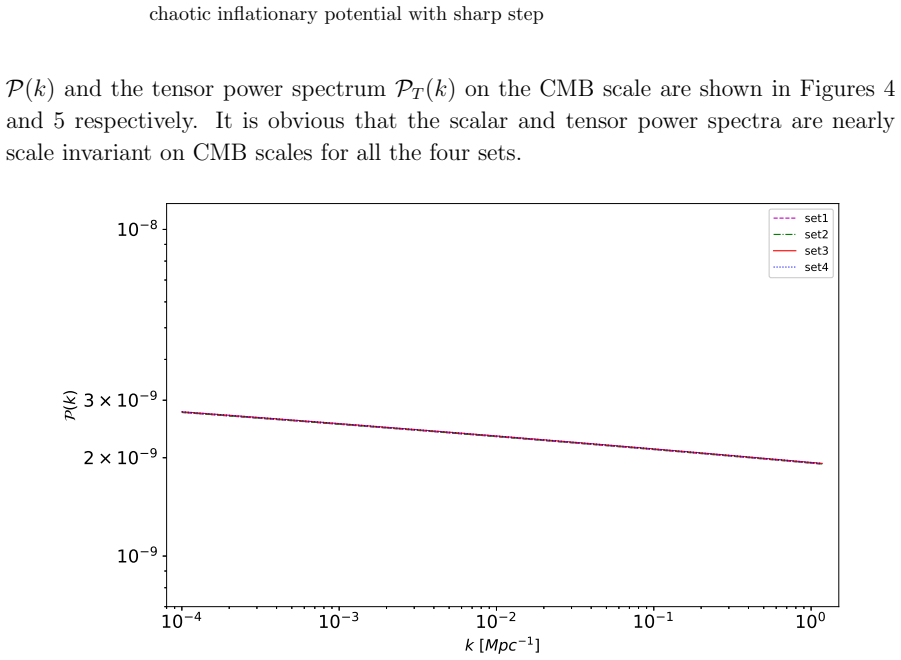
- [Section 2, Table 1] The text states that all four parameter sets give the same n_s and r at the CMB pivot scale and that these are consistent with Planck, but Table 1 lists numerical entries for n_s and r only for set 2 (0.96 and 0.02); sets 1, 3, and 4 have empty entries. The authors should report n_s and r for every set, with uncertainties and the Planck reference values, or the claim of separate control of CMB observables is not supported by the presented data.
- [Section 5 vs. Abstract and Table 2] The conclusions contain internal inconsistencies: the text refers to PBH masses of 10^-13 M_sun and 10^-10 M_sun and to windows of 1 M_sun and 10 M_sun, while the abstract and Table 2 give 10^-13 M_sun, 10^-11 M_sun, 1 M_sun, and 6 M_sun. The manuscript also refers to a previous mass range of 10^-17 M_sun, 10^-13 M_sun, and 30 M_sun in Section 3, which is not clearly distinguished from the current results. These discrepancies must be reconciled before publication.
- [Sections 2–3, numerical method] The paper does not describe the numerical pipeline used to solve the Mukhanov-Sasaki equation: no initial conditions, number of e-folds, k-grid resolution, Runge-Kutta step size, or convergence tests are reported. Since the peak amplitude and position of P(k) are the fundamental inputs to f_PBH and since Fig. 6 shows that the peak amplitude changes by two orders of magnitude under c -> c + 10^-7, the absence of numerical details compromises reproducibility and prevents a reader from assessing whether the reported power spectra are converged.
minor comments (6)
- [Section 1, Introduction] There is a typo: "Press-Scheter" should be "Press-Schechter."
- [Global] Several stylistic errors appear, including "inturn," "extremely light weigh," and "e fold"; a careful proofreading pass is needed.
- [Section 3, Eq. (10)] The notation g_s0* is confusing; the entropy degrees-of-freedom symbols should be defined consistently with the energy degrees-of-freedom g_*.
- [Fig. 10–12] The figures for f_PBH versus mass are presented with shaded observational constraints, but the numerical values of f_PBH for the four points are not given; a table of f_PBH values, with and without the sensitivity test, would be more informative.
- [Section 4.1, Eq. (25)] Please verify the prefactor in the GLMS expression; the standard GLMS result is often written with a factor 1/(2 pi) rather than 1/sqrt(2 pi), and the derivation leading to Eq. (25) should be shown or cited explicitly.
- [Section 2, Table 1] The table header formatting for d/M_pl and phi_step/M_pl is not clear from the text; the units should be stated explicitly for every entry.
Circularity Check
No significant circularity: PBH abundances are computed from the model power spectrum with a literature threshold; mass windows are tuned parameter choices but are presented as exploration, not independent predictions.
full rationale
The derivation chain is not circular. The authors solve the Mukhanov-Sasaki equation for the step potential, obtain P(k), smooth it with a Gaussian window (Eqs. 17-20), and insert sigma_delta and sigma_1 into the GLMS formula (Eq. 25) or the PS integral (Eq. 27), with delta_th = 0.414 stated as an adopted literature value. Nothing in the text indicates that c, d, or phi_step were adjusted to match f_PBH; the sensitivity plots (Figs. 6-8) vary parameters around a fixed set and recompute P(k). The four mass windows do follow from parameter choices (Section 3 states that increasing phi_step shifts the peak to larger scales and hence increases the PBH mass), so the masses are targets of the parameter scan rather than unique predictions; however, the paper describes this as a parameter-space exploration ("we have explored a broader parameter space, which shows how different sets of parameters leads to PBH formation across different mass ranges"), so this is model-building, not a hidden fit. The exponential sensitivity of f_PBH to delta_th and the absence of a threshold scan is a real robustness concern but not circularity: delta_th is an external input, and the computation is an honest application of the stated formula. Reference [57] is a self-citation but is not load-bearing, since the same statement is also supported by [49]. Thus the central abundance results retain independent content.
Assumptions & free parameters
free parameters (5)
- c (step height, sets 1 to 4) =
-7.91501e-3; -6.97333e-3; -2.70720e-3; -2.52303e-3
- d (step width, sets 1 to 4) =
0.029; 0.027; 0.003; 0.002
- phi_step (step position, sets 1 to 4) =
9.6; 10.2; 12.2; 12.32
- delta_th (PBH formation threshold) =
0.414
- gamma (collapse efficiency) =
0.2
assumptions (5)
- domain assumption Gaussian random field for the density contrast
- domain assumption Fixed threshold delta_th=0.414 with radiation equation of state
- domain assumption Nearly monochromatic PBH mass function
- domain assumption Tree-level power spectrum is sufficient
- ad hoc to paper Sharp step ansatz for the potential
invented entities (1)
-
None
Cite this review
Pith. "Pith review of Primordial blackhole formation: Exploring chaotic potential with a sharp step via the GLMS perspective." pith.science (2026). https://pith.science/paper/XMZEDNFO
@misc{pith2026241110076,
  author       = {Pith},
  title        = {Pith review of: Primordial blackhole formation: Exploring chaotic potential with a sharp step via the GLMS perspective},
  year         = {2026},
  howpublished = {\url{https://pith.science/paper/XMZEDNFO}},
  note         = {Machine review of arXiv:2411.10076}
}
abstract
A sharp step on a chaotic potential can enhance primordial curvature fluctuations on smaller scales to the $\mathcal{O}(10^{-2})$ to form primordial black holes (PBHs). The present study discusses an inflationary potential with a sharp step that results in the formation of PBHs in four distinct mass ranges. Also this inflationary model allows the separate consideration of observable parameters $n_s$ and $r$ on the CMB scale from the physics at small scales, where PBHs formation occur. In this work we computed the fractional abundance of PBHs ($f_{PBH}$) using the GLMS approximation of peak theory and also the Press-Schechter (PS) formalism. In the two typical mass windows, $10^{-13}M_\odot$ and $10^{-11}M_\odot$, $f_{PBH}$ calculated using the GLMS approximation is nearly equal to 1 and that calculated via PS is of $10^{-3}$. In the other two mass windows $1M_\odot$ and $6M_\odot$, $f_{PBH}$ obtained using GLMS approximation is 0.01 and 0.001 respectively, while $f_{PBH}$ calculated via PS formalism yields $10^{-5}$ and $10^{-6}$. The results obtained via GLMS approximation are found to be consistent with observational constraints. A comparative analysis of $f_{PBH}$ obtained using the GLMS perspective and the PS formalism is also included.
Figures


Figures from the paper (9 more)


Reference graph
Works this paper leans on
-
[1]
Starobinsky A A 1979 Zh.E.T.F Pisma 30 719–723
1979
-
[2]
al 2016 Phys
Abbott B P, Abbott R, Abbott T D, Abernathy M R et. al 2016 Phys. Rev. Lett. 116(6) 061102
2016
-
[3]
Einstein A 1918 Sitzungsber. Preuss. Akad. Wiss. Berlin 154
1918
-
[4]
Einstein A 1915 Sitzungsber. Preuss. Akad. Wiss. Berlin 778
1915
-
[5]
Khlebnikov S and Tkachev I 1997 Phys. Rev. D 56(2) 653–660
1997
-
[6]
Liu J, Guo Z K, Cai R G and Shiu G 2018 Phys. Rev. Lett. 120(3) 031301
2018
-
[7]
Kuroyanagi S, Lin C, Sasaki M and Tsujikawa S 2018 Phys. Rev. D 97(2) 023516
2018
-
[8]
Kosowsky A and Turner M S 1993 Phys. Rev. D 47(10) 4372–4391
1993
Show all 105 references
-
[9]
Kamionkowski M, Kosowsky A and Turner M S 1994 Phys. Rev. D 49(6) 2837–2851
1994
-
[10]
Vilenkin A 1981 Phys. Rev. D 23(4) 852–857
1981
-
[11]
Vachaspati T and Vilenkin A 1985 Phys. Rev. D 31(12) 3052–3058
1985
-
[12]
2023The Ast
Agazie G, Anumarlapudi A, Archibald A M et al. 2023The Ast. Phys. J. Lett. 951 L8
-
[13]
, A&A 678 A50, 2023,
EPTA Collaboration and InPTA Collaboration, Antoniadis J, Arumu gam P, Arumugam S et al. , A&A 678 A50, 2023,
2023
-
[14]
Agazie, J
G. Agazie, J. Antoniadis, A. Anumarlapudi et al. 2024The Ast. Phys. J. 966(1), 105
-
[15]
Blanco-Pillado, Ken D
Jose J. Blanco-Pillado, Ken D. Olum and Xavier Siemens 2018 Phys. Lett. B 778 392-396
2018
-
[16]
Starobinsky A A 1980 Phys. Lett. B 91 99
1980
-
[17]
Guth A H 1981 Phys. Rev. D 23 347
1981
-
[18]
Guth A H and Pi S Y 1985 Phys. Rev. D 32 1899
1985
-
[19]
High Energy Astrophys
Vagnozzi S 2023 J. High Energy Astrophys. 39 81–98
2023
-
[20]
Yang W, Vagnozzi S, Valentino E D, Nunes R C, Pan S and Mota D F 2 019 J. Cosmol. Astropart. Phys. JCAP07(2019) 037
2019
-
[21]
Young S 2022 J. Cosmol. Astropart. Phys. JCAP05(2022) 037
2022
-
[22]
Salopek D S, Bond J R and Bardeen J M 1989 Phys. Rev. D 40(6) 1753–1788
1989
-
[23]
Polarski D and Starobinsky A A 1992 Nucl. Phys. B 385 623–650
1992
-
[24]
55 489–494
Starobinsky A A 1992 JETP Lett. 55 489–494
1992
-
[25]
Garc ´ ıa-Bellido J, Linde A and Wands D 1996 Phys. Rev. D 54(10) 6040–6058
1996
-
[26]
Hawking S W 1975 Commun. Math. Phys. 43 199–220
1975
-
[27]
Zhao Z C and Wang S 2022 Universe17
2022
-
[28]
Cang J, Ma Y Z and Gao Y 2023 Astrophys. J. 949 64
2023
-
[29]
Carr B J and Rees M J 1984 Mon. Not. R. Astron. Soc. 206 801–818
1984
-
[30]
Bean R and Magueijo J a 2002 Phys. Rev. D 66(6) 063505 Primordial black hole formation 21
2002
-
[31]
Afshordi N, McDonald P and Spergel D N 2003 The Astrophys. J. 594 L71
2003
-
[32]
Belotsky K and Kirillov A 2015 J. Cosmol. Astropart. Phys. JCAP01(2015) 041
2015
-
[33]
Chapline G F 1975 Nature 253 251–252
1975
-
[34]
Meszaros P 1975 A&A 38 5–13
1975
-
[35]
Ali-Ha ¨ ımoud Y, Kovetz E D and Kamionkowski M 2017 Phys. Rev. D 96(12) 123523
2017
-
[36]
Kavanagh B J, Gaggero D and Bertone G 2018 Phys. Rev. D 98(2) 023536
2018
-
[37]
Ana Alexandre, Gia Dvali, and Emmanouil Koutsangelas 2024 arxiv2402.14069
2024 arXiv
-
[38]
Valentin Thoss, Andreas Burkert, and Kazunori Kohri 2024 arxiv2402.17823
2024 arXiv
-
[39]
Theodoros Papanikolaou, Vincent Vennin, and David Langlois 202 1 J. Cosmol. Astropart. Phys. JCAP03(2021) 053
2021
-
[40]
Guillem Dom` enech, Chunshan Lin, and Misao Sasaki 2021 J. Cosmol. Astropart. Phys. JCAP04(2021) 062
2021
-
[41]
Theodoros Papanikolaou 2022 J. Cosmol. Astropart. Phys. JCAP10(2022) 089
2022
-
[42]
Shyam Balaji, Guillem Dom` enech, Gabriele Franciolini, Alexander Ga nz, and Jan Tr¨ ankle 2024 arxiv 2403.14309
2024 arXiv
-
[43]
Ivanov P, Naselsky P and Novikov I 1994 Phys. Rev. D 50(12) 7173–7178
1994
-
[44]
Motohashi H and Hu W 2017 Phys. Rev. D 96(6) 063503
2017
-
[45]
Ballesteros G and Taoso M 2018 Phys. Rev. D 97(2) 023501
2018
-
[46]
Bhaumik N and Jain R K 2020 J. Cosmol. Astropart. Phys. JCAP 01(2020) 037
2020
-
[47]
Green A M, Liddle A R, Malik K A and Sasaki M 2004 Phys. Rev. D 70(4) 041502
2004
-
[48]
Press W H and Schechter P 1974 Astrophys. J. 187 425–438
1974
-
[49]
Adams J, Cresswell B and Easther R 2001 Phys. Rev. D 64(12) 123514
2001
-
[50]
Hamann J, Covi L, Melchiorri A and Slosar A c v 2007 Phys. Rev. D 76(2) 023503
2007
-
[51]
Hamann J, Shafieloo A and Souradeep T 2010 J. Cosmol. Astropart. Phys. JCAP04(2010) 010
2010
-
[52]
Dark Universe 18 6–10
Germani C and Prokopec T 2017 Phys. Dark Universe 18 6–10
2017
-
[53]
Domcke V, Schmitz K 2018 Phys. Rev. D 97(11) 115025
2018
-
[54]
and Ruiz Morales E
Garc ´ ıa-Bellido J. and Ruiz Morales E. 2002 Phys. Lett. B 536(3–4) 193–202
2002
-
[55]
and Shafi Q
Pallis C. and Shafi Q. 2014 Phys. Lett. B 736 261-266
2014
-
[56]
and Linde A
Kallosh R. and Linde A. 2010 J. Cosmol. Astropart. Phys. JCAP11(2010) 011
2010
-
[57]
2023 Phys
Thomas R., Thomas J., Joy M. 2023 Phys. of the dark universe 42 101313
2023
-
[58]
K., Aich M., Jain R
Hazra D. K., Aich M., Jain R. K., Sriramkumar L., and Souradeep T. 2 010 J. Cosmol. Astropart. Phys. JCAP10(2010) 008
2010
-
[59]
Chandra R. S. and Souradeep T. 2021 J. Cosmol. Astropart. Phys. JCAP10(2021) 081
2021
-
[60]
Shafieloo A., Souradeep T. et. al. 2007 Phys. Rev. D. 75(12) 123502
2007
-
[61]
K., Shafieloo A and Souradeep
Hazra D. K., Shafieloo A and Souradeep. T 2014 J. Cosmol. Astropart. Phys. JCAP11(2014) 011
2014
-
[62]
Sasaki M 1986 Prog. Theor. Phys. 76 1036–1046
1986
-
[63]
Mukhanov V F 1988 Sov. Phys. JETP 67 1297–1302
1988
-
[64]
G. A. Palma, B. Pradenas, W. Riquelme, and S. Sypsas 2017 Phys. Rev. D 95 083519
2017
-
[65]
Dimopoulos K 2017 Phys. Lett. B 775 262–265
2017
-
[66]
S., Gow A
Cole P. S., Gow A. D., Byrnes C. T., and Patil S. P. 2023 J. Cosmol. Astropart. Phys. JCAP08(2023) 031
2023
-
[67]
and Jain, Jayesh C
Gangopadhyay, Mayukh R. and Jain, Jayesh C. et.al. 2022 The European Phys. J. C 82 (9)
2022
-
[68]
Dark Universe 18 47–54
Garc ´ ıa-Bellido J and Ruiz Morales E 2017 Phys. Dark Universe 18 47–54
2017
-
[69]
Mishra S S and Sahni V 2020 J. Cosmol. Astropart. Phys. JCAP04(2020) 007
2020
-
[70]
Carr B and K¨ uhnel F 2020 Annu. Rev. Nucl. Part. Sci. 70 355–394
2020
-
[71]
Inomata K, Braglia M, Chen X 2023 J. Cosmol. Astropart. Phys. JCAP04(2023) 011
2023
-
[72]
and Yokoyama J
Kristiano J. and Yokoyama J. 2024 Phys. Rev. Lett. 132(22) 221003
2024
-
[73]
Choudhury S., Panda S., and Sami M. 2023 J. Cosmol. Astropart. Phys. JCAP11(2023) 066
2023
-
[74]
2023 Phys
Choudhury S., Panda S., and Sami M. 2023 Phys. Lett. B 845 138123
2023
-
[75]
R., and Sami M
Choudhury S., Gangopadhyay M. R., and Sami M. 2023 arXiv:2301 .10000
2023
-
[76]
and Egea J
Ballesteros G. and Egea J. G. 2024 arXiv:2404.07196 Primordial black hole formation 22
2024 arXiv
-
[77]
J., Taoso M., and Urbano A
Franciolini G., Iovino A. J., Taoso M., and Urbano A. 2023, arXiv:23 05.03491
2023
-
[78]
Carr B J and Hawking S W 1974 Mon. Not. R. Astron. Soc. 168 399–415
1974
-
[79]
Sasaki M, Suyama T, Tanaka T and Yokoyama S 2018 Classical Quantum Gravity 35 063001
2018
-
[80]
Carr B J 1975 Astrophys. J. 201 1–19
1975
-
[81]
Inomata K, Kawasaki M, Mukaida K, Tada Y and Yanagida T T 2017 Phys. Rev. D 96(4) 043504
2017
-
[82]
Carr B, Kohri K, Sendouda Y and Yokoyama J 2021 Rep. Progr. Phys. 84 116902
2021
-
[83]
2020 A& A 641 A10
Collaboration P, Akrami Y, Arroja F et al. 2020 A& A 641 A10
2020
-
[84]
Wang Q, Liu Y C, Su B Y and Li N 2021 Phys. Rev. D 104(8) 083546
2021
-
[85]
Murgia R, Scelfo G, Viel M and Raccanelli A 2019 Phys. Rev. Lett. 123(7) 071102
2019
-
[86]
Mena O, Palomares-Ruiz S, Villanueva-Domingo P and Witte S J 2019 Phys. Rev. D 100(4) 043540
2019
-
[87]
Young S 2019 Int. J. Mod. Phys. D 29 2030002
2019
-
[88]
Tokeshi K, Inomata K and Yokoyama J 2020 J. Cosmol. Astropart. Phys. JCAP12(2020) 038
2020
-
[89]
Ando K, Inomata K and Kawasaki M 2018 Phys. Rev. D 97(10) 103528
2018
-
[90]
Young S, Byrnes C T and Sasaki M 2014 J. Cosmol. Astropart. Phys. JCAP07(2014) 045
2014
-
[91]
Bardeen J M, Bond J R, Kaiser N and Szalay A S 1986 Astrophys. J. 304 15
1986
-
[92]
Gow A D, Byrnes C T, Cole P S and Young S 2021 J. Cosmol. Astropart. Phys. JCAP02(2021) 002
2021
-
[93]
Yoo C M, Harada T, Garriga J and Kohri K 2018 Prog. Theor. Exp. Phys. 2018 123E01
2018
-
[94]
Musco I 2019 Phys. Rev. D 100(12) 123524
2019
-
[95]
Cristiano Germani and Ilia Musco 2019 Phys. Rev. Lett. 122(14) 141302
2019
-
[96]
Harada T, Yoo C M and Kohri K 2013 Phys. Rev. D 88(8) 084051
2013
-
[97]
Escriv` a A, Germani C, and Sheth R K 2021 J. Cosmol. Astropart. Phys. JCAP01(2021) 030
2021
-
[98]
Papanikolaou T 2022 Phys. Rev. D 105(12) 124055
2022
-
[99]
Kehagias, I
A. Kehagias, I. Musco, and A. Riotto 2019 J. Cosmol. Astropart. Phys. JCAP12(2019) 029
2019
-
[100]
Chul-Moon Yoo, Tomohiro Harada, and Hirotada Okawa 2020 Phys. Rev. D 102 (4) 043526
2020
-
[101]
Musco, T
I. Musco, T. Papanikolaou, 2022 Phys. Rev. D 106(8) 083017
2022
-
[102]
C., Jedamzik, K.1999 Phys
Niemeyer J. C., Jedamzik, K.1999 Phys. Rev. D 59(12)
1999
-
[103]
Musco I., Miller C.J. et.al. 2005 Classical and Quantum Gravity 22(7) 1405–1424
2005
-
[104]
Yi-Peng Wu 2020 Physics of the Dark Universe 30 100654
2020
-
[105]
Escriv` a A, Germani C and Sheth R K 2020 Phys. Rev. D 101(4) 044022
2020
Reviewed August 12, 2026 · model on record in the stance chip above.
Discussion (0). Continue with ORCID to comment.