REVIEW 4 major objections 5 minor 45 references
Coherent Control of Ion-Photoelectron Dynamics through Rabi Oscillations: An ab initio study
T0 review · 4 major / 5 minor · reviewed 2026-08-07 · deepseek-v4-flash
Pith's one-line read Rabi coupling between ionic states converts incoherent photoelectron pathways into a phase-controllable coherent signal.
desk verdict Credible ab initio support for Rabi-induced ion-photoelectron coherence, but the pathway decomposition rests on an undescribed method. read the letter →
The pith
A machine-rendered reading of the paper's core claim, the machinery that carries it, and where it could break.
The reading
What carries the argument
The load-bearing mechanism is the Rabi coupling between the $2s$ and $2p$ ionic states, driven by the resonant $\omega$ pulse. This coupling converts the entanglement between the photoelectron and the ionic state into a coherent superposition, so that ionization pathways with different ionic states merge and interfere. The calculation uses the multiconfigurational time-dependent Hartree-Fock (MCTDHF) method to propagate all active electrons, and a newly developed channel-resolved time-dependent surface flux (t-SURFF) method to split the final photoelectron spectrum by ionic channel; the paper states that details of that decomposition will be presented elsewhere.
What would settle it
A concrete test: recompute the neon momentum distribution with the resonant coupling between the $2s$ and $2p$ orbitals artificially switched off while keeping the same pulses; if interference fringes or phase-dependent left-right asymmetry still appear, Rabi coupling is not the cause. Experimentally, measuring the half-integrated asymmetry as a function of relative phase at zero delay with FEL parameters near $I_\omega=8.9\times10^{11}$ W/cm$^2$ and $I_{2\omega}=2.0\times10^{13}$ W/cm$^2$ should show the predicted sinusoidal swing; a flat, $\delta$-independent result would refute the mechanism.
Extended reading notes
Core claim
The central discovery is that photoelectron wave packets created by ionizing the Ne $2p$ shell with an $\omega$ photon and the $2s$ shell with a $2\omega$ photon---same electron energy, opposite parity, different ion core---are initially incoherent because the two pathways are entangled with distinct ionic states. Driving the $2s$--$2p$ transition resonantly with the same fundamental pulse induces Rabi oscillations that convert those ionic states into each other, so that pathways ending in the same ion state can interfere. In the computed momentum distribution this shows up as energy-domain fringes from temporal double-slit interference and as a phase-dependent asymmetry $A(\delta,E_0)$ in the angle-resolved photoelectron distribution. The asymmetry oscillates with the relative phase $\delta$, and the half-integrated asymmetry over energies below and above $E_0$ survives realistic energy resolution, which the paper proposes as the experimental observable.
Load-bearing premise
The load-bearing premise is that the newly introduced channel-sorting analysis, whose details are deferred to another publication, correctly assigns every photoelectron to the ion state left behind, since all statements about which pathways interfere rest on that assignment.
Editorial extensions
If this is right
- The essential-states analytical model of Ref. [26] is validated by a full-dimensional all-electron calculation, so the simpler model can be used to scan parameter ranges quickly.
- Coherent control via interference is extended from photoelectrons emitted from the same shell to photoelectrons emitted from different subshells of the same atom.
- The phase-dependent left-right asymmetry of the photoelectron angular distribution is the direct experimental signature of Rabi-restored coherence, tunable by the relative phase $\delta$ between the $\omega$ and $2\omega$ pulses.
- At zero time delay, the half-integrated asymmetry (separate integrals over $E<E_0$ and $E>E_0$) retains the phase-controlled signal even when the energy resolution is too coarse to resolve the $<0.1$ eV fringes, making the effect accessible with existing FELs.
- The ion-photoelectron entanglement structure is modified by Rabi coupling, which is the underlying reason that otherwise incoherent channels regain coherence.
Reading between the lines
- The authors do not state it, but the same Rabi-restored interference should appear in any atom or molecule with two photoemitting subshells whose energy separation matches the fundamental photon, so neon is likely one point on a general design rule for bichromatic coherent control.
- Implicit in the zero-delay half-integrated asymmetry result is a trade: the full-window asymmetry integrates to zero, so experiments should plan to measure the two halves separately rather than the total, a prescription that transfers to other observables reporting ionic-state population.
- A natural extension the paper leaves open is a pump-probe scan: varying the delay between the $2\omega$ and $\omega$ pulses should map the Rabi oscillation itself as the phase-dependent asymmetry swings with the accumulated Rabi angle.
Editorial analysis
A structured set of objections, weighed in public.
Referee Report
Summary. The paper reports ab initio MCTDHF simulations of bichromatic (omega + 2omega) photoionization of neon, with omega tuned to the 2s-2p energy difference, and claims that Rabi coupling between the 2s and 2p ionic states converts incoherent photoelectron wave packets from different ionization channels into a coherent superposition, producing a phase-dependent asymmetry in the photoelectron angular distribution. The authors state that their results confirm the essential-states model of Ref. [26] and propose an experimentally feasible half-integrated asymmetry observable. The central evidence consists of channel-resolved photoelectron spectra obtained with a newly developed channel-resolved t-SURFF method that is announced in Sec. II but not described.
Significance. If the technical results are correct, the paper provides the first independent ab initio validation of the proposed Rabi-induced coherence mechanism and shows that the effect survives a full all-electron treatment. The predicted phase-dependent asymmetry is a concrete, falsifiable signature for FEL experiments, and the proposed half-integrated observable is a useful step toward experimental feasibility. The paper also makes its data openly available, which is commendable. However, the significance currently rests on an undescribed channel-decomposition method and on a qualitative comparison with Ref. [26], so the validation claim is not yet fully established.
major comments (4)
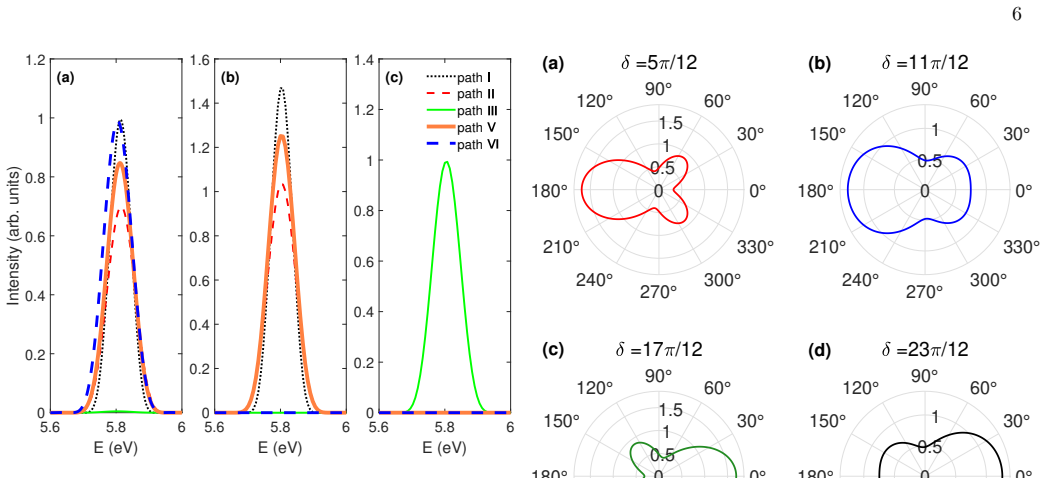
- [Sec. II (Numerical Methods), final paragraph] The channel-resolved t-SURFF method is introduced but not described; the paper states only that 'Further details will be presented elsewhere.' Every channel attribution in Sec. III (pathways II/VI, III/V, and the partial-wave intensities in Fig. 3) is obtained with this black-box method. To make the central claim checkable, the manuscript must provide a full specification of the method, including how the entangled electron-ion wavefunction is projected onto ionic states, how the flux is evaluated per channel, and a validation (e.g., that the channel-resolved spectra sum to the total photoelectron momentum distribution, or a comparison against a system with known channel amplitudes). Without this, the central interference attribution is not established.
- [Sec. III, Figs. 2 and 3] No convergence tests or error estimates are presented for the MCTDHF parameters (l_max = 12, radial box 120 a.u., 30 finite elements, 23 DVR points, active space of 9 orbitals). The quantitative amplitudes and phases of the different pathways in Fig. 3, which determine the interference asymmetry, are therefore unverified. The authors should show that the asymmetry A(delta, E0) in Fig. 5 is converged with respect to the basis size, box size, time step, and active space, and that the channel-resolved spectra sum to the total PMD within the convergence error.
- [Abstract and Sec. III, Fig. 5] The abstract claims that the calculations 'confirm' the analytical results of Ref. [26], but the only quantitative comparison reported is the location of the minimum of A(delta, E0), described as 'consistent' with Ref. [26]. The authors should provide a quantitative comparison, for example by fitting the amplitude and phase of A(delta, E0) to the essential-states prediction, and should state the numerical uncertainty on these fitted parameters. Without this, the validation claim is not supported beyond a qualitative level.
- [Sec. III, discussion of Fig. 2(a)] The causal role of Rabi coupling is inferred from the channel analysis rather than demonstrated by a control calculation. The single-pulse spectra in Figs. 2(b) and 2(c) show no asymmetry, but they also lack the two-pulse interference that is essential to the proposed effect. A more direct test would be a two-pulse calculation with the 2s-2p resonance detuned (or with the Rabi coupling artificially suppressed), showing that the asymmetry in the PAD disappears. Such a control calculation would strengthen the central attribution of the effect to Rabi-induced coherence.
minor comments (5)
- [Title] The title contains 'Ra bi Oscillations' with a space; this is likely a line-break artifact and should be corrected to 'Rabi Oscillations'.
- [Eq. (3) and Sec. III] The sin-squared envelope parameters N1 and N2 are not defined after Eq. (3), yet the text later states that the pulses have FWHM of approximately 30 fs and 45 fs; please define the relationship between N1, N2 and the FWHM.
- [Sec. III, first paragraph] The ionic-state notation (e.g., |2p^{-1}_0>, |2s^{-1}_0>) is used without a definition at first occurrence; please define it when the channels are introduced, preferably in Sec. II or at the start of Sec. III.
- [Fig. 3 caption] The caption refers to 'path' and line styles, but the text refers to pathways I, II, III, V, and VI; please list the pathway labels explicitly in the caption to avoid ambiguity.
- [Sec. III, Fig. 1 discussion] The sentence 'For the case shown in Fig. 1(b) for pathway II' is confusing because pathway II is not explicitly labeled in Fig. 1(b); consider clarifying which panel and pathway is being referenced.
Circularity Check
No significant circularity: the MCTDHF simulation is self-contained; the only self-referential element is the authors' earlier essential-states model used as the interpretive benchmark, which is not load-bearing.
full rationale
The central numerical result, a phase-dependent left-right asymmetry in the photoelectron angular distribution, is obtained from a first-principles MCTDHF solution of the time-dependent Schrodinger equation, with laser parameters, grid, basis, and active space stated independently. The asymmetry is read directly from the full photoelectron momentum distribution via Eq. (10), not from the essential-states model of Ref. [26]. No fitted parameter is renamed as a prediction: the intensities are chosen for visibility, but the full 0-2pi phase scan in Figs. 4 and 5 is a genuine prediction of the simulation. The paper explicitly describes itself as a follow-up to Ref. [26] and states that the MCTDHF calculations confirm the analytical results of that model; because one coauthor (K. L. Ishikawa) is also an author of Ref. [26], this is a self-citation, but it is not load-bearing. The simulation does not import the model's amplitudes or phases, and the model is independently falsifiable by the numerical data. The main caveat is the channel-resolved t-SURFF method announced in Sec. II but not described ('Further details will be presented elsewhere'), which is used to assign photoelectron spectra to ionic channels and to support the pathway-level interpretation in Figs. 2(d)-2(f) and Fig. 3. This is a reproducibility gap, not a circular reduction: there is no evidence that the decomposition hardcodes the expected Rabi-interference outcome, and the overall asymmetry observable does not depend on that method. Overall, no derivation step reduces to its own input by construction, so the score reflects only the minor self-citation and interpretive reliance on the authors' earlier analytical model.
Assumptions & free parameters
free parameters (3)
- Iω (fundamental intensity) =
8.9e11 W/cm2
- I2ω (second harmonic intensity) =
2.0e13 W/cm2
- ω (fundamental photon energy) =
27.22 eV
assumptions (4)
- domain assumption Nonrelativistic Hamiltonian with dipole approximation and length gauge (Eq. 2) describes the ionization dynamics.
- domain assumption MCTDHF with 5 frozen-core and 9 active orbitals (complete active space for 8 electrons) is sufficiently accurate.
- ad hoc to paper The channel-resolved t-SURFF method correctly projects the entangled photoelectron-ion state onto the predefined ionic states.
- domain assumption The essential-states model of Ref [26] provides the correct set of pathways for interpreting the spectra.
Cite this review
Pith. "Pith review of Coherent Control of Ion-Photoelectron Dynamics through Rabi Oscillations: An ab initio study." pith.science (2026). https://pith.science/paper/XOW2SGZY
@misc{pith2026250519681,
  author       = {Pith},
  title        = {Pith review of: Coherent Control of Ion-Photoelectron Dynamics through Rabi Oscillations: An ab initio study},
  year         = {2026},
  howpublished = {\url{https://pith.science/paper/XOW2SGZY}},
  note         = {Machine review of arXiv:2505.19681}
}
abstract
We present first-principles numerical simulations of photoionization in neon induced by bichromatic extreme ultraviolet pulses with frequencies $\omega$ and $2\omega$, specially chosen to make $\omega$ equal to the energy difference between the $2s$ and $2p$ subshells. This allows for the production of photoelectrons from the $2s$ shell by $2\omega$ pulse and from the $2p$ shell by $\omega$ pulse with the same energy. Using the multi-configurational time-dependent Hartree-Fock method, we explore how Rabi coupling between subshells generates coherence between the corresponding photoelectron wave packets. Our \textit{ab initio} calculations confirm the analytical results derived from the essential-states approach in [K. L. Ishikawa, K. C. Prince, and K. Ueda, J. Phys. Chem. A 127, 10638 (2023)], validating the theoretical predictions. Although we focus on the Ne $2p$ and $2s$ subshells, our approach is applicable to a broad range of systems exhibiting photoionization from multiple subshells. The laser parameters employed in our simulations are available in modern Free Electron Lasers (FELs), and we anticipate that this work could stimulate experimental investigations using FELs to study ion-photoelectron coherence and entanglement.
Figures


Figures from the paper (2 more)


Reference graph
Works this paper leans on
-
[26]
M. Ruberti, V. Averbukh, and F. Mintert, Bell test of quantum entanglement in attosecond photoionization, Phys. Rev. X 14, 041042 (2024)
work page 2024
- [1]
-
[2]
J.-A. You, N. Rohringer, and J. M. Dahlstr¨ om, At- tosecond photoionization dynamics with stimulated core- valence transitions, Phys. Rev. A 93, 033413 (2016)
work page 2016
-
[3]
F. Mahmood, C.-K. Chan, Z. Alpichshev, D. Gardner, Y. Lee, P. A. Lee, and N. Gedik, Selective scattering between floquet–bloch and volkov states in a topological insulator, Nature Physics 12, 306 (2016)
work page 2016
-
[4]
A. H. Zewail, Femtochemistry: Atomic-scale dynamics of the chemical bond, J. Phys. Chem. A 104, 5660 (2000)
work page 2000
-
[5]
To make the asymmetry of our coherent control more clearly observable, we propose us- ing the half-integrated asymmetry. Instead of integrating the PADs over the full energy range near E0, we split the range into two subgroups: one for E <E0 and the other for E >E0. Figures 6(d), 6(e), and 6(f) show how these two values depend on δ for delays of 120 fs, 2...
-
[6]
Y.-Y. Yin, C. Chen, D. S. Elliott, and A. V. Smith, Asymmetric photoelectron angular distri- butions from interfering photoionization processes, Phys. Rev. Lett. 69, 2353 (1992)
work page 1992
- [7]
Show all 45 references
-
[8]
Giannessi, E
L. Giannessi, E. Allaria, K. C. Prince, C. Calle- gari, G. Sansone, K. Ueda, T. Morishita, C. N. Liu, A. N. Grum-Grzhimailo, E. V. Gryzlova, et al. , Co- herent control schemes for the photoionization of neon and helium in the extreme ultraviolet spectral region, Sci. Rep. 8, ...
2018
-
[9]
Di Fraia, O
M. Di Fraia, O. Plekan, C. Callegari, K. C. Prince, L. Giannessi, E. Allaria, L. Badano, G. De Ninno, M. Trov` o, B. Diviacco, D. Gauthier, N. Mirian, G. Penco, P. c. v. R. Ribiˇ c, S. Spampinati, C. Spez- zani, G. Gaio, Y. Orimo, O. Tugs, T. Sato, K. L. Ishikawa, P. A. Carpeg...
2019
-
[10]
D. You, K. Ueda, E. V. Gryzlova, A. N. Grum- Grzhimailo, M. M. Popova, E. I. Staroselskaya, O. Tugs, Y. Orimo, T. Sato, K. L. Ishikawa, P. A. Carpeg- 9 giani, T. Csizmadia, M. F¨ ule, G. Sansone, P. K. Maroju, A. D’Elia, T. Mazza, M. Meyer, C. Callegari, M. Di Fraia, O. Plekan...
2020
-
[11]
Popova, E
M. Popova, E. Gryzlova, M. Kiselev, and A. Grum- Grzhimailo, Ionization of atoms by a bichromatic fields of ω + 2 ω multiple frequencies with arbitrary polarization, J. Exp. Theor. Phys. 135, 58 (2022)
2022
-
[12]
Mao, H.-B
Y.-J. Mao, H.-B. Yao, M. He, Z.-H. Zhang, Y. Li, and F. He, Unveiling rabi dynamics through angle-resolved photoelectron momentum distributions using an ω − 2ω pulse pair, Phys. Rev. A 108, 053117 (2023)
2023
-
[13]
Chen, Y.-J
T. Chen, Y.-J. Mao, Y. Li, and F. He, Resolving distinct ionization channels via interferometric phase analysis of partial waves, Phys. Rev. A 111, 043104 (2025)
2025
-
[14]
Chen, Y.-Y
C. Chen, Y.-Y. Yin, and D. S. Elliott, Interference between optical transitions, Phys. Rev. Lett. 64, 507 (1990)
1990
-
[15]
Ayvazyan, N
V. Ayvazyan, N. Baboi, I. Bohnet, R. Brinkmann, M. Castellano, P. Castro, L. Catani, S. Choroba, A. Cianchi, M. Dohlus, H. T. Edwards, B. Faatz, A. A. Fateev, J. Feldhaus, K. Fl¨ ottmann, A. Gamp, T. Garvey, H. Genz, C. Gerth, V. Gretchko, B. Grigoryan, U. Hahn, C. Hessler, K....
2002
-
[16]
W. a. Ackermann, G. Asova, V. Ayvazyan, A. Az- ima, N. Baboi, J. B¨ ahr, V. Balandin, B. Beutner, A. Brandt, A. Bolzmann, et al. , Operation of a free- electron laser from the extreme ultraviolet to the water window, Nat. Photonics 1, 336 (2007)
2007
-
[17]
P. Emma, R. Akre, J. Arthur, R. Bionta, C. Bost- edt, J. Bozek, A. Brachmann, P. Bucksbaum, R. Cof- fee, F.-J. Decker, et al. , First lasing and opera- tion of an ˚ angstrom-wavelength free-electron laser, Nat. Photonics 4, 641 (2010)
2010
-
[18]
Allaria, R
E. Allaria, R. Appio, L. Badano, W. Barletta, S. Bas- sanese, S. Biedron, A. Borga, E. Busetto, D. Castronovo, P. Cinquegrana, et al. , Highly coherent and stable pulses from the fermi seeded free-electron laser in the extreme ultraviolet, Nat. Photonics 6, 699 (2012)
2012
-
[19]
Young, K
L. Young, K. Ueda, M. G¨ uhr, P. H. Bucks- baum, M. Simon, S. Mukamel, N. Rohringer, K. C. Prince, C. Masciovecchio, M. Meyer, et al. , Roadmap of ultrafast x-ray atomic and molecular physics, J. Phys. B: At. Mol. Opt. Phys. 51, 032003 (2018)
2018
-
[20]
Richter, U
F. Richter, U. Saalmann, E. Allaria, M. Wollen- haupt, B. Ardini, A. Brynes, C. Callegari, G. Cerullo, M. Danailov, A. Demidovich, et al. , Strong-field quan- tum control in the extreme ultraviolet domain using pulse shaping, Nature 636, 337 (2024)
2024
-
[21]
Nandi, E
S. Nandi, E. Olofsson, M. Bertolino, S. Carlstr¨ om, F. Zapata, D. Busto, C. Callegari, M. Di Fraia, P. Eng-Johnsson, R. Feifel, et al. , Observation of rabi dynamics with a short-wavelength free-electron laser, Nature 608, 488 (2022)
2022
-
[22]
Laurell, S
H. Laurell, S. Luo, R. Weissenbilder, M. Ammitzb¨ oll, S. Ahmed, H. S¨ oderberg, C. L. M. Petersson, V. Poulain, C. Guo, C. Dittel, et al. , Measuring the quantum state of photoelectrons, Nat. Photonics , 1 (2025)
2025
-
[23]
Vatasescu, Entanglement between electronic and vi- brational degrees of freedom in a laser-driven molecular system, Phys
M. Vatasescu, Entanglement between electronic and vi- brational degrees of freedom in a laser-driven molecular system, Phys. Rev. A 88, 063415 (2013)
2013
-
[24]
M. J. J. Vrakking, Control of attosecond entanglement and coherence, Phys. Rev. Lett. 126, 113203 (2021)
2021
-
[25]
L.-M. Koll, L. Maikowski, L. Drescher, T. Witting, and M. J. J. Vrakking, Experimental control of quantum- mechanical entanglement in an attosecond pump-probe experiment, Phys. Rev. Lett. 128, 043201 (2022)
2022
-
[27]
K. L. Ishikawa, K. C. Prince, and K. Ueda, Control of ion-photoelectron entanglement and coherence via rabi oscillations, J. Phys. Chem. A 127, 10638 (2023)
2023
-
[28]
I. I. Rabi, Space quantization in a gyrating magnetic field, Phys. Rev. 51, 652 (1937)
1937
-
[29]
T. R. Gentile, B. J. Hughey, D. Kleppner, and T. W. Ducas, Experimental study of one- and two-photon rabi oscillations, Phys. Rev. A 40, 5103 (1989)
1989
-
[30]
P. J. Windpassinger, D. Oblak, P. G. Petrov, M. Kubasik, M. Saffman, C. L. G. Alzar, J. Appel, J. H. M¨ uller, N. Kjærgaard, and E. S. Polzik, Nonde- structive probing of rabi oscillations on the cesium clock transition near the standard quantum limit, Phys. Rev. Lett. 100, 103...
2008
-
[31]
Fl¨ ogel, J
M. Fl¨ ogel, J. Dur´ a, B. Sch¨ utte, M. Ivanov, A. Rouz´ ee, and M. J. J. Vrakking, Rabi oscillations in ex- treme ultraviolet ionization of atomic argon, Phys. Rev. A 95, 021401 (2017)
2017
-
[32]
Yu and L
C. Yu and L. B. Madsen, Core-resonant ionization of helium by intense xuv pulses: Analytical and nu- merical studies on channel-resolved spectral features, Phys. Rev. A 98, 033404 (2018)
2018
-
[33]
S. L. Haan, M. Bolt, H. Nymeyer, and R. Grobe, Effects of positive-ion resonances in photoionization of neutral atoms, Phys. Rev. A 51, 4640 (1995)
1995
-
[34]
J. H. Eberly, J. Javanainen, and K. Rz¸ a˙ zewski, Above- threshold ionization, Phys. Rep. 204, 331 (1991)
1991
-
[35]
Grobe and J
R. Grobe and J. H. Eberly, Observation of co- herence transfer by electron-electron correlation, Phys. Rev. A 48, 623 (1993)
1993
-
[36]
K. L. Ishikawa and T. Sato, A review on ab initio approaches for multielectron dynamics, IEEE J. Sel. Top. Quantum Electron. 21, 1 (2015)
2015
-
[37]
Hochstuhl, C
D. Hochstuhl, C. M. Hinz, and M. Bonitz, Time-dependent multiconfiguration methods for the numerical simulation of photoion- ization processes of many-electron atoms, The European Physical Journal Special Topics 223, 177 (2014) . 10
2014
-
[38]
A. U. Lode, C. L´ evˆ eque, L. B. Madsen, A. I. Streltsov, and O. E. Alon, Colloquium: Multiconfigurational time- dependent hartree approaches for indistinguishable par- ticles, Rev. Mod. Phys. 92, 011001 (2020)
2020
-
[39]
Zanghellini, M
J. Zanghellini, M. Kitzler, C. Fabian, T. Brabec, and A. Scrinzi, An mctdhf approach to multielectron dynam- ics in laser fields, Laser Phys. 13, 1064 (2003)
2003
-
[40]
Kato and H
T. Kato and H. Kono, Time-dependent multiconfigura- tion theory for electronic dynamics of molecules in an intense laser field, Chem. Phys. Lett. 392, 533 (2004)
2004
-
[41]
Sato and K
T. Sato and K. L. Ishikawa, Time-dependent complete-active-space self-consistent-field method for multielectron dynamics in intense laser fields, Phys. Rev. A 88, 023402 (2013)
2013
-
[42]
Miyagi and L
H. Miyagi and L. B. Madsen, Time-dependent restricted-active-space self-consistent-field the- ory for laser-driven many-electron dynamics, Phys. Rev. A 87, 062511 (2013)
2013
-
[43]
Sato and K
T. Sato and K. L. Ishikawa, Time-dependent mul- ticonfiguration self-consistent-field method based on the occupation-restricted multiple-active-space model for multielectron dynamics in intense laser fields, Phys. Rev. A 91, 023417 (2015)
2015
-
[44]
Mao, Z.-H
Y.-J. Mao, Z.-H. Zhang, T. Chen, H.-B. Yao, Y. Li, and F. He, Decoupling the complex am- plitudes of partial waves in two-photon ionization, Phys. Rev. A 109, 063117 (2024)
2024
-
[45]
Shen, Y.-J
B.-r. Shen, Y.-J. Mao, Z.-H. Zhang, Y. Li, T. Sato, K. L. Ishikawa, and F. He, https://scidata.sjtu.edu.cn/records/9rcw0-0mr57
Reviewed August 7, 2026 · model on record in the stance chip above.
Discussion (0). Continue with ORCID to comment.