REVIEW 5 major objections 4 minor 40 references
Chromatic Calorimetry -- A Novel Approach to Validate Energy Resolution and Particle Discrimination
T0 review · 5 major / 4 minor · reviewed 2026-08-04 · deepseek-v4-flash
Pith's one-line read Chromatic calorimetry—stacking scintillators with distinct emission wavelengths—yields 95% particle-ID purity and 1.6% energy resolution in test beams, with simulations pointing to a 0.35% constant term.
desk verdict Interesting concept, but the headline numbers don't survive contact with the paper's own tables. read the letter →
The pith
A machine-rendered reading of the paper's core claim, the machinery that carries it, and where it could break.
The reading
What carries the argument
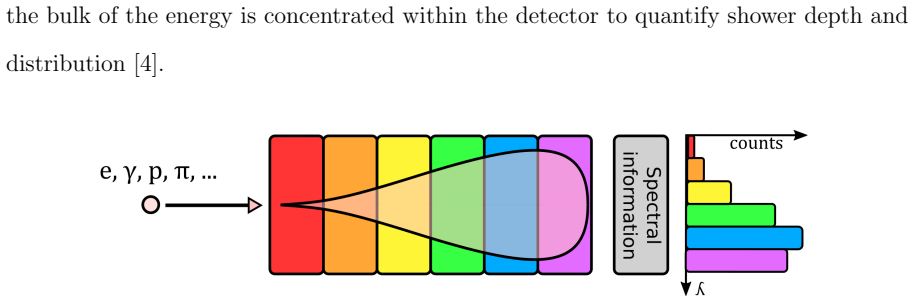
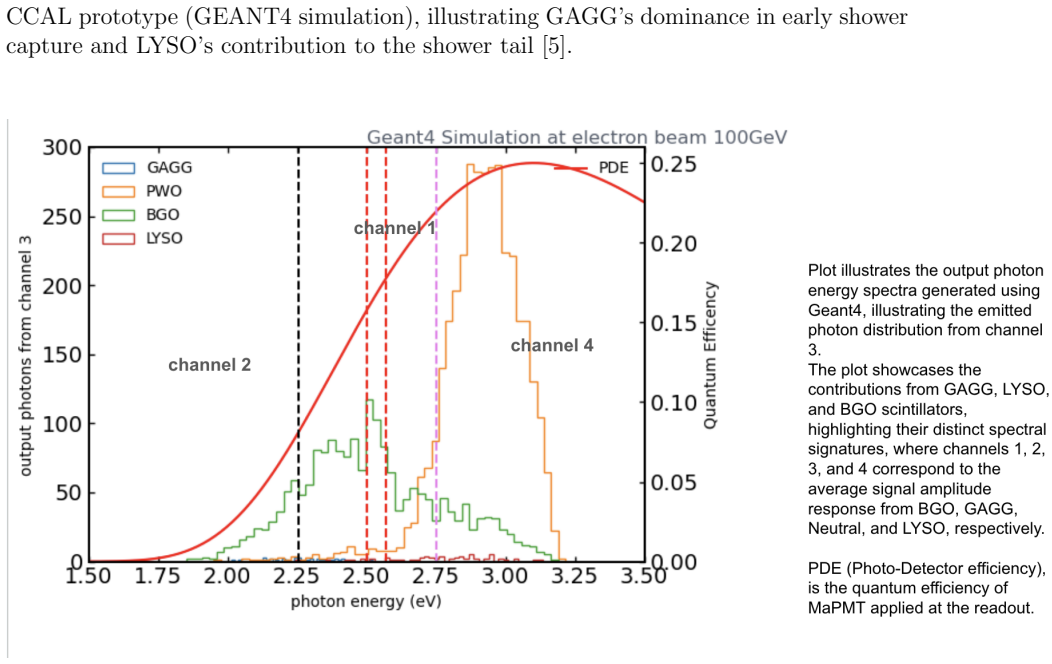
Chromatic calorimetry (CCAL): a stack of scintillators with distinct emission wavelengths, read by a multi-anode photomultiplier through wavelength-selective filters. Each color acts as a longitudinal-depth bin; the amplitude fraction f_i = A_i / sum_j A_j and the center of gravity <z_cog> = sum_i z_i E_i / sum_i E_i convert the color-resolved signals into shower-depth observables. The 2024 test-beam version replaces the low-yield PWO with PbF2 (a Cherenkov radiator) plus fast plastic scintillators, and the quantum-dot simulation uses PbWO4 absorbers interleaved with QD-doped PMMA wavelength-shifting layers.
What would settle it
Build the 2024 stack twice, identical except for PWO in place of PbF2, and compare resolutions at the same beam energies with the same analysis. If the PbF2 version does not show better or equal resolution, or if a full GEANT4 model with 0.38 photons/MeV cannot reproduce the 1.6% at 91.51 GeV, the central attribution fails. A simpler test: measure the photoelectron yield per GeV in the PbF2 channel and check whether it allows the quoted stochastic term.
Extended reading notes
Core claim
The central claim is that segmenting a calorimeter longitudinally by emission wavelength in place of mechanical layers gives the same or better shower information. Amplitude fractions and center-of-gravity of wavelength-resolved signals track shower depth; k-means clustering on two scintillator amplitudes separates electrons from pions with 95% purity; and changing the stack from a PWO-based to a PbF2-plus-plastic configuration improved energy resolution to 1.6% at 91.51 GeV. Simulations show quantum-dot layers with 20 nm emission bands could reduce the constant term to 0.35%, which the thesis reads as evidence that chromatic calorimetry can meet future-collider pile-up requirements.
Load-bearing premise
The load-bearing premise is that replacing PWO with PbF2 improves energy resolution through a larger Cherenkov contribution, even though PbF2's quoted light yield (0.38 photons/MeV) is about 400 times smaller than PWO's (150 photons/MeV), so the improvement must overcome the usual 1/sqrt(N_photons) scaling of stochastic resolution.
Editorial extensions
If this is right
- If CCAL works as claimed, calorimeters can recover longitudinal shower structure without fine physical segmentation, assigning each depth layer a distinct emission color and reading them through filters.
- The demonstrated 95% electron-pion separation at 100 GeV would let high-luminosity collider experiments suppress pion backgrounds using a single optical readout per color.
- The simulated 0.35% constant term suggests quantum-dot wavelength-shifting layers could approach the energy resolution of existing crystal calorimeters while adding depth information.
- The logarithmic center-of-gravity versus beam-energy relation gives a calibration handle for depth-dependent energy correction and possibly for shower-leakage estimation.
- The 2023-to-2024 improvement from 2.5% to 1.6% is presented as evidence that material choice and Cherenkov contribution can dominate over raw light yield in defining resolution.
Reading between the lines
- The appendix reports systematic energy uncertainties of 10% (2023) and 7% (2024), several times larger than the quoted 2.5% and 1.6% resolutions; the thesis does not reconcile these, so the headline resolution is best read as detector precision rather than total uncertainty.
- The 2023-to-2024 comparison changes materials, filters, and beam energies simultaneously, so the specific attribution to PbF2's Cherenkov signal is underdetermined; a single-variable substitution test would be required to confirm it.
- If quantum-dot layers with 20 nm emission bands realize the simulated performance, CCAL could provide roughly 20 depth bins through one optical readout--a natural extension of the test-beam evidence that the thesis only simulates.
- The wavelength-coding idea could plausibly extend to hadronic calorimetry and dual-readout compensation; the thesis's plastic-scintillator layers hint at this, but the experimental tests are electromagnetic.
Editorial analysis
A structured set of objections, weighed in public.
Referee Report
Summary. The thesis reports on chromatic calorimetry (CCAL), a detector concept that stacks scintillators with distinct emission wavelengths to measure longitudinal shower development. It presents two SPS test-beam experiments: a 2023 GAGG/PWO/BGO/LYSO prototype and a 2024 GAGG/PbF2/EJ262/EJ228 prototype, together with GEANT4 simulations of a quantum-dot-based CCAL. The paper claims 95% electron–pion PID purity in both years, an energy resolution of 2.5% at 100 GeV in 2023 improving to 1.6% at 91.51 GeV in 2024, and a simulated 0.35% constant term for a QD design. From these results it concludes that CCAL satisfies FCC requirements including pile-up of up to 1000 events per crossing.
Significance. If the headline numbers were reliable, CCAL would be a genuinely novel calorimeter concept: wavelength-coded longitudinal segmentation could simultaneously provide finer shower tomography, improved e/pi separation, and competitive energy resolution for FCC-era detectors. The paper has strengths: it is based on two real test-beam campaigns, reports measured amplitude spectra and scatter plots, and uses GEANT4 to model shower development. The 95% PID purity demonstrated in beam data is a useful proof of concept. However, the quantitative claims that would make the paper significant are undermined by internal inconsistencies and unsupported attributions, as detailed below.
major comments (5)
- [§4.2.5, §4.3.2, Table 5.1] The 2024 resolution improvement is attributed to replacing PWO with PbF2 and to 'the enhanced Cherenkov contribution from PbF2' (§4.3.1–4.3.2). Table 5.1 lists PbF2 as a Cherenkov radiator with 0.38 photons/MeV, about 400 times lower than PWO's 150 photons/MeV. Since the stochastic term of energy resolution scales roughly as 1/√N_pe, removing a 150-ph/MeV absorber and adding a 0.38-ph/MeV radiator cannot, by itself, improve the energy resolution. No error budget in §4.2.5 separates stochastic, noise, and constant terms; without this, the 1.6% result is unexplained and the stated mechanism is internally inconsistent.
- [§A.4.1 vs. abstract/§5.4] Appendix A.4.1 reports total systematic uncertainties in energy measurements of 10% (2023) and 7% (2024), dominated by ±5% MaPMT gain variation and ±2 nm filter misalignment. The abstract and §5.4 quote a '1.6% energy resolution at 91.51 GeV' without this systematic. A resolution quoted as a detector performance must include or explicitly separate systematics; as written, the 1.6% figure is likely a statistical-only fit width and is not comparable to the 2.5% 2023 value or to CMS ECAL, which also include systematics.
- [§4.2.6, Fig. 4.20(b), abstract] The simulated QD energy resolution is fit in Fig. 4.20(b) as σE/E = 7.7%/√E ⊕ 15.1%/E ⊕ 0.4%, i.e., a 0.4% constant term. The abstract, §1.6, and §5.4 repeatedly claim a '0.35% constant term.' These numbers are inconsistent. Moreover §4.3.4 concedes that the QD simulations 'lacked comprehensive nanophotonic models,' so the simulated constant term is not a validated performance number. This discrepancy affects a headline claim.
- [§4.2.5, §4.2.4] E_reco is defined as Σ c_i A_i(E_beam), with calibration coefficients c_i determined from the same beam energies, and ⟨z_cog⟩ is fitted with three free parameters C1,C2,C3. Reporting a resolution after calibrating on the beam-energy points is a closure test, not an independent validation. Without a train/test split or a demonstration that the resolution is stable under different calibration samples, the 1.6% value cannot be interpreted as a predictive detector resolution.
- [Abstract, §5.4] The abstract and §5.4 state that the results 'confirm CCAL's capability to address FCC requirements, including pile-up rates of up to 1000 events per crossing.' The experiments are single-particle test-beam runs at 10–100 GeV and the QD simulation is a simplified GEANT4 model; no pile-up, occupancy, rate, or timing measurements are presented. This is an overstatement that goes beyond the evidence in the manuscript.
minor comments (4)
- [§5.1.2 vs. §4.2.1] The text states the R7600U-200 has quantum efficiency 80% across 400–550 nm, while §4.2.1 and Fig. 4.7 use a PDE peaking at 0.25. Please reconcile these values.
- [§5.1.2] The 420 nm bandpass filter is said to align with PWO and LYSO, but the 2024 stack contains neither; this appears to be a copy-paste from the 2023 configuration.
- [Figures and typos] Several minor errors occur: 'wavelenght' in Fig. 4.17, 'ActivEX' in §5.2.3, and inconsistent capitalization in Fig. A.2 captions.
- [References/A.5] The reference list and the publication list in §A.5 give different arXiv identifiers for works that appear to be the same; please make these consistent.
Circularity Check
One circular fit-validation in the shower-depth model; the central 1.6% resolution is an independent measurement, though the thesis leans on self-citations for the QD simulation claims.
-
fitted input called prediction
[Section 4.2.4 (Shower Depth), Equation ⟨z_cog⟩=C1 ln(E+C2)+C3 and Figure 4.15]
"The parameters C1, C2, and C3 are empirically determined constants that depend on the detector material, geometry, and the type of particle initiating the shower... The figure, reproduced from [4], demonstrates the logarithmic increase in shower depth with energy, validating the model."
The logarithmic model ⟨z_cog⟩=C1 ln(E+C2)+C3 is fit to the 2024 beam-energy data with C1, C2, C3 explicitly stated to be 'empirically determined.' The same dataset is then displayed in Figure 4.15 and said to 'validate the model.' A function fitted to a dataset cannot be validated against that same dataset; the agreement is enforced by construction. This is a real but minor circularity, confined to the shower-depth demonstration, not to the paper's headline energy-resolution measurement.
full rationale
The thesis's central experimental claims—2.5% resolution at 100 GeV (2023) and 1.6% at 91.51 GeV (2024)—are reported as measured widths of reconstructed-energy distributions, not as predictions derived from fitted inputs. The reconstruction formula E_reco = Σ c_i A_i(E_beam) uses beam-energy calibration as calorimeters normally do; calibrating amplitudes to a known energy does not by itself force the width of the distribution. The 1.6% value is thus an independent experimental result, albeit one with a serious caveat: Appendix A.4.1 states total systematic uncertainties of 7% for the 2024 energy measurement, which is not reconciled with the quoted 1.6% resolution. That caveat is a correctness/consistency problem, not circularity. The QD simulation's 0.35% constant term is a fit to the simulation's own output, and the thesis acknowledges in Sections 4.2.7 and 4.3.4 that the QD models are simplified and pending experimental validation; the reliance on the same group's prior papers [4], [5], [23] for these simulation results is self-citation, but not a load-bearing circular chain. The one genuine circular step is the shower-depth model being 'validated' by the same data used to determine its empirical constants. Overall, the central energy-resolution claim retains independent experimental content, so the circularity score is moderate rather than high.
Assumptions & free parameters
free parameters (4)
- Channel calibration coefficients c_i (2023 and 2024) =
not tabulated
- Center-of-gravity parameters C1, C2, C3 =
not tabulated
- QD energy resolution fit parameters (stochastic, noise, constant) =
S=7.7%, N=15.1%, C=0.4% (figure) / 0.35% (text)
- Fraction-based correction factors K_i(E_beam) =
not tabulated
assumptions (6)
- domain assumption N_detected,i = Y_i * E_i * eta_i * T_i (detected photons proportional to light yield, deposited energy, quantum efficiency, filter transmission)
- domain assumption Arranging scintillators in decreasing emission wavelength minimizes photon reabsorption
- ad hoc to paper GEANT4 simulation with FTFP-BERT and simplified QD optical models accurately represents the detector response
- domain assumption K-means with k=2 and 10 iterations yields correct electron/pion clusters
- standard math Bethe-Bloch formula applies to 150 GeV muons for MIP calibration
- standard math Radiation length formula X0 ≈ 716.4 A/(Z(Z+1) ln(287/√Z)) g/cm²
Cite this review
Pith. "Pith review of Chromatic Calorimetry -- A Novel Approach to Validate Energy Resolution and Particle Discrimination." pith.science (2026). https://pith.science/paper/XRWHQ74M
@misc{pith2026250909511,
  author       = {Pith},
  title        = {Pith review of: Chromatic Calorimetry -- A Novel Approach to Validate Energy Resolution and Particle Discrimination},
  year         = {2026},
  howpublished = {\url{https://pith.science/paper/XRWHQ74M}},
  note         = {Machine review of arXiv:2509.09511}
}
abstract
Chromatic calorimetry (CCAL) analyses particle detection by utilizing scintillators with distinct emission wavelengths to measure the longitudinal energy deposition of particle showers in high-energy physics, improving particle identification (PID) and energy resolution. By stacking scintillators in order of decreasing emission wavelength, CCAL enables layer-specific energy measurements, analyzed via amplitude fractions ($f_i = A_i / \sum_j A_j$) and center of gravity ($\langle z_{\text{cog}} \rangle = \sum_i z_i E_i / \sum_i E_i$). This thesis presents results from two CERN Super Proton Synchrotron (SPS) experiments conducted in 2023 and 2024, complemented by GEANT4 simulations of a quantum dot (QD)-based CCAL design, to validate its potential for future colliders such as the Future Circular Collider (FCC).
Figures


Figures from the paper (23 more)




Reference graph
Works this paper leans on
-
[4]
Arora, D., et al.,Advances in Calorimetry Techniques for High-Energy Physics,EPJ Web of Conferences, Proceedings of the CALOR 2024 Conference, Vol. 305, pp. 01001–01010, DOI: 10.1051/epjconf/202530501001
arXiv 2024
-
[5]
Arora, D., Salomoni, M., Haddad, Y., Zabloudil, V., Doser, M., Owari, M., and Auf- fray, E.,Progress in Chromatic Calorimetry Concept: Improved Techniques for En- ergy Resolution and Particle Discrimination,Journal of Instrumentation (JINST), Accepted by IOP Publishing, 16 May 2025
2025
-
[23]
Haddad, Y., et al.,Quantum Dot Based Chromatic Calorimetry: A Proposal for Next-Generation Detectors, arXiv:2501.09876, 2025, pp. 1–25. 85
arXiv 2025
-
[1]
Wigmans, R.,Calorimetry: Energy Measurement in Particle Physics, 1st ed., In- ternational Series of Monographs on Physics, Oxford University Press, Oxford, UK, 2000, ISBN: 978-0-19-850296-8, pp. 1–726
2000
-
[2]
KGaA, Weinheim, Germany, 2008, ISBN: 978-3-527-40601-2, pp
Griffiths, D.,Introduction to Elementary Particles, 2nd ed., Wiley-VCH Verlag GmbH & Co. KGaA, Weinheim, Germany, 2008, ISBN: 978-3-527-40601-2, pp. 1–470, DOI: 10.1002/9783527610105
-
[3]
cern/science/accelerators/large-hadron-collider, Accessed: June 8, 2025
CERN,Large Hadron Collider and Detector Overview, European Organization for Nuclear Research (CERN), Geneva, Switzerland, 2024, Available at:https://home. cern/science/accelerators/large-hadron-collider, Accessed: June 8, 2025
2024
-
[6]
Doser, M., et al.,Quantum Detectors for High-Energy Physics: Principles and Ap- plications,Quantum Science and Technology, Vol. 7, No. 2, 2022, Article 025011, IOP Publishing, Bristol, UK, pp. 1–15, DOI: 10.1088/2058-9565/ac4b12
-
[7]
Abada, A., et al.,Future Circular Collider Study: Physics Opportunities,The Eu- 83 ropean Physical Journal C, Vol. 79, No. 6, 2019, Article 474, Springer, Heidelberg, Germany, pp. 1–57, DOI: 10.1140/epjc/s10052-019-6904-3
Show all 40 references
-
[8]
E., et al.,Nanoparticle-Based Scintillators for Radiation Detection,Nano Letters, Vol
Letant, S. E., et al.,Nanoparticle-Based Scintillators for Radiation Detection,Nano Letters, Vol. 6, No. 9, American Chemical Society, Washington, DC, USA, 2006, pp. 2168–2172, DOI: 10.1021/nl0614682
2006 doi
-
[9]
12, 2021, Article 5507, Nature Publishing Group, London, UK, pp
Zhang, Z., et al.,High-Efficiency Perovskite Scintillators for Particle Detection,Na- ture Communications, Vol. 12, 2021, Article 5507, Nature Publishing Group, London, UK, pp. 1–10, DOI: 10.1038/s41467-021-25800-7
2021 doi
-
[10]
Liu, Y., et al.,Advanced Scintillator Materials for High-Energy Physics Applications, Advanced Materials, Vol. 32, No. 20, 2020, Article 2001814, Wiley-VCH, Weinheim, Germany, pp. 1–12, DOI: 10.1002/adma.202001814
2020 doi
-
[11]
Mao, Y., et al.,Optical Properties of Scintillator Materials for Calorimetry,Journal of Luminescence, Vol. 129, No. 12, Elsevier, Amsterdam, Netherlands, 2009, pp. 1566–1570, DOI: 10.1016/j.jlumin.2009.07.005
2009 doi
-
[12]
Thorlabs, Inc.,Optical Filters Catalog: Technical Specifications and Applications, Thorlabs, Newton, NJ, USA, 2024, Available at:https://www.thorlabs.com/ navigation.cfm?guide_id=2001, Accessed: June 8, 2025
2024
-
[13]
958, Elsevier, Amster- dam, Netherlands, 2020, Article 162829, pp
Bonanomi, M., et al.,Next-Generation Calorimeter Prototypes for Collider Experi- ments,Nuclear Instruments and Methods in Physics Research Section A: Accelera- tors, Spectrometers, Detectors and Associated Equipment, Vol. 958, Elsevier, Amster- dam, Netherlands, 2020, Article ...
2020
-
[14]
1002, Elsevier, Amsterdam, Netherlands, 2021, Article 165285, pp
Akchurin, N., et al.,Performance of Dual-Layer Calorimeters in High-Energy Physics,Nuclear Instruments and Methods in Physics Research Section A: Accelerators, Spectrometers, Detectors and Associated Equipment, Vol. 1002, Elsevier, Amsterdam, Netherlands, 2021, Article 165285,...
2021
-
[15]
Scionix Holland B.V.,Scintillator Materials and Detectors: Technical Data Sheets, Scionix, Bunnik, Netherlands, 2024, Available at:https://www.scionix.nl/ products/scintillators, Accessed: June 8, 2025
2024
-
[16]
Hamamatsu Photonics K.K.,R7600U-200 Multi-Anode PMT: Technical Datasheet, Hamamatsu Photonics, Hamamatsu City, Japan, 2024, Available at:https: //www.hamamatsu.com/jp/en/product/photomultiplier-tubes.html, Accessed: June 8, 2025
2024
-
[17]
Achenbach, P., et al.,Scintillator-Based Calorimetry for Low-Energy Particles,Nu- clear Instruments and Methods in Physics Research Section A: Accelerators, Spec- trometers, Detectors and Associated Equipment, Vol. 416, No. 2–3, Elsevier, Ams- terdam, Netherlands, 1998, pp. 35...
1998 doi
-
[18]
17, 2022, Article P05023, IOP Publishing, Bristol, UK, pp
An, S., et al.,Novel Readout Techniques for High-Resolution Calorimeters,Journal of Instrumentation (JINST), Vol. 17, 2022, Article P05023, IOP Publishing, Bristol, UK, pp. 1–12, DOI: 10.1088/1748-0221/17/05/P05023
2022 doi
-
[19]
F.,Radiation Detection and Measurement, Wiley, Hoboken, NJ, 2010
Knoll, G. F.,Radiation Detection and Measurement, Wiley, Hoboken, NJ, 2010
2010
-
[20]
Allison, J., et al.,Geant4: A Simulation Toolkit for Particle Physics,IEEE Trans- actions on Nuclear Science, Vol. 53, No. 1, IEEE, Piscataway, NJ, USA, 2006, pp. 270–278, DOI: 10.1109/TNS.2006.869826
2006
-
[21]
E.,Charmonium Spectroscopy and Decay Modes, Ph.D
Gaiser, J. E.,Charmonium Spectroscopy and Decay Modes, Ph.D. Thesis, Stanford University, Stanford, CA, USA, 1982, UMI Number: 8301234, pp. 1–150
1982
-
[22]
1–344, Available at:https: //cds.cern.ch/record/2272264
CMS Collaboration,Technical Proposal for the Phase-2 Upgrade of the CMS De- tector, CERN-LHCC-2017-009, CMS-TDR-017, European Organization for Nuclear Research (CERN), Geneva, Switzerland, 2017, pp. 1–344, Available at:https: //cds.cern.ch/record/2272264
2017
-
[24]
Gupta, S., et al.,Nanostructured Scintillators for Enhanced Energy Resolution,Jour- nal of Applied Physics, Vol. 108, No. 6, AIP Publishing, Melville, NY, USA, 2010, Article 064317, pp. 1–8, DOI: 10.1063/1.3482023
2010 doi
-
[25]
3, 2008, Article S08003, IOP Publishing, Bristol, UK, pp
ATLAS Collaboration,The ATLAS Experiment at the CERN Large Hadron Collider, Journal of Instrumentation (JINST), Vol. 3, 2008, Article S08003, IOP Publishing, Bristol, UK, pp. 1–437, DOI: 10.1088/1748-0221/3/08/S08003
2008 doi
-
[26]
Kim, H., et al.,Hybrid Quantum Dot-Perovskite Scintillators for High- Efficiency Particle Detection,Advanced Functional Materials, Vol. 33, No. 15, Wiley-VCH, Weinheim, Germany, 2023, Article 2213456, pp. 1–10, DOI: 10.1002/adfm.202213456
2023 doi
-
[27]
Fermi National Accelerator Laboratory,Advances in Calorimeter Technologies for Future Colliders, Fermilab-Pub-24-032, Batavia, IL, USA, 2024, Available at: https://arxiv.org/abs/2407.15678, Accessed: June 8, 2025
2024 arXiv
-
[28]
1035, Elsevier, Amsterdam, Netherlands, 2022, Article 166789, pp
Wang, L., et al.,Temporal Resolution in High-Luminosity Calorimeters Us- ing Quantum Dots,Nuclear Instruments and Methods in Physics Research Sec- tion A: Accelerators, Spectrometers, Detectors and Associated Equipment, Vol. 1035, Elsevier, Amsterdam, Netherlands, 2022, Articl...
2022
-
[29]
Benedetti, L., et al.,Shower Tomography in Calorimeters: Concepts and Appli- cations,The European Physical Journal C, Vol. 83, No. 8, Springer, Heidelberg, Germany, 2023, Article 712, pp. 1–15, DOI: 10.1140/epjc/s10052-023-11876-5
2023 doi
-
[30]
Singh, R., et al.,Optimization of Quantum Dot Scintillators for FCC Detec- tors,Proceedings of the 2025 International Conference on Particle Detectors, arXiv:2503.04567, 2025, pp. 1–12
2025 arXiv
-
[31]
Lee, J., et al.,Radiation Hardness of Perovskite Quantum Dots for High-Energy Physics,Applied Physics Letters, Vol. 119, No. 10, AIP Publishing, Melville, NY, USA, 2021, Article 103507, pp. 1–6, DOI: 10.1063/5.0062341. 86
2021 doi
-
[32]
Particle Data Group, et al.,Review of Particle Physics,Physical Review D, Vol. 110, No. 3, American Physical Society, College Park, MD, USA, 2024, Article 030001, pp. 1–1592, DOI: 10.1103/PhysRevD.110.030001
2024 doi
-
[33]
169, Part B, Elsevier, Amsterdam, Netherlands, 2015, pp
Nikl, M., et al.,Development of Novel Scintillator Crystals,Journal of Lumines- cence, Vol. 169, Part B, Elsevier, Amsterdam, Netherlands, 2015, pp. 539–546, DOI: 10.1016/j.jlumin.2014.09.035
2015 doi
-
[34]
2024, Eljen Technology, Sweetwater, TX, USA, 2024, pp
Eljen Technology, et al.,Advances in Plastic Scintillator Materials for Neutron and Gamma Detection,Eljen Technology Technical Report, Vol. 2024, Eljen Technology, Sweetwater, TX, USA, 2024, pp. 1–10, URL: https://eljentechnology.com/products/plastic-scintillators
2024
-
[35]
Enhancing 87 Energy Resolution and Particle Identification via Chromatic Calorimetry: A Concept Validation Study
Chen, G., et al.,Machine Learning-Based Calibration Techniques for Quantum Dot Detectors in High-Energy Physics,Journal of Instrumentation, Vol. 19, No. 7, IOP Publishing, Bristol, UK, 2024, Article P07012, pp. 1–15, DOI: 10.1088/1748- 0221/19/07/P07012. A.5 List of Publicatio...
2024 doi
-
[36]
Progress in Chromatic Calorimetry Con- cept: Improved Techniques for Energy Resolution and Particle Discrimination,
Yacine Haddad,Devanshi Arora, Etiennette Auffray, Michael Doser, Matteo Sa- lomoni and Michele Weber. ”Quantum Dot Based Chromatic Calorimetry: A proposal.” arXiv:2501.12738 [physics.ins-det], under review in Journal of Instrument (2025). C. Other articles- Non D. Presentation...
2025 arXiv
-
[38]
Salomoni,D
M. Salomoni,D. Arora, Y. Haddad, I. Frank, M. Doser, M. Owari, and E. Auffray. ”Enhancing Particle Identification and Energy Resolution through Chromatic Calorime- try: a Proof-of-Concept Study.” 2024 IEEE Nuclear Science Symposium (NSS), Medical Imaging Conference (MIC) and R...
2024
-
[39]
Chromatic calorimetry (quantum dots)
Yacine Haddad,Devanshi Arora,Etiennette Auffray, Michael Doser, Matteo Sa- lomoni, and Michele Weber, “Chromatic calorimetry (quantum dots)”, International Conference on Quantum Technologies for High-Energy Physics 20- 24, January 2025, Zurich, Switzerland
2025
-
[40]
Investigation of Nanocompos- ite Scintillators and New Detector Concepts for High Energy Physics
I. Frank, R. Cala, N. Kratochwil, L. Martinazzoli, F. Pagano,D. Arora, M. Pizzi- chemi, M. Salomoni, M. Doser, E. Auffray Hillemanns, “Investigation of Nanocompos- ite Scintillators and New Detector Concepts for High Energy Physics”, 2023 IEEE Nu- clear Science Symposium, Medi...
2023
-
[2025]
Related conference talks presented at CALOR 2024, Tsukuba International Congress Center, Tsukuba City, Japan, May 20–24, (2024)
2024
Reviewed August 4, 2026 · model on record in the stance chip above.
Discussion (0). Continue with ORCID to comment.