REVIEW 4 major objections 6 minor 6 cited by
Probing of EoS with clusters and hypernuclei
T0 review · 4 major / 6 minor · reviewed 2026-08-06 · deepseek-v4-flash
Pith's one-line read A soft momentum-dependent nuclear equation of state reproduces most baryon, cluster, and hypernucleus observables in 3 GeV Au+Au collisions, while a hard static equation of state shows a similar trend.
desk verdict A thorough and honest PHQMD benchmark against STAR 3 GeV data; SM EoS broadly works, hard EoS stays in the picture, and the cluster/hypernucleus probes are the least secure part. read the letter →
The pith
A machine-rendered reading of the paper's core claim, the machinery that carries it, and where it could break.
The reading
What carries the argument
The central object is the PHQMD transport model with its three parametrized equations of state. The EoS is encoded in a two-body potential with a Skyrme-type static density-dependent part and a momentum-dependent part fitted to the measured Schr\"odinger-equivalent optical potential from proton-nucleus scattering; the parameters are fixed by requiring the binding energy per nucleon to be $-16$ MeV at $\rho_0$ and by choosing the compressibility modulus $K=200$ or $380$ MeV. Clusters and hypernuclei are identified with a combination of a kinetic production channel and a minimum-spanning-tree snapshot in which nucleons within $r_{\rm clus}=4$ fm in their pair rest frame are treated as bound. This machinery lets the authors vary stiffness and momentum dependence separately and test which EoS reproduces both the single-particle and the composite-particle observables.
What would settle it
A decisive check would be a high-statistics measurement of the proton elliptic flow at $\sqrt{s_{NN}}=3$ GeV: PHQMD with the soft momentum-dependent EoS predicts that $v_2(p_T)$ keeps decreasing above $p_T\approx 1.4$ GeV/c, whereas the current data hint that it bends upward; if the upward bend is confirmed, the claimed quantitative flow agreement for the favored EoS would be refuted.
Extended reading notes
Core claim
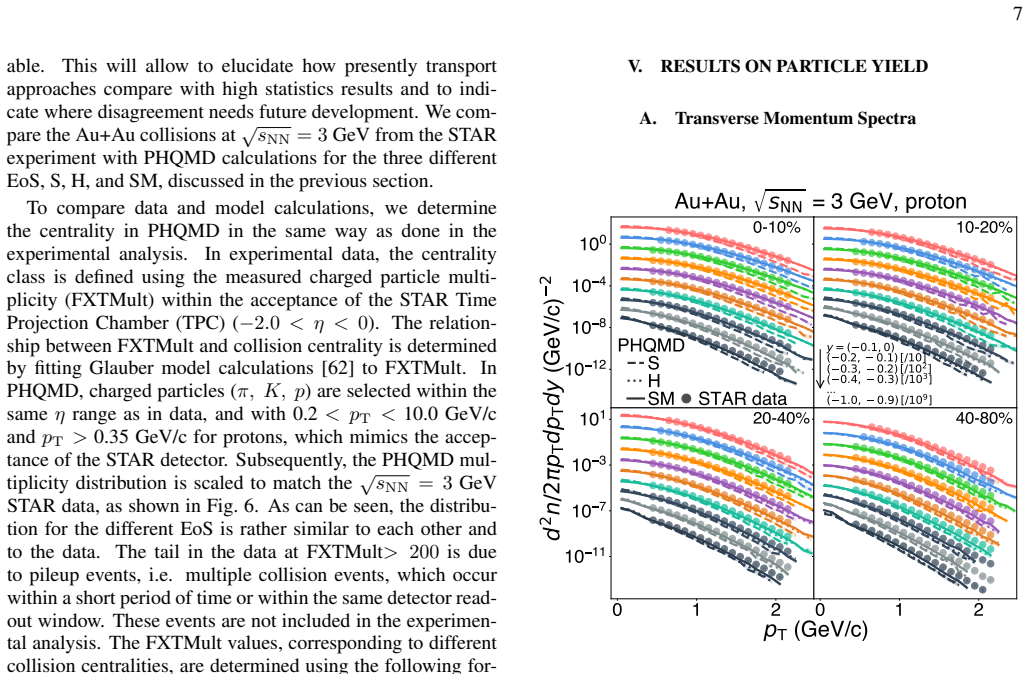
Using PHQMD with three EoS variants, a static soft EoS ($K=200$ MeV), a static hard EoS ($K=380$ MeV), and a soft momentum-dependent EoS ($K=200$ MeV), the paper finds that the soft momentum-dependent EoS gives the best overall description of the $\sqrt{s_{NN}}=3$ GeV Au+Au data: $p_T$ spectra of protons, $\Lambda$s, clusters, and hyperclusters are matched over roughly five orders of magnitude, mid-rapidity cluster yields are reproduced to about 30% for deuterons and to about a factor of two for $^4$He, and the rapidity distributions of the hypernuclei $^3_\Lambda$H and $^4_\Lambda$H are nicely reproduced. The directed and elliptic flow data favor the soft momentum-dependent and hard static EoS over the static soft one, with the hard static EoS producing a similar trend rather than a distinct signature. The paper also observes that the mass-number scaling of $v_2/A$ seen at 2.4 GeV breaks at 3 GeV, indicating that clusters are no longer random combinations of nucleons, and that hypernucleus-to-nucleus yield ratios are non-monotonic in mass number, with feed-down from the excited $^4_\Lambda$H$^*$ state a likely contributor. The authors therefore present clusters and hypernuclei, particularly hypernuclei, as new EoS-sensitive observables, while cautioning that a complete understanding of feed-down is needed before hypernuclei can be established as EoS probes.
Load-bearing premise
The EoS conclusions drawn from clusters and hypernuclei rest on the assumption that PHQMD's cluster-formation procedure, binding nucleons within 4 fm via a minimum-spanning-tree snapshot plus a kinetic channel, with no feed-down from the excited $^4_\Lambda$H$^*$ state, correctly captures how clusters actually form at 3 GeV, an assumption the paper itself flags as incomplete at backward rapidity.
Editorial extensions
If this is right
- A static soft EoS is disfavored at 3 GeV because it gives the wrong sign of the elliptic flow for clusters and underestimates the directed flow and mean transverse momentum, while soft momentum-dependent and hard static EoS both describe the data.
- Because the hard static EoS shows a similar trend to the soft momentum-dependent one, the flow and yield data at this energy cannot by themselves pin down both the stiffness and the momentum dependence of the EoS.
- Hypernucleus yields are about a factor of two more sensitive to the EoS than ordinary hadron yields, making $^3_\Lambda$H and $^4_\Lambda$H promising future probes once the role of feed-down from excited states is quantified.
- The breakdown of $v_2/A$ scaling at 3 GeV indicates that clusters are not formed by random coalescence of nucleons at this energy; PHQMD captures this behavior only approximately.
- The freeze-out temperature and collective velocity extracted at 3 GeV do not continue the trend seen between 7.7 and 200 GeV, suggesting a change in the expansion dynamics or medium properties in this energy range.
Reading between the lines
- A testable extension of the paper's approach would be to measure the $\gamma$ decay of the excited $^4_\Lambda$H$^*$ state; if its feed-down is substantial, the hypernucleus yield comparisons made without it would need revision.
- If the soft momentum-dependent EoS is the right description of high-density matter, translating its parameter set into a cold neutron-matter EoS and checking neutron-star mass-radius constraints would connect these results to astrophysics.
- The near-degeneracy between the hard static and soft momentum-dependent EoS suggests that stiffness and momentum dependence can only be separated with observables that probe high momenta explicitly, such as high-$p_T$ flow at higher beam energies.
- The backward-rapidity cluster flow discrepancy points to a concrete model improvement: replacing snapshot-based minimum-spanning-tree clustering with a dynamical cluster formation and decay scheme would test whether the missing positive $v_2$ of clusters originates in cluster-formation mechanics.
Editorial analysis
A structured set of objections, weighed in public.
Referee Report
Summary. The paper compares PHQMD transport-model calculations for Au+Au collisions at sqrt(s_NN)=3 GeV with a comprehensive set of STAR data: transverse-momentum spectra, rapidity distributions, yields, coalescence parameters, mean transverse momentum, and directed/elliptic flow for protons, Lambdas, light clusters up to A=4, and hypernuclei. Three equations of state are explored: a static soft EoS, a static hard EoS, and a soft momentum-dependent EoS (SM), with the momentum-dependent potential built from an extrapolation of the optical potential extracted from proton-nucleus scattering. The central claim is that the SM EoS reproduces most baryon and cluster observables, including flow, quantitatively, while the hard static EoS shows a similar trend. The paper also studies the sensitivity of observables to the extrapolation of the optical potential and extracts kinetic freeze-out parameters via blast-wave fits.
Significance. If the central claim holds, the paper provides a valuable benchmark showing that a soft momentum-dependent EoS is consistent with the large body of 3 GeV STAR data within the PHQMD framework, while also demonstrating that static hard EoS predictions are not strongly excluded because they trend similarly. The paper is strong in its breadth: it uses a large experimental dataset, makes its potential parameters explicit in Table I, openly quantifies several discrepancies (cluster yields low by factors of 2-3, cluster v2 deviations at backward rapidity, Lambda v1 overestimation), and makes falsifiable predictions about cluster production mechanisms and the breaking of v2/A scaling. These strengths are genuine and useful for the heavy-ion community. However, the paper's novel discriminative power comes from cluster and hypernucleus observables whose production mechanism is acknowledged to be incomplete, and the headline "quantitatively" is not backed by a quantitative goodness-of-fit metric.
major comments (4)
- [Sec. V.B and Sec. VI.C] The cluster and hypernucleus observables, which are the claimed EoS discriminators, are produced by the MST+kinetic cluster recognition scheme with r_clus=4 fm and no feed-down from the excited 4LambdaH*(1+) state. The paper itself states in Sec. V.B that a more complete understanding of feed-down "may be needed to establish hypernuclei as probes for the equation-of-state in the future," and in Sec. VI.C that the cluster v2 discrepancy at backward rapidity "points towards a cluster production process, which is not yet correctly modeled in PHQMD." Since the hard EoS already reproduces the same trend as SM for most baryon observables, the added discriminative power is carried by exactly the observables whose production mechanism is acknowledged to be incomplete. Please validate the cluster scheme independently (e.g., against HADES 2.4 GeV data) or provide a sensitivity study to r_clus, the kinetic channel strength, and the 4LambdaH* feed-down, or explicitly weaken the central claim to depend on the validity of the cluster scheme.
- [Abstract and Sec. VII] The abstract claims that the SM EoS reproduces most baryon and cluster observables "quantitatively," and the summary states "qualitative and in many kinematical regions quantitative agreement," but no chi-squared, p-value, or other quantitative goodness-of-fit metric is given for any observable. In particular, the flow comparisons in Figs. 18, 21, and 22 show visible deviations (e.g., SM v1 underpredicting data, cluster v2 being more negative than data) that are described in words but never quantified. Without a metric, the central claim is not falsifiable from the reported comparisons. Please add a quantitative measure of agreement (e.g., chi2 per point or a band-based discrepancy measure), or revise the phrasing so that "quantitative" is not used in the abstract.
- [Sec. VI.B and Fig. 20] The directed flow of Lambda is used as an EoS-sensitive observable, but PHQMD assumes the Lambda potential is identical to the nucleon potential, while the text notes that the choice of the Lambda potential influences the flow and cites Ref. [72] on this issue. Figure 20 shows that SM overestimates v1 of Lambda, and the paper speculates about the LambdaN cross section and the stiffness of the SM EoS. Because this assumption is untested and the observable is part of the EoS comparison, the Lambda-potential ambiguity is load-bearing for the claim that SM describes the data. Please add a sensitivity test with a different Lambda potential or quantify the resulting uncertainty on the EoS conclusions.
- [Sec. IV and Fig. 6] The PHQMD FXT multiplicity distribution is scaled to match the STAR data before centrality selection, but the normalization factor is not stated and no uncertainty from this scaling is propagated into the centrality-dependent yields and flow. Since all subsequent centrality-selected comparisons depend on this procedure, a fixed ad hoc scaling could bias the quantitative comparisons. Please state the normalization factor explicitly and test the sensitivity of the final observables to variations of the scaling (or justify that the scaling is merely a minor overall normalization).
minor comments (6)
- [Abstract and Introduction] There are typos and grammar issues: "is a one of the primary goals" should be "is one of the primary goals," and "hard EOS show a similar trend" should be "hard EoS show similar trends."
- [Sec. III] The text says "in Fig. 4 for the in-plane flow v1(pT) and in Fig. 4 for the elliptic flow v2(pT)"; the second reference should be to Fig. 5, which contains the v2 panels.
- [Figs. 3-5] The captions use "5.4 GeV" in the panels and text but sometimes refer to "5 GeV" in the narrative; please unify the beam-energy notation throughout.
- [Sec. VI.A and Fig. 16] The "additional 5% uncertainty (fudge factor)" added to statistical errors to achieve a reasonable chi2/ndf is not derived from any physical or systematic uncertainty. It should be justified, or the fit uncertainties should be reported without this adjustment.
- [Sec. II.D] In the description of the potential mechanism, the notation "ta" in "At a given time ta" is undefined, and the binding condition "EB > 0" is not explained; please clarify the notation and the definition of EB.
- [Appendix Figs. 25 and 26] The y-axis labels such as "d2n/2 pTdpTdy" appear garbled and should be typeset consistently as the invariant yield expression used in the main text.
Circularity Check
No significant circularity: EoS inputs are fixed by external pA scattering data and nuclear matter saturation properties, while the STAR 3 GeV data serve as independent benchmarks.
full rationale
The derivation chain is self-contained. The momentum-dependent part of the potential is fitted to external pA elastic scattering data (Sec. II.B, Eqs. 14-19, Fig. 1), and the static potential parameters are fixed by the nuclear matter saturation constraint E/A = -16 MeV at rho_0 plus a chosen compressibility K (Sec. II.C, Eqs. 22-25, Table I); none of these parameters are fitted to the STAR 3 GeV observables. The PHQMD multiplicity distribution is only scaled to the STAR FXTMult distribution to define centrality bins (Sec. IV, Fig. 6), a calibration that does not determine the spectra, yields, or flow coefficients subsequently compared. The cluster recognition algorithms (MST with r_clus = 4 fm plus a kinetic channel) are taken from prior PHQMD papers and are model assumptions, not outputs of this comparison; the STAR data are external and the comparison is a genuine test. The paper explicitly flags its own limitations: the missing 4Lambda-H* feed-down in Sec. V.B and the cluster v2 discrepancy at backward rapidity in Sec. VI.C, which are correctness risks for the cluster-based EoS conclusions but do not make the predictions reduce to inputs. Self-citations to PHQMD development papers are normal model references and are not used as uniqueness theorems or fitted constraints. The finding that hard EoS shows a similar trend to the soft momentum-dependent EoS further indicates that the conclusion is not forced by a fit.
Assumptions & free parameters
free parameters (8)
- Skyrme parameters for soft EoS (S) =
alpha=-0.3835 GeV, beta=0.3295 GeV, gamma=1.15
- Skyrme parameters for hard EoS (H) =
alpha=-0.1253 GeV, beta=0.071 GeV, gamma=2.0
- Skyrme parameters for soft momentum-dependent EoS (SM) =
alpha=-0.478 GeV, beta=0.4137 GeV, gamma=1.1
- Momentum-dependent potential parameters (Parameterization I) =
a=236.326 GeV^-1, b=-20.730 GeV^-3, c=0.901 GeV^-1
- Gaussian width L =
2.16 fm^2
- Cluster recognition radius r_clus =
4 fm
- Additional 5% uncertainty (fudge factor) =
0.05 relative
- Blast-wave fit parameters Tkin and betaS =
varies per particle and centrality (Table II)
assumptions (7)
- domain assumption The N-body wavefunction factorizes into a product of single-particle Gaussians with fixed width; antisymmetrization is neglected.
- domain assumption Scalar and vector mean-field potentials vary linearly with baryon density, so the two-body momentum-dependent potential is proportional to delta(r1-r2).
- ad hoc to paper The optical potential U_opt can be extrapolated beyond p about 1.7 GeV/c, and Parameterization I is the adopted extrapolation.
- ad hoc to paper The PHQMD FXT multiplicity distribution is scaled to match the STAR data before centrality selection.
- domain assumption MST clustering with r_clus=4 fm plus a binding condition, combined with the kinetic channel, correctly identifies clusters and hypernuclei.
- ad hoc to paper The Lambda potential is identical to the nucleon potential in PHQMD.
- domain assumption Feed-down from the excited 4Lambda-H* state is neglected in PHQMD.
Cite this review
Pith. "Pith review of Probing of EoS with clusters and hypernuclei." pith.science (2026). https://pith.science/paper/XXOG6ZPR
@misc{pith2026250714255,
  author       = {Pith},
  title        = {Pith review of: Probing of EoS with clusters and hypernuclei},
  year         = {2026},
  howpublished = {\url{https://pith.science/paper/XXOG6ZPR}},
  note         = {Machine review of arXiv:2507.14255}
}
abstract
The study of the nuclear equation-of-state (EoS) is a one of the primary goals of experimental and theoretical heavy-ion physics. The comparison of recent high statistics data from the STAR Collaboration with transport models provides a unique possibility to address this topic in a yet unexplored energy domain. Employing the microscopic N-body Parton-Hadron-Quantum-Molecular Dynamics (PHQMD) transport approach, which allows to describe the propagation and interactions of hadronic and partonic degrees of freedom including cluster and hyper-nucleus formation and dynamics, we investigate the influence of different EoS on bulk observables, the multiplicity, $p_T$ and rapidity distributions of protons, $\Lambda$s and clusters up to A=4 as well as their influence on the collective flow. We explore three different EoS: two static EoS, dubbed 'soft' and 'hard', which differ in the compressibility modulus, as well as a soft momentum dependent EoS. We find that a soft momentum dependent EoS reproduces most baryon and cluster observables, including the flow observables, quantitatively, however, hard EOS show a similar trend.
Figures


Figures from the paper (20 more)



Forward citations
Cited by 6 Pith papers
-
Effects of light-cluster degrees of freedom on collective flows in heavy-ion collisions at FOPI energies
Explicitly propagating light clusters in a Boltzmann-Uehling-Uhlenbeck transport model substantially modifies predicted proton v1-v4 flows at low FOPI energies (120-400 A MeV) but not above 600 A MeV.
-
Probing (Hyper)Nuclei Wave Functions and Production Mechanisms in $\sqrt{s_{\rm{NN}}}=200$ GeV Isobar Collisions at RHIC
Isobar collision yields of ³_ΛH and light nuclei favor coalescence with non-Gaussian hypertriton wave functions that carry enhanced short-distance d–Λ probability, inconsistent with a Gaussian ansatz tied to the measu...
-
Light and heavy $\Lambda$ hyperclusters in nuclear matter with relativistic-mean-field models
In relativistic-mean-field calculations, Lambda hyperclusters in nuclear matter lose binding as density rises and melt at a Mott density, with light clusters destabilized and heavier ones stabilized by the hyperon.
-
Nuclear equation-of-state at high density and multi-messenger astronomy: contribution of heavy-ion collisions
Review of heavy-ion collision constraints on the nuclear EoS that produce neutron-star pressure profiles consistent with gravitational-wave and pulsar observations up to 2.5 n_sat.
-
Nuclear equation-of-state at high density and multi-messenger astronomy: contribution of heavy-ion collisions
Heavy-ion collision data and neutron-star observations yield consistent nuclear equations of state, with laboratory accuracy matching astronomical accuracy up to about 1.5 times nuclear saturation density.
-
Study on the equation-of-state with light clusters and hypernuclei
A review of transport-model constraints on the nuclear equation of state from flow of protons, light clusters, and hypernuclei, concluding that soft momentum-dependent potentials fit few-GeV data best.
Reference graph
Works this paper leans on
-
[72]
Albergo et al., Lambda spectra in 11.6-A-GeV/c Au Au col- lisions, Phys
S. Albergo et al., Lambda spectra in 11.6-A-GeV/c Au Au col- lisions, Phys. Rev. Lett.88, 062301 (2002)
work page 2002
-
[1]
a difference of the integrated yield in the measured region
-
[2]
a difference of the extrapolation of the experimental data into the unmeasuredp T regions by a fit function because the extrapolation function is not uniquely determined. The latter may be a consequence of a different shape of the calculations and data in the measured region, even if both agree in between the error bars. The proton rapidity distribution i...
-
[3]
M. C. Miller et al., PSR J0030+0451 Mass and Radius fromN ICERData and Implications for the Properties of Neutron Star Matter, Astrophys. J. Lett.887, L24 (2019), arXiv:1912.05705 [astro-ph.HE]
arXiv 2019
-
[4]
J. Adamczewski-Musch et al. (HADES), Directed, Elliptic, and Higher Order Flow Harmonics of Protons, Deuterons, and Tri- tons inAu + AuCollisions at √sN N= 2.4 GeV, Phys. Rev. Lett.125, 262301 (2020), arXiv:2005.12217 [nucl-ex]
arXiv 2020
-
[5]
J. Adamczewski-Musch et al. (HADES), Proton, deuteron and triton flow measurements in Au+Au collisions at √sNN = 2.4GeV, Eur. Phys. J. A59, 80 (2023), arXiv:2208.02740 [nucl-ex]
arXiv 2023
-
[6]
G. Raaijmakers et al., AN ICERview of PSR J0030+0451: Implications for the dense matter equation of state, Astrophys. J. Lett.887, L22 (2019), arXiv:1912.05703 [astro-ph.HE]
arXiv 2019
-
[7]
S. Bogdanov et al., Constraining the Neutron Star Mass–Radius Relation and Dense Matter Equation of State withN ICER. I. The Millisecond Pulsar X-Ray Data Set, Astrophys. J. Lett. 887, L25 (2019), arXiv:1912.05706 [astro-ph.HE]
arXiv 2019
Show all 75 references
-
[8]
Bogdanov et al., Constraining the Neutron Star Mass–Radius Relation and Dense Matter Equation of State withN ICER
S. Bogdanov et al., Constraining the Neutron Star Mass–Radius Relation and Dense Matter Equation of State withN ICER. II. Emission from Hot Spots on a Rapidly Rotating Neutron Star, Astrophys. J. Lett.887, L26 (2019), arXiv:1912.05707 [astro- ph.HE]
2019 arXiv
-
[9]
Gaitanos, C
T. Gaitanos, C. Fuchs, H. H. Wolter, and A. Faessler, Testing Dirac-Brueckner models in collective flow of heavy ion colli- sions, Eur. Phys. J. A12, 421 (2001), arXiv:nucl-th/0102010
2001 arXiv
-
[10]
B. P. Abbott et al. (LIGO Scientific, Virgo), GW170817: Mea- surements of neutron star radii and equation of state, Phys. Rev. Lett.121, 161101 (2018), arXiv:1805.11581 [gr-qc]
2018 arXiv
-
[11]
B. P. Abbott et al. (LIGO Scientific, Virgo), GW190425: Ob- servation of a Compact Binary Coalescence with Total Mass∼ 3.4M⊙, Astrophys. J. Lett.892, L3 (2020), arXiv:2001.01761 [astro-ph.HE]
2020 arXiv
-
[12]
M. S. Abdallah et al. (STAR), Disappearance of partonic col- lectivity in sNN=3GeV Au+Au collisions at RHIC, Phys. Lett. B827, 137003 (2022), arXiv:2108.00908 [nucl-ex]
2022
-
[13]
J. W. Holt and N. Kaiser, Equation of state of nuclear and neutron matter at third-order in perturbation theory from chi- ral effective field theory, Phys. Rev. C95, 034326 (2017), arXiv:1612.04309 [nucl-th]
2017 arXiv
-
[14]
Abdulhamid et al
M. Abdulhamid et al. (STAR), Production of protons and light nuclei in Au+Au collisions at sNN=3 GeV with the STAR de- tector, Phys. Rev. C110, 054911 (2024), arXiv:2311.11020 [nucl-ex]
2024
-
[15]
Abdallah et al
M. Abdallah et al. (STAR), Measurements ofH 3 Λ andH 4 Λ Lifetimes and Yields in Au+Au Collisions in the High Baryon Density Region, Phys. Rev. Lett.128, 202301 (2022), arXiv:2110.09513 [nucl-ex]
2022
-
[16]
M. I. Abdulhamid et al. (STAR), Strangeness production in√sNN = 3 GeV Au+Au collisions at RHIC, JHEP10, 139, arXiv:2407.10110 [nucl-ex]
-
[17]
M. S. Abdallah et al. (STAR), Light nuclei collectivity from √sN N= 3 GeV Au+Au collisions at RHIC, Phys. Lett. B 827, 136941 (2022), arXiv:2112.04066 [nucl-ex]
2022
-
[18]
Hartnack, H
C. Hartnack, H. Oeschler, Y . Leifels, E. L. Bratkovskaya, and J. Aichelin, Strangeness Production close to Threshold in Proton-Nucleus and Heavy-Ion Collisions, Phys. Rept.510, 119 (2012), arXiv:1106.2083 [nucl-th]
2012 arXiv
-
[19]
Aboona et al
B. Aboona et al. (STAR), Observation of Directed Flow of Hy- pernuclei HΛ3 and HΛ4 in sNN=3 GeV Au+Au Collisions at RHIC, Phys. Rev. Lett.130, 212301 (2023), arXiv:2211.16981 [nucl-ex]
2023
-
[20]
[34, 51–53] and for BUU type approaches in Ref
and explored later in Refs. [34, 51–53] and for BUU type approaches in Ref. [54] and been widely applied in different forms [25, 26, 55–61]. C. Relation of the potential to the EoS of nuclear matter In infinite nuclear matter, momentum and position are not correlated and one c...
-
[21]
Hartnack, H
C. Hartnack, H. Oeschler, and J. Aichelin, Hadronic mat- ter is soft, Phys. Rev. Lett.96, 012302 (2006), arXiv:nucl- th/0506087
2006
-
[22]
J. J. Molitoris, D. Hahn, and H. Stoecker, Circumstantial Evi- dence for a Stiff Nuclear Equation of State, Nucl. Phys. A447, 13C (1986)
1986
-
[23]
Aichelin, A
J. Aichelin, A. Rosenhauer, G. Peilert, H. Stoecker, and W. Greiner, Importance of Momentum Dependent Interactions for the Extraction of the Nuclear Equation of State From High- energy Heavy Ion Collisions, Phys. Rev. Lett.58, 1926 (1987)
1987
-
[24]
Ollitrault, On the measurement of azimuthal anisotropies in nucleus-nucleus collisions, (1997), arXiv:nucl-ex/9711003
J.-Y . Ollitrault, On the measurement of azimuthal anisotropies in nucleus-nucleus collisions, (1997), arXiv:nucl-ex/9711003
1997 arXiv
-
[25]
A. M. Poskanzer and S. A. V oloshin, Methods for analyzing anisotropic flow in relativistic nuclear collisions, Phys. Rev. C 58, 1671 (1998), arXiv:nucl-ex/9805001
1998 arXiv
-
[26]
A. Z. Mekjian and L. Zamick, Nuclear equation of state and incompressibility in a model with correlations from gi- ant monopole vibrations, Phys. Rev. C85, 044318 (2012), arXiv:1112.0457 [nucl-th]
2012 arXiv
-
[27]
H. A. Gustafsson et al., Collective Flow Observed in Relativis- tic Nuclear Collisions, Phys. Rev. Lett.52, 1590 (1984)
1984
-
[28]
P. K. Sahu, A. Hombach, W. Cassing, and U. Mosel, Baryon flow at SIS energies and beyond, Nucl. Phys. A640, 493 (1998), arXiv:nucl-th/9801043
1998 arXiv
-
[29]
P. K. Sahu and W. Cassing, Differential flow of protons in Au+Au collisions at AGS energies, Nucl. Phys. A712, 357 (2002), arXiv:nucl-th/0208002
2002 arXiv
-
[30]
G. M. Welke, M. Prakash, T. T. S. Kuo, S. Das Gupta, and C. Gale, Azimuthal distributions in heavy ion collisions and the nuclear equation of state, Phys. Rev. C38, 2101 (1988)
1988
-
[31]
Kireyeu, V
V . Kireyeu, V . V oronyuk, M. Winn, S. Gl ¨aßel, J. Aichelin, C. Blume, E. Bratkovskaya, G. Coci, and J. Zhao, Constraints on the equation-of-state from low energy heavy-ion collisions within the PHQMD microscopic approach with momentum- dependent potential, (2024), arXiv:241...
2024 arXiv
-
[32]
Aichelin, E
J. Aichelin, E. Bratkovskaya, A. Le F `evre, V . Kireyeu, V . Kolesnikov, Y . Leifels, V . V oronyuk, and G. Coci, Parton- hadron-quantum-molecular dynamics: A novel microscopicn -body transport approach for heavy-ion collisions, dynamical cluster formation, and hypernuclei pr...
2020 arXiv
-
[33]
Gl ¨aßel, V
S. Gl ¨aßel, V . Kireyeu, V . V oronyuk, J. Aichelin, C. Blume, E. Bratkovskaya, G. Coci, V . Kolesnikov, and M. Winn, Clus- ter and hypercluster production in relativistic heavy-ion col- lisions within the parton-hadron-quantum-molecular-dynamics approach, Phys. Rev. C105, 01...
2022 arXiv
-
[34]
Kireyeu, J
V . Kireyeu, J. Steinheimer, J. Aichelin, M. Bleicher, and E. Bratkovskaya, Deuteron production in ultrarelativistic heavy-ion collisions: A comparison of the coalescence and the minimum spanning tree procedure, Phys. Rev. C105, 044909 (2022), arXiv:2201.13374 [nucl-th]. 19 0 ...
2022 arXiv
-
[35]
G. Coci, S. Gl ¨aßel, V . Kireyeu, J. Aichelin, C. Blume, E. Bratkovskaya, V . Kolesnikov, and V . V oronyuk, Dynam- ical mechanisms for deuteron production at mid-rapidity in relativistic heavy-ion collisions from energies available at the GSI Schwerionensynchrotron to those ...
2023 arXiv
-
[36]
Kireyeu, G
V . Kireyeu, G. Coci, S. Gl ¨aßel, J. Aichelin, C. Blume, and E. Bratkovskaya, Cluster formation near midrapidity: How the production mechanisms can be identified experimentally, Phys. Rev. C109, 044906 (2024)
2024
-
[37]
Aichelin, ’Quantum’ molecular dynamics: A Dynamical mi- croscopic n body approach to investigate fragment formation and the nuclear equation of state in heavy ion collisions, Phys
J. Aichelin, ’Quantum’ molecular dynamics: A Dynamical mi- croscopic n body approach to investigate fragment formation and the nuclear equation of state in heavy ion collisions, Phys. Rept.202, 233 (1991)
1991
-
[38]
Aichelin, A
J. Aichelin, A. Bohnet, G. Peilert, H. Stoecker, W. Greiner, and A. Rosenhauer, Quantum Molecular Dynamics Approach to Heavy Ion Collisions: Description of the Model, Compari- son With Fragmentation Data, and the Mechanism of Fragment Formation, Phys. Rev. C37, 2451 (1988)
1988
-
[39]
Hartnack, R
C. Hartnack, R. K. Puri, J. Aichelin, J. Konopka, S. A. Bass, H. Stoecker, and W. Greiner, Modeling the many body dynam- ics of heavy ion collisions: Present status and future perspec- tive, Eur. Phys. J. A1, 151 (1998), arXiv:nucl-th/9811015
1998 arXiv
-
[40]
Cassing and E
W. Cassing and E. L. Bratkovskaya, Parton transport and hadronization from the dynamical quasiparticle point of view, Phys. Rev. C78, 034919 (2008), arXiv:0808.0022 [hep-ph]
2008 arXiv
-
[41]
Cassing, From Kadanoff-Baym dynamics to off-shell par- ton transport, Eur
W. Cassing, From Kadanoff-Baym dynamics to off-shell par- ton transport, Eur. Phys. J. ST168, 3 (2009), arXiv:0808.0715 [nucl-th]
2009 arXiv
-
[42]
Cassing and E
W. Cassing and E. L. Bratkovskaya, Parton-Hadron-String Dy- namics: an off-shell transport approach for relativistic energies, Nucl. Phys. A831, 215 (2009), arXiv:0907.5331 [nucl-th]
2009 arXiv
-
[43]
E. L. Bratkovskaya, W. Cassing, V . P. Konchakovski, and O. Linnyk, Parton-Hadron-String Dynamics at Relativistic Col- lider Energies, Nucl. Phys. A856, 162 (2011), arXiv:1101.5793 [nucl-th]
2011 arXiv
-
[44]
Linnyk, E
O. Linnyk, E. L. Bratkovskaya, and W. Cassing, Effective QCD and transport description of dilepton and photon production in heavy-ion collisions and elementary processes, Prog. Part. Nucl. Phys.87, 50 (2016), arXiv:1512.08126 [nucl-th]
2016 arXiv
-
[45]
Moreau, O
P. Moreau, O. Soloveva, L. Oliva, T. Song, W. Cassing, and E. Bratkovskaya, Exploring the partonic phase at finite chem- ical potential within an extended off-shell transport approach, Phys. Rev. C100, 014911 (2019), arXiv:1903.10257 [nucl-th]
2019 arXiv
-
[46]
Raab, Chem
A. Raab, Chem. Phys. Lett.319, 674 (2000)
2000
-
[47]
Broeckhove, L
J. Broeckhove, L. Lathouwers, E. Kesteloot, and P. Van Leu- ven, On the equivalence of time-dependent variational princi- ples, Chemical Physics Letters149, 547 (1988)
1988
-
[48]
Feldmeier, FERMIONIC MOLECULAR DYNAMICS, Nucl
H. Feldmeier, FERMIONIC MOLECULAR DYNAMICS, Nucl. Phys. A515, 147 (1990)
1990
-
[49]
A. Ono, H. Horiuchi, T. Maruyama, and A. Ohnishi, Antisym- metrized version of molecular dynamics with two nucleon col- lisions and its application to heavy ion reactions, Prog. Theor. Phys.87, 1185 (1992)
1992
-
[50]
B. C. Clark, E. D. Cooper, and S. Hama, Global Dirac phe- nomenology for proton elastic scattering from He4, Phys. Rev. C73, 024608 (2006)
2006
-
[51]
E. D. Cooper, S. Hama, B. C. Clark, and R. L. Mercer, Global Dirac phenomenology for proton nucleus elastic scattering, Phys. Rev. C47, 297 (1993)
1993
-
[52]
Jaminon, C
M. Jaminon, C. Mahaux, and P. Rochus, OPTICAL MODEL POTENTIAL IN A RELATIVISTIC QUANTUM FIELD MODEL, Phys. Rev. C22, 2027 (1980)
1980
-
[53]
S. Hama, B. C. Clark, E. D. Cooper, H. S. Sherif, and R. L. Mer- cer, Global Dirac optical potentials for elastic proton scattering from heavy nuclei, Phys. Rev. C41, 2737 (1990)
1990
-
[54]
Le F `evre, Y
A. Le F `evre, Y . Leifels, C. Hartnack, and J. Aichelin, Origin of elliptic flow and its dependence on the equation of state in heavy ion reactions at intermediate energies, Phys. Rev. C98, 034901 (2018), arXiv:1611.07500 [nucl-th]
2018 arXiv
-
[55]
Hillmann, J
P. Hillmann, J. Steinheimer, T. Reichert, V . Gaebel, M. Ble- icher, S. Sombun, C. Herold, and A. Limphirat, First, second, third and fourth flow harmonics of deuterons and protons in Au+Au reactions at 1.23 AGeV, J. Phys. G47, 055101 (2020), arXiv:1907.04571 [nucl-th]
2020 arXiv
-
[56]
Y . Nara, T. Maruyama, and H. Stoecker, Momentum-dependent potential and collective flows within the relativistic quantum molecular dynamics approach based on relativistic mean-field theory, Phys. Rev. C102, 024913 (2020), arXiv:2004.05550 [nucl-th]
2020 arXiv
-
[57]
C. Gale, G. Bertsch, and S. Das Gupta, Heavy-ion collision the- ory with momentum-dependent interactions, Phys. Rev. C35, 1666 (1987)
1987
-
[58]
C. M. Ko, Q. Li, and R.-C. Wang, Relativistic Vlasov Equation for Heavy Ion Collisions, Phys. Rev. Lett.59, 1084 (1987)
1987
-
[59]
Weber, B
K. Weber, B. Blaettel, W. Cassing, H. C. Doenges, A. Lang, T. Maruyama, and U. Mosel, Relativistic potentials for a coun- terstreaming nuclear matter scenario with a covariant momen- tum dependent interaction, Nucl. Phys. A552, 571 (1993)
1993
-
[60]
Danielewicz, R
P. Danielewicz, R. A. Lacey, P. B. Gossiaux, C. Pinkenburg, P. Chung, J. M. Alexander, and R. L. McGrath, Disappearance of elliptic flow: a new probe for the nuclear equation of state, Phys. Rev. Lett.81, 2438 (1998), arXiv:nucl-th/9803047
1998 arXiv
-
[61]
P. K. Sahu, W. Cassing, U. Mosel, and A. Ohnishi, Baryon flow from SIS to AGS energies, Nucl. Phys. A672, 376 (2000), arXiv:nucl-th/9907002
2000 arXiv
-
[62]
Cassing, E
W. Cassing, E. L. Bratkovskaya, and S. Juchem, Excitation functions of hadronic observables from SIS to RHIC energies, Nucl. Phys. A674, 249 (2000), arXiv:nucl-th/0001024
2000 arXiv
-
[63]
O. Buss, T. Gaitanos, K. Gallmeister, H. van Hees, M. Kaskulov, O. Lalakulich, A. B. Larionov, T. Leitner, J. Weil, and U. Mosel, Transport-theoretical Description of Nuclear Re- actions, Phys. Rept.512, 1 (2012), arXiv:1106.1344 [hep-ph]
2012 arXiv
-
[64]
J. Mohs, M. Ege, H. Elfner, and M. Mayer (SMASH), Collec- tive flow at SIS energies within a hadronic transport approach: Influence of light nuclei formation and equation of state, Phys. Rev. C105, 034906 (2022), arXiv:2012.11454 [nucl-th]
2022 arXiv
-
[65]
M. L. Miller, K. Reygers, S. J. Sanders, and P. Steinberg, Glauber modeling in high energy nuclear collisions, Ann. Rev. Nucl. Part. Sci.57, 205 (2007), arXiv:nucl-ex/0701025
2007 arXiv
-
[66]
Schnedermann, J
E. Schnedermann, J. Sollfrank, and U. W. Heinz, Thermal phe- nomenology of hadrons from 200-A/GeV S+S collisions, Phys. Rev. C48, 2462 (1993), arXiv:nucl-th/9307020
1993 arXiv
-
[67]
V ovchenko, B
V . V ovchenko, B. D¨onigus, and H. Stoecker, Multiplicity de- pendence of light nuclei production at LHC energies in the canonical statistical model, Phys. Lett. B785, 171 (2018), arXiv:1808.05245 [hep-ph]
2018 arXiv
-
[68]
Sun, W.-H
K.-J. Sun, W.-H. Zhou, L.-W. Chen, C. M. Ko, F. Li, R. Wang, and J. Xu, Spinodal Enhancement of Light Nuclei Yield Ratio in Relativistic Heavy Ion Collisions, (2022), arXiv:2205.11010 [nucl-th]
2022 arXiv
-
[69]
Sun, L.-W
K.-J. Sun, L.-W. Chen, C. M. Ko, J. Pu, and Z. Xu, Light nuclei production as a probe of the QCD phase diagram, Phys. Lett. B 781, 499 (2018), arXiv:1801.09382 [nucl-th]
2018 arXiv
-
[70]
Shuryak and J
E. Shuryak and J. M. Torres-Rincon, Baryon preclustering at the freeze-out of heavy-ion collisions and light-nuclei pro- duction, Phys. Rev. C101, 034914 (2020), arXiv:1910.08119 21 0 0.5 1 1.5 2 8 −107 −106 −105 −104 −103 −102 −101 −101 0-10% 3 GeV Au+Au Collisions 0 -0.1 < y...
2020 arXiv
-
[71]
Bastid et al
N. Bastid et al. (FOPI), K0 and Lambda production in Ni + Ni collisions near threshold, Phys. Rev. C76, 024906 (2007), arXiv:nucl-ex/0703036
2007 arXiv
-
[73]
Adamczyk et al
L. Adamczyk et al. (STAR), Bulk Properties of the Medium Produced in Relativistic Heavy-Ion Collisions from the Beam Energy Scan Program, Phys. Rev. C96, 044904 (2017), arXiv:1701.07065 [nucl-ex]
2017 arXiv
-
[74]
David, C
C. David, C. Hartnack, and J. Aichelin, On the flow of kaons produced in relativistic heavy ion collisions, Nucl. Phys. A650, 358 (1999), arXiv:nucl-th/9805017
1999 arXiv
-
[75]
Y . Nara, A. Jinno, K. Murase, and A. Ohnishi, Directed flow ofΛin high-energy heavy-ion collisions andΛpoten- tial in dense nuclear matter, Phys. Rev. C106, 044902 (2022), arXiv:2208.01297 [nucl-th]
2022 arXiv
Reviewed August 6, 2026 · model on record in the stance chip above.
Discussion (0). Sign in to comment.