REVIEW 3 major objections 5 minor 65 references
This paper proves an all-order analytic-continuation relation that turns known two-loop deeply virtual meson production kernels into NNLO QCD predictions for pion- and kaon-induced exclusive Drell-Yan processes, and finds the NNLO correctio
Reviewed by Pith at T0; open to challenge. T0 means a machine referee read the full paper against a public rubric. the ladder, T0–T4 →
T0 review · deepseek-v4-flash
2026-08-01 23:49 UTC pith:XZIJ5UXG
load-bearing objection First NNLO exDY predictions rest on a one-line analytic continuation with an apparent sign inconsistency; interesting phenomenology, conditional numbers. the 3 major comments →
Next-to-next-to-leading order QCD corrections to pion (kaon)-induced exclusive Drell-Yan process
The pith
A machine-rendered reading of the paper's core claim, the machinery that carries it, and where it could break.
Core claim
On its own terms, this paper claims that the transition form factors governing pion- and kaon-induced exclusive Drell-Yan are not independent perturbative objects: Eq. (10) expresses them as the complex conjugate of the corresponding deeply virtual meson production form factors plus a series of derivatives with respect to log Q^2 weighted by powers of (-i pi), an all-order consequence of analytically continuing the timelike logarithm. Because of this relation, the two-loop hard-scattering kernels for pi^- p -> gamma* n and K^- p -> gamma* Lambda are obtained by analytic continuation from the known NNLO deeply virtual meson production kernel. Numerically, within leading-twist collinear factor
What carries the argument
The load-bearing device is Eq. (10), the all-order analytic-continuation identity F_exDY = F*_DVMP + sum_{n>=1} (1/n!)(-i pi d/d log Q^2)^n F*_DVMP for the transition form factors. It follows from expressing the hard-scattering kernel in terms of the pion electromagnetic form factor kernel and identifying v_exDY = v*_DVMP, so the timelike logarithm acquires an i pi. This identity converts any known deeply virtual meson production hard-scattering kernel, currently known through NNLO, into the exclusive Drell-Yan kernel at the same order, bypassing a separate two-loop calculation.
Load-bearing premise
The load-bearing premise is that leading-twist collinear factorization is quantitatively accurate at the planned moderate photon virtualities, where higher-twist and target-mass effects are neglected, and that the independently calculated two-loop deeply virtual meson production kernel used as input is correct.
What would settle it
Measure the lepton-pair angular distribution in pion-beam exclusive Drell-Yan at Q^2 ≈ 5 GeV^2 and tau ≈ 0.2, isolate the longitudinal-photon part, and compare the integrated |t'| ≤ 0.5 GeV^2 cross section with the NNLO prediction; a disagreement beyond the scale-variation band would indicate missing higher-twist contributions or an incorrect input kernel.
If this is right
- NNLO corrections must be included before comparing leading-twist predictions with future pion- and kaon-beam lepton-pair data; dropping them substantially understates the predicted cross sections.
- The all-order relation means any future extension of deeply virtual meson production to higher orders automatically upgrades exclusive Drell-Yan predictions to the same order without new diagram calculations.
- The transverse single-spin asymmetry is stable against NLO and NNLO corrections, so it can serve as a cleaner observable for constraining the helicity-flip generalized parton distribution than the unpolarized cross section.
- The two phenomenological GPD parametrizations used in the paper differ by roughly an order of magnitude in cross section even after NNLO corrections, so cross-section data will mainly discriminate among GPD models unless the hard-scattering piece is pinned down.
Where Pith is reading between the lines
- If the leading-twist expansion is as slowly converging as the size of these NNLO terms suggests, resummed or higher-twist-improved predictions may be needed before the same hard-scattering coefficients can be used to extract GPDs; the paper itself notes that no known method resolves this issue.
- The same analytic-continuation dictionary likely applies to other timelike GPD observables, such as timelike Compton scattering or crossed channels of other hard exclusive processes, offering a general way to recycle spacelike NNLO kernels.
- A testable extension would measure the ratio of kaon- to pion-induced cross sections; the NNLO treatment predicts an SU(3)-breaking pattern through the kaon distribution amplitude and strange-quark GPDs that could be checked independently.
- Because the asymmetry is NNLO-stable, even a low-luminosity polarized-target measurement could usefully constrain the GPD E, a point the paper states but does not develop as a dedicated experimental strategy.
Editorial analysis
A structured set of objections, weighed in public.
Referee Report
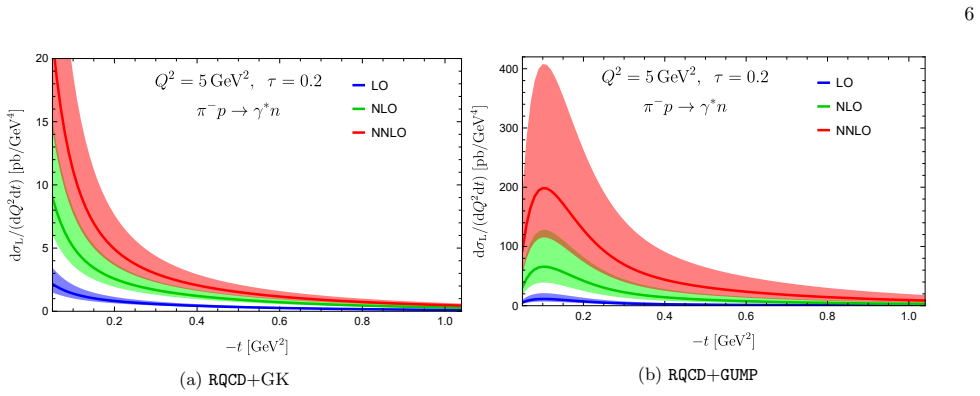
Summary. The paper claims the first NNLO QCD calculation for the exclusive pion- and kaon-induced Drell-Yan processes π^- p → γ^* n and K^- p → γ^* Λ in leading-twist collinear factorization. The technical route is crossing: Eq. (10) relates the Drell-Yan transition form factors to complex-conjugated DVMP form factors through a logarithmic shift, and the NNLO DVMP kernel from the companion paper [32] is imported. Numerical predictions for J-PARC kinematics (Q^2 ~ 2–6 GeV^2, τ ~ 0.2) are made with two GPD models (GK and GUMP) and lattice-motivated pion/kaon DAs. The central phenomenological claim is that NNLO corrections are large and positive, often exceeding 100% of the already large NLO corrections, so their inclusion is imperative. The paper also evaluates the transverse single-spin asymmetry and finds it relatively stable order by order.
Significance. If Eq. (10) and the imported two-loop kernel are correct, this is a useful and timely first NNLO study of these exclusive Drell-Yan channels, directly relevant to the proposed J-PARC measurements. The paper benefits from using two independent GPD parametrizations, explicit DA inputs, scale-variation uncertainties, and a polarization observable. The crossing strategy is plausible and the NLO expression in Eq. (8) is explicit. However, the paper is not self-contained: the all-order relation Eq. (10) is not derived, no NNLO coefficient function is displayed, and the numerical results depend on companion work [32] with overlapping authorship. The phenomenological conclusion is also drawn entirely from leading-twist predictions in a moderate-Q^2 region where the paper itself concedes higher-twist effects can be significant.
major comments (3)
- [§II.B, Eq. (10)] The all-order relation F_exDY = F*_DVMP + Σ (1/n!)(-iπ d/dlog Q^2)^n F*_DVMP is the linchpin of the NNLO claim, but it is stated without derivation. Starting from Eq. (7) with L = log(μ^2/Q^2), the timelike continuation is L → L + iπ; a Taylor expansion of F*_DVMP(L) gives exp(iπ d/dL) = exp(-iπ d/dlog Q^2) only if the derivative acts at fixed α_s, fixed GPDs and DAs, and if the coefficient functions are real-analytic in v. None of these conditions is stated. In addition, Eq. (6) changes ξ from +η (DVMP) to −η (Drell-Yan), and the x-integration contour can cross the singularities at x = ±ξ; the paper does not justify the contour deformation. A direct NLO verification of Eq. (10) against Eq. (8) would resolve whether the sign and contour are correct. Without that, the NNLO results rest on an unverified assumption.
- [§III and §IV] No NNLO coefficient function C_i^2(u,v) is displayed anywhere, and no numerical code is provided. The entire NNLO prediction is imported from ref. [32] through Eq. (10). Since ref. [32] has overlapping authorship with this manuscript, this is not an independent check. A reader cannot verify the continuation or the numerical implementation. At minimum, the paper should display one explicit two-loop coefficient function (or provide an ancillary file) and compare the NLO limit of the continued formula with the direct NLO calculation from Eq. (8).
- [§II.A and §IV] The abstract and summary state that NNLO corrections are 'imperative for reliable theoretical predictions' and often exceed 100% of the NLO corrections. These claims are drawn entirely from leading-twist predictions at Q^2 ~ 2–6 GeV^2. The paper itself notes after Eq. (3) that higher-twist contributions 'can remain numerically significant in the moderate-Q region.' No estimate of higher-twist or target-mass corrections is provided, and the two GPD models differ by roughly an order of magnitude in the plotted cross sections. The central phenomenological conclusion should either be supported by a quantitative estimate of neglected terms or be reformulated as a statement about the leading-twist perturbative series only.
minor comments (5)
- [Eqs. (2), (5), (6)] The sign convention between ξ and η is confusing: Eq. (2) defines ξ negative for Drell-Yan, Eq. (5) states η ≈ −ξ, and Eq. (6) uses ξ = η for DVMP but ξ = −η for Drell-Yan. Please make the notation consistent throughout, especially in Eq. (10).
- [Eqs. (7)–(8)] The text says singularities at x = ±ξ are regulated by ξ → ξ − iε, but Eq. (8) has denominators (ξ − x − iε) and (ξ + x − iε). Clarify how these two prescriptions are related and how the continuation to v* affects the iε terms.
- [Section III] The symbol n_L = 3 in the numerical setup is not defined. If it means the number of active flavors or the loop order, please define it explicitly.
- [References] Ref. [30] is incomplete in the bibliography as printed (missing journal/volume/page or arXiv identifier). Please correct.
- [Section III] The text repeatedly states that NNLO corrections 'exceed 100% of the already large NLO corrections' but gives no explicit K-factors or a table quantifying LO→NLO→NNLO ratios. A table would make the central claim quantitative and easier to verify from the figures.
Circularity Check
No significant circularity: the NNLO DY result is derived by analytic continuation from an independent (though overlapping-author) DVMP calculation, and no fitted parameter is relabeled as a prediction.
full rationale
The central NNLO hard-scattering coefficients are not fit to data and are not defined in terms of the DY observables. Eq. (10) is presented as a derived all-order connection between the DVMP and exclusive-DY TFFs, obtained by complex conjugation and analytic continuation of logarithms; this is a legitimate application of a prior result rather than a self-definitional identity. The GPD and DA inputs (GK, GUMP, RQCD, LPC) are external phenomenological/lattice inputs used to evaluate the convolutions, not parameters fitted to the DY cross sections that are then 'predicted.' Ref. [32] does overlap in authorship, but it is a parameter-free perturbative calculation with stated factorization assumptions and does not contain the DY result as an input, so the self-citation is real evidence rather than circularity. The reviewer's concerns about the sign of the i pi term, the xi-singularity contour, and the lack of an independent check of [32] are important correctness and reproducibility risks, but they are not circularity: even if Eq. (10) were wrong, that would be an error, not a reduction of the output to the input by construction. Accordingly, no circular step can be exhibited, and the score is 0.
Axiom & Free-Parameter Ledger
free parameters (3)
- Pion DA Gegenbauer moment a2(2 GeV) =
0.116 +0.019 -0.020
- Kaon DA Gegenbauer moments a1..a4(2 GeV) =
a1=-0.108±0.014±0.051, a2=0.170±0.014±0.044, a3=-0.043±0.006±0.022, a4=0.073±0.008±0.021
- Parameters of GK and GUMP nucleon GPD models =
Not listed in this paper; taken from refs [36-39,45]
axioms (5)
- domain assumption Twist-2 collinear factorization of the exclusive meson-induced Drell-Yan amplitude in terms of meson DAs and nucleon GPDs (Eq. 6) is valid at leading twist.
- standard math The all-order analytic-continuation relation Eq. (10) between exDY and DVMP transition form factors is correct.
- domain assumption The two-loop DVMP hard-scattering kernel quoted from ref. [32] is correct for both pion and kaon DAs.
- domain assumption Nonperturbative inputs (RQCD pion DA moments, LPC kaon DA moments, GK and GUMP GPD parametrizations) are accurate enough for the quoted cross-section magnitudes.
- domain assumption At the planned J-PARC kinematics Q^2 ~ 2-6 GeV^2, higher-twist and target-mass effects are sufficiently suppressed by 1/Q to be neglected at leading twist.
read the original abstract
The high-energy pion and kaon beams proposed for future experiments at J-PARC offer a unique opportunity to investigate exclusive Drell-Yan processes induced by pions or kaons, which correspond to inverse deeply virtual meson production with $M=\pi,K$. To facilitate precise comparisons between theoretical predictions and forthcoming experimental data, we calculate the next-to-next-to-leading order (NNLO) QCD corrections to the processes $\pi^- p\to \gamma^*(\to l^+l^-) + n$ and $K^- p\to \gamma^*(\to l^+l^-) + \Lambda$. Our calculations are performed within the generalized parton distribution (GPD) factorization framework, accurate to leading twist in the generalized Bjorken limit ($Q^2\gg |t|,\,\Lambda_{\rm QCD}^2$). We find that the NNLO QCD corrections are substantial and positive; therefore, their inclusion is imperative for reliable theoretical predictions in confrontation with future experiments.
Figures



Reference graph
Works this paper leans on
-
[1]
M¨ uller, D
D. M¨ uller, D. Robaschik, B. Geyer, F. M. Dittes and J. Hoˇ rejˇ si, Fortsch. Phys.42(1994), 101-141
1994
-
[2]
X. D. Ji, Phys. Rev. D55(1997), 7114-7125
1997
-
[3]
A. V. Radyushkin, Phys. Lett. B380(1996), 417-425
1996
-
[4]
Diehl, Phys
M. Diehl, Phys. Rept.388(2003), 41-277
2003
-
[5]
A. V. Belitsky and A. V. Radyushkin, Phys. Rept.418(2005), 1-387
2005
-
[6]
Boffi and B
S. Boffi and B. Pasquini, Riv. Nuovo Cim.30(2007) no.9, 387-448
2007
-
[7]
Goeke, M
K. Goeke, M. V. Polyakov and M. Vanderhaeghen, Prog. Part. Nucl. Phys.47(2001), 401-515
2001
-
[8]
M. Bo¨ er, A. Camsonne, M. Constantinou, H. S. Jo, K. Joo, K. Semenov-Tian-Shansky, H. D. Son, P. Sznajder, C. Van Hulse and J. Wagner,et al.[arXiv:2512.15064 [hep-ph]]
-
[9]
Burkardt, Phys
M. Burkardt, Phys. Rev. D62(2000), 071503 [erratum: Phys. Rev. D66(2002), 119903]
2000
-
[10]
V. D. Burkert, L. Elouadrhiri, F. X. Girod, C. Lorc´ e, P. Schweitzer and P. E. Shanahan, Rev. Mod. Phys.95(2023) no.4, 041002
2023
-
[11]
Kumano, Q
S. Kumano, Q. T. Song and O. V. Teryaev, Phys. Rev. D97(2018) no.1, 014020
2018
-
[12]
Freese and I
A. Freese and I. C. Clo¨ et, Phys. Rev. C100(2019) no.1, 015201 [erratum: Phys. Rev. C105(2022) no.5, 059901]
2019
-
[13]
B. D. Sun and Y. B. Dong, Phys. Rev. D101(2020) no.9, 096008
2020
-
[14]
Duran, Z
B. Duran, Z. E. Meziani, S. Joosten, M. K. Jones, S. Prasad, C. Peng, W. Armstrong, H. Atac, E. Chudakov and H. Bhatt, et al.Nature615(2023) no.7954, 813-816
2023
-
[15]
D. C. Hackett, D. A. Pefkou and P. E. Shanahan, Phys. Rev. Lett.132(2024) no.25, 251904
2024
-
[16]
X. H. Cao, F. K. Guo, Q. Z. Li and D. L. Yao, Nature Commun.16(2025), 6979
2025
-
[17]
Y. Guo, F. Yuan and W. Zhao, Phys. Rev. Lett.135(2025) no.11, 111902
2025
-
[18]
Tanaka, D
M. Tanaka, D. Fujii and M. Kawaguchi, Phys. Rev. D112(2025) no.5, 054048
2025
-
[19]
Lorc´ e and Q
C. Lorc´ e and Q. T. Song, Phys. Lett. B864(2025), 139433
2025
-
[20]
Hatta and J
Y. Hatta and J. Schoenleber, Phys. Rev. Lett.134(2025) no.25, 251901
2025
-
[21]
X. D. Ji, Phys. Rev. Lett.78(1997), 610-613
1997
-
[22]
E. R. Berger, M. Diehl and B. Pire, Phys. Lett. B523(2001), 265-272
2001
-
[23]
Mueller, B
D. Mueller, B. Pire, L. Szymanowski and J. Wagner, Phys. Rev. D86(2012), 031502
2012
-
[24]
Sawada, W
T. Sawada, W. C. Chang, S. Kumano, J. C. Peng, S. Sawada and K. Tanaka, Phys. Rev. D93(2016) no.11, 114034
2016
-
[25]
K. Aoki, H. Fujioka, T. Gogami, Y. Hidaka, E. Hiyama, R. Honda, A. Hosaka, Y. Ichikawa, M. Ieiri and M. Isaka,et al. [arXiv:2110.04462 [nucl-ex]]
-
[26]
Jung-Keun Ahn, Sakiko Ashikag and Wen-Chen Changet al., Letter of Intent for J-PARC: Studying Generalized Parton Distributions with Exclusive Drell-Yan process at J- PARC
-
[27]
S. V. Goloskokov and P. Kroll, Phys. Lett. B748(2015), 323-327. 10
2015
-
[28]
V. M. Braun, Y. Ji and J. Schoenleber, Phys. Rev. Lett.129(2022) no.17, 172001
2022
-
[29]
Ji and J
Y. Ji and J. Schoenleber, JHEP01(2024), 053
2024
-
[30]
V. M. Braun, P. Gotzler and A. N. Manashov,
-
[31]
V. M. Braun, H. Y. Jiang, A. N. Manashov and A. von Manteuffel, JHEP01(2025), 069
2025
-
[32]
W. Chen, F. Feng, Y. Jia, Q. T. Song, G. Tang and Z. Y. Wang, [arXiv:2604.28164 [hep-ph]]
-
[33]
Mankiewicz, G
L. Mankiewicz, G. Piller and T. Weigl, Phys. Rev. D59(1999), 017501
1999
-
[34]
L. B. Chen, W. Chen, F. Feng and Y. Jia, Phys. Rev. Lett.132(2024) no.20, 201901 [erratum: Phys. Rev. Lett.134 (2025) no.22, 229901]
2024
-
[35]
L. L. Frankfurt, P. V. Pobylitsa, M. V. Polyakov and M. Strikman, Phys. Rev. D60(1999), 014010
1999
-
[36]
Kroll, Eur
P. Kroll, Eur. Phys. J. A55(2019) no.5, 76
2019
-
[37]
S. V. Goloskokov and P. Kroll, Eur. Phys. J. C65(2010), 137-151
2010
-
[38]
S. V. Goloskokov and P. Kroll, Eur. Phys. J. A47(2011), 112
2011
-
[39]
Kroll, H
P. Kroll, H. Moutarde and F. Sabatie, Eur. Phys. J. C73(2013) no.1, 2278
2013
-
[40]
Vanderhaeghen, P
M. Vanderhaeghen, P. A. M. Guichon and M. Guidal, Phys. Rev. D60(1999), 094017
1999
-
[41]
Kumeriˇ cki and D
K. Kumeriˇ cki and D. M¨ uller, EPJ Web Conf.112(2016), 01012
2016
-
[42]
Kumericki, S
K. Kumericki, S. Liuti and H. Moutarde, Eur. Phys. J. A52(2016) no.6, 157
2016
-
[43]
Moutarde, P
H. Moutarde, P. Sznajder and J. Wagner, Eur. Phys. J. C79(2019) no.7, 614
2019
-
[44]
Kriesten, P
B. Kriesten, P. Velie, E. Yeats, F. Y. Lopez and S. Liuti, Phys. Rev. D105(2022) no.5, 056022
2022
-
[45]
Y. Guo, F. P. Aslan, X. Ji and M. G. Santiago, Phys. Rev. Lett.135(2025) no.26, 261903
2025
-
[46]
H. T. Ding, X. Gao, S. Mukherjee, P. Petreczky, Q. Shi, S. Syritsyn and Y. Zhao, JHEP02(2025), 056
2025
-
[47]
X. Gao, S. Mukherjee, Q. Shi, F. Yao and Y. Zhao, Phys. Rev. D113(2026) no.1, 014505
2026
-
[48]
H. W. Lin, Phys. Lett. B846(2023), 138181
2023
-
[49]
Bhattacharya, K
S. Bhattacharya, K. Cichy, M. Constantinou, J. Dodson, X. Gao, A. Metz, J. Miller, S. Mukherjee, P. Petreczky and F. Steffens,et al.Phys. Rev. D109(2024) no.3, 034508
2024
-
[50]
Bhattacharya, K
S. Bhattacharya, K. Cichy, M. Constantinou, X. Gao, A. Metz, J. Miller, S. Mukherjee, P. Petreczky, F. Steffens and Y. Zhao, JHEP01(2025), 146
2025
-
[51]
M. H. Chu, M. Cola¸ co, S. Bhattacharya, K. Cichy, M. Constantinou, A. Metz and F. Steffens, Phys. Rev. D112(2025) no.9, 094510
2025
-
[52]
Cichy, S
K. Cichy, S. Bhattacharya, M. Constantinou, J. Dodson, X. Gao, A. Metz, J. Miller, S. Mukherjee, A. Scapellato and F. Steffens,et al.Acta Phys. Polon. Supp.16(2023) no.7, 7-A6
2023
-
[53]
Alexandrou, K
C. Alexandrou, K. Cichy, M. Constantinou, K. Hadjiyiannakou, K. Jansen, A. Scapellato and F. Steffens, Phys. Rev. Lett. 125(2020) no.26, 262001
2020
-
[54]
H. W. Lin, Phys. Lett. B824(2022), 136821
2022
-
[55]
Dutrieuxet al.[HadStruc], JHEP08(2024), 162
H. Dutrieuxet al.[HadStruc], JHEP08(2024), 162
2024
-
[56]
H. Dutrieux, R. G. Edwards, J. Karpie, C. Mezrag, C. Monahan, K. Orginos, A. Radyushkin, D. Richards, E. Romero and S. Zafeiropoulos, [arXiv:2604.21476 [hep-lat]]
-
[57]
A. V. Belitsky and D. Mueller, Phys. Lett. B513(2001), 349-360
2001
-
[58]
G. S. Baliet al.[RQCD], JHEP08(2019), 065
2019
-
[59]
Huaet al.[Lattice Parton], Phys
J. Huaet al.[Lattice Parton], Phys. Rev. Lett.129(2022) no.13, 132001
2022
-
[60]
Y. Ji, B. X. Shi, J. Wang, Y. F. Wang, Y. M. Wang and H. X. Yu, Phys. Rev. Lett.134(2025) no.22, 221901
2025
-
[61]
L. B. Chen, W. Chen, F. Feng and Y. Jia, Phys. Lett. B870(2025), 139886
2025
-
[62]
A. P. Bakulev and V. L. Khandramai, Comput. Phys. Commun.184(2013) no.1, 183-193
2013
-
[63]
V. M. Braun, A. N. Manashov, S. Moch and M. Strohmaier, JHEP06(2017), 037
2017
-
[64]
Conformal symmetry breaking and evolution equations in Quantum Chromodynamics,
M. Strohmaier, “Conformal symmetry breaking and evolution equations in Quantum Chromodynamics,” 2018
2018
-
[65]
Freese, D
A. Freese, D. Adamiak, I. Clo¨ et, W. Melnitchouk, J. W. Qiu, N. Sato and M. Zaccheddu, Comput. Phys. Commun.311 (2025), 109552
2025
discussion (0)
Sign in with ORCID, Apple, or X to comment. Anyone can read and Pith papers without signing in.