REVIEW 2 major objections 6 minor 1 cited by
A 16 Myr super-Neptune in Upper-Centaurus Lupus and a preliminary survey of transiting planets in Sco-Cen with TESS
T0 review · 2 major / 6 minor · reviewed 2026-08-09 · deepseek-v4-flash
Pith's one-line read A 16-million-year-old super-Neptune spotted in Sco-Cen
desk verdict The planet validation is solid and worth publishing; the population-level 'excess' claim is not supported by the analysis actually presented. read the letter →
The pith
A machine-rendered reading of the paper's core claim, the machinery that carries it, and where it could break.
The reading
What carries the argument
The argument is carried by a joint Markov-chain Monte Carlo global model that simultaneously fits the TESS and LCO transit light curves and the stellar spectral energy distribution against MIST isochrones, with Gaussian priors on age ($16\pm2$ Myr), metallicity, and other spectroscopic parameters. The stellar radius ($0.911\,R_\odot$) produced by this fit converts the transit depth into the planet radius of $5.03\,R_\oplus$ and fixes the orbital parameters. The planetary interpretation is separately secured by the MOLUSC simulation of possible binary configurations feeding a TRICERATOPS false-probability calculation, which returns a false-positive probability below $1.4\times10^{-4}$.
What would settle it
A direct age indicator—such as a much weaker lithium line or a rotation period inconsistent with Upper-Centaurus Lupus members—showing the host star is an older field interloper would collapse the adopted 16 Myr age; with an older stellar radius the derived planet radius ($5.03\,R_\oplus$) and the newborn-super-Neptune designation would no longer hold.
Extended reading notes
Core claim
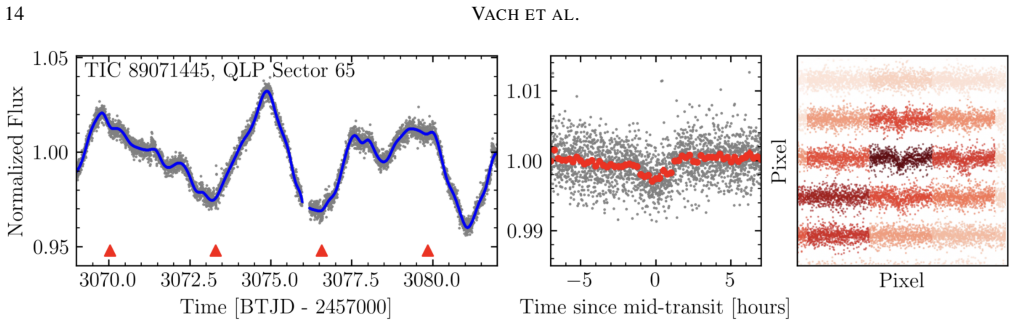
The central claim is that TIC 88785435 b is a real, very young transiting super-Neptune. On the paper's own terms, the system consists of a pre-main-sequence K7V star ($M_\star = 0.724\,M_\odot$, $R_\star = 0.911\,R_\odot$, $T_{\rm eff}\approx 3998$ K) at a distance of 122 pc, hosting a planet with radius $5.03^{+0.21}_{-0.20}\,R_\oplus$, period $10.508843^{+0.000037}_{-0.000034}$ days, and equilibrium temperature $635\pm16$ K. The authors validate the planet through ground-based transit observations in $g'$ and $i'$ bands, speckle imaging that excludes close stellar companions, and a MOLUSC+TRICERATOPS false-positive analysis giving a probability below $1.4\times10^{-4}$. They place the star in the $\phi$Lup substructure of Upper-Centaurus Lupus and adopt an age of $16\pm2$ Myr from the literature, supported by rotation period, lithium absorption, and H$\alpha$ emission that match UCL members.
Load-bearing premise
The planet is exactly as young as its star: the whole newborn-planet interpretation rests on the star genuinely belonging to the 16-million-year-old Upper-Centaurus Lupus association, a membership inferred from rotation, lithium, and H-alpha emission rather than directly measured.
Editorial extensions
If this is right
- TIC 88785435 b joins the small set of validated transiting planets younger than about 20 Myr, and at $T_{\rm eq}\approx 635$ K it is among the coolest such planets, making it a prime target for atmospheric transmission spectroscopy.
- The preliminary Sco-Cen survey, which recovers members like HIP 67522 b, finds a population of Neptune- and Jupiter-sized close-in planets that are rare in the mature Kepler population, supporting the idea that young planets are born inflated.
- Dynamical mass measurements of this and similar young planets could distinguish between the small-planet-progenitor scenario and the young-hot-Jupiter scenario.
- If the age holds, the planet's radius of $5.03\,R_\oplus$ at 16 Myr provides a direct constraint on thermal contraction and atmospheric mass-loss models in the first tens of megayears.
Reading between the lines
- A radial-velocity campaign to measure the planet's mass could discriminate between a gas-rich born-inflated planet and a young close-in giant; the paper does not attempt this, and the outcome is not predicted.
- If the star's membership were ever refuted, the planet would likely remain a valid super-Neptune but would lose its unique age anchor, so the system's value as a formation probe depends on continued membership verification.
- The survey's recovered candidates, none of which are statistically validated with TESS data alone, suggest that a larger ground-based follow-up program in Sco-Cen would be needed to map the young-planet occurrence rate, a step the paper leaves to future work.
Editorial analysis
A structured set of objections, weighed in public.
Referee Report
Summary. The paper reports the discovery and validation of TIC 88785435 b, a transiting super-Neptune with radius R_b = 5.03(+0.21,-0.20) R_Earth and period P = 10.508843 days around a K7V pre-main-sequence star in the Upper-Centaurus Lupus region of Sco-Cen. The validation rests on TESS photometry from three sectors, four ground-based transit observations in two filters, high-resolution speckle imaging that rules out resolved companions, and a joint MOLUSC/TRICERATOPS false-positive analysis giving a probability below 1.4e-4. The stellar characterization uses Veloce spectroscopy, rotation periods, and Li/H-alpha equivalent widths to support membership and youth, and the global model jointly fits transits and the stellar SED with a 16 +/- 2 Myr age prior adopted from Mamajek et al. (2002). The paper also presents a preliminary TESS survey of 5713 Sco-Cen members, recovering four confirmed planets and three unvalidated candidates, and concludes in Section 7 that the survey finds an excess of larger planets compared to Kepler demographics. That demographic conclusion is not supported by the analysis in the manuscript, because the promised forward-modeling comparison is not presented.
Significance. If the planet validation holds, TIC 88785435 b is a valuable addition to the young transiting planet sample: it is among the youngest and coolest (T_eq = 635 K) known transiting planets amenable to atmospheric follow-up, and the ground-based confirmation plus the very low false-positive probability make the detection itself robust. The manuscript is also transparent about its procedures and uses publicly available data, and the stellar youth indicators are presented in a falsifiable way. The demographic part of the paper, however, is not at the same standard: the claimed excess of large planets in Sco-Cen is asserted without the completeness and injection-recovery analysis that Section 6 promises, and unvalidated candidates are included in the same table as confirmed planets. This weakens the paper's broader claim, although it does not undermine the central discovery.
major comments (2)
- [Section 6 and Section 7] The demographic conclusion in Section 7 that the Sco-Cen survey finds 'an excess of larger planets compared to the Kepler demographics' is not supported by the analysis presented in Section 6. Section 6 promises 'an initial forward modeling comparison against mature-aged demographics following the methodology outlined in Vach et al. (2024)', but no completeness calculation, injection-recovery map, or occurrence-rate comparison appears in the manuscript. Table 6 includes three unvalidated candidates with false-positive rates of 0.0121, 0.38, and 0.0417, and the text states that no newly identified candidate could be statistically validated with TESS data alone; counting these candidates as planets, or comparing a handful of detections to Kepler rates without accounting for detection sensitivity and young-star variability, cannot establish an excess. I recommend either removing the demographic claim from the abstract and Section 7 or adding the promised forward-modeling analysis using only validated planets.
- [Section 4, Table 5, and Section 3.3.1] The headline '16 Myr' age is not measured from the star but is adopted from the literature age of Upper-Centaurus Lupus (Mamajek et al. 2002) and entered as a Gaussian prior in the global model. Section 3.3.1 explicitly states that the authors could not make statistically significant claims regarding membership in the phi Lup substructure, so the youth argument rests on consistency with rotation, Li, and H-alpha distributions rather than a direct measurement. Because the MIST-isochrone fit uses this age prior to derive R_star = 0.911 R_sun, the reported planet radius R_b = 5.03 R_Earth is age-dependent, and a field interloper or older age would shift the radius and undermine the newborn-planet interpretation. The paper should quantify how R_b changes under a wider age prior or an unconstrained age fit, and should state this dependence prominently in the title and abstract claims.
minor comments (6)
- [Section 2.2] The text says the LCO light curves confirm the TESS transits 'in both the g' and r' bands', but Table 1 lists only i' and g' observations; either the r' mention is a typo for i', or an r' observation is missing from the table.
- [Section 2.2] The sentence 'The SINISTRO camera is a 4 which observes a 13' x 13' field of view' appears incomplete and should be reworded.
- [Section 3.3 and Table 4] The table caption reads 'The derived Li EW are presented in Tabel 4'; 'Tabel' should be 'Table'.
- [Abstract] The abstract contains the typo 'long-candence', which should be 'long-cadence'.
- [Table 3] The age row lists '16.0 +/- 1.6' with source '7 This work', but Section 4 says the age is adopted from Mamajek et al. (2002); the table source should reflect this adoption rather than implying a new measurement.
- [Section 6] The phrase 'false-postive probability' should be 'false-positive probability'.
Circularity Check
No significant circularity; the planet validation and radius derive from external data, while the Sco-Cen demographic 'excess' claim is an unsupported over-interpretation rather than a circular step.
full rationale
The central discovery chain is self-contained. TIC 88785435 b's period (10.508843 d), radius (5.03 R_Earth), and false-positive probability (<1.4e-4) come from a simultaneous fit to TESS FFI light curves, four ground-based LCO transits, Veloce spectra, SED magnitudes, Gaia parallax, and Zorro speckle-imaging contrast curves (Sections 2, 4, 5). The transit ratio R_p/R_star is measured from data, and R_star is constrained by an MIST-based SED fit; neither is renamed as a prediction. The 16±2 Myr age is an external literature prior adopted from Mamajek et al. (2002) in Sections 3.3.1 and 4 and is separately supported by rotation, Li absorption, and H-alpha emission; it is not derived from the planet, so the '16 Myr super-Neptune' characterization is not self-definitional. Self-citations to Vach et al. (2024) and Vach et al. (2025) provide search, detrending, and joint-modeling methodology, but the planet parameters are recomputed from the present observations, so these citations are not load-bearing. The paper itself flags its survey limitations: no newly identified candidate could be statistically validated with TESS data alone, FPPs reach 0.38, and Table 6 mixes confirmed planets and candidates. Section 6 promises 'an initial forward modeling comparison against mature-aged demographics following the methodology outlined in Vach et al. (2024),' but no completeness or injection-recovery calculation appears, making Section 7's 'excess of larger planets compared to the Kepler demographics' an over-interpretation of a small sample. That is a statistical and evidentiary gap, not a circular reduction: the conclusion is not equal by construction to an input or fitted parameter. Hence no circularity step is identified.
Assumptions & free parameters
free parameters (8)
- Stellar age =
16.0 ± 1.6 Myr (Gaussian prior 16 ± 2 Myr)
- Eccentricity parameters sqrt(e)cos(w), sqrt(e)sin(w) =
-0.003+0.136/-0.136; -0.010+0.069/-0.061; derived e = 0.131+0.060/-0.064
- Limb-darkening coefficients u1, u2 =
TESS u1=0.349±0.026, u2=0.256±0.014; i' and g' values in Table 3
- Stellar mass M* =
0.724 ± 0.017 M_sun
- Effective temperature Teff =
3998 ± 95 K
- Metallicity [m/H] =
-0.08 ± 0.11
- Parallax =
8.191 ± 0.015 mas
- Detrending coefficients =
Not reported individually
assumptions (6)
- domain assumption TIC 88785435 is a member of Sco-Cen/UCL.
- domain assumption The age of UCL is 16 ± 2 Myr.
- domain assumption MIST stellar evolution tracks correctly model pre-main-sequence K7V stars.
- domain assumption Claret (2017) limb-darkening tables are applicable to TESS, Sloan i', and Sloan g' bandpasses.
- domain assumption TRICERATOPS and MOLUSC correctly enumerate astrophysical false-positive scenarios.
- domain assumption Gaia DR3 astrometry is reliable and the target has no unresolved companion affecting RUWE.
Cite this review
Pith. "Pith review of A 16 Myr super-Neptune in Upper-Centaurus Lupus and a preliminary survey of transiting planets in Sco-Cen with TESS." pith.science (2026). https://pith.science/paper/Y7BLKJGS
@misc{pith2026250200576,
  author       = {Pith},
  title        = {Pith review of: A 16 Myr super-Neptune in Upper-Centaurus Lupus and a preliminary survey of transiting planets in Sco-Cen with TESS},
  year         = {2026},
  howpublished = {\url{https://pith.science/paper/Y7BLKJGS}},
  note         = {Machine review of arXiv:2502.00576}
}
abstract
Measuring the properties of planets younger than about 50 Myr helps to test different planetary formation and evolution models. NASA's Transiting Exoplanet Survey Satellite (TESS) has observed nearly the entire sky, including a wide range of star-forming regions and young stellar clusters, expanding our census of the newborn planet population. In this work, we present the discovery of the TIC 88785435 planetary system located in the Upper-Centaurus Lupus (UCL) region of the Scorpius-Centaurus OB association (Sco-Cen) and a preliminary survey of the planet population within Sco-Cen. TIC 88785435 is a pre-main sequence, K7V dwarf ($M_\star = 0.72M_\odot$, $R_\star = 0.91R_\odot$, $T_\mathrm{eff}$ = 3998K, V = 11.7 mag) located within the bounds of UCL. We investigate the distribution of rotation periods measured from the TESS long-cadence data and the Halpha and Li abundances from the spectra of TIC 88785435. TESS long-candence data reveal that TIC 88785435 hosts a transiting super-Neptune ($R_b = 5.03R_\oplus$, P = 10.51 days), TIC 88785435 b. Ground-based follow-up validates the planetary nature of TIC 88785435 b. Using the TESS data, we perform a preliminary survey to investigate how TIC 88785435 b compares to the population of newly born planets located within Sco-Cen.
Figures


Figures from the paper (7 more)




Forward citations
Cited by 1 Pith paper
-
The Longest-period Young Transiting Exoplanets. A Duo of Puffy Giants inside a Debris Disk
HD 114082 hosts two puffy, moderate-to-low-mass giants on nearly circular, coplanar, near-resonant orbits of 225.55 and ~314 days, the longest-period young transiting exoplanets known.
Reference graph
Works this paper leans on
-
[1]
, " * write output.state after.block = add.period write newline
ENTRY address archivePrefix author booktitle chapter doi edition editor eprint howpublished institution journal key month number organization pages publisher school series title misctitle type volume year version url label extra.label sort.label short.list INTEGERS output.state before.all mid.sentence after.sentence after.block FUNCTION init.state.consts ...
-
[2]
write newline
" write newline "" before.all 'output.state := FUNCTION format.url url empty "" new.block "" url * "" * if FUNCTION format.eprint eprint empty "" archivePrefix empty "" archivePrefix "arXiv" = new.block " " eprint * " " * new.block " " eprint * " " * if if if FUNCTION format.doi doi empty "" " " doi * " " * if FUNCTION format.pid doi empty eprint empty ur...
-
[3]
602C `\.=
thebibliography [1] 20pt to REFERENCES 6pt =0pt -12pt 10pt plus 3pt =0pt =0pt =1pt plus 1pt =0pt =0pt -12pt =13pt plus 1pt =20pt =13pt plus 1pt \@M =10000 =-1.0em =0pt =0pt 0pt =0pt =1.0em @enumiv\@empty 10000 10000 `\.\@m \@noitemerr \@latex@warning Empty `thebibliography' environment \@ifnextchar \@reference \@latexerr Missing key on reference command E...
2021
-
[4]
Astropy Collaboration , Robitaille , T. P., Tollerud , E. J., et al. 2013, , 558, A33, 10.1051/0004-6361/201322068
-
[5]
Astropy Collaboration , Price-Whelan , A. M., Sip o cz , B. M., et al. 2018, , 156, 123, 10.3847/1538-3881/aabc4f
-
[6]
Astropy Collaboration , Price-Whelan , A. M., Lim , P. L., et al. 2022, , 935, 167, 10.3847/1538-4357/ac7c74
-
[7]
2024 a , Nature Astronomy, 8, 899, 10.1038/s41550-024-02257-0
Barat , S., D \'e sert , J.-M., Vazan , A., et al. 2024 a , Nature Astronomy, 8, 899, 10.1038/s41550-024-02257-0
-
[8]
Barat , S., D \'e sert , J.-M., Goyal , J. M., et al. 2024 b , arXiv e-prints, arXiv:2407.14995, 10.48550/arXiv.2407.14995
Show all 95 references
- [9]
-
[10]
G., Mann , A
Barber , M. G., Mann , A. W., Vanderburg , A., et al. 2024 b , , 635, 574, 10.1038/s41586-024-08123-3
2024 doi
-
[11]
Barnes , S. A. 2007, , 669, 1167, 10.1086/519295
2007 doi
-
[12]
2014, , 569, A111, 10.1051/0004-6361/201423945
Blanco-Cuaresma , S., Soubiran , C., Heiter , U., & Jofr \'e , P. 2014, , 569, A111, 10.1051/0004-6361/201423945
2014 doi
-
[13]
G., Palumbo , E
Bouma , L. G., Palumbo , E. K., & Hillenbrand , L. A. 2023, , 947, L3, 10.3847/2041-8213/acc589
2023 doi
- [14]
-
[15]
T., Gillen , E., Queloz , D., et al
Briegal , J. T., Gillen , E., Queloz , D., et al. 2022, , 513, 420, 10.1093/mnras/stac898
2022 doi
-
[16]
M., Baliber , N., Bianco , F
Brown , T. M., Baliber , N., Bianco , F. B., et al. 2013, Publications of the Astronomical Society of the Pacific, 125, 1031, 10.1086/673168
2013 doi
-
[17]
Castelli , F., & Kurucz , R. L. 2004, ArXiv Astrophysics e-prints
2004
-
[18]
L., Zink , J
Christiansen , J. L., Zink , J. K., Hardegree-Ullman , K. K., et al. 2023, , 166, 248, 10.3847/1538-3881/acf9f9
2023 doi
-
[19]
2017, , 600, A30, 10.1051/0004-6361/201629705
Claret , A. 2017, , 600, A30, 10.1051/0004-6361/201629705
2017 doi
-
[20]
2019, in American Astronomical Society Meeting Abstracts, Vol
Collins , K. 2019, in American Astronomical Society Meeting Abstracts, Vol. 233, American Astronomical Society Meeting Abstracts \#233, 140.05
2019
-
[21]
A., Kielkopf , J
Collins , K. A., Kielkopf , J. F., Stassun , K. G., & Hessman , F. V. 2017, , 153, 77, 10.3847/1538-3881/153/2/77
2017 doi
-
[22]
M., Wright , E
Cutri , R. M., Wright , E. L., Conrow , T., et al. 2021, VizieR Online Data Catalog: AllWISE Data Release (Cutri+ 2013) , VizieR On-line Data Catalog: II/328. Originally published in: IPAC/Caltech (2013)
2013
-
[23]
2019, , 623, A112, 10.1051/0004-6361/201833994
Damiani , F., Prisinzano , L., Pillitteri , I., Micela , G., & Sciortino , S. 2019, , 623, A112, 10.1051/0004-6361/201833994
2019 doi
-
[24]
J., Petigura , E
David , T. J., Petigura , E. A., Luger , R., et al. 2019, , 885, L12, 10.3847/2041-8213/ab4c99
2019 doi
-
[25]
J., Hillenbrand , L
David , T. J., Hillenbrand , L. A., Petigura , E. A., et al. 2016, , 534, 658, 10.1038/nature18293
2016 doi
-
[26]
T., Hoogerwerf , R., de Bruijne , J
de Zeeuw , P. T., Hoogerwerf , R., de Bruijne , J. H. J., Brown , A. G. A., & Blaauw , A. 1999, , 117, 354, 10.1086/300682
1999 doi
-
[27]
D., Rees , D
Donati , J.-F., Semel , M., Carter , B. D., Rees , D. E., & Collier Cameron , A. 1997, , 291, 658, 10.1093/mnras/291.4.658
1997 doi
-
[28]
2016, , 222, 8, 10.3847/0067-0049/222/1/8
Dotter , A. 2016, , 222, 8, 10.3847/0067-0049/222/1/8
2016 doi
-
[29]
2022 a , in Bulletin of the American Astronomical Society, Vol
Fernandes , R., Mulders , G., Pascucci , I., Bergsten , G., & Koskinen , T. 2022 a , in Bulletin of the American Astronomical Society, Vol. 54, 102.47
2022
-
[30]
B., Mulders , G
Fernandes , R. B., Mulders , G. D., Pascucci , I., et al. 2022 b , , 164, 78, 10.3847/1538-3881/ac7b29
2022 doi
-
[31]
W., Lang , D., & Goodman , J
Foreman-Mackey , D., Hogg , D. W., Lang , D., & Goodman , J. 2013, , 125, 306, 10.1086/670067
2013 doi
-
[32]
Gaia Collaboration , Vallenari , A., Brown , A. G. A., et al. 2023, , 674, A1, 10.1051/0004-6361/202243940
2023 doi
-
[33]
Giacalone , S., & Dressing , C. D. 2020, triceratops: Candidate exoplanet rating tool . 2002.004
2020
-
[34]
D., Jensen , E
Giacalone , S., Dressing , C. D., Jensen , E. L. N., et al. 2021, , 161, 24, 10.3847/1538-3881/abc6af
2021 doi
-
[35]
2018, in Society of Photo-Optical Instrumentation Engineers (SPIE) Conference Series, Vol
Gilbert , J., Bergmann , C., Bloxham , G., et al. 2018, in Society of Photo-Optical Instrumentation Engineers (SPIE) Conference Series, Vol. 10702, Ground-based and Airborne Instrumentation for Astronomy VII, ed. C. J. Evans , L. Simard , & H. Takami , 107020Y, 10.1117/12.2312399
2018 doi
-
[36]
C., & Henning , T
Goldman , B., R \"o ser , S., Schilbach , E., Mo \'o r , A. C., & Henning , T. 2018, , 868, 32, 10.3847/1538-4357/aae64c
2018 doi
-
[37]
Gray , D. F. 2005, The Observation and Analysis of Stellar Photospheres ( Cambridge University Press )
2005
-
[38]
A., Levine , S
Henden , A. A., Levine , S. E., Terrell , D., Smith , T. C., & Welch , D. 2012, JAAVSO, 40, 430
2012
-
[39]
B., Everett , M
Howell , S. B., Everett , M. E., Sherry , W., Horch , E., & Ciardi , D. R. 2011, , 142, 19, 10.1088/0004-6256/142/1/19
2011 doi
-
[40]
B., Sobeck , C., Haas , M., et al
Howell , S. B., Sobeck , C., Haas , M., et al. 2014, , 126, 398, 10.1086/676406
2014 doi
-
[41]
X., Vanderburg , A., P \'a l , A., et al
Huang , C. X., Vanderburg , A., P \'a l , A., et al. 2020 a , Research Notes of the American Astronomical Society, 4, 204, 10.3847/2515-5172/abca2e
2020 doi
-
[42]
2020 b , Research Notes of the American Astronomical Society, 4, 206, 10.3847/2515-5172/abca2d
---. 2020 b , Research Notes of the American Astronomical Society, 4, 206, 10.3847/2515-5172/abca2d
2020 doi
-
[43]
Hunter , J. D. 2007, Computing in Science and Engineering, 9, 90, 10.1109/MCSE.2007.55
2007 doi
-
[44]
Ida , S., & Lin , D. N. C. 2004, , 604, 388, 10.1086/381724
2004 doi
-
[45]
D., Jackson , R
Jeffries , R. D., Jackson , R. J., Wright , N. J., et al. 2023, , 523, 802, 10.1093/mnras/stad1293
2023 doi
-
[46]
2013, Tapir: A web interface for transit/eclipse observability , Astrophysics Source Code Library
Jensen , E. 2013, Tapir: A web interface for transit/eclipse observability , Astrophysics Source Code Library. 1306.007
2013
-
[47]
Kerr , R. M. P., Rizzuto , A. C., Kraus , A. L., & Offner , S. S. R. 2021, , 917, 23, 10.3847/1538-4357/ac0251
2021 doi
-
[48]
2022, , 657, A7, 10.1051/0004-6361/202142146
Kervella , P., Arenou , F., & Th \'e venin , F. 2022, , 657, A7, 10.1051/0004-6361/202142146
2022 doi
-
[49]
2021, segasai/minimint: Minimint 0.3.0 , v0.3.0, Zenodo, 10.5281/zenodo.5610692
Koposov , S. 2021, segasai/minimint: Minimint 0.3.0 , v0.3.0, Zenodo, 10.5281/zenodo.5610692
2021 doi
-
[50]
2002, , 391, 369, 10.1051/0004-6361:20020802
Kov \'a cs , G., Zucker , S., & Mazeh , T. 2002, , 391, 369, 10.1051/0004-6361:20020802
2002 doi
- [51]
-
[52]
Kunimoto , M., & Matthews , J. M. 2020, , 159, 248, 10.3847/1538-3881/ab88b0
2020 doi
-
[53]
A., et al
Lambrechts , M., Morbidelli , A., Jacobson , S. A., et al. 2019, , 627, A83, 10.1051/0004-6361/201834229
2019 doi
-
[54]
J., Chiang , E., & Ormel , C
Lee , E. J., Chiang , E., & Ormel , C. W. 2014, , 797, 95, 10.1088/0004-637X/797/2/95
2014 doi
-
[55]
D., Fortney , J
Lopez , E. D., Fortney , J. J., & Miller , N. 2012, , 761, 59, 10.1088/0004-637X/761/1/59
2012 doi
-
[56]
Luhman , K. L. 2022, , 163, 24, 10.3847/1538-3881/ac35e2
2022 doi
-
[57]
E., & Hillenbrand , L
Mamajek , E. E., & Hillenbrand , L. A. 2008, , 687, 1264, 10.1086/591785
2008 doi
-
[58]
E., Meyer , M
Mamajek , E. E., Meyer , M. R., & Liebert , J. 2002, , 124, 1670, 10.1086/341952
2002 doi
-
[59]
2002, , 580, L171, 10.1086/345520
Mandel , K., & Agol , E. 2002, , 580, L171, 10.1086/345520
2002 doi
-
[60]
W., Gaidos , E., Mace , G
Mann , A. W., Gaidos , E., Mace , G. N., et al. 2016, , 818, 46, 10.3847/0004-637X/818/1/46
2016 doi
-
[61]
W., Gaidos , E., Vanderburg , A., et al
Mann , A. W., Gaidos , E., Vanderburg , A., et al. 2017, , 153, 64, 10.1088/1361-6528/aa5276
2017 doi
-
[62]
W., Wood , M
Mann , A. W., Wood , M. L., Schmidt , S. P., et al. 2022, , 163, 156, 10.3847/1538-3881/ac511d
2022 doi
-
[63]
H., Harbeck , D.-R., et al
McCully , C., Volgenau , N. H., Harbeck , D.-R., et al. 2018, in Society of Photo-Optical Instrumentation Engineers (SPIE) Conference Series, Vol. 10707, , 107070K, 10.1117/12.2314340
2018 doi
-
[64]
R., Irwin , J., Charbonneau , D., et al
Newton , E. R., Irwin , J., Charbonneau , D., et al. 2017, , 834, 85, 10.3847/1538-4357/834/1/85
2017 doi
-
[65]
R., Mann , A
Newton , E. R., Mann , A. W., Tofflemire , B. M., et al. 2019, , 880, L17, 10.3847/2041-8213/ab2988
2019 doi
- [66]
-
[67]
2016, , 817, 107, 10.3847/0004-637X/817/2/107
---. 2016, , 817, 107, 10.3847/0004-637X/817/2/107
2016 doi
- [68]
-
[69]
J., Mamajek , E
Pecaut , M. J., Mamajek , E. E., & Bubar , E. J. 2012, , 746, 154, 10.1088/0004-637X/746/2/154
2012 doi
-
[70]
2020, , 582, 497, 10.1038/s41586-020-2400-z
Plavchan , P., Barclay , T., Gagn \'e , J., et al. 2020, , 582, 497, 10.1038/s41586-020-2400-z
2020 doi
-
[71]
o ck , S., Gro schedl , J. E., M \
Ratzenb \"o ck , S., Gro schedl , J. E., M \"o ller , T., et al. 2023 a , , 677, A59, 10.1051/0004-6361/202243690
2023 doi
-
[72]
E., Alves , J., et al
Ratzenb \"o ck , S., Gro schedl , J. E., Alves , J., et al. 2023 b , , 678, A71, 10.1051/0004-6361/202346901
2023 doi
-
[73]
M., Stauffer , J
Rebull , L. M., Stauffer , J. R., Cody , A. M., et al. 2018, , 155, 196, 10.3847/1538-3881/aab605
2018 doi
-
[74]
M., Stauffer , J
Rebull , L. M., Stauffer , J. R., Hillenbrand , L. A., et al. 2022, , 164, 80, 10.3847/1538-3881/ac75f1
2022 doi
-
[75]
R., Winn , J
Ricker , G. R., Winn , J. N., Vanderspek , R., et al. 2015, Journal of Astronomical Telescopes, Instruments, and Systems, 1, 014003, 10.1117/1.JATIS.1.1.014003
2015 doi
-
[76]
C., Ireland , M
Rizzuto , A. C., Ireland , M. J., & Kraus , A. L. 2015, , 448, 2737, 10.1093/mnras/stv207
2015 doi
-
[77]
C., Mann , A
Rizzuto , A. C., Mann , A. W., Vanderburg , A., Kraus , A. L., & Covey , K. R. 2017, , 154, 224, 10.3847/1538-3881/aa9070
2017 doi
-
[78]
C., Newton , E
Rizzuto , A. C., Newton , E. R., Mann , A. W., et al. 2020, , 160, 33, 10.3847/1538-3881/ab94b7
2020 doi
- [79]
-
[80]
G., Schlichting , H
Rogers , J. G., Schlichting , H. E., & Owen , J. E. 2023, , 947, L19, 10.3847/2041-8213/acc86f
2023 doi
-
[81]
J., Howell , S
Scott , N. J., Howell , S. B., Gnilka , C. L., et al. 2021, Frontiers in Astronomy and Space Sciences, 8, 138, 10.3389/fspas.2021.716560
2021
-
[82]
2003, , 585, 1038, 10.1086/346105
Seager , S., & Mall \'e n-Ornelas , G. 2003, , 585, 1038, 10.1086/346105
2003 doi
-
[83]
F., Cutri , R
Skrutskie , M. F., Cutri , R. M., Stiening , R., et al. 2006, , 131, 1163, 10.1086/498708
2006 doi
-
[84]
G., Oelkers , R
Stassun , K. G., Oelkers , R. J., Paegert , M., et al. 2019, , 158, 138, 10.3847/1538-3881/ab3467
2019 doi
- [85]
-
[86]
X., et al
Vach , S., Zhou , G., Huang , C. X., et al. 2024 a , , 167, 210, 10.3847/1538-3881/ad3108
2024 doi
- [87]
-
[88]
C., & Varoquaux , G
van der Walt , S., Colbert , S. C., & Varoquaux , G. 2011, Computing in Science and Engineering, 13, 22, 10.1109/MCSE.2011.37
2011 doi
-
[89]
X., Rodriguez , J
Vanderburg , A., Huang , C. X., Rodriguez , J. E., et al. 2019, , 881, L19, 10.3847/2041-8213/ab322d
2019 doi
-
[90]
E., et al
Virtanen , P., Gommers , R., Oliphant , T. E., et al. 2020, Nature Methods, 17, 261, 10.1038/s41592-019-0686-2
2020 doi
-
[91]
A., Morgan , D
West , A. A., Morgan , D. P., Bochanski , J. J., et al. 2011, , 141, 97, 10.1088/0004-6256/141/3/97
2011 doi
-
[92]
L., Mann , A
Wood , M. L., Mann , A. W., & Kraus , A. L. 2021, , 162, 128, 10.3847/1538-3881/ac0ae9
2021 doi
-
[93]
L., Mann , A
Wood , M. L., Mann , A. W., Barber , M. G., et al. 2023, , 165, 85, 10.3847/1538-3881/aca8fc
2023 doi
-
[94]
T., Girard , T
Zacharias , N., Finch , C. T., Girard , T. M., et al. 2013, , 145, 44, 10.1088/0004-6256/145/2/44
2013 doi
-
[95]
N., Irwin , J., et al
Zhou , G., Quinn , S. N., Irwin , J., et al. 2021, , 161, 2, 10.3847/1538-3881/abba22
2021 doi
Reviewed August 9, 2026 · model on record in the stance chip above.
Discussion (0). Continue with ORCID to comment.