REVIEW 3 major objections 5 minor 36 references
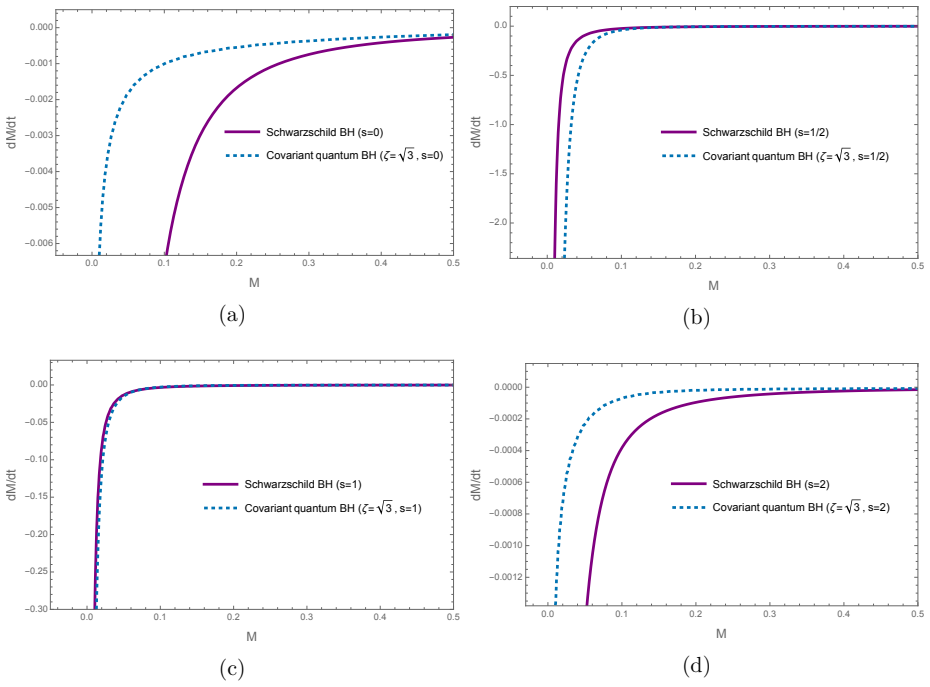
For covariant quantum black holes at sub-Planckian masses, the evaporation rate is spin-dependent: neutrino emission can exceed the Schwarzschild rate, graviton and scalar emission fall below it, and photon emission stays essentially unchan
Reviewed by Pith at T0; open to challenge. T0 means a machine referee read the full paper against a public rubric. the ladder, T0–T4 →
T0 review · deepseek-v4-flash
2026-08-01 17:45 UTC pith:YBBG7KIQ
load-bearing objection Spin-resolved evaporation for a covariant LQG black hole is a fair idea, but the printed metric contradicts the actual computation, so the central figures rest on an unstated h=r^2. the 3 major comments →
Evaporation and fate of covariant quantum black holes
The pith
A machine-rendered reading of the paper's core claim, the machinery that carries it, and where it could break.
Core claim
For the time-radial covariant quantum black hole metric, the Hawking temperature remains exactly T = 1/(8πM), identical to Schwarzschild. The quantum corrections act only on the effective potential barrier that emitted particles must cross. In the low-mass regime, the greybody factors for scalar, spin-half neutrino, and graviton modes deviate from their Schwarzschild counterparts, while photon greybody factors remain essentially unchanged. Consequently the mass-loss rate is suppressed for scalar and graviton emission, enhanced for neutrino emission, and nearly equal to Schwarzschild for photons. For larger black hole masses, the quantum corrections become negligible and all results converge
What carries the argument
The central object is the covariant quantum black hole metric, whose time-radial symmetry gives f(r) = g(r) = 1 - 2M/r + ζ²/r²(1 - 2M/r)², with the horizon at r = 2M and temperature T = 1/(8πM). Greybody factors are computed by rewriting the radial Teukolsky equation for spin s as a Schrödinger-like equation in the tortoise coordinate, with spin-dependent effective potentials V_sl; the transmission probability Γ_l(ω) through this barrier enters the Hawking emission formula, and integrating the energy flux gives the mass-loss rate. The paper sets h(r) = 1 in the line element, although the effective-potential formulas it uses are written for h(r) = r², a point on which the internal consistency
Load-bearing premise
The central results rest on treating the semiclassical fixed-background greybody calculation as valid for sub-Planckian black holes, where the Hawking temperature exceeds the black hole mass and a single quantum can carry away more energy than the hole contains; a second, mechanical fragility is that the effective potentials used require h(r) = r² while the stated metric sets h(r) = 1.
What would settle it
Compute the l = 0 scalar greybody factor directly from the radial Teukolsky equation with the literal covariant quantum metric: if h(r) = 1, the scalar effective potential is identically zero, so the greybody factor is Γ = 1 for all ω, and the two-order-of-magnitude suppression near ω = 10 shown in Fig. 1(a) disappears. Alternatively, check whether photon greybody factors remain exactly Schwarzschild for all sub-Planckian masses using a direct shooting method.
If this is right
- Scalar-only evaporation estimates are insufficient for this model; neutrino emission dominates the mass-loss rate at sub-Planckian masses.
- Since the temperature is unchanged, any deviation in evaporation must come from greybody factors, not from a modified Hawking temperature.
- Graviton and scalar emission rates fall below Schwarzschild in the low-mass regime, so the final stages of evaporation in those channels would be slower than classical predictions.
- For larger black holes (around M = 0.5 in Planck units), quantum corrections are negligible and the model agrees with general relativity.
- If these covariant quantum black holes are primordial, their evaporation signatures would differ from Schwarzschild-based predictions, offering a potential observational test of loop quantum gravity.
Where Pith is reading between the lines
- The near-identity of the photon greybody factors suggests the spin-1 effective potential may be exactly insensitive to the ζ² correction, which could be verified analytically rather than numerically.
- The sub-Planckian regime plotted in the paper (where the Hawking temperature exceeds the black hole mass) is where the fixed-background semiclassical approximation is least reliable; a more complete quantum-gravity treatment might produce a remnant rather than complete evaporation.
- The same effective-potential method could be applied to other quantum-corrected black hole metrics to test whether the spin-dependent suppression or enhancement is generic or specific to the time-radial metric.
- A direct integration of the radial Teukolsky equation for the literal h(r) = 1 metric would check whether the reported deviations are physical or an artifact of the effective-potential rewriting.
Editorial analysis
A structured set of objections, weighed in public.
Referee Report
Summary. The paper studies Hawking evaporation of a class of loop-quantum-gravity-inspired 'covariant quantum black holes' described by a static, spherically symmetric metric with f(r)=g(r)=1-2M/r+(\zeta^2/r^2)(1-2M/r)^2. The authors derive the Hawking temperature, compute greybody factors for spins 0, 1/2, 1, and 2 using Teukolsky-based effective potentials, and then compute particle spectra and mass-loss rates, comparing them with Schwarzschild black holes. The central claim is that, while the temperature is exactly Schwarzschild, the greybody factors and mass-loss rates differ from Schwarzschild in the low-mass regime, with the deviations depending on the spin of the emitted particles: scalar and graviton emission are suppressed, neutrino emission is enhanced, and photon emission is essentially unchanged. The paper argues that this spin dependence implies that scalar-only evaporation studies are insufficient and that these differences may offer a way to test loop quantum gravity through primordial black hole evaporation.
Significance. The paper has a clean, parameter-free temperature derivation and uses standard, well-established greybody machinery; if the numerical results are correct, the spin-dependent evaporation pattern would be an interesting and falsifiable prediction of this LQG-inspired model. It also avoids circularity: the quantum parameter \zeta is an input from the LQG model, and no output is fitted. However, the manuscript as written contains an internal inconsistency in the metric definition that undermines the numerical results, and the most interesting regime (M<0.5 in Planck units) is precisely where the semiclassical approximation is questionable. The strengths are the clear setup and the use of a standard comparison baseline, but the current version does not yet establish the claimed predictions.
major comments (3)
- [Section II, Eq. (4) vs Section III, Eqs. (12)-(13) and Figs. 1-4] The printed metric sets h(r)=1. In the effective potentials (13a)-(13d), this gives V_0l = l(l+1) f for s=0, so for l=0 the potential vanishes identically. Equation (12) then has plane-wave solutions and the greybody factor is \Gamma=1 for every \omega, in direct contradiction to the non-trivial l=0 curve in Fig. 1(a) and to the statement in Sec. VI that at \omega=10 the covariant quantum BH greybody factor is about two orders of magnitude smaller. For l>0, the same potentials tend to a non-zero constant as r\to\infty, so the plane-wave boundary conditions (15)-(16) are not satisfied. Thus the numerical results in Figs. 1-4 cannot be generated by the metric of Eq. (4). The natural correction is h(r)=r^2, the areal radius assumed in the Teukolsky reduction of Ref. [32]; the manuscript must state this corrected metric and the numerics must be reproduced with it before the central spin-depe
- [Section V, Figs. 3-4] The mass-loss curves are computed for M down to 0.01 in Planck units. Since T=1/(8\pi M), for M \lesssim 0.2 the Hawking temperature exceeds the BH mass; at M=0.01, T\approx4, so a single typical Hawking quantum carries more energy than the black hole's rest mass. The semiclassical fixed-background emission formula (21) and the greybody treatment assume the background is stable under the emitted flux, i.e. M\gg1 or at least T\ll M. No justification is given for the sub-Planckian extrapolation, and the interesting deviations from Schwarzschild occur exactly there. The quantitative predictions in this regime are therefore not established; the paper should either restrict the analysis to M\gg1 or provide a concrete justification for retaining the semiclassical approximation.
- [Section V and Fig. 3/Fig. 4 captions] The curves are labeled l=0, l=1/2, l=1, and l=2, i.e. only the lowest angular multipole per spin appears to be included, whereas Eq. (21) sums over all l with degeneracy (2l+1). Higher multipoles can contribute appreciably, especially at the larger masses shown (M~0.5), where the Hawking temperature is not far above the potential barrier. If only one l is used, the plotted quantity is not the total mass-loss rate and the comparison with Schwarzschild is incomplete. The authors should show convergence in l, or explicitly justify that higher-l contributions are negligible in the displayed mass range.
minor comments (5)
- [Section II, Eq. (4)] The metric equation as written is almost certainly a typographical error: in a Boyer-Lindquist-style line element, h(r) must be r^2 for the angular part to have the correct area radius. Please correct and define h(r) explicitly in the metric.
- [Numerical methods] The manuscript does not state how Eq. (12) was solved (shooting method, WKB, or other), what integration range and boundary conditions were used, or how convergence was checked. These details are needed for reproducibility, especially because the figures are the basis of the main claims.
- [Fig. 1/Fig. 2 captions] The figures show only l=0 for the scalar field; the text should state this explicitly and discuss why higher multipoles do not affect the qualitative comparison.
- [Section VI, last paragraph] The statement that the covariant quantum BHs 'will finally evaporate completely' is not derived in the paper. The mass-loss rates are integrated over energy, not over time, and no lifetime or end-state calculation is presented. The conclusion should be limited to what the figures show.
- [Section III, Eq. (13d)] For spin 1/2, the notation 'l=1/2' is non-standard in the context of spin-weighted spherical harmonics; the text should define the allowed l values, e.g. l\ge|s| with half-integer increments, so that the sum in Eq. (19) is unambiguous.
Circularity Check
No circularity: the greybody and evaporation results are direct computed consequences of the assumed metric and standard Teukolsky machinery; no fitted parameters and no load-bearing self-citations.
full rationale
The paper's derivation chain is self-contained and non-circular. The covariant quantum BH metric is taken from the external reference [31] (Eqs. 1–4), with ζ an input parameter. The Hawking temperature is computed algebraically from f(r), g(r) and the horizon condition r_H = 2M (Eqs. 2, 3, 7), yielding T = 1/(8πM); this is a derived consequence, not an assumed output. Greybody factors are obtained by solving the Teukolsky equation (Eq. 8) with effective potentials (Eqs. 13a–13d) from the external references [30, 32]; no parameter is fitted to any target greybody or mass-loss value. The Hawking radiation and mass-loss rates follow by straightforward integration (Eqs. 19, 21). The self-citations ([15], [23]–[26]) are background context and are not used as premises for the central calculation. The reader's note about h(r)=1 causing an internal inconsistency in the potentials (e.g., V_0l = l(l+1)f would give Γ=1 for l=0, contradicting Fig. 1(a)) is a correctness concern, but it is not a circularity: the computation is not equivalent to its inputs, even if it may be internally inconsistent. Therefore no circular step is identified.
Axiom & Free-Parameter Ledger
free parameters (1)
- quantum parameter ζ =
√3, 10 (chosen, not fitted)
axioms (4)
- domain assumption The metric of [31] (Eqs. 2-4) is the correct effective spacetime for a covariant quantum black hole in LQG.
- ad hoc to paper The semiclassical Hawking radiation framework (fixed background, Teukolsky greybody factors, Eq. 21) is valid for sub-Planckian black hole masses M < 1, where the Hawking temperature exceeds the black hole mass.
- domain assumption The effective potentials in Eq. (13) (from [30,32]) are the correct ones for the metric (1)-(4); this implicitly requires the areal-radius gauge h(r)=r², not the printed h(r)=1.
- ad hoc to paper Only the lowest angular multipole contributes significantly to the mass loss rate; higher l are dropped in Figs. 3 and 4.
read the original abstract
A growing number of phenomena and theoretical problems indicate that quantum gravity theory is necessary. In this paper, we investigate the evaporation of covariant quantum BHs for particles with different spins and compare the results with the Schwarzschild case. Our results show that the Hawking radiation and mass loss rate of covariant quantum BHs differ from those of Schwarzschild BHs and they depend on the spins of the emitted particles. Therefore, these results suggest that it may be insufficient to consider only BH evaporation in the massless scalar field case and may provide a possible way to test loop quantum gravity in the future.
Figures



Reference graph
Works this paper leans on
-
[3]
For all spin scenarios considered here, the covariant quantum BHs will finally evaporate completely
Hence, it is reasonable to expect that larger values ofζwill cause the deviations from the Schwarzschild results to appear at larger BH masses, while the overall behavior remains qualitatively consistent with that found for the smallζcase. For all spin scenarios considered here, the covariant quantum BHs will finally evaporate completely. In addition, thi...
Pith/arXiv arXiv 2018
-
[4]
Penrose,Gravitational collapse and space-time singularities,Phys
R. Penrose,Gravitational collapse and space-time singularities,Phys. Rev. Lett.14(1965) 57
1965
-
[5]
Hawking,Breakdown of predictability in gravitational collapse,Phys
S.W. Hawking,Breakdown of predictability in gravitational collapse,Phys. Rev. D14(1976) 2460
1976
-
[6]
Schwarz,The Early Years of String Theory: A Personal Perspective,0708.1917
J.H. Schwarz,The Early Years of String Theory: A Personal Perspective,0708.1917
Pith/arXiv arXiv 1917
-
[7]
L. Alvarez-Gaume and M.A. Vazquez-Mozo,Anomalies and the Green-Schwarz Mechanism, 14 (2024), DOI [2211.06467]
Pith/arXiv arXiv 2024
-
[8]
B. Chen, B. Czech and Z.-z. Wang,Quantum information in holographic duality,Rept. Prog. Phys.85(2022) 046001 [2108.09188]
Pith/arXiv arXiv 2022
-
[9]
Ashtekar,New Variables for Classical and Quantum Gravity,Phys
A. Ashtekar,New Variables for Classical and Quantum Gravity,Phys. Rev. Lett.57(1986) 2244
1986
-
[10]
Rovelli and L
C. Rovelli and L. Smolin,Loop Space Representation of Quantum General Relativity,Nucl. Phys. B331(1990) 80
1990
-
[11]
C. Rovelli and L. Smolin,Discreteness of area and volume in quantum gravity,Nucl. Phys. B 442(1995) 593 [gr-qc/9411005]
Pith/arXiv arXiv 1995
-
[12]
A. Ashtekar, T. Pawlowski and P. Singh,Quantum nature of the big bang,Phys. Rev. Lett. 96(2006) 141301 [gr-qc/0602086]
Pith/arXiv arXiv 2006
-
[13]
J. Yang, Y. Ding and Y. Ma,Alternative quantization of the Hamiltonian in loop quantum cosmology II: Including the Lorentz term,Phys. Lett. B682(2009) 1 [0904.4379]
Pith/arXiv arXiv 2009
-
[14]
M. Assanioussi, A. Dapor, K. Liegener and T. Paw lowski,Emergent de Sitter Epoch of the Quantum Cosmos from Loop Quantum Cosmology,Phys. Rev. Lett.121(2018) 081303 [1801.00768]
Pith/arXiv arXiv 2018
-
[15]
Z. Shuai and X. Zhang,Non-singular Inflation-Dark Energy Unification Model Based on Loop Quantum Cosmology and Mass-Varying Neutrinos,2605.19791
-
[16]
A. Peltola and G. Kunstatter,A Complete, Single-Horizon Quantum Corrected Black Hole Spacetime,Phys. Rev. D79(2009) 061501 [0811.3240]
Pith/arXiv arXiv 2009
-
[17]
E. Bianchi, M. Christodoulou, F. D’Ambrosio, H.M. Haggard and C. Rovelli,White holes as remnants: a surprising scenario for the end of a black hole,Class. Quant. Grav.35(2018) 225003 [1802.04264]
Pith/arXiv arXiv 2018
-
[18]
F. D’Ambrosio and C. Rovelli,How information crosses Schwarzschild’s central singularity, Class. Quant. Grav.35(2018) 215010 [1803.05015]
Pith/arXiv arXiv 2018
-
[19]
J. Lewandowski, Y. Ma, J. Yang and C. Zhang,Quantum Oppenheimer-Snyder and Swiss Cheese Models,Phys. Rev. Lett.130(2023) 101501 [2210.02253]
Pith/arXiv arXiv 2023
-
[20]
Z. Shi, X. Zhang and Y. Ma,Higher-dimensional quantum Oppenheimer-Snyder model, Phys. Rev. D110(2024) 104074 [2408.15821]
Pith/arXiv arXiv 2024
-
[21]
J. Chen and J. Yang,Motion of spinning particles around a quantum-corrected black hole without Cauchy horizons,2509.07682. 15
-
[22]
I.H. Belfaqih, M. Bojowald, S. Brahma and E.I. Duque,Black holes in effective loop quantum gravity: Covariant holonomy modifications,Phys. Rev. D112(2025) 046022 [2407.12087]
Pith/arXiv arXiv 2025
- [23]
- [24]
-
[25]
J. Lin, X. Zhang and M. Bravo-Gaete,Mass inflation and strong cosmic censorship conjecture in the covariant quantum black hole,Phys. Rev. D111(2025) 106025 [2412.01448]
Pith/arXiv arXiv 2025
-
[26]
Y. Du, Y. Liu and X. Zhang,Spinning particle dynamics and the innermost stable circular orbit in covariant loop quantum gravity,JCAP05(2025) 045 [2411.13316]
Pith/arXiv arXiv 2025
-
[27]
L.-S. Wang and X. Zhang,Quantum Oppenheimer-Snyder primordial black holes as all the dark matter,2604.00515
-
[28]
M. Calz` a, D. Pedrotti, G.-W. Yuan and S. Vagnozzi,Primordial regular black holes as all the dark matter. III. Covariant canonical quantum gravity models,Phys. Rev. D112(2025) 124015 [2507.02396]
arXiv 2025
-
[29]
I.H. Belfaqih, M. Bojowald, S. Brahma and E.I. Duque,Hawking Evaporation and the Fate of Black Holes in Loop Quantum Gravity,Phys. Rev. Lett.135(2025) 161501 [2504.11998]
Pith/arXiv arXiv 2025
-
[30]
A. Arbey, J. Auffinger, M. Geiller, E.R. Livine and F. Sartini,Hawking radiation by spherically-symmetric static black holes for all spins. II. Numerical emission rates, analytical limits, and new constraints,Phys. Rev. D104(2021) 084016 [2107.03293]
Pith/arXiv arXiv 2021
- [31]
-
[32]
Arbey, J
A. Arbey, J. Auffinger, M. Geiller, E.R. Livine and F. Sartini,Hawking radiation by spherically-symmetric static black holes for all spins: Teukolsky equations and potentials, Physical Review D103(2021)
2021
-
[33]
M. Calz` a, D. Pedrotti and S. Vagnozzi,Primordial regular black holes as all the dark matter. II. Non-time-radial-symmetric and loop quantum gravity-inspired metrics,Phys. Rev. D111 (2025) 024010 [2409.02807]
Pith/arXiv arXiv 2025
-
[34]
M. Calz` a, D. Pedrotti and S. Vagnozzi,Primordial regular black holes as all the dark matter. I. Time-radial-symmetric metrics,Phys. Rev. D111(2025) 024009 [2409.02804]. 16
Pith/arXiv arXiv 2025
-
[35]
Hawking,Particle Creation by Black Holes,Commun
S.W. Hawking,Particle Creation by Black Holes,Commun. Math. Phys.43(1975) 199
1975
-
[36]
Page,Particle Emission Rates from a Black Hole: Massless Particles from an Uncharged, Nonrotating Hole,Phys
D.N. Page,Particle Emission Rates from a Black Hole: Massless Particles from an Uncharged, Nonrotating Hole,Phys. Rev. D13(1976) 198
1976
-
[37]
A. Arbey and J. Auffinger,BlackHawk: A public code for calculating the Hawking evaporation spectra of any black hole distribution,Eur. Phys. J. C79(2019) 693 [1905.04268]
Pith/arXiv arXiv 2019
-
[38]
MacGibbon,Quark and gluon jet emission from primordial black holes
J.H. MacGibbon,Quark and gluon jet emission from primordial black holes. 2. The Lifetime emission,Phys. Rev. D44(1991) 376. 17
1991
discussion (0)
Sign in with ORCID, Apple, or X to comment. Anyone can read and Pith papers without signing in.