REVIEW 3 major objections 5 minor 40 references
Transport phenomena and observables associated with viscous properties of an anisotropic hot QCD medium at finite baryon asymmetry
T0 review · 3 major / 5 minor · reviewed 2026-08-01 · deepseek-v4-flash
Pith's one-line read Expansion-induced anisotropy reduces shear and bulk viscosity of hot QCD matter; baryon asymmetry increases both.
desk verdict A careful RTA calculation of shear and bulk viscosities in an anisotropic, baryon-asymmetric QGP, but the scalar eta is an implicit angular average that needs to be stated and justified before the central numbers hold up. read the letter →
The pith
A machine-rendered reading of the paper's core claim, the machinery that carries it, and where it could break.
The reading
What carries the argument
The central objects are the deformed phase-space distribution functions of quarks, antiquarks, and gluons, obtained from an isotropic distribution by the substitution p → √(p² + ξ(p·n)²), normalized by √(1+ξ), and expanded to first order in the anisotropy parameter ξ. These distributions determine both the transport coefficients—through the dissipative part of the energy-momentum tensor in the relaxation-time approximation—and the quasiparticle masses of the medium, which become functions of temperature, chemical potential, and ξ. The shear and bulk viscosities are then read off as the coefficients of the traceless and trace parts of the momentum-space gradient terms.
What would settle it
A lattice QCD calculation of shear and bulk viscosities for a quark-gluon plasma with finite quark chemical potential and an anisotropic distribution—or a kinetic-theory computation without the small-ξ truncation—would settle whether η and ζ indeed decrease with ξ and increase with μ at the quantitative level claimed here.
Extended reading notes
Core claim
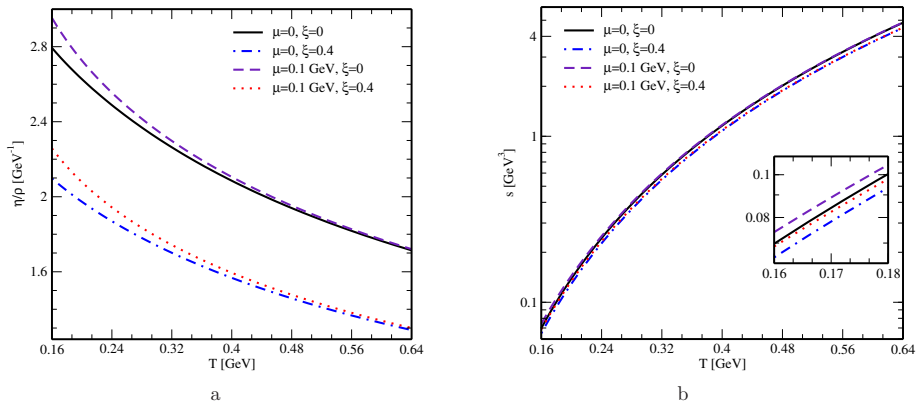
The central claim is that in a baryon-asymmetric QCD plasma, a weak expansion-induced anisotropy (parameter ξ > 0) lowers both the shear viscosity η and the bulk viscosity ζ relative to the isotropic plasma, while increasing the quark chemical potential at fixed ξ raises both coefficients. The paper derives closed-form integral expressions for η and ζ from the deformed quark, antiquark, and gluon distributions and the ξ-dependent quasiparticle masses, and shows numerically that the trends persist across temperatures from 0.16 to 0.64 GeV. The same computation yields the Prandtl number, Reynolds number, and specific viscosities, all of which show a stronger response to anisotropy than to bary
Load-bearing premise
The relaxation times for quarks, antiquarks, and gluons are taken from isotropic equilibrium and assumed momentum-independent, which fixes the overall scale of both viscosities; if the true relaxation times depend on anisotropy, chemical potential, or momentum, the magnitude—and possibly the ordering—of the effects would change.
Editorial extensions
If this is right
- Hydrodynamic models of the pre-equilibrium stage should use lower η and ζ when momentum anisotropy is present, reducing dissipative corrections during the early expansion.
- At finite baryon density, viscosities rise relative to baryonless matter, partially counteracting the anisotropy effect and shifting the balance with temperature.
- The Prandtl number exceeding unity in all scenarios means momentum diffusion dominates sound attenuation, with anisotropy weakening that dominance and baryon asymmetry barely changing it.
- The specific shear viscosity approaches the conjectured 1/(4π) bound in the baryonless anisotropic case, so early-time anisotropy makes the plasma appear more nearly perfect.
- The temperature at which ζ/s dips is modified by both ξ and μ, giving a concrete signature of where the plasma is closest to conformal symmetry.
Reading between the lines
- Because the relaxation times are taken from isotropic equilibrium and momentum-independent, the quantitative magnitudes of the viscosity shifts should be tested against a calculation with momentum-dependent relaxation; the qualitative sign pattern is likely robust to that change.
- The same deformed-distribution machinery should also modify electrical and thermal conductivities in a baryon-asymmetric anisotropic plasma, so the pattern of transport-coefficient suppression with ξ is a testable family of predictions.
- Bayesian extractions of η/s and ζ/s from heavy-ion data at different collision energies—where baryon chemical potential varies—could distinguish the anisotropic model from an isotropic baryonless baseline.
- Extending the first-order-in-ξ expansion to second order at ξ ≈ 0.5 could quantify the error of the truncation and check whether the decreasing trends survive.
Editorial analysis
A structured set of objections, weighed in public.
Referee Report
Summary. The manuscript studies the viscous transport properties of an expanding, baryon-asymmetric quark-gluon plasma with a weak momentum-space anisotropy. Working in the relaxation-time approximation (RTA) to the relativistic Boltzmann equation with Romatschke–Strickland deformed distributions expanded to first order in the anisotropy parameter ξ, and with temperature-, chemical-potential-, and ξ-dependent quasiparticle masses, the authors derive closed-form expressions for the shear viscosity η and bulk viscosity ζ (Eqs. (29) and (38)) and, using these, compute the Prandtl number, Reynolds number, η/s, and ζ/s. The central claims are that expansion-induced anisotropy reduces both η and ζ, that finite baryon asymmetry increases them, and that the combined effects leave distinct signatures on the derived observables—with η/s approaching the conjectured 1/4π bound in the baryonless anisotropic case and ζ/s exhibiting a temperature dip whose depth and position shift with μ and ξ. The paper is essentially a calculational survey, with numerical results displayed in eight figures for T ∈ [0.16, 0.64] GeV, μ = 0 or 0.1 GeV, and ξ = 0 or 0.4.
Significance. If the results hold, the calculation provides a self-contained RTA/quasiparticle description of momentum transport in the early-stage QGP, quantifying two competing effects: anisotropy (from longitudinal expansion) suppresses η and ζ, while baryon asymmetry enhances them. The closed-form expressions (29) and (38) are easy to reuse, the calculation is parameter-driven (ξ, μ, T are inputs; no output fitting), and the qualitative predictions—most notably the reduction of η/s toward 1/4π with anisotropy and the opposite shift from μ—are falsifiable against more complete kinetic-theory or hydrodynamics treatments. A strength is the self-consistency of the setup: the ξ-dependent quasiparticle masses are computed from the same deformed distributions that enter the transport integrals, so the mass and transport inputs are not independently fitted. The significance is moderated by the issues raised in the major comments: the extraction of scalar viscous coefficients from an anisotropic medium requires an explicit projection prescription, and the O(ξ) results are used at values of ξ where the truncation error is untested.
major comments (3)
- [§2, Eqs. (26)–(29), (37)–(38)] For a fixed anisotropy axis n, the angular integrands in (26) contain c(α,θ,φ)=(n·p̂)². The tensor ∫dΩ p̂^i p̂^j p̂^k p̂^l (n·p̂)² is not proportional to the isotropic rank-4 tensor; contracted with traceless W_kl it yields different coefficients for different shear components (e.g., W_xy vs W_xz) plus a trace contribution, so no unique scalar η satisfying the isotropic relation (27) exists. The closed forms (28)–(29) are obtained by replacing c with its angular average 1/3; the same applies to ζ through (30)–(33) → (37)–(38). This implicit isotropic projection is never stated or justified. Please specify the projection used to define η and ζ (e.g., a definite contraction with W^ij, or report the full set of anisotropic coefficients η∥, η⊥ and the corresponding bulk response), and show that the closed forms follow. As written, the quantities labeled η and ζ in Figs. 5–8 are angle-average
- [§2, Eqs. (4)–(6), (29), (38); §5, Figs. 1–8] All analytic results are first order in ξ, but the paper plots and interprets results at ξ = 0.4–0.6, where ξ² = 0.16–0.36 is not negligible compared with unity. No truncation-error estimate is given, and the isotropic baryonless limit ξ = 0, μ = 0 is not benchmarked against existing RTA/quasiparticle calculations, despite being the baseline for all four scenarios. Since the quasiparticle masses (56)–(57) are also linear in ξ, the trends reported in Figs. 1–8 may receive significant O(ξ²) corrections. Please (i) compute η and ζ at ξ = 0.4 and 0.6 using the exact Romatschke–Strickland distributions (1)–(3) without the ξ-expansion and compare with (29) and (38); (ii) report the ξ = 0, μ = 0 values against a published limit.
- [§2, Eqs. (13)–(17), (22)–(24)] The relaxation times (16)–(17) are momentum-independent isotropic-equilibrium expressions; their use in an anisotropic, baryon-asymmetric plasma is assumed without discussion of possible ξ- or μ-dependence, and no sensitivity test is provided. In addition, the derivatives (22)–(24) omit terms proportional to ∂ω/∂T and ∂ω/∂μ arising from the ξ-dependent quasiparticle masses (56)–(57) that enter the distributions; such terms are known to contribute to bulk viscosity in quasiparticle models. Because the absolute values of η/s, Pr, Re, and the quantitative size of the baryon-asymmetry enhancement depend on these choices, I ask that the assumptions be stated explicitly and their impact be assessed—e.g., by including the mass-derivative terms, or by testing an anisotropic and/or momentum-dependent τ at one representative temperature.
minor comments (5)
- [§4–5, Eqs. (31)–(38)] The numerical evaluation uses ε, P, and the speed-of-sound squared (∂P/∂ε) that appear in (31)–(38), but the explicit expressions used for these quantities are not given. Please provide them so the results are reproducible.
- [§2, Eqs. (34)–(36)] The Landau–Lifshitz conditions are imposed species-by-species; only the total ΔT^00 = 0 is required by energy-momentum conservation. Please justify the per-species choice or show that it is equivalent to the total condition.
- [§3.1, Eq. (42)] The definition of C_P in (42) is not the standard constant-pressure specific heat T(∂s/∂T)_P, and it is not stated whether the derivative is taken at fixed μ or fixed P. Since the Prandtl number (39) also uses κ from Ref. [10], please clarify the consistency of the two calculations.
- [§4, Eqs. (54)–(55)] Please verify the momentum powers and coefficients in (54)–(55). Direct substitution of (4)–(6) into (52) gives a gluon ξβ term of the form −ξβg²/(9π²)∫dp p³/ω_g f_g(1+f_g), whereas Eq. (54) shows p² f_g(1+f_g); several terms in (55) appear to have the same issue. If an ultrarelativistic approximation ω ≈ p is intended, state it explicitly.
- [Throughout; Figs. 5–8] The notation f_f for both flavor and function makes Eqs. (4)–(6) and (22)–(24) hard to parse; a cleaner notation (e.g., f_q, f_qbar) would help. The inset panels in Figs. 5 and 7 are too small to read, and the curves in Fig. 8(b) are nearly coincident at low T, making the claimed ordering at the dip hard to verify.
Circularity Check
No significant circularity: η and ζ are computed from stated model inputs via explicit integrals, not fitted or defined by the target result.
full rationale
The derivation chain is self-contained: the inputs are the anisotropic distribution functions (Eqs. 1-6), the momentum-independent relaxation times (Eqs. 16-17), the quasiparticle masses (Eqs. 56-57), and the free parameters ξ, μ, and T. The shear and bulk viscosities are then obtained by evaluating the momentum-space integrals in Eqs. (28) and (37) after solving the relativistic Boltzmann equation in the relaxation-time approximation. No parameter is fitted to the claimed outputs, and the central claims that anisotropy decreases η and ζ while baryon asymmetry increases them are consequences of the numerical evaluation of these integrals, not identities built into the definitions. The quasiparticle masses depend on the same anisotropic distributions used in the viscosity calculation, but this is a self-consistent model construction rather than a tautology. The one same-author result used as an external input is the thermal conductivity from Ref. [10] entering the Prandtl number in Sec. 3.1; even if that citation carries some weight, the Prandtl number is a secondary observable and the central viscosity result does not reduce to it. The possible ambiguity in extracting a single scalar shear viscosity from an intrinsically anisotropic response is a modeling/correctness concern, not a circularity: it does not make the prediction equivalent to its input by construction. A non-finding is therefore appropriate.
Assumptions & free parameters
free parameters (3)
- anisotropy parameter ξ =
0-0.6; figures highlight ξ=0.4 and ξ=0.6
- baryon chemical potential μ =
0.1 GeV (0.06 GeV in mass/distribution figures)
- Reynolds-number geometry L, v =
L=4 fm, v≈1
assumptions (6)
- standard math Romatschke-Strickland anisotropic distribution with normalization N(ξ)=√(1+ξ) and linearization in ξ
- domain assumption Relaxation-time approximation with momentum-independent τ_f, τ_ḡ, τ_g from isotropic equilibrium
- standard math Hard-thermal-loop quasiparticle masses for quarks/gluons and one-loop running coupling
- ad hoc to paper ξ-dependent quasiparticle masses obtained by inserting the anisotropic f^ξ into the HTL mass integrals
- domain assumption u, d, s flavors with equal chemical potential μ_f=μ, N_f=3
- domain assumption Weak-anisotropy limit ξ<1 and neglect of O(ξ²) terms
Cite this review
Pith. "Pith review of Transport phenomena and observables associated with viscous properties of an anisotropic hot QCD medium at finite baryon asymmetry." pith.science (2026). https://pith.science/paper/YCM5TM2R
@misc{pith2026260718581,
  author       = {Pith},
  title        = {Pith review of: Transport phenomena and observables associated with viscous properties of an anisotropic hot QCD medium at finite baryon asymmetry},
  year         = {2026},
  howpublished = {\url{https://pith.science/paper/YCM5TM2R}},
  note         = {Machine review of arXiv:2607.18581}
}
read the original abstract
We have studied the transport phenomena and observables associated with viscous properties of a baryon asymmetric hot QCD medium in the presence of a weak-momentum anisotropy arising due to the asymptotic expansion of the matter in the initial stages of ultrarelativistic heavy-ion collisions. This study facilitates the understanding of the sound attenuation in the medium through the Prandtl number, the nature of flow through the Reynolds number, fluid behavior through the specific shear viscosity, and conformal symmetry through the specific bulk viscosity for an anisotropic hot QCD medium at finite baryon asymmetry. We have determined the shear and bulk viscosities by solving the relativistic Boltzmann transport equation in the relaxation time approximation method. The interactions among partons are incorporated through their distribution functions within the quasiparticle model of hot QCD medium at finite temperature, anisotropy and baryon asymmetry. We have observed a decrease in the shear and bulk viscosities in the presence of expansion-induced anisotropy for baryonless scenario as well as for baryon asymmetric scenario. Conversely, these viscosities are larger in baryon asymmetric matter compared to their counterparts in baryonless matter. The impact of anisotropy on baryon asymmetric matter is observed to be as conspicuous as on baryonless matter. The above results are broadly attributed to the squeezing of the distribution function due to the momentum anisotropy generated by the asymptotic expansion of baryon asymmetric matter and the dispersion relations of partons in the presence of anisotropy. Additionally, the aforesaid observables are also significantly modulated by the expansion-induced anisotropy in the baryon asymmetric medium, indicating new predictions for the sound attenuation, flow characteristics, fluid behavior and conformal symmetry of the said medium.
Figures


Figures from the paper (5 more)



Reference graph
Works this paper leans on
-
[10]
Rath, Anisotropic modifications to the transport phenomena and ob servables in a hot QCD medium at finite baryon asymmetry , Eur
S. Rath, Anisotropic modifications to the transport phenomena and ob servables in a hot QCD medium at finite baryon asymmetry , Eur. Phys. J. A 62, 66 (2026)
2026
-
[1]
Dumitru, Y
A. Dumitru, Y. Guo and M. Strickland, The heavy-quark potential in an anisotropic plasma, Phys. Lett. B 662, 37 (2008). 27
2008
-
[2]
Dumitru, Y
A. Dumitru, Y. Guo, ´A. M´ ocsy and M. Strickland, Quarkonium states in an anisotropic QCD plasma , Phys. Rev. D 79, 054019 (2009)
2009
-
[3]
Martinez and M
M. Martinez and M. Strickland, Pre-equilibrium dilepton production from an anisotropic quark-gluon plasma , Phys. Rev. C 78, 034917 (2008)
2008
-
[4]
Ryblewski and M
R. Ryblewski and M. Strickland, Dilepton production from the quark-gluon plasma using (3+1)-dimensional anisotropic dissipative hydrody namics, Phys. Rev. D 92, 025026 (2015)
2015
-
[5]
Mukherjee, M
A. Mukherjee, M. Mandal and P. Roy, Jet-dilepton conversion from an anisotropic quark-gluon plasma , Eur. Phys. J. A 53, 81 (2017)
2017
-
[6]
Bhattacharya, R
L. Bhattacharya, R. Ryblewski and M. Strickland, Photon production from a nonequi- librium quark-gluon plasma , Phys. Rev. D 93, 065005 (2016)
2016
-
[7]
Thakur, N
L. Thakur, N. Haque, U. Kakade and B. K. Patra, Dissociation of quarkonium in an anisotropic hot QCD medium , Phys. Rev. D 88, 054022 (2013)
2013
Show all 40 references
-
[8]
Rath and B
S. Rath and B. K. Patra, Revisit to electrical and thermal conductivities, Lorenz a nd Knudsen numbers in thermal QCD in a strong magnetic field , Phys. Rev. D 100, 016009 (2019)
2019
-
[9]
Rath and B
S. Rath and B. K. Patra, Momentum and its affiliated transport coefficients for hot QCD matter in a strong magnetic field , Phys. Rev. D 102, 036011 (2020)
2020
-
[11]
Rath and N
S. Rath and N. A. Neill, Studying the thermoelectric properties of an anisotropic Q GP medium, Phys. Rev. D 113, 076004 (2026)
2026
-
[12]
Braun-Munzinger and J
P. Braun-Munzinger and J. Stachel, Particle ratios, equilibration and the QCD phase boundary, J. Phys. G: Nucl. Part. Phys. 28, 1971 (2002)
1971
-
[13]
Cleymans, Rapidity and energy dependence of thermal parameters , J
J. Cleymans, Rapidity and energy dependence of thermal parameters , J. Phys. G: Nucl. Part. Phys. 35, 044017 (2008)
2008
-
[14]
Andronic et al
A. Andronic et al. , Hadron production in ultra-relativistic nuclear collisio ns: Quarky- onic matter and a triple point in the phase diagram of QCD , Nucl. Phys. A 837, 65 (2010)
2010
-
[15]
Fukushima and Y
K. Fukushima and Y. Hidaka, Magnetic Shift of the Chemical Freeze-out and Electric Charge Fluctuations , Phys. Rev. Lett. 117, 102301 (2016)
2016
-
[16]
Rath and B
S. Rath and B. K. Patra, Effect of magnetic field on the charge and thermal transport properties of hot and dense QCD matter , Eur. Phys. J. C 80, 747 (2020). 28
2020
-
[17]
Rath and B
S. Rath and B. K. Patra, Viscous properties of hot and dense QCD matter in the presence of a magnetic field , Eur. Phys. J. C 81, 139 (2021)
2021
-
[18]
Rath and S
S. Rath and S. Dash, Momentum transport properties of a hot and dense QCD matter in a weak magnetic field , Eur. Phys. J. C 82, 797 (2022)
2022
-
[19]
Rath and S
S. Rath and S. Dash, Effects of weak magnetic field and finite chemical potential on the transport of charge and heat in hot QCD matter , Eur. Phys. J. A 59, 25 (2023)
2023
-
[20]
Pu, S.-Y
S. Pu, S.-Y. Wu and D.-L. Yang, Chiral Hall effect and chiral electric waves , Phys. Rev. D 91, 025011 (2015)
2015
-
[21]
E. V. Gorbar, I. A. Shovkovy, S. Vilchinskii, I. Rudenok, A. Boy arsky and O. Ruchayskiy, Anomalous Maxwell equations for inhomogeneous chiral plas ma, Phys. Rev. D 93, 105028 (2016)
2016
-
[22]
Ryu, J.-F
S. Ryu, J.-F. Paquet, C. Shen, G. S. Denicol, B. Schenke, S. Je on and C. Gale, The importance of the bulk viscosity of QCD in ultrarelativisti c heavy-ion collisions , Phys. Rev. Lett. 115, 132301 (2015)
2015
-
[23]
P. K. Kovtun, D. T. Son and A. O. Starinets, Viscosity in Strongly Interacting Quan- tum Field Theories from Black Hole Physics , Phys. Rev. Lett. 94, 111601 (2005)
2005
-
[24]
P. B. Arnold, C. Dogan and G. D. Moore, Bulk viscosity of high-temperature QCD , Phys. Rev. D 74, 085021 (2006)
2006
-
[25]
Bors´ anyiet al
S. Bors´ anyiet al. , The QCD equation of state with dynamical quarks , J. High Energy Phys. 1011, 077 (2010)
2010
-
[26]
Bazavov et al
A. Bazavov et al. , The equation of state in (2+1)-flavor QCD , Phys. Rev. D 90, 094503 (2014)
2014
-
[27]
Physical Kinetics
E. M. Lifshitz and L. P. Pitaevskii, “Physical Kinetics”, Pergamo n Press, 1981
1981
-
[28]
Tuchin, On viscous flow and azimuthal anisotropy of the quark-gluon p lasma in a strong magnetic field , J
K. Tuchin, On viscous flow and azimuthal anisotropy of the quark-gluon p lasma in a strong magnetic field , J. Phys. G: Nucl. Part. Phys. 39, 025010 (2012)
2012
-
[29]
Hattori, Xu-G
K. Hattori, Xu-G. Huang, D. H. Rischke and D. Satow, Bulk viscosity of quark-gluon plasma in strong magnetic fields , Phys. Rev. D 96, 094009 (2017)
2017
-
[30]
Rath and Nicol´ as A
S. Rath and Nicol´ as A. Neill, Deciphering the viscous properties and the Bjorken expansion of the QGP medium at finite angular velocity , Phys. Rev. D 112, 076017 (2025)
2025
-
[31]
Romatschke and M
P. Romatschke and M. Strickland, Collective modes of an anisotropic quark-gluon plasma, Phys. Rev. D 68, 036004 (2003). 29
2003
-
[32]
Romatschke and M
P. Romatschke and M. Strickland, Collective modes of an anisotropic quark-gluon plasma: II , Phys. Rev. D 70, 116006 (2004)
2004
-
[33]
Hosoya and K
A. Hosoya and K. Kajantie, Transport coefficients of QCD matter , Nucl. Phys. B 250, 666 (1985)
1985
-
[34]
L. D. Landau and E. M. Lifshitz, Fluid Mechanics , Pergamon Press, 1987
1987
-
[35]
P. F. Kelly, Q. Liu, C. Lucchesi and C. Manuel, Classical transport theory and hard thermal loops in the quark-gluon plasma , Phys. Rev. D 50, 4209 (1994)
1994
-
[36]
D. F. Litim and C. Manuel, Semi-classical transport theory for non-Abelian plasmas , Phys. Rep. 364, 451 (2002)
2002
-
[37]
Braaten and R
E. Braaten and R. D. Pisarski, Simple effective Lagrangian for hard thermal loops , Phys. Rev. D 45, R1827 (1992)
1992
-
[38]
Peshier, B
A. Peshier, B. K¨ ampfer and G. Soff, From QCD lattice calculations to the equation of state of quark matter , Phys. Rev. D 66, 094003 (2002)
2002
-
[39]
Blaizot, A
J.-P. Blaizot, A. Ipp, A. Rebhan and U. Reinosa, Asymptotic thermal quark masses and the entropy of QCD in the large- Nf limit, Phys. Rev. D 72, 125005 (2005)
2005
-
[40]
J. I. Kapusta and C. Gale, Finite Temperature Field Theory Principles and Applica- tions, Cambridge University Press, 2006. 30
2006
Reviewed August 1, 2026 · model on record in the stance chip above.
Discussion (0). Continue with ORCID to comment.