REVIEW 4 minor 45 references
Fourier imaging shows that the ring-shaped light from a superradiant cold-atom cloud is the action of a single collective jump operator that can be spatially filtered and isolated.
Reviewed by Pith at T0; open to challenge. T0 means a machine referee read the full paper against a public rubric. the ladder, T0–T4 →
T0 review · grok-4.5
2026-07-14 15:33 UTC pith:YF2AIG7N
load-bearing objection Clean experimental isolation of Carmichael’s most-superradiant jump operator via Fourier imaging; the central claim holds without relying on the approximate models.
Fourier imaging of collective spontaneous emission modes in superradiant cold atomic clouds
The pith
A machine-rendered reading of the paper's core claim, the machinery that carries it, and where it could break.
Core claim
The highly directional ring-shaped emission recorded in the Fourier plane of a superradiant elongated cloud of cold 87Rb atoms is the far-field pattern of a single collective jump operator belonging to the most superradiant eigenpair of the decay matrix. Spatial filtering isolates this channel and yields a clear intensity burst whose peak scales super-linearly with atom number above a critical density set by the condition that the mode rate exceeds twice the single-atom rate.
What carries the argument
Collective jump operators obtained by diagonalizing the N-by-N decay matrix Gamma_ij whose entries are the imaginary parts of the vacuum Green’s function between atom pairs; each operator radiates into a distinct far-field intensity pattern given by the coherent sum of the eigenvector components.
Load-bearing premise
The simplified bosonic and single-mode-plus-individual-decay models used to explain mode competition remain adequate even though both omit the coherent dipole-dipole Hamiltonian that is present in the full master equation.
What would settle it
A cloud geometry that removes the spectral gap between the top two eigenvalues and the bulk of the spectrum should eliminate the dominance of the ring pattern and the associated super-linear burst when the same Fourier-plane filter is applied.
Editorial analysis
A structured set of objections, weighed in public.
Referee Report
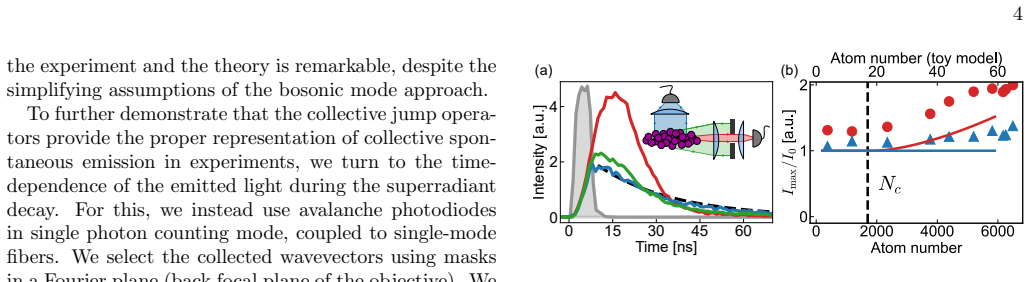
Summary. The manuscript reports Fourier-plane imaging of the light emitted by an inverted, elongated cloud of cold 87Rb atoms. The authors observe a highly directional ring-shaped emission pattern that appears only above a critical atom number and whose FWHM scales with cloud length. By diagonalizing the collective decay matrix Gamma_ij constructed from the vacuum Green function for the experimental geometry, they identify this pattern with the far-field radiation of the most-superradiant pair of collective jump operators. Spatial filtering of that angular sector recovers a Dicke-like temporal burst whose peak rate scales superlinearly with N, while orthogonal collection yields ordinary exponential decay. Two simplified models of mode competition (a bosonic mapping and a single-collective-plus-independent Lindblad model) are shown to reproduce the qualitative features of the data.
Significance. If the identification holds, the work provides the first direct experimental access to the collective jump operators introduced by Carmichael et al., converting a long-standing theoretical construct into a measurable and filterable degree of freedom. The combination of Fourier imaging, spatial filtering, and quantitative comparison to the eigenvectors of Gamma_ij is technically clean and immediately useful for free-space light-matter interfaces based on atomic ensembles or arrays. The initial-slope criterion Gamma_l > 2 Gamma_0 that defines a critical atom number per mode is derived including the coherent dipole-dipole Hamiltonian and is therefore robust. The experimental demonstration that a single mode can be isolated and that its radiation pattern is geometry-determined constitutes a clear advance for the field.
minor comments (4)
- The free parameter eta used in the toy Lindblad model (Fig. 4) is chosen for numerical convenience rather than taken from the microscopic eta extracted from Gamma_1(N). A short sentence clarifying that the model is only qualitative would avoid any impression of quantitative fitting.
- Supplemental Material Fig. S5 shows that the bosonic model overestimates both peak height and burst duration; this limitation is already noted in the text but could be flagged more explicitly in the main-text discussion of Fig. 3 so that readers do not over-interpret the agreement.
- The systematic uncertainties on cloud sizes (25 % axial, 20 % radial) are stated once; repeating them in the caption of Fig. 2(d) would make the gray error band self-contained.
- A few typographical inconsistencies remain (e.g., “Carmichaelet al.” missing space, “superra-diant” hyphenation). A final proof-reading pass would remove them.
Circularity Check
No significant circularity: observed Fourier ring is independently matched to eigenvectors of the measured-geometry Γ_ij matrix; models are post-hoc and non-load-bearing.
full rationale
The central claim (ring-shaped Fourier pattern = far-field radiation of the most-superradiant collective jump operator(s) obtained by diagonalizing Γ_ij for the experimental cloud) rests on direct imaging plus an independent numerical diagonalization of the vacuum Green-function matrix for the measured Gaussian sizes σ_x, σ_r. Equation (1) and the subsequent azimuthal/FWHM comparisons (Fig. 2) contain no free parameters fitted to the emission pattern itself; geometry uncertainties are propagated as an error band. Spatial filtering then isolates that angular sector and recovers a Dicke-like burst whose critical atom number is predicted from the same eigenvalues via the initial-slope criterion Γ_l > 2Γ_0 (derived in the SM including H_dd, which cancels). The two simplified competition models (bosonic mapping and single-collective-plus-individual Lindblad) are introduced only after the imaging identification and are acknowledged to be approximate; the single free parameter η in the toy model is chosen for numerical convenience and does not define the observed spatial pattern. Self-citations are limited to prior experimental methods of the same group and do not close any logical loop for the mode identification or the Carmichael framework. The derivation is therefore self-contained against external benchmarks and exhibits no reduction of a claimed prediction to its own inputs by construction.
Axiom & Free-Parameter Ledger
free parameters (3)
- eta (toy-model collective fraction) =
0.06
- numerical eta for Gamma_1(N) =
≈ 6 × 10^{-4}
- cloud rms sizes (sigma_x, sigma_r) =
sigma_x = 23–80 µm, sigma_r = 1.3–2.2 µm
axioms (4)
- domain assumption Collective decay is described by the non-diagonal Lindbladian with rates Gamma_ij = 6 pi Gamma_0 / k_0 Im[G(r_i - r_j)] obtained from the vacuum Green tensor.
- ad hoc to paper Bosonic replacement S_l^- → a_l^† b maps the inverted ensemble onto a set of harmonic oscillators whose trajectories approximate mode competition.
- domain assumption A mode produces a temporal burst if and only if Gamma_l > 2 Gamma_0, obtained from the initial slope of I_l(t) starting from full inversion.
- ad hoc to paper The toy Lindblad operator consisting of one collective jump plus independent single-atom decays is sufficient to capture the observed peak-rate scaling.
read the original abstract
We measure the spatial pattern associated with the superradiant emission from a cloud of cold 87Rb atoms using Fourier imaging. We observe a highly directional, ring-shaped emission structure, which corresponds to a single collective jump operator associated to the most superradiant mode of the ensemble. Using spatial filtering, we isolate this channel and find the typical superradiant burst with superlinear scaling of the intensity with atom number. We compare our results to two models that describe the competition between the various decay channels, finding good agreement. Our work shows that the collective jump operators introduced by Carmichael et al. [Optics Communications 179, 417 (2000)] can be measured and manipulated.
Figures


Reference graph
Works this paper leans on
-
[1]
Carmichael and K
H. Carmichael and K. Kim, A quantum trajectory unrav- eling of the superradiance master equation, Optics Com- munications179, 417 (2000)
2000
-
[2]
R. H. Dicke, Coherence in spontaneous radiation pro- cesses, Phys. Rev.93, 99 (1954)
1954
-
[3]
Skribanowitz, I
N. Skribanowitz, I. P. Herman, J. C. MacGillivray, and M. S. Feld, Observation of Dicke Superradiance in Opti- cally Pumped HF Gas, Phys. Rev. Lett.30, 309 (1973)
1973
-
[4]
Gross, C
M. Gross, C. Fabre, P. Pillet, and S. Haroche, Observa- tion of Near-Infrared Dicke Superradiance on Cascading Transitions in Atomic Sodium, Phys. Rev. Lett.36, 1035 (1976)
1976
-
[5]
D. J. Heinzen, J. E. Thomas, and M. S. Feld, Coherent ringing in superfluorescence, Phys. Rev. Lett.54, 677 (1985)
1985
-
[6]
Inouye, A
S. Inouye, A. P. Chikkatur, D. M. Stamper-Kurn, J. Stenger, D. E. Pritchard, and W. Ketterle, Superra- diant Rayleigh Scattering from a Bose-Einstein Conden- sate, Science285, 571 (1999)
1999
-
[7]
Lopes, A
R. Lopes, A. Imanaliev, M. Bonneau, J. Ruaudel, M. Ch- eneau, D. Boiron, and C. I. Westbrook, Second-order co- herence of superradiance from a Bose-Einstein conden- sate, Phys. Rev. A90, 013615 (2014)
2014
-
[8]
Gross and S
M. Gross and S. Haroche, Superradiance: An essay on the theory of collective spontaneous emission, Physics Reports93, 301 (1982)
1982
-
[9]
Allen and J
L. Allen and J. H. Eberly,Optical resonance and two-level atoms(Wiley, New York, 1975)
1975
-
[10]
M. A. Norcia, M. N. Winchester, J. R. K. Cline, and J. K. Thompson, Superradiance on the millihertz linewidth strontium clock transition, Science Advances 2, 10.1126/sciadv.1601231 (2016)
-
[11]
Ferioli, A
G. Ferioli, A. Glicenstein, F. Robicheaux, R. T. Suther- land, A. Browaeys, and I. Ferrier-Barbut, Laser-Driven Superradiant Ensembles of Two-Level Atoms near Dicke Regime, Phys. Rev. Lett.127, 243602 (2021)
2021
-
[12]
Liedl, F
C. Liedl, F. Tebbenjohanns, C. Bach, S. Pucher, A. Rauschenbeutel, and P. Schneeweiss, Observation of superradiant bursts in a cascaded quantum system, Phys. Rev. X14, 011020 (2024)
2024
-
[13]
Glicenstein, A
A. Glicenstein, A. Apoorva, D. B. Orenes, H. Letellier, A. M. G. a. de Melo, R. Saint-Jalm, and R. Kaiser, In situ measurements of light diffusion in an optically dense atomic ensemble, Phys. Rev. Lett.133, 233401 (2024)
2024
-
[14]
A. Douglas, L. Su, M. Szurek, R. Groth, S. Brandstetter, O. Markovi´ c, O. Rubies-Bigorda, S. Ostermann, S. F. Yelin, and M. Greiner, Many-body super- and subradi- ance in ordered atomic arrays (2026), arXiv:2604.11795 [quant-ph]
Pith/arXiv arXiv 2026
-
[15]
J. P. Clemens, L. Horvath, B. C. Sanders, and H. J. Carmichael, Collective spontaneous emission from a line of atoms, Phys. Rev. A68, 023809 (2003)
2003
-
[16]
R. T. Sutherland and F. Robicheaux, Superradiance in inverted multilevel atomic clouds, Phys. Rev. A95, 033839 (2017)
2017
-
[17]
S. J. Masson, I. Ferrier-Barbut, L. A. Orozco, A. Browaeys, and A. Asenjo-Garcia, Many-body signa- tures of collective decay in atomic chains, Phys. Rev. Lett.125, 263601 (2020)
2020
-
[18]
Robicheaux, Theoretical study of early-time superra- diance for atom clouds and arrays, Phys
F. Robicheaux, Theoretical study of early-time superra- diance for atom clouds and arrays, Phys. Rev. A104, 063706 (2021)
2021
-
[19]
S. J. Masson and A. Asenjo-Garcia, Universality of dicke superradiance in arrays of quantum emitters, Nature Communications13, 2285 (2022)
2022
-
[20]
Holzinger, O
R. Holzinger, O. Rubies-Bigorda, S. F. Yelin, and H. Ritsch, Symmetry-based efficient simulation of higher- order coherences in quantum many-body superradiance, Phys. Rev. Res.7, 033203 (2025)
2025
-
[21]
C. C. Rusconi, E. Sierra, W.-K. Mok, A. Poddar, S. B. J¨ ager, and A. Asenjo-Garcia, Optical depth dictates uni- versal bounds on many-body decay in atomic ensembles (2026), arXiv:2604.24680 [quant-ph]
Pith/arXiv arXiv 2026
-
[22]
Facchinetti, S
G. Facchinetti, S. D. Jenkins, and J. Ruostekoski, Stor- ing light with subradiant correlations in arrays of atoms, Phys. Rev. Lett.117, 243601 (2016)
2016
-
[23]
J. Rui, D. Wei, A. Rubio-Abadal, S. Hollerith, J. Zeiher, D. M. Stamper-Kurn, C. Gross, and I. Bloch, A subradi- ant optical mirror formed by a single structured atomic layer, Nature583, 369 (2020)
2020
-
[24]
Y. Solomons, R. Ben-Maimon, A. Behera, O. Firsten- berg, N. Davidson, and E. Shahmoon, Free-space quan- tum interface of a single atomic tweezer array with light (2025), arXiv:2510.23398 [quant-ph]
arXiv 2025
-
[25]
Gavalda,et al., in preparation
A. Gavalda,et al., in preparation
-
[26]
Pancaldi,Building a new flexible set-up for the mea- surement of collective light-matter effects in a dense atomic cloud, Phd thesis, Universit´ e Paris-Saclay (2025)
S. Pancaldi,Building a new flexible set-up for the mea- surement of collective light-matter effects in a dense atomic cloud, Phd thesis, Universit´ e Paris-Saclay (2025)
2025
-
[27]
Glicenstein, G
A. Glicenstein, G. Ferioli, L. Brossard, Y. R. P. Sor- tais, D. Barredo, F. Nogrette, I. Ferrier-Barbut, and A. Browaeys, Preparation of one-dimensional chains and dense cold atomic clouds with a high numerical aperture four-lens system, Phys. Rev. A103, 043301 (2021)
2021
-
[28]
D. A. Steck, Quantum and atom optics, available online athttp://atomoptics.uoregon.edu/ ~dsteck/ teaching/quantum-optics/(2026), revision 0.16.8
2026
-
[29]
R. H. Lehmberg, Radiation from ann-atom system. i. general formalism, Phys. Rev. A2, 883 (1970)
1970
-
[30]
Supplemental Material
-
[31]
Nowak and J
R. Nowak and J. P. Clemens, Quantum trajectory the- ory of superradiant emission from randomly distributed atomic samples, J. Opt. Soc. Am. B25, 564 (2008)
2008
-
[32]
In our previous study [11], we collected the light in an aperture contained both the center and surrounding re- gion, thus averaging over several superradiant modes
-
[33]
N. Leppenen and E. Shahmoon, Quantum correlated steady states under competing collective and individual decay (2025), arXiv:2404.02134 [quant-ph]
arXiv 2025
-
[34]
Lambert, E
N. Lambert, E. Gigu‘ere, P. Menczel, B. Li, P. Hopf, G. Su’arez, M. Gali, J. Lishman, R. Gadhvi, R. Agarwal, A. Galicia, N. Shammah, P. Nation, J. R. Johansson, S. Ahmed, S. Cross, A. Pitchford, and F. Nori, Qutip 5: 6 The quantum toolbox in Python, Physics Reports1153, 1 (2026)
2026
-
[35]
Shammah, S
N. Shammah, S. Ahmed, N. Lambert, S. De Liberato, and F. Nori, Open quantum systems with local and col- lective incoherent processes: Efficient numerical simula- tions using permutational invariance, Phys. Rev. A98, 063815 (2018). [36]ηis chosen so thatN c does not exceed our computational power
2018
-
[36]
S. E. Skipetrov and A. Goetschy, Eigenvalue distributions of large euclidean random matrices for waves in random media, Journal of Physics A: Mathematical and Theoret- ical44, 065102 (2011)
2011
-
[37]
Viggiano, R
V. Viggiano, R. Bachelard, F. D. Cunden, P. Facchi, R. Kaiser, S. Pascazio, and F. V. Pepe, Cooperative pho- ton emission rates in random atomic clouds, Phys. Rev. A108, 063701 (2023)
2023
-
[38]
C. D. Mink and M. Fleischhauer, Collective radiative in- teractions in the discrete truncated Wigner approxima- tion, SciPost Phys.15, 233 (2023)
2023
-
[39]
R. J. Bettles, S. A. Gardiner, and C. S. Adams, En- hanced optical cross section via collective coupling of atomic dipoles in a 2d array, Phys. Rev. Lett.116, 103602 (2016)
2016
-
[40]
Shahmoon, D
E. Shahmoon, D. S. Wild, M. D. Lukin, and S. F. Yelin, Cooperative resonances in light scattering from two-dimensional atomic arrays, Phys. Rev. Lett.118, 113601 (2017)
2017
-
[41]
selective radiance
A. Asenjo-Garcia, M. Moreno-Cardoner, A. Albrecht, H. J. Kimble, and D. E. Chang, Exponential improve- ment in photon storage fidelities using subradiance and “selective radiance” in atomic arrays, Phys. Rev. X7, 031024 (2017)
2017
-
[42]
M. T. Manzoni, M. Moreno-Cardoner, A. Asenjo-Garcia, J. V. Porto, A. V. Gorshkov, and D. E. Chang, Optimiza- tion of photon storage fidelity in ordered atomic arrays, New Journal of Physics20, 083048 (2018)
2018
-
[43]
Bekenstein, I
R. Bekenstein, I. Pikovski, H. Pichler, E. Shahmoon, S. F. Yelin, and M. D. Lukin, Quantum metasurfaces with atom arrays, Nature Physics16, 676 (2020)
2020
-
[44]
Srakaew, P
K. Srakaew, P. Weckesser, S. Hollerith, D. Wei, D. Adler, I. Bloch, and J. Zeiher, A subwavelength atomic array switched by a single Rydberg atom, Nature Physics19, 714 (2023). 7 Supplemental Material EXPRESSION OF THE V ACUUM GREEN’S FUNCTION For our experimental case of atoms with two levels cou- pled by aσ +-transition, the expression of the Green ten-...
2023
-
[45]
For a perfect 1D cloud (σ r = 0) this most superradiant mode corresponds to all atoms in phase, i. e. radiating coher- ently in all directions perpendicular tox. This means thatI 1(k) is peaked fork ⊥ =k 0 (θ=π/2). On the contrary, for large radial sizesσ r ≫λ 0 (but still with σr ≪σ x) one finds that the most superradiant wave has k⊥ = 0 because construc...
2000
discussion (0)
Sign in with ORCID, Apple, or X to comment. Anyone can read and Pith papers without signing in.