REVIEW 3 major objections 5 minor 30 references
Properties of a static dipolar impurity in a 2D dipolar BEC
T0 review · 3 major / 5 minor · reviewed 2026-08-10 · deepseek-v4-flash
Pith's one-line read Trap geometry controls the energy cost of a dipolar impurity in a 2D dipolar BEC.
desk verdict A useful but incompletely supported numerical parameter scan of dipolar impurities in 2D dipolar BECs; the qualitative trends are plausible, but the cutoff-dependent self-energy values need a convergence study. read the letter →
The pith
A machine-rendered reading of the paper's core claim, the machinery that carries it, and where it could break.
The reading
What carries the argument
The carrying object is the Gross-Pitaevskii equation for the condensate in the impurity frame, with the impurity entering as a static external potential of strength $\beta$ times the dipolar interaction. The dipolar potential $V_{\rm dip}(\mathbf{r}) = (C_{dd}/4\pi)(1-3\cos^2\theta_d)/r^3$ is the active ingredient: it reduces to a purely repulsive isotropic interaction in the plane perpendicular to the polarization and to an anisotropic attraction-repulsion balance in the parallel plane. The quasi-2D reduction assumes the tight-confinement direction stays in the ground state and integrates it out, and the resulting equations are propagated with the split-step Crank-Nicolson method. The trap-deformation parameter $\epsilon = a/b - b/a$ quantifies anisotropy at fixed trap area, and the self-energy is extracted from the energy difference between the system with and without the impurity.
What would settle it
Measure the impurity self-energy, for example as an rf or clock frequency shift, in a dysprosium dipolar BEC as a function of atom number $N$ and of trap deformation $\varepsilon$: the claim requires a monotonic increase of the magnitude with $N$ and a decrease when the parallel-geometry trap is elongated along the polarization axis. A measurement showing independence of trap deformation, or a nonmonotonic dependence on $N$, would falsify the central claim.
Extended reading notes
Core claim
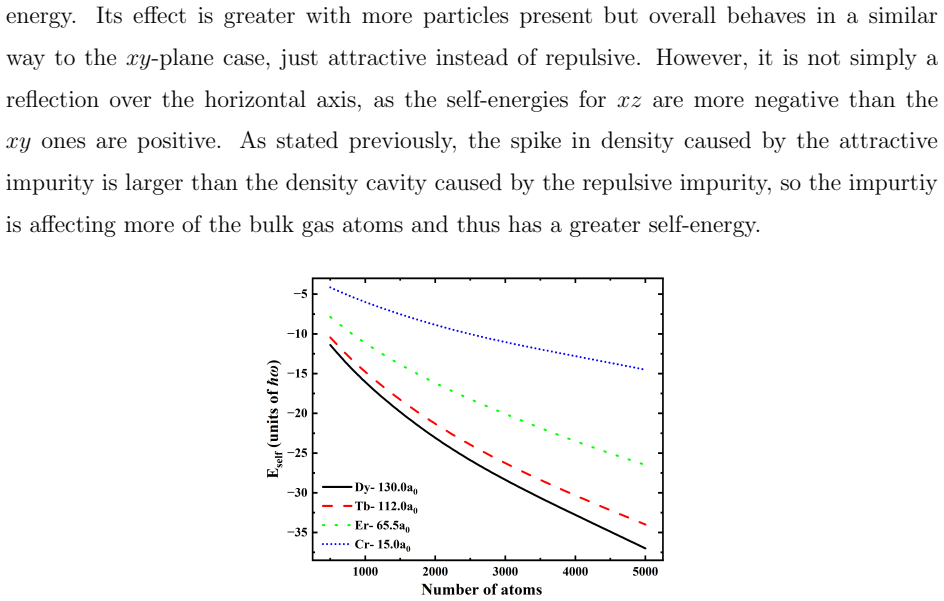
The central claim is that the self-energy of a static dipolar impurity in a quasi-2D dipolar BEC, defined as the total-energy change $E[\beta]-E[0]$ when the impurity interaction is switched on, is controlled by the particle number and by trap anisotropy. For confinement perpendicular to the dipole polarization the dipolar interaction is repulsive and isotropic, the impurity excavates a density dip surrounded by an annulus, and the self-energy is positive and grows with $N$, appearing to scale linearly at large $N$. For confinement parallel to the polarization the interaction is attractive head-to-tail along $z$ and repulsive side-by-side along $x$, the impurity produces a central density spike, and the self-energy is negative and larger in magnitude than the positive perpendicular value. Elongating the trap along $z$ in this parallel geometry lowers the self-energy magnitude, while elongating it along $x$ raises it. The paper also shows that suddenly switching on the impurity launches density ripples that extend well beyond the region of static density distortion.
Load-bearing premise
The load-bearing premise is that the quasi-2D reduction is valid, namely that the atoms remain in the transverse ground state while the anisotropic long-range dipolar interaction is integrated out, and that the singular dipolar potential at the impurity can be regularized by averaging four neighboring grid points without a quantified error estimate.
Editorial extensions
If this is right
- The self-energy magnitude rises with condensate atom number and approaches linear scaling at large $N$, so larger dipolar condensates pay proportionally more energy to host a fixed impurity.
- The sign of the self-energy is set by geometry: positive repulsive in the plane perpendicular to the polarization, negative and larger in magnitude in the parallel plane.
- Matching the trap elongation to the gas's natural dipole orientation reduces the impurity's energy cost, giving experimentalists a geometric control knob independent of scattering lengths.
- Static density changes stay localized near the impurity, but the transient response to suddenly introducing the impurity reaches far outside that region, so time-resolved imaging can see the disturbance before it settles.
Reading between the lines
- Because the self-energy is the quantity behind observable impurity energy shifts, anisotropic confinement could be used experimentally to tune the effective impurity-bath coupling without changing the magnetic field or scattering length.
- If the same deformation dependence holds for a moving impurity, anisotropic traps would also tune the impurity's effective mass and mobility, a testable prediction for future experiments.
- Tilting the confinement between the two extreme geometries, toward the magic angle where the dipolar interaction vanishes along one axis, should interpolate between the positive and negative self-energy regimes and may show a zero crossing; the paper notes this angle but does not compute it.
- The time-dependent method could be extended to two impurities, where the density ripples launched by each impurity would mediate a distance-dependent interaction between them.
Editorial analysis
A structured set of objections, weighed in public.
Referee Report
Summary. The paper studies a quasi-2D dipolar BEC containing a single static dipolar impurity at the trap center. The authors solve the Gross-Pitaevskii equation with the split-step Crank-Nicolson method, modeling the impurity-bath interaction through a strength factor beta. They present density contours, 1D cross sections, self-energies (defined as E[beta]-E[0]), and real-time density dynamics for two geometries: confinement perpendicular to the dipole polarization (xy-plane) and parallel to it (xz-plane). The central qualitative claims are that the self-energy magnitude increases with particle number and that, for parallel confinement, elongating the trap along the dipole polarization (z-axis) reduces the self-energy magnitude. The calculations use experimentally motivated parameters for Dy, Cr, Er, and Tb impurities.
Significance. The topic is timely, and the coordinate-space GPE approach gives direct access to density distortions, which is a useful complement to momentum-space studies. The qualitative physics reported--repulsive isotropic response in the xy-plane, attractive anisotropic response with a central density spike in the xz-plane, and a trap-anisotropy effect on the self-energy--is physically plausible. The paper also includes real-time dynamics that could be of experimental interest. However, the quantitative claims rest on an unverified regularization of the singular dipolar interaction and on an unjustified quasi-2D reduction, and no numerical uncertainty is reported. These issues are central because the reported self-energies are energy differences involving a singular attractive -1/r^3 interaction in the xz geometry.
major comments (3)
- [Section II, after Eq. (3)] The regularization of the singular dipole-dipole potential by setting V_dip at the origin to the average of the four nearest grid points introduces an uncontrolled short-distance cutoff. This is load-bearing: in the xz-plane the interaction is attractive along z and behaves as -C/r^3, and in the continuum limit the quasi-2D energy functional is not bounded below under a local density contraction. The negative self-energies in Figs. 4 and 5 could therefore be dominated by the grid-scale regulator rather than by physical dipolar physics. The statement that the short-range behavior is "not vital to our findings" is not supported. Please add a grid-spacing convergence study, a box-size study, and a sensitivity check with respect to the regularization procedure, or connect the cutoff to a physical short-range parameter such as a 2D scattering length.
- [Section II, Eqs. (4)-(5)] The quasi-2D reduction is stated but not justified. The manuscript assumes that all particles occupy the ground state of the tight confinement direction and integrates that direction out, but the anisotropic and long-range dipole-dipole interaction can couple the confined direction to the in-plane motion. A validity condition (for example, hbar*omega_3D large compared with relevant interaction energies, or the confinement length much smaller than the dipolar length scale) is never given. Since Eq. (4) and all subsequent self-energies depend on this 2D potential, the reduction should be checked, e.g., by comparing with a full 3D GPE calculation for at least one parameter set.
- [Section III, Figs. 2, 4, and 5] The central quantitative results are presented without any estimate of numerical uncertainty. The self-energy in Eq. (6) is a difference of two energies of the same trapped system, and its magnitude, especially for small particle numbers and weak impurities, may be comparable to the numerical error of the split-step Crank-Nicolson solver. Please provide error bars or a quantitative convergence statement (e.g., residual variation with time step, grid spacing, and propagation time) for the self-energy values plotted.
minor comments (5)
- [Throughout] Typos should be corrected: "realtities" (Section II), "impurtiy" (Section III B), "Feschbach-Fano resonances" (should be Feshbach resonances), and "elipses" (Section III C caption).
- [Section II] The sentence "The reader will have noticed that the Hamiltonian, Eq. (1), is a three-dimensional equation" is informal; consider replacing it with a direct statement of the quasi-2D approximation and its assumptions.
- [Section II, Eq. (7)] In Eq. (7), define a and b explicitly as dimensionless scale factors and state the normalization convention (e.g., ab=1) rather than only saying that sqrt(ab) is constant.
- [Section III, figure captions] The captions of Figs. 2 and 4 do not state the trap parameters (omega, ell) or the numerical grid used; adding these would improve reproducibility.
- [End matter] No data/code availability statement is included. Since the manuscript adapts a publicly available code, a statement about sharing the modified code and data would be helpful.
Circularity Check
No circularity: the self-energies are computed energy differences (Eq. 6) from numerical GPE solutions, and the central trends are outputs, not fitted inputs.
full rationale
The paper's derivation chain is self-contained and non-circular. The self-energy is defined as E_self = E[beta] - E[beta = 0] (Eq. 6) and is computed directly from numerical solutions of the Gross-Pitaevskii equation, with no parameter fitted to the predicted quantities. The central claims — that the self-energy magnitude grows with particle number and that it is reduced when the trap is elongated along the dipole-aligned z-axis — are numerical outputs of the GPE, not identities built into the definitions. The trap deformation parameter epsilon is a control variable, and the reported dependence of E_self on epsilon is a computed consequence rather than a tautology. The authors' own prior work is cited only for context and contrast ('This is in contrast to our previous work, [19]'), not as the load-bearing justification for any result; the GPE and quasi-2D reduction are supported by standard external references [20-25, 27]. The paper does state a limitation, 'The short-range behavior of the dipole-dipole interaction is beyond the scope of this paper and not vital to our findings' (Section II), and the singular-potential grid-cell averaging is an uncontrolled numerical regularization; however, this is a correctness or convergence concern, not a circular step. No 'prediction' reduces by construction to an input, and no fitted parameter is renamed as a prediction. Accordingly, there is no significant circularity.
Assumptions & free parameters
assumptions (5)
- domain assumption The many-body wavefunction is a product of single-particle wavefunctions (Gross-Pitaevskii mean-field approximation).
- domain assumption The atoms are in the ground state in the tightly confined direction, and that direction can be integrated out to give a quasi-2D equation.
- domain assumption The impurity is static at the trap center, either because the trap is large or because an external laser pins it.
- ad hoc to paper The singular dipole-dipole interaction at the origin can be regularized by setting the potential to the average of the four nearest grid points.
- standard math The split-step Crank-Nicolson method implemented in a public code [27] provides accurate solutions of the GPE.
Cite this review
Pith. "Pith review of Properties of a static dipolar impurity in a 2D dipolar BEC." pith.science (2026). https://pith.science/paper/YG6D5CE2
@misc{pith2026241219962,
  author       = {Pith},
  title        = {Pith review of: Properties of a static dipolar impurity in a 2D dipolar BEC},
  year         = {2026},
  howpublished = {\url{https://pith.science/paper/YG6D5CE2}},
  note         = {Machine review of arXiv:2412.19962}
}
read the original abstract
We study a system of ultra cold dipolar Bose gas atoms confined in a two-dimensional (2D) harmonic trap with a dipolar impurity implanted at the center of the trap. Due to recent experimental progress in dipolar condensates, we focused on calculating properties of dipolar impurity systems that might guide experimentalists if they choose to study impurities in dipolar gases. We used the Gross-Pitaevskii formalism solved numerically via the split-step Crank-Nicolson method. We chose parameters of the background gas to be consistent with dysprosium (Dy), one of the strongest magnetic dipoles and of current experimental interest, and used chromium (Cr), erbium (Er), terbium (Tb), and Dy for the impurity. The dipole moments were aligned by an external field along what was chosen to be the z-axis, and studied 2D confinements that were perpendicular or parallel to the external field. We show density contour plots for the two confinements, 1D cross sections of the densities, calculated self-energies of the impurities while varying both number of atoms in the condensate and the symmetry of the trap. We also calculated the time evolution of the density of an initially pure system where an impurity is introduced. Our results found that while the self-energy increases in magnitude with increasing number of particles, it is reduced when the trap anisotropy follows the natural anisotropy of the gas, i.e., elongated along the z-axis in the case of parallel confinement. This work builds upon work done in Bose gases with zero-range interactions and demonstrates some of the features that could be found when exploring dipolar impurities in 2D Bose gases.
Figures


Figures from the paper (5 more)


Reference graph
Works this paper leans on
-
[19]
A. G. Volosniev, G. Bighin, L. Santos, and L. A. Pe˜ na Ardila, SciPost Physics 15 (2023)
work page 2023
-
[1]
Lahaye, C
T. Lahaye, C. Menotti, L. Santos, M. Lewenstein, and T. Pfau, Reports on Progress in Physics 72, 126401 (2009)
2009
- [2]
-
[3]
≈ 54.74◦ where the dipolar interaction vanishes in one direction, but the interaction in the perpendicular direction would remain dipolar. V. ACKNOWLEDGEMENTS The authors acknowledge that this material is based upon work supported by the National Science Foundation/EPSCoR RII Track-1: Emergent Quantum Materials and Technologies (EQUATE), Award OIA-2044049. 13
-
[4]
A. Griesmaier, J. Werner, S. Hensler, J. Stuhler, and T. Pfau, Physical Review Letters 94, 160401 (2005)
work page 2005
-
[5]
N. Bigagli, W. Yuan, S. Zhang, B. Bulatovic, T. Karman, I. Stevenson, and S. Will, Nature , 1 (2024)
work page 2024
-
[6]
M.-G. Hu, M. J. Van de Graaff, D. Kedar, J. P. Corson, E. A. Cornell, and D. S. Jin, Physical Review Letters 117, 055301 (2016)
work page 2016
-
[7]
N. B. Jørgensen, L. Wacker, K. T. Skalmstang, M. M. Parish, J. Levinsen, R. S. Christensen, G. M. Bruun, and J. J. Arlt, Physical Review Letters 117, 055302 (2016)
work page 2016
Show all 30 references
-
[8]
Scazza, M
F. Scazza, M. Zaccanti, P. Massignan, M. M. Parish, and J. Levinsen, Atoms 10, 55 (2022)
2022
-
[9]
S. I. Mistakidis, A. Volosniev, R. Barfknecht, T. Fogarty, T. Busch, A. Foerster, P. Schmelcher, and N. Zinner, Physics Reports 1042, 1 (2023)
2023
-
[10]
Grusdt, N
F. Grusdt, N. Mostaan, E. Demler, and L. A. P. Ardila, arXiv preprint arXiv:2410.09413 (2024)
2024 arXiv
-
[11]
A. G. Volosniev, A. S. Jensen, N. L. Harshman, J. R. Armstrong, and N. T. Zinner, Euro- physics Letters 125, 20003 (2019)
2019
-
[12]
Mehboudi, A
M. Mehboudi, A. Lampo, C. Charalambous, L. A. Correa, M. ´A. Garc ´ ıa-March, and M. Lewenstein, Physical Review Letters 122, 030403 (2019)
2019
-
[13]
Bouton, J
Q. Bouton, J. Nettersheim, D. Adam, F. Schmidt, D. Mayer, T. Lausch, E. Tiemann, and A. Widera, Physical Review X 10, 011018 (2020)
2020
-
[14]
Zhang, W
Y. Zhang, W. Ong, I. Arakelyan, and J. Thomas, Physical Review Letters 108, 235302 (2012)
2012
-
[15]
W. Ong, C. Cheng, I. Arakelyan, and J. Thomas, Physical Review Letters 114, 110403 (2015)
2015
-
[16]
Koschorreck, D
M. Koschorreck, D. Pertot, E. Vogt, B. Fr¨ ohlich, M. Feld, and M. K¨ ohl, Nature 485, 619 (2012)
2012
-
[17]
Kain and H
B. Kain and H. Y. Ling, Physical Review A 89, 023612 (2014). 14
2014
-
[18]
L. A. P. Ardila and T. Pohl, Journal of Physics B: Atomic, Molecular and Optical Physics 52, 015004 (2018)
2018
-
[20]
Shukla, A
N. Shukla, A. G. Volosniev, and J. R. Armstrong, Physical Review A 110, 053317 (2024)
2024
-
[21]
Gross, Annals of Physics 19, 234 (1962)
E. Gross, Annals of Physics 19, 234 (1962)
1962
-
[22]
A. G. Volosniev and H.-W. Hammer, Physical Review A 96, 031601 (2017)
2017
-
[23]
Hryhorchak, G
O. Hryhorchak, G. Panochko, and V. Pastukhov, Journal of Physics B: Atomic, Molecular and Optical Physics 53, 205302 (2020)
2020
-
[24]
Jager, R
J. Jager, R. Barnett, M. Will, and M. Fleischhauer, Physical Review Research 2, 033142 (2020)
2020
-
[25]
Drescher, M
M. Drescher, M. Salmhofer, and T. Enss, Physical Review Research 2, 032011 (2020)
2020
-
[26]
Guenther, R
N.-E. Guenther, R. Schmidt, G. M. Bruun, V. Gurarie, and P. Massignan, Physical Review A 103, 013317 (2021)
2021
-
[27]
Catani, G
J. Catani, G. Lamporesi, D. Naik, M. Gring, M. Inguscio, F. Minardi, A. Kantian, and T. Giamarchi, Physical Review A 85, 023623 (2012)
2012
-
[28]
R. K. Kumar, L. E. Young-S, D. Vudragovi´ c, A. Balaˇ z, P. Muruganandam, and S. K. Adhikari, Computer Physics Communications 195, 117 (2015)
2015
-
[29]
C. Chin, R. Grimm, P. Julienne, and E. Tiesinga, Reviews of Modern Physics 82, 1225 (2010)
2010
-
[30]
Paredes, G
R. Paredes, G. Bruun, and A. Camacho-Guardian, Physical Review A 110, 030101 (2024). 15
2024
Reviewed August 10, 2026 · model on record in the stance chip above.
Discussion (0). Continue with ORCID to comment.