REVIEW 2 major objections 3 minor 40 references
This work reports the first lattice-QCD determination of the proton's momentum and angular-momentum decomposition at the continuum limit using only physical-mass ensembles, with total sums of 0.995(60)(29) and 0.507(43)(65).
Reviewed by Pith at T0; open to challenge. T0 means a machine referee read the full paper against a public rubric. the ladder, T0–T4 →
T0 review · deepseek-v4-flash
2026-08-01 08:05 UTC pith:YILMIRN6
load-bearing objection A credible continuum-limit momentum sum-rule result, but the spin decomposition hinges on unpublished axial charges; needs the companion papers before this is more than conditional. the 2 major comments →
Spin and momentum fraction carried by partons in the nucleon
The pith
A machine-rendered reading of the paper's core claim, the machinery that carries it, and where it could break.
Core claim
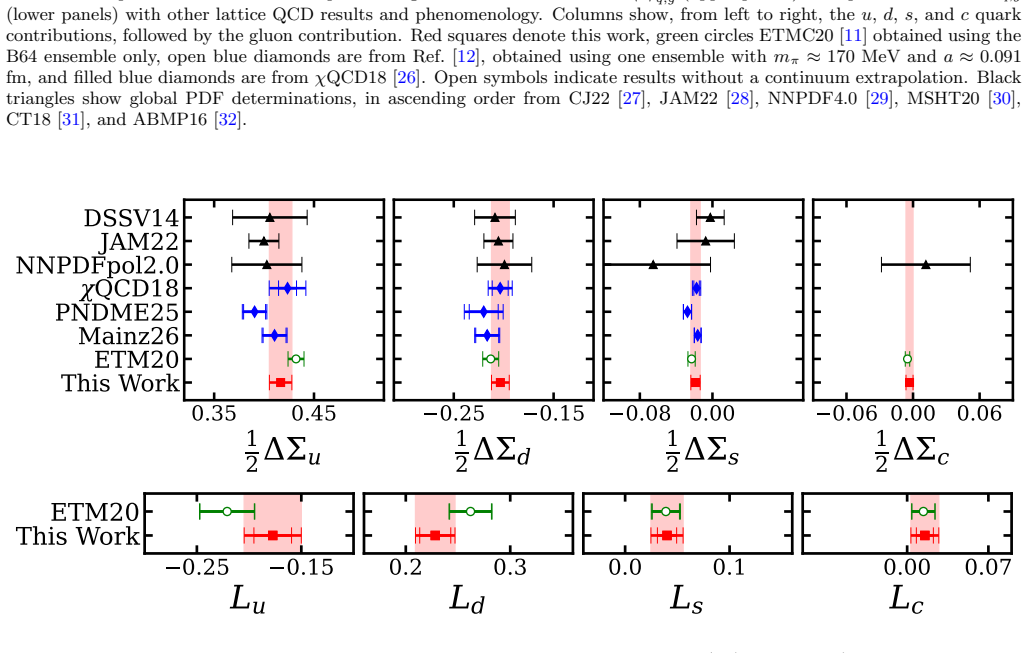
The central claim is that the proton's momentum fraction and total angular momentum can be decomposed into quark (up, down, strange, charm) and gluon contributions directly from lattice QCD at the physical point, with all renormalization factors—including the quark-singlet and gluon mixing—computed non-perturbatively. The authors obtain total momentum fraction <x>_N = 0.995(60)(29) and total spin J_N = 0.507(43)(65), consistent with the sum rules <x>_q + <x>_g = 1 and J_q + J_g = 1/2. They further split J_q into intrinsic quark spin (1/2)ΔΣ_q, taken from axial charges of a companion paper, and orbital angular momentum L_q = J_q - (1/2)ΔΣ_q, yielding a decomposition in which the up quark carr
What carries the argument
The machinery is the nucleon matrix element of the QCD energy-momentum tensor, parameterized by gravitational form factors A20(Q^2) and B20(Q^2). In the forward limit, A20(0) is the momentum fraction <x>; the Ji relation J = (1/2)[A20(0) + B20(0)] gives the total angular momentum. The paper computes these matrix elements on four twisted-mass clover-improved ensembles at different lattice spacings, renormalizes the quark singlet and gluon operators non-perturbatively using a 2x2 mixing matrix, and extrapolates to the continuum using constant and linear fits in a^2 averaged with the Akaike information criterion.
Load-bearing premise
The spin-orbit split assumes the axial-charge values (1/2)ΔΣ_q taken from a companion paper listed as 'In preparation' are correct; if those are wrong, L_q and the spin decomposition change, although the total J_N from A20+B20 is unaffected.
What would settle it
Recompute L_q using independently determined axial charges; if the resulting L_q values move by more than the quoted errors, the decomposition is not yet robust. Alternatively, a future measurement of the proton's total angular momentum (e.g., through deeply virtual Compton scattering) that disagrees with J_N = 0.507(43)(65) would falsify the sum-rule claim.
If this is right
- The momentum sum rule is satisfied at the physical point without chiral extrapolation: <x>_N = 0.995(60)(29), so no missing momentum needs to be attributed to unknown sources.
- The spin sum J_N = 0.507(43)(65) confirms the Ji spin sum rule, with gluons contributing about 42% and sea quarks about 10%, providing a first-principles answer to the proton spin puzzle.
- The quark momentum fractions agree with global PDF analyses, and the lattice intrinsic quark spin has better precision than current polarized-PDF integrals, offering a benchmark for phenomenological fits.
- The small but statistically non-zero strange and charm quark momentum fractions imply intrinsic heavy-quark contributions in the nucleon that global fits should accommodate.
- The individual quark orbital angular momenta, extracted as L_q = J_q - (1/2)ΔΣ_q, are a new continuum-limit prediction that future GPD-based experiments could test.
Where Pith is reading between the lines
- Because the total J_N is built from A20 and B20 alone, while the spin-orbit split uses external axial charges, the decomposition is only as solid as those axial charges; a revision of the companion paper's values would change L_q but not J_N.
- The same lattice machinery could be extended to other second Mellin moments, such as helicity and transversity, to complete the parton picture at the same physical-point continuum limit.
- A natural testable extension is to compute the axial charges on the same four ensembles rather than importing them from a separate analysis, removing an external input and letting the spin-orbit decomposition stand alone.
- If future global analyses tighten the small-x region of polarized PDFs, the lattice intrinsic-spin values here provide a cross-check that could distinguish genuine QCD sea polarization from model assumptions.
Editorial analysis
A structured set of objections, weighed in public.
Referee Report
Summary. The paper reports a lattice QCD determination of the quark and gluon contributions to the nucleon momentum fraction and total angular momentum, using four Nf=2+1+1 twisted-mass ensembles at physical pion mass and lattice spacings from 0.049 to 0.079 fm, with a continuum extrapolation via AIC-weighted constant/linear fits. It quotes ⟨x⟩_N = 0.995(60)(29) and J_N = 0.507(43)(65), consistent with the momentum and spin sum rules. The quark intrinsic spin and orbital angular momentum are derived by combining the computed J_q with axial charges taken from a companion study (Ref. [24]); the paper claims to provide the first complete parton decomposition at physical masses with a continuum limit.
Significance. If correct, the results constitute a major step: a first-principles check of the momentum and spin sum rules at the physical point, with a flavor decomposition and continuum extrapolation. The internal consistency of the sums, the use of four lattice spacings, non-perturbative renormalization including quark-gluon mixing, and AIC-weighted model averaging are strengths. The cross-checks against phenomenological PDFs are useful. The main reservation is that the advertised spin decomposition depends on axial charges from an unpublished companion paper.
major comments (2)
- [Results and discussion, Table II] The central advertised result—a complete decomposition of the proton spin into intrinsic quark spin and orbital angular momentum—rests on the values of 1/2 ΔΣ_q taken from Ref. [24], which is cited as 'In preparation.' These values are not derived or shown in this manuscript. Since L_q = J_q − 1/2 ΔΣ_q (defined in the paragraph before Table II), any error or bias in the axial charges directly changes all L_q and the interpretation of the spin decomposition. This is load-bearing for the conclusion 'first quantitatively complete parton decomposition.' Please either include the axial-charge calculation and its full error budget here, or replace the reference with a publicly available, published analysis. In addition, state how the quoted L_q errors are propagated from J_q and ΔΣ_q, including whether correlations between the two are neglected.
- [Table II footnote; Conclusions] The error definitions are inconsistent. Table II states that the first error on ⟨x⟩ and J combines the statistical error with the AIC model-average error of the continuum extrapolation, while the Conclusions state that 'the first error is the statistical error.' This mislabel affects the interpretation of the central results. The footnote also gives only one error for 1/2 ΔΣ_q; the systematic uncertainty on L_q therefore does not include the systematic error of the axial-charge input. Please clarify the error definitions and, if possible, provide a complete error breakdown for the decomposed quantities.
minor comments (3)
- [Extraction section] Typo: 'solve it using the its singular value decomposition' should be 'solve it using its singular value decomposition'.
- [Table II footnote] Typo: 'taken form Ref. [24]' should be 'taken from Ref. [24]'.
- [Conclusions] The statement 'we also find a small non-zero contribution of the charm quark to the momentum fraction' is based on ⟨x⟩_c = 0.025(10)(7); even with errors added in quadrature this is only about a 2σ effect. Please soften to 'consistent with a small positive charm contribution' or provide a quantitative significance.
Circularity Check
No circularity: momentum and spin fractions are computed from matrix elements and summed; the spin-orbit decomposition uses an external, independent axial-charge input.
full rationale
The paper's central derivation computes quark and gluon momentum fractions and total angular momentum directly from lattice matrix elements of the energy-momentum tensor. The momentum sum rule and spin sum rule are not imposed as constraints; the paper states 'we check the momentum and spin sums by computing ab initio all components.' The continuum extrapolation, renormalization, and A20/B20 extraction are standard and not defined in terms of the final sum-rule results. The spin decomposition uses L_q = J_q − 1/2 ΔΣ_q with ΔΣ_q taken from Ref. [24], a companion paper by the same collaboration that is 'In preparation.' This is a genuine external-input dependency and a limitation for auditability, but it is not circular: the axial charges are a separate observable (nucleon axial charges), not the paper's target result, and the relation used is a definitional decomposition, not a fitted parameter called a prediction. Similarly, Refs. [20] and [11] supply methodology and previous results, not the target claims. Therefore no circular step can be exhibited; the derivation does not reduce to its inputs.
Axiom & Free-Parameter Ledger
axioms (6)
- standard math The QCD energy-momentum tensor can be decomposed into quark and gluon parts whose forward matrix elements give momentum fractions via A20(0) (Eq. 3) and total angular momentum via J=1/2(A20+B20) (Eq. 4).
- standard math Nucleon matrix elements of the EMT are parametrized by the gravitational form factors A20, B20, C20 (Eq. 2).
- domain assumption The twisted-mass clover action is at maximal twist, so physical matrix elements are automatically O(a) improved without additional operator improvement.
- domain assumption The four ensembles with m_pi between 136.5 and 140.8 MeV are treated as being at the physical pion mass, so the continuum limit can be taken in a^2 without a chiral extrapolation.
- domain assumption The nonperturbative RI'-MOM renormalization conditions (including the 2x2 mixing matrix in Eq. 5 and suppression of gauge-noninvariant mixing) are sufficient to yield the physical MS matrix elements at 2 GeV.
- domain assumption The intrinsic quark spin 1/2 DeltaSigma_q equals half the axial charge g_A^q from Ref. [24] and those values are correct.
read the original abstract
We determine the momentum fraction and angular momentum carried by quarks and gluons in the proton in lattice QCD. We use four ensembles simulated with up, down, strange and charm quarks with their masses tuned to their physical values. These ensembles have similar physical volume and different lattice spacings allowing us to take the continuum limit directly at the physical pion mass point. We extract the quark and gluon momentum fractions and total angular momentum in the continuum limit as well as the intrinsic quark spin and orbital angular momentum contributions to the proton spin. We find the total momentum fraction $\langle x_N \rangle= 0.995(60)(29)$ and the total spin $J_N = 0.507(43)(65)$, showing that both the momentum and spin sum rules are satisfied. We compare our results to those extracted from phenomenological analyses.
Figures


Reference graph
Works this paper leans on
-
[1]
C. A. Aidala, S. D. Bass, D. Hasch, and G. K. Mallot, The Spin Structure of the Nucleon, Rev. Mod. Phys.85, 655 (2013), arXiv:1209.2803 [hep-ph]
Pith/arXiv arXiv 2013
-
[2]
L. Adamczyket al.(STAR), Precision Measurement of the Longitudinal Double-spin Asymmetry for Inclu- sive Jet Production in Polarized Proton Collisions at√s= 200 GeV, Phys. Rev. Lett.115, 092002 (2015), arXiv:1405.5134 [hep-ex]
Pith/arXiv arXiv 2015
-
[3]
A. Accardiet al., Electron Ion Collider: The Next QCD Frontier: Understanding the glue that binds us all, Eur. Phys. J. A52, 268 (2016), arXiv:1212.1701 [nucl-ex]
Pith/arXiv arXiv 2016
-
[4]
J. Ashmanet al.(European Muon Collaboration), A measurement of the spin asymmetry and determination of the structure function g1 in deep inelastic muon-proton scattering, Physics Letters B206, 364 (1988)
1988
-
[5]
J. Ashmanet al.(European Muon Collaboration), An investigation of the spin structure of the proton in deep inelastic scattering of polarized muons on polarized pro- tons, Nuclear Physics B328, 1 (1989)
1989
-
[6]
Adevaet al.(Spin Muon), Spin asymmetries A(1) and structure functions g1 of the proton and the deuteron from polarized high-energy muon scattering, Phys
B. Adevaet al.(Spin Muon), Spin asymmetries A(1) and structure functions g1 of the proton and the deuteron from polarized high-energy muon scattering, Phys. Rev. D58, 112001 (1998)
1998
-
[7]
A. Airapetianet al.(HERMES), Precise determination of the spin structure function g(1) of the proton, deuteron and neutron, Phys. Rev. D75, 012007 (2007), arXiv:hep- ex/0609039
arXiv 2007
-
[8]
C. Adolphet al.(COMPASS), Multiplicities of charged pions and charged hadrons from deep-inelastic scattering of muons off an isoscalar target, Phys. Lett. B764, 1 (2017), arXiv:1604.02695 [hep-ex]
Pith/arXiv arXiv 2017
-
[9]
X. Ji, F. Yuan, and Y. Zhao, Proton spin after 30 years: What we know and what we don’t, Nature Reviews Physics3, 27 (2021), arXiv:2009.01291 [hep-ph]
Pith/arXiv arXiv 2021
-
[10]
C. Alexandrou, Hadron Structure from lattice QCD in the context of the Electron-Ion Collider, in42th In- ternational Symposium on Lattice Field Theory(2026) arXiv:2603.28604 [hep-lat]
Pith/arXiv arXiv 2026
-
[11]
C. Alexandrou, S. Bacchio, M. Constantinou, J. Finken- rath, K. Hadjiyiannakou, K. Jansen, G. Koutsou, H. Panagopoulos, and G. Spanoudes, Complete fla- vor decomposition of the spin and momentum frac- tion of the proton using lattice QCD simulations at physical pion mass, Phys. Rev. D101, 094513 (2020), arXiv:2003.08486 [hep-lat]
Pith/arXiv arXiv 2020
-
[12]
D. C. Hackett, D. A. Pefkou, and P. E. Shanahan, Grav- itational form factors of the proton from lattice QCD, Phys. Rev. Lett.132, 251904 (2024), arXiv:2310.08484 [hep-lat]
Pith/arXiv arXiv 2024
- [13]
-
[14]
Ji, Gauge-Invariant Decomposition of Nucleon Spin, Phys
X. Ji, Gauge-Invariant Decomposition of Nucleon Spin, Phys. Rev. Lett.78, 610 (1997), arXiv:hep-ph/9603249
Pith/arXiv arXiv 1997
-
[15]
R. Frezzotti, P. A. Grassi, S. Sint, and P. Weisz (Alpha), Lattice QCD with a chirally twisted mass term, JHEP 08, 058, arXiv:hep-lat/0101001
-
[16]
R. Frezzotti and G. C. Rossi, Chirally improving Wil- son fermions. 1. O(a) improvement, JHEP08, 007, arXiv:hep-lat/0306014
-
[17]
C. Alexandrouet al.(Extended Twisted Mass), Lattice calculation of the short and intermediate time-distance hadronic vacuum polarization contributions to the muon magnetic moment using twisted-mass fermions, Phys. Rev. D107, 074506 (2023), arXiv:2206.15084 [hep-lat]
Pith/arXiv arXiv 2023
-
[18]
C. Alexandrouet al.(Extended Twisted Mass Collabo- ration), Strange and charm quark contributions to the muon anomalous magnetic moment in lattice QCD with twisted-mass fermions, Phys. Rev. D111, 054502 (2025), arXiv:2411.08852 [hep-lat]
Pith/arXiv arXiv 2025
-
[19]
C. Morningstar and M. Peardon, Analytic Smearing of SU(3) Link Variables in Lattice QCD, Phys. Rev. D69, 054501 (2004), arXiv:hep-lat/0311018
Pith/arXiv arXiv 2004
-
[20]
C. Alexandrou, S. Bacchio, J. Finkenrath, C. Iona, G. Koutsou, C. Kummer, Y. Li, B. Prasad, and G. Spanoudes, Nucleon unpolarized second Mellin mo- ments using lattice QCD ensembles with physical quark masses and in the continuum limit (2026) arXiv:2607.20337 [hep-lat]
arXiv 2026
-
[21]
G. Martinelli, C. Pittori, C. T. Sachrajda, M. Testa, and A. Vladikas, A General method for nonperturbative renormalization of lattice operators, Nucl. Phys. B445, 81 (1995), arXiv:hep-lat/9411010
Pith/arXiv arXiv 1995
-
[22]
W. I. Jay and E. T. Neil, Bayesian model averaging for analysis of lattice field theory results, Phys. Rev. D103, 114502 (2021), arXiv:2008.01069 [stat.ME]
Pith/arXiv arXiv 2021
-
[23]
E. T. Neil and J. W. Sitison, Improved information cri- teria for Bayesian model averaging in lattice field the- ory, Phys. Rev. D109, 014510 (2024), arXiv:2208.14983 [stat.ME]
Pith/arXiv arXiv 2024
-
[24]
Extended Twisted Mass Collaboration, Flavor decompo- sition of the nucleon axial and tensor charges from lattice QCD, In preparation
-
[25]
C. Alexandrou, S. Bacchio, J. Finkenrath, C. Iona, G. Koutsou, Y. Li, and G. Spanoudes, Nucleon charges andσ-terms in lattice QCD, Phys. Rev. D111, 054505 (2025), arXiv:2412.01535 [hep-lat]
Pith/arXiv arXiv 2025
-
[26]
Y.-B. Yang, J. Liang, Y.-J. Bi, Y. Chen, T. Draper, K.-F. Liu, and Z. Liu, Proton mass decomposition from the qcd energy momentum tensor, Phys. Rev. Lett.121, 212001 (2018), arXiv:1808.08677 [hep-lat]
Pith/arXiv arXiv 2018
-
[27]
A. Accardi, X. Jing, J. F. Owens, and S. Park, Light quark and antiquark constraints from new electroweak data, Phys. Rev. D107, 113005 (2023), arXiv:2303.11509 [hep-ph]
Pith/arXiv arXiv 2023
-
[28]
C. Cocuzza, W. Melnitchouk, A. Metz, and N. Sato (Jef- ferson Lab Angular Momentum (JAM)), Polarized anti- matter in the proton from a global QCD analysis, Phys. Rev. D106, L031502 (2022), arXiv:2202.03372 [hep-ph]
Pith/arXiv arXiv 2022
-
[29]
R. D. Ball, S. Carrazza, J. Cruz-Martinez,et al. (NNPDF), The path to proton structure at 1% accu- racy, Eur. Phys. J. C82, 428 (2022), arXiv:2109.02653 [hep-ph]
Pith/arXiv arXiv 2022
-
[30]
S. Bailey, T. Cridge, L. Harland-Lang, A. Martin, and R. Thorne, Parton distributions from LHC, HERA, Teva- tron and fixed target data: MSHT20 PDFs, Eur. Phys. J. C81, 341 (2021), arXiv:2012.04684 [hep-ph]
Pith/arXiv arXiv 2021
-
[31]
T.-J. Hou, J. Gao, T. Hobbs,et al., New CTEQ global analysis of quantum chromodynamics with high-precision data from the LHC, Phys. Rev. D103, 014013 (2021), arXiv:1912.10053 [hep-ph]
Pith/arXiv arXiv 2021
-
[32]
S. Alekhin, J. Bl¨ umlein, S. Moch, and R. Placakyte, Par- ton distribution functions,α s, and heavy-quark masses 8 for LHC Run II, Phys. Rev. D96, 014011 (2017), arXiv:1701.05838 [hep-ph]
Pith/arXiv arXiv 2017
-
[33]
S. Park, R. Gupta, T. Bhattacharya, F. He, S. Mondal, H.-W. Lin, and B. Yoon, Flavor diagonal nucleon charges using clover fermions on MILC HISQ ensembles, Phys. Rev. D112, 054508 (2025), arXiv:2503.07100 [hep-lat]
arXiv 2025
-
[34]
A. Barone, D. Djukanovic, G. von Hippel, H. B. Meyer, K. Ottnad, and H. Wittig, The strange and flavor-singlet axial form factors of the nucleon from lattice QCD (2026), arXiv:2605.06559 [hep-lat]
Pith/arXiv arXiv 2026
-
[35]
D. Djukanovic, G. von Hippel, H. B. Meyer, K. Ottnad, and H. Wittig, Improved analysis of isovector nucleon matrix elements with Nf=2+1 flavors of O(a) improved Wilson fermions, Phys. Rev. D109, 074507 (2024), arXiv:2402.03024 [hep-lat]
Pith/arXiv arXiv 2024
-
[36]
J. Liang, Y.-B. Yang, T. Draper, M. Gong, and K.-F. Liu, Quark spins and Anomalous Ward Identity, Phys. Rev. D98, 074505 (2018), arXiv:1806.08366 [hep-ph]
Pith/arXiv arXiv 2018
-
[37]
J. Cruz-Martinez, T. Hasenack, F. Hekhorn, G. Magni, E. R. Nocera, T. R. Rabemananjara, J. Rojo, T. Sharma, and G. van Seeventer, NNPDFpol2.0: A global de- termination of polarised PDFs and their uncertain- ties at next-to-next-to-leading order, JHEP07, 168, arXiv:2503.11814 [hep-ph]
-
[38]
D. De Florian, G. A. Lucero, R. Sassot, M. Stratmann, and W. Vogelsang, Monte Carlo sampling variant of the DSSV14 set of helicity parton densities, Phys. Rev. D 100, 114027 (2019), arXiv:1902.10548 [hep-ph]
Pith/arXiv arXiv 2019
-
[39]
J¨ ulich Supercomputing Centre, JUWELS: Modular Tier-0/1 Supercomputer at the J¨ ulich Supercomput- ing Centre, Journal of large-scale research facilities5, 10.17815/jlsrf-5-171 (2019)
-
[40]
J¨ ulich Supercomputing Centre, JUWELS Cluster and Booster: Exascale Pathfinder with Modular Supercom- puting Architecture at Juelich Supercomputing Centre, Journal of large-scale research facilities7, 10.17815/jlsrf- 7-183 (2021)
doi:10.17815/jlsrf- 2021
discussion (0)
Sign in with ORCID, Apple, or X to comment. Anyone can read and Pith papers without signing in.