REVIEW 2 major objections 5 minor 93 references
Search for Vector-mediated Dark Matter at the LHC with Forward Proton Tagging
T0 review · 2 major / 5 minor · reviewed 2026-08-14 · deepseek-v4-flash
Pith's one-line read Forward-tagged photon collisions at the LHC could exclude a vector dark-matter mediator up to about 1.4 TeV, and a dark-matter mass above about 550 GeV.
desk verdict A clean parton-level feasibility study whose headline reach is conditional on an untested pileup-suppression assumption; the mixed-scenario curves are new, but the phenomenological window is already closed by dijet searches. read the letter →
The pith
A machine-rendered reading of the paper's core claim, the machinery that carries it, and where it could break.
The reading
What carries the argument
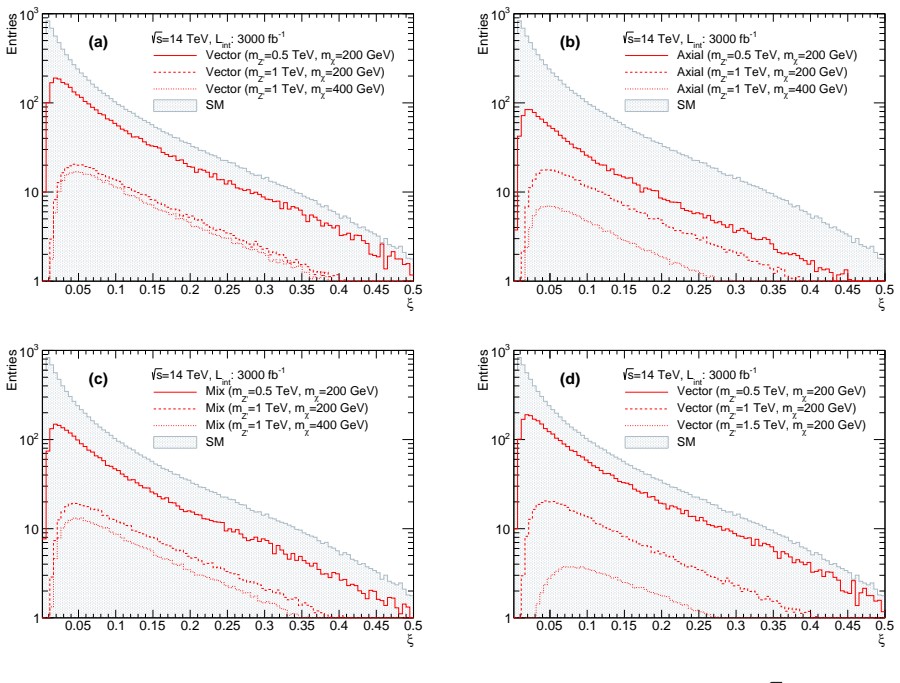
The carrying mechanism is forward proton tagging through the momentum fraction loss $\xi$, the fractional momentum carried away from the intact proton, with detector acceptance $0.015<\xi<0.15$ and an analysis cut $0.05<\xi<0.15$. The signal's $\xi$ distribution shifts to larger values as $m_{Z'}$ grows, while the dominant background $pp\to p\gamma p\to pj\nu\bar{\nu}X$ peaks at low $\xi$, so the cut suppresses that background to about 28% of its original rate while keeping about 48% of the benchmark signal. The photon flux is modeled by the equivalent photon approximation with survival probability $S^2=0.7$, and the mediator interactions are implemented with benchmark spin-1 couplings.
What would settle it
A measurement of the rate of jet-plus-missing-energy events that carry a forward proton from pileup, under Run-III conditions with the same $0.05<\xi<0.15$ cut, would settle the claim: if that rate exceeds the 2305 background events assumed in the 95% confidence calculation, the projected 1.4 TeV mediator exclusion does not survive, and if it can be suppressed below that level, the channel is viable.
Extended reading notes
Core claim
The paper studies the simplified model in which a leptophobic spin-1 mediator $Z'$ couples to quarks and to a Dirac fermion dark matter candidate $\chi$, and considers the photon-induced process $pp\to p\gamma p\to pj\chi\bar{\chi}X$, where the photon-emitting proton stays intact and is tagged by a forward proton detector while the central detector sees a jet and missing transverse energy. The irreducible background is $pp\to p\gamma p\to pj\nu\bar{\nu}X$ with neutrinos summed over three flavors. Using parton-level event generation, jet cuts $p_T^j>200$ GeV and $|\eta^j|<3.0$, the forward-proton cut $0.05<\xi<0.15$, and a 95% confidence requirement $N_S/\sqrt{N_B}>1.96$ at 14 TeV with 3000 fb$^{-1}$, the paper claims that mediator masses below about 1.4 TeV are excluded for all three coupling scenarios, with lower dark-matter mass bounds of about 550 GeV at $m_{Z'}=1.2$ TeV in the vector scenario, 400 GeV at 1.1 TeV in the axial-vector scenario, and 500 GeV at 1.1 TeV in the mixed scenario.
Load-bearing premise
The limits stand or fall on the assumption that pileup-produced forward protons can be separated from the signal's own forward proton, even though ordinary jet-plus-missing-energy events with a pileup proton are roughly a thousand times more common and the paper does not specify how the separation would be done.
Editorial extensions
If this is right
- A null result in the forward-tagged channel at 14 TeV with 3000 inverse femtobarns excludes mediator masses below about 1.4 TeV at 95% confidence in all three coupling scenarios when the dark matter is light.
- In the vector scenario the channel sets a dark-matter mass bound of about 550 GeV at a 1.2 TeV mediator, slightly stronger than the compared energetic-jet analysis for mediator masses below about 1.2 TeV.
- The mixed vector-plus-axial scenario, not covered by the cited energetic-jet searches, receives a projected dark-matter mass bound of about 500 GeV at a 1.1 TeV mediator.
- Cutting the intact proton's momentum loss to the 0.05-0.15 window reduces the main background to about 28% of its original rate while keeping about 48% of the benchmark signal.
Reading between the lines
- The same momentum-loss tagging logic could be applied to other invisible or semi-invisible new-physics channels, since the background suppression is kinematic rather than model-specific.
- A pileup-aware detector-level study using timing or vertex matching is the natural next step: it would convert these parton-level projections into a search strategy, or show that the assumed suppression is not achievable.
- Given the strong dijet limits on the mediator, the practical window for this channel is likely the lower-mediator-mass, higher-dark-matter-mass corner where resonance searches are weaker; the paper notes the dijet bound but does not quantify the overlap.
Signed reviews
Editorial analysis
A structured set of objections, weighed in public.
Referee Report
Summary. The paper presents a parton-level feasibility study of fermionic dark-matter pair production through photon-induced interactions at the LHC, pp -> p gamma p -> p j chi chi-bar X, with a leptophobic spin-1 mediator Z' and one intact proton tagged by forward proton detectors such as AFP and CT-PPS. Signal and irreducible Standard Model background (pp -> p gamma p -> p j nu nu-bar X) are simulated with MadGraph5_aMC@NLO using the DMsimp model and NNPDF2.3, with the selections pT(j) > 200 GeV, |eta(j)| < 3.0, and 0.05 < xi < 0.15. Exclusion limits are derived with the criterion N_S / sqrt(N_B) > 1.96 at 95% C.L. for sqrt(s) = 14 TeV and L_int = 3000 fb^-1, and the paper claims sensitivity to m_Z' up to about 1.4 TeV and, in the vector scenario, a lower bound m_chi > about 550 GeV at m_Z' = 1.2 TeV. The analysis explicitly omits pileup, single-diffractive, and other QCD backgrounds, and the pileup suppression needed for the central claim is left to future work.
Significance. If the projected sensitivity can be made realistic, the forward-proton-tagged photon-induced channel would be a useful complement to monojet and dijet searches, potentially covering a mixed vector-axial mediator scenario that the energetic-jet analyses have not presented. The paper has clear strengths: the benchmark couplings follow LHC Dark Matter Working Group recommendations, the cut flow in Table 1 is explicit, the comparison with the ATLAS energetic-jet limits in Fig. 5 is informative, and the parton-level computation is internally consistent. The caveat is that the headline exclusion contours are computed with only the irreducible background and therefore depend on an unquantified assumption that pileup-generated forward protons can be rejected. Because that assumption is load-bearing, the published claims need either a quantitative treatment of the pileup background or a prominently qualified statement of what is being assumed.
major comments (2)
- [Section 3, pileup paragraph; Section 4 and Fig. 5] This is the central issue. The paper states that pp -> j + /ET + X with an accidental forward proton from pileup has a rate about 1000 times larger than the tagged photon-induced process and that 'unless the pileup events are controlled well enough, the process pp -> j/ET X with one final forward proton from pileup events overwhelmingly dominates over our process.' It then explicitly says that the suppression mechanism is left to future work. Since N_B in the significance calculation includes only the irreducible photon-induced background, the 95% C.L. contours in Fig. 5, and the abstract's m_Z' < about 1.4 TeV and m_chi > about 550 GeV claims, rely on an unquantified assumption of essentially perfect rejection of accidental forward protons. The authors should include a quantitative estimate of the accidental tagging rate for HL-LHC pileup conditions (with timing and vertex-matching information for AFP and CT-PPS), add this component to the background in the N_S/sqrt(N_B) calculation, or present all sensitivity numbers as explicitly conditional on a stated pileup-rejection performance. A corresponding qualifier in the abstract is also needed.
- [Section 4, dijet comparison paragraph] The paper acknowledges that the combined dijet invariant-mass search excludes m_Z' above about 5 TeV for the benchmark quark couplings, which is much stronger than the forward-proton channel's claimed sensitivity of m_Z' < about 1.4 TeV. Because the exclusion contours in Fig. 5 lie almost entirely in parameter space already excluded by dijet searches, the statement that this production channel is 'sensitive' to the simplified model is potentially misleading. The authors should either identify a parameter region or observable that is not already covered by dijet bounds (for example, the DM mass reach at a fixed, still-allowed m_Z', or a smaller g_q scenario that evades dijet limits), or present the paper explicitly as a detector-feasibility and method study rather than as a new competitive constraint. This is a framing issue, but it directly affects the significance of the central claim.
minor comments (5)
- [Abstract and Section 3] The abstract should carry the same caveat as Section 3 about the pileup background, since the present wording presents the sensitivity numbers as unconditional.
- [Section 3, background sentence] The sentence 'this cross section is about 2000 times smaller' should specify that it is about 2000 times smaller than the leading background cross section, to avoid ambiguity.
- [Figures 3 and 4 captions] The axis labels in the figure captions are garbled (for example, 'Entries/GeV -1: 3000 fbint=14 TeV, Ls...') and should be cleaned up; the y-axis unit also appears to be 'Entries' in Fig. 4 but 'Entries/GeV' in Fig. 3.
- [References [40] and [88]] References [40] and [88] are left as placeholders with 'Non-standard form, no INSPIRE lookup performed' and must be replaced with full bibliographic entries.
- [Section 3, background discussion] The treatment of single-diffractive and QCD processes is only a one-sentence assertion; a quantitative statement of why these backgrounds are negligible in the chosen 0.05 < xi < 0.15 window would strengthen the background model.
Circularity Check
No significant circularity: the projected sensitivity bounds are the output of an independent parton-level simulation with benchmark couplings, and the explicit pileup caveat is an unverified assumption rather than a circular reduction.
full rationale
The paper's central claim--that forward-proton-tagged photon-induced production can exclude mZ' up to about 1.4 TeV and mchi above about 550 GeV at mZ' = 1.2 TeV in the vector scenario--is obtained by generating parton-level signal and background events with MadGraph using the DMsimp simplified-model implementation, with benchmark couplings adopted from the LHC Dark Matter Working Group (Eqs. 6-8). No quantity in the exclusion contours is fitted to the data being predicted; the 95% C.L. contours follow from the stated NS/sqrt(NB) > 1.96 criterion applied to independently computed cross sections. The self-citations in the paper (Ref. [30] on spin-2 mediator searches and Ref. [74] on forward-proton pileup backgrounds) support methodology and background-discussion ideas, not the sensitivity result itself, so they are not load-bearing. The paper explicitly acknowledges that 'we assume that the pileup events are sufficiently suppressed, and we leave an investigation of the suppression mechanism to the future work'; this is a genuine missing-support caveat that conditions the projection, but it does not make the derivation circular because the claim is explicitly stated under that assumption and is not obtained by assuming the conclusion. No equation reduces to its own input, and no fitted parameter is renamed as a prediction. The honest finding is that the derivation chain is self-contained for what it claims, with the pileup-suppression assumption identified as future work.
Assumptions & free parameters
free parameters (9)
- gV_chi (vector scenario) =
1.0
- gV_q (vector scenario) =
0.25
- gA_chi (axial scenario) =
1.0
- gA_q (axial scenario) =
0.25
- Mixed scenario couplings =
gV_chi = gA_chi = 1/sqrt(2), gV_q = gA_q = 1/(4 sqrt(2))
- Survival probability S2 =
0.7
- Jet pT cut =
200 GeV
- Jet pseudorapidity cut =
|eta| < 3.0
- xi selection window =
0.05 < xi < 0.15
assumptions (6)
- domain assumption Leptophobic Z' simplified model with interactions of Eq. (5)
- domain assumption Equivalent photon approximation accurately describes photon emission from protons in MadGraph
- domain assumption Survival probability S2 is a constant 0.7
- ad hoc to paper Pileup events can be suppressed sufficiently for the signal to be observable
- domain assumption Dark matter chi is stable and escapes the detector, providing missing transverse energy
- domain assumption The SM background is dominated by pp to p gamma p to p j nu nubar X
Cite this review
Pith. "Pith review of Search for Vector-mediated Dark Matter at the LHC with Forward Proton Tagging." pith.science (2026). https://pith.science/paper/YKXKBLF3
@misc{pith2026190806357,
  author       = {Pith},
  title        = {Pith review of: Search for Vector-mediated Dark Matter at the LHC with Forward Proton Tagging},
  year         = {2026},
  howpublished = {\url{https://pith.science/paper/YKXKBLF3}},
  note         = {Machine review of arXiv:1908.06357}
}
abstract
We investigate the production of fermionic dark matter $\chi$ via $pp \to p\gamma p \to p j \chi \bar{\chi}X$ mediated by a leptophobic spin-1 particle, where one of the protons remains intact and is tagged by forward proton detectors. We find that the masses of $\chi$ and the mediator $Z'$ are severely constrained when $Z'$ interacts with $\chi$ and quarks through the vector couplings. We show that dark matter searches in this production channel are sensitive to a mediator mass $m_{Z'} \lesssim 1.4~\mathrm{TeV}$ at 14 TeV at the LHC with an integrated luminosity $L_{\rm{int}} = 3000~\rm{fb}^{-1}$. The lower mass bound on the dark matter is $m_\chi \simeq 550~\mathrm{GeV}$ at the mediator mass $m_{Z'}=1.2~\mathrm{TeV}$.
Figures


Figures from the paper (2 more)

Reference graph
Works this paper leans on
-
[65]
Dark Matter Searches in Jet plus Missing Energy in $\rm \gamma p$ collision at CERN LHC
H. Sun, Phys. Rev. D 90, no. 3, 035018 (2014) doi:10.1103/PhysRevD.90.035018 [arXiv:1407.5356 [hep-ph]]
work page Pith review arXiv 2014
-
[1]
D. Alves et al. [LHC New Physics Working Group], J. Phys. G 39, 105005 (2012) doi:10.1088/0954- 3899/39/10/105005 [arXiv:1105.2838 [hep-ph]]. 12
arXiv 2012
-
[2]
J. Abdallah et al. , Phys. Dark Univ. 9-10, 8 (2015) doi:10.1016/j.dark.2015.08.001 [arXiv:1506.03116 [hep-ph]]
arXiv 2015
-
[4]
A. Boveia et al., Phys. Dark Univ. 27, 100365 (2020) doi:10.1016/j.dark.2019.100365 [arXiv:1603.04156 [hep-ex]]
arXiv 2020
-
[5]
A. Albert et al., Phys. Dark Univ. 26, 100377 (2019) doi:10.1016/j.dark.2019.100377 [arXiv:1703.05703 [hep-ex]]
arXiv 2019
- [6]
-
[7]
V. Khachatryan et al. [CMS Collaboration], JHEP 1612, 083 (2016) Erratum: [JHEP 1708, 035 (2017)] doi:10.1007/JHEP12(2016)083, 10.1007/JHEP08(2017)035 [arXiv:1607.05764 [hep-ex]]
arXiv 2016
-
[8]
CMS Collaboration [CMS Collaboration], CMS-PAS-EXO-16-037
Show all 93 references
-
[9]
A. M. Sirunyan et al. [CMS Collaboration], Phys. Rev. D 97, no. 9, 092005 (2018) doi:10.1103/PhysRevD.97.092005 [arXiv:1712.02345 [hep-ex]]
2018 arXiv
-
[10]
A. M. Sirunyan et al. [CMS Collaboration], Eur. Phys. J. C 78, no. 4, 291 (2018) doi:10.1140/epjc/s10052-018-5740-1 [arXiv:1711.00431 [hep-ex]]
2018 arXiv
-
[11]
A. M. Sirunyan et al. [CMS Collaboration], Eur. Phys. J. C 77, no. 12, 845 (2017) doi:10.1140/epjc/s10052-017-5317-4 [arXiv:1706.02581 [hep-ex]]
2017 arXiv
-
[12]
A. M. Sirunyan et al. [CMS Collaboration], Phys. Rev. D 97, no. 3, 032009 (2018) doi:10.1103/PhysRevD.97.032009 [arXiv:1711.00752 [hep-ex]]
2018 arXiv
-
[13]
Aaboud et al
M. Aaboud et al. [ATLAS Collaboration], JHEP 1905, 142 (2019) doi:10.1007/JHEP05(2019)142 [arXiv:1903.01400 [hep-ex]]
2019 arXiv
-
[14]
Aaboud et al
M. Aaboud et al. [ATLAS Collaboration], JHEP 1806, 108 (2018) doi:10.1007/JHEP06(2018)108 [arXiv:1711.11520 [hep-ex]]
2018 arXiv
-
[15]
Aaboud et al
M. Aaboud et al. [ATLAS Collaboration], Eur. Phys. J. C78, no. 1, 18 (2018) doi:10.1140/epjc/s10052- 017-5486-1 [arXiv:1710.11412 [hep-ex]]
2018 arXiv
-
[16]
Aaboud et al
M. Aaboud et al. [ATLAS Collaboration], JHEP 1606, 059 (2016) doi:10.1007/JHEP06(2016)059 [arXiv:1604.01306 [hep-ex]]
2016 arXiv
-
[17]
Aaboud et al
M. Aaboud et al. [ATLAS Collaboration], Phys. Rev. D 94, no. 3, 032005 (2016) doi:10.1103/PhysRevD.94.032005 [arXiv:1604.07773 [hep-ex]]
2016 arXiv
-
[18]
Aaboud et al
M. Aaboud et al. [ATLAS Collaboration], Phys. Lett. B 763, 251 (2016) doi:10.1016/j.physletb.2016.10.042 [arXiv:1608.02372 [hep-ex]]
2016 arXiv
-
[19]
Aaboud et al
M. Aaboud et al. [ATLAS Collaboration], Phys. Lett. B 765, 11 (2017) doi:10.1016/j.physletb.2016.11.035 [arXiv:1609.04572 [hep-ex]]
2017 arXiv
-
[20]
A. M. Sirunyan et al. [CMS Collaboration], Phys. Lett. B 769, 520 (2017) Erratum: [Phys. Lett. B 772, 882 (2017)] doi:10.1016/j.physletb.2017.09.029, 10.1016/j.physletb.2017.02.012 [arXiv:1611.03568 [hep-ex]]
2017 arXiv
-
[21]
CMS Collaboration [CMS Collaboration], CMS-PAS-EXO-16-038
-
[22]
CMS Collaboration [CMS Collaboration], CMS-PAS-EXO-16-039
-
[23]
A. M. Sirunyan et al. [CMS Collaboration], JHEP 1707, 014 (2017) doi:10.1007/JHEP07(2017)014 [arXiv:1703.01651 [hep-ex]]
2017 arXiv
-
[24]
Aaboud et al
M. Aaboud et al. [ATLAS Collaboration], Eur. Phys. J. C 77, no. 11, 765 (2017) doi:10.1140/epjc/s10052-017-5315-6 [arXiv:1707.03263 [hep-ex]]. 13
2017 arXiv
-
[25]
Aaboud et al
M. Aaboud et al. [ATLAS Collaboration], JHEP 1801, 126 (2018) doi:10.1007/JHEP01(2018)126 [arXiv:1711.03301 [hep-ex]]
2018 arXiv
-
[26]
H. M. Lee, M. Park and V. Sanz, Eur. Phys. J. C 74, 2715 (2014) doi:10.1140/epjc/s10052-014-2715-8 [arXiv:1306.4107 [hep-ph]]
2014 arXiv
-
[27]
H. M. Lee, M. Park and V. Sanz, JHEP 1405, 063 (2014) doi:10.1007/JHEP05(2014)063 [arXiv:1401.5301 [hep-ph]]
2014 arXiv
-
[28]
C. Han, H. M. Lee, M. Park and V. Sanz, Phys. Lett. B 755, 371 (2016) doi:10.1016/j.physletb.2016.02.040 [arXiv:1512.06376 [hep-ph]]
2016 arXiv
-
[29]
B. M. Dillon, C. Han, H. M. Lee and M. Park, Int. J. Mod. Phys. A 32, no. 33, 1745006 (2017) doi:10.1142/S0217751X17450063 [arXiv:1606.07171 [hep-ph]]
2017 arXiv
-
[30]
Kraml, U
S. Kraml, U. Laa, K. Mawatari and K. Yamashita, Eur. Phys. J. C 77, no. 5, 326 (2017) doi:10.1140/epjc/s10052-017-4871-0 [arXiv:1701.07008 [hep-ph]]
2017 arXiv
-
[31]
Carrillo-Monteverde, Y
A. Carrillo-Monteverde, Y. J. Kang, H. M. Lee, M. Park and V. Sanz, JHEP 1806, 037 (2018) doi:10.1007/JHEP06(2018)037 [arXiv:1803.02144 [hep-ph]]
2018 arXiv
-
[32]
Carrillo-Monteverde, Y
A. Carrillo-Monteverde, Y. J. Kang, H. M. Lee, M. Park and V. Sanz, PoS ICHEP 2018, 351 (2019) doi:10.22323/1.340.0351 [arXiv:1811.02789 [hep-ph]]
2019 arXiv
-
[33]
Adamczyk et al
L. Adamczyk et al. , CERN-LHCC-2015-009, ATLAS-TDR-024
2015
-
[34]
Albrow et al
M. Albrow et al. [CMS and TOTEM Collaborations], CERN-LHCC-2014-021, TOTEM-TDR-003, CMS-TDR-13
2014
-
[35]
Schul and K
N. Schul and K. Piotrzkowski, Nucl. Phys. Proc. Suppl. 179-180, 289 (2008) doi:10.1016/j.nuclphysbps.2008.07.036 [arXiv:0806.1097 [hep-ph]]
2008 arXiv
-
[36]
L. A. Harland-Lang, V. A. Khoze, M. G. Ryskin and M. Tasevsky, JHEP 1904, 010 (2019) doi:10.1007/JHEP04(2019)010 [arXiv:1812.04886 [hep-ph]]
2019 arXiv
-
[37]
P. A. Erland [ATLAS Collaboration], PoS VERTEX 2018, 007 (2019). doi:10.22323/1.348.0007
2019 doi
-
[38]
M. G. Albrow [CMS and TOTEM Collaborations], PoS DIS 2015, 064 (2015). doi:10.22323/1.247.0064
2015 doi
-
[39]
Baldenegro, S
C. Baldenegro, S. Fichet, G. von Gersdorff and C. Royon, JHEP 1806, 131 (2018) doi:10.1007/JHEP06(2018)131 [arXiv:1803.10835 [hep-ph]]
2018 arXiv
-
[41]
I. F. Ginzburg and A. Schiller, Phys. Rev. D 60, 075016 (1999) doi:10.1103/PhysRevD.60.075016 [hep-ph/9903314]
1999 arXiv
-
[42]
V. A. Khoze, A. D. Martin and M. G. Ryskin, Eur. Phys. J. C23, 311 (2002) doi:10.1007/s100520100884 [hep-ph/0111078]
2002 arXiv
-
[43]
Kepka and C
O. Kepka and C. Royon, Phys. Rev. D 78, 073005 (2008) doi:10.1103/PhysRevD.78.073005 [arXiv:0808.0322 [hep-ph]]
2008 arXiv
-
[44]
Dougall and S
T. Dougall and S. D. Wick, Eur. Phys. J. A 39, 213 (2009) doi:10.1140/epja/i2008-10701-8 [arXiv:0706.1042 [hep-ph]]
2009 arXiv
-
[45]
Chaichian, P
M. Chaichian, P. Hoyer, K. Huitu, V. A. Khoze and A. D. Pilkington, JHEP 0905, 011 (2009) doi:10.1088/1126-6708/2009/05/011 [arXiv:0901.3746 [hep-ph]]
2009 arXiv
-
[46]
Sahin and S
I. Sahin and S. C. Inan, JHEP 0909, 069 (2009) doi:10.1088/1126-6708/2009/09/069 [arXiv:0907.3290 [hep-ph]]
2009 arXiv
-
[47]
Chapon, C
E. Chapon, C. Royon and O. Kepka, Phys. Rev. D 81, 074003 (2010) doi:10.1103/PhysRevD.81.074003 [arXiv:0912.5161 [hep-ph]]
2010 arXiv
-
[48]
Piotrzkowski and N
K. Piotrzkowski and N. Schul, AIP Conf. Proc. 1200, no. 1, 434 (2010) doi:10.1063/1.3327609 [arXiv:0910.0202 [hep-ph]]. 14
2010 arXiv
-
[49]
S. C. Inan, Phys. Rev. D 81, 115002 (2010) doi:10.1103/PhysRevD.81.115002 [arXiv:1005.3432 [hep- ph]]
2010 arXiv
-
[50]
S. Atag, S. C. Inan and I. Sahin, JHEP 1009, 042 (2010) doi:10.1007/JHEP09(2010)042 [arXiv:1005.4792 [hep-ph]]
2010 arXiv
-
[51]
V. P. Goncalves and W. K. Sauter, Phys. Rev. D 82, 056009 (2010) doi:10.1103/PhysRevD.82.056009 [arXiv:1007.5487 [hep-ph]]
2010 arXiv
-
[52]
Sahin and M
I. Sahin and M. Koksal, JHEP 1103, 100 (2011) doi:10.1007/JHEP03(2011)100 [arXiv:1010.3434 [hep- ph]]
2011 arXiv
-
[53]
Sahin and A
I. Sahin and A. A. Billur, Phys. Rev. D 83, 035011 (2011) doi:10.1103/PhysRevD.83.035011 [arXiv:1101.4998 [hep-ph]]
2011 arXiv
-
[54]
R. S. Gupta, Phys. Rev. D 85, 014006 (2012) doi:10.1103/PhysRevD.85.014006 [arXiv:1111.3354 [hep- ph]]
2012 arXiv
-
[55]
L. N. Epele, H. Fanchiotti, C. A. G. Canal, V. A. Mitsou and V. Vento, Eur. Phys. J. Plus 127, 60 (2012) doi:10.1140/epjp/i2012-12060-8 [arXiv:1205.6120 [hep-ph]]
2012 arXiv
-
[56]
Sahin and A
B. Sahin and A. A. Billur, Phys. Rev. D 86, 074026 (2012) doi:10.1103/PhysRevD.86.074026 [arXiv:1210.3235 [hep-ph]]
2012 arXiv
-
[57]
Sahin, A
I. Sahin, A. A. Billur, S. C. Inan, B. Sahin, M. Koksal, P. Tektas, E. Alici and R. Yildirim, Phys. Rev. D 88, 095016 (2013) doi:10.1103/PhysRevD.88.095016 [arXiv:1304.5737 [hep-ph]]
2013 arXiv
-
[58]
Koksal and S
M. Koksal and S. C. Inan, Adv. High Energy Phys. 2014, 935840 (2014) doi:10.1155/2014/935840 [arXiv:1305.7096 [hep-ph]]
2014 arXiv
-
[59]
Lebiedowicz, R
P. Lebiedowicz, R. Pasechnik and A. Szczurek, Nucl. Phys. B 881, 288 (2014) doi:10.1016/j.nuclphysb.2014.02.008 [arXiv:1309.7300 [hep-ph]]
2014 arXiv
-
[60]
Fichet and G
S. Fichet and G. von Gersdorff, JHEP 1403, 102 (2014) doi:10.1007/JHEP03(2014)102 [arXiv:1311.6815 [hep-ph]]
2014 arXiv
-
[61]
Fichet, G
S. Fichet, G. von Gersdorff, O. Kepka, B. Lenzi, C. Royon and M. Saimpert, Phys. Rev. D 89, 114004 (2014) doi:10.1103/PhysRevD.89.114004 [arXiv:1312.5153 [hep-ph]]
2014 arXiv
-
[62]
Sun and C
H. Sun and C. X. Yue, Eur. Phys. J. C 74, 2823 (2014) doi:10.1140/epjc/s10052-014-2823-5 [arXiv:1401.0250 [hep-ph]]
2014 arXiv
-
[63]
Sun, Nucl
H. Sun, Nucl. Phys. B 886, 691 (2014) doi:10.1016/j.nuclphysb.2014.07.012 [arXiv:1402.1817 [hep-ph]]
2014 arXiv
-
[64]
Sun, Eur
H. Sun, Eur. Phys. J. C 74, no. 8, 2977 (2014) doi:10.1140/epjc/s10052-014-2977-1 [arXiv:1406.3897 [hep-ph]]
2014 arXiv
-
[66]
Sahin, M
I. Sahin, M. Koksal, S. C. Inan, A. A. Billur, B. Sahin, P. Tektas, E. Alici and R. Yildirim, Phys. Rev. D 91, 035017 (2015) doi:10.1103/PhysRevD.91.035017 [arXiv:1409.1796 [hep-ph]]
2015 arXiv
-
[67]
S. C. Inan, Nucl. Phys. B 897, 289 (2015) doi:10.1016/j.nuclphysb.2015.05.028 [arXiv:1410.3609 [hep- ph]]
2015 arXiv
-
[68]
Senol and M
A. Senol and M. Koksal, Phys. Lett. B 742, 143 (2015) doi:10.1016/j.physletb.2015.01.022 [arXiv:1410.3648 [hep-ph]]
2015 arXiv
-
[69]
D. Alva, T. Han and R. Ruiz, JHEP 1502, 072 (2015) doi:10.1007/JHEP02(2015)072 [arXiv:1411.7305 [hep-ph]]
2015 arXiv
-
[70]
Fichet, G
S. Fichet, G. von Gersdorff, B. Lenzi, C. Royon and M. Saimpert, JHEP 1502, 165 (2015) doi:10.1007/JHEP02(2015)165 [arXiv:1411.6629 [hep-ph]]. 15
2015 arXiv
-
[71]
Fayazbakhsh, S
S. Fayazbakhsh, S. T. Monfared and M. Mohammadi Najafabadi, Phys. Rev. D 92, no. 1, 014006 (2015) doi:10.1103/PhysRevD.92.014006 [arXiv:1504.06695 [hep-ph]]
2015 arXiv
-
[72]
R. E. Ruiz, arXiv:1509.06375 [hep-ph]
-
[73]
Fichet, Acta Phys
S. Fichet, Acta Phys. Polon. Supp. 8, 811 (2015) doi:10.5506/APhysPolBSupp.8.811 [arXiv:1510.01004 [hep-ph]]
2015 arXiv
-
[74]
G. C. Cho, T. Kono, K. Mawatari and K. Yamashita, Phys. Rev. D 91, no. 11, 115015 (2015) doi:10.1103/PhysRevD.91.115015 [arXiv:1503.05678 [hep-ph]]
2015 arXiv
-
[75]
Fichet, JHEP 1704, 088 (2017) doi:10.1007/JHEP04(2017)088 [arXiv:1609.01762 [hep-ph]]
S. Fichet, JHEP 1704, 088 (2017) doi:10.1007/JHEP04(2017)088 [arXiv:1609.01762 [hep-ph]]
2017 arXiv
-
[76]
Fichet, G
S. Fichet, G. von Gersdorff and C. Royon, Phys. Rev. D 93, no. 7, 075031 (2016) doi:10.1103/PhysRevD.93.075031 [arXiv:1512.05751 [hep-ph]]
2016 arXiv
-
[77]
Koksal, S
M. Koksal, S. C. Inan, A. A. Billur, Y. Ozguven and M. K. Bahar, Phys. Lett. B 783, 375 (2018) doi:10.1016/j.physletb.2018.07.018 [arXiv:1711.02405 [hep-ph]]
2018 arXiv
-
[78]
S. C. Inan and A. V. Kisselev, Eur. Phys. J. C 78, no. 9, 729 (2018) doi:10.1140/epjc/s10052-018-6210-5 [arXiv:1805.01441 [hep-ph]]
2018 arXiv
- [79]
-
[80]
Heinemeyer, V
S. Heinemeyer, V. A. Khoze, M. G. Ryskin, W. J. Stirling, M. Tasevsky and G. Weiglein, Eur. Phys. J. C 53, 231 (2008) doi:10.1140/epjc/s10052-007-0449-6 [arXiv:0708.3052 [hep-ph]]
2008 arXiv
-
[81]
Tasevsky, Int
M. Tasevsky, Int. J. Mod. Phys. A 29, 1446012 (2014) doi:10.1142/S0217751X14460129 [arXiv:1407.8332 [hep-ph]]
2014 arXiv
-
[82]
Das and N
A. Das and N. Okada, Phys. Rev. D 93, no. 3, 033003 (2016) doi:10.1103/PhysRevD.93.033003 [arXiv:1510.04790 [hep-ph]]
2016 arXiv
-
[83]
Aaboud et al
M. Aaboud et al. [ATLAS Collaboration], JHEP 1710, 182 (2017) doi:10.1007/JHEP10(2017)182 [arXiv:1707.02424 [hep-ex]]
2017 arXiv
-
[84]
A. M. Sirunyan et al. [CMS Collaboration], JHEP 1806, 120 (2018) doi:10.1007/JHEP06(2018)120 [arXiv:1803.06292 [hep-ex]]
2018 arXiv
-
[85]
Backovic, M
M. Backovic, M. Kramer, F. Maltoni, A. Martini, K. Mawatari and M. Pellen, Eur. Phys. J. C 75, no. 10, 482 (2015) doi:10.1140/epjc/s10052-015-3700-6 [arXiv:1508.05327 [hep-ph]]
2015 arXiv
-
[86]
Alwall et al
J. Alwall et al. , JHEP 1407, 079 (2014) doi:10.1007/JHEP07(2014)079 [arXiv:1405.0301 [hep-ph]]
2014 arXiv
-
[87]
R. D. Ball et al. , Nucl. Phys. B 867, 244 (2013) doi:10.1016/j.nuclphysb.2012.10.003 [arXiv:1207.1303 [hep-ph]]
2013 arXiv
-
[88]
*** Non-standard form, no INSPIRE lookup performed ***
-
[89]
V. M. Budnev, I. F. Ginzburg, G. V. Meledin and V. G. Serbo, Phys. Rept. 15, 181 (1975). doi:10.1016/0370-1573(75)90009-5
1975 doi
-
[90]
S. P. Jones, A. D. Martin, M. G. Ryskin and T. Teubner, JHEP 1311, 085 (2013) doi:10.1007/JHEP11(2013)085 [arXiv:1307.7099 [hep-ph]]
2013 arXiv
-
[91]
Conte, B
E. Conte, B. Fuks and G. Serret, Comput. Phys. Commun. 184, 222 (2013) doi:10.1016/j.cpc.2012.09.009 [arXiv:1206.1599 [hep-ph]]
2013 arXiv
-
[92]
CMS Collaboration [CMS Collaboration], CMS-PAS-EXO-16-048
-
[93]
Bagnaschi et al
E. Bagnaschi et al. , Eur. Phys. J. C 79, no. 11, 895 (2019) doi:10.1140/epjc/s10052-019-7382-3 [arXiv:1905.00892 [hep-ph]]
2019 arXiv
-
[94]
D’Eramo, B
F. D’Eramo, B. J. Kavanagh and P. Panci, JHEP 1608, 111 (2016) doi:10.1007/JHEP08(2016)111 [arXiv:1605.04917 [hep-ph]]
2016 arXiv
- [95]
Reviewed August 14, 2026 · model on record in the stance chip above.
Discussion (0). Continue with ORCID to comment.