REVIEW 3 major objections 3 minor 98 references
Planck-scale modified kinematics do not stabilize Schwarzschild black holes: the cubic entropy correction yields only unstable equilibrium branches with winding number -1.
Reviewed by Pith at T0; open to challenge. T0 means a machine referee read the full paper against a public rubric. the ladder, T0–T4 →
T0 review · deepseek-v4-flash
2026-08-02 07:12 UTC pith:YNHORZ6Q
load-bearing objection The winding-number result is correct inside the entropy-geometry correspondence, but the MDR derivation has errors, the τ-domain threshold is arithmetically wrong, and the no-go claim evaporates if you use the standard fixed-background mass. the 3 major comments →
A winding number analysis of Schwarzschild black hole stability in light of Planck-scale modified kinematics
The pith
A machine-rendered reading of the paper's core claim, the machinery that carries it, and where it could break.
Core claim
Under the entropy-geometry correspondence, for S(r_h)=πr_h² - α r_h³ with α=2η/(3κ), the ADM mass M=S'/(4π) and Hawking temperature T=S''/(4πS'). Physical black holes require S'>0 and T>0. For α<0 these hold for all r_h>0; for α>0 they restrict r_h<π/(3α). The equilibrium condition from the off-shell free energy yields two roots for α>0, but only the smaller root lies in the physical domain; it carries winding number w=-1. The larger root, carrying w=+1, violates both positivity conditions (S'<0 means negative mass, S''<0 means negative temperature) and is also outside the perturbative regime ηr_h/κ<~1. Thus every physical equilibrium branch has w=-1 and W=-1, identical to the classical Schw
What carries the argument
The entropy-geometry correspondence, taken as given, which fixes the metric from the entropy functional: f(r)=1-4πM/S'(r), M=S'(r_h)/(4π), T=S''(r_h)/(4πS'(r_h)). Together with the thermodynamic topology construction—generalized free energy F=M-S/τ, vector field φ=(∂F/∂r_h, -cotθ cscθ)—it maps equilibrium states to winding numbers w_i=±1, which correspond to stable/unstable only when S'>0 and M'>0. The paper complements this with the physical domain constraint S'(r_h)>0 and T>0.
Load-bearing premise
The load-bearing premise is the entropy-geometry correspondence, which sets the black hole mass to M=S'(r_h)/(4π) and temperature to T=S''/(4πS'); if that identification is wrong, the exclusion of the w=+1 branch as negative-mass/negative-temperature loses its basis.
What would settle it
Compute the specific heat C=dM/dT directly from M=S'/(4π) and T=S''/(4πS') for the physical branch r_h<π/(3α) with α>0; if C turns out positive for any r_h in that domain, the claim that all physical branches are unstable is wrong. Alternatively, choose a different entropy-geometry correspondence that preserves M=r_h/2 and re-evaluate the winding numbers; if the w=+1 root then satisfies S'>0 and T>0, the conclusion is correspondence-dependent.
If this is right
- If the entropy-geometry correspondence is the right way to incorporate modified entropy into the metric, the cubic MDR correction cannot produce stable Schwarzschild black holes; the total topological charge remains -1.
- The w=+1 branch that appears in the mathematical classification is not a physical stable phase; any analysis that reports stability from winding numbers must first verify S'>0 and T>0.
- The result distinguishes this cubic entropy from logarithmic and Kaniadakis corrections, which have W=0 with coexisting stable and unstable branches; the difference is that the would-be stable branch for the cubic correction violates positivity.
- The perturbative derivation of the entropy correction breaks down near r_h~κ/η, so even ignoring positivity, the stable branch lies in a regime where the entropy formula itself is unreliable.
Where Pith is reading between the lines
- The paper's method effectively turns the topological classification into a filter: only entropy functions that keep S' and S'' positive over a sufficiently wide domain can yield w=+1 physical branches; this suggests a systematic criterion for scanning entropies for Planck-scale stabilization.
- Because the exclusion of the stable branch relies on identifying ADM mass with S'/(4π), a different entropy-geometry embedding (e.g., one that keeps M=r_h/2 while correcting only the entropy) could leave the w=+1 branch physical; the conclusion is therefore tied to the correspondence, not to the entropy correction alone.
- A concrete extension: apply the same physical-constraint check to other proposed entropy corrections (Barrow, Tsallis, Rényi, logarithmic, Kaniadakis) and recompute winding numbers; the paper predicts only entropies maintaining S'>0 and S''>0 throughout the equilibrium domain can host stable branches.
Editorial analysis
A structured set of objections, weighed in public.
Referee Report
Summary. The paper studies the thermodynamic topology of Schwarzschild black holes with a cubic entropy correction S(r_h) = πr_h² − αr_h³, which it claims to derive from the Planck-scale-modified dispersion relation E² = p² + ηE³/E_P via the Hamilton–Jacobi tunneling method. Using the entropy–geometry correspondence of Refs. [65,66], the authors impose physical constraints S′(r_h)>0 and T>0, solve the equilibrium condition ∂F/∂r_h=0, and compute winding numbers. They find that every physical equilibrium branch has w=−1 and total charge W=−1 for both signs of η; a second mathematical root with w=+1 for η>0 is discarded as unphysical because it has S′(r_h)<0 (negative ADM mass) and lies outside the perturbative regime. The paper concludes that this class of MDRs does not yield stable Schwarzschild black holes, while acknowledging that the entropy–geometry correspondence was taken as given and that alternative approaches could give different results.
Significance. If the derivation and framework were sound, the paper would provide a useful cautionary example for the thermodynamic-topology literature: winding-number classifications must be restricted to the physical domain, and a formal w=+1 root can be an artifact of a non-standard mass–entropy relation. The topological step itself is clean: for the cubic entropy, Q(r)=4π²−12παr+18α²r²>0, so every root with S′(r)>0 necessarily has w=−1. The paper is transparent in listing its limitations, including the perturbative validity of the entropy formula and the borrowed nature of the entropy–geometry correspondence. However, the input derivation contains an internal error (the energy E is dropped from the temperature), the integrated entropy coefficient is inconsistent with the preceding equation, and the central no-stabilization claim is contingent on a correspondence that is not defended. These issues significantly limit the generality of the advertised conclusion, although the core topological calculation remains instructive as a framework-specific consistency check.
major comments (3)
- [Section II, Eqs. (2.8)–(2.13)] The derivation of the cubic entropy is internally inconsistent. Equation (2.8) gives T_eff(E) ≈ T_H[1+ηE/(2κ)], but Eq. (2.9) removes the energy dependence without any stated identification of E, writing T ≈ 1/(8πM)+η/(16πκ). Different choices for E (e.g., E=T_H or E=M) yield different r_h-dependences after integration, so Eq. (2.13) is not established. Moreover, integrating Eq. (2.12) gives S ≈ A/4 − η/(48√π κ) A^{3/2}, not Eq. (2.13); the coefficient in Eq. (2.13) is larger by a factor 4/π. Consequently, the definition α ≡ 2η/(3κ) used in Eq. (4.1) is not the coefficient that follows from the preceding equations. This is load-bearing because S(r_h)=πr_h²−αr_h³ is the input for the entire topological analysis.
- [Section III.C, Section VI, and Eq. (4.2)] The central conclusion that no stable branch exists is entirely conditioned on the entropy–geometry correspondence, specifically M=S′(r_h)/(4π) and T=S″(r_h)/(4πS′(r_h)). The paper explicitly states in Section VI that this correspondence 'was taken as given.' This is not a harmless caveat: using the standard fixed-background Schwarzschild mass M=r_h/2 (the approach of Refs. [67,68]) with the same cubic entropy, the equilibrium condition τ=2S′(r_h) admits, for α>0, a root in the interval r_max<r_h<r_c where S′(r_h)>0 and S″(r_h)<0. In that interval the specific heat C=−S′²/S″ is positive and ∂²F/∂r_h²=−S″/τ>0, giving w=+1 and a thermodynamically stable branch. Thus the no-stabilization claim is not a property of the MDR-derived entropy alone; it is an artifact of the adopted dictionary. The abstract and Section V should either restrict the claim to the entropy–geometry correspondence or p
- [Section IV, Eqs. (4.24)–(4.27) and Table II] The evaluation of Q(r_max) contains an algebraic error. Substituting r_max=π/(3α) into Eq. (4.24) gives Q(r_max)=2π²/(3α)−τ−4π²/(3α)+τ = −2π²/(3α), which is independent of τ and always negative. Equation (4.26), Q(r_max)=τ/2−2π²/(3α), is therefore incorrect. As a consequence, the threshold τ_max=4π²/(3α) in Eq. (4.27) is spurious: the smaller root r₁*(τ) is physical for every τ>0, not only for τ≤τ_max, and the claim that no physical root exists for large τ is false. In addition, the larger root satisfies r₂*>r_c, so both S′(r₂*) and S″(r₂*) are negative; Eq. (4.3) then gives T>0, contradicting Table II, which lists T<0 for that branch. The branch is still excluded by its negative ADM mass and by the breakdown of the perturbative expansion, but the stated reasons need to be corrected.
minor comments (3)
- [Section III.B, Eq. (3.17)] Equation (3.17) is missing a factor of S′. From Eqs. (3.14) and (3.16), ∂²F/∂r_h² = (M″S′−M′S″)/S′ = M′S′/C, not M′S′²/C. The sign conclusion in Eq. (3.18) still holds in the physical domain S′>0, but the displayed formula is incorrect.
- [Throughout] There are numerous typographical and grammatical issues: 'By serving Hamilton-Jacobi tunneling method' (Section II), 'We analyzes the resulting phase portraits' (Section I), 'Now we are in a right position to extracting' (Section IV), and 'the cubic correction at hand' (Section V). A careful editing pass is needed.
- [Abstract and Section V] The abstract's concluding sentence, 'Thus, this class of MDRs does not yield stable Schwarzschild black holes,' is too strong given the explicit framework dependence acknowledged in Section VI. The wording should include the qualification 'within the entropy–geometry correspondence adopted here.'
Circularity Check
No significant circularity: the winding-number result is a direct analytic consequence of the stated MDR and entropy-geometry correspondence, with no fitted parameter or self-citation chain at the core.
full rationale
The claimed derivation is self-contained given its explicitly stated inputs. The MDR (2.1) is used to derive the cubic entropy S = π r_h^2 − α r_h^3 through the Hamilton–Jacobi tunneling calculation (Sec. II). The winding number is then computed analytically from the generalized free energy F = S'(r_h)/(4π) − S(r_h)/τ that follows from the entropy-geometry correspondence of Refs. [65,66] (Secs. III–IV); no parameter is fitted to the conclusion and no 'prediction' is a renamed fit. The exclusion of the w = +1 root is a direct consequence of imposing S'(r_h) > 0 and T > 0 within that correspondence (Eqs. (4.4)–(4.7) and (4.32)), and the paper explicitly flags in Sec. VI that the correspondence was 'taken as given' and that alternative correspondences could give different conclusions. The topological method itself is imported from Wei–Liu–Mann and Anand et al., not from the present authors, so there is no load-bearing self-citation. Internal algebraic/interpretive issues (e.g., the entropy coefficient in Eq. (2.13) and the temperature/mass status of r_2^* in Table II) are correctness concerns, not circularity. Hence no circular step can be exhibited.
Axiom & Free-Parameter Ledger
free parameters (2)
- η =
unconstrained; |η| of order 1–10 from GRB bounds cited
- α =
α=2η/(3κ)
axioms (6)
- domain assumption Modified dispersion relation E²=p²+ηE³/E_P (Eq. 2.1)
- domain assumption Hamilton-Jacobi tunneling with corrected group velocity yields T_eff and the integrated entropy (Eqs. 2.6–2.13)
- domain assumption Entropy-geometry correspondence: M=S'(r_h)/(4π), T=S''(r_h)/(4πS'(r_h)) (Eqs. 3.21–3.24)
- domain assumption Physical constraints S'(r_h)>0 and T>0 define the physical domain
- standard math Thermodynamic topology formalism: generalized free energy, vector field, winding number (Eqs. 3.1–3.12)
- domain assumption Perturbative smallness of ηr_h/κ in deriving the entropy correction
read the original abstract
Determining whether Planck-scale effects can stabilize black holes addresses fundamental questions about black hole evaporation and quantum gravity consistency. Here, we analyze the thermodynamic topology of Schwarzschild black holes under Planck-scale modified kinematics, using a cubic entropy correction derived from a well-known phenomenological MDR with leading correction \(\eta E^3/E_P\). Enforcing physical constraints (\(S'(r_h) > 0\), \(T > 0\)) via the entropy-geometry correspondence, we find a single unstable branch with \(w = -1\) and \(W = -1\) for both signs of the correction parameter. A second root suggesting stability (\(w = +1\)) is excluded due to negative mass/temperature and lies outside the perturbative regime. Thus, this class of MDRs does not yield stable Schwarzschild black holes. However, MDRs with different leading-order corrections may behave otherwise, leaving the search for Planck-scale stabilization an open endeavor.
Figures

Reference graph
Works this paper leans on
-
[1]
At equilibrium,τ −1 =T(r h), the Hawking temperature
Thermodynamic stability from winding number The generalized off-shell free energy is F(r h, τ) =M(rh)− S(rh) τ ,(A1) whereM(r h)is the black-hole mass expressed as a function of the horizon radiusr h. At equilibrium,τ −1 =T(r h), the Hawking temperature. The specific heat at constant volume is C=T ∂S ∂T = T dT /dS.(A2) As shown in Eqs. (3.16)–(3.19), with...
-
[2]
The unstable node atr ∗ 2 corresponds to a region whereS ′(rh)<0(negative mass) andT <0(negative temperature), rendering it unphysical
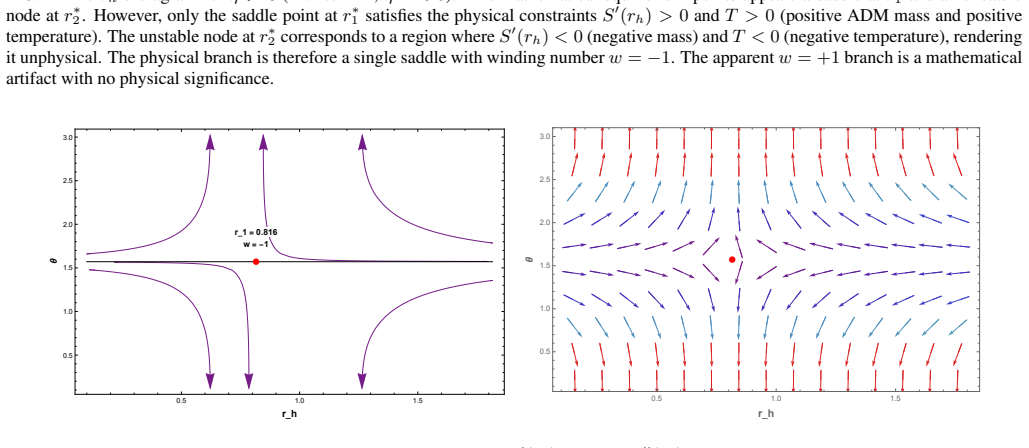
However, only the saddle point atr ∗ 1 satisfies the physical constraintsS ′(rh)>0andT >0(positive ADM mass and positive temperature). The unstable node atr ∗ 2 corresponds to a region whereS ′(rh)<0(negative mass) andT <0(negative temperature), rendering it unphysical. The physical branch is therefore a single saddle with winding numberw=−1. The apparent...
-
[3]
S. Mukhi, Class. Quant. Grav.28(2011), 153001 [arXiv:1110.2569 [physics.pop-ph]]
Pith/arXiv arXiv 2011
-
[4]
The Jacobian at such a point is diagonal: J= λr 0 0 1 ! , λ r ≡ ∂ϕrh ∂rh r∗ h = ∂2F ∂r 2 h r∗ h .(A8) The eigenvalues areλ 1 =λ r andλ 2 = 1
Phase-space dynamics The auxiliary vector field ϕ(rh, θ) = ϕrh , ϕθ , ϕ rh = ∂F ∂rh , ϕ θ =−cotθcscθ, (A6) defines a fictitious dynamical system on the(r h, θ)plane: drh dt =ϕ rh , dθ dt =ϕ θ.(A7) Equilibrium points(r ∗ h, π/2)satisfyϕ rh = 0andϕ θ = 0. The Jacobian at such a point is diagonal: J= λr 0 0 1 ! , λ r ≡ ∂ϕrh ∂rh r∗ h = ∂2F ∂r 2 h r∗ h .(A8) T...
-
[5]
D. J. Gross and P. F. Mende, Nucl. Phys. B303(1988), 407-454
1988
-
[6]
Amati, M
D. Amati, M. Ciafaloni and G. Veneziano, Phys. Lett. B216 (1989), 41-47
1989
-
[7]
L. J. Garay, Int. J. Mod. Phys. A10(1995), 145-166 [arXiv:gr- qc/9403008 [gr-qc]]
arXiv 1995
-
[8]
C. Rovelli and L. Smolin, Nucl. Phys. B442(1995), 593- 622 [erratum: Nucl. Phys. B456(1995), 753-754] [arXiv:gr- qc/9411005 [gr-qc]]
arXiv 1995
-
[9]
A. Ashtekar and J. Lewandowski, Class. Quant. Grav.14 (1997), A55-A82 [arXiv:gr-qc/9602046 [gr-qc]]
Pith/arXiv arXiv 1997
-
[10]
Wallden, J
P. Wallden, J. Phys. Conf. Ser.453(2013), 012023
2013
-
[11]
M. Khodadi, K. Nozari and A. Hajizadeh, Phys. Lett. B770 (2017), 556-563 [arXiv:1702.06357 [gr-qc]]
Pith/arXiv arXiv 2017
-
[12]
X. Calmet, M. Graesser and S. D. H. Hsu, Phys. Rev. Lett.93 (2004), 211101 [arXiv:hep-th/0405033 [hep-th]]
Pith/arXiv arXiv 2004
-
[13]
A. F. Ali, Class. Quant. Grav.28(2011), 065013 [arXiv:1101.4181 [hep-th]]
Pith/arXiv arXiv 2011
-
[14]
A. Farag Ali, M. M. Khalil and E. C. Vagenas, EPL112(2015) no.2, 20005 [arXiv:1510.06365 [gr-qc]]
Pith/arXiv arXiv 2015
-
[15]
P. Tee and N. Jafari, Eur. Phys. J. C82(2022) no.6, 571 [arXiv:2207.05063 [gr-qc]]
Pith/arXiv arXiv 2022
-
[16]
K. Nozari, M. Khodadi and M. A. Gorji, EPL112(2015) no.6, 60003 [arXiv:1512.07779 [gr-qc]]
Pith/arXiv arXiv 2015
-
[17]
M. Khodadi, K. Nozari and E. N. Saridakis, Class. Quant. Grav. 35(2018) no.1, 015010 [arXiv:1612.09254 [gr-qc]]
Pith/arXiv arXiv 2018
-
[18]
M. Khodadi, K. Nozari, H. Abedi and S. Capozziello, Phys. Lett. B783(2018), 326-333 [arXiv:1805.11310 [gr-qc]]
Pith/arXiv arXiv 2018
-
[19]
S. Nojiri and S. D. Odintsov, Phys. Rept.505(2011), 59-144 [arXiv:1011.0544 [gr-qc]]
Pith/arXiv arXiv 2011
-
[20]
R. Casadio, W. Feng, I. Kuntz and F. Scardigli, Phys. Lett. B 838(2023), 137722 [arXiv:2210.12801 [hep-th]]
Pith/arXiv arXiv 2023
-
[21]
Y . J. Ng, [arXiv:1102.4109 [gr-qc]]
-
[22]
T. P. Sotiriou and V . Faraoni, Rev. Mod. Phys.82(2010), 451- 497 [arXiv:0805.1726 [gr-qc]]
Pith/arXiv arXiv 2010
-
[23]
G. Amelino-Camelia and T. Piran, Phys. Rev. D64(2001), 036005 [arXiv:astro-ph/0008107 [astro-ph]]
Pith/arXiv arXiv 2001
-
[24]
A. Salvio, Front. in Phys.6(2018), 77 [arXiv:1804.09944 [hep- th]]
Pith/arXiv arXiv 2018
-
[25]
T. Biswas, E. Gerwick, T. Koivisto and A. Mazumdar, Phys. Rev. Lett.108(2012), 031101 [arXiv:1110.5249 [gr-qc]]
Pith/arXiv arXiv 2012
-
[26]
D. Colladay and V . A. Kostelecky, Phys. Rev. D58(1998), 116002 [arXiv:hep-ph/9809521 [hep-ph]]
Pith/arXiv arXiv 1998
-
[27]
J. Kowalski-Glikman, Phys. Lett. A286(2001), 391-394 [arXiv:hep-th/0102098 [hep-th]]
Pith/arXiv arXiv 2001
-
[28]
G. Amelino-Camelia, Phys. Lett. B510(2001), 255-263 [arXiv:hep-th/0012238 [hep-th]]
Pith/arXiv arXiv 2001
-
[29]
G. Amelino-Camelia, Int. J. Mod. Phys. D11(2002), 35-60 [arXiv:gr-qc/0012051 [gr-qc]]
Pith/arXiv arXiv 2002
-
[30]
Amelino-Camelia, [arXiv:gr-qc/0309054 [gr-qc]]
G. Amelino-Camelia, [arXiv:gr-qc/0309054 [gr-qc]]
-
[31]
N. Jafari and M. R. R. Good, Phys. Lett.B(2020), 135735 [arXiv:2009.06096 [gr-qc]]
Pith/arXiv arXiv 2020
-
[32]
G. Amelino-Camelia, L. Freidel, J. Kowalski-Glikman and L. Smolin, Phys. Rev. D84(2011), 084010 [arXiv:1101.0931 [hep-th]]
Pith/arXiv arXiv 2011
-
[33]
J. Magueijo and L. Smolin, Phys. Rev. Lett.88(2002), 190403 [arXiv:hep-th/0112090 [hep-th]]
Pith/arXiv arXiv 2002
-
[34]
G. Amelino-Camelia, J. R. Ellis, N. E. Mavromatos, D. V . Nanopoulos and S. Sarkar, Nature393(1998), 763-765 [arXiv:astro-ph/9712103 [astro-ph]]
Pith/arXiv arXiv 1998
-
[35]
J. Magueijo and L. Smolin, Phys. Rev. D67(2003), 044017 [arXiv:gr-qc/0207085 [gr-qc]]
Pith/arXiv arXiv 2003
-
[36]
R. C. Myers and M. Pospelov, Phys. Rev. Lett.90(2003), 211601 [arXiv:hep-ph/0301124 [hep-ph]]
Pith/arXiv arXiv 2003
-
[37]
J. Kowalski-Glikman and S. Nowak, Int. J. Mod. Phys. D12 (2003), 299-316 [arXiv:hep-th/0204245 [hep-th]]
Pith/arXiv arXiv 2003
-
[38]
Amelino-Camelia, Nature418(2002), 34-35 [arXiv:gr- qc/0207049 [gr-qc]]
G. Amelino-Camelia, Nature418(2002), 34-35 [arXiv:gr- qc/0207049 [gr-qc]]
arXiv 2002
-
[39]
A. Guvendi, O. Mustafa and N. Jafari, Phys. Lett. B866(2025), 139547 [arXiv:2504.10537 [physics.gen-ph]]
arXiv 2025
-
[40]
S. Majid and H. Ruegg, Phys. Lett. B334(1994), 348-354 [arXiv:hep-th/9405107 [hep-th]]
Pith/arXiv arXiv 1994
-
[41]
J. M. Carmona, J. L. Cortes and J. J. Relancio, Phys. Rev. D94 (2016) no.8, 084008 [arXiv:1609.01347 [hep-th]]
Pith/arXiv arXiv 2016
-
[42]
S. Majid, Lect. Notes Phys.541(2000), 227-276 [arXiv:hep- th/0006166 [hep-th]]
arXiv 2000
-
[43]
Khodadi and K
M. Khodadi and K. Nozari, Commun. Theor. Phys.71(2019) no.6, 677-684
2019
-
[44]
N. Jafari and A. Guvendi, Phys. Lett. B866(2025), 139515 [arXiv:2511.05641 [gr-qc]]
arXiv 2025
-
[45]
N. Jafari and A. Boumali, Phys. Lett. B871(2025), 140019 [arXiv:2510.05117 [physics.gen-ph]]
arXiv 2025
-
[46]
A. Boumali, N. Jafari, B. Shukirgaliyev and F. Serdouk, Eur. Phys. J. C85(2025) no.10, 1147 [arXiv:2511.11709 [gr-qc]]
arXiv 2025
-
[47]
E. P. Verlinde, JHEP04(2011), 029 [arXiv:1001.0785 [hep- th]]
Pith/arXiv arXiv 2011
-
[48]
J. D. Bekenstein, Phys. Rev. D7(1973), 2333-2346
1973
-
[49]
S. W. Hawking, Commun. Math. Phys.43(1975), 199-220 [er- ratum: Commun. Math. Phys.46(1976), 206]
1975
-
[50]
T. Padmanabhan, Rept. Prog. Phys.73(2010), 046901 [arXiv:0911.5004 [gr-qc]]
Pith/arXiv arXiv 2010
-
[51]
C. Q. Geng, Y . T. Hsu, J. R. Lu and L. Yin, Eur. Phys. J. C80 (2020) no.1, 21 [arXiv:1911.06046 [astro-ph.CO]]
Pith/arXiv arXiv 2020
-
[52]
A. J. M. Medved, Class. Quant. Grav.22(2005), 133-142 [arXiv:gr-qc/0406044 [gr-qc]]
Pith/arXiv arXiv 2005
-
[53]
B. Pourhassan and M. Faizal, Eur. Phys. J. C77(2017) no.2, 96 [arXiv:1703.00517 [quant-ph]]
Pith/arXiv arXiv 2017
-
[54]
S. Nojiri, S. D. Odintsov and E. N. Saridakis, Eur. Phys. J. C79 (2019) no.3, 242 [arXiv:1903.03098 [gr-qc]]
Pith/arXiv arXiv 2019
-
[55]
S. Nojiri, S. D. Odintsov and V . Faraoni, Phys. Rev. D105 (2022) no.4, 044042 [arXiv:2201.02424 [gr-qc]]
Pith/arXiv arXiv 2022
-
[56]
A. Chatterjee and A. Ghosh, Phys. Rev. Lett.125(2020) no.4, 041302 [arXiv:2007.15401 [gr-qc]]
Pith/arXiv arXiv 2020
-
[57]
K. Jusufi and A. Sheykhi, Phys. Lett. B836(2023), 137621 [arXiv:2210.01584 [gr-qc]]
Pith/arXiv arXiv 2023
-
[58]
D. J. Zamora and C. Tsallis, Eur. Phys. J. C82(2022) no.8, 689 [arXiv:2201.03385 [gr-qc]]
Pith/arXiv arXiv 2022
-
[59]
S. Jalalzadeh, H. Moradpour and P. V . Moniz, Phys. Dark Univ. 42(2023), 101320 [arXiv:2308.12089 [gr-qc]]
Pith/arXiv arXiv 2023
-
[60]
S. Nojiri, S. D. Odintsov and T. Paul, Phys. Lett. B831(2022), 137189 [arXiv:2205.08876 [gr-qc]]
Pith/arXiv arXiv 2022
-
[61]
G. G. Luciano and A. Sheykhi, Phys. Dark Univ.42(2023), 101319 [arXiv:2304.11006 [hep-th]]
Pith/arXiv arXiv 2023
-
[62]
S. Basilakos, A. Lymperis, M. Petronikolou and E. N. Saridakis, Eur. Phys. J. C84(2024) no.3, 297 [arXiv:2308.01200 [gr-qc]]
Pith/arXiv arXiv 2024
-
[63]
T. Jacobson, Phys. Rev. Lett.75(1995), 1260-1263 [arXiv:gr- 14 qc/9504004 [gr-qc]]
arXiv 1995
-
[64]
E. Ebrahimi and A. Sheykhi, Phys. Dark Univ.45(2024), 101518 [arXiv:2405.13096 [gr-qc]]
Pith/arXiv arXiv 2024
-
[65]
S. Capozziello and M. Shokri, Eur. Phys. J. C85(2025) no.2, 200 [arXiv:2501.12987 [gr-qc]]
Pith/arXiv arXiv 2025
- [66]
-
[67]
S. Nojiri, S. D. Odintsov and V . Faraoni, Astrophysics65 (2022) no.4, 534-551 [arXiv:2208.10235 [gr-qc]]
Pith/arXiv arXiv 2022
-
[68]
H. B. Callen, Thermodynamics and an Introduction to Thermo- statistics. John Wiley & Sons, 2nd ed., 1985
1985
-
[69]
A. Anand, S. Devdutt, K. Jusufi and E. N. Saridakis, Eur. Phys. J. C86(2026) no.5, 534 [arXiv:2511.04613 [gr-qc]]
Pith/arXiv arXiv 2026
- [70]
-
[71]
S. W. Hawking and D. N. Page, Commun. Math. Phys.87 (1983), 577
1983
-
[72]
E. Elizalde, S. Nojiri and S. D. Odintsov, Universe11(2025) no.2, 60 [arXiv:2502.05801 [gr-qc]]
Pith/arXiv arXiv 2025
-
[73]
P. C. W. Davies, Rept. Prog. Phys.41(1978), 1313-1355
1978
-
[74]
R. M. Wald, Living Rev. Rel.4(2001), 6 [arXiv:gr-qc/9912119 [gr-qc]]
Pith/arXiv arXiv 2001
-
[75]
Vasileiou, J
V . Vasileiou, J. Granot, T. Piran and G. Amelino-Camelia, Na- ture Phys.11(2015) no.4, 344-346
2015
-
[76]
A. Chamblin, R. Emparan, C. V . Johnson and R. C. Myers, Phys. Rev. D60(1999), 064018 [arXiv:hep-th/9902170 [hep- th]]
Pith/arXiv arXiv 1999
-
[77]
S. W. Wei, Y . X. Liu and R. B. Mann, Phys. Rev. Lett.129 (2022) no.19, 191101 [arXiv:2208.01932 [gr-qc]]
Pith/arXiv arXiv 2022
-
[78]
S. W. Wei, Y . X. Liu and R. B. Mann, Phys. Rev. D110(2024) no.8, L081501 [arXiv:2409.09333 [gr-qc]]
Pith/arXiv arXiv 2024
-
[79]
F. W. Stecker, Astropart. Phys.35(2011), 95-97 [arXiv:1102.2784 [astro-ph.HE]]
Pith/arXiv arXiv 2011
-
[80]
U. Jacob and T. Piran, Nature Phys.3(2007), 87-90 [arXiv:hep- ph/0607145 [hep-ph]]
arXiv 2007
discussion (0)
Sign in with ORCID, Apple, or X to comment. Anyone can read and Pith papers without signing in.