REVIEW 2 major objections 5 minor 87 references
A machine-learned probability distribution in the phase space of turbulent channel flow for synthetic turbulence and flow reconstruction
T0 review · 2 major / 5 minor · reviewed 2026-08-01 · deepseek-v4-flash
Pith's one-line read A machine-learned probability distribution approximates the natural distribution of turbulent channel flow, enabling realistic synthetic fields and probabilistic reconstruction.
desk verdict A solid ML-for-turbulence paper with a genuinely new construction; the conditional sampling derivation leans on an unproven independence assumption that deserves a close look, but the empirical results are encouraging. read the letter →
The pith
A machine-rendered reading of the paper's core claim, the machinery that carries it, and where it could break.
The reading
What carries the argument
The flow-based generative model trained via conditional flow matching, with a Gaussian conditional optimal transport path, maps random Gaussian fields to synthetic turbulence through straight-line trajectories. For conditional sampling, the modified ODE system (2.23) pins observed components to their measurements along the path while letting unobserved components evolve under the marginal generator. The minimal conditional flow unit—the smallest domain in homogeneous directions outside which conditioning on a central velocity component is indistinguishable from unconditional sampling—carries the argument, since it permits sequential conditional sampling to arbitrarily large domains under a l
What would settle it
For a mask that observes a large fraction of the domain (e.g., 75% of the velocity components), compute the ensemble variance of the reconstructions produced by Eq. (2.23) and compare it to the true conditional variance estimated from DNS snapshots; a systematic discrepancy that grows with the observed fraction would indicate the independence assumption is violated.
Extended reading notes
Core claim
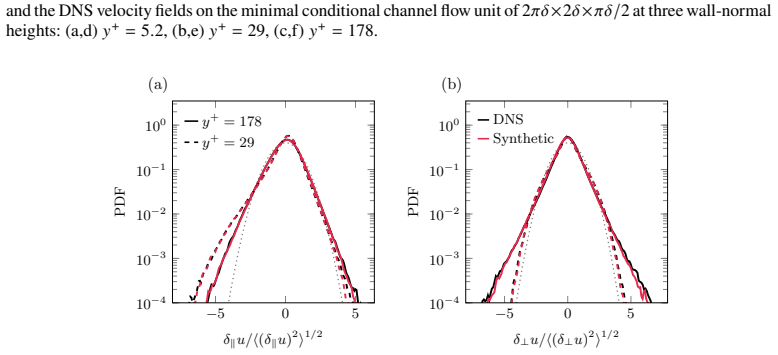
The central claim is that the learned distribution provides a good approximation to the natural distribution of the turbulent dynamical system (Abstract, §4). Three properties are demonstrated: physical ensemble statistics (mean profile, Reynolds stresses, energy spectra, skewness, flatness, heavy-tailed velocity increments), consistent conditional sampling (reconstruction errors match an LSE-based estimate, with ensemble variance as uncertainty), and dynamical invariance (synthetic fields used as DNS initial conditions show stationary energy spectra and TKE budget terms after a brief Kolmogorov-timescale transient). The minimal conditional flow unit is the key enabling object, making large-
Load-bearing premise
The load-bearing premise is that the unobserved part of the guided generator network can be treated as independent of the observed components, so that the previously trained marginal generator can be reused in Eq. (2.23); the paper does not prove this independence holds for a general trained network.
Editorial extensions
If this is right
- Synthetic initial conditions can be generated that skip the long transient to statistical stationarity in DNS, because samples already live on the attractor.
- Flow reconstruction from sparse observations becomes a sampling problem, producing an ensemble of realistic fields with quantified uncertainty rather than a single conditional average.
- The learned distribution can be reused for arbitrary masks of observed/unobserved variables without retraining, making the method flexible for varying sensor placements.
- Non-Gaussian statistics such as intermittency, skewness, and nonlinear energy transfer are preserved, which Gaussian-based synthetic generators cannot capture.
- The minimal conditional flow unit provides a domain-size-independent representation: sequential sampling extends fields to domains 24 times the training unit with adequate spectral fidelity.
Reading between the lines
- The local-conditioning approximation (conditioning only on the neighboring subdomain) relies on a screening effect; at higher Reynolds numbers or in flows with very long coherent structures, this screening may weaken, and the approximation may need larger units.
- The independence assumption behind the guided generator (unobserved part independent of observations) is untested for general masks; if it fails, the conditional sampling ensembles could under- or over-estimate reconstruction uncertainty.
- A natural extension is to condition on derived quantities such as wall shear stress or pressure, which the paper suggests but does not demonstrate; the same conditional-sampling mechanism should apply.
- Because the model learns incompressibility implicitly, explicitly enforcing a divergence-free constraint at generation time could reduce small-scale discrepancies at higher Reynolds numbers.
Editorial analysis
A structured set of objections, weighed in public.
Referee Report
Summary. The paper trains a flow-matching generative model on a 'minimal conditional flow unit' (MCFU) to approximate the invariant phase-space distribution of turbulent channel flow at Re_tau=180, and evaluates the approximation through three properties: physical ensemble statistics, consistent conditional sampling, and dynamical invariance. The authors define the MCFU as the smallest domain outside which conditional fields are indistinguishable from unconditional fields in mean-square sense, estimate its size from two-point correlations, and use sequential conditional sampling to generate fields on larger domains. For conditional sampling they derive a guided flow-matching loss and propose an approximate minimizer that reuses the unconditional generator. Comparisons with DNS are reported for one-point, two-point, and higher-order statistics, for a flow-reconstruction problem, and for DNS initialized with synthetic fields. The paper concludes that the learned distribution is a good approximation to the natural distribution.
Significance. If the claims hold, this is a notable step: it is one of the first explicit attempts to approximate the full three-dimensional invariant phase-space distribution of a wall-bounded turbulent flow rather than only selected statistics. The unconditional generation reproduces higher-order moments (skewness, flatness, increment distributions) and the dynamical-invariance test via DNS initialization is a meaningful and nonstandard validation. The study also has concrete strengths: a held-out test set, validation-based model selection, comparison against a carefully derived LSE-based error estimate, and DNS-based scrutiny of the generated fields. These elements make the empirical core credible. The main risk is the unproven conditional-independence approximation in the conditional sampling procedure, which is load-bearing for the reconstruction-uncertainty interpretation and for the sequential generation of large domains.
major comments (2)
- [§2.4, Eq. (2.22)–(2.24)] The derivation of the conditional sampling ODE rests on an unproven independence restriction. The paper states that if the unobserved part M⊥ f(v,ξ|u_o) is 'restricted to be independent of u_o', then the guided conditional flow-matching loss (2.22) reduces to a selection of terms from the unconditional loss (2.18), allowing reuse of the marginal generator. However, the resulting ODE (2.23) has unobserved update M⊥ f*_θ(v,ξ), and v depends on u_o through the observed-part integration (2.24a), i.e., v = ξu_o + (1−ξ)(observed components of v0). Thus the approximation is effectively E[u_u | v] ≈ E[u_u | v, u_o]. The marginal generator was trained on the unconditional loss (2.18), not on the guided loss (2.22), so there is no training pressure enforcing this. If the approximation fails, Eq. (2.23) samples a distribution different from π(u_u|u_o), invalidating the uncertainty quantification in
- [§2.2, Eq. (2.10) and §3.2, Figs. 9–11] The MCFU construction and the sequential sampling rely on two approximations whose quantitative validity is not established: (i) the dimensions R_x≈πδ and R_z≈πδ/4 are inferred from a visually assessed threshold of squared correlations, with no explicit criterion for 'sufficiently small'; (ii) the local-conditioning approximation π(u_C|u_A,u_B)≈π(u_C|u_B) in Eq. (2.10) is motivated by the screening effect, but the footnote in §2.2 correctly notes that marginal decorrelation does not imply conditional independence and the relay effect can transmit information. The large-domain results in Figs. 9–11 show precisely the kind of artifacts one would expect if this approximation is imperfect: cut-through structures at the interfaces between conditioned blocks and underrepresentation of the largest streamwise/spanwise scales. Since the paper claims the MCFU representation enables sampling on 'ar
minor comments (5)
- [§2.2, Fig. 2] The definition of R_h would benefit from a quantitative threshold, e.g., the distance beyond which ρ² drops below a stated value, rather than an informal visual estimate.
- [§3.1, Fig. 6] The sentence 'Only the largest spanwise scales of the streamwise velocity component are underrepresented as seen in figure 6(e)' is not easy to verify from the plotted curves; consider adding an inset or arrow.
- [§3.3, Figs. 12–13] The color legend is labeled '0.1 2 4 6 8 10'; it would be clearer to use a continuous colorbar with a title such as 't u_τ/δ'.
- [Eq. (3.1)] The numerator in the integrand appears to omit an ensemble-average bracket; please check the notation so that the equation matches the described quantity.
- [§2.5] The acronym MCFU is used in the abstract and in the text but is not defined at first use; define it when the minimal conditional flow unit is introduced.
Circularity Check
No significant circularity: the derivation is a standard flow-matching construction, and the validation uses held-out DNS data and DNS evolution rather than re-stating the training statistics.
full rationale
The paper's derivation chain is not circular. The flow-matching loss (2.18) and the guided conditional loss (2.20) are standard mathematical constructions; the approximate conditional sampler (2.23) is obtained by explicitly reusing the marginal generator under an independence restriction, not by defining the target distribution to equal the trained generator. The central claim—that the learned distribution approximates the natural distribution—is tested against held-out DNS snapshots (10% test set), against DNS evolution in the dynamical-invariance test, and against an LSE-based reconstruction-error benchmark computed from DNS data (Appendix B). These are external checks, not identities with the training objective. The paper explicitly acknowledges the local-conditioning approximation is not guaranteed by marginal decorrelation alone, and the independence restriction in §2.4 is unproven; these are honest limitations rather than circular reductions. The self-citations (SPWind code, shifted periodic boundary conditions) are methodological references and are not load-bearing evidence for the main claim. No uniqueness theorem or ansatz is imported from the authors' prior work, and no fitted parameter is renamed as a prediction. Therefore the appropriate finding is no significant circularity.
Assumptions & free parameters
free parameters (3)
- MCFU half-extent R_x≈πδ, R_z≈πδ/4 =
R_x≈πδ, R_z≈πδ/4
- Coarsening factor 2 (field resolution 23.6×[0.34-6.2]×11.8) =
Δx+≈23.6, Δy+∈[0.34,6.2], Δz+≈11.8
- Number of RK4 integration steps =
20
assumptions (6)
- domain assumption A coarse-grained natural density π exists via noise kernel K_ε (Eq. 2.4)
- ad hoc to paper Local conditioning approximation π(u_C|u_A,u_B)≈π(u_C|u_B) (Eq. 2.10)
- ad hoc to paper Unobserved part of the guided generator can be treated as independent of u_o (§2.4)
- ad hoc to paper MCFU defined by single-component conditioning is adequate for half-domain or multi-component conditioning
- domain assumption DNS snapshots are samples of the coarse-grained natural distribution
- standard math Flow-matching/COT path theory (Lipman et al.)
invented entities (1)
-
Minimal conditional flow unit (MCFU)
Cite this review
Pith. "Pith review of A machine-learned probability distribution in the phase space of turbulent channel flow for synthetic turbulence and flow reconstruction." pith.science (2026). https://pith.science/paper/Z3Q7YK6X
@misc{pith2026260718058,
  author       = {Pith},
  title        = {Pith review of: A machine-learned probability distribution in the phase space of turbulent channel flow for synthetic turbulence and flow reconstruction},
  year         = {2026},
  howpublished = {\url{https://pith.science/paper/Z3Q7YK6X}},
  note         = {Machine review of arXiv:2607.18058}
}
abstract
Although a complete characterisation of the probability distribution in the phase space of turbulent flows remains elusive, accurately sampling this distribution is essential for both synthetic turbulence generation and turbulent flow reconstruction. Motivated by these applications, we examine to what extent a machine-learned distribution can approximate the physical invariant distribution of turbulent channel flow at $\mathrm{Re}_\tau=180$. We assess three important properties of the approximation: physical ensemble statistics, consistent conditional sampling, and dynamical invariance. To this end, a flow-based generative model is trained on a minimal conditional flow unit, which we define as the smallest domain outside which conditional fields, given a single observation at the domain centre, are indistinguishable from unconditional fields in terms of mean-square discrepancy to other conditional fields. We also introduce a consistent procedure for sampling from the conditional learned distribution. Comparisons with direct numerical simulation show that synthetic turbulent fields reproduce key statistical and dynamical features of turbulence, including intermittency and nonlinear energy transfer. The consistency of conditional sampling is demonstrated in a flow reconstruction problem, and subsequently used to generate synthetic turbulent velocity fields on a large domain. When adopted as initial conditions in direct numerical simulations, these fields yield physical and statistically stationary ensemble statistics, indicating that the learned distribution provides a good approximation to the natural distribution of the turbulent dynamical system.
Figures


Figures from the paper (10 more)




Reference graph
Works this paper leans on
-
[1]
Ergodic theory of chaos and strange attractors , author =. Rev. Mod. Phys. , volume =. 1985 , month =. doi:10.1103/RevModPhys.57.617 , url =
-
[2]
Synchronization of turbulence in channel flow , volume =. J. Fluid Mech. , author =. 2022 , pages =. doi:10.1017/jfm.2022.397 , language =
-
[3]
Regeneration of. Phys. Rev. Lett. , author =. 2005 , pages =. doi:10.1103/PhysRevLett.94.014501 , language =
-
[4]
Logarithmic-layer turbulence: a view from the wall , volume =. Phys. Rev. Fluids , author =. 2019 , pages =. doi:10.1103/PhysRevFluids.4.114603 , language =
-
[5]
Stochastic estimation of organized turbulent structure: homogeneous shear flow , volume =. J. Fluid Mech. , author =. 1988 , pages =. doi:10.1017/S0022112088001442 , language =
-
[6]
Robust flow reconstruction from limited measurements via sparse representation , volume =. Phys. Rev. Fluids , author =. 2019 , pages =. doi:10.1103/PhysRevFluids.4.103907 , language =
-
[7]
Unsupervised deep learning for super-resolution reconstruction of turbulence , volume =. J. Fluid Mech. , author =. 2021 , pages =. doi:10.1017/jfm.2020.1028 , language =
arXiv 2021
-
[8]
High-fidelity reconstruction of turbulent flow from spatially limited data using enhanced super-resolution generative adversarial network , volume =. Phys. Fluids , author =. 2021 , pages =. doi:10.1063/5.0066077 , language =
Show all 87 references
-
[9]
Symmetry-preserving discretization of turbulent flow , volume =. J. Comput. Phys. , author =. 2003 , pages =. doi:10.1016/S0021-9991(03)00126-8 , language =
2003 doi
-
[10]
Synchronization of. Phys. Rev. Lett. , author =. 2013 , pages =. doi:10.1103/PhysRevLett.110.084102 , language =
2013 doi
- [11]
-
[12]
Generative modeling of turbulence , volume =. Phys. Fluids , author =. 2022 , pages =. doi:10.1063/5.0082562 , language =
2022 doi
-
[13]
A physics-informed diffusion model for high-fidelity flow field reconstruction , volume =. J. Comput. Phys. , author =. 2023 , pages =. doi:10.1016/j.jcp.2023.111972 , language =
2023
-
[14]
and Martínez-Tossas, Luis A
Rybchuk, Alex and Hassanaly, Malik and Hamilton, Nicholas and Doubrawa, Paula and Fulton, Mitchell J. and Martínez-Tossas, Luis A. , title =. Phys. Fluids , volume =. 2023 , month =. doi:10.1063/5.0172559 , url =
2023 doi
-
[15]
Pope, Stephen B. , doi =. Turbulent flows , publisher=
-
[16]
Synthetic turbulence inflow conditions for large-eddy simulation , volume =. Phys. Fluids , author =. 2006 , pages =. doi:10.1063/1.2130744 , language =
2006 doi
-
[17]
A synthetic-eddy-method for generating inflow conditions for large-eddy simulations , volume =. Int. J. Heat Fluid Flow , author =. 2006 , pages =. doi:10.1016/j.ijheatfluidflow.2006.02.006 , language =
2006 doi
-
[18]
Shifted periodic boundary conditions for simulations of wall-bounded turbulent flows , volume =. Phys. Fluids , author =. 2016 , pages =. doi:10.1063/1.4941912 , language =
2016 doi
-
[19]
Conditional neural field latent diffusion model for generating spatiotemporal turbulence , volume =. Nat. Commun. , author =. 2024 , pages =. doi:10.1038/s41467-024-54712-1 , language =
2024 doi
-
[20]
Turbulence:
Frisch, Uriel , month = nov, year =. Turbulence:
-
[21]
and Azizpour, Hossein and Vinuesa, Ricardo , month = may, year =
Vishwasrao, Abhijeet and Gutha, Sai Bharath Chandra and Cremades, Andres and Wijk, Klas and Patil, Aakash and Gorle, Catherine and McKeon, Beverley J. and Azizpour, Hossein and Vinuesa, Ricardo , month = may, year =. Diff-. doi:10.48550/arXiv.2506.00214 , language =
-
[22]
Atmosphere , author =
Multi-. Atmosphere , author =. 2023 , pages =. doi:10.3390/atmos15010060 , language =
2023 doi
-
[23]
A deep-learning approach for reconstructing. Sci. Rep. , author =. 2023 , pages =. doi:10.1038/s41598-023-29525-9 , language =
2023 doi
-
[24]
The spatial structure of neutral atmospheric surface-layer turbulence , volume =. J. Fluid Mech. , author =. 1994 , pages =. doi:10.1017/S0022112094001886 , language =
1994 doi
-
[25]
A minimal multiscale. Phys. Fluids , author =. 2006 , pages =. doi:10.1063/1.2227003 , language =
2006 doi
- [26]
- [27]
- [28]
- [29]
-
[30]
Hierarchy of minimal flow units in the logarithmic layer , volume =. Phys. Fluids , author =. 2010 , pages =. doi:10.1063/1.3464157 , language =
2010 doi
-
[31]
Turbulence statistics in fully developed channel flow at low. J. Fluid Mech. , author =. 1987 , pages =. doi:10.1017/S0022112087000892 , language =
1987 doi
- [32]
- [33]
-
[34]
Effect of the computational domain on direct simulations of turbulent channels up to. Phys. Fluids , author =. 2014 , pages =. doi:10.1063/1.4862918 , language =
2014 doi
-
[35]
Three-dimensional generative adversarial networks for turbulent flow estimation from wall measurements , volume =. J. Fluid Mech. , author =. 2024 , pages =. doi:10.1017/jfm.2024.432 , language =
2024 doi
-
[36]
On spectral linear stochastic estimation , volume =. Exp. Fluids , author =. 2006 , pages =. doi:10.1007/s00348-006-0199-5 , language =
2006 doi
- [37]
-
[38]
Cvitanovi\'c, Predrag and Artuso, Roberto and Mainieri, Ronnie and Tanner, Gregor and Vattay, Gábor , year =. Chaos:
-
[39]
Inflow. Annu. Rev. Fluid Mech. , author =. 2017 , pages =. doi:10.1146/annurev-fluid-010816-060322 , language =
2017 doi
-
[40]
Diffusion by a. Phys. Fluids , author =. 1970 , pages =. doi:10.1063/1.1692799 , number =
1970 doi
-
[41]
Flow Turbul
Efficient. Flow Turbul. Combust. , author =. 2008 , keywords =. doi:10.1007/s10494-008-9151-5 , language =
2008 doi
-
[42]
Random. J. Fluids Eng. , author =. 2001 , pages =. doi:10.1115/1.1369598 , number =
2001 doi
-
[43]
Dissipation in. Annu. Rev. Fluid Mech. , author =. 2015 , pages =. doi:10.1146/annurev-fluid-010814-014637 , language =
2015 doi
-
[44]
Generation of. J. Comput. Phys. , author =. 1998 , pages =. doi:10.1006/jcph.1998.5882 , language =
1998
-
[45]
A digital filter based generation of inflow data for spatially developing direct numerical or large eddy simulations , volume =. J. Comput. Phys. , author =. 2003 , pages =. doi:10.1016/S0021-9991(03)00090-1 , language =
2003 doi
-
[46]
Indiana Univ
Statistical. Indiana Univ. Math. J. , author =. 1952 , pages =. doi:10.1512/iumj.1952.1.51004 , language =
1952 doi
-
[47]
Hydrodynamic turbulence as a problem in nonequilibrium statistical mechanics , volume =. Proc. Natl. Acad. Sci. U.S.A. , author =. 2012 , pages =. doi:10.1073/pnas.1218747109 , language =
2012 doi
-
[48]
Monin, A. S. and Yaglom, A. M. , year =. Statistical fluid mechanics: mechanics of turbulence , isbn =
-
[49]
A mathematical example displaying features of turbulence , volume =. Commun. Pure Appl. Math. , author =. 1948 , pages =. doi:10.1002/cpa.3160010401 , language =
1948 doi
-
[50]
What. Prog. Theor. Phys. Suppl. , author =. 1978 , pages =. doi:10.1143/PTPS.64.339 , language =
1978 doi
-
[51]
Flow Turbul
A. Flow Turbul. Combust. , author =. 2013 , keywords =. doi:10.1007/s10494-013-9488-2 , language =
2013 doi
-
[52]
Adrian, R. J. , editor =. Stochastic. Eddy. 1996 , doi =
1996
-
[53]
Stochastic estimation and proper orthogonal decomposition:. Exp. Fluids , author =. 1994 , keywords =. doi:10.1007/BF01874409 , language =
1994 doi
-
[54]
Aerodynamic. AIAA J. , author =. 2004 , pages =. doi:10.2514/1.2159 , number =
2004 doi
-
[55]
Karhunen–. J. Opt. Soc. Am. A , author =. 1995 , pages =. doi:10.1364/JOSAA.12.001657 , language =
1995 doi
-
[56]
AIAA AVIATION 2021 FORUM , year =
Anna Bertram and Philipp Bekemeyer and Matthias Held , title =. AIAA AVIATION 2021 FORUM , year =. doi:10.2514/6.2021-2602 , URL =
2021 doi
-
[57]
What. J. Stat. Phys. , author =. 2002 , pages =. doi:10.1023/A:1019762724717 , language =
2002 doi
-
[58]
Deterministic. J. Atmos. Sci. , author =. 1963 , pages =. doi:10.1175/1520-0469(1963)020<0130:DNF>2.0.CO;2 , language =
1963 doi
-
[59]
Multi-scale reconstruction of turbulent rotating flows with proper orthogonal decomposition and generative adversarial networks , volume =. J. Fluid Mech. , author =. 2023 , pages =. doi:10.1017/jfm.2023.573 , language =
2023 doi
-
[60]
The minimal flow unit in near-wall turbulence , volume =. J. Fluid Mech. , author =. 1991 , pages =. doi:10.1017/S0022112091002033 , language =
1991 doi
-
[61]
Villani, Cédric , year =. Optimal
-
[62]
Conditional flow matching for generative modelling of near-wall turbulence with quantified uncertainty , volume =. J. Fluid Mech. , author =. 2026 , pages =. doi:10.1017/jfm.2026.11193 , language =
2026
-
[63]
Super-resolution reconstruction of turbulent velocity fields using a generative adversarial network-based artificial intelligence framework , volume =. Phys. Fluids , author =. 2019 , pages =. doi:10.1063/1.5127031 , number =
2019 doi
-
[64]
From coarse wall measurements to turbulent velocity fields through deep learning , volume =. Phys. Fluids , author =. 2021 , pages =. doi:10.1063/5.0058346 , number =
2021 doi
-
[65]
ACM Trans. Graph. , author =. 2018 , pages =. doi:10.1145/3197517.3201304 , language =
2018
-
[66]
Deep unsupervised learning of turbulence for inflow generation at various. J. Comput. Phys. , author =. 2020 , keywords =. doi:10.1016/j.jcp.2019.109216 , urldate =
2020
-
[67]
Bayesian conditional diffusion models for versatile spatiotemporal turbulence generation , volume =. Comput. Methods Appl. Mech. Eng. , author =. 2024 , pages =. doi:10.1016/j.cma.2024.117023 , language =
2024
-
[68]
Generative learning for forecasting the dynamics of high-dimensional complex systems , volume =. Nat. Commun. , author =. 2024 , keywords =. doi:10.1038/s41467-024-53165-w , language =
2024 doi
-
[69]
Generative adversarial networks , volume =. Commun. ACM , author =. 2020 , pages =. doi:10.1145/3422622 , number =
2020 doi
-
[70]
Gappy data and reconstruction procedures for flow past a cylinder , volume =. J. Fluid Mech. , author =. 2004 , pages =. doi:10.1017/S0022112004001338 , language =
2004 doi
-
[71]
Physica D: Nonlinear Phenomena , author =
Chaotic dynamics of coherent structures , volume =. Physica D: Nonlinear Phenomena , author =. 1989 , pages =. doi:10.1016/0167-2789(89)90123-1 , language =
1989 doi
-
[72]
Quadrant. Annu. Rev. Fluid Mech. , author =. 2016 , pages =. doi:10.1146/annurev-fluid-122414-034550 , language =
2016 doi
-
[73]
Turbulence generation and data assimilation in wall-bounded flows with a latent diffusion model , copyright =
Steinbrenner, Fabian and Turan, Baris and Teng, Hao and Xiao, Heng , year =. Turbulence generation and data assimilation in wall-bounded flows with a latent diffusion model , copyright =. doi:10.48550/arXiv.2603.02143 , language =
-
[74]
Amorós-Trepat, Marc and Medrano-Navarro, Luis and Liu, Qiang and Guastoni, Luca and Thuerey, Nils , title =. Phys. Fluids , volume =. 2026 , month =. doi:10.1063/5.0304492 , url =
2026 doi
-
[75]
Is plane-channel flow a friendly case for the testing of large-eddy simulation subgrid-scale models? , volume =. Phys. Fluids , author =. 2007 , pages =. doi:10.1063/1.2722422 , number =
2007 doi
-
[76]
The screening effect in. Ann. Stat. , author =. 2002 , pages =. doi:10.1214/aos/1015362194 , language =
2002
-
[77]
2010. Ann. Stat. , author =. 2011 , pages =
2010
-
[78]
Geostatistics:
Chilès, Jean-Paul and Delfiner, Pierre , year =. Geostatistics:
- [79]
- [80]
-
[81]
Advances in neural information processing systems , volume=
Generative adversarial nets , author=. Advances in neural information processing systems , volume=
-
[82]
Symposia on Turbulence in Liquids , author =
On the role of conditional averages in turbulence theory , volume =. Symposia on Turbulence in Liquids , author =. 1977 , pages =
1977
-
[83]
2010 , chapter =
Johan Meyers and Charles Meneveau , title =. 2010 , chapter =
2010
-
[84]
Andersen, H. H. , year =. Linear and graphical models: for the multivariate complex normal distribution , isbn =
-
[85]
Schur complements and statistics , volume =
Ouellette, Diane Valérie , year =. Schur complements and statistics , volume =. doi:10.1016/0024-3795(81)90232-9 , journal =
-
[86]
Les rencontres physiciens-math
On the nature of turbulence , author=. Les rencontres physiciens-math
-
[87]
and Meyers, J
Bon, T. and Meyers, J. , year =. Stable channel flow with spanwise heterogeneous surface temperature , volume =. doi:10.1017/jfm.2021.1113 , journal =
2021
Reviewed August 1, 2026 · model on record in the stance chip above.
Discussion (0). Continue with ORCID to comment.