REVIEW 2 major objections 4 minor 125 references
Bulk viscous matter in $f(T)$ gravity: A path to cosmic acceleration
T0 review · 2 major / 4 minor · reviewed 2026-08-10 · deepseek-v4-flash
Pith's one-line read Bulk viscous matter in $f(T)=\alpha T$ gravity, with viscosity $\zeta(t)=\zeta_0+\zeta_1 H$, fits combined cosmological data and can drive the observed transition to accelerated expansion without a dark-energy component.
desk verdict The Case I results rest on an H(z) that does not solve the paper's own Eq. (23), so the advertised path to cosmic acceleration is unsupported. read the letter →
The pith
A machine-rendered reading of the paper's core claim, the machinery that carries it, and where it could break.
The reading
What carries the argument
The object carrying the argument is the explicit Hubble parameter $H(z)$ obtained by integrating the modified Friedmann equation under the linear torsion model $f(T)=\alpha T$ and the bulk-viscosity prescription $p_{\mathrm{eff}}=p-3\zeta(t)H$. That single function enters every subsequent diagnostic: the deceleration parameter $q$, jerk $j$, effective equation of state $\omega_{\mathrm{eff}}$, statefinder pair $(r,s)$, and $Om(z)$ are all computed from $H(z)$ or its derivatives, so the fit quality and the predicted cosmic acceleration depend entirely on this expression and on the two fitted viscosity parameters $\zeta_0$ and $\zeta_1$.
What would settle it
Direct substitution of Eq. (24) into Eq. (23) fails for $\zeta_1\neq0$: the homogeneous term needs the exponent $3(\alpha-\zeta_1)/(2\alpha)$, not $3/2$. Re-running the MCMC with the correctly integrated $H(z)$ would settle whether the quoted Case I best-fit parameters and $q_0\approx-0.49$ survive.
Extended reading notes
Core claim
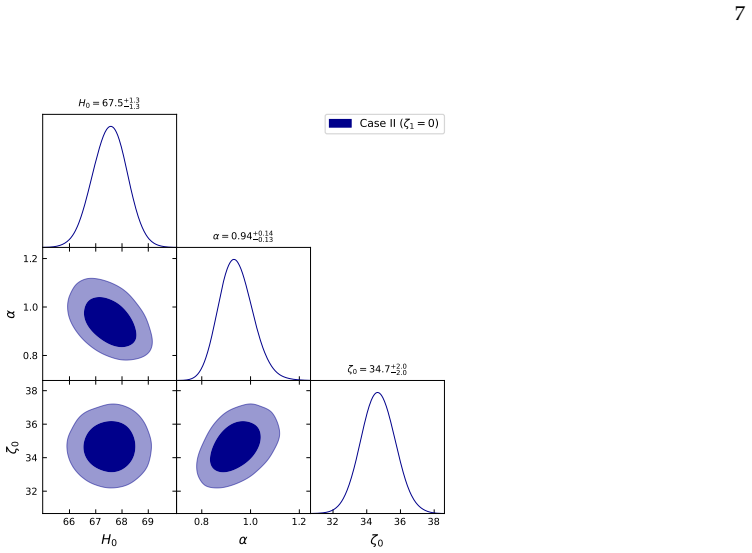
The central claim is that a pressureless matter fluid with bulk viscosity $\zeta(t)=\zeta_0+\zeta_1 H$, coupled through $f(T)=\alpha T$ teleparallel gravity, yields the Hubble-rate solution $H(z)=H_0(1+z)^{3/2}+\frac{\zeta_0}{\alpha-\zeta_1}\left[1-(1+z)^{\frac{3(\alpha-\zeta_1)}{2\alpha}}\right]$, and that this solution, when fitted to $H(z)+\text{Pantheon}^{+}+\text{BAO}$ data, gives an accelerating universe without dark energy. For $\zeta_1\neq0$ the best fit is $H_0=60.0^{+2.0}_{-1.9}$ km/s/Mpc, $\alpha=1.01^{+0.10}_{-0.098}$, $\zeta_0=40.1^{+1.9}_{-2.0}$, and $\zeta_1=0.123^{+0.093}_{-0.088}$; for $\zeta_1=0$ it is $H_0=67.5^{+1.3}_{-1.3}$ km/s/Mpc, $\alpha=0.94^{+0.14}_{-0.13}$, and $\zeta_0=34.7^{+2.0}_{-2.0}$. The resulting jerk parameter, effective equation of state, statefinder trajectories, and $Om(z)$ diagnostic all indicate quintessence-like behavior, with the model approaching the $\Lambda$CDM fixed point in the far future.
Load-bearing premise
The load-bearing premise is that the Hubble parameter expression in Eq. (24) is the correct integral of Eq. (23) when $\zeta_1\neq0$; if that integration is not correct, every Case I parameter constraint and diagnostic built on it has to be recomputed.
Editorial extensions
If this is right
- If the model is correct, no cosmological constant or scalar field is needed: the negative effective pressure that accelerates the expansion comes from the bulk-viscosity term $-3\zeta H$ in a universe dominated by ordinary matter.
- The combined dataset fixes the parameters tightly enough to predict a transition redshift $z_{\mathrm{tr}}\approx0.90$ for $\zeta_1\neq0$ and $z_{\mathrm{tr}}\approx0.80$ for $\zeta_1=0$, with present-day deceleration $q_0\approx-0.49$ and $-0.32$.
- The statefinder and $Om(z)$ trajectories lie in the quintessence region and converge to the $\Lambda$CDM fixed point $(r,s)=(1,0)$ and the de Sitter point $(r,q)=(1,-1)$ in the future, so the model mimics $\Lambda$CDM at late times while differing at intermediate redshifts.
- The fitted $\alpha$ values are close to $1$, so the model can be viewed as a small torsion-gravity correction to the standard Friedmann dynamics of a viscous fluid.
Reading between the lines
- The same derivation could be repeated for nonlinear $f(T)$ models, such as adding a quadratic torsion term, where the torsion correction and the viscous pressure would interact; those extended models could be tested against the same $H(z)$, Pantheon+, and BAO data.
- The gap between the inferred $H_0$ values in the two cases ($\approx60$ versus $\approx67.5$ km/s/Mpc) suggests that deciding whether viscosity scales with $H$ strongly affects the Hubble-constant estimate; a formal model-selection comparison between the two cases is a natural next step.
- Because every quoted diagnostic is a functional of the single $H(z)$ expression, a reader can reconstruct the entire analysis from Eqs. (20)--(24) and the quoted best-fit parameters; no additional closure assumptions are needed to reproduce the figures.
Editorial analysis
A structured set of objections, weighed in public.
Referee Report
Summary. The manuscript considers a flat FLRW universe in f(T)=αT teleparallel gravity whose matter content is a pressureless fluid with bulk viscosity ζ(t)=ζ0+ζ1H. It solves the background Friedmann equation for two cases (ζ1≠0 and ζ1=0), fits the resulting H(z) to the combined H(z)+Pantheon++BAO dataset with an MCMC, and studies the deceleration, jerk, effective EoS, statefinder, and Om(z) diagnostics. The abstract reports accelerating solutions with q0≈−0.49 (Case I) and q0≈−0.32 (Case II) and concludes that bulk viscous matter in f(T) gravity can explain cosmic acceleration without dark energy.
Significance. The idea is not without interest: a single viscous matter component in a simple f(T) gravity could in principle mimic dark energy, and the paper uses standard cosmological datasets with a clearly stated likelihood. The analytical derivation is also checkable, which is a strength. However, the main announced result (Case I) is built on an incorrect solution of the model's own field equation, so none of the Case I constraints or diagnostics can be trusted. In addition, the paper's diagnostics are deterministic functions of the fitted parameters and are not independent tests. As it stands, the manuscript does not provide credible evidence for the claimed path to cosmic acceleration.
major comments (2)
- [III, Eqs. (23)–(24)] Equation (24) is not the solution of Eq. (23) for ζ1≠0. Writing Eq. (23) as dH/d ln a + A H = B with A=3(α−ζ1)/(2α) and B=3ζ0/(2α), the general solution is H(z)=H0(1+z)^A + (B/A)[1−(1+z)^A] = H0(1+z)^{3(α−ζ1)/(2α)} + ζ0/(α−ζ1)[1−(1+z)^{3(α−ζ1)/(2α)}]. Equation (24) instead uses H0(1+z)^{3/2} for the homogeneous term, so direct substitution leaves a residual (A−3/2)H0(1+z)^{3/2}. Since ζ1≠0, A≠3/2 and Eq. (24) does not satisfy Eq. (23). Every Case I result—the best-fit parameters in Fig. 1, H(z) in Fig. 3, q0≈−0.49, j0≈0.68, and the statefinder and Om(z) curves—is computed from this invalid expression and must be either recomputed with the correct solution or removed.
- [V–VII] The claimed confirmation of acceleration is partly circular. The deceleration, jerk, EoS, statefinder, and Om(z) are evaluated by inserting the best-fit parameters from Section IV into the same H(z) that was fitted to the data; they are not independent predictions. To substantiate the title's claim, the paper needs at least a model comparison (for example Δχ², AIC, or DIC relative to ΛCDM and to Case II) and a demonstration that the fitted model is statistically preferred. Without this, the statement that the model explains acceleration is largely a restatement of the fit.
minor comments (4)
- [IV] The MCMC description should report the burn-in length, convergence diagnostics (such as Gelman-Rubin statistics), and the final χ² per degree of freedom; otherwise the quoted 1σ intervals cannot be independently checked.
- [V.C and Conclusion] The text says 'the present-day values of the jerk parameter are approximately ω0≈−0.78 and ω0≈−0.55', but ω0 is the effective EoS parameter, not the jerk parameter; this sentence should be corrected.
- [III and IV] The units of ζ0 and ζ1 should be reconciled with the use of H in km/s/Mpc; as written, ζ=ζ0+ζ1H mixes quantities whose physical dimensions differ unless H is converted to s⁻¹ or natural units are explicitly specified.
- [Figures 4–11] The diagnostic curves are shown only for best-fit parameter values; including MCMC uncertainty bands would make the plots more informative and would also clarify how robust the quoted q0, j0, and ωeff values are.
Circularity Check
No significant circularity: diagnostics are derived from best-fit parameters, not independent predictions; the main defect is an algebraic inconsistency rather than a circular argument.
full rationale
The paper fits (H0, alpha, zeta0, zeta1) to the combined H(z)+Pantheon+BAO data and then computes q, j, omega_eff, statefinder, and Om(z) from the resulting H(z). These quantities are deterministic functions of the fitted parameters, so they are not out-of-sample predictions; however, the paper does not present them as independent confirmations. The abstract and conclusion describe them as 'the analysis reveals' and 'determined,' not as predictions from first principles. No self-citation is load-bearing: the several works by the same group are cited only as comparisons for q0, j0, and omega0 values, not to justify the model's uniqueness or validity. The serious problem in the paper is mathematical, not circular: Eq. (24) does not follow from integrating Eq. (23) when zeta1 != 0, because the first term should have exponent 3(alpha-zeta1)/(2 alpha), not 3/2. That invalidates the Case I fits and all Case I diagnostics, but an incorrect solution is not a reduction of the conclusion to its inputs. Since circularity requires exhibiting Eq. X = Eq. Y by construction or a fitted parameter renamed as a prediction, and neither is present, the circularity score is 0.
Assumptions & free parameters
free parameters (4)
- H0 =
60.0^{+2.0}_{-1.9} (Case I), 67.5^{+1.3}_{-1.3} (Case II) km/s/Mpc
- alpha =
1.01^{+0.10}_{-0.098} (Case I), 0.94^{+0.14}_{-0.13} (Case II)
- zeta0 =
40.1^{+1.9}_{-2.0} (Case I), 34.7^{+2.0}_{-2.0} (Case II) kg/m/s
- zeta1 =
0.123^{+0.093}_{-0.088} (only Case I)
assumptions (5)
- domain assumption Flat FLRW metric (ds2 = -dt2 + a2(dx2+dy2+dz2))
- domain assumption f(T) = alpha T with alpha not equal to 0
- ad hoc to paper Bulk viscosity coefficient zeta(t)=zeta0+zeta1 H
- domain assumption Pressureless dust (p=0) for matter
- domain assumption kappa^2 = 1
Cite this review
Pith. "Pith review of Bulk viscous matter in $f(T)$ gravity: A path to cosmic acceleration." pith.science (2026). https://pith.science/paper/Z53PPSPL
@misc{pith2026250103388,
  author       = {Pith},
  title        = {Pith review of: Bulk viscous matter in $f(T)$ gravity: A path to cosmic acceleration},
  year         = {2026},
  howpublished = {\url{https://pith.science/paper/Z53PPSPL}},
  note         = {Machine review of arXiv:2501.03388}
}
abstract
In this paper, we investigate the effects of varying bulk viscosity coefficients $\zeta(t)=\zeta_{0}+\zeta_{1}H$ on cosmic evolution within the framework of $f(T)$ teleparallel gravity. We focus on two cases: (i) $\zeta_{1} \neq0$ and (ii) $\zeta_{1} =0$, deriving the Hubble parameter $H$ as a function of redshift $z$ using a linear $f(T)$ model ($f(T) = \alpha T$ where $\alpha \neq 0$). Using the combined $H(z)+Pantheon^{+}+BAO$ dataset, we obtain observational constraints on model parameters. For Case I ($\zeta_1 \neq 0$), best-fit values are $H_0=60.0^{+2.0}_{-1.9}$ km/s/Mpc, $\alpha=1.01^{+0.10}_{-0.098}$, $\zeta_0=40.1^{+1.9}_{-2.0}$, and $\zeta_1=0.123^{+0.093}_{-0.088}$, while for Case II ($\zeta_1 = 0$), they are $H_0=67.5^{+1.3}_{-1.3}$ km/s/Mpc, $\alpha=0.94^{+0.14}_{-0.13}$, and $\zeta_0=34.7^{+2.0}_{-2.0}$. The analysis reveals a transition in the deceleration parameter, indicating a shift from deceleration to acceleration of the universe's expansion, with present-day values of $q_{0} \approx -0.49$ and $q_{0} \approx -0.32$ for the respective cases. The jerk parameter $j(z)$ and effective EoS for the cosmic viscous fluid also support the cosmic acceleration, with trajectories aligning with the quintessence scenario. These findings underscore the potential of our $f(T)$ model dominated by bulk viscous matter in explaining cosmic acceleration.
Figures


Figures from the paper (4 more)


Reference graph
Works this paper leans on
-
[1]
Einstein, Sitzungsberichte der K¨oniglich Preussischen Akademie der Wissenschaften zu Berlin, 831 (1995)
A. Einstein, Sitzungsberichte der K¨oniglich Preussischen Akademie der Wissenschaften zu Berlin, 831 (1995)
1995
-
[2]
Hilbert, Nachrichten von der Gesellschaft der Wis- senschaften zu G ¨ottingen - Mathematisch - Physikalis- cheKlasse, 3, 395 (1915)
D. Hilbert, Nachrichten von der Gesellschaft der Wis- senschaften zu G ¨ottingen - Mathematisch - Physikalis- cheKlasse, 3, 395 (1915)
1915
-
[3]
Further, the present-day values of the jerk parameter are approximately ω0 ≈ −0.78 and ω0 ≈ −0.55 for the respective cases [115–118]
in the present epoch and converges to the EoS of ΛCDM ( ωΛ = −1) in the distant future. Further, the present-day values of the jerk parameter are approximately ω0 ≈ −0.78 and ω0 ≈ −0.55 for the respective cases [115–118]. The same figure shows the evolution of ωe f f for different cases of the bulk viscos- ity parameter ζ0. Specifically, we observe a sign...
-
[4]
Einstein, Ann
A. Einstein, Ann. Phys., 354, 769 (1916)
1916
-
[5]
Landau and E.M
L.D. Landau and E.M. Lifshitz, The Classical Theory of Fields (Pergamon Press, Oxford 1970)
1970
-
[6]
Shapiro, W.B
I.I. Shapiro, W.B. Smith, M.E. Ash, and S. Herrick, As- tron. J., 76, 588 (1971)
1971
-
[7]
Shapiro, C.C
I.I. Shapiro, C.C. Counselman, R.W. King, Phys. Rev. Lett., 36, 555 (1976)
1976
-
[8]
Taylor and J.M
J.H. Taylor and J.M. Weisberg, Astrophys. J., 253, 908 (1982)
1982
Show all 125 references
-
[9]
Will, Living Rev
C.M. Will, Living Rev. Relat., 17, 4 (2014)
2014
-
[10]
Ishak, Living Rev
M. Ishak, Living Rev. Relat., 22, 1 (2019)
2019
-
[11]
Abbott et al., Phys
B.P . Abbott et al., Phys. Rev. Lett.,116, 061102 (2016)
2016
-
[12]
Riess et al., Astrophys
A.G. Riess et al., Astrophys. J., 116, 1009 (1998)
1998
-
[13]
Perlmutter et al., Astrophys
S. Perlmutter et al., Astrophys. J., 517, 377 (1999)
1999
-
[14]
Eisenstein et al., Astrophys
D.J. Eisenstein et al., Astrophys. J., 633, 560 (2005)
2005
-
[15]
Percival et al., S, Mon
W.J. Percival et al., S, Mon. Not. Roy. Astron. Soc., 381 1053 (2007)
2007
-
[16]
Komatsu et al., Astrophys
E. Komatsu et al., Astrophys. J., 192, 18 (2011)
2011
-
[17]
Buchdahl, Month
H.A. Buchdahl, Month. Not. R. Astron. Soc., 150, 1 (1970)
1970
-
[18]
Barrow and A.C
J.D. Barrow and A.C. Ottewill, J. Phys. A: Math. Gen.,16, 2757 (1983)
1983
-
[19]
A. A. Starobinsky, JETP Letters, 86, 157 (2007)
2007
-
[20]
Capozziello, V
S. Capozziello, V . F. Cardone, V . Salzano, Phys. Rev. D, 78, 063504 (2008)
2008
-
[21]
Chiba, T.L
T. Chiba, T.L. Smith, A.L. Erickcek, Phys. Rev. D, 75, 124014 (2007)
2007
-
[22]
Astorga-Moreno and E.A
J.A. Astorga-Moreno and E.A. Mena-Barboza, Phys. Lett. A, 481, 129012 (2023)
2023
-
[23]
Harko et al., Phys
T. Harko et al., Phys. Rev. D, 84, 024020 (2011)
2011
-
[24]
Moraes, P .K
P .H.R.S. Moraes, P .K. Sahoo, Phys. Rev. D, 96, 044038 (2017)
2017
-
[25]
Amani and A
A.R. Amani and A. Samiee-Nouri, Commun. Theor. Phys., 64, 485 (2015)
2015
-
[26]
J. B. Jimenez et al., Phys. Rev. D, 98, 044048 (2018). 12
2018
-
[27]
De Laurentis, M
M. De Laurentis, M. Paolella, S. Capozziello, Phys. Rev. D, 91, 083531 (2015)
2015
-
[28]
de la Cruz-Dombriz, D
A. de la Cruz-Dombriz, D. S-Gomez, Class. Quantum Grav., 29, 245014 (2012)
2012
-
[29]
Weitzenb ¨ock, Invariantentheorie (Noordhoff, Gronin- gen, 1923)
R. Weitzenb ¨ock, Invariantentheorie (Noordhoff, Gronin- gen, 1923)
1923
-
[30]
Einstein, Preussische Akademie der Wissenschaften, Phys
A. Einstein, Preussische Akademie der Wissenschaften, Phys. math. Klasse, Sitzungsberichte, 1928, 217 (1928)
1928
-
[31]
M ¨oller, Mat
C. M ¨oller, Mat. Fys. Skr. Dan. Vid. Selsk.,1, 10 (1961)
1961
-
[32]
Pellegrini and J
C. Pellegrini and J. Plebanski, Mat. Fys. Skr. Dan. Vid. Selsk., 2, 4 (1963)
1963
-
[33]
Hayashi and T
K. Hayashi and T. Shirafuji, Phys. Rev. D,19, 3524 (1979)
1979
-
[34]
Aldrovandi and J.G
R. Aldrovandi and J.G. Pereira, Teleparallel Gravity, vol. 173 (Fundamental Theories of Physics (Springer, Heidel- berg, 2013)
2013
-
[35]
Paliathanasis, J
A. Paliathanasis, J. D. Barrow, P . G. L. Leach, Phys. Rev. D, 94, 023525 (2016)
2016
-
[36]
I. G. Salako et al., J. Cosmol. Astropart. Phys., 11 060 (2013)
2013
-
[37]
Myrzakulov, Eur
R. Myrzakulov, Eur. Phys. J. C, 71, 1752 (2011)
2011
-
[38]
Bamba et al., J
K. Bamba et al., J. Cosmol. Astropart. Phys., 01, 021 (2011)
2011
-
[39]
S-Hung Chen et al., Phys. Rev. D, 83, 023508 (2011)
2011
-
[40]
B. Li, T.P . Sotiriou, and J.D. Barrow, Phys. Rev. D, 83, 104017 (2011)
2011
-
[41]
Capozziello et al., Phys
S. Capozziello et al., Phys. Rev. D, 84, 043527 (2011)
2011
-
[42]
Liu and M.J
D. Liu and M.J. Reboucas, Phys. Rev. D, 86, 083515 (2012)
2012
-
[43]
Cai et al., Class
Y.F. Cai et al., Class. Quantum Gravity,28, 215011 (2011)
2011
-
[44]
Jamil, D
M. Jamil, D. Momeni, and R. Myrzakulov, Eur. Phys. J. C, 73, 1-13 (2013)
2013
-
[45]
Rodrigues et al., Phys
M.E. Rodrigues et al., Phys. Rev. D, 86, 104059 (2012)
2012
-
[46]
Koussour and M
M. Koussour and M. Bennai, Class. Quantum Gravity, 39, 105001 (2022)
2022
-
[47]
Nunes, S
R.C. Nunes, S. Pan, and E.N. Saridakis, J. Cosmol. As- tropart. Phys., 08, 011 (2016)
2016
-
[48]
Yang, R.H
J. Yang, R.H. Lin, and X.H. Zhai, Eur. Phys. J. C, 82, 1-11 (2022)
2022
-
[49]
Ganjizadeh, A
S. Ganjizadeh, A. Amani, and M.A. Ramzanpour, Chin. Phys. C, 46, 125104 (2022)
2022
-
[50]
Rezaei and A
T.M. Rezaei and A. Amani, Can. J. Phys., 95, 1068-1073 (2017)
2017
-
[51]
Misner, Astrophys
W. Misner, Astrophys. J., 151, 431 (1968)
1968
-
[52]
Israel and J.N
W. Israel and J.N. Vardalas, Nuovo Cimento Lett., 4, 887 (1970)
1970
-
[53]
Murphy, Phys
G.L. Murphy, Phys. Rev. D, 8, 4231 (1973)
1973
-
[54]
Belinskii and I.M
V .A. Belinskii and I.M. Kalatnikov, Pisma Zh. Eksp. Tekhn. Fiz., 21, 223 (1974)
1974
-
[55]
Diosi, B
L. Diosi, B. Keszthelyi, B. Lukacs, and G. Paal, Acta Phys. Pol. B, 15, 909 (1984)
1984
-
[56]
Waga, R.C
I. Waga, R.C. Falcao, and R. Chanda, Phys. Rev. D, 33, 1839 (1986)
1986
-
[57]
Barrow, Phys
J.D. Barrow, Phys. Lett., 180, 335 (1986)
1986
-
[58]
Barrow, Nucl
J.D. Barrow, Nucl. Phys. B, 380, 743 (1988)
1988
-
[59]
Zimdahl, D.J
W. Zimdahl, D.J. Schwarz, A.B. Balakin, and D. Pavon, Phys. Rev. D, 64, 063501 (2001)
2001
-
[60]
Velten and D.J
H. Velten and D.J. Schwarz, Phys. Rev. D, 86, 083501 (2012)
2012
-
[61]
Setare and A
M.R. Setare and A. Sheykhi, Int. J. Mod. Phys. D,19, 1205 (2010)
2010
-
[62]
Cataldo, N
M. Cataldo, N. Cruz, and S. Lepe, Phys. Lett. B, 619, 5 (2005)
2005
-
[63]
Brevik and O
I. Brevik and O. Gorbunova, Gen. Relativ. Gravit., 37, 2039 (2005)
2005
-
[64]
Cos- mol
Jean-Sebastien Gagnon and Julien Lesgourgues, J. Cos- mol. Astropart. Phys., 09, 026 (2011)
2011
-
[65]
Brevik, E
I. Brevik, E. Elizalde, and S.D. Odintsov, Phys. Rev. D, 84, 103508 (2001)
2001
-
[66]
Gron, Astrophys.Space Sci., 173, 191-225 (1990)
O. Gron, Astrophys.Space Sci., 173, 191-225 (1990)
1990
-
[67]
Eckart, Phys
C. Eckart, Phys. Rev.,, 58, 919 (1940)
1940
-
[68]
Li and J.D
B. Li and J.D. Barrow, Phys. Rev. D, 79, 103521 (2009)
2009
-
[69]
Hipolito-Ricaldi, H.E.S
W.S. Hipolito-Ricaldi, H.E.S. Velten, and W. Zimdahl, J. Cosmol. Astropart. Phys., 06, 016 (2009)
2009
-
[70]
Montiel and N
A. Montiel and N. Bretn, J. Cosmol. Astropart. Phys., 08, 023 (2011)
2011
-
[71]
Hu and X.-H
M.G. Hu and X.-H. Meng, Phys. Lett. B, 635, 186 (2006)
2006
-
[72]
Jie Ren and Xin-He Meng, Phys. Lett. B, 633, 1 (2006)
2006
-
[73]
Gagnon and J
J.S. Gagnon and J. Lesgourgues, J. Cosmol. Astropart. Phys., 09, 026 (2011)
2011
-
[74]
Ryden, Introduction to Cosmology (Addison Wesley, San Francisco, United States of America, 2003)
B. Ryden, Introduction to Cosmology (Addison Wesley, San Francisco, United States of America, 2003)
2003
-
[75]
Meng and X
X.H. Meng and X. Dou, Commun. Theor. Phys., 52, 377 (2009)
2009
-
[76]
X.H. Meng, J. Ren, and M.G. Hu, Commun. Theor. Phys., 47, 379 (2007)
2007
-
[77]
Avelino, U
A. Avelino, U. Nucamendi, J. Cosmol. Astropart. Phys., 9, 1008 (2010)
2010
-
[78]
Sharif and S
M. Sharif and S. Rani , Mod. Phys. Lett. A, 28, 1350118 (2013)
2013
-
[79]
D. F. Mackey et al., Publ. Astron. Soc. Pac., 125, 306 (2013)
2013
-
[80]
Jimenez et al., Astrophys
R. Jimenez et al., Astrophys. J. 593, 622 (2003)
2003
-
[81]
Simon, L
J. Simon, L. Verde, and R. Jimenez, Phys. Rev. D 71, 123001 (2005)
2005
-
[82]
Stren et al., J
D. Stren et al., J. Cosmol. Astropart. Phys. 2010, 008 (2010)
2010
-
[83]
Moresco et al., J
M. Moresco et al., J. Cosmol. Astropart. Phys. 2012, 006 (2010)
2010
-
[84]
Zhang et al., Res
C. Zhang et al., Res. Astron. Astrophys. 14, 1221 (2014)
2014
-
[85]
Moresco, Mon
M. Moresco, Mon. Not. Roy. Astron. Soc. 450, L16 (2015)
2015
-
[86]
Moresco et al., J
M. Moresco et al., J. Cosmol. Astropart. Phys. 2016, 014 (2016)
2016
-
[87]
Jimenez and A
R. Jimenez and A. Loeb, Astrophys. J. 573, 37 (2002)
2002
-
[88]
Scolnic et al., Astrophys
D. Scolnic et al., Astrophys. J., 938, 113 (2022)
2022
-
[89]
Brout et al., Astrophys
D. Brout et al., Astrophys. J., 938, 110 (2022)
2022
-
[90]
Blake et al., Mon
C. Blake et al., Mon. Not. Roy. Astron. Soc. , 418, 1707 (2011)
2011
-
[91]
W. J. Percival et al., Mon. Not. Roy. Astron. Soc. , 401, 2148 (2010)
2010
-
[92]
Beutler et al., Mon
F. Beutler et al., Mon. Not. Roy. Astron. Soc. , 416, 3017 (2011)
2011
-
[93]
Jarosik et al., Astrophys
N. Jarosik et al., Astrophys. J. Suppl., 192, 14 (2011)
2011
-
[94]
D. J. Eisenstein et al., Astrophys. J., 633, 560 (2005)
2005
-
[95]
Giostri et al., J
R. Giostri et al., J. Cosm. Astropart. Phys., 1203, 027 (2012)
2012
-
[96]
Aghanim et al., Astron
N. Aghanim et al., Astron. Astrophys., 641, A6 (2020). 13
2020
-
[97]
Cunha and J.A.S
J.V . Cunha and J.A.S. Lima, Mon. Not. Roy. Astron. Soc. , 390, 210 (2008)
2008
-
[98]
Cunha,Phys
J.V . Cunha,Phys. Rev. D, 79, 047301 (2009)
2009
-
[99]
Nair et al., J
R. Nair et al., J. Cosmol. Astropart. Phys. , 01, 018 (2012)
2012
-
[100]
Koussour et al., Results Phys., 55, 107166 (2023)
M. Koussour et al., Results Phys., 55, 107166 (2023)
2023
-
[101]
Wang et al., Eur
D. Wang et al., Eur. Phys. J. C, 83, 1-14 (2023)
2023
-
[102]
Koussour et al., Eur
M. Koussour et al., Eur. Phys. J. Plus, 139, 1-13 (2023)
2023
-
[103]
Koussour et al., Chin
M. Koussour et al., Chin. J. Phys. 90, 108-120 (2024)
2024
- [104]
-
[105]
Myrzakulov et al., Phys
Y. Myrzakulov et al., Phys. Dark Universe 46, 101614 (2024)
2024
-
[106]
Myrzakulov et al., J
K. Myrzakulov et al., J. High Energy Astro. Phys. 44, 164- 171 (2024)
2024
-
[107]
Zhadyranova et al., J
A. Zhadyranova et al., J. High Energy Astro. Phys. 44, 123- 131 (2024)
2024
-
[108]
Koussour et al., Chin
M. Koussour et al., Chin. J. Phys. 91, 445-457 (2024)
2024
-
[109]
Myrzakulov et al., J
Y. Myrzakulov et al., J. High Energy Astro. Phys. 43, 209- 216 (2024)
2024
-
[110]
Myrzakulov et al., Eur
Y. Myrzakulov et al., Eur. Phys. J. C 87, 665 (2024)
2024
-
[111]
Visser, Class
M. Visser, Class. Quantum Gravity, 21, 2603 (2004)
2004
-
[112]
Visser, Gen
M. Visser, Gen. Relativ. Gravit., 37, 1541-1548 (2005)
2005
-
[113]
Myrzakulov, M
N. Myrzakulov, M. Koussour and D.J. Gogoi, Eur. Phys. J. C, 83, 594 (2023)
2023
-
[114]
Tsujikawa, Class
S. Tsujikawa, Class. Quant. Grav., 30, 214003 (2013)
2013
-
[115]
R. R. Caldwell, Phys. Lett. B, 545, 23 (2002)
2002
-
[116]
Koussour and A
M. Koussour and A. De, Eur. Phys. J. C, 83, 400 (2023)
2023
-
[117]
Mukherjee, Mon
A. Mukherjee, Mon. Not. R. Astron. Soc., 460, 273-282 (2016)
2016
-
[118]
Dark Universe,34, 100889 (2021)
A N `ajera and A Fajardo, Phys. Dark Universe,34, 100889 (2021)
2021
-
[119]
Myrzakulov et al., Eur
N. Myrzakulov et al., Eur. Phys. J. Plus, 138, 852 (2023)
2023
-
[120]
Sahni et al., J
V . Sahni et al., J. Exp. Theor. Phys. Lett., 77, 201-206 (2003)
2003
-
[121]
alam et al., Mon
U. alam et al., Mon. Not. Roy. Astron. Soc., 344, 1057 (2003)
2003
-
[122]
Sahni, A
V . Sahni, A. Shafieloo and A. A. Starobinsky, Phys. Rev. D, 78, 103502 (2008)
2008
-
[123]
Singh and A
C.P . Singh and A. Kumar, Mod. Phys. Lett. A,33, 1850225 (2018)
2018
-
[124]
Singh and A
C.P . Singh and A. Kumar, Eur. Phys. J. Plus, 133, 312 (2018)
2018
-
[125]
Singh and M
C.P . Singh and M. Srivastava, Eur. Phys. J. C, 78, 190 (2018)
2018
Reviewed August 10, 2026 · model on record in the stance chip above.
Discussion (0). Continue with ORCID to comment.