REVIEW 4 major objections 6 minor 57 references
Why Can Accurate Models Be Learned from Inaccurate Annotations?
T0 review · 4 major / 6 minor · reviewed 2026-08-07 · deepseek-v4-flash
Pith's one-line read A model's principal subspace survives label noise, keeping it accurate
desk verdict A genuinely interesting empirical observation and a useful plug-in, wrapped in a theory that only covers a simpler model than the one the paper actually uses. read the letter →
The pith
A machine-rendered reading of the paper's core claim, the machinery that carries it, and where it could break.
The reading
What carries the argument
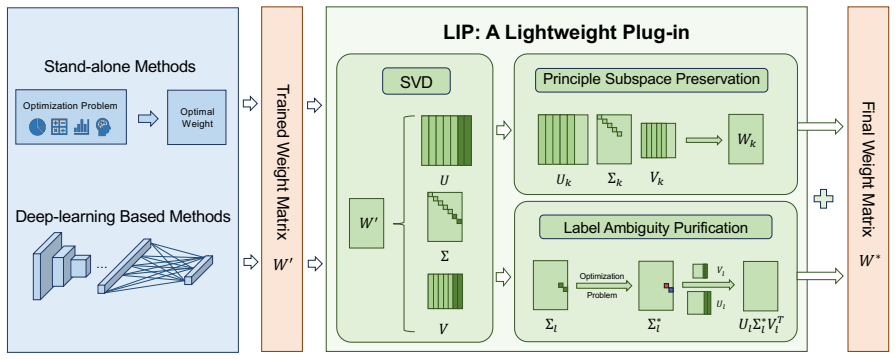
The central object is the final classification weight matrix $W$ and its singular-value decomposition. The argument treats label inaccuracy as an additive perturbation $\Delta W = K^{-1}X^T M$ to the ridge-regression solution $W$ and then applies the Davis-Kahan sine theorem to bound the rotation of the principal subspace. The proposed LIP plug-in uses the same machinery: it SVD-decomposes the trained weight $W'$, keeps the top $k$ singular components, and re-estimates the remaining singular values with a closed-form least-squares update, so it needs no training.
What would settle it
Train the same deep-network architecture on a clean dataset and on a version with a known label-noise rate $p$, compute the SVD of the final-layer weights, and measure the principal angle between their top-$k$ subspaces; the paper's claim fails if the angle grows much faster than $\sqrt{p}$ or if accuracy collapses while the angle remains small.
Extended reading notes
Core claim
On the paper's own terms, the central discovery is that a certain degree of label inaccuracy does not cause the principal subspace of the information learned from clean data to shift severely. Concretely, if the final classifier weight matrix is written as $W = (X^T X + \lambda I)^{-1} X^T G$ for clean labels $G$ and $W' = W + \Delta W$ for corrupted labels $Y = G + M$, then the sine of the angle $\theta$ between the principal subspaces of $W$ and $W'$ is bounded by $\sin\theta \le \frac{\sigma_{\max}(X)\sqrt{nl}}{\delta(\lambda_{\min}(X^T X)+\lambda)}\sqrt{p}$, where $p$ is the label-noise rate. When this bound is small, the top singular directions of the weights learned from inaccurate labels remain aligned with those from clean labels, preserving task-relevant information; the paper argues this is why models still generalize.
Load-bearing premise
The analysis assumes the final classification layer obeys the ridge-regression closed form $W = (X^T X + \lambda I)^{-1} X^T Y$, but deep-network classifiers used in the experiments are trained with cross-entropy and jointly learned features, and the paper does not argue that the perturbation model transfers to that setting.
Editorial extensions
If this is right
- The proof gives a quantitative criterion for when annotation noise is harmless: the product $\sigma_{\max}(X)\sqrt{p}/(\lambda_{\min}(X^T X)+\lambda)$ relative to the spectral gap $\delta$ controls whether the learned subspace stays aligned.
- LIP can be bolted onto any existing classifier without retraining, and the experiments show consistent accuracy gains across partial-label and noisy-label benchmarks.
- The framework suggests that preserving the principal subspace while refining lower singular values is a general recipe for robustness to label inaccuracy, not a trick specific to one architecture.
- Even in fully supervised settings, applying LIP to clean-trained weights gives small but consistent gains, indicating the principal-subspace view also captures useful structure in ordinary classifiers.
Reading between the lines
- If the bound is right, then the spectral gap $\delta$ of the weight matrix should predict when a given label-noise rate becomes catastrophic: smaller gaps should tolerate less noise, a claim the paper does not test directly.
- The perturbation model, though derived for ridge regression, may transfer to other linearized views of deep networks such as neural tangent kernels; if so, the same bound would explain noise robustness in overparameterized models without the closed-form assumption.
- LIP's two-step recipe could be adapted to other weight matrices such as attention projections in transformers, potentially making fine-tuned models more robust to noisy task labels, but this is a speculative extension beyond the paper's experiments.
- A direct test of the paper's core claim would be to measure whether the principal angle between clean and noisy weight subspaces actually follows the predicted $\sqrt{p}$ scaling across several architectures and noise models.
Editorial analysis
A structured set of objections, weighed in public.
Referee Report
Summary. The paper asks why models trained on inaccurate annotations (noisy or partial labels) can still generalize well. It studies the final classification weight matrix, observing empirically that label inaccuracy primarily affects lower singular components while the principal subspace remains largely aligned with that of cleanly trained weights. The authors then prove a perturbation bound for ridge regression: for W=(X^T X+λI)^{-1}X^T G and W'=W+ΔW with ΔW=K^{-1}X^T M, the sine of the angle between the principal subspaces is bounded by σ_max(X)√(nl)/(δ(λ_min(X^T X)+λ))√p (Eq. 9). Based on this, they propose LIP, a training-free post-processing plug-in that keeps the top-k singular components and re-fits the remaining singular values by a least-squares objective. Experiments on partial-label and noisy-label benchmarks show consistent, albeit often small, improvements when LIP is added to existing methods.
Significance. If the proposed explanation survives scrutiny, it would be a conceptually useful account of robustness to label noise, and LIP would be a simple and cheap plug-in. The paper's strengths include a self-contained derivation of the perturbation bound for the ridge model, a clear closed-form solution for the LAP refinement (Eq. 17), and a broad set of experiments spanning several partial-label and noisy-label settings. However, the central claim is about deep networks, while the theorem is proved only for fixed-feature ridge regression, and the key gap δ is never quantified; these issues currently prevent the paper from fully supporting its headline conclusion.
major comments (4)
- [Section 3.1 and Section 5.1] The theoretical result is derived for the ridge-regression model in Eqs. (2)-(4), where the feature matrix X and the regularization λ are identical for the clean and noisy problems. For the deep classifiers used in the experiments (PRODEN, PICO, and others in Section 5.1), the final FC layer is trained with softmax cross-entropy and the penultimate features are jointly learned from the noisy labels, so the clean/noisy weight difference is not a fixed-X perturbation of the form ΔW = K^{-1} X^T M. The paper gives no argument that final-layer weights of these networks approximately satisfy the ridge closed form, and Eq. (9) therefore does not directly explain the subspace stability reported in Fig. 2. I recommend either restricting the theoretical claim to the ridge model and validating Eq. (9) on that model, or supplying a transfer argument, such as fixed pretrained features or a linearized training analysis.
- [Section 3.3, Eq. (9)] δ is not a free hyper-parameter; it is the gap between the relevant singular values of W and is data-dependent. The paper never measures δ or verifies that the right-hand side of Eq. (9) is smaller than 1 in the regime p ≤ 0.1 where the empirical claim is made. Without such a check, the theorem provides only a conditional bound: if the gap is large, the angle is small. The observed similarity of principal subspaces therefore remains without quantitative support, and the 'certain range' of label inaccuracy is never defined. The authors should report empirical estimates of δ and the resulting bound values for at least the CIFAR-100 and CUB-200 setups.
- [Section 4.2, Eqs. (12)-(17)] The LAP module solves min_{Σ_l} ∥X(W_k + U_l Σ_l V_l^T) − Y∥_F^2 using the same noisy label matrix Y that caused the corruption. The closed-form solution in Eq. (17) re-fits the bottom singular components to the noisy labels, which appears to contradict the paper's explanation that label inaccuracy accumulates noise in the lower singular components. If those directions are noisy, projecting the residual Y − X W_k onto them can reintroduce the very noise the method claims to purify. The paper provides no analysis of why this objective removes noise; the ablation in Table 4 shows an empirical gain but does not establish the mechanism. The authors should analyze the objective, use a clean/validation subset, or compare against simple shrinkage of the bottom singular values.
- [Section 3.2, Eq. (7)] The identity ∥M∥_F = √(pnl) treats the random perturbation mask as if its realized norm always equals the expected value under the corruption model. For a random M with P(M_ij ≠ 0) = p, the realized norm fluctuates around √(pnl), and the bound in Eq. (9) holds only for a specific realization with exactly pnl nonzeros. The paper should either state that p is the realized fraction of corrupted entries or turn the statement into a probabilistic bound.
minor comments (6)
- [Section 3.3, Eq. (8)] The Davis-Kahan bound in Eq. (8) is stated without specifying the dimension k of the principal subspace or the precise gap δ = σ_k − σ_{k+1}; since the principal subspace is the span of the top-k singular vectors, the theorem should state the gap explicitly and ensure that the perturbed matrix has no eigenvalue crossing.
- [Section 2.2, Eq. (1)] The text says 'subspace similarity between top-i column vectors of W and top-j of W′', but the formula uses V and V′; please make the notation consistent.
- [Section 5.4] The claim of a 'substantial 15.5% improvement' for PL-CL on MSRCv2 should be stated as a relative improvement; the absolute increase is 7.0 percentage points (from 45.1 to 52.1).
- [Section 4.4] The sentence 'LIP can achieve a substantial performance improvement in just one second' is inconsistent with the reported execution times of 9.98 ms and 16.13 ms; please correct the time scale.
- [Abstract and Section 1] The abstract contains the redundant phrase 'remains unexplored' twice, and the conclusion says 'to understand of model robustness'; these sentences should be edited for clarity.
- [Section 5.4] The bullet 'LIP significantly improves the performance of all these approaches across all cases' is too strong given that some differences in Table 1 are within one standard deviation; please qualify this claim with the specific pairwise t-test results and effect sizes.
Circularity Check
Main theorem is an external perturbation bound applied to a ridge model; no load-bearing circularity, only a minor self-referential fitting step in LAP.
full rationale
The central derivation is not circular. Section 3.1 defines a ridge-regression classifier with closed form W = (X^T X + λI)^{-1} X^T G, and then, with Y = G + M, algebraically obtains W' = W + ΔW where ΔW = K^{-1} X^T M (Eqs. 2-4). Equation (7) is a standard norm bound, and Eq. (9) follows by applying the external Davis-Kahan theorem to this perturbation. The theorem is not defined in terms of the empirical phenomenon it is meant to explain; it is a conditional bound whose smallness depends on σ_max(X), λ_min(X^T X), n, l, and δ. The paper does not measure these quantities, and it treats δ as a hyperparameter rather than computing the actual singular-value gap of W, so the observed p ≤ 0.1 threshold is not derived from Eq. (9). This is a validation gap, not circularity. The LAP module in Section 4.2 solves min_{Σ_l} ∥XW' - Y∥_F^2, i.e., it refits the bottom singular values to the same corrupted label matrix Y that generated the noise via M in Eq. (4); this is a mild self-referential fitting step, but it is an engineering component evaluated on held-out data and does not feed back into the proof of the main theorem. Self-citations [41-43] are used only to support the ancillary claim that bottom singular components matter, alongside external reference [14], and are not load-bearing for the central bound. No step reduces to its own input by construction, so the derivation as a whole is self-contained.
Assumptions & free parameters
free parameters (3)
- k =
⌈0.8l⌉, e.g., 160 for CUB-200; tuned via grid search
- λ (ridge regularization) =
not specified
- δ (singular value gap) =
treated as hyper-parameter, not estimated
assumptions (5)
- ad hoc to paper Final-layer weights of deep classifiers are well described by ridge regression solution W = (X^T X + λI)^{-1} X^T Y
- domain assumption Label corruption matrix M has i.i.d. entries with P(M_ij ≠ 0) = p, and ||M||_F = sqrt(pnl)
- standard math Feature matrix X has full column rank (q << n)
- standard math Davis-Kahan sine theorem
- ad hoc to paper Spectral gap δ is sufficiently large to make the bound small
Cite this review
Pith. "Pith review of Why Can Accurate Models Be Learned from Inaccurate Annotations?." pith.science (2026). https://pith.science/paper/ZEF26XUD
@misc{pith2026250516159,
  author       = {Pith},
  title        = {Pith review of: Why Can Accurate Models Be Learned from Inaccurate Annotations?},
  year         = {2026},
  howpublished = {\url{https://pith.science/paper/ZEF26XUD}},
  note         = {Machine review of arXiv:2505.16159}
}
read the original abstract
Learning from inaccurate annotations has gained significant attention due to the high cost of precise labeling. However, despite the presence of erroneous labels, models trained on noisy data often retain the ability to make accurate predictions. This intriguing phenomenon raises a fundamental yet largely unexplored question: why models can still extract correct label information from inaccurate annotations remains unexplored. In this paper, we conduct a comprehensive investigation into this issue. By analyzing weight matrices from both empirical and theoretical perspectives, we find that label inaccuracy primarily accumulates noise in lower singular components and subtly perturbs the principal subspace. Within a certain range, the principal subspaces of weights trained on inaccurate labels remain largely aligned with those learned from clean labels, preserving essential task-relevant information. We formally prove that the angles of principal subspaces exhibit minimal deviation under moderate label inaccuracy, explaining why models can still generalize effectively. Building on these insights, we propose LIP, a lightweight plug-in designed to help classifiers retain principal subspace information while mitigating noise induced by label inaccuracy. Extensive experiments on tasks with various inaccuracy conditions demonstrate that LIP consistently enhances the performance of existing algorithms. We hope our findings can offer valuable theoretical and practical insights to understand of model robustness under inaccurate supervision.
Figures


Figures from the paper (1 more)

Reference graph
Works this paper leans on
-
[1]
Is your noise correction noisy? pls: Robustness to label noise with two stage detection
Paul Albert, Eric Arazo, Tarun Krishna, Noel E O’Connor, and Kevin McGuinness. Is your noise correction noisy? pls: Robustness to label noise with two stage detection. InPro- ceedings of the IEEE/CVF winter conference on applications of computer vision, pages 118–127, 2023. 6
work page 2023
-
[2]
Yingbin Bai, Erkun Yang, Bo Han, Yanhua Yang, Jiatong Li, Yinian Mao, Gang Niu, and Tongliang Liu. Understand- ing and improving early stopping for learning with noisy la- bels.Advances in Neural Information Processing Systems, 34:24392–24403, 2021. 8
work page 2021
-
[3]
David Berthelot, Nicholas Carlini, Ian Goodfellow, Nicolas Papernot, Avital Oliver, and Colin A Raffel. Mixmatch: A holistic approach to semi-supervised learning.Advances in neural information processing systems, 32, 2019. 8
work page 2019
-
[4]
Learning from ambiguously labeled images
Timoth ´ee Cour, Benjamin Sapp, Chris Jordan, and Benjamin Taskar. Learning from ambiguously labeled images. In2009 IEEE Computer Society Conference on Computer Vision and Pattern Recognition (CVPR 2009), 20-25 June 2009, Mi- ami, Florida, USA, pages 919–926. IEEE Computer Society,
work page 2009
-
[5]
Learning from partial labels.J
Timoth ´ee Cour, Benjamin Sapp, and Ben Taskar. Learning from partial labels.J. Mach. Learn. Res., 12:1501–1536,
-
[6]
The rotation of eigenvectors by a perturbation
Chandler Davis and William Morton Kahan. The rotation of eigenvectors by a perturbation. iii.SIAM Journal on Numer- ical Analysis, 7(1):1–46, 1970. 4
work page 1970
-
[7]
Leveraging latent label distributions for partial label learning
Lei Feng and Bo An. Leveraging latent label distributions for partial label learning. InProceedings of the Twenty- Seventh International Joint Conference on Artificial Intelli- gence, IJCAI 2018, July 13-19, 2018, Stockholm, Sweden, pages 2107–2113. ijcai.org, 2018. 6, 8
work page 2018
-
[8]
Partial label learning with self-guided retraining
Lei Feng and Bo An. Partial label learning with self-guided retraining. InThe Thirty-Third AAAI Conference on Artificial Intelligence, AAAI 2019, The Thirty-First Innovative Appli- cations of Artificial Intelligence Conference, IAAI 2019, The Ninth AAAI Symposium on Educational Advances in Artifi- cial Intelligence, EAAI 2019, Honolulu, Hawaii, USA, Jan- ...
work page 2019
Show all 57 references
-
[9]
Robust loss functions under label noise for deep neural networks
Aritra Ghosh, Himanshu Kumar, and P Shanti Sastry. Robust loss functions under label noise for deep neural networks. InProceedings of the AAAI conference on artificial intelli- gence, 2017. 8
2017
-
[10]
Training deep neural-networks using a noise adaptation layer
Jacob Goldberger and Ehud Ben-Reuven. Training deep neural-networks using a noise adaptation layer. InInterna- tional conference on learning representations, 2017. 8
2017
-
[11]
Isaac newton, philosophiae natu- ralis principia mathematica, (1687)
Niccol `o Guicciardini. Isaac newton, philosophiae natu- ralis principia mathematica, (1687). InLandmark Writings in Western Mathematics 1640-1940, pages 59–87. Elsevier,
1940
-
[12]
Multiple instance metric learning from automatically labeled bags of faces
Matthieu Guillaumin, Jakob Verbeek, and Cordelia Schmid. Multiple instance metric learning from automatically labeled bags of faces. InComputer Vision - ECCV 2010, 11th Eu- ropean Conference on Computer Vision, Heraklion, Crete, Greece, September 5-11, 2010, Proceedings, Part ...
2010
-
[13]
Co- teaching: Robust training of deep neural networks with ex- tremely noisy labels.Advances in neural information pro- cessing systems, 31, 2018
Bo Han, Quanming Yao, Xingrui Yu, Gang Niu, Miao Xu, Weihua Hu, Ivor Tsang, and Masashi Sugiyama. Co- teaching: Robust training of deep neural networks with ex- tremely noisy labels.Advances in neural information pro- cessing systems, 31, 2018. 8
2018
-
[14]
Svdiff: Compact param- eter space for diffusion fine-tuning
Ligong Han, Yinxiao Li, Han Zhang, Peyman Milanfar, Dimitris Metaxas, and Feng Yang. Svdiff: Compact param- eter space for diffusion fine-tuning. InProceedings of the IEEE/CVF International Conference on Computer Vision, pages 7323–7334, 2023. 5
2023
-
[15]
Deep residual learning for image recognition
Kaiming He, Xiangyu Zhang, Shaoqing Ren, and Jian Sun. Deep residual learning for image recognition. InProceed- ings of the IEEE conference on computer vision and pattern recognition, pages 770–778, 2016. 2
2016
-
[16]
Partial label learning with semantic label representations
Shuo He, Lei Feng, Fengmao Lv, Wen Li, and Guowu Yang. Partial label learning with semantic label representations. InProceedings of the 28th ACM SIGKDD Conference on Knowledge Discovery and Data Mining, pages 545–553,
-
[17]
Lora: Low-rank adaptation of large language models.arXiv preprint arXiv:2106.09685, 2021
Edward J Hu, Yelong Shen, Phillip Wallis, Zeyuan Allen- Zhu, Yuanzhi Li, Shean Wang, Lu Wang, and Weizhu Chen. Lora: Low-rank adaptation of large language models.arXiv preprint arXiv:2106.09685, 2021. 3
2021 arXiv
-
[18]
O2u- net: A simple noisy label detection approach for deep neu- ral networks
Jinchi Huang, Lie Qu, Rongfei Jia, and Binqiang Zhao. O2u- net: A simple noisy label detection approach for deep neu- ral networks. InProceedings of the IEEE/CVF international conference on computer vision, pages 3326–3334, 2019. 8
2019
-
[19]
Huiskes and Michael S
Mark J. Huiskes and Michael S. Lew. The MIR flickr re- trieval evaluation. InProceedings of the 1st ACM SIGMM International Conference on Multimedia Information Re- trieval, MIR 2008, Vancouver, British Columbia, Canada, October 30-31, 2008, pages 39–43. ACM, 2008. 7
2008
-
[20]
Learning from am- biguously labeled examples
Eyke H ¨ullermeier and J ¨urgen Beringer. Learning from am- biguously labeled examples. InAdvances in Intelligent Data Analysis VI, 6th International Symposium on Intelligent Data Analysis, IDA 2005, Madrid, Spain, September 8-10, 2005, Proceedings, pages 168–179. Springer, 2005. 8
2005
-
[21]
Complemen- tary classifier induced partial label learning.arXiv preprint arXiv:2305.09897, 2023
Yuheng Jia, Chongjie Si, and Min-ling Zhang. Complemen- tary classifier induced partial label learning.arXiv preprint arXiv:2305.09897, 2023. 1, 6
2023 arXiv
-
[22]
Partial la- bel learning with dissimilarity propagation guided candidate label shrinkage.Advances in neural information processing systems, 36:34190–34200, 2023
Yuheng Jia, Fuchao Yang, and Yongqiang Dong. Partial la- bel learning with dissimilarity propagation guided candidate label shrinkage.Advances in neural information processing systems, 36:34190–34200, 2023. 6
2023
-
[23]
Learning multiple layers of features from tiny images
Alex Krizhevsky, Geoffrey Hinton, et al. Learning multiple layers of features from tiny images. 2009. 2, 7
2009
-
[24]
Learning to learn from noisy labeled data
Junnan Li, Yongkang Wong, Qi Zhao, and Mohan S Kankan- halli. Learning to learn from noisy labeled data. InProceed- ings of the IEEE/CVF conference on computer vision and pattern recognition, pages 5051–5059, 2019. 8
2019
-
[25]
Dividemix: Learning with noisy labels as semi-supervised learning
Junnan Li, Richard Socher, and Steven CH Hoi. Dividemix: Learning with noisy labels as semi-supervised learning. arXiv preprint arXiv:2002.07394, 2020. 8
2002 arXiv
-
[26]
A conditional multino- mial mixture model for superset label learning.Advances in neural information processing systems, 25, 2012
Liping Liu and Thomas Dietterich. A conditional multino- mial mixture model for superset label learning.Advances in neural information processing systems, 25, 2012. 7
2012
-
[27]
Progressive identification of true labels 9 for partial-label learning
Jiaqi Lv, Miao Xu, Lei Feng, Gang Niu, Xin Geng, and Masashi Sugiyama. Progressive identification of true labels 9 for partial-label learning. Ininternational conference on ma- chine learning, pages 6500–6510. PMLR, 2020. 2, 6, 7, 8
2020
-
[28]
Deep graph matching for partial label learning
Gengyu Lyu, Yanan Wu, and Songhe Feng. Deep graph matching for partial label learning. InProceedings of the In- ternational Joint Conference on Artificial Intelligence, pages 3306–3312, 2022. 8
2022
-
[29]
Normalized loss functions for deep learning with noisy labels
Xingjun Ma, Hanxun Huang, Yisen Wang, Simone Romano, Sarah Erfani, and James Bailey. Normalized loss functions for deep learning with noisy labels. InInternational confer- ence on machine learning, pages 6543–6553. PMLR, 2020. 8
2020
-
[30]
Self: Learning to filter noisy la- bels with self-ensembling.arXiv preprint arXiv:1910.01842,
Duc Tam Nguyen, Chaithanya Kumar Mummadi, Thi Phuong Nhung Ngo, Thi Hoai Phuong Nguyen, Laura Beggel, and Thomas Brox. Self: Learning to filter noisy la- bels with self-ensembling.arXiv preprint arXiv:1910.01842,
1910 arXiv
-
[31]
Classification with partial labels
Nam Nguyen and Rich Caruana. Classification with partial labels. InProceedings of the 14th ACM SIGKDD Interna- tional Conference on Knowledge Discovery and Data Min- ing, Las Vegas, Nevada, USA, August 24-27, 2008, pages 551–559. ACM, 2008. 8
2008
-
[32]
Gabriel Panis, Andreas Lanitis, Nicolas Tsapatsoulis, and Timothy F. Cootes. Overview of research on facial ageing using the FG-NET ageing database.IET Biom., 5(2):37–46,
-
[33]
Pytorch: An im- perative style, high-performance deep learning library.Ad- vances in neural information processing systems, 32, 2019
Adam Paszke, Sam Gross, Francisco Massa, Adam Lerer, James Bradbury, Gregory Chanan, Trevor Killeen, Zeming Lin, Natalia Gimelshein, Luca Antiga, et al. Pytorch: An im- perative style, high-performance deep learning library.Ad- vances in neural information processing systems, ...
2019
-
[34]
Making deep neural net- works robust to label noise: A loss correction approach
Giorgio Patrini, Alessandro Rozza, Aditya Krishna Menon, Richard Nock, and Lizhen Qu. Making deep neural net- works robust to label noise: A loss correction approach. In Proceedings of the IEEE conference on computer vision and pattern recognition, pages 1944–1952, 2017. 8
1944
-
[35]
The matrix cookbook.Technical University of Denmark, 7(15): 510, 2008
Kaare Brandt Petersen, Michael Syskind Pedersen, et al. The matrix cookbook.Technical University of Denmark, 7(15): 510, 2008. 4
2008
-
[36]
Learning to reweight examples for robust deep learning
Mengye Ren, Wenyuan Zeng, Bin Yang, and Raquel Urta- sun. Learning to reweight examples for robust deep learning. InProceedings of the 35th International Conference on Ma- chine Learning, ICML 2018, Stockholmsm¨assan, Stockholm, Sweden, July 10-15, 2018, pages 4331–4340. PMLR, 2018. 8
2018
-
[37]
Adaptive integration of par- tial label learning and negative learning for enhanced noisy label learning
Mengmeng Sheng, Zeren Sun, Zhenhuang Cai, Tao Chen, Yichao Zhou, and Yazhou Yao. Adaptive integration of par- tial label learning and negative learning for enhanced noisy label learning. InProceedings of the AAAI Conference on Artificial Intelligence, pages 4820–4828, 2024. 7
2024
-
[38]
Meta transition adaptation for robust deep learning with noisy la- bels.arXiv preprint arXiv:2006.05697, 2020
Jun Shu, Qian Zhao, Zongben Xu, and Deyu Meng. Meta transition adaptation for robust deep learning with noisy la- bels.arXiv preprint arXiv:2006.05697, 2020. 8
2006 arXiv
-
[39]
Appeal: Allow mislabeled samples the chance to be rectified in partial label learning.arXiv preprint arXiv:2312.11034, 2023
Chongjie Si, Xuehui Wang, Yan Wang, Xiaokang Yang, and Wei Shen. Appeal: Allow mislabeled samples the chance to be rectified in partial label learning.arXiv preprint arXiv:2312.11034, 2023. 1
2023 arXiv
-
[40]
Partial label learning with a partner
Chongjie Si, Zekun Jiang, Xuehui Wang, Yan Wang, Xi- aokang Yang, and Wei Shen. Partial label learning with a partner. InProceedings of the AAAI Conference on Artificial Intelligence, pages 15029–15037, 2024. 2
2024
-
[41]
Unleashing the power of task-specific directions in parameter efficient fine-tuning
Chongjie* Si, Zhiyi* Shi, Shifan Zhang, Xiaokang Yang, Hanspeter Pfister, and Wei Shen. Unleashing the power of task-specific directions in parameter efficient fine-tuning. arXiv preprint arXiv:2409.01035, 2024. 5
2024
-
[42]
Flora: Low-rank core space for n-dimension.arXiv preprint arXiv:2405.14739, 2024
Chongjie* Si, Xuehui* Wang, Xue Yang, Zhengqin Xu, Qingyun Li, Jifeng Dai, Yu Qiao, Xiaokang Yang, and Wei Shen. Flora: Low-rank core space for n-dimension.arXiv preprint arXiv:2405.14739, 2024
2024 arXiv
-
[43]
See further for parameter efficient fine-tuning by standing on the shoulders of decomposition.arXiv preprint arXiv:2407.05417, 2024
Chongjie Si, Xiaokang Yang, and Wei Shen. See further for parameter efficient fine-tuning by standing on the shoulders of decomposition.arXiv preprint arXiv:2407.05417, 2024. 5
2024 arXiv
-
[44]
Webly supervised fine-grained recognition: Benchmark datasets and an approach
Zeren Sun, Yazhou Yao, Xiu-Shen Wei, Yongshun Zhang, Fumin Shen, Jianxin Wu, Jian Zhang, and Heng Tao Shen. Webly supervised fine-grained recognition: Benchmark datasets and an approach. InProceedings of the IEEE/CVF international conference on computer vision, pages 10602– 10...
2021
-
[45]
Adaptive graph guided disambiguation for partial label learning.IEEE Trans
Deng-Bao Wang, Min-Ling Zhang, and Li Li. Adaptive graph guided disambiguation for partial label learning.IEEE Trans. Pattern Anal. Mach. Intell., 44(12):8796–8811, 2022. 6, 8
2022
-
[46]
Pico: Contrastive la- bel disambiguation for partial label learning.arXiv preprint arXiv:2201.08984, 2022
Haobo Wang, Ruixuan Xiao, Yixuan Li, Lei Feng, Gang Niu, Gang Chen, and Junbo Zhao. Pico: Contrastive la- bel disambiguation for partial label learning.arXiv preprint arXiv:2201.08984, 2022. 2, 6, 7, 8
2022 arXiv
-
[47]
Symmetric cross entropy for robust learn- ing with noisy labels
Yisen Wang, Xingjun Ma, Zaiyi Chen, Yuan Luo, Jinfeng Yi, and James Bailey. Symmetric cross entropy for robust learn- ing with noisy labels. InProceedings of the IEEE/CVF in- ternational conference on computer vision, pages 322–330,
-
[48]
Caltech-ucsd birds 200
Peter Welinder, Steve Branson, Takeshi Mita, Catherine Wah, Florian Schroff, Serge Belongie, and Pietro Perona. Caltech-ucsd birds 200. 2010. 7
2010
-
[49]
Revisiting consistency regularization for deep partial label learning
Dong-Dong Wu, Deng-Bao Wang, and Min-Ling Zhang. Revisiting consistency regularization for deep partial label learning. InInternational Conference on Machine Learning, pages 24212–24225. PMLR, 2022. 8
2022
-
[50]
Instance-dependent partial label learning.Advances in Neu- ral Information Processing Systems, 34:27119–27130, 2021
Ning Xu, Congyu Qiao, Xin Geng, and Min-Ling Zhang. Instance-dependent partial label learning.Advances in Neu- ral Information Processing Systems, 34:27119–27130, 2021. 8
2021
-
[51]
Probabilistic end-to-end noise cor- rection for learning with noisy labels
Kun Yi and Jianxin Wu. Probabilistic end-to-end noise cor- rection for learning with noisy labels. InProceedings of the IEEE/CVF conference on computer vision and pattern recognition, pages 7017–7025, 2019. 2
2019
-
[52]
Learning by associat- ing ambiguously labeled images
Zinan Zeng, Shijie Xiao, Kui Jia, Tsung-Han Chan, Shenghua Gao, Dong Xu, and Yi Ma. Learning by associat- ing ambiguously labeled images. In2013 IEEE Conference on Computer Vision and Pattern Recognition, Portland, OR, USA, June 23-28, 2013, pages 708–715. IEEE Computer So- ci...
2013
-
[53]
Partial label learning via feature-aware disambiguation
Min-Ling Zhang, Bin-Bin Zhou, and Xu-Ying Liu. Partial label learning via feature-aware disambiguation. InProceed- ings of the 22nd ACM SIGKDD International Conference on Knowledge Discovery and Data Mining, San Francisco, CA, USA, August 13-17, 2016, pages 1335–1344. ACM, 2016. 6
2016
-
[54]
Par- tial label learning via cost-guided retraining
Zhaoyuan Zhang, Zhenbing Liu, and Haoxiang Lu. Par- tial label learning via cost-guided retraining. InECAI 2024, pages 2170–2177. IOS Press, 2024. 6
2024
-
[55]
Asymmetric loss functions for noise- tolerant learning: Theory and applications.IEEE Transac- tions on Pattern Analysis and Machine Intelligence, 45(7): 8094–8109, 2023
Xiong Zhou, Xianming Liu, Deming Zhai, Junjun Jiang, and Xiangyang Ji. Asymmetric loss functions for noise- tolerant learning: Theory and applications.IEEE Transac- tions on Pattern Analysis and Machine Intelligence, 45(7): 8094–8109, 2023. 6
2023
-
[56]
A brief introduction to weakly supervised learning.National science review, 5(1):44–53, 2018
Zhi-Hua Zhou. A brief introduction to weakly supervised learning.National science review, 5(1):44–53, 2018. 1
2018
-
[57]
Goldberg
Xiaojin Zhu and Andrew B. Goldberg. Introduction to semi- supervised learning.Synthesis Lectures on Artificial Intelli- gence and Machine Learning, 2009. 1 11
2009
Reviewed August 7, 2026 · model on record in the stance chip above.
Discussion (0). Continue with ORCID to comment.