REVIEW 5 major objections 5 minor 36 references
Fragile Unconventional Magnetism in RuO$_2$ by Proximity to Landau-Pomeranchuk Instability
T0 review · 5 major / 5 minor · reviewed 2026-08-10 · deepseek-v4-flash
Pith's one-line read RuO2's altermagnetic state is fragile because the material sits close to a spin-channel Landau-Pomeranchuk instability; small changes in strain, doping, or interactions can switch the magnetic order on or off, reconciling conflicting…
desk verdict Useful phase diagrams and a legitimate historical symmetry connection, but the LP-instability proximity claim is an interpretation of numerical fragility rather than a demonstrated mechanism. read the letter →
The pith
A machine-rendered reading of the paper's core claim, the machinery that carries it, and where it could break.
The reading
What carries the argument
The load-bearing object is the Landau-Pomeranchuk instability in the spin channel of a Landau-Fermi liquid, quantified by the Landau parameter $F_l^a$; when $F_l^a$ falls below a critical value (for example $F_2^a<-2$ in two dimensions), the Fermi surfaces for the two spin species spontaneously deform in opposite directions, producing a spin-split, zero-magnetization ordered state. The paper's working hypothesis is expressed as $F_2^a(U,\eta,N_k)$: the relevant Landau parameter depends on the Hubbard $U$, on the equibiaxial epitaxial strain $\eta$ (which changes the hopping integral $t$ and therefore the ratio $U/t$), and even on the $k$-point grid $N_k$ of the DFT calculation, because numerical noise matters when the true value sits close to the critical threshold. The α-phase of the earlier unconventional-magnetism theory—in which the spin-up and spin-down Fermi surfaces become orthogonal ellipses at $l=2$—is the named state that this paper identifies with d-wave altermagnetism.
What would settle it
A measurement that would settle the claim: track the magnetic order of a single, well-characterized RuO2 sample while continuously varying epitaxial strain or hole doping, using muon spin rotation or neutron diffraction; if the moment does not appear or disappear near the strain/doping combinations where the paper's phase diagram predicts the critical line (for example, near $U^*\approx1.0$ eV with 0.4 holes per Ru and 1% tensile strain), the proximity interpretation would be hard to sustain. On the nonmagnetic side of the transition, the picture also predicts enhanced spin fluctuations or a soft collective mode that high-resolution inelastic neutron or X-ray scattering could look for.
Extended reading notes
Core claim
Altermagnetism in RuO2 is a realization of the α-phase of unconventional magnetism: the ordered state that forms when the spin-channel Landau parameter $F_2^a$ crosses its critical value and the spin-up and spin-down Fermi surfaces spontaneously distort in opposite directions, producing spin-split bands with zero net magnetization. The paper argues that RuO2 sits very near this Landau-Pomeranchuk quantum critical point, so the magnetic ground state is delicate rather than robust. The DFT+U phase diagrams show the critical Hubbard value $U^*$ decreasing from about 1.2 eV at zero strain and doping to about 0.9 eV with 0.4 holes per unit cell and 1% tensile strain, and the calculations reproduce a striking numerical sensitivity: total energies are converged to under 0.5 meV/atom while the magnetic state changes qualitatively between $12\times12\times12$ and $20\times20\times20$ k-point grids. The paper's resolution of the experimental conflict is that different measurements are probing the same system on different sides of a steep phase boundary.
Load-bearing premise
The load-bearing premise is that the extreme sensitivity of the DFT+U results to k-point grid, U, strain, and doping is a faithful reflection of the material's physical proximity to a spin-channel Landau-Pomeranchuk instability, rather than a numerical artifact or a metastable DFT solution.
Editorial extensions
If this is right
- Hole doping of about 0.4 holes per Ru combined with moderate tensile strain (1–2%) should stabilize the altermagnetic order in RuO2 at Hubbard $U$ values near 1 eV, where the nonmagnetic and magnetic states compete in the calculations.
- The small magnetic moments or absent spin splitting reported by muSR and spin-ARPES experiments are consistent with RuO2 sitting on the nonmagnetic side of the transition under ambient conditions, so those null results do not rule out an intrinsic altermagnetic tendency.
- Because the state is controlled by $F_2^a$ near its critical value, a wide range of weak perturbations—disorder, pressure, film thickness, or proximity to other materials—can switch altermagnetism on or off, making RuO2 a sensitive tunable platform rather than a fixed altermagnet.
- The symmetry-based classification of altermagnetism (d-wave, g-wave, i-wave) maps onto the even-$l$ α-phases of unconventional magnetism, so the two descriptions are adiabatically connected and results from either framework transfer to the other.
Reading between the lines
- If the proximity picture is correct, RuO2 should display pronounced spin-channel fluctuations even where it is nonmagnetic—enhanced susceptibility, non-Fermi-liquid transport, or a softening collective spin mode—which would be a direct experimental signature beyond the static order parameter.
- The same reasoning suggests a practical heuristic: candidate altermagnets whose DFT+U ground state is unusually sensitive to computational parameters may be the materials closest to an LP critical point, and therefore the most promising for electrically or strain-switchable spintronic devices.
- A definitive test of the mechanism would be a many-body calculation (beyond DFT+U) of the spin-channel Landau parameter $F_2^a$ in RuO2; the paper argues this is impractical, but an independent estimate of whether $F_2^a$ sits near its critical value would separate the proximity interpretation from a numerical artifact.
Editorial analysis
A structured set of objections, weighed in public.
Referee Report
Summary. The manuscript argues that altermagnetism, exemplified by RuO2, is a realization of "unconventional magnetism" in the sense of spin-channel Landau-Pomeranchuk (LP) instabilities with even angular momentum l, first developed by one of the authors and collaborators. After reviewing the symmetry connection between d-wave altermagnetism and the l=2 alpha-phase of the earlier theory, the paper reports DFT+U phase diagrams for RuO2 as functions of the Hubbard U, equibiaxial epitaxial strain, and hole doping. The main numerical finding is that the magnetic ground state is extremely sensitive to computational parameters: at U = 1.0 eV, a 12x12x12 k-point grid yields a weakly AFM state with moments around 0.1 mu_B/Ru over a wide strain range, while a 20x20x20 grid yields a nonmagnetic state for strains below about 1.8%, despite total-energy differences below 0.5 meV/atom. The paper interprets this numerical fragility, together with the decrease of the critical U under tensile strain and hole doping, as evidence that RuO2 sits near a spin-channel LP instability, with a Landau parameter F_a^2 near its critical value. It concludes that conflicting experimental reports on RuO2 magnetism can be reconciled by this proximity to a quantum phase transition.
Significance. If the central claim were established, the paper would provide a unified theoretical framework connecting altermagnetism to a specific many-body instability mechanism, and would offer a natural explanation for the widely conflicting experimental and theoretical results on RuO2. The paper has several strengths: the symmetry-based mapping between the earlier l=2 alpha-phase and d-wave altermagnetism is well explained and is a legitimate contribution to the field's conceptual history; the DFT+U phase diagrams are systematically constructed over U, strain, and doping; and the authors are unusually honest in reporting the k-point-grid sensitivity of their magnetic moments, rather than hiding convergence problems. However, the load-bearing inference that numerical DFT+U fragility reflects physical proximity to an LP instability is not supported by a microscopic calculation or an independent observable. The Landau parameter F_a^2 is never computed; instead, it is assumed to depend on the computational parameter Nk, which is circular.
major comments (5)
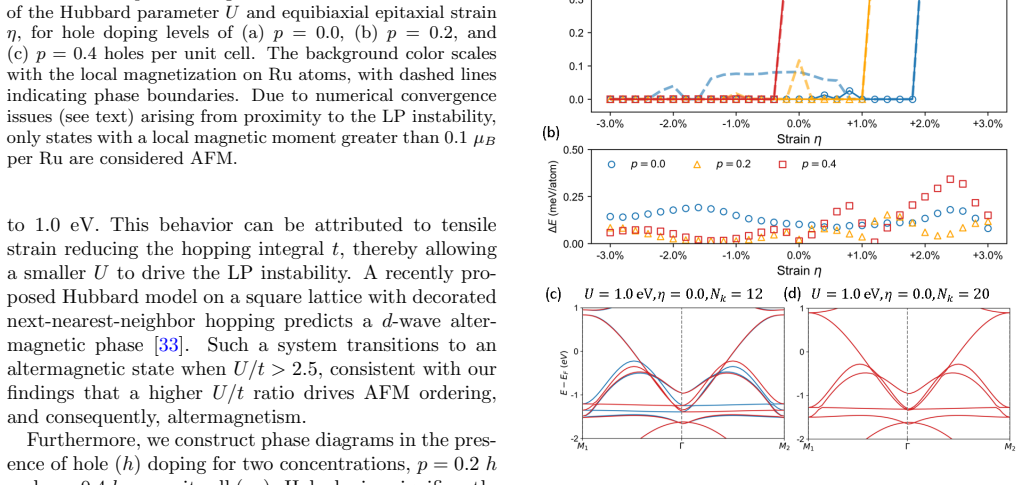
- [Section "We also comment on the numerical fragility..." and Fig. 3] The central inference that k-point-grid sensitivity is evidence of proximity to an LP instability is underdetermined. The data in Fig. 3 show that changing Nk from 12 to 20 changes the magnetic moment by more than 0.1 mu_B/Ru while the total energy changes by less than 0.5 meV/atom. This pattern is equally, and perhaps more naturally, explained by a metastable DFT+U solution stabilized by insufficient Brillouin-zone sampling, or by the known multiplicity of self-consistent DFT+U solutions, rather than by a physical near-critical state. The statement that the discrepancies "can be interpreted as evidence of the system's proximity to an LP instability" is too weak to support the paper's abstract claim that RuO2 is intrinsically near an LP instability. A concrete, non-circular test would be to compute the static spin susceptibility or a constrained-RPA estimate of the relevant Landau parameter and show that it is near the instability threshold, or to demonstrate that systematically denser k-point grids and varied initial magnetic configurations do not remove the sensitivity.
- [Expression F_a^2(U, eta, Nk) in the numerical-fragility discussion] A Landau parameter is a physical property of the interacting electron system and cannot depend on the numerical k-point grid Nk. Writing F_a^2 as a function of Nk conflates numerical convergence error with the physical interaction strength and makes the argument circular: the DFT+U sensitivity to Nk is used as evidence for LP proximity, while the LP framework is invoked to explain that same sensitivity. No independent estimate of F_a^2 is provided for RuO2, so the claim that F_a^2 is near its critical value remains an assumption rather than a derived result. The paper should either compute F_a^2 from a many-body method (e.g., constrained RPA or a calculated spin susceptibility) or clearly identify an observable consequence of LP proximity that is not simply the fragility of the DFT+U solution.
- [Sections "Landau-Pomeranchuk instabilities" and Fig. 1; critical value F_a^2 < -2] The theoretical criterion quoted, F_a^2 < -2 in 2D, is derived for a two-dimensional Fermi liquid, but RuO2 is a three-dimensional rutile crystal. While the symmetry classification of the l=2 alpha-phase may carry over to 3D, the critical value of the Landau parameter and the d-wave Fermi-surface distortion are dimension-dependent. The manuscript does not justify applying the 2D threshold to a 3D material, nor does it specify what the corresponding 3D criterion would be. This weakens the quantitative statement that RuO2 is "near" the LP threshold and needs to be addressed.
- [Phase diagrams in Fig. 2 and definition of AFM states] The phase diagrams identify AFM order with a local magnetic moment exceeding 0.1 mu_B per Ru, but this threshold is introduced without justification. The choice of 0.1 mu_B is not derived from any experimental or theoretical criterion, and it directly affects the location of the phase boundary U* reported in the text (e.g., U* = 1.2 eV at zero strain). Since the paper's subsequent interpretation relies on these boundaries, the threshold's sensitivity should be documented, for example by showing how U* shifts if the threshold is changed to 0.05 or 0.2 mu_B/Ru. Without this, the phase diagram is only a statement about a specific numerical convention.
- [Discussion reconciling experiments and theory] The claim that proximity to an LP instability reconciles conflicting experimental reports is not quantitatively supported. The muSR upper limits on the ordered moment (1.4e-4 mu_B in bulk and 7.5e-4 mu_B in films, Refs. [29,30]) and the absence of spin splitting in photoemission (Ref. [31]) are orders of magnitude smaller than the 0.1 mu_B moments obtained in the DFT+U calculations. Proximity to a critical point can, in principle, explain smallness of the ordered moment, but the paper does not connect its calculated moments or critical parameters to any specific experimental condition (temperature, disorder, strain state, or magnetic field). A falsifiable prediction, such as a divergent spin susceptibility or a soft collective mode near the proposed critical point, would be needed to make the reconciliation substantive.
minor comments (5)
- [Introduction, paragraph on neutron diffraction] There is a typo: "polarized neutron differaction" should read "polarized neutron diffraction."
- [Fig. 1 caption] The phrase "arising form the LP instabilities" should read "arising from the LP instabilities."
- [End Matter and Fig. 2 caption] The definition of hole doping p as "holes per unit cell" is clear, but the text also writes "p = 0.2 h/uc" and "p = 0.4 h/uc"; please use one consistent notation throughout.
- [Theoretical framework, Ref. [18] discussion] The text says the framework was developed "over two decades ago," but Ref. [18] is from 2007 and Ref. [17] from 2004; the phrase "nearly two decades ago" in the abstract is already more accurate and should be used in the main text as well.
- [Fig. 3] The color coding of spin-up and spin-down bands in Figs. 3(c) and 3(d) is defined only in the caption; it would help to add a legend or state the definition in the main text where the bands are discussed.
Circularity Check
RuO2's 'proximity to LP instability' is inferred from the same DFT+U numerical fragility it is then used to explain; the symmetry identification itself is not circular.
-
renaming known result
[Fig. 2 caption (phase-diagram section)]
"Due to numerical convergence issues (see text) arising from proximity to the LP instability, only states with a local magnetic moment greater than 0.1 µB per Ru are considered AFM."
The numerical convergence issues are the evidence from which 'proximity to the LP instability' is inferred in the main text. Calling the convergence issues 'arising from' that proximity presupposes the very inference the paper is trying to establish. With no independent estimate of the Landau parameter F_a^2, the phase diagram is defined by numerical fragility while presenting fragility as the consequence of LP proximity. The claimed explanation and the input observation are the same fact expressed in different language.
-
self definitional
[Paragraph beginning 'We also comment on the numerical fragility...', discussion of Fig. 3 (pp. 4-5)]
"These numerical discrepancies can be interpreted as evidence of the system's proximity to an LP instability. We argue that the value of F a 2 depends sensitively on the DFT computational parameters, expressed as F a 2 (U, η, Nk)."
A Landau parameter is a physical property of the interacting electron system; it cannot depend on the numerical k-point grid Nk. By writing F_a^2(U, η, Nk), the paper folds the numerical discrepancy into the Landau parameter and then treats a change in F_a^2 as proximity to the LP threshold. No independent determination of F_a^2 is offered, and the paper concedes that 'precise determination through single-particle DFT calculations is impractical.' Consequently, 'near the LP instability' is defined to be whatever numerical sensitivity is observed. The derivation reduces by construction to: the magnetic state is computationally sensitive because the magnetic state is computationally sensitive.
full rationale
The paper contains two separable claims. First, altermagnetism belongs to the same symmetry class as the l=2 spin-channel Landau-Pomeranchuk instability, i.e., the authors' earlier 'unconventional magnetism.' That identification is supported by the symmetry comparison, the reproduced d-wave Fermi-surface illustration, and the shared spin-space-group structure, and it does not depend on the numerical calculations; the self-citations to Ref. [18] are precedents rather than load-bearing circular evidence. Second, the RuO2-specific claim is that its fragile magnetic state reflects physical proximity to an LP instability. The only direct evidence offered for this proximity is the DFT+U sensitivity to Hubbard U, strain, hole doping, and k-point grid, shown in Figs. 2 and 3. The paper states that the numerical discrepancies 'can be interpreted as evidence of the system's proximity to an LP instability' and then posits F_a^2(U, η, Nk), allowing the Landau parameter to depend on the numerical grid. This is circular: since F_a^2 is never computed independently, the 'near-critical' statement is an encoding of the numerical fragility rather than a property established by any observable. The caption's phrase 'numerical convergence issues ... arising from proximity to the LP instability' uses the conclusion to label the evidence. The observation that the energy is converged to below 0.5 meV/atom while the moment changes by more than 0.1 µB/Ru could equally indicate metastable DFT+U solutions or poor Brillouin-zone sampling; the paper does not rule this out with an independent susceptibility or constrained-RPA estimate. Thus the central RuO2-specific explanation reduces by construction to the input numerical sensitivity, while the symmetry framework retains independent content. This is partial circularity, not a fully vacuous derivation, so the score is 6 rather than 8 or 10.
Assumptions & free parameters
free parameters (4)
- Hubbard U on Ru 4d orbitals =
scanned from 0 to >1.2 eV; critical U* = 1.0-1.2 eV depending on strain/doping
- AFM moment threshold =
0.1 μB per Ru
- Epitaxial strain eta =
-2% to +2% (scanned)
- Hole doping p =
0, 0.2, 0.4 holes per unit cell
assumptions (4)
- domain assumption Landau-Fermi liquid theory and the existence of spin-channel Landau-Pomeranchuk instabilities for l>=1.
- domain assumption PBE+U with a single Hubbard U on Ru 4d states captures the essential correlation physics of RuO2.
- ad hoc to paper The Landau parameter F_a^2 is a smooth function of U, strain, and doping and is near its critical value in RuO2.
- ad hoc to paper DFT+U numerical sensitivity to k-point grid is a faithful proxy for physical proximity to the LP instability.
Cite this review
Pith. "Pith review of Fragile Unconventional Magnetism in RuO$_2$ by Proximity to Landau-Pomeranchuk Instability." pith.science (2026). https://pith.science/paper/ZFFFLZB3
@misc{pith2026250113616,
  author       = {Pith},
  title        = {Pith review of: Fragile Unconventional Magnetism in RuO$_2$ by Proximity to Landau-Pomeranchuk Instability},
  year         = {2026},
  howpublished = {\url{https://pith.science/paper/ZFFFLZB3}},
  note         = {Machine review of arXiv:2501.13616}
}
abstract
Altermagnetism has attracted considerable attention for its remarkable combination of spin-polarized band structures and zero net magnetization, making it a promising candidate for spintronics applications. We demonstrate that this magnetic phase represents a case of ``unconventional magnetism," first proposed nearly two decades ago by one of the present authors as part of a broader framework for understanding Landau-Pomeranchuk instabilities in the spin channel, driven by many-body interactions. By systematically analyzing the altermagnetism in RuO$_2$ with first-principles calculations, we reconcile conflicting experimental and theoretical reports by attributing it to RuO$_2$'s proximity to a quantum phase transition. We emphasize the critical role of tuning parameters, such as the Hubbard $U$, hole doping, and epitaxial strain, in modulating quasiparticle interactions near the Fermi surface. This work provides fresh insights into the origin and tunability of altermagnetism in RuO$_2$, highlighting its potential as a platform for investigating quantum phase transitions and the broader realm of unconventional magnetism.
Figures


Reference graph
Works this paper leans on
-
[31]
J. Liu, J. Zhan, T. Li, J. Liu, S. Cheng, Y. Shi, L. Deng, M. Zhang, C. Li, J. Ding, Q. Jiang, M. Ye, Z. Liu, Z. Jiang, S. Wang, Q. Li, Y. Xie, Y. Wang, S. Qiao, J. Wen, Y. Sun, and D. Shen, Absence of altermagnetic spin splitting character in rutile oxide RuO 2, Phys. Rev. Lett. 133, 176401 (2024)
work page 2024
-
[1]
ˇSmejkal, J
L. ˇSmejkal, J. Sinova, and T. Jungwirth, Emerging re- search landscape of altermagnetism, Phys. Rev. X 12, 040501 (2022)
2022
-
[2]
ˇSmejkal, J
L. ˇSmejkal, J. Sinova, and T. Jungwirth, Beyond conven- tional ferromagnetism and antiferromagnetism: A phase with nonrelativistic spin and crystal rotation symmetry, Phys. Rev. X 12, 031042 (2022)
2022
-
[3]
Mazin (The PRX Editors), Editorial: Altermagnetism—a new punch line of fundamental magnetism, Phys
I. Mazin (The PRX Editors), Editorial: Altermagnetism—a new punch line of fundamental magnetism, Phys. Rev. X 12, 040002 (2022)
2022
-
[4]
O. J. Amin, A. Dal Din, E. Golias, Y. Niu, A. Za- kharov, S. C. Fromage, C. J. B. Fields, S. L. Heywood, R. B. Cousins, F. Maccherozzi, J. Krempask´ y, J. H. Dil, D. Kriegner, B. Kiraly, R. P. Campion, A. W. Rushforth, K. W. Edmonds, S. S. Dhesi, L. ˇSmejkal, T. Jungwirth, and P. Wadley, Nanoscale imaging and control of alter- magnetism in mnte, Nature 63...
work page 2024
-
[5]
Gonz´ alez-Hern´ andez, L.ˇSmejkal, K
R. Gonz´ alez-Hern´ andez, L.ˇSmejkal, K. V´ yborn´ y, Y. Ya- hagi, J. Sinova, T. c. v. Jungwirth, and J. ˇZelezn´ y, Efficient electrical spin splitter based on nonrelativis- tic collinear antiferromagnetism, Phys. Rev. Lett. 126, 127701 (2021)
2021
-
[6]
ˇSmejkal, R
L. ˇSmejkal, R. Gonz´ alez-Hern´ andez, T. Jungwirth, and J. Sinova, Crystal time-reversal symmetry breaking and spontaneous hall effect in collinear antiferromagnets, Sci. Adv. 6, eaaz8809 (2020)
2020
-
[7]
Z. Feng, X. Zhou, L. ˇSmejkal, L. Wu, Z. Zhu, H. Guo, R. Gonz´ alez-Hern´ andez, X. Wang, H. Yan, P. Qin, X. Zhang, H. Wu, H. Chen, Z. Meng, L. Liu, Z. Xia, J. Sinova, T. Jungwirth, and Z. Liu, An anomalous hall effect in altermagnetic ruthenium dioxide, Nat. Electron. 5, 735–743 (2022)
work page 2022
Show all 36 references
-
[8]
Tschirner, P
T. Tschirner, P. Keßler, R. D. Gonzalez Betancourt, T. Kotte, D. Kriegner, B. B¨ uchner, J. Dufouleur, M. Kamp, V. Jovic, L. Smejkal, J. Sinova, R. Claessen, T. Jungwirth, S. Moser, H. Reichlova, and L. Veyrat, Saturation of the anomalous hall effect at high magnetic fields in...
2023
-
[9]
Karube, T
S. Karube, T. Tanaka, D. Sugawara, N. Kadoguchi, M. Kohda, and J. Nitta, Observation of spin-splitter torque in collinear antiferromagnetic RuO 2, Phys. Rev. Lett. 129, 137201 (2022)
2022
-
[10]
H. Bai, L. Han, X. Y. Feng, Y. J. Zhou, R. X. Su, Q. Wang, L. Y. Liao, W. X. Zhu, X. Z. Chen, F. Pan, X. L. Fan, and C. Song, Observation of spin splitting torque in a collinear antiferromagnet RuO 2, Phys. Rev. Lett. 128, 197202 (2022)
2022
-
[11]
A. Bose, N. J. Schreiber, R. Jain, D.-F. Shao, H. P. Nair, J. Sun, X. S. Zhang, D. A. Muller, E. Y. Tsymbal, D. G. Schlom, and D. C. Ralph, Tilted spin current generated by the collinear antiferromagnet ruthenium dioxide, Nat. Electron. 5, 267–274 (2022)
2022
-
[12]
H. Bai, Y. C. Zhang, Y. J. Zhou, P. Chen, C. H. Wan, L. Han, W. X. Zhu, S. X. Liang, Y. C. Su, X. F. Han, F. Pan, and C. Song, Efficient spin-to-charge conversion via altermagnetic spin splitting effect in antiferromagnet RuO2, Phys. Rev. Lett. 130, 216701 (2023)
2023
-
[13]
Z. Xiao, J. Zhao, Y. Li, R. Shindou, and Z.-D. Song, Spin space groups: Full classification and applications, Phys. Rev. X 14, 031037 (2024)
2024
-
[14]
X. Chen, J. Ren, Y. Zhu, Y. Yu, A. Zhang, P. Liu, J. Li, Y. Liu, C. Li, and Q. Liu, Enumeration and representa- tion theory of spin space groups, Phys. Rev. X14, 031038 (2024)
2024
-
[15]
Jiang, Z
Y. Jiang, Z. Song, T. Zhu, Z. Fang, H. Weng, Z.-X. Liu, J. Yang, and C. Fang, Enumeration of spin-space groups: Toward a complete description of symmetries of magnetic orders, Phys. Rev. X 14, 031039 (2024)
2024
-
[16]
Unconventional 6 Magnetism
The earliest online record of the term “Unconventional 6 Magnetism” appears in a talk given by Wu at the Kavli Institute for Theoretical Physics on May 16, 2007,https: //online.kitp.ucsb.edu/online/coldatoms07/wu1/
2007
-
[17]
Wu and S.-C
C. Wu and S.-C. Zhang, Dynamic generation of spin-orbit coupling, Phys. Rev. Lett. 93, 036403 (2004)
2004
-
[18]
C. Wu, K. Sun, E. Fradkin, and S.-C. Zhang, Fermi liquid instabilities in the spin channel, Phys. Rev. B 75, 115103 (2007)
2007
-
[19]
I. I. Pomeranchuk, On the stability of a fermi liquid, JETP 8, 361 (1959)
1959
-
[20]
Oganesyan, S
V. Oganesyan, S. A. Kivelson, and E. Fradkin, Quantum theory of a nematic fermi fluid, Phys. Rev. B 64, 195109 (2001)
2001
-
[21]
J. E. Hirsch, Spin-split states in metals, Phys. Rev. B 41, 6820 (1990)
1990
-
[22]
J. E. Hirsch, Chromium: A possible spin-split metal, Phys. Rev. B 41, 6828 (1990)
1990
-
[23]
Lee and C
W.-C. Lee and C. Wu, Theory of unconventional meta- magnetic electron states in orbital band systems, Phys. Rev. B 80, 104438 (2009)
2009
-
[24]
Li and C
Y. Li and C. Wu, Spin-orbit coupled fermi liquid theory of ultracold magnetic dipolar fermions, Phys. Rev. B 85, 205126 (2012)
2012
-
[25]
W. D. Ryden and A. W. Lawson, Magnetic susceptibility of IrO2 and RuO2, J. Chem. Phys. 52, 6058 (1970)
1970
-
[26]
J. J. Lin, S. M. Huang, Y. H. Lin, T. C. Lee, H. Liu, X. X. Zhang, R. S. Chen, and Y. S. Huang, Low temperature electrical transport properties of RuO 2 and IrO 2 single crystals, J. Phys.: Condens. Matter 16, 8035 (2004)
2004
-
[27]
Berlijn, P
T. Berlijn, P. C. Snijders, O. Delaire, H.-D. Zhou, T. A. Maier, H.-B. Cao, S.-X. Chi, M. Matsuda, Y. Wang, M. R. Koehler, P. R. C. Kent, and H. H. Weitering, Itin- erant antiferromagnetism in RuO2, Phys. Rev. Lett. 118, 077201 (2017)
2017
-
[28]
Z. H. Zhu, J. Strempfer, R. R. Rao, C. A. Occhialini, J. Pelliciari, Y. Choi, T. Kawaguchi, H. You, J. F. Mitchell, Y. Shao-Horn, and R. Comin, Anomalous anti- ferromagnetism in metallic RuO2 determined by resonant x-ray scattering, Phys. Rev. Lett. 122, 017202 (2019)
2019
-
[29]
Hiraishi, H
M. Hiraishi, H. Okabe, A. Koda, R. Kadono, T. Muroi, D. Hirai, and Z. Hiroi, Nonmagnetic ground state in RuO2 revealed by muon spin rotation, Phys. Rev. Lett. 132, 166702 (2024)
2024
-
[30]
Philipp, G.-G
K. Philipp, G.-G. Laura, S. Andreas, P. Thomas, S. Za- her, K. Dmitry, M. Pascal, O. Fabio, M. Igor I., V. Roser, and M. Simon, Absence of magnetic order in RuO 2: in- sights from µSR spectroscopy and neutron diffraction, arXiv , 2405.10820 (2024)
2024 arXiv
-
[32]
Smolyanyuk, I
A. Smolyanyuk, I. I. Mazin, L. Garcia-Gassull, and R. Valent ´ ı, Fragility of the magnetic order in the pro- totypical altermagnet RuO 2, Phys. Rev. B 109, 134424 (2024)
2024
-
[33]
P. Das, V. Leeb, J. Knolle, and M. Knap, Realizing al- termagnetism in fermi-hubbard models with ultracold atoms, Phys. Rev. Lett. 132, 263402 (2024)
2024
-
[34]
Giannozzi, S
P. Giannozzi, S. Baroni, N. Bonini, M. Calandra, R. Car, C. Cavazzoni, D. Ceresoli, G. L. Chiarotti, M. Cococ- cioni, I. Dabo, et al., QUANTUM ESPRESSO: a modu- lar and open-source software project for quantum simula- tions of materials, J. Phys. Condens. Matter 21, 395502 (2009)
2009
-
[35]
Giannozzi, O
P. Giannozzi, O. Andreussi, T. Brumme, O. Bunau, M. B. Nardelli, M. Calandra, R. Car, C. Cavazzoni, D. Ceresoli, M. Cococcioni, et al., Advanced capabilities for materials modelling with QUANTUM ESPRESSO, J. Phys. Condens. Matter 29, 465901 (2017)
2017
-
[36]
van Setten, M
M. van Setten, M. Giantomassi, E. Bousquet, M. Ver- straete, D. Hamann, X. Gonze, and G.-M. Rignanese, The PseudoDojo: Training and grading a 85 element op- timized norm-conserving pseudopotential table, Comput. Phys. Commun. 226, 39 (2018). END MA TTER All DFT calculations ar...
2018
Reviewed August 10, 2026 · model on record in the stance chip above.
Discussion (0). Continue with ORCID to comment.