REVIEW 3 major objections 5 minor 45 references
Sparse Self-Federated Learning for Energy Efficient Cooperative Intelligence in Society 5.0
T0 review · 3 major / 5 minor · reviewed 2026-08-06 · deepseek-v4-flash
Pith's one-line read This paper argues that pruning and quantizing the exchanged models gives self-federated learning large energy and bandwidth savings without meaningful accuracy loss.
desk verdict A clear, honest roadmap for compressing proximity-based FL, but the central accuracy claim is unmeasured end-to-end. read the letter →
The pith
A machine-rendered reading of the paper's core claim, the machinery that carries it, and where it could break.
The reading
What carries the argument
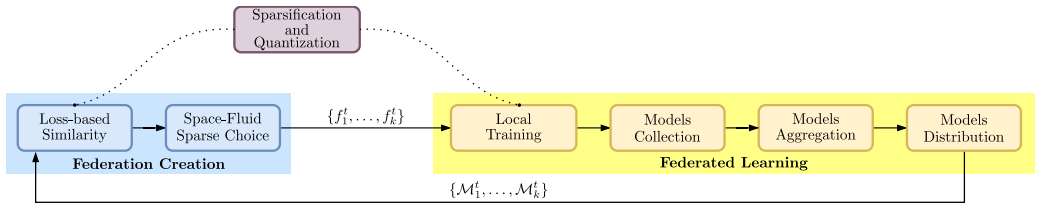
The load-bearing mechanism is the loss-based similarity check performed on compressed models. In PSFL, two devices $s_i$ and $s_j$ exchange trained models, evaluate each other's model on their own local data, and form a federation when the combined loss $d_{s_{i,j}} = L_{i,j} + L_{j,i}$ falls below a threshold $\tau$; this proxy stands in for direct comparison of private datasets. SParSeFuL's compression strategy $C$ with sparsification ratio $\psi$ is applied before the model is broadcast, so the similarity metric and the eventual FedAvg aggregation operate on sparse, quantized models. The Self-Organizing Coordination Region pattern supplies the distributed leader election (S-block), gradient-based propagation (G-block), and collection/aggregation (C-block) that turn the pairwise similarity decisions into stable federations.
What would settle it
Run SParSeFuL on a non-IID benchmark with, say, four known data subregions, sweeping the sparsification ratio $\psi$; if the number of converged federations diverges from four, or accuracy drops beyond the dense baseline's variance, at $\psi$ values below 0.8, then the central claim that compression preserves federation formation is falsified. The paper itself warns that $\psi \geq 0.8$ can break differentiation.
Extended reading notes
Core claim
The central discovery, on the paper's own terms, is that the resource bottleneck of self-federated learning can be attacked at the model-exchange level without sacrificing federation quality. SParSeFuL extends PSFL, where devices elect leaders through an aggregate-computing Self-Organizing Coordination Region pattern and form federations by pairwise loss-based similarity $d_{s_{i,j}} = L_{i,j} + L_{j,i}$; the extension compresses each model with a compression strategy $C$ at sparsity ratio $\psi$ before local training, broadcast, similarity evaluation, and aggregation. The authors report that aggressive sparsification is tolerable up to a point: measured on an MLP trained on Extended MNIST, $\psi = 0.3$ reduces inference time by nearly two-thirds and relative energy consumption to about 41% of the dense baseline with no noticeable accuracy loss, while performance degrades only near $\psi = 0.9$. Quantization at 8 bits reduces the exchanged model to about a quarter of its original size. The intended upshot is that a partially compressed pipeline can run on resource-constrained IoT devices and still converge to the correct number of federations.
Load-bearing premise
The similarity metric computed on compressed models must remain a reliable proxy for true data-distribution similarity at the sparsity levels that deliver the reported savings.
Editorial extensions
If this is right
- If the claim holds, a moderately sparse model exchange near $\psi = 0.3$ can be used in the similarity check without degrading federation formation, because the loss proxy remains informative at that sparsity.
- Energy per device falls roughly in half at $\psi = 0.3$, so the aggregate energy budget of large IoT deployments would shrink correspondingly.
- Eight-bit quantization cuts model size to about one fourth, which directly reduces the bandwidth of every model broadcast and collection in the federated loop.
- Federations should still converge to the true number of data distributions, because the similarity check is evaluated after compression, not on full models.
- Extreme sparsification near $\psi \geq 0.8$ is expected to break distribution differentiation and must be avoided.
Reading between the lines
- A testable extension the paper leaves implicit is to make the sparsity ratio adaptive per device, using the converged federation count as feedback to lower compression when federations fail to stabilize.
- Because iterative pruning can leave devices with architecturally diverse sparse models, the FedAvg step may need a mask-alignment or topology-matching procedure; comparing plain FedAvg against such a procedure on sparse models would be a concrete next experiment.
- The reported energy figures measure single-model inference, not the full federated loop, so an honest extrapolation is that end-to-end measurements are needed to see whether communication energy, rather than compute energy, dominates the savings in bandwidth-limited IoT settings.
Editorial analysis
A structured set of objections, weighed in public.
Referee Report
Summary. The paper proposes SParSeFuL, a sparse, quantized extension of Proximity-based Self-Federated Learning (PSFL) for large-scale IoT systems. The core mechanism combines aggregate-computing-based self-organization (SCR pattern) with neural network compression: models are sparsified and quantized before the loss-based similarity check that determines federation membership, and compressed models are then used for local training, exchange, and aggregation. The contributions are stated as (i) integrating compression into PSFL, (ii) a research roadmap for implementation and evaluation, and (iii) a discussion of impacts and challenges. The only quantitative evidence is a standalone MLP experiment on EMNIST showing reduced inference time and energy after post-hoc sparsification, plus a report that 8-bit quantization reduces model size from 1.8MB to 454KB. The abstract and conclusion claim that SParSeFuL reduces energy and communication overhead while maintaining competitive accuracy even under significant sparsification.
Significance. If established, the central claim would be relevant to green federated learning in non-IID IoT settings: combining self-organizing federation formation with compression addresses a real gap, since most prior work handles non-IID data, compression, or decentralization separately but not jointly. The paper is clearly written and provides a concrete algorithmic skeleton (Algorithm 1), a sensible roadmap, and honest preliminary measurements using a public dataset and the PyJoules energy tool. However, as it stands, the paper is a position/roadmap contribution rather than a validated method: no experiment exercises Algorithm 1 end-to-end, and the one load-bearing component that is new relative to PSFL—compressed-model loss similarity for federation formation—is explicitly conceded in Section III-B to fail at high sparsity and is never measured. The claimed energy, bandwidth, and accuracy benefits of SParSeFuL therefore remain unsubstantiated.
major comments (3)
- [Section V, Table I, Figure 4] The only quantitative evidence for the central claim is a post-pruned, standalone MLP: inference time, accuracy, and energy are measured outside any federated loop. There is no end-to-end run of Algorithm 1, no measurement of federation formation quality (e.g., whether federations converge to the true subregions), no federated accuracy after sparsification/quantization, and no accounting of communication or aggregation energy/bandwidth for SParSeFuL versus the uncompressed PSFL baseline. The abstract and conclusion claim that SParSeFuL 'can reduce power consumption and (partially) communication overhead while maintaining competitive accuracy,' but these quantities are never measured on SParSeFuL. The energy numbers in Table I are also unexplained in their steep non-monotonic drop from 41% at psi=0.3 to 3% at psi=0.5, and no variance or repetition information is given.
- [Section III-B and Algorithm 1, lines 3-5] The load-bearing premise is that the loss-based similarity metric d_{si,j} computed on compressed models remains a faithful proxy for data-distribution similarity. Algorithm 1 compresses the model before the similarity check and before local training, so the fidelity of d_{si,j} under sparsification and quantization determines whether federations form correctly. The paper itself states that at an 'excessively high sparsity level (e.g., psi >= 0.8)' the similarity check may fail to differentiate distributions, leading to inaccurate federation formation. Yet Figure 4 reports large inference savings precisely at psi in {0.7, 0.9}, and no experiment determines the threshold at which compression breaks federation formation. Without this measurement, the conclusion that SParSeFuL maintains accuracy 'even with significant sparsification' is unsupported.
- [Section IV-A] The research roadmap describes the integration of compression into the similarity check as a 'crucial first step' that must be verified before compression is extended to the learning phase: 'Once it is verified that this approximation enables effective federation formation without degrading accuracy...'. This is an explicit statement that the core mechanism of SParSeFuL has not yet been validated. The manuscript therefore overstates its contribution when it says in the abstract that SParSeFuL 'bridges this gap' and in the conclusion that it 'can reduce power consumption... while maintaining competitive accuracy.' The available evidence is consistent with the paper being a proposal, not with the paper having demonstrated a working method.
minor comments (5)
- [Section III-B] The phrase 'the similarity is computed as follow' should read 'as follows'; the enumerated steps (Models Exchange, Cross Validation, Similarity Metric Computation, Federation Decision) would be clearer as a numbered list with mathematical notation for L_{i,j} and d_{si,j} defined in one place.
- [Algorithm 1] Line 5 broadcasts M^{t,c}_i, the compressed model after local training, but the relationship between the broadcast model and the model used in the similarity metric computation (which evaluates received models on local data) is not fully specified; in particular, it is ambiguous whether the uncompressed local model is retained for training while only the exchanged copy is compressed, or whether compression affects the locally trained model itself. Clarifying this would make the algorithm reproducible.
- [Section V] The text says the experiment used an 'MLP network trained on the Extended MNIST dataset,' but Section IV-B mentions MNIST and CIFAR-10 as datasets for future evaluation; stating explicitly which dataset (EMNIST versus MNIST) was used in the reported experiment would avoid confusion.
- [Section V, Table I] The relative energy values would benefit from error bars or multiple runs, and the sudden drop between psi=0.3 and psi=0.5 should be explained (e.g., hardware caching, threshold effects in the pruning implementation, or measurement granularity).
- [Section II-C] The description of SCR relies heavily on the cited reference for the meaning of the S-block, G-block, and C-block; a one-sentence definition of each block at first use would make Section III more self-contained.
Circularity Check
No circularity: the compression gains are independently measured on a standalone model, and the PSFL baseline is prior work, not a fitted input.
full rationale
SParSeFuL's efficiency claims rest on direct measurements, not on derivation from its own assumptions. Figure 4 and Table I report inference time, accuracy, and PyJoules-measured energy for a post-pruned MLP on EMNIST, and the quantization result is given as a concrete model-size reduction at 8-bit integer precision. None of these quantities is fitted, renamed, or derived from the cited PSFL framework; PSFL from [8] is the algorithmic substrate, not the source of the efficiency numbers. The framework's core mechanism, the loss-based similarity metric, is inherited from PSFL and is admittedly fragile: Section III-B explicitly states that at high sparsity (psi >= 0.8) the process may fail to differentiate distributions, and Section IV-A lists verifying that compressed similarity enables effective federation formation as a future objective. These are empirical validity gaps and correctness risks, not circular reductions. The paper also cites several prior works by overlapping authors, including PSFL [8], FBFL [36], and ProFed [43], but these citations provide context and baselines; the central claim about compression does not reduce to any of them by construction. No equation in the paper is equivalent to another by definition, and no fitted parameter is relabeled as a prediction. Therefore the honest finding is no significant circularity.
Assumptions & free parameters
free parameters (3)
- sparsification ratio psi =
tested 0.0, 0.3, 0.5, 0.7, 0.9; no principled selection
- similarity threshold tau =
not specified
- compression strategy C =
post-pruning with unspecified criterion; 8-bit integer quantization
assumptions (4)
- domain assumption Devices in spatial proximity experience similar data distributions
- domain assumption Cross-validation loss on compressed models is a reliable proxy for data distribution similarity
- domain assumption The SCR pattern (S-block, G-block, C-block) provides correct self-stabilizing federation formation
- domain assumption FedAvg aggregation works for models with differing sparsity patterns
Cite this review
Pith. "Pith review of Sparse Self-Federated Learning for Energy Efficient Cooperative Intelligence in Society 5.0." pith.science (2026). https://pith.science/paper/ZFNDKUHP
@misc{pith2026250707613,
  author       = {Pith},
  title        = {Pith review of: Sparse Self-Federated Learning for Energy Efficient Cooperative Intelligence in Society 5.0},
  year         = {2026},
  howpublished = {\url{https://pith.science/paper/ZFNDKUHP}},
  note         = {Machine review of arXiv:2507.07613}
}
read the original abstract
Federated Learning offers privacy-preserving collaborative intelligence but struggles to meet the sustainability demands of emerging IoT ecosystems necessary for Society 5.0-a human-centered technological future balancing social advancement with environmental responsibility. The excessive communication bandwidth and computational resources required by traditional FL approaches make them environmentally unsustainable at scale, creating a fundamental conflict with green AI principles as billions of resource-constrained devices attempt to participate. To this end, we introduce Sparse Proximity-based Self-Federated Learning (SParSeFuL), a resource-aware approach that bridges this gap by combining aggregate computing for self-organization with neural network sparsification to reduce energy and bandwidth consumption.
Figures


Figures from the paper (1 more)

Reference graph
Works this paper leans on
-
[1]
A. Deguchi, C. Hirai, H. Matsuoka, T. Nakano, K. Oshima, M. Tai, and S. Tani, “What is society 5.0,” Society, vol. 5, no. 0, pp. 1–24, 2020
work page 2020
-
[2]
Foundations of cooperative AI,
V . Conitzer and C. Oesterheld, “Foundations of cooperative AI,” in Thirty-Seventh AAAI Conference on Artificial Intelligence, AAAI 2023, Thirty-Fifth Conference on Innovative Applications of Artificial Intelligence, IAAI 2023, Thirteenth Symposium on Educational Advances in Artificial Intelligence, EAAI 2023, Washington, DC, USA, February 7-14, 2023 , B....
-
[3]
An efficient framework for clustered federated learning,
A. Ghosh, J. Chung, D. Yin, and K. Ramchandran, “An efficient framework for clustered federated learning,” IEEE Trans. Inf. Theory, vol. 68, no. 12, pp. 8076–8091, 2022. [Online]. Available: https://doi.org/10.1109/TIT.2022.3192506
-
[4]
Z. Li, J. Lu, S. Luo, D. Zhu, Y . Shao, Y . Li, Z. Zhang, Y . Wang, and C. Wu, “Towards effective clustered federated learning: A peer-to-peer framework with adaptive neighbor matching,” IEEE Trans. Big Data , vol. 10, no. 6, pp. 812–826, 2024. [Online]. Available: https://doi.org/10.1109/TBDATA.2022.3222971
-
[5]
P. Prakash, J. Ding, R. Chen, X. Qin, M. Shu, Q. Cui, Y . Guo, and M. Pan, “Iot device friendly and communication-efficient federated learning via joint model pruning and quantization,” IEEE Internet Things J., vol. 9, no. 15, pp. 13 638–13 650, 2022. [Online]. Available: https://doi.org/10.1109/JIOT.2022.3145865
-
[6]
Towards self-adaptive cooperative learning in collective systems,
D. Domini, “Towards self-adaptive cooperative learning in collective systems,” in IEEE International Conference on Autonomic Computing and Self-Organizing Systems, ACSOS 2024 - Companion, Aarhus, Denmark, September 16-20, 2024 . IEEE, 2024, pp. 158–160. [Online]. Available: https://doi.org/10.1109/ACSOS-C63493.2024.00049
-
[7]
Decentralized learning works: An empirical comparison of gossip learning and federated learning,
I. Heged ¨us, G. Danner, and M. Jelasity, “Decentralized learning works: An empirical comparison of gossip learning and federated learning,” J. Parallel Distributed Comput. , vol. 148, pp. 109–124, 2021. [Online]. Available: https://doi.org/10.1016/j.jpdc.2020.10.006
-
[8]
Proximity-based self-federated learning,
D. Domini, G. Aguzzi, N. Farabegoli, M. Viroli, and L. Esterle, “Proximity-based self-federated learning,” in IEEE International Conference on Autonomic Computing and Self- Organizing Systems, ACSOS 2024, Aarhus, Denmark, September 16-20, 2024 . IEEE, 2024, pp. 139–144. [Online]. Available: https://doi.org/10.1109/ACSOS61780.2024.00033
Show all 45 references
-
[9]
Communication-efficient learning of deep networks from decentralized data,
B. McMahan, E. Moore, D. Ramage, S. Hampson, and B. A. y Arcas, “Communication-efficient learning of deep networks from decentralized data,” in Proceedings of the 20th International Conference on Artificial Intelligence and Statistics, AISTATS 2017, 20-22 April 2017, Fort Laud...
2017
-
[10]
Federated learning of deep networks using model averaging,
H. B. McMahan, E. Moore, D. Ramage, and B. A. y Arcas, “Federated learning of deep networks using model averaging,” CoRR, vol. abs/1602.05629, 2016. [Online]. Available: http://arxiv.org/abs/1602.05629
2016 arXiv
-
[11]
Personalized federated learning for cross-city traffic prediction,
Y . Zhang, H. Lu, N. Liu, Y . Xu, Q. Li, and L. Cui, “Personalized federated learning for cross-city traffic prediction,” in Proceedings of the Thirty-Third International Joint Conference on Artificial Intelligence, IJCAI 2024, Jeju, South Korea, August 3-9, 2024 . ijcai.org, ...
2024
-
[12]
A survey on federated learning in intelligent transportation systems,
R. Zhang, H. Wang, B. Li, X. Cheng, and L. Yang, “A survey on federated learning in intelligent transportation systems,” CoRR, vol. abs/2403.07444, 2024. [Online]. Available: https://doi.org/10.48550/arXiv.2403.07444
-
[13]
A survey on federated learning for resource-constrained iot devices,
A. Imteaj, U. Thakker, S. Wang, J. Li, and M. H. Amini, “A survey on federated learning for resource-constrained iot devices,” IEEE Internet Things J. , vol. 9, no. 1, pp. 1–24, 2022. [Online]. Available: https://doi.org/10.1109/JIOT.2021.3095077
2022
-
[14]
Federated learning on non-iid data silos: An experimental study,
Q. Li, Y . Diao, Q. Chen, and B. He, “Federated learning on non-iid data silos: An experimental study,” in Proceedings of the International Conference on Data Engineering . IEEE, 2022, pp. 965–978. [Online]. Available: https://doi.org/10.1109/ICDE53745.2022.00077
2022
-
[15]
Imteaj, K
A. Imteaj, K. Mamun Ahmed, U. Thakker, S. Wang, J. Li, and M. H. Amini, Federated Learning for Resource-Constrained IoT Devices: Panoramas and State of the Art . Cham: Springer International Publishing, 2023, pp. 7–27. [Online]. Available: https://doi.org/10.1007/978-3-031-11748-0 2
2023 doi
-
[16]
Federated optimization in heterogeneous networks,
T. Li, A. K. Sahu, M. Zaheer, M. Sanjabi, A. Talwalkar, and V . Smith, “Federated optimization in heterogeneous networks,” in Proceedings of the Third Conference on Machine Learning and Systems, MLSys 2020, Austin, TX, USA, March 2-4, 2020 , I. S. Dhillon, D. S. Papailiopoulos...
2020
-
[17]
SCAFFOLD: stochastic controlled averaging for federated learning,
S. P. Karimireddy, S. Kale, M. Mohri, S. J. Reddi, S. U. Stich, and A. T. Suresh, “SCAFFOLD: stochastic controlled averaging for federated learning,” in Proceedings of the 37th International Conference on Machine Learning, ICML 2020, 13-18 July 2020, Virtual Event , ser. Proce...
2020
-
[18]
Unsupervised graph structure-assisted personalized federated learning,
X. Li, X. Chen, B. Tang, S. Wang, Y . Xuan, and Z. Zhao, “Unsupervised graph structure-assisted personalized federated learning,” in Proceedings of the European Conference on Artificial Intelligence , ser. Frontiers in Artificial Intelligence and Applications, vol. 372. IOS Pr...
2023 doi
-
[19]
Deep learning in multiagent systems,
L. Esterle, “Deep learning in multiagent systems,” in Deep Learning for Robot Perception and Cognition . Elsevier, 2022, pp. 435–460
2022
-
[20]
Neighbor-based decentralized training strategies for multi-agent reinforcement learning,
N. Malucelli, D. Domini, G. Aguzzi, and M. Viroli, “Neighbor-based decentralized training strategies for multi-agent reinforcement learning,” in Proceedings of the 40th ACM/SIGAPP Symposium on Applied Com- puting, SAC 2025, Catania, Italy, March 31-April 4, 2025. ACM, 2024, pp. 3–10
2025
-
[21]
Field-based coordination for federated learning,
D. Domini, G. Aguzzi, L. Esterle, and M. Viroli, “Field-based coordination for federated learning,” in Coordination Models and Languages - 26th IFIP WG 6.1 International Conference, COORDINATION 2024, Held as Part of the 19th International Federated Conference on Distributed C...
2024
-
[22]
Edge AI: On-demand acceler- ating deep neural network inference via edge computing,
E. Li, L. Zeng, Z. Zhou, and X. Chen, “Edge AI: On-demand acceler- ating deep neural network inference via edge computing,” IEEE Trans. Wirel. Commun., vol. 19, no. 1, pp. 447–457, Jan. 2020
2020
-
[23]
Pruning and quantization for deep neural network acceleration: A survey,
T. Liang, J. Glossner, L. Wang, S. Shi, and X. Zhang, “Pruning and quantization for deep neural network acceleration: A survey,” Neuro- computing, vol. 461, pp. 370–403, Oct. 2021
2021
-
[24]
Comparing training of sparse to classic neural networks for binary classification in medical data,
L. Erhan, A. Liotta, and L. Cavallaro, “Comparing training of sparse to classic neural networks for binary classification in medical data,” in Lecture Notes in Computer Science , ser. Lecture notes in computer science. Cham: Springer Nature Switzerland, 2025, pp. 101–106
2025
-
[25]
Resprune: An energy-efficient restorative filter pruning method using stochastic optimization for accelerating cnn,
A. Jayasimhan and P. P., “Resprune: An energy-efficient restorative filter pruning method using stochastic optimization for accelerating cnn,” Pattern Recognition, vol. 155, p. 110671, Nov 2024. [Online]. Available: https://www.sciencedirect.com/science/article/pii/S0031320324004229
2024
-
[26]
Unveiling the power of sparse neural networks for feature selection,
Z. Atashgahi, T. Liu, M. Pechenizkiy, R. Veldhuis, D. C. Mocanu, and M. van der Schaar, “Unveiling the power of sparse neural networks for feature selection,” Oct. 2024. [Online]. Available: https://arxiv.org/abs/2408.04583
2024 arXiv
-
[27]
Quantizing deep convolutional networks for efficient inference: A whitepaper,
R. Krishnamoorthi, “Quantizing deep convolutional networks for efficient inference: A whitepaper,” 2018. [Online]. Available: https://arxiv.org/abs/1806.08342
2018 arXiv
-
[28]
Aggregate programming for the internet of things,
J. Beal, D. Pianini, and M. Viroli, “Aggregate programming for the internet of things,” Computer, vol. 48, no. 9, pp. 22–30, 2015. [Online]. Available: https://doi.org/10.1109/MC.2015.261
2015 doi
-
[29]
Macroprogramming: Concepts, state of the art, and opportunities of macroscopic behaviour modelling,
R. Casadei, “Macroprogramming: Concepts, state of the art, and opportunities of macroscopic behaviour modelling,” ACM Comput. Surv., vol. 55, no. 13s, pp. 275:1–275:37, 2023. [Online]. Available: https://doi.org/10.1145/3579353
2023 doi
-
[30]
Co-fields: A physically inspired approach to motion coordination,
M. Mamei, F. Zambonelli, and L. Leonardi, “Co-fields: A physically inspired approach to motion coordination,” IEEE Pervasive Comput., vol. 3, no. 2, pp. 52–61, 2004. [Online]. Available: https://doi.org/10.1109/MPRV .2004.1316820
2004 arXiv
-
[31]
A higher-order calculus of computational fields,
G. Audrito, M. Viroli, F. Damiani, D. Pianini, and J. Beal, “A higher-order calculus of computational fields,” ACM Trans. Comput. Log., vol. 20, no. 1, pp. 5:1–5:55, 2019. [Online]. Available: https://doi.org/10.1145/3285956
2019 doi
-
[32]
Space-time universality of field calculus,
G. Audrito, J. Beal, F. Damiani, and M. Viroli, “Space-time universality of field calculus,” in Coordination Models and Languages - 20th IFIP WG 6.1 International Conference, COORDINATION 2018, Held as Part of the 13th International Federated Conference on Distributed Computin...
2018
-
[33]
Engineering resilient collective adaptive systems by self-stabilisation,
M. Viroli, G. Audrito, J. Beal, F. Damiani, and D. Pianini, “Engineering resilient collective adaptive systems by self-stabilisation,” ACM Trans. Model. Comput. Simul. , vol. 28, no. 2, pp. 16:1–16:28, 2018. [Online]. Available: https://doi.org/10.1145/3177774
2018 doi
-
[34]
Self-adaptation to device distribution in the internet of things,
J. Beal, M. Viroli, D. Pianini, and F. Damiani, “Self-adaptation to device distribution in the internet of things,” ACM Trans. Auton. Adapt. Syst., vol. 12, no. 3, pp. 12:1–12:29, 2017. [Online]. Available: https://doi.org/10.1145/3105758
2017 doi
-
[35]
Self-organising coordination regions: A pattern for edge computing,
R. Casadei, D. Pianini, M. Viroli, and A. Natali, “Self-organising coordination regions: A pattern for edge computing,” in Coordination Models and Languages - 21st IFIP WG 6.1 International Conference, COORDINATION 2019, Held as Part of the 14th International Federated Confere...
2019
-
[36]
FBFL: A field-based coordination approach for data heterogeneity in federated learning,
D. Domini, G. Aguzzi, L. Esterle, and M. Viroli, “FBFL: A field-based coordination approach for data heterogeneity in federated learning,” CoRR, vol. abs/2502.08577, 2025. [Online]. Available: https://doi.org/10.48550/arXiv.2502.08577
2025 doi
-
[37]
Scarlib: Towards a hybrid toolchain for aggregate computing and many-agent reinforcement learning,
D. Domini, F. Cavallari, G. Aguzzi, and M. Viroli, “Scarlib: Towards a hybrid toolchain for aggregate computing and many-agent reinforcement learning,” Sci. Comput. Program. , vol. 238, p. 103176, 2024. [Online]. Available: https://doi.org/10.1016/j.scico.2024.103176
2024
-
[38]
Field-informed reinforcement learning of collective tasks with graph neural networks,
G. Aguzzi, M. Viroli, and L. Esterle, “Field-informed reinforcement learning of collective tasks with graph neural networks,” in IEEE International Conference on Autonomic Computing and Self-Organizing Systems, ACSOS 2023, Toronto, ON, Canada, September 25-29, 2023 . IEEE, 202...
2023
-
[39]
Scalable training of artificial neural networks with adaptive sparse connectivity inspired by network science,
D. C. Mocanu, E. Mocanu, P. Stone, P. H. Nguyen, M. Gibescu, and A. Liotta, “Scalable training of artificial neural networks with adaptive sparse connectivity inspired by network science,” Nature communica- tions, vol. 9, no. 1, p. 2383, 2018
2018
-
[40]
Mnist handwritten digit database,
Y . LeCun, C. Cortes, C. Burges et al. , “Mnist handwritten digit database,” 2010
2010
-
[41]
Cifar-10 (cana- dian institute for advanced research)
A. Krizhevsky, V . Nair, and G. Hinton, “Cifar-10 (cana- dian institute for advanced research).” [Online]. Available: http://www.cs.toronto.edu/ kriz/cifar.html
-
[42]
Flower: A friendly federated learning research framework,
D. J. Beutel, T. Topal, A. Mathur, X. Qiu, T. Parcollet, and N. D. Lane, “Flower: A friendly federated learning research framework,” CoRR, vol. abs/2007.14390, 2020. [Online]. Available: https://arxiv.org/abs/2007.14390
2007 arXiv
-
[44]
Pyjoules: Python library that measures python code snippets,
M. c. Belgaid, R. Rouvoy, and L. Seinturier, “Pyjoules: Python library that measures python code snippets,” Nov. 2019. [Online]. Available: https://github.com/powerapi-ng/pyJoules
2019
-
[2018]
Lecture Notes in Computer Science, G
Proceedings, ser. Lecture Notes in Computer Science, G. D. M. Serugendo and M. Loreti, Eds., vol. 10852. Springer, 2018, pp. 1–20. [Online]. Available: https://doi.org/10.1007/978-3-319-92408-3 1
2018 doi
-
[2025]
Available: https://arxiv.org/abs/2503.20618
[Online]. Available: https://arxiv.org/abs/2503.20618
Reviewed August 6, 2026 · model on record in the stance chip above.
Discussion (0). Continue with ORCID to comment.