REVIEW 2 major objections 4 minor 109 references
Fractal Aggregate Aerosols in the Virga Cloud Code I: Model Description and Application to a Benchmark Cloudy Exoplanet
T0 review · 2 major / 4 minor · reviewed 2026-08-04 · deepseek-v4-flash
Pith's one-line read Fluffy fractal clouds, not just spheres, can now be modeled fast in Virga 2.0, with settling and scattering tied together.
desk verdict Virga v2.0 brings fractal aggregates to a widely used cloud code, but the 'self-consistent' dynamics rest on an unvalidated spherical closure; it still deserves refereeing. read the letter →
The pith
A machine-rendered reading of the paper's core claim, the machinery that carries it, and where it could break.
The reading
What carries the argument
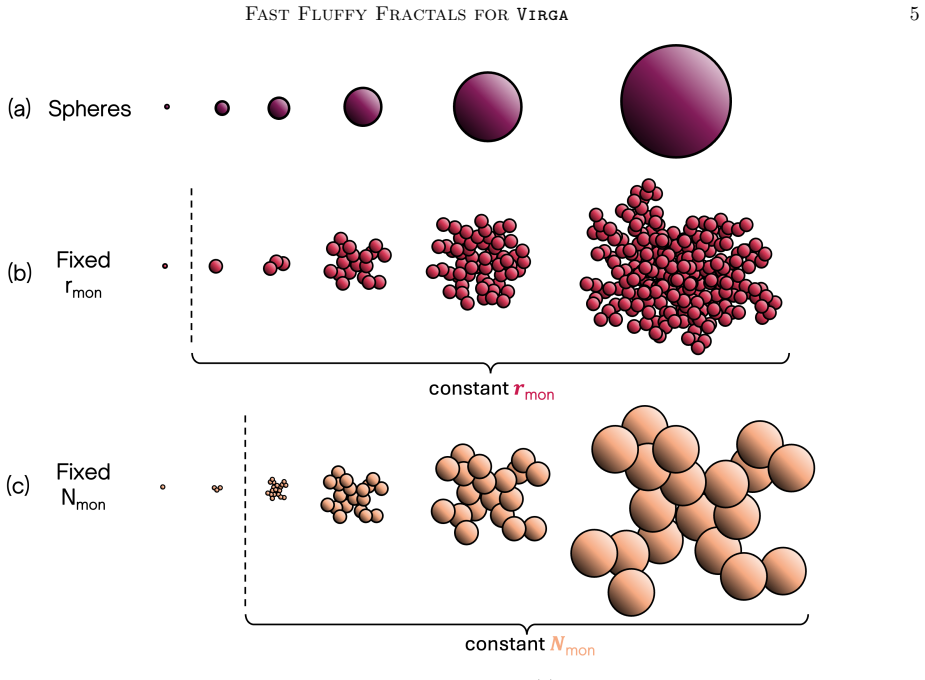
The load-bearing object is the fractal aggregate parametrization: an aggregate is a cluster of N_mon identical monomers with fractal dimension D_f and radius of gyration R_agg, related by N_mon = k0 (R_agg/r_mon)^Df. Dynamics use R_agg as the characteristic radius in kinetic- and continuum-regime fall-speed formulas, with the aggregate density set by the fractal dimension. The analytic closure of the original model—a power-law relation between fall speed and particle radius (v_fall = w* (r/r_w)^alpha)—is retained, but alpha is computed from spheres and assumed to hold for aggregates. Optics use Modified Mean Field Theory (MMF), implemented via the OpTool package, to compute extinction, scatt
What would settle it
Run a microphysical cloud model with the same GJ 1214 b conditions and D_f < 2 KCl aggregates, reporting the actual aggregate radii as a function of pressure. If those radii deviate systematically from the r_w-based sizes Virga 2.0 predicts—or if laboratory settling measurements show aggregate fall speeds that violate the assumed power-law closure—the central claim of self-consistent dynamics would be falsified for fluffy particles. A simpler observational check: measure the cloud-top pressure and visible scattering slope at high precision; the model predicts a sharp transparency drop for D_f
Extended reading notes
Core claim
The central claim is that fractal aggregate clouds can be incorporated into the analytic EddySed/Virga mass-balance framework without abandoning its speed: aggregate fall speeds are computed from the radius of gyration and fractal dimension, and aggregate optics from Modified Mean Field Theory (MMF), benchmarked against discrete dipole approximation (DDA) calculations. Applied to KCl clouds in a GJ 1214 b-like atmosphere, the method reproduces the Df = 2 spectra of a prior microphysical model, including the steep visible scattering slope for small monomers and the muted near- and mid-infrared features. The paper also identifies a structural consequence: because the cloud mass profile in this
Load-bearing premise
The load-bearing premise is that the analytic spherical relation between the characteristic particle radius r_g and the settling-balance radius r_w continues to hold for aggregates, even though aggregate fall speeds have different, sometimes non-monotonic functional forms; the paper states this assumption explicitly after deriving alpha from spheres.
Editorial extensions
If this is right
- Transmission spectra of cloudy exoplanets can now be generated with fractal aggregate aerosols across a wide parameter space at the speed of the analytic Virga model, not the cost of microphysical simulations.
- For fractal dimensions at or below about 2.2, fluffy KCl aggregates are predicted to be more transparent at visible wavelengths than spheres, with a sharp drop in mass scattering opacity; this is a testable spectral signature rather than a small correction.
- The fixed-monomer-number growth option always finds a stable cloud solution, while fixed-monomer-radius runs can fail for very fluffy particles; the paper recommends fixed-N_mon as the safer default.
- The close reproduction of the Df = 2 KCl reference spectra suggests existing aggregate cloud observations interpreted with microphysical models may be re-interpretable with this faster framework, including a broader family of particle shapes.
Reading between the lines
- If the assumed r_g–r_w closure fails for very fluffy aggregates, the predicted particle size distributions would shift, but the paper's own analysis shows the optical consequences are muted by the shape-independence of the cloud mass profile; a direct microphysical comparison would settle how much this matters.
- Because the cloud mass profile is independent of particle shape in this framework, any observed spectral difference between spherical and aggregate clouds in Virga is purely an optical effect; this clean separation could be used to isolate optical morphology constraints from vertical transport constraints.
- The same machinery should transfer directly to condensates with strong mid-infrared spectral features (e.g., silicates) where aggregate morphology matters more than for featureless KCl; the paper notes this as future work.
- The more stable behavior of fixed-N_mon suggests a natural bridge to retrievals: treat N_mon as a free parameter alongside D_f, since it controls both settling and monomer-level optics.
Editorial analysis
A structured set of objections, weighed in public.
Referee Report
Summary. The paper extends the Virga/EddySed cloud modeling framework to fractal aggregate aerosols. It introduces a parameterized treatment of aggregate fall speeds (free-molecular and continuum/slip regimes), imposes a fall-speed floor for very fluffy aggregates, and offers two growth modes (fixed monomer radius or fixed monomer number). Optical properties are computed with Modified Mean Field Theory (MMF) via Optool and benchmarked against DDA (CORAL); the resulting opacity grids are released. The model is applied to GJ 1214 b-like KCl clouds and simulated transmission spectra are compared with earlier microphysical models, particularly Ohno et al. (2020). Section 4.4 presents an analytic scaling argument intended to explain why some fluffy aggregate clouds are optically transparent. The code is released as Virga v2.0 with supporting data on Zenodo.
Significance. The paper fills a practical and timely gap: a fast, open-source, parameterized alternative to microphysical aggregate cloud models, suitable for large parameter-space sweeps and retrievals. The MMF opacity grid, benchmarked against DDA, and the public release of code and opacity data are concrete strengths. The D_f=2 fixed-r_mon spectral comparisons to Ohno et al. (2020) provide a useful consistency check. Section 4.4 is a valuable analytic attempt to explain morphology-dependent cloud transparency. However, the central claim that the model accounts for both dynamical and optical consequences of fractal aggregates 'in a self-consistent way' (Section 5) is not supported as written because the aggregate size distribution is closed using the spherical fall-speed power law. The dynamical part of the contribution therefore needs either a corrected closure or an explicit, tested limitation before the paper can be accepted.
major comments (2)
- [Section 2, Eqs. (16)-(17)] The load-bearing closure for the aggregate size distribution uses spherical dynamics: 'α is determined using spherical particles (using Eq. 16), and we assume the same relationship between r_g and r_w holds for aggregates.' This maps r_w to r_g and then, through the MMF grid, to every opacity and spectrum. For aggregates, however, Eq. (11) gives v_fall,agg proportional to R_agg^{(D_f-2)} in the kinetic regime, so for D_f≤2 there is no unique aggregate radius satisfying v_fall(r_w)=w*; the spherical α does not represent aggregate dynamics. The comparison to Ohno et al. (2020) in Section 4.3 cannot isolate this assumption because the cloud mass profile is shape-independent by construction (Eq. 23) and f_sed is fixed. The Section 5 claim of self-consistent aggregate dynamics is therefore not established. I recommend deriving an aggregate α from the local slope of v_fall vs R_agg, or solving
- [Section 4.4, Eq. (24)] The printed scattering formula has a sign/applicability problem. The text states that Eq. (24) is 'applicable to D_f>2', but the denominator (D_f−1)(2−D_f) is negative for D_f>2, making C_sca,agg negative. The subsequent claim that ζ 'drops sharply' for D_f≲2.2 appears to use the D_f<2 branch, where the denominator is positive. As printed, the analytic transparency explanation is therefore not self-consistent. The formula should be corrected (or the reference expression quoted accurately) and the conclusion re-evaluated.
minor comments (4)
- [Figures 3, 7-12] Unit labels in several figure captions and axis labels appear as 'm' where 'μm' is intended (e.g., 'rmon = 0.01 m', 'Mean Aggregate Radius ( m)'). Please fix to avoid confusion.
- [Eqs. (14)-(15)] The linear interpolation for k_0 in Eq. (15) is stated to transition smoothly to Eq. (14) at N_mon=100, but at N_mon=99 the two expressions are only approximately equal, not exactly. Please clarify the intended continuity or adjust the interpolation.
- [Section 3, Figure 4] The DDA/MMF benchmark is shown for one illustrative grid (D_f=1.8). A supplementary table or figure with quantitative errors across the full D_f and size grid would strengthen the claim that MMF is 'much closer to DDA' across the parameter space.
- [Section 4.2] The sentence 'we do not adjust for the atmospheric metallicity in calculating its saturation vapor pressure profile' is important for understanding the mass-profile comparison to Ohno et al.; consider stating this limitation earlier in the case-study setup.
Circularity Check
No significant circularity: the aggregate model is an openly parametrized implementation, benchmarked against external DDA and microphysical results, and the spherical closure is a stated assumption rather than a disguised input.
full rationale
The central deliverable is a code implementation and a benchmark, not a quantity derived from itself. No parameter is fitted to a subset of data and then relabeled a prediction; α is taken from the standard spherical EddySed closure and applied to aggregates under an explicit assumption (Section 2: 'Instead α is determined using spherical particles (using Eq. 16), and we assume the same relationship between r_g and r_w holds for aggregates'). This is an unvalidated modeling assumption and a limitation, but not circular: the paper does not present it as a derived result, and the subsequent optical calculations (MMF opacity grid, Section 3) are independent of the closure. The MMF implementation is benchmarked against DDA (Figure 4) using CORAL, and the D_f=2 spectra reproduce the independent microphysical model of Ohno et al. (2020) (Section 4.3). The analytic transparency result (Section 4.4) is derived from published monomer-scattering and fall-speed formulas, not from the simulation outputs. Several cited works share authors (Ohno, Vahidinia, Lodge), but these are peer-reviewed derivations with stated assumptions and an external numerical method (DDA), so they constitute independent support rather than a self-citation chain. The paper itself flags the main limitations (e.g., no microphysics, shape-independent mass profile, multiple/no-solution cases for D_f≤2) in Sections 2, 4.2, and 5. The overstatement of 'self-consistent' in the conclusion is a correctness risk about the validity of the spherical closure for aggregates, not a circularity in the derivation chain.
Assumptions & free parameters
free parameters (7)
- fractal dimension D_f =
grid: 1.2, 1.6, 2.0, 2.4, 2.8
- monomer radius r_mon =
0.01, 0.1, 1 micron
- number of monomers N_mon =
100, 1000, 10000
- sedimentation efficiency f_sed =
0.3
- lognormal width sigma =
2
- Knudsen number bifurcation =
10
- v_fall floor condition =
v_fall(aggregate) >= v_fall(monomer)
assumptions (5)
- standard math Fractal scaling relation N_mon = k0 (R_agg/r_mon)^D_f
- domain assumption Monomer mass density equals bulk material density and monomers are spherical and non-porous
- ad hoc to paper EddySed mass balance Eq. 1 and power-law closure Eq. 16 hold, with alpha from spherical particles also valid for aggregates
- domain assumption Modified Mean Field Theory with Gaussian cutoff (iqcor=1) approximates aggregate optics
- domain assumption The cloud mass mixing ratio profile is independent of particle shape in EddySed (Eq. 23)
Cite this review
Pith. "Pith review of Fractal Aggregate Aerosols in the Virga Cloud Code I: Model Description and Application to a Benchmark Cloudy Exoplanet." pith.science (2026). https://pith.science/paper/ZGDSRODW
@misc{pith2026250906708,
  author       = {Pith},
  title        = {Pith review of: Fractal Aggregate Aerosols in the Virga Cloud Code I: Model Description and Application to a Benchmark Cloudy Exoplanet},
  year         = {2026},
  howpublished = {\url{https://pith.science/paper/ZGDSRODW}},
  note         = {Machine review of arXiv:2509.06708}
}
read the original abstract
We introduce new functionality to treat fractal aggregate aerosol particles within the Virga cloud modeling framework. Previously, the open source cloud modeling code Virga (Batalha et al. 2025), the Python version of EddySed (Ackerman & Marley, 2001), assumed spherical particles to compute particle mass and size distributions throughout the atmosphere. The initial release of Virga also assumed spherical particles to compute Mie scattering properties, which include the single scattering albedo, asymmetry parameter, and optical depth as a function of particle radius and composition. However, extensive evidence from Solar system aerosols, astrophysical disks and dust, and Earth climate studies suggests that non-spherical aggregate particles are common compared to idealized compact spherical particles. Following recent advances in microphysical and opacity modeling, we implement a simple parametrization for dynamical and optical (modified mean field theory) effects of fractal aggregate particles into Virga. We then use this new functionality to perform a case study using basic planetary parameters similar to the well-characterized, aerosol-laden mini-Neptune GJ 1214 b, using KCl clouds made of aggregate particles. We choose KCl to most directly explore comparisons to previous studies. We demonstrate 1) how our method compares to previous fractal aggregate particle treatments and 2) how our new fractal treatment affects theoretical spectra of cloudy atmospheres. Overall, our model is faster and more flexible for a wider range of parameter space than previous studies. We explore the limitations of our modeling set-up and offer guidance for future investigations using our framework.
Figures


Figures from the paper (9 more)


Reference graph
Works this paper leans on
-
[1]
Ackerman, A. S., & Marley, M. S. 2001, ApJ, 556, 872, doi: 10.1086/321540
doi:10.1086/321540 2001
-
[2]
H., & Buseck, P
Adachi, K., Chung, S. H., & Buseck, P. R. 2010, Journal of Geophysical Research: Atmospheres, 115
2010
-
[3]
Adams, D., Gao, P., de Pater, I., & Morley, C. V. 2019, ApJ, 874, 61, doi: 10.3847/1538-4357/ab074c
-
[4]
Ahrer, E.-M., Stevenson, K. B., Mansfield, M., et al. 2023, Nature, 614, 653, doi: 10.1038/s41586-022-05590-4
-
[5]
Arney, G. N., Meadows, V. S., Domagal-Goldman, S. D., et al. 2017, ApJ, 836, 49, doi: 10.3847/1538-4357/836/1/49 Astropy Collaboration, Robitaille, T. P., Tollerud, E. J., et al. 2013, A&A, 558, A33, doi: 10.1051/0004-6361/201322068 Astropy Collaboration, Price-Whelan, A. M., Sip˝ ocz, B. M., et al. 2018, AJ, 156, 123, doi: 10.3847/1538-3881/aabc4f Astrop...
-
[6]
Batalha, N., Rooney, C. M., & Mukherjee, S. 2020, Virga: Initial Release, v0.0, Zenodo, doi: 10.5281/zenodo.3759888
-
[7]
2025, natashabatalha/virga: v2.0.0, v2.0, Zenodo, doi: 10.5281/zenodo.17065733
Batalha, N., Rooney, C., Mukherjee, S., et al. 2025, natashabatalha/virga: v2.0.0, v2.0, Zenodo, doi: 10.5281/zenodo.17065733
-
[8]
Batalha, N. E., Marley, M. S., Lewis, N. K., & Fortney, J. J. 2019, ApJ, 878, 70, doi: 10.3847/1538-4357/ab1b51
Show all 109 references
-
[9]
E., Rooney, C
Batalha, N. E., Rooney, C. M., Visscher, C., et al. 2025, Condensation Clouds in Substellar Atmospheres with Virga. https://arxiv.org/abs/2508.15102
2025 arXiv
-
[10]
L., Miller-Ricci Kempton, E., & Homeier, D
Bean, J. L., Miller-Ricci Kempton, E., & Homeier, D. 2010, Nature, 468, 669, doi: 10.1038/nature09596
2010 doi
-
[11]
V., & Percival, I
Berry, M. V., & Percival, I. C. 1986, Optica Acta, 33, 577, doi: 10.1080/713821987
1986 doi
-
[12]
A., Lewis, N
Boehm, V. A., Lewis, N. K., Fairman, C. E., et al. 2025, AJ, 169, 23, doi: 10.3847/1538-3881/ad8dde
2025 doi
-
[13]
F., & Huffman, D
Bohren, C. F., & Huffman, D. R. 1983, Absorption and scattering of light by small particles
1983
-
[14]
Brande, J., Crossfield, I. J. M., Kreidberg, L., et al. 2024, ApJL, 961, L23, doi: 10.3847/2041-8213/ad1b5c
2024 doi
-
[15]
1993, Planet
Cabane, M., Rannou, P., Chassefiere, E., & Israel, G. 1993, Planet. Space Sci., 41, 257, doi: 10.1016/0032-0633(93)90021-S
1993 doi
-
[16]
2015a, ApJ, 813, 15, doi: 10.1088/0004-637X/813/1/15
Charnay, B., Meadows, V., & Leconte, J. 2015a, ApJ, 813, 15, doi: 10.1088/0004-637X/813/1/15
-
[17]
2015b, ApJL, 813, L1, doi: 10.1088/2041-8205/813/1/L1
Arney, G. 2015b, ApJL, 813, L1, doi: 10.1088/2041-8205/813/1/L1
-
[18]
2023, Icarus, 404, 115667, doi: 10.1016/j.icarus.2023.115667
Chavez, E., de Pater, I., Redwing, E., et al. 2023, Icarus, 404, 115667, doi: 10.1016/j.icarus.2023.115667
2023
-
[19]
2019, Icarus, 330, 16, doi: https://doi.org/10.1016/j.icarus.2019.04.004
Chen-Chen, H., P´ erez-Hoyos, S., & S´ anchez-Lavega, A. 2019, Icarus, 330, 16, doi: https://doi.org/10.1016/j.icarus.2019.04.004
2019 doi
-
[20]
A., Mayne, N
Christie, D. A., Mayne, N. J., Gillard, R. M., et al. 2022, MNRAS, 517, 1407, doi: 10.1093/mnras/stac2763
2022 doi
-
[21]
2025, Nature Astronomy, 9, 512, doi: 10.1038/s41550-025-02488-9
Coulombe, L.-P., Radica, M., Benneke, B., et al. 2025, Nature Astronomy, 9, 512, doi: 10.1038/s41550-025-02488-9
2025 doi
-
[22]
C., Roellig, T
Cushing, M. C., Roellig, T. L., Marley, M. S., et al. 2006, ApJ, 648, 614, doi: 10.1086/505637 D´ esert, J.-M., Bean, J., Miller-Ricci Kempton, E., et al. 2011, ApJL, 731, L40, doi: 10.1088/2041-8205/731/2/L40
2006 doi
-
[23]
2021, OpTool: Command-line driven tool for creating complex dust opacities, Astrophysics Source Code Library, record ascl:2104.010
Dominik, C., Min, M., & Tazaki, R. 2021, OpTool: Command-line driven tool for creating complex dust opacities, Astrophysics Source Code Library, record ascl:2104.010. http://ascl.net/2104.010
2021
-
[24]
T., & Flatau, P
Draine, B. T., & Flatau, P. J. 1994, Journal of the Optical Society of America A, 11, 1491
1994
-
[25]
2024, Nature, 625, 51, doi: 10.1038/s41586-023-06849-0
Dyrek, A., Min, M., Decin, L., et al. 2024, Nature, 625, 51, doi: 10.1038/s41586-023-06849-0
2024 doi
-
[26]
2018, ApJ, 863, 165, doi: 10.3847/1538-4357/aad461
Gao, P., & Benneke, B. 2018, ApJ, 863, 165, doi: 10.3847/1538-4357/aad461
2018 doi
-
[27]
S., & Ackerman, A
Gao, P., Marley, M. S., & Ackerman, A. S. 2018, ApJ, 855, 86, doi: 10.3847/1538-4357/aab0a1
2018 doi
-
[28]
R., Moran, S
Gao, P., Wakeford, H. R., Moran, S. E., & Parmentier, V. 2021, Journal of Geophysical Research (Planets), 126, e06655, doi: 10.1029/2020JE006655
2021 doi
-
[29]
P., Lee, E
Gao, P., Thorngren, D. P., Lee, E. K. H., et al. 2020, Nature Astronomy, 4, 951, doi: 10.1038/s41550-020-1114-3
2020 doi
-
[30]
Gao, P., Piette, A. A. A., Steinrueck, M. E., et al. 2023, ApJ, 951, 96, doi: 10.3847/1538-4357/acd16f
2023 doi
-
[31]
K., Wakeford, H
Grant, D., Lewis, N. K., Wakeford, H. R., et al. 2023, ApJL, 956, L32, doi: 10.3847/2041-8213/acfc3b10.3847/2041-8213/acfdab
2023 doi
-
[32]
2010, A&A, 520, A27, doi: 10.1051/0004-6361/200913396
Guillot, T. 2010, A&A, 520, A27, doi: 10.1051/0004-6361/200913396
2010 doi
-
[33]
D., Johnson, A
Hamill, C. D., Johnson, A. V., & Gao, P. 2024, PSJ, 5, 186, doi: 10.3847/PSJ/ad6569 F ast Fluffy Fractals forVirga23
2024 doi
-
[34]
Hansen, J. E. 1971, Journal of Atmospheric Sciences, 28, 1400 , doi: 10.1175/1520-0469(1971)028⟨1400:MSOPLI⟩2.0.CO;2
1971 doi
-
[35]
E., & Travis, L
Hansen, J. E., & Travis, L. D. 1974, SSRv, 16, 527, doi: 10.1007/BF00168069
1974 doi
-
[36]
R., Millman, K
Harris, C. R., Millman, K. J., van der Walt, S. J., et al. 2020, Nature, 585, 357, doi: 10.1038/s41586-020-2649-2
2020 doi
-
[37]
M., Lewis, N
He, C., H¨ orst, S. M., Lewis, N. K., et al. 2018, ApJL, 856, L3, doi: 10.3847/2041-8213/aab42b
2018 doi
-
[38]
E., et al
He, C., Radke, M., Moran, S. E., et al. 2024, Nature Astronomy, 8, 182, doi: 10.1038/s41550-023-02140-4
2024 doi
-
[39]
2019, Annual Review of Earth and Planetary Sciences, 47, 583, doi: 10.1146/annurev-earth-053018-060401
Helling, C. 2019, Annual Review of Earth and Planetary Sciences, 47, 583, doi: 10.1146/annurev-earth-053018-060401
2019 doi
-
[40]
W., & Min, M
Huang, H., Ormel, C. W., & Min, M. 2024, A&A, 691, A291, doi: 10.1051/0004-6361/202451112
2024 doi
-
[41]
Hunter, J. D. 2007, Computing in Science Engineering, 9, 90, doi: 10.1109/MCSE.2007.55
2007 doi
-
[42]
2018, ApJ, 853, 7, doi: 10.3847/1538-4357/aaa0c5
Kawashima, Y., & Ikoma, M. 2018, ApJ, 853, 7, doi: 10.3847/1538-4357/aaa0c5
2018 doi
-
[43]
Kempton, E. M. R., Zhang, M., Bean, J. L., et al. 2023, Nature, 620, 67, doi: 10.1038/s41586-023-06159-5
2023 doi
-
[44]
N., Sagan, C., Arakawa, E
Khare, B. N., Sagan, C., Arakawa, E. T., et al. 1984, Icarus, 60, 127, doi: 10.1016/0019-1035(84)90142-8
1984 doi
-
[45]
A., et al
Kiefer, S., Samra, D., Lewis, D. A., et al. 2024, A&A, 690, A244, doi: 10.1051/0004-6361/202450526
2024 doi
-
[46]
2006, A&A, 449, 1243, doi: 10.1051/0004-6361:20041783
Kimura, H., Kolokolova, L., & Mann, I. 2006, A&A, 449, 1243, doi: 10.1051/0004-6361:20041783
2006 doi
-
[47]
2016, ApJ, 817, 32, doi: 10.3847/0004-637X/817/1/32
Kopparla, P., Natraj, V., Zhang, X., et al. 2016, ApJ, 817, 32, doi: 10.3847/0004-637X/817/1/32
2016 doi
-
[48]
L., D´ esert, J.-M., et al
Kreidberg, L., Bean, J. L., D´ esert, J.-M., et al. 2014, Nature, 505, 69, doi: 10.1038/nature12888
2014 doi
-
[49]
E., Garc ´ ıa Mu˜ noz, A., & Showman, A
Lavvas, P., Koskinen, T., Steinrueck, M. E., Garc ´ ıa Mu˜ noz, A., & Showman, A. P. 2019, ApJ, 878, 118, doi: 10.3847/1538-4357/ab204e
2019 doi
-
[50]
F., et al
Lavvas, P., Lellouch, E., Strobel, D. F., et al. 2021, Nature Astronomy, 5, 289, doi: 10.1038/s41550-020-01270-3
2021 doi
-
[51]
Lee, E. K. H., & Ohno, K. 2025, arXiv e-prints, arXiv:2507.12928, doi: 10.48550/arXiv.2507.12928
2025 doi
-
[52]
K., Burningham, B., Saumon, D., et al
Leggett, S. K., Burningham, B., Saumon, D., et al. 2010, ApJ, 710, 1627, doi: 10.1088/0004-637X/710/2/1627
2010 doi
-
[53]
Lodders, K., Palme, H., & Gail, H. P. 2009, Landolt Bornstein, 4B, 712, doi: 10.1007/978-3-540-88055-4 34
2009 doi
-
[54]
E., & Batalha, N
Lodge, M., Moran, S. E., & Batalha, N. 2025, ”Mie” Coefficients for Fractal Aggregates for the Virga Exoplanet Cloud Model (Virga V2), Zenodo, doi: 10.5281/zenodo.16581692
2025 doi
-
[55]
G., Wakeford, H
Lodge, M. G., Wakeford, H. R., & Leinhardt, Z. M. 2024a, MNRAS, 527, 11113, doi: 10.1093/mnras/stad3743 —. 2024b, MNRAS, 535, 1964, doi: 10.1093/mnras/stae2451
1964 doi
-
[56]
2021, Correlated k coefficients for H2-He atmospheres; 196 spectral windows and 1460 pressure-temperature points, Zenodo, doi: 10.5281/zenodo.7542068
Lupu, R., Freedman, R., Gharib-Nezhad, E., Visscher, C., & Molliere, P. 2021, Correlated k coefficients for H2-He atmospheres; 196 spectral windows and 1460 pressure-temperature points, Zenodo, doi: 10.5281/zenodo.7542068
2021 doi
-
[57]
J., & Batalha, N
MacDonald, R. J., & Batalha, N. E. 2023, Research Notes of the American Astronomical Society, 7, 54, doi: 10.3847/2515-5172/acc46a
2023 doi
-
[58]
J., & Madhusudhan, N
MacDonald, R. J., & Madhusudhan, N. 2017, MNRAS, 469, 1979, doi: 10.1093/mnras/stx804
2017 doi
-
[59]
2025, AJ, 169, 221, doi: 10.3847/1538-3881/adb7e8
Malsky, I., Rauscher, E., Stevenson, K., et al. 2025, AJ, 169, 221, doi: 10.3847/1538-3881/adb7e8
2025 doi
-
[60]
V., Robinson, T
Mang, J., Morley, C. V., Robinson, T. D., & Gao, P. 2024, ApJ, 974, 190, doi: 10.3847/1538-4357/ad6c4c
2024 doi
-
[61]
S., Ackerman, A
Marley, M. S., Ackerman, A. S., Cuzzi, J. N., & Kitzmann, D. 2013, in Comparative Climatology of Terrestrial Planets, ed. S. J. Mackwell, A. A. Simon-Miller, J. W. Harder, & M. A. Bullock, 367–392, doi: 10.2458/azu uapress 9780816530595-ch015
2013 doi
-
[62]
S., & Robinson, T
Marley, M. S., & Robinson, T. D. 2015, ARA&A, 53, 279, doi: 10.1146/annurev-astro-082214-122522
2015 doi
-
[63]
E., Biller, B
Miles, B. E., Biller, B. A., Patapis, P., et al. 2023, ApJL, 946, L6, doi: 10.3847/2041-8213/acb04a Miller-Ricci Kempton, E., Zahnle, K., & Fortney, J. J. 2012, ApJ, 745, 3, doi: 10.1088/0004-637X/745/1/3
2023 doi
-
[64]
2015, in European Physical Journal Web of
Min, M. 2015, in European Physical Journal Web of
2015
-
[65]
102, European Physical Journal Web of Conferences, 00005, doi: 10.1051/epjconf/201510200005
Conferences, Vol. 102, European Physical Journal Web of Conferences, 00005, doi: 10.1051/epjconf/201510200005
-
[66]
Waters, L. B. F. M. 2006, A&A, 445, 1005, doi: 10.1051/0004-6361:20053212
2006 doi
-
[67]
Wakeford, H. R. 2018, AJ, 156, 252, doi: 10.3847/1538-3881/aae83a
2018 doi
-
[68]
F., et al
Morel, K., Coulombe, L.-P., Rowe, J. F., et al. 2025, AJ, 169, 277, doi: 10.3847/1538-3881/adc43f
2025 doi
-
[69]
V., Fortney, J
Morley, C. V., Fortney, J. J., Kempton, E. M. R., et al. 2013, ApJ, 775, 33, doi: 10.1088/0004-637X/775/1/33
2013 doi
-
[70]
V., Fortney, J
Morley, C. V., Fortney, J. J., Marley, M. S., et al. 2012, ApJ, 756, 172, doi: 10.1088/0004-637X/756/2/172 —. 2015, ApJ, 815, 110, doi: 10.1088/0004-637X/815/2/110
2012 doi
-
[71]
E., Fortney, J
Mukherjee, S., Batalha, N. E., Fortney, J. J., & Marley, M. S. 2023, ApJ, 942, 71, doi: 10.3847/1538-4357/ac9f48
2023 doi
-
[72]
K., & MacDonald, R
Mullens, E., Lewis, N. K., & MacDonald, R. J. 2024, ApJ, 977, 105, doi: 10.3847/1538-4357/ad8575
2024 doi
-
[73]
2024, The Journal of Open Source Software, 9, 5875, doi: 10.21105/joss.05875 24Moran and Lodge et al
Nasedkin, E., Molli` ere, P., & Blain, D. 2024, The Journal of Open Source Software, 9, 5875, doi: 10.21105/joss.05875 24Moran and Lodge et al
2024 doi
-
[74]
2024, ApJ, 977, 188, doi: 10.3847/1538-4357/ad8e67
Ohno, K. 2024, ApJ, 977, 188, doi: 10.3847/1538-4357/ad8e67
2024 doi
-
[75]
2020, ApJL, 895, L47, doi: 10.3847/2041-8213/ab93d7
Ohno, K., & Kawashima, Y. 2020, ApJL, 895, L47, doi: 10.3847/2041-8213/ab93d7
2020 doi
-
[76]
2017, ApJ, 835, 261, doi: 10.3847/1538-4357/835/2/261
Ohno, K., & Okuzumi, S. 2017, ApJ, 835, 261, doi: 10.3847/1538-4357/835/2/261
2017 doi
-
[77]
2018, The Astrophysical Journal, 859, 34
Ohno, K., & Okuzumi, S. 2018, The Astrophysical Journal, 859, 34
2018
-
[78]
2020, ApJ, 891, 131, doi: 10.3847/1538-4357/ab44bd
Ohno, K., Okuzumi, S., & Tazaki, R. 2020, ApJ, 891, 131, doi: 10.3847/1538-4357/ab44bd
2020 doi
-
[79]
Ohno, K., & Tanaka, Y. A. 2021, ApJ, 920, 124, doi: 10.3847/1538-4357/ac1516
2021 doi
-
[80]
2021, The Astrophysical Journal, 912, 37
Ohno, K., Zhang, X., Tazaki, R., & Okuzumi, S. 2021, The Astrophysical Journal, 912, 37
2021
-
[81]
J., et al
Ohno, K., Schlawin, E., Bell, T. J., et al. 2025, ApJL, 979, L7, doi: 10.3847/2041-8213/ada02c
2025 doi
-
[82]
Palik, E. D. 1985, Handbook of optical constants of solids
1985
-
[83]
2019, ApJ, 887, 170, doi: 10.3847/1538-4357/ab55d9
Powell, D., Louden, T., Kreidberg, L., et al. 2019, ApJ, 887, 170, doi: 10.3847/1538-4357/ab55d9
2019 doi
-
[84]
2025, miepython: Pure python calculation of Mie scattering, 3.0.0, Zenodo, doi: 10.5281/zenodo.15035350
Prahl, S. 2025, miepython: Pure python calculation of Mie scattering, 3.0.0, Zenodo, doi: 10.5281/zenodo.15035350
2025 doi
-
[85]
M., & Pennypacker, C
Purcell, E. M., & Pennypacker, C. R. 1973, Astrophysical
1973
-
[86]
Journal, Vol. 186, pp. 705-714 (1973), 186, 705
1973
-
[87]
R., GROUNDMD., E
Querry, M., DEVELOPMENT, C. R., GROUNDMD., E. C. A. P., et al. 1987, Optical Constants of Minerals and Other Materials from the Millimeter to the Ultraviolet, CRDC-CR (US Army Armament, Munitions & Chemical
1987
-
[88]
L., Van Cleve, J
Roellig, T. L., Van Cleve, J. E., Sloan, G. C., et al. 2004, ApJS, 154, 418, doi: 10.1086/421978
2004 doi
-
[89]
M., Batalha, N
Rooney, C. M., Batalha, N. E., Gao, P., & Marley, M. S. 2022, ApJ, 925, 33, doi: 10.3847/1538-4357/ac307a
2022 doi
-
[90]
2022, A&A, 663, A47, doi: 10.1051/0004-6361/202142651
Samra, D., Helling, C., & Birnstiel, T. 2022, A&A, 663, A47, doi: 10.1051/0004-6361/202142651
2022 doi
-
[91]
2020, A&A, 639, A107, doi: 10.1051/0004-6361/202037553 S´ anchez-Lavega, A., Irwin, P., & Garc ´ ıa Mu˜ noz, A
Samra, D., Helling, C., & Min, M. 2020, A&A, 639, A107, doi: 10.1051/0004-6361/202037553 S´ anchez-Lavega, A., Irwin, P., & Garc ´ ıa Mu˜ noz, A. 2023, A&A Rv, 31, 5, doi: 10.1007/s00159-023-00150-9
2020 doi
-
[92]
J., et al
Schlawin, E., Ohno, K., Bell, T. J., et al. 2024, ApJL, 974, L33, doi: 10.3847/2041-8213/ad7fef
2024 doi
-
[93]
2011, Aerosol Science and Technology, 45, 765
Sorensen, C. 2011, Aerosol Science and Technology, 45, 765
2011
-
[94]
E., Koskinen, T., Lavvas, P., et al
Steinrueck, M. E., Koskinen, T., Lavvas, P., et al. 2023, ApJ, 951, 117, doi: 10.3847/1538-4357/acd4bb STScI Development Team. 2013, pysynphot: Synthetic photometry software package, Astrophysics Source Code Library, record ascl:1303.023. http://ascl.net/1303.023 Su´ arez, G.,...
2023 doi
-
[95]
J., Heinson, W
Sumlin, B. J., Heinson, W. R., & Chakrabarty, R. K. 2018, JQSRT, 205, 127, doi: 10.1016/j.jqsrt.2017.10.012
2018 doi
-
[96]
2021, MNRAS, 504, 2811, doi: 10.1093/mnras/stab1069
Tazaki, R. 2021, MNRAS, 504, 2811, doi: 10.1093/mnras/stab1069
2021 doi
-
[97]
2018, ApJ, 860, 79, doi: 10.3847/1538-4357/aac32d
Tazaki, R., & Tanaka, H. 2018, ApJ, 860, 79, doi: 10.3847/1538-4357/aac32d
2018 doi
-
[98]
2008, Planetary and Space Science, 56, 669
Tomasko, M., Doose, L., Engel, S., et al. 2008, Planetary and Space Science, 56, 669
2008
-
[99]
G., & West, R
Tomasko, M. G., & West, R. A. 2010, in Titan from Cassini-Huygens, ed. R. H. Brown, J.-P. Lebreton, & J. H. Waite, 297, doi: 10.1007/978-1-4020-9215-2 12
2010 doi
-
[100]
B., Turco, R., & Pollack, J
Toon, O. B., Turco, R., & Pollack, J. B. 1980, Icarus, 43, 260
1980
-
[101]
E., Marley, M
Vahidinia, S., Moran, S. E., Marley, M. S., & Cuzzi, J. N. 2024, PASP, 136, 084404, doi: 10.1088/1538-3873/ad6cf2 van der Walt, S., Colbert, S. C., & Varoquaux, G. 2011, Computing in Science Engineering, 13, 22, doi: 10.1109/MCSE.2011.37
2024 doi
-
[102]
2019, scipy/scipy: SciPy 1.2.1, v1.2.1, Zenodo, doi: 10.5281/zenodo.2560881
Virtanen, P., Gommers, R., Burovski, E., et al. 2019, scipy/scipy: SciPy 1.2.1, v1.2.1, Zenodo, doi: 10.5281/zenodo.2560881
2019 doi
-
[103]
R., Wilson, T
Wakeford, H. R., Wilson, T. J., Stevenson, K. B., & Lewis, N. K. 2019, Research Notes of the American Astronomical Society, 3, 7, doi: 10.3847/2515-5172/aafc63
2019 doi
-
[104]
2017, Environmental Science & Technology Letters, 4, 487, doi: 10.1021/acs.estlett.7b00418
Wang, Y., Liu, F., He, C., et al. 2017, Environmental Science & Technology Letters, 4, 487, doi: 10.1021/acs.estlett.7b00418
2017 doi
-
[105]
2004, in 35th COSPAR Scientific Assembly, Vol
West, R. 2004, in 35th COSPAR Scientific Assembly, Vol. 35, 466
2004
-
[106]
A., & Smith, P
West, R. A., & Smith, P. H. 1991, Icarus, 90, 330, doi: 10.1016/0019-1035(91)90113-8
1991 doi
-
[107]
2003, A&A, 399, 297, doi: 10.1051/0004-6361:20021734
Woitke, P., & Helling, C. 2003, A&A, 399, 297, doi: 10.1051/0004-6361:20021734
2003 doi
-
[108]
M., He, C., et al
Yu, X., H¨ orst, S. M., He, C., et al. 2020, ApJ, 905, 88, doi: 10.3847/1538-4357/abc55d
2020 doi
-
[109]
2021, Nature Astronomy, 5, 822, doi: 10.1038/s41550-021-01375-3
Yu, X., He, C., Zhang, X., et al. 2021, Nature Astronomy, 5, 822, doi: 10.1038/s41550-021-01375-3
2021 doi
Reviewed August 4, 2026 · model on record in the stance chip above.
Discussion (0). Continue with ORCID to comment.