REVIEW 2 major objections 5 minor 2 cited by
The Impact of Different Haze Types on the Atmosphere and Observations of Hot Jupiters: 3D Simulations of HD 189733b, HD209458b and WASP-39b
T0 review · 2 major / 5 minor · reviewed 2026-08-15 · deepseek-v4-flash
Pith's one-line read 3D simulations show that 1.5-nanometre haze, carried by the superrotating jet and trapped in nightside vortices, can make the morning terminator of a hot Jupiter more opaque than the evening terminator.
desk verdict Solid 3D haze modeling with a testable morning-limb prediction that is a scenario, not a robust forecast. read the letter →
The pith
A machine-rendered reading of the paper's core claim, the machinery that carries it, and where it could break.
The reading
What carries the argument
The machinery is the transported haze tracer in the 3D general circulation model: the haze mass mixing ratio changes by advection, gravitational settling, a fixed log-normal production term peaking near 0.005 mbar, and a destruction boundary below 100 mbar. The physical load-bearing feature is that a 1.5 nm spherical particle is advected faster than it settles, so the circulation, not gravity, places the haze. To attribute the placement, the horizontal wind is decomposed into divergent, jet, and eddy components; the eddy mass flux convergence piles haze at the jet edges, while cyclonic nightside vortices near the morning terminator trap it there.
What would settle it
Measure WASP-39b's transmission spectrum separately at the morning and evening limbs in the 0.3-0.5 micron range: if the morning-limb transit depth is not larger than the evening-limb depth under a Titan-like or water-world-like haze spectral shape, the prediction fails. A second check is particle microphysics: if the haze particles are retrieved or computed to be at least 30 nm in radius or fractal agglomerates rather than 1.5 nm spheres, the morning-terminator opacity enhancement is expected to disappear or reverse.
Extended reading notes
Core claim
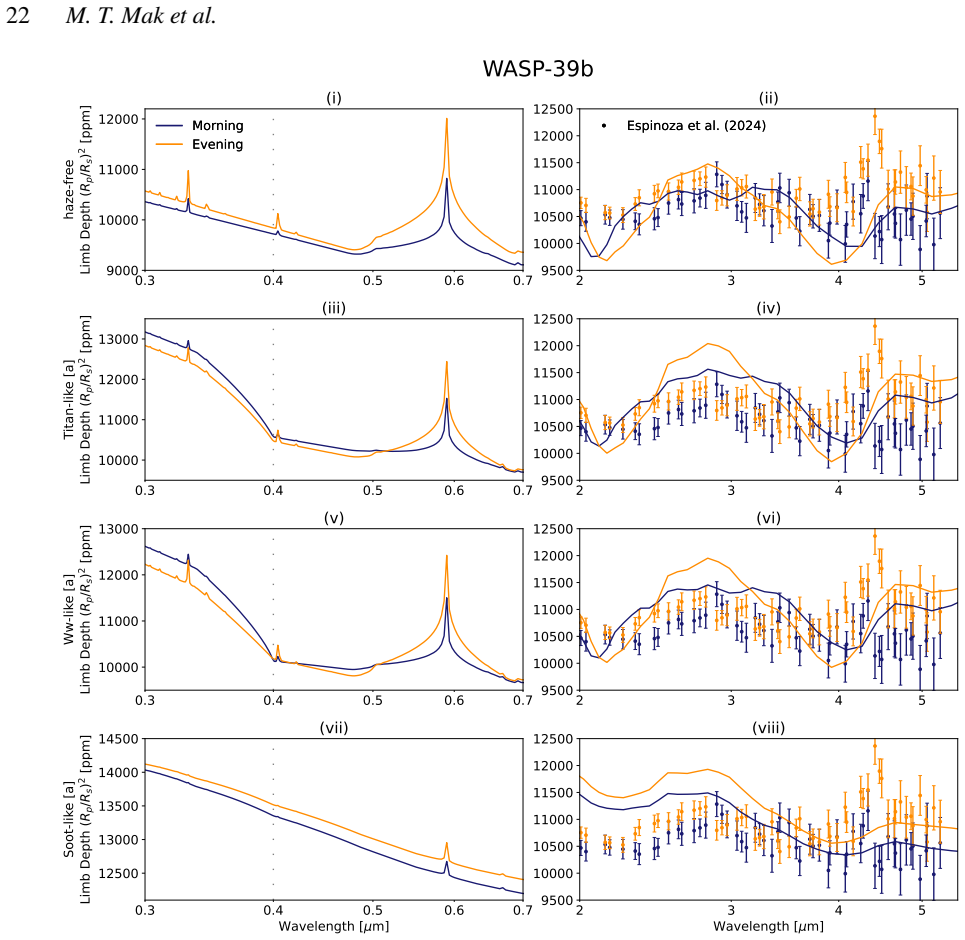
The central claim is that a single dynamical picture governs where nanometre-sized photochemical haze sits in all three simulated hot Jupiters, regardless of haze type or whether the haze's radiative feedback is switched on. The equatorial superrotating jet exports haze from the dayside production region to the nightside; eddies, measured by the eddy mass flux, concentrate it at mid-latitudes near the jet edges; and the divergent plus eddy components of the wind shape the remaining longitudinal structure. Because the planets are tidally locked, the nightside vortices sit near the morning terminator and trap the haze, giving the morning limb a stronger haze opacity. In the WASP-39b runs with Titan-like or water-world-like haze this opacity wins over the hotter evening-limb temperature in the UV-optical, producing a larger morning-limb transit depth; with the more strongly absorbing soot-like haze the evening limb stays deeper at all wavelengths. The same simulations show that stronger haze absorption strengthens the jet, evens out the day-night haze contrast, and increases the transit depth while muting spectral features.
Load-bearing premise
The whole morning-terminator prediction rests on the assumption that the haze particles are 1.5 nm spheres whose advection time is shorter than their settling time, with coagulation neglected; the paper states that for particles of about 30 nm or larger settling dominates and the limb asymmetry reverses.
Editorial extensions
If this is right
- If hot-Jupiter hazes are nanometre-sized and non-fractal, the morning terminator should be the more opaque limb in the UV-optical for planets whose haze is not strongly absorbing.
- A morning-limb transit-depth excess across the UV-optical could serve as a haze indicator that is not spectrally degenerate with cloud opacity or temperature-driven disequilibrium chemistry.
- Stronger haze absorption, such as soot-like haze, predicts a stronger superrotating jet, a more homogenised day-night haze distribution, and a larger transit depth with muted spectral features.
- For HD 189733b and HD 209458b the evening limb remains deeper than the morning limb despite more morning haze, because the evening terminator is hotter, so a morning-limb excess is not predicted to be universal among hot Jupiters.
- The same three-way control by jet, eddies, and decomposed wind should apply to other tidally locked hot Jupiters with small-particle haze, though the specific distribution pattern will be planet-specific.
Reading between the lines
- If the WASP-39b morning-limb excess is confirmed in the UV-optical, a natural extension is to search for the same signature in other low-gravity, high-metallicity hot Jupiters where Titan-like haze is plausible; the paper's mechanism implies the asymmetry amplitude should track the eddy mass flux at the jet edge.
- The fixed production profile and single particle radius mean the most decisive test is microphysical: computing or measuring the haze size distribution would determine whether the advection-dominated regime assumed here is the right one for a given planet.
- A retrograde jet or a morning-side cloud opacity could mimic the morning-limb signal, so the wavelength dependence matters: haze should produce a smooth UV-optical rise, whereas clouds and chemical abundance contrasts should produce different spectral signatures.
Signed reviews
Editorial analysis
A structured set of objections, weighed in public.
Referee Report
Summary. The paper presents 3D GCM simulations of three hot Jupiters (HD 189733b, HD 209458b, WASP-39b) including a parameterized haze production/removal scheme with three different haze optical properties (Titan-like, water-world-like, soot-like), each in radiatively passive and active configurations. The central dynamical claim is that in every simulated case the haze spatial distribution is set by three mechanisms: the superrotating jet controls the day-to-night distribution, eddies control the latitudinal distribution, and the decomposed divergent/eddy wind components control the finer structure. The radiative feedback of stronger-absorbing haze strengthens the jet, reduces day-night haze contrast, and increases the transit depth. The key observational claim is that for WASP-39b with Titan-like or water-world-like haze, the morning terminator shows a larger transit depth than the evening terminator in the UV-optical, which the authors propose as a strong indicator of the presence of small-particle haze.
Significance. If the results hold, this is one of the few 3D studies of haze radiative feedback on hot-Jupiter circulation and spectra, and it offers a falsifiable observable diagnostic (limb asymmetry in the UV-optical) that is not produced by clouds or disequilibrium chemistry in the paper's own tests. The work is carefully executed within its stated assumptions: the simulations are internally consistent, the wind decomposition analysis is informative, the comparison with Steinrueck et al. (2023) is a valuable cross-model check, and the underlying data are publicly archived (Zenodo, Mak 2025). The significance is tempered by the acknowledged sensitivity of the headline limb-asymmetry prediction to particle size and production rate, which the paper does not map quantitatively.
major comments (2)
- [Sec. 4.2, Sec. 3.3.1, Abstract]
- [Sec. 2.3, Sec. 3.2, Fig. 18]
minor comments (5)
- [Sec. 4.3]
- [Sec. 3.3.1, Fig. 18]
- [Sec. 2.3]
- [Fig. 22]
- [Table 3]
Circularity Check
No significant circularity: the haze-distribution and limb-asymmetry results are emergent GCM outputs, not fitted or redefined inputs.
full rationale
All three headline findings (jet-controlled day-night transport, eddy-controlled latitudinal distribution, and decomposed-wind fine structure) are diagnostics of a 3D GCM integration with a prescribed haze source/sink and Mie-derived optical properties. The production term (Eq. 2) and loss term (Eq. 3) are inputs, but the claimed night-side accumulation, vortex trapping, and morning-terminator opacity are not encoded in those inputs; they emerge from the modeled circulation. The synthetic transmission spectra are compared with observations only after a common additive offset chosen on the haze-free case (Sec. 3.3.1; the same offset is applied to active cases), so the morning-evening limb difference is internal and unaffected by that offset. The paper explicitly decomposes the limb asymmetry into haze-only spectra (full minus clean) and gas-temperature contributions (Sec. 3.3.2, Fig. 22), which is an analysis of the simulation, not a fitting of the conclusion. Self-citations to Steinrueck et al. (2021, 2023), Mak et al. (2023, 2024), and Zamyatina et al. are used for model parameterizations and comparisons; these are prior modeling choices with independent content, not uniqueness theorems or fitted predictions. The acknowledged sensitivity to particle radius (>=30 nm reverses the asymmetry), production rate, and neglect of coagulation/clouds is a robustness caveat, not a circular reduction. Therefore no step in the derivation reduces to its own input by definition or by fitted-parameter renaming.
Assumptions & free parameters
free parameters (6)
- Column haze mass production rate F0 =
1e-12 kg m-2 s-1
- Haze particle radius =
1.5 nm
- Median production pressure m =
0.005 mbar
- Production distribution width sigma =
0.576
- Haze loss timescale tau_loss =
1e3 s
- Deep haze removal boundary p_deep =
100 mbar
assumptions (6)
- domain assumption Haze particles are spherical and Mie scattering applies.
- domain assumption Haze production follows a fixed log-normal pressure profile proportional to cos(zenith angle), independent of chemistry and radiative feedback.
- domain assumption No clouds, UV photolysis, thermal chemistry, or aerosol-cloud microphysics are included.
- domain assumption The model reaches a pseudo-steady state in the upper atmosphere after 1200 Earth days; the deeper atmosphere is still evolving.
- ad hoc to paper Upper boundary truncation and capping of haze production above the dayside top has little effect on final haze concentration.
- domain assumption Linear additive offset of synthetic spectra to match observed water features does not affect relative limb differences.
Cite this review
Pith. "Pith review of The Impact of Different Haze Types on the Atmosphere and Observations of Hot Jupiters: 3D Simulations of HD 189733b, HD209458b and WASP-39b." pith.science (2026). https://pith.science/paper/ZHNBLV45
@misc{pith2026250720366,
  author       = {Pith},
  title        = {Pith review of: The Impact of Different Haze Types on the Atmosphere and Observations of Hot Jupiters: 3D Simulations of HD 189733b, HD209458b and WASP-39b},
  year         = {2026},
  howpublished = {\url{https://pith.science/paper/ZHNBLV45}},
  note         = {Machine review of arXiv:2507.20366}
}
read the original abstract
We present the results from the simulations of the atmospheres of hot-Jupiters HD189733b, HD209458b and WASP-39b, assuming the presence of three different types of haze. Using a 3D General Circulation Model, the Unified Model, we capture the advection, settling and radiative impact of Titan-like, water-world-like and soot-like haze, with a particle radius of 1.5 nm. We show that the radiative impact of haze leads to drastic changes in the thermal structure and circulation in the atmosphere. We then show that in all our simulations, 1) the superrotating jet largely determines the day-to-night haze distribution, 2) eddies drive the latitudinal haze distribution, and 3) the divergent and eddy component of the wind control the finer structure of the haze distribution. We further show that the stronger the absorption strength of the haze, the stronger the superrotating jet, lesser the difference of the day-to-night haze distribution, and larger the transit depth in the synthetic transmission spectrum. We also demonstrate that the presence of such small hazes could result in a stronger haze opacity over the morning terminator in all three planets. This could lead to an observable terminator asymmetry in WASP-39b, with the morning terminator presenting a larger transit depth than the evening terminator. This work suggests that, although it might not be a typical detection feature for hot-Jupiters, an observed increase in transit depth over the morning terminator across the UV and optical wavelength regime could serve as a strong indicator of the presence of haze.
Figures


Figures from the paper (19 more)



Forward citations
Cited by 2 Pith papers
-
Mitigating Charge Migration in JWST NIRISS Reveals That KELT-7 b is a Metal-enriched Ultra-hot Jupiter Orbiting a Young Metal-rich Star
Correcting NIRISS charge migration reveals KELT-7 b as a metal-enriched (~92x solar) ultra-hot Jupiter with H2O, CO2 and TiO but no H- or clouds, orbiting a young metal-rich star.
-
Flow-Driven Limb-Asymmetry of Haze Distribution Part I: An Analytical Framework for Predicting the Size Distribution of Photochemical Hazes Across the Two Limbs of hot-Jupiters
A new dimensionless ratio, ΨHALD, predicts the maximum haze particle radius that can reach a hot Jupiter's morning limb, and matches 3D climate simulations to within a factor of a few.
Reference graph
Works this paper leans on
-
[1]
Amundsen D. S., et al., 2016, A&A, 595, A36 AndrewsM.B.,etal.,2020,JournalofAdvancesinModelingEarthSystems, 12, e2019MS001995 Arfaux A., Lavvas P., 2022, MNRAS, 515, 4753 Arfaux A., Lavvas P., 2023, MNRAS, 522, 2525 Arfaux A., Lavvas P., 2024, MNRAS, 530, 482 Arney G., et al., 2016, Astrobiology, 16, 873 Asplund M., Grevesse N., Sauval A. J., Scott P., 20...
arXiv 2025
Reviewed August 15, 2026 · model on record in the stance chip above.
Discussion (0). Continue with ORCID to comment.