REVIEW 4 major objections 6 minor 54 references
Thermodynamic Theory of Linear Optical and Electro-Optic Properties of Ferroelectrics
T0 review · 4 major / 6 minor · reviewed 2026-08-11 · deepseek-v4-flash
Pith's one-line read A single thermodynamic free energy that couples lattice and electronic polarization predicts the full linear optical and electro-optic tensors of BaTiO3 across its ferroelectric phases.
desk verdict A genuinely new thermodynamic framework for ferroelectric optical properties, but the validation is partly circular and the low-temperature predictions rest on an acknowledged extrapolation beyond the quadratic regime. read the letter →
The pith
A machine-rendered reading of the paper's core claim, the machinery that carries it, and where it could break.
The reading
What carries the argument
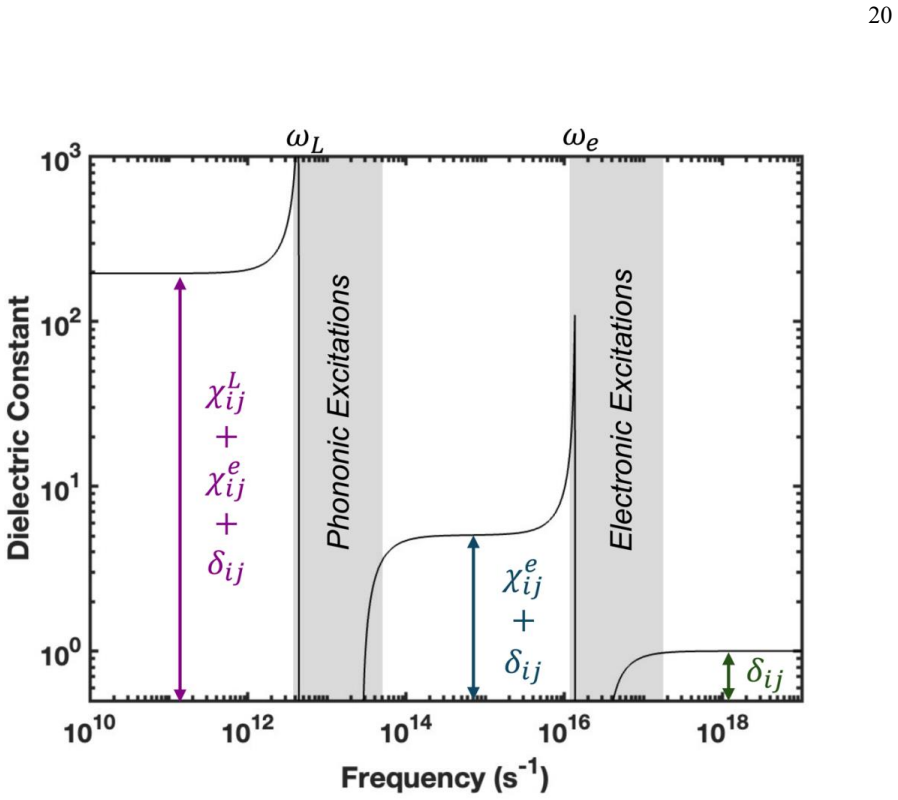
The load-bearing object is the free-energy density of Eq. (17), in which the lattice polarization follows an eighth-order Landau expansion and the electronic polarization enters through a stiffness $B^{e,\mathrm{ref}}(T) + g^{LL} P^L P^L$ modulated by the lattice polarization, plus higher-order couplings $g^{Le}$ and $g^{ee}$. Dispersion is added through an equation of motion for $P^e$ with an electronic effective mass $\mu^e$ and damping $\gamma^e$, yielding a Lorentz-like frequency-dependent susceptibility $\tilde{\chi}^e(\omega) = [B^e - \epsilon_0(i\omega\gamma^e + \omega^2\mu^e)]^{-1}$. All linear optical properties—refractive index, birefringence, and the electro-, thermo-, and piezo-optic tensors—are derivatives of this single free energy, so one set of constants links ferroelectric, optical, and dispersive behavior.
What would settle it
Measure the ordinary and extraordinary refractive indices or the electro-optic coefficients of bulk BaTiO$_3$ in the orthorhombic and rhombohedral phases below 270 K and compare with the predicted values; a deviation beyond the quadratic model's expected accuracy would show the truncation fails. Alternatively, compute $B^e$ with DFT for lattice polarizations above 0.2 C/m² along the orthorhombic and rhombohedral polarization directions to test whether the omitted sixth-rank polar-optic tensor changes the predicted $r$ coefficients.
Extended reading notes
Core claim
The central claim is that a Landau–Ginzburg–Devonshire free energy density $f(T,P^L_i,P^e_j,\sigma_{ij},E_i)$ containing the lattice polarization $P^L$ and the induced electronic polarization $P^e$ as separate order parameters, with biquadratic couplings $g^{LL}$, $g^{Le}$, and $g^{ee}$, accounts for the linear optical and electro-optic response of ferroelectric crystals. In the visible and near-infrared the optical indicatrix is set by the electronic dielectric stiffness $B^e_{ij} = \epsilon_0\,\partial^2 f/\partial P^e_i \partial P^e_j$, and the lattice polarization modifies it through $\Delta B^e = g^{LL} P^L P^L + g^{Le} P^L P^e + g^{ee} P^e P^e + \cdots$. The total Pockels tensor is the sum of lattice and electronic terms, each the product of a polar-optic factor and the corresponding susceptibility; the lattice term dominates because $\chi^L$ is orders of magnitude larger than $\chi^e$. For BaTiO$_3$ the computed electro-optic coefficients at 633 nm, $r_{33}=109$ pm/V and $r_{51}=1396$ pm/V, agree with experiment, and the temperature dependence across all three ferroelectric phases emerges from the same free energy.
Load-bearing premise
The electronic dielectric stiffness depends on the lattice polarization only through constant quadratic coupling tensors, a relation that density-functional calculations show holds only up to a lattice polarization of about 0.2 C/m², so the model's low-temperature predictions rely on extrapolating beyond the validated range.
Editorial extensions
If this is right
- Below terahertz frequencies the electro-optic response of a ferroelectric is dominated by the polar-optic coupling times the lattice dielectric susceptibility, so enhancements of $\chi^L$ near phase transitions directly boost the Pockels coefficients.
- The framework gives temperature- and wavelength-dependent dispersion consistently, so refractive indices, birefringence, and electro-optic coefficients can be computed from one parameter set instead of separate Sellmeier fits at each temperature.
- Because the polar-optic tensors are fixed by the symmetry of the parent cubic phase, the theory automatically generates the symmetry-allowed optical and electro-optic tensors for the tetragonal, orthorhombic, and rhombohedral phases of BaTiO$_3$.
- Legendre transforms of the free energy extend the description to constant-strain and thin-film boundary conditions, allowing phase-field modeling of optical properties in multidomain, defective, or strained ferroelectric films.
Reading between the lines
- Since the quadratic polar-optic law breaks down above roughly 0.2 C/m², the low-temperature phases of BaTiO$_3$ are the natural test bed: measured deviations of the refractive indices beyond the model's stated accuracy would indicate that sixth-rank coupling terms are needed.
- The same effective mass and damping constants that fit optical dispersion set the frequency ceiling for electro-optic modulation, implying a quantitative trade-off between $r$ and bandwidth that could be checked with GHz-range electro-optic experiments.
- The lattice/electronic decomposition may connect Wannier-center first-principles calculations with continuum thermodynamics, potentially allowing macroscopic refractive-index measurements to extract microscopic polarization information.
Signed reviews
Editorial analysis
A structured set of objections, weighed in public.
Referee Report
Summary. The paper proposes a Landau-Ginzburg-Devonshire-type thermodynamic free energy that separates the total polarization into a lattice part P^L and an induced electronic part P^e, couples them biquadratically through tensors g^LL, g^Le, and g^ee, and derives the linear optical dielectric tensor, the polar-optic tensors, and the linear electro-optic (Pockels) tensor in the thermodynamic limit. It extends the model to finite optical frequencies through a Lorentz-like equation of motion for P^e with an effective mass and damping, and applies the formalism to BaTiO3, reporting temperature- and wavelength-dependent refractive indices, birefringence, and electro-optic coefficients through the cubic, tetragonal, orthorhombic, and rhombohedral phases. The abstract claims excellent agreement with experiments and first-principles calculations across these phase transitions.
Significance. If the approach is made fully quantitative, it would be a useful extension of LGD theory: it connects ferroelectric order parameters to optical response in the visible range, provides a route to electro-, thermo-, and piezo-optic tensors from one free energy, and is compatible with phase-field modeling. The paper's conceptual separation of lattice and electronic polarization and its derivation of the polar-optic and electro-optic tensors from derivatives of a single free energy are clear strengths, as is the DFT+U+V calculation of the polarization-dependent electronic dielectric stiffness. The approach is not parameter-free: g^LL, the electronic effective mass, damping, reference stiffness, elasto-optic coefficients, and reference temperature are fitted to experimental data, so the predictive claims stand or fall on the quality and independence of the validation.
major comments (4)
- [§II.B, Eq. (13), Fig. 3, §III] The central constitutive truncation is not valid in the regime in which the model is applied. Eq. (13) keeps only the quadratic term in P^L with constant g^LL, and the paper's own DFT+U+V results in Fig. 3 show that this relation is accurate only for |P^L| up to roughly 0.2 C/m^2, with a 6th-rank polar-optic term required beyond that. The spontaneous lattice polarization at 300 K in the tetragonal phase (from the Appendix A coefficients used to produce Fig. 4a) is already above 0.2 C/m^2, and it is larger in the orthorhombic and rhombohedral phases. The text acknowledges this caveat for the refractive indices but still applies the same quadratic form to the electro-optic tensors in all phases through Eqs. (22)-(27) and Table D1. The factor-of-two discrepancy in r13 at 633 nm in Table 1 (15 pm/V versus 8±2 pm/V) is consistent with this extrapolation. The claim of 'excellent agreement ... through multiple ferroelectric phase transitions' is therefore not supported for the lower-temperature phases. Please either include the next-order polar-optic term, restrict the claims to the validated polarization range, or provide a quantitative sensitivity analysis showing that the results are robust beyond 0.2 C/m^2.
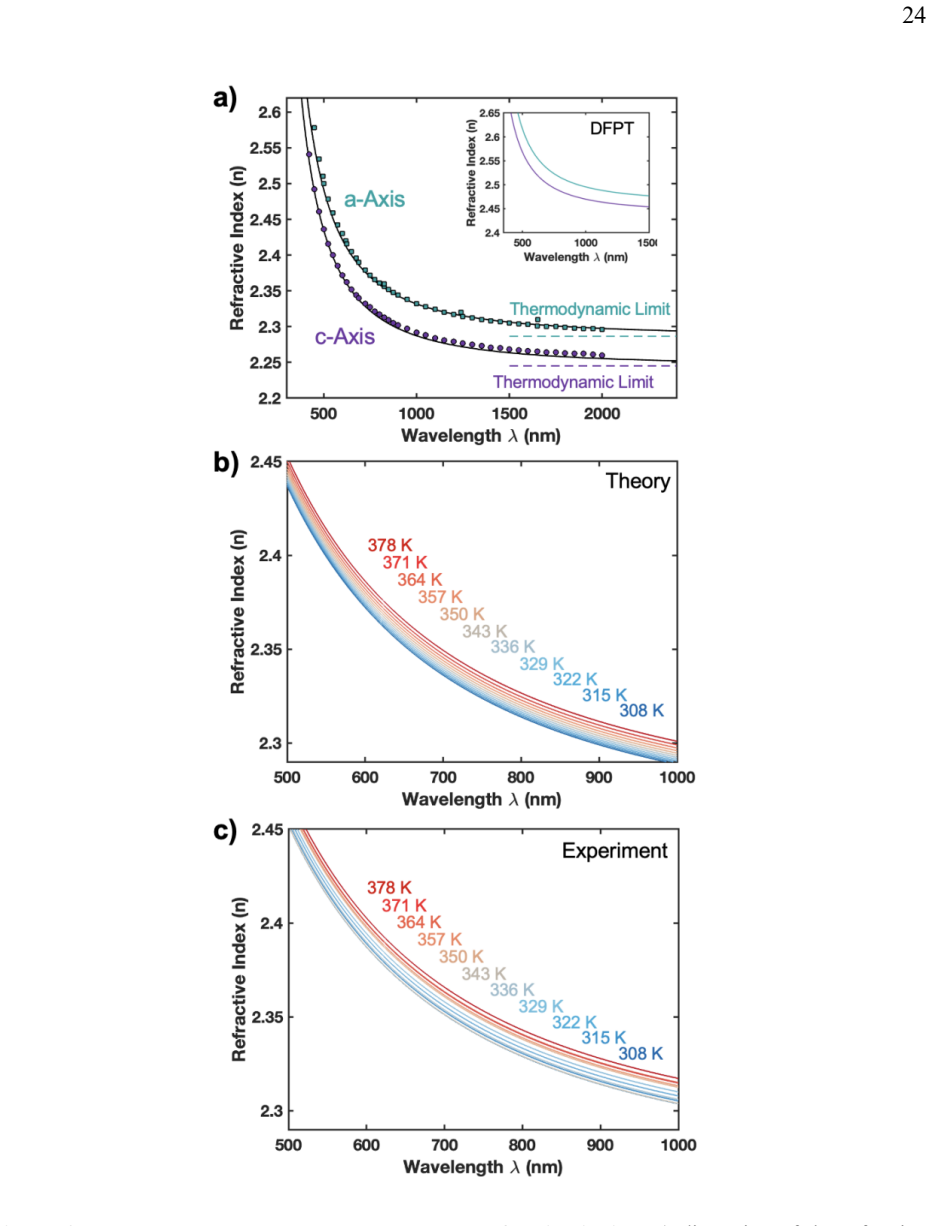
- [§III, Fig. 4, Fig. 6, Table 1] The validation is substantially in-sample. The fit list in §III states that the model was fitted to room-temperature refractive indices and dispersion from Refs. [33-36,38], electro-optic coefficients at 546.1 nm between 280 K and 400 K from Ref. [37], and temperature-dependent birefringence from Refs. [34,35]. Figures 4b, 4c, and 6a then compare the model with those same datasets. The only clearly held-out comparison is Table 1 against the 633 nm data of Zgonik et al. [39], and even there r33 and r51 are strongly controlled by the fitted g^LL through the lattice electro-optic channel of Eq. (25). To support the claim of predictive power, the paper should provide a genuine out-of-sample test, for example by fitting on a subset of temperatures and wavelengths and predicting the remainder, together with parameter uncertainties.
- [Appendix A, Table A1, Eq. (17)] The numerical implementation omits terms that appear in the central free energy. Eq. (17) contains g^Le and g^ee coupling tensors, and Eqs. (22)-(27) use them in the polar-optic and electro-optic coefficients. The expanded BaTiO3 free energy in Appendix A and the parameter list in Table A1 contain only g^LL coefficients; no values are given for g^Le and g^ee, and the text does not state that they are zero. If they are zero for BaTiO3, that choice should be stated and justified; if they are nonzero, the numerical results are currently under-specified and not reproducible.
- [§III, §V, Table D1] The claim of agreement through multiple phase transitions overreaches the experimental evidence. No bulk electro-optic measurements below 280 K are presented; Table D1 lists predicted tensors for the orthorhombic and rhombohedral phases, and the only low-temperature comparison is the cryogenic thin-film result of Eltes et al., whose effective r_eff = 200 pm/V is not the same quantity as the bulk r51 = 125 pm/V reported here. The conclusion should distinguish predicted low-temperature tensors from tested room-temperature behavior.
minor comments (6)
- [Eq. (14)] The definition of g^ee appears to be copied from g^Le: it should be the second derivative of the electronic dielectric stiffness with respect to P^e twice, not with respect to P^e and P^L.
- [Appendix A] There are several typographical slips in the expansion: the first quadratic term in the lattice polarization repeats P2^L instead of listing P1^L, P2^L, P3^L, and Table A1 lists a11112222 twice.
- [Fig. 3 caption] The caption refers to a '2nd-rank polar optic tensor' where the text means a fourth-rank tensor quadratic in polarization; the terminology should be made consistent.
- [Table A1] The units given for μ^e and γ^e, such as 'Kg m m4/C2', are formatted confusingly and should be rewritten with clear SI units.
- [§II.D] The sentence preceding Eq. (36) says 'at a sufficient frequency so that we assume the lattice polarization remains static'; this should be clarified as 'at optical frequencies above the lattice resonances but below the electronic resonance window considered here'.
- [§III] The statement that the predicted r51 = 125 pm/V at 4 K shows 'close agreement' with r_eff = 200 pm/V from Eltes et al. should acknowledge that these are different quantities measured in different geometries and that the numerical ratio is approximately 1.6.
Circularity Check
Validation is partly circular: room-temperature refractive indices, birefringence, and 546 nm electro-optic data are fitted, then the same datasets are presented as 'excellent agreement,' making the 633 nm coefficients and Fig. 4c consistency checks rather than independent predictions.
-
fitted input called prediction
[Section III (Results), first paragraph; Table 1]
"The free energy density function coefficients are found by using the existing thermodynamic description of BaTiO3 [32], and fitting the optical properties and dynamic coefficients to available experimental data [33–37]. Specifically, we fit our model from room temperature refractive indices and dispersion from [33–36,38], the electro-optic coefficients measured at 546.1 nm between 280K – 400K from [37], and the temperature dependent birefringence from [34,35]."
Eq. 40 gives r(ω) = f^L(ω)χ^L, with f^L(ω) determined by the fitted g^LL and by B^e(ω); Eqs. 37–39 show B^e(ω) contains the fitted μ^e and γ^e and the fitted B^e_ref(T)+g^LLP^2. Since g^LL, μ^e, and γ^e are fit to the 546.1 nm electro-optic data and to room-temperature refractive indices, the 'predicted' 633 nm coefficients in Table 1 are not an independent result: they are the fitted 546 nm response carried to a nearby wavelength by the fitted dispersion model. The same fitted parameters then appear as 'excellent agreement' with experiments cited as validation, so the claimed prediction is statistically forced by the fit.
-
fitted input called prediction
[Section III (Results), Figure 4c discussion]
"Figure 4c shows the temperature-dependent birefringence at various wavelengths and shows excellent agreement with the experimental values at 633nm, demonstrating an increased birefringence at shorter wavelengths."
The same section first states that the model was fit using 'the temperature dependent birefringence from [34,35]'. Figure 4c then reports agreement with 'the experimental values at 633nm' from those same references. The temperature dependence enters through the fitted p and α coefficients (Eq. 15 and Table A1), so the plotted agreement is the model reproducing its own calibration target; it is a consistency check, not an out-of-sample prediction.
full rationale
The derivation of Eq. 17 from Eq. 13 is internally consistent: the biquadratic coupling is a Taylor expansion and the optical properties follow by differentiation (Eqs. 19–27). The DFT+U+V calculation in Fig. 3 independently supports the quadratic functional form up to roughly 0.2 C/m2, and the low-temperature predictions are genuine extrapolations beyond the fitted window (the text concedes refractive indices may deviate because the quadratic regime may be exceeded). The LGD potential [32], though self-cited, is an external empirical parameterization and is not circular by itself. However, the quantitative validation in Section III is partly circular. The g^LL, μ^e, γ^e, p, and α coefficients are fitted to room-temperature refractive indices, dispersion, 546.1 nm electro-optic coefficients, and temperature-dependent birefringence; the same datasets are then displayed as 'excellent agreement.' Table 1's 633 nm electro-optic coefficients are essentially the fitted 546 nm coefficients with a small dispersion correction from Eqs. 37–40, and Fig. 4c's birefringence agreement is a reproduction of the fitted temperature-dependent birefringence. Thus the central validation claim is partially a consistency check. The model retains independent predictive content in its symmetry structure, in the low-temperature extrapolation, and in the DFT-supported quadratic form, so this is partial rather than total circularity.
Assumptions & free parameters
free parameters (8)
- g1111^LL =
0.185 m4/C2
- g1122^LL =
0.025 m4/C2
- g1212^LL =
0.1285 m4/C2
- mu^e (electronic polarization effective mass) =
35.5e-23 (kg/m)(m4/C2) [units as printed]
- gamma^e (electronic polarization damping) =
3e-9 (kg/(m s))(m4/C2) [units as printed]
- B^e_ref(T0) =
0.2356 (unitless)
- p1111, p1122, p1212 (elasto-optic strain tensors) =
0.5328, 0.1584, -0.432 (unitless)
- T0 (reference temperature) =
398 K
assumptions (5)
- domain assumption The modern theory of polarization (Berry phase and Wannier centers) provides a valid decomposition of total polarization into lattice and electronic parts, with electrons in instantaneous equilibrium with ions.
- domain assumption The free energy density is analytic in the order parameters and can be truncated at the lowest-order symmetry-allowed terms.
- domain assumption The Landau coefficients from Li et al. [32] accurately describe the lattice polarization free energy of BaTiO3 in all three ferroelectric phases.
- domain assumption The electronic dispersion is described by a single Lorentz oscillator with temperature-independent effective mass and damping.
- ad hoc to paper The quadratic relation between electronic dielectric stiffness and polarization remains valid for polarization values beyond 0.2 C/m2 where DFT indicates higher-order terms are needed.
invented entities (1)
-
Electronic polarization P^e as an independent thermodynamic order parameter
independent evidence
Cite this review
Pith. "Pith review of Thermodynamic Theory of Linear Optical and Electro-Optic Properties of Ferroelectrics." pith.science (2026). https://pith.science/paper/ZKNQEHKU
@misc{pith2026241203459,
  author       = {Pith},
  title        = {Pith review of: Thermodynamic Theory of Linear Optical and Electro-Optic Properties of Ferroelectrics},
  year         = {2026},
  howpublished = {\url{https://pith.science/paper/ZKNQEHKU}},
  note         = {Machine review of arXiv:2412.03459}
}
read the original abstract
Ferroelectric materials underlie key optical technologies in optical communications, integrated optics and quantum computing. Yet, there is a lack of a consistent thermodynamic framework to predict the optical properties of ferroelectrics and the mutual connections among ferroelectric polarization, optical properties, and optical dispersion. For example, there is no existing thermodynamic model for establishing the relationship between the ferroelectric polarization and the optical properties in the visible spectrum. Here we present a thermodynamic theory of the linear optical and electro-optic properties of ferroelectrics by separating the lattice and electronic contributions to the total polarization. We introduce a biquadratic coupling between the lattice and electronic contributions validated by both first-principles calculations and experimental measurements. As an example, we derive the temperature and wavelength-dependent anisotropic optical properties of BaTiO3, including the full linear optical dielectric tensor and the linear electro-optic (Pockels) effect through multiple ferroelectric phase transitions, which are in excellent agreement with existing experimental data and first principles calculations. This general framework incorporates essentially all optical properties of materials, including coupling between the ionic and electronic order parameters, as well as their dispersion and temperature dependence, and thus offers a powerful theoretical tool for analyzing light-matter interactions in ferroelectrics-based optical devices.
Figures


Figures from the paper (5 more)




Reference graph
Works this paper leans on
-
[37]
A. R. Johnston and J. M. Weingart, Determination of the Low-Frequency Linear Electro- Optic Effect in Tetragonal BaTiO3, J. Opt. Soc. Am., JOSA 55, 828 (1965)
work page 1965
- [39]
-
[1]
S. Abel et al., Large Pockels Effect in Micro- and Nanostructured Barium Titanate Integrated on Silicon, Nature Mater 18, 1 (2019)
work page 2019
-
[2]
J. Geler-Kremer, F. Eltes, P. Stark, D. Stark, D. Caimi, H. Siegwart, B. Jan Offrein, J. Fompeyrine, and S. Abel, A Ferroelectric Multilevel Non-Volatile Photonic Phase Shifter, Nat. Photon. 16, 7 (2022)
work page 2022
-
[3]
Eltes et al., An Integrated Optical Modulator Operating at Cryogenic Temperatures, Nat
F. Eltes et al., An Integrated Optical Modulator Operating at Cryogenic Temperatures, Nat. Mater. 19, 11 (2020)
work page 2020
-
[4]
E. L. Wooten et al., A Review of Lithium Niobate Modulators for Fiber-Optic Communications Systems, IEEE Journal of Selected Topics in Quantum Electronics 6, 69 (2000)
work page 2000
-
[5]
Y . Liu, G. Ren, T. Cao, R. Mishra, and J. Ravichandran, Modeling Temperature, Frequency, and Strain Effects on the Linear Electro-Optic Coefficients of Ferroelectric Oxides, Journal of Applied Physics 131, 163101 (2022)
work page 2022
-
[6]
W. Li, C. M. Landis, and A. A. Demkov, Domain Morphology and Electro-Optic Effect in Si- Integrated Epitaxial $\mathrm{BaTi}{\mathrm{O}}_{3}$ Films, Phys. Rev. Mater. 6, 095203 (2022)
work page 2022
Show all 54 references
-
[7]
V . B. Shirokov, P. E. Timoshenko, and V . V . Kalinchuk, Thermodynamic Analysis of Electro- Optic Coefficients of Ferroelectrics, Journal of Applied Physics 133, 063103 (2023)
2023
-
[8]
L. D. Landau, On the Theory of Phase Transitions. I., Phys. Z. Sowjet. 11, 26 (1937)
1937
-
[9]
A. F. Devonshire, Theory of Ferroelectrics, Advances in Physics 3, 85 (1954)
1954
-
[10]
M. J. Haun, E. Furman, S. J. Jang, H. A. McKinstry, and L. E. Cross, Thermodynamic Theory of PbTiO3, Journal of Applied Physics 62, 3331 (1987)
1987
-
[11]
Íñiguez, S
J. Íñiguez, S. Ivantchev, J. M. Perez-Mato, and A. García, Devonshire-Landau Free Energy of BaTiO3 from First Principles, Phys. Rev. B 63, 144103 (2001)
2001
-
[12]
Chen, Phase-Field Method of Phase Transitions/Domain Structures in Ferroelectric Thin Films: A Review, Journal of the American Ceramic Society 91, 1835 (2008)
L.-Q. Chen, Phase-Field Method of Phase Transitions/Domain Structures in Ferroelectric Thin Films: A Review, Journal of the American Ceramic Society 91, 1835 (2008)
2008
-
[13]
J. E. Geusic, S. K. Kurtz, L. G. Van Uitert, and S. H. Wemple, ELECTRO‐OPTIC PROPERTIES OF SOME ABO3 PEROVSKITES IN THE P ARAELECTRIC PHASE, Applied Physics Letters 4, 141 (1964)
1964
-
[14]
DiDomenico Jr
M. DiDomenico Jr. and S. H. Wemple, Oxygen‐Octahedra Ferroelectrics. I. Theory of Electro‐optical and Nonlinear Optical Effects, Journal of Applied Physics 40, 720 (1969)
1969
-
[15]
3 (Elsevier, 1972), pp
Electrooptical and Nonlinear Optical Properties of Crystals, in Applied Solid State Science, V ol. 3 (Elsevier, 1972), pp. 263–383
1972
-
[16]
S. H. Wemple and M. DiDomenico, Theory of the Elasto-Optic Effect in Nonmetallic Crystals, Phys. Rev. B 1, 193 (1970)
1970
-
[17]
J. D. Zook and T. N. Casselman, Electro-Optic Effects in Paraelectric Perovskites, Phys. Rev. Lett. 17, 960 (1966)
1966
-
[18]
F. N. H. Robinson, Nonlinear Optical Coefficients, Bell System Technical Journal 46, 913 (1967)
1967
-
[19]
Flytzanis and J
Chr. Flytzanis and J. Ducuing, Second-Order Optical Susceptibilities of III-V Semiconductors, Phys. Rev. 178, 1218 (1969)
1969
-
[20]
Garrett, Nonlinear Optics, Anharmonic Oscillators, and Pyroelectricity, IEEE Journal of Quantum Electronics 4, 70 (1968)
C. Garrett, Nonlinear Optics, Anharmonic Oscillators, and Pyroelectricity, IEEE Journal of Quantum Electronics 4, 70 (1968)
1968
-
[21]
Resta, Theory of the Electric Polarization in Crystals, Ferroelectrics 136, 51 (1992)
R. Resta, Theory of the Electric Polarization in Crystals, Ferroelectrics 136, 51 (1992). 28
1992
-
[22]
R. D. King-Smith and D. Vanderbilt, Theory of Polarization of Crystalline Solids, Phys. Rev. B 47, 1651 (1993)
1993
-
[23]
R. W. Nunes and D. Vanderbilt, Real-Space Approach to Calculation of Electric Polarization and Dielectric Constants, Phys. Rev. Lett. 73, 712 (1994)
1994
-
[24]
Souza, J
I. Souza, J. Íñiguez, and D. Vanderbilt, First-Principles Approach to Insulators in Finite Electric Fields, Phys. Rev. Lett. 89, 117602 (2002)
2002
-
[25]
S. Pal, N. Strkalj, C.-J. Yang, M. C. Weber, M. Trassin, M. Woerner, and M. Fiebig, Origin of Terahertz Soft-Mode Nonlinearities in Ferroelectric Perovskites, Phys. Rev. X 11, 021023 (2021)
2021
-
[26]
Ghosez, J.-P
Ph. Ghosez, J.-P. Michenaud, and X. Gonze, Dynamical Atomic Charges: The Case of $\mathrm{AB}{\mathrm{O}}_{3}$ Compounds, Phys. Rev. B 58, 6224 (1998)
1998
-
[27]
Veithen, X
M. Veithen, X. Gonze, and Ph. Ghosez, Nonlinear Optical Susceptibilities, Raman Efficiencies, and Electro-Optic Tensors from First-Principles Density Functional Perturbation Theory, Phys. Rev. B 71, 125107 (2005)
2005
-
[28]
V . L. Campo and M. Cococcioni, Extended DFT + U + V Method with On-Site and Inter- Site Electronic Interactions, J. Phys.: Condens. Matter 22, 055602 (2010)
2010
-
[29]
Gebreyesus, L
G. Gebreyesus, L. Bastonero, M. Kotiuga, N. Marzari, and I. Timrov, Understanding the Role of Hubbard Corrections in the Rhombohedral Phase of ${\mathrm{BaTiO}}_{3}$, Phys. Rev. B 108, 235171 (2023)
2023
-
[30]
V . L. Ginzburg, Polarizasyon and Piezoelectric Effect in BaTiO3 near the Ferroelectric Transition Point, Zh. Eksp. Teor. Fiz 19, 36 (1949)
1949
-
[31]
H. A. Lorentz, Versuch Einer Theorie der Electrischen und Optischen Erscheinungen in Bewegten Körpern, in Collected Papers: Volume V, edited by H. A. Lorentz (Springer Netherlands, Dordrecht, 1937), pp. 1–138
1937
-
[32]
Y . L. Li, L. E. Cross, and L. Q. Chen, A Phenomenological Thermodynamic Potential for BaTiO3 Single Crystals, Journal of Applied Physics 98, 064101 (2005)
2005
-
[33]
C. Wong, Y . Y . Teng, J. Ashok, and P. L. H. Varaprasad, Barium Titanate (BaTiO3), in Handbook of Optical Constants of Solids, edited by E. D. Palik (Academic Press, Burlington, 1997), pp. 789–803
1997
-
[34]
S. H. Wemple, M. Didomenico, and I. Camlibel, Dielectric and Optical Properties of Melt- Grown BaTiO3, Journal of Physics and Chemistry of Solids 29, 1797 (1968)
1968
-
[35]
K. Buse, S. Riehemann, S. Loheide, H. Hesse, F. Mersch, and E. Krätzig, Refractive Indices of Single Domain BaTiO3 for Different Wavelengths and Temperatures, Physica Status Solidi (a) 135, K87 (1993)
1993
-
[36]
L. V . Deshpande, M. B. Joshi, and R. B. Mishra, Angle of Polarization and Refractive Indices of BaTiO3, J. Opt. Soc. Am., JOSA 70, 1163 (1980)
1980
-
[38]
A. R. Johnston, Dispersion of Electro‐Optic Effect in BaTiO3, Journal of Applied Physics 42, 3501 (1971)
1971
-
[40]
T. Yang, B. Wang, J.-M. Hu, and L.-Q. Chen, Domain Dynamics under Ultrafast Electric- Field Pulses, Phys. Rev. Lett. 124, 107601 (2020). 29
2020
-
[41]
Cheng, B
X. Cheng, B. Wang, and L.-Q. Chen, Polarization near Dislocation Cores in SrTiO 3 Single Crystals: The Role of Flexoelectricity, Applied Physics Letters 124, 132905 (2024)
2024
-
[42]
Yang and L.-Q
T. Yang and L.-Q. Chen, Dynamical Phase-Field Model of Coupled Electronic and Structural Processes, Npj Comput Mater 8, 1 (2022)
2022
-
[43]
Cammarata and J
A. Cammarata and J. M. Rondinelli, Contributions of Correlated Acentric Atomic Displacements to the Nonlinear Second Harmonic Generation and Response, ACS Photonics 1, 96 (2014)
2014
-
[44]
B. K. VanLeeuwen and V . Gopalan, The Antisymmetry of Distortions, Nat Commun 6, 8818 (2015)
2015
-
[45]
R. Zu et al., Large Enhancements in Optical and Piezoelectric Properties in Ferroelectric Zn1-xMgxO Thin Films through Engineering Electronic and Ionic Anharmonicities, Advanced Physics Research 2, 2300003 (2023)
2023
-
[46]
Giannozzi et al., QUANTUM ESPRESSO: A Modular and Open-Source Software Project for Quantum Simulations of Materials, J
P. Giannozzi et al., QUANTUM ESPRESSO: A Modular and Open-Source Software Project for Quantum Simulations of Materials, J. Phys.: Condens. Matter 21, 395502 (2009)
2009
-
[47]
J. P. Perdew, A. Ruzsinszky, G. I. Csonka, O. A. Vydrov, G. E. Scuseria, L. A. Constantin, X. Zhou, and K. Burke, Restoring the Density-Gradient Expansion for Exchange in Solids and Surfaces, Phys. Rev. Lett. 100, 136406 (2008)
2008
-
[48]
Prandini, A
G. Prandini, A. Marrazzo, I. E. Castelli, N. Mounet, and N. Marzari, Precision and Efficiency in Solid-State Pseudopotential Calculations, Npj Comput Mater 4, 1 (2018)
2018
-
[49]
Lejaeghere et al., Reproducibility in Density Functional Theory Calculations of Solids, Science 351, aad3000 (2016)
K. Lejaeghere et al., Reproducibility in Density Functional Theory Calculations of Solids, Science 351, aad3000 (2016)
2016
-
[50]
Timrov, N
I. Timrov, N. Marzari, and M. Cococcioni, HP – A Code for the Calculation of Hubbard Parameters Using Density-Functional Perturbation Theory, Computer Physics Communications 279, 108455 (2022)
2022
-
[51]
R. Zu, B. Wang, J. He, J.-J. Wang, L. Weber, L.-Q. Chen, and V . Gopalan, Analytical and Numerical Modeling of Optical Second Harmonic Generation in Anisotropic Crystals Using ♯SHAARP Package, Npj Comput Mater 8, 1 (2022)
2022
-
[52]
R. Zu, B. Wang, J. He, L. Weber, A. Saha, L.-Q. Chen, and V . Gopalan, Optical Second Harmonic Generation in Anisotropic Multilayers with Complete Multireflection of Linear and Nonlinear Waves Using ♯SHAARP .Ml Package, Npj Comput Mater 10, 1 (2024)
2024
-
[53]
R. C. Miller, Optical Harmonic Generation in Single Crystal BaTi O 3, Phys. Rev. 134, A1313 (1964)
1964
-
[54]
W. N. Herman and L. M. Hayden, Maker Fringes Revisited: Second-Harmonic Generation from Birefringent or Absorbing Materials, J. Opt. Soc. Am. B, JOSAB 12, 416 (1995)
1995
Reviewed August 11, 2026 · model on record in the stance chip above.
Discussion (0). Continue with ORCID to comment.