REVIEW 3 major objections 4 minor 1 cited by
Full Gate-Voltage Control of a Parity-Protected Superconducting Qubit with an Altermagnetic Josephson Junction
T0 review · 3 major / 4 minor · reviewed 2026-07-11 · grok-4.5
Pith's one-line read A gate-tunable altermagnet Josephson junction can host a parity-protected superconducting qubit with no magnetic flux bias and estimated coherence of tens of milliseconds.
desk verdict Clean materials-to-circuit proposal that electrically reaches a cos2φ parity-protected regime; the ms coherence numbers are soft but the qualitative idea is solid and worth refereeing. read the letter →
The pith
A machine-rendered reading of the paper's core claim, the machinery that carries it, and where it could break.
The reading
What carries the argument
The altermagnet-induced momentum shift q that splits the two spin-resolved Andreev channels by opposite phase ±2qd; when 2qd ≈ π/2 the interference cancels the cos φ term and leaves a dominant cos 2φ Josephson potential.
What would settle it
Fabricate a short SC–AM–SC junction (e.g., MnTe or CrSb weak link), gate-tune the chemical potential through the predicted 0–π point, and measure whether the current–phase relation is dominated by the second harmonic and whether the resulting qubit T2 reaches the millisecond regime under the stated noise assumptions.
Extended reading notes
Core claim
At the electrically tuned 0–π transition of a superconductor–altermagnet–superconductor Josephson junction the first Josephson harmonic is strongly suppressed while the second harmonic dominates, yielding a double-well potential with two nearly degenerate states of opposite Cooper-pair parity that, for realistic gatemon parameters, support coherence times up to tens of milliseconds under fully gate-controlled operation.
Load-bearing premise
The conversion of laboratory charge-noise amplitude into chemical-potential noise via a lever-arm factor, together with a fixed 1/f spectrum and cutoffs, that produces the claimed tens-of-milliseconds coherence times.
Editorial analysis
A structured set of objections, weighed in public.
Referee Report
Summary. The manuscript proposes a parity-protected superconducting qubit realized in a gate-tunable superconductor–altermagnet–superconductor Josephson junction. Momentum-dependent spin splitting in the altermagnet produces opposite phase shifts for the two spin channels; electrical tuning of the chemical potential drives the junction through a 0–π transition at which the first Josephson harmonic is suppressed and the second harmonic dominates, yielding a double-well potential whose lowest states have opposite Cooper-pair parity. The circuit is analyzed in a gatemon architecture with standard charging-energy terms, sweet-spot operation with respect to both µ and ng is identified, and coherence times of tens of milliseconds are estimated from a 1/f noise model. Fully electrical initialization, X/Z control and readout are outlined, and candidate altermagnets (MnTe, CrSb) are suggested.
Significance. If the electrically driven 0–π transition and the associated parity protection can be realized with the claimed coherence, the work would remove the need for magnetic-flux biasing that currently limits scalability of many protected qubits. The combination of a microscopic BdG/tight-binding derivation (analytic Andreev levels plus KWANT Fourier coefficients) with a concrete gatemon circuit model is a clear strength; the proposal is falsifiable by measuring the gate-tuned current–phase relation and the residual EJ,1. The result would open a materials-based route to all-electrical protected qubits and is therefore of interest to both the superconducting-qubit and altermagnet communities.
major comments (3)
- [Coherent properties of the qubit] Coherent-properties section, Eqs. (12)–(13) and the paragraph converting Ang = 10^{-8}e^{2} into Aµ ≈ 10^{-20}: the claimed T1/T2 of tens of milliseconds rests entirely on this conversion (lever arm κ ≈ 10^{-2} eV/V, Cg ≈ 3–5 fF taken from ordinary 2DEG/gatemon literature). The conversion is not re-derived for an altermagnetic weak link whose density of states, interface capacitance and gate lever arm may differ substantially. If the actual µ-noise amplitude is even modestly larger, or if residual EJ,1 never fully vanishes, the matrix element that sets Γi→f rises and the coherence estimates collapse by orders of magnitude. A quantitative sensitivity analysis or an independent estimate of Aµ for the SC–AM–SC geometry is required before the abstract/conclusion claim can stand.
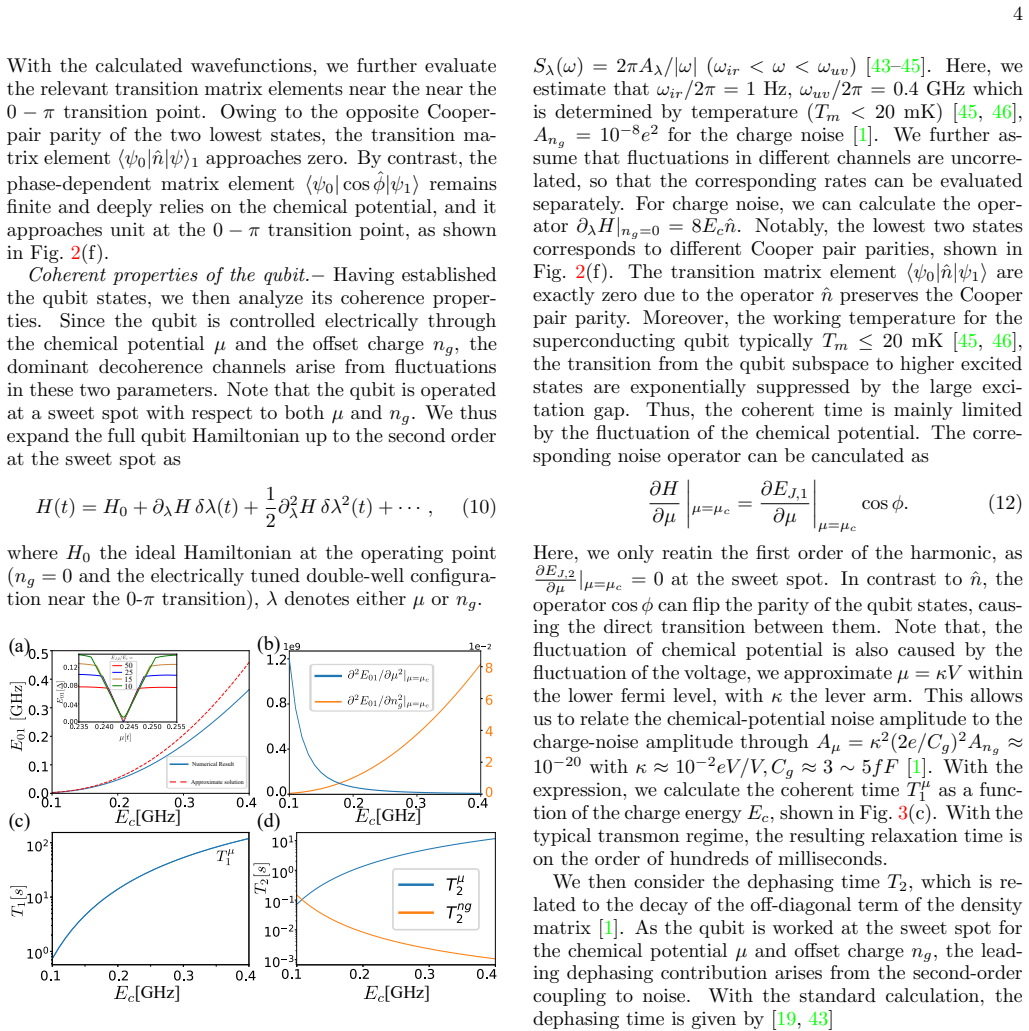
- [Andreev levels / Construction of the qubit states] Fig. 2(d) and the accompanying text: EJ,1 is stated to be “strongly suppressed” at the electrically tuned 0–π point, yet the numerical Fourier coefficients remain visibly finite and the analytic short-junction form EJ,n ∼ cos[kn(µ − µ0)] only approximately zeros the odd harmonics. Any residual first harmonic re-opens a first-order parity-breaking channel. The manuscript should quantify how small EJ,1/EJ,2 must remain (including disorder and multi-channel effects) for the quoted coherence times to survive, and should show the corresponding degradation of T1/T2.
- [Coherent properties / Fig. 4] Fig. 4 and the final paragraph of the coherence discussion: smaller altermagnetic splitting M improves dephasing (lower curvature of E01) but shifts the critical chemical potential µc. The manuscript does not demonstrate that the required µc remains experimentally accessible for the materials (MnTe, CrSb) and gate voltages (2–3 V) cited in Appendix B. A concrete window of M and µ that simultaneously satisfies both the 0–π condition and the quoted coherence should be provided.
minor comments (4)
- [Throughout] Several typographical errors appear in the main text (“superconducting desgin”, “stronglu suppressed”, “consver the Cooper pair parity”, “finit gap”, “reatin the first order”). A careful proof-reading pass is needed.
- [Figures 1–2] Fig. 1(b) caption and the wave-function insets of Fig. 2(f) would benefit from explicit labels of the even/odd parity sectors and the locations of the potential minima (ϕ = 0, π).
- [Appendix B] Appendix B quotes InSb parameters for the chemical-potential estimate while the main text discusses Al/MnTe or Al/CrSb hybrids; a short clarification of which material parameters are intended for the final device would avoid confusion.
- [Coherent properties] The infrared/ultraviolet cut-offs of the 1/f spectrum (ωir/2π = 1 Hz, ωuv/2π = 0.4 GHz) are stated without reference to a specific measurement or temperature model; a brief citation or justification would help reproducibility.
Circularity Check
No significant circularity: the 0–π double-well and parity protection follow from an independent microscopic BdG/tight-binding derivation; coherence numbers are external-noise estimates, not fitted or self-defined predictions.
full rationale
The load-bearing chain begins with the altermagnet tight-binding Hamiltonian (Eq. 1), proceeds through linearized BdG channels and scattering-matrix Andreev levels (Eq. 5 and Appendix A), and yields the Josephson potential whose Fourier coefficients EJ,n(μ) are extracted by direct Fourier transform of the free energy (Eq. 6, Fig. 2d). At the electrically tuned point where EJ,1 vanishes while EJ,2 > 0 the double-well and opposite-parity eigenstates of H = 4Ec(n̂−ng)2 + V follow by standard diagonalization; nothing in this construction is defined in terms of the final coherence times. The T1/T2 estimates (Eqs. 11–13) import laboratory 1/f amplitudes Ang and lever-arm conversions from the external gatemon/transmon literature; they are not fitted to any data set of the present model, nor do they feed back into the microscopic potential. Self-citations to the author’s earlier parity-qubit papers appear only as architectural context and are not used to prove uniqueness or to force the altermagnetic mechanism. Consequently the central claim is self-contained against its own microscopic inputs and external noise benchmarks; residual model uncertainties (lever arm, residual EJ,1) affect correctness risk, not circularity.
Assumptions & free parameters
free parameters (4)
- Altermagnetic splitting M
- Junction length d and width W (in lattice units)
- Charge-noise amplitude Ang and lever arm κ
- Charging energy Ec relative to EJ,2
assumptions (4)
- domain assumption BdG mean-field description of the SC–AM–SC junction with momentum-dependent altermagnetic term M(cos kx-cos ky)sz and no net magnetization.
- domain assumption 1/f noise spectrum for both charge and chemical-potential fluctuations with fixed infrared (1 Hz) and ultraviolet (0.4 GHz) cutoffs.
- domain assumption Short-junction, high-transparency limit in which only a few transverse channels dominate and higher Josephson harmonics remain small near the 0–π point.
- standard math Parity protection follows once the potential is dominated by cos2φ and the lowest two eigenstates have opposite Cooper-pair parity.
invented entities (1)
-
Gate-tunable altermagnetic parity-protected qubit (SC–AM–SC gatemon)
Cite this review
Pith. "Pith review of Full Gate-Voltage Control of a Parity-Protected Superconducting Qubit with an Altermagnetic Josephson Junction." pith.science (2026). https://pith.science/paper/ZOCULVHC
@misc{pith2026260704097,
  author       = {Pith},
  title        = {Pith review of: Full Gate-Voltage Control of a Parity-Protected Superconducting Qubit with an Altermagnetic Josephson Junction},
  year         = {2026},
  howpublished = {\url{https://pith.science/paper/ZOCULVHC}},
  note         = {Machine review of arXiv:2607.04097}
}
abstract
Parity-protected superconducting qubits offer intrinsically long coherence, but many current implementations require magnetic-flux biasing, which introduces flux noise, control overhead, and limited scalability. Here we propose a parity-protected qubit based on a gate-tunable superconductor-altermagnet-superconductor Josephson junction. Altermagnets are compensated magnets with momentum-dependent spin splitting and zero net magnetization, providing spin-dependent functionality without external magnetic fields. In the proposed junction, the two spin sectors acquire opposite phase shifts, generating two Josephson channels whose interference is controlled electrically by the chemical potential. At the tuned $0$-$\pi$ transition, the first Josephson harmonic is strongly suppressed while the second harmonic dominates, yielding a double-well potential with two nearly degenerate states of opposite Cooper-pair parity. For realistic gatemon-compatible parameters, we estimate coherence times of up to tens of milliseconds while maintaining fully gate-controlled qubit operations. These results establish altermagnetic Josephson junctions as a promising route toward protected superconducting qubits with local, scalable, and all-electrical control.
Figures


Figures from the paper (2 more)


Forward citations
Cited by 1 Pith paper
-
Protected measurements for protected superconducting qubits
Protected Z and X measurements of the 0-pi qubit are proposed, with exponentially suppressed errors via GKP-state encoding and charge-parity mapping.
Reference graph
Works this paper leans on
-
[1]
J. Koch, T. M. Yu, J. Gambetta, A. A. Houck, D. I. Schuster, J. Majer, A. Blais, M. H. Devoret, S. M. Girvin, and R. J. Schoelkopf, Phys. Rev. A 76, 042319 (2007)
2007
-
[2]
Arute, K
F. Arute, K. Arya, R. Babbush, D. Bacon, J. C. Bardin, R. Barends, R. Biswas, S. Boixo, F. G. S. L. Brandao, D. A. Buell, B. Burkett, Y. Chen, Z. Chen, B. Chiaro, R. Collins, W. Courtney, A. Dunsworth, E. Farhi, B. Foxen, A. Fowler, C. Gidney, M. Giustina, R. Graff, K. Guerin, S. Habegger, M. P. Harrigan, M. J. Hartmann, A. Ho, M. Hoffmann, T. Huang, T. S...
2019
-
[3]
Kjaergaard, M
M. Kjaergaard, M. E. Schwartz, J. Braum¨ uller, P. Krantz, J. I.-J. Wang, S. Gustavsson, and W. D. Oliver, Annual Review of Condensed Matter Physics 11, 369 (2020)
2020
-
[4]
Wu, W.-S
Y. Wu, W.-S. Bao, S. Cao, F. Chen, M.-C. Chen, X. Chen, T.-H. Chung, H. Deng, Y. Du, D. Fan, M. Gong, C. Guo, C. Guo, S. Guo, L. Han, L. Hong, H.-L. Huang, Y.-H. Huo, L. Li, N. Li, S. Li, Y. Li, F. Liang, C. Lin, J. Lin, H. Qian, D. Qiao, H. Rong, H. Su, L. Sun, L. Wang, S. Wang, D. Wu, Y. Xu, K. Yan, W. Yang, Y. Yang, Y. Ye, J. Yin, C. Ying, J. Yu, C. Zh...
2021
-
[5]
Acharya, I
R. Acharya, I. Aleiner, R. Allen, T. I. Andersen, M. Ans- mann, F. Arute, K. Arya, A. Asfaw, J. Atalaya, R. Bab- bush, D. Bacon, J. C. Bardin, J. Basso, A. Bengtsson, S. Boixo, G. Bortoli, A. Bourassa, J. Bovaird, L. Brill, M. Broughton, B. B. Buckley, D. A. Buell, T. Burger, B. Burkett, N. Bushnell, Y. Chen, Z. Chen, B. Chiaro, J. Cogan, R. Collins, P. C...
2023
-
[6]
D. Gao, D. Fan, C. Zha, J. Bei, G. Cai, J. Cai, S. Cao, F. Chen, J. Chen, K. Chen, X. Chen, X. Chen, Z. Chen, Z. Chen, Z. Chen, W. Chu, H. Deng, Z. Deng, P. Ding, X. Ding, Z. Ding, S. Dong, Y. Dong, B. Fan, Y. Fu, S. Gao, L. Ge, M. Gong, J. Gui, C. Guo, S. Guo, X. Guo, L. Han, T. He, L. Hong, Y. Hu, H.-L. Huang, Y.-H. Huo, T. Jiang, Z. Jiang, H. Jin, Y. L...
2025
-
[7]
W. Huang, X.-C. Zhou, L. Zhang, J. Zhang, Y. Zhou, B.- C. Yao, Z. Guo, P. Huang, Q. Li, Y. Liang, Y. Liu, J. Qiu, D. Sun, X. Sun, Z. Wang, C. Xie, Y. Xiong, X. Yang, J. Zhang, Z. Zhang, J. Chu, W. Guo, J. Jiang, X. Lin- peng, W. Ren, Y. Yuan, J. Niu, Z. Tao, S. Liu, Y. Zhong, X.-J. Liu, and D. Yu, Nature Physics 10.1038/s41567- 026-03333-0 (2026)
doi:10.1038/s41567- 2026
-
[8]
L. E. Fischer, M. Leahy, A. Eddins, N. Keenan, D. Fer- racin, M. A. C. Rossi, Y. Kim, A. He, F. Pietracaprina, B. Sokolov, S. Dooley, Z. Zimbor´ as, F. Tacchino, S. Man- iscalco, J. Goold, G. Garc´ ıa-P´ erez, I. Tavernelli, A. Kan- dala, and S. N. Filippov, Nature Physics 22, 302 (2026)
2026
Show all 55 references
-
[9]
Jiang, J
T. Jiang, J. Cai, J. Huang, N. Zhou, Y. Zhang, J. Bei, G. Cai, S. Cao, F. Chen, J. Chen, K. Chen, X. Chen, X. Chen, Z. Chen, Z. Chen, Z. Chen, W. Chu, H. Deng, Z. Deng, P. Ding, X. Ding, Z. Ding, S. Dong, B. Fan, D. Fan, Y. Fu, D. Gao, L. Ge, J. Gui, C. Guo, S. Guo, X. Guo, L....
2026
-
[10]
Siddiqi, Nature Reviews Materials 6, 875 (2021)
I. Siddiqi, Nature Reviews Materials 6, 875 (2021)
2021
-
[11]
Gyenis, A
A. Gyenis, A. Di Paolo, J. Koch, A. Blais, A. A. Houck, and D. I. Schuster, PRX Quantum 2, 030101 (2021)
2021
-
[12]
Huang, D
H.-L. Huang, D. Wu, D. Fan, and X. Zhu, Science China Information Sciences 63, 180501 (2020)
2020
-
[13]
V. E. Manucharyan, J. Koch, L. I. Glazman, and M. H. Devoret, Science 326, 113 (2009)
2009
-
[14]
I. M. Pop, K. Geerlings, G. Catelani, R. J. Schoelkopf, L. I. Glazman, and M. H. Devoret, Nature 508, 369 (2014)
2014
-
[15]
L. B. Nguyen, Y.-H. Lin, A. Somoroff, R. Mencia, N. Grabon, and V. E. Manucharyan, Phys. Rev. X 9, 041041 (2019)
2019
-
[16]
Kitaev, arXiv e-prints , cond-mat/0609441 (2006)
A. Kitaev, arXiv e-prints , cond-mat/0609441 (2006)
2006 arXiv
-
[17]
Brooks, A
P. Brooks, A. Kitaev, and J. Preskill, Phys. Rev. A 87, 052306 (2013)
2013
-
[18]
J. M. Dempster, B. Fu, D. G. Ferguson, D. I. Schuster, and J. Koch, Phys. Rev. B 90, 094518 (2014)
2014
-
[19]
Groszkowski, A
P. Groszkowski, A. D. Paolo, A. L. Grimsmo, A. Blais, D. I. Schuster, A. A. Houck, and J. Koch, New Journal of Physics 20, 043053 (2018)
2018
-
[20]
D. K. Weiss, A. C. Y. Li, D. G. Ferguson, and J. Koch, Phys. Rev. B 100, 224507 (2019)
2019
-
[21]
Guo, H.-B
G.-L. Guo, H.-B. Leng, Y. Hu, and X. Liu, Phys. Rev. B 105, L180502 (2022)
2022
-
[22]
Guo, H.-B
G.-L. Guo, H.-B. Leng, and X. Liu, New Journal of Physics 26, 063005 (2024)
2024
-
[23]
F. Bao, H. Deng, D. Ding, R. Gao, X. Gao, C. Huang, X. Jiang, H.-S. Ku, Z. Li, X. Ma, X. Ni, J. Qin, Z. Song, H. Sun, C. Tang, T. Wang, F. Wu, T. Xia, W. Yu, F. Zhang, G. Zhang, X. Zhang, J. Zhou, X. Zhu, Y. Shi, J. Chen, H.-H. Zhao, and C. Deng, Phys. Rev. Lett. 129, 010502 (2022)
2022
-
[24]
K. Nie, J. N. Bradford, S. Mandal, A. Bista, W. Pfaff, and A. Kou, PRX Quantum 7, 010357 (2026), arXiv:2505.23641 [quant-ph]
2026 arXiv
-
[25]
T. W. Larsen, K. D. Petersson, F. Kuemmeth, T. S. Jespersen, P. Krogstrup, J. Nyg˚ ard, and C. M. Marcus, Phys. Rev. Lett. 115, 127001 (2015)
2015
-
[26]
de Lange, B
G. de Lange, B. van Heck, A. Bruno, D. J. van Woerkom, A. Geresdi, S. R. Plissard, E. P. A. M. Bakkers, A. R. Akhmerov, and L. DiCarlo, Phys. Rev. Lett. 115, 127002 (2015)
2015
-
[27]
Casparis, M
L. Casparis, M. R. Connolly, M. Kjaergaard, N. J. Pear- son, A. Kringhøj, T. W. Larsen, F. Kuemmeth, T. Wang, C. Thomas, S. Gronin, G. C. Gardner, M. J. Manfra, C. M. Marcus, and K. D. Petersson, Nature Nanotech- nology 13, 915 (2018)
2018
-
[28]
Fu and C
L. Fu and C. L. Kane, Physical Review B 79, 161408 (2009)
2009
-
[29]
H. Ren, F. Pientka, S. Hart, A. T. Pierce, M. Kosowsky, L. Lunczer, R. Schlereth, B. Scharf, E. M. Hankiewicz, L. W. Molenkamp, B. I. Halperin, and A. Yacoby, Nature 569, 93 (2019)
2019
-
[30]
T. W. Larsen, M. E. Gershenson, L. Casparis, A. Kringhøj, N. J. Pearson, R. P. G. McNeil, F. Kuem- meth, P. Krogstrup, K. D. Petersson, and C. M. Marcus, Phys. Rev. Lett. 125, 056801 (2020)
2020
-
[31]
L. Bai, W. Feng, S. Liu, L. Smejkal, Y. Mokrousov, and Y. Yao, Advanced Functional Materials 34, 2409327 (2024), https://advanced.onlinelibrary.wiley.com/doi/pdf/10.1002/adfm.202409327
2024 doi
-
[32]
C. Song, H. Bai, Z. Zhou, L. Han, H. Reichlova, J. H. Dil, J. Liu, X. Chen, and F. Pan, Nature Reviews Materials 10, 473 (2025)
2025
-
[33]
Li, J.-X
C. Li, J.-X. Hou, F.-C. Zhang, S.-B. Zhang, and L.-H. Hu, Phys. Rev. Lett. 136, 116701 (2026)
2026
-
[34]
Banerjee and M
S. Banerjee and M. S. Scheurer, Phys. Rev. B 110, 024503 (2024)
2024
-
[36]
Y. Chen, X. Liu, H.-Z. Lu, and X. C. Xie, Phys. Rev. Lett. 135, 016701 (2025)
2025
-
[37]
Lin, S.-B
H.-J. Lin, S.-B. Zhang, H.-Z. Lu, and X. C. Xie, Phys. Rev. Lett. 134, 136301 (2025)
2025
-
[38]
Davydova, S
M. Davydova, S. Prembabu, and L. Fu, Science Advances 8, eabo0309 (2022)
2022
-
[39]
J. Mei, S. Qin, and J. Hu, arXiv e-prints , arXiv:2510.15788 (2025), arXiv:2510.15788 [cond- mat.supr-con]
2025
-
[40]
C. W. Groth, M. Wimmer, A. R. Akhmerov, and X. Waintal, New Journal of Physics 16, 063065 (2014)
2014
-
[41]
W. C. Smith, A. Kou, X. Xiao, U. Vool, and M. H. De- voret, npj Quantum Information 6, 8 (2020)
2020
-
[42]
D. J. Griffiths, Introduction to Quantum Mechanics (Cambridge University Press, 2018)
2018
-
[43]
Ithier, E
G. Ithier, E. Collin, P. Joyez, P. J. Meeson, D. Vion, D. Esteve, F. Chiarello, A. Shnirman, Y. Makhlin, J. Schriefl, and G. Sch¨ on, Phys. Rev. B 72, 134519 (2005)
2005
-
[44]
Paladino, Y
E. Paladino, Y. M. Galperin, G. Falci, and B. L. Alt- shuler, Rev. Mod. Phys. 86, 361 (2014)
2014
-
[45]
Krantz, M
P. Krantz, M. Kjaergaard, F. Yan, T. P. Orlando, S. Gus- tavsson, and W. D. Oliver, Applied Physics Reviews 6, 021318 (2019)
2019
-
[46]
M. H. Devoret and R. J. Schoelkopf, Science 339, 1169 (2013)
2013
-
[47]
A. D. Paolo, A. L. Grimsmo, P. Groszkowski, J. Koch, and A. Blais, New Journal of Physics 21, 043002 (2019)
2019
-
[48]
Gyenis, P
A. Gyenis, P. S. Mundada, A. Di Paolo, T. M. Hazard, X. You, D. I. Schuster, J. Koch, A. Blais, and A. A. Houck, PRX Quantum 2, 010339 (2021)
2021
-
[49]
S. Lee, S. Lee, S. Jung, J. Jung, D. Kim, Y. Lee, B. Seok, J. Kim, B. G. Park, L. Smejkal, C.-J. Kang, and C. Kim, Phys. Rev. Lett. 132, 036702 (2024)
2024
-
[50]
J. Ding, Z. Jiang, X. Chen, Z. Tao, Z. Liu, T. Li, J. Liu, J. Sun, J. Cheng, J. Liu, Y. Yang, R. Zhang, L. Deng, W. Jing, Y. Huang, Y. Shi, M. Ye, S. Qiao, Y. Wang, Y. Guo, D. Feng, and D. Shen, Phys. Rev. Lett. 133, 206401 (2024)
2024
-
[51]
Krempask´ y, L
J. Krempask´ y, L. Smejkal, S. W. D’Souza, M. Ha- jlaoui, G. Springholz, K. Uhl´ ı rov´ a, F. Alarab, P. C. Constantinou, V. Strocov, D. Usanov, W. R. Pudelko, 9 R. Gonz´ alez-Hern´ andez, A. Birk Hellenes, Z. Jansa, H. Reichlov´ a, Z. Sob´ an, R. D. Gonzalez Betancourt, P. Wa...
2024
-
[52]
X. Duan, J. Zhang, Z. Zhu, Y. Liu, Z. Zhang, I. Zuti´ c, and T. Zhou, Phys. Rev. Lett. 134, 106801 (2025)
2025
-
[53]
Bratland Tjernshaugen, M
J. Bratland Tjernshaugen, M. Amundsen, and J. Linder, arXiv e-prints , arXiv:2606.02761 (2026), arXiv:2606.02761 [quant-ph]
2026 arXiv
-
[54]
C. T. Ke, C. M. Moehle, F. K. de Vries, C. Thomas, S. Metti, C. R. Guinn, R. Kallaher, M. Lodari, G. Scap- pucci, T. Wang, R. E. Diaz, G. C. Gardner, M. J. Man- fra, and S. Goswami, Nature Communications 10, 3764 (2019)
2019
-
[55]
Luryi, Applied Physics Letters 52, 501 (1988), https://pubs.aip.org/aip/apl/article- pdf/52/6/501/18464649/501 1 online.pdf
S. Luryi, Applied Physics Letters 52, 501 (1988), https://pubs.aip.org/aip/apl/article- pdf/52/6/501/18464649/501 1 online.pdf
1988
-
[56]
J. Xia, F. Chen, J. Li, and N. Tao, Nature Nanotechnol- ogy 4, 505 (2009)
2009
Reviewed July 11, 2026 · model on record in the stance chip above.
Discussion (0). Sign in to comment.