REVIEW 2 major objections 6 minor 5 cited by
Searching for Inflationary Physics with the CMB Trispectrum: 2. Code & Validation
T0 review · 2 major / 6 minor · reviewed 2026-08-08 · deepseek-v4-flash
Pith's one-line read This paper presents PolySpec, a public code that estimates eleven primordial trispectrum amplitudes from the CMB's four-point correlations, and validates on simulations that the estimates are unbiased and near-minimum-variance.
desk verdict PolySpec is a genuinely useful public code with thorough Gaussian-level validation of new CMB trispectrum estimators, but the absolute calibration of the new exchange templates rests on internal consistency checks alone, so the abstract oversells the non-Gaussian validation. read the letter →
The pith
A machine-rendered reading of the paper's core claim, the machinery that carries it, and where it could break.
The reading
What carries the argument
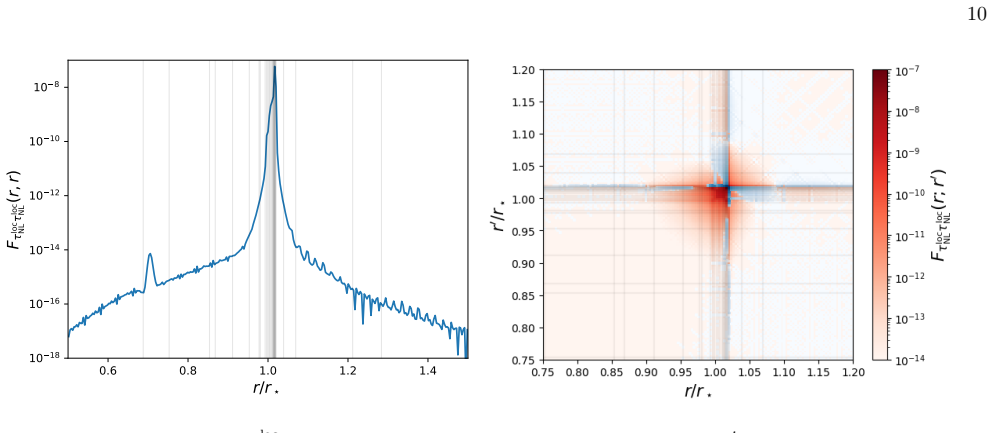
The load-bearing mechanism is the Hermite-expansion quartic estimator. Schematically, for each amplitude $A_\alpha$ it computes a numerator $\hat{N}_\alpha$ from filtered maps $h = S^{-1}d$: the four-field term $h^4$, a two-field term $-6h^2\langle h^2\rangle$, and a zero-field term $3\langle h^2\rangle^2$, then normalizes by the Fisher matrix $F_{\alpha\beta}$ estimated by stochastic trace estimation over Gaussian random fields. The templates are made computationally separable in one of two ways: contact templates factor into products of single-momentum functions with one radial integral over $r$; exchange templates factor into two quadratic pieces coupled by $F_L(r,r')$, involving two radial integrals. A greedy optimization step compresses the radial integrals to $N_{\rm opt} \approx 10$–$100$ points with weights, reproducing the idealized Fisher matrix within $f_{\rm thresh}$ (typically $10^{-3}$ to $10^{-4}$), which is what makes the code fast enough for Planck-resolution data. The collider templates additionally impose a collapsed-limit cut via $k > k_{\rm coll}$, $K < k_{\rm coll}$ with $k_{\rm coll} = 0.01\,{\rm Mpc}^{-1}$ and $L_{\rm max} \ge \ell_{\rm max}/4$.
What would settle it
Inject a collider signal with support at $K \sim k$ rather than $K \ll k$ into the non-Gaussian simulation suites and run PolySpec on the resulting maps; if the recovered $\tau_{\rm NL}$ amplitudes deviate from the input by more than the Monte Carlo error, the collapsed-limit truncation is losing real signal.
Extended reading notes
Core claim
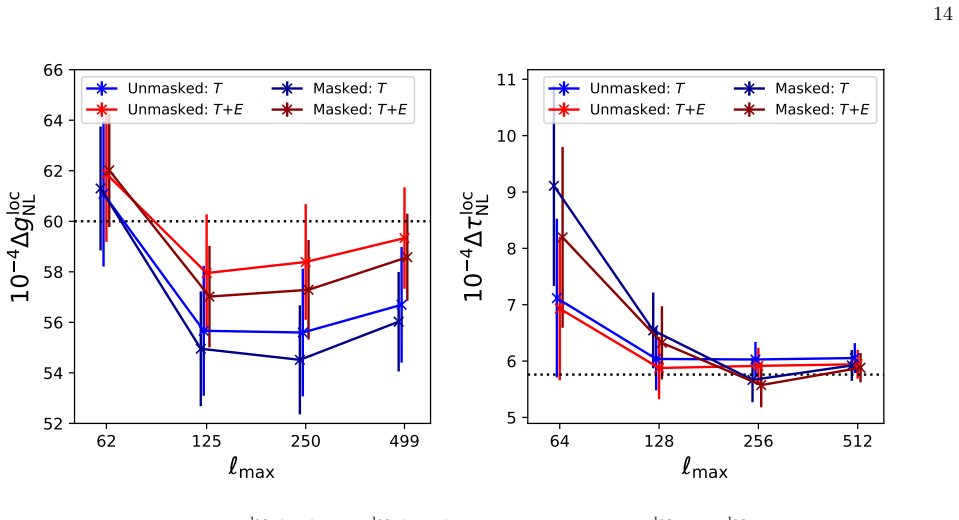
On its own terms, the paper establishes that PolySpec is ready for real data. For each of eleven primordial amplitudes, plus gravitational lensing and point sources, it constructs the optimal estimator of Paper 1—a Hermite-expansion numerator with four-, two-, and zero-field terms, normalized by a Fisher matrix obtained by Monte Carlo—and verifies three properties that together define readiness: no false signal on Gaussian maps, unbiased recovery of injected non-Gaussian amplitudes, and empirical covariances consistent with the inverse Fisher matrix across masks, scale cuts, and temperature-versus-polarization choices. The paper further finds that adding E-mode polarization tightens constraints by roughly 40% for local shapes and by 30–70% for direction-dependent and collider shapes, and that the collider and direction-dependent templates are only weakly correlated with the local and EFTI shapes, implying that prior Planck non-detections do not bound them. On this basis the code is presented as the foundation for the Planck trispectrum constraints of Paper 3.
Load-bearing premise
The load-bearing premise is that the primordial signals are exactly the factorized templates of Paper 1 and live entirely in the collapsed limit, so truncating at $k_{\rm coll} = 0.01\,{\rm Mpc}^{-1}$ and $L_{\rm max} \ge \ell_{\rm max}/4$ discards no real signal; if a genuine signal extends outside that regime, the recovered amplitudes would be biased or null.
Editorial extensions
If this is right
- Paper 3 will place first Planck constraints on spinning massive-particle exchange and direction-dependent trispectra, because those templates are not already bounded by previous local and EFTI searches.
- Future trispectrum analyses should include E-mode polarization, since the validation shows up to 40% tighter constraints on local shapes and 30–70% tighter constraints on direction-dependent and collider shapes.
- The odd-parity direction-dependent templates with odd $n_1,n_3$ are excluded from the Planck analysis because they fail $k$-resolution convergence, so the public template list is not the full set of inflationary models.
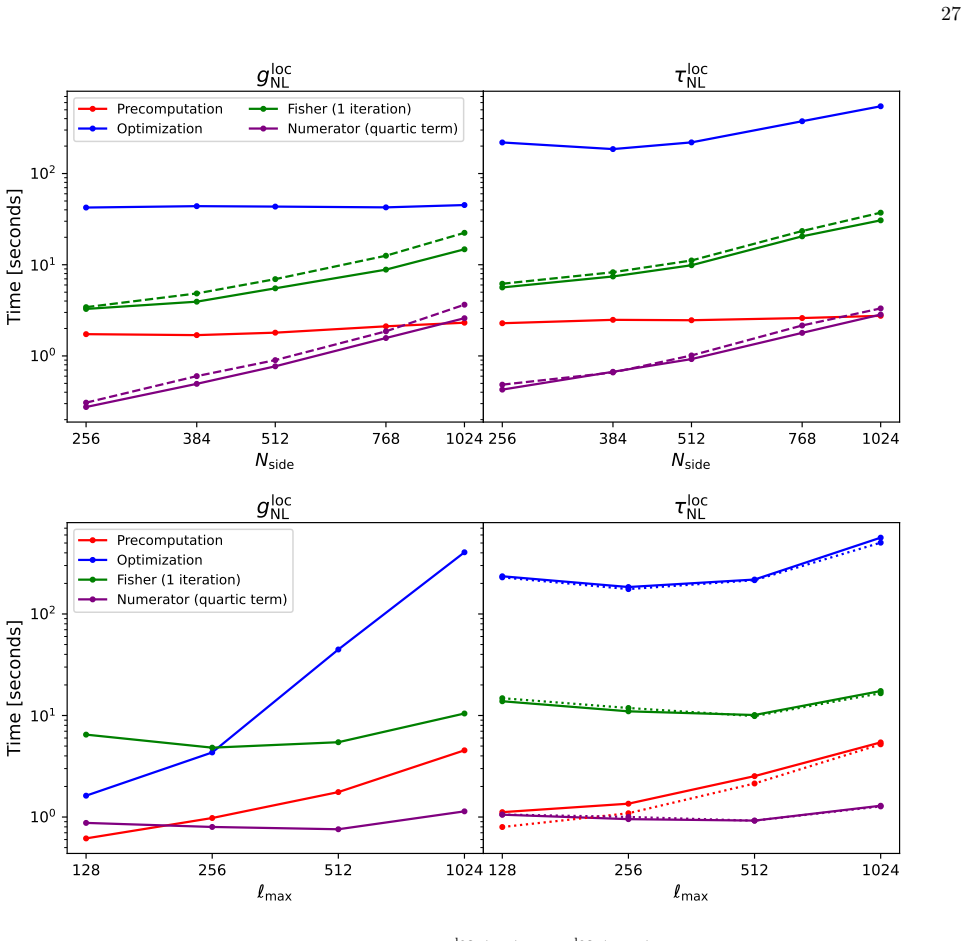
- At Planck-like resolution ($\ell_{\rm max} = 2048$), estimator numerators take seconds and Fisher-matrix realizations minutes per realization, so the analysis is computationally feasible on current clusters.
- Using $k_{\rm coll} = 0.01\,{\rm Mpc}^{-1}$ and $L_{\rm max} \ge \ell_{\rm max}/4$ retains the majority of the Fisher information for every collider template, which validates the collapsed-limit strategy.
Reading between the lines
- Beyond the paper, the weak correlations among templates suggest that a joint multi-template search could substantially outperform separate single-template analyses; this is testable in the Paper 3 dataset by comparing joint and marginalized constraints.
- If a real inflationary signal has support in non-collapsed tetrahedra, the collapsed-limit truncation would make PolySpec miss it even though the estimator is validated on collapsed-limit injections; a natural extension is to build non-collapsed templates or relax $k_{\rm coll}$ and check whether constraints degrade.
- The radial-point optimization used here to compress Fisher information could be transplanted to other optimal estimators, such as bispectrum or 21cm polyspectrum analyses, yielding similar speed-ups.
- The failure of odd $n_1,n_3$ templates to converge when the $k$-grid is doubled suggests that convergence testing is a cheap diagnostic for whether a new template can be meaningfully constrained.
Editorial analysis
A structured set of objections, weighed in public.
Referee Report
Summary. This paper presents PolySpec, a public CMB trispectrum estimation code implementing quasi-optimal quartic estimators for a wide set of inflationary trispectrum amplitudes: local (g^loc_NL, tau^loc_NL), constant (g^con_NL), EFTI (g^{dot-sigma^4}_NL, g^{dot-sigma^2(d sigma)^2}_NL, g^{(d sigma)^4}_NL), direction-dependent (tau^{n1 n3 n}_NL, tau^{n,even}_NL, tau^{n,odd}_NL), cosmological collider (light and heavy spin-s exchange), plus lensing and point-source amplitudes. The paper describes the code architecture, the radial-integral optimization algorithm, computational scaling, and an extensive validation suite: Gaussian null tests, empirical variances versus Fisher-matrix predictions, comparisons with analytic Fisher computations and published scaling forecasts, hyperparameter stability checks, and non-Gaussian injection tests for gloc_NL, tau_loc_NL, and lensing. It also provides forecasts emphasizing the information content of polarization and the weak correlations among many of the new templates versus previously studied shapes.
Significance. If the validation is accepted, PolySpec is a substantial and carefully engineered public code that should enable first direct Planck constraints on several inflationary trispectrum families, including cosmological collider signals. The paper's strengths are its breadth, the extensive Gaussian validation, the comparisons with analytic calculations and published forecasts, the explicit reporting of failed convergence for some direction-dependent templates, and the public availability of the code. The principal weakness is that unbiasedness in the presence of a signal is demonstrated end-to-end for only three estimators (gloc_NL, tau_loc_NL, Alens); for the EFTI, direction-dependent, and collider families the validation is Gaussian-only, which leaves a specific class of template-normalization errors undetected. This gap is load-bearing for the abstract's central claim and needs to be addressed or explicitly re-scoped.
major comments (2)
- [Abstract; Secs. IV.D-IV.F] The abstract's claim that the estimators are 'unbiased and minimum-variance, both in Gaussian and non-Gaussian regimes' is stronger than the evidence provided. Non-Gaussian injection tests are performed only for gloc_NL and tau_loc_NL (Fig. 7) and for lensing (Fig. 23); Sec. IV.D states explicitly that 'non-Gaussian simulations have not been generated' for the EFTI shapes, and Secs. IV.E and IV.F likewise validate the direction-dependent and collider estimators only on Gaussian simulations. This is not a purely cosmetic gap: a constant normalization error in the implemented template derivative Q_alpha is invisible to Gaussian-only tests. In Eq. (3), if Q -> c Q, then the numerator N scales as c, the Fisher matrix F scales as c^2, the estimated amplitude bA = F^{-1} N is biased by a factor 1/c, while the predicted covariance F^{-1} scales as 1/c^2 and the empirical-variance check against F^{-1} still passes. The internal consistency check d†Q = tau compares the numerator and Fisher code paths against each other, not against an independent definition of the template. The analytic Fisher comparisons in Secs. IV.C and IV.D are reassuring only if the analytic calculation is genuinely independent of the code's Q_alpha construction. I request at least one non-Gaussian injection test (or an equivalent independent normalization check) for a representative template in each of the EFTI, direction-dependent, and collider families, or, failing that, a clear restriction of the unbiasedness claim to the tested templates in both the abstract and the conclusions.
- [Sec. IV.E; Sec. VI] The direction-dependent estimators with odd n1,n3 (and the corresponding parity-even/odd combinations with mismatched parity) do not pass the k-space convergence tests and are explicitly said to 'cannot be meaningfully constrained from the CMB'; they are excluded from Paper 3. This is an honest and useful statement, but it conflicts with the blanket wording in Sec. VI that 'All templates have passed these checks except for certain direction-dependent tauNL shapes.' For these shapes the optimization algorithm is not guaranteed to converge, so the fthresh-based error bound does not apply. The paper should state explicitly that the validation, forecast, and unbiasedness claims are restricted to the well-behaved subset of direction-dependent templates, and should phrase the abstract's 'wide variety of templates' so that it does not imply validated estimators for all listed shapes.
minor comments (6)
- [Sec. IV.C.4, Fig. 6] The masked tau_loc_NL case at lmax=64 shows a clear mismatch between the empirical variance and the Fisher prediction; the text attributes this to the approximate S^{-1} weighting. This is not fatal for Paper 3 if the analysis runs at lmax=2048, but it should be listed explicitly as a known limitation of the minimum-variance claim for that configuration.
- [Sec. V.D] The sentence 'the more complex estimators can be applied to high-resolution Planck data prohibitive computational costs' appears to be missing the word 'without' before 'prohibitive'.
- [Fig. 20 caption] The word 'agremeent' in the caption should be 'agreement'.
- [Sec. IV.E] The text says the estimators are built for '(small) positive integer ni', but templates with ni=0 are included (e.g., tau^{000}_NL); 'non-negative integer' would be more accurate.
- [Sec. IV.B, Eq. (13)] The filter in Eq. (13) includes a beam B_ell, while Sec. IV.B says 'do not otherwise include a beam'; please clarify whether the fiducial analysis sets B_ell = 1 or whether a beam is included in the filter.
- [General] Consider adding a reproducibility note giving the exact version/commit of PolySpec used for the validation numbers, and a list of the random seeds or a statement on how they were drawn, to make the Monte Carlo results fully reproducible.
Circularity Check
No significant circularity: the estimator pipeline is validated against external analytic forecasts and non-Gaussian simulations where available, and the remaining Gaussian-only validation of EFTI, direction-dependent, and collider estimators is a disclosed limitation rather than a circular reduction.
full rationale
The paper's derivation chain is bA = F^{-1} bN from Eq. (3), implemented from template derivatives defined in Paper 1 and from the independent optimal-estimation formalism of Smith, Senatore, and Zaldarriaga [21]. The templates are not defined in terms of the quantities being predicted, and the claimed predictions are not fitted to the data used for validation. Contact-template Fisher matrices are checked against independent analytic calculations (e.g., Fig. 4 and Fig. 10 circles), empirical variances are compared with F^{-1} predictions from large sets of Gaussian simulations, and the local and lensing estimators recover injected non-Gaussian amplitudes in Figs. 7 and 23. Reliance on Paper 1 (same author) for template definitions and optimization algorithms is legitimate self-citation because the estimators are additionally tested against external scaling forecasts (e.g., Kalaja et al. 2021; Kogo and Komatsu 2006) and through explicit grid-doubling convergence tests. The only substantive gap is that EFTI, direction-dependent, and collider estimators are not tested with non-Gaussian injections; the paper explicitly states this, e.g., in Section IV D: 'non-Gaussian simulations have not been generated, thus we must validate our estimators in the Gaussian limit,' with analogous statements in Sections IV E and IV F. Gaussian-only tests cannot detect a constant template-normalization error because both numerator and Fisher matrix inherit the same proportionality to the template derivative Q, so bA = F^{-1}bN is changed by 1/c while the predicted covariance F^{-1} changes by 1/c^2 and can still match the empirical variance. That is a genuine validation limitation for the unbiasedness claim extended to all eleven primordial templates, but it is not circularity: the estimator is not equivalent to its inputs by construction, the limitation is acknowledged in the manuscript, and no load-bearing step reduces to a self-citation or a fitted parameter renamed as a prediction.
Assumptions & free parameters
free parameters (5)
- kcoll =
0.01 Mpc^-1
- fthresh =
10^-4 (primary), 10^-3 (some exchange templates)
- Nopt =
Varies by template, 30 to roughly 100
- Nfish =
50 to 100 (varies by test)
- Ndisc =
50 to 100 (varies by test)
assumptions (5)
- domain assumption The optimal estimator (Eq. 3) is unbiased and minimum-variance when the data covariance is known and the inverse-variance filter equals P^dagger C^-1.
- domain assumption All templates are exactly separable into contact (Eq. 6) or exchange (Eq. 10) forms.
- domain assumption The theoretical trispectra for collider particles are valid only in the collapsed limit, and the kcoll truncation removes contamination from non-collapsed regimes.
- domain assumption Monte Carlo averages over Ndisc simulations with covariance matching the data remove the disconnected trispectrum exactly.
- ad hoc to paper The optimized radial basis (Nopt points and weights) reproduces the full Fisher matrix to accuracy sqrt(fthresh).
Cite this review
Pith. "Pith review of Searching for Inflationary Physics with the CMB Trispectrum: 2. Code & Validation." pith.science (2026). https://pith.science/paper/ZXDSNGMN
@misc{pith2026250205258,
  author       = {Pith},
  title        = {Pith review of: Searching for Inflationary Physics with the CMB Trispectrum: 2. Code & Validation},
  year         = {2026},
  howpublished = {\url{https://pith.science/paper/ZXDSNGMN}},
  note         = {Machine review of arXiv:2502.05258}
}
read the original abstract
To unlock the vast potential of the CMB trispectrum, we require both robust estimators and efficient computational tools. In this work, we introduce the public code PolySpec: a suite of quartic estimators designed to measure the amplitudes of a wide variety of inflationary templates, including local non-Gaussianity, effective field theory models, direction-dependent trispectra, spinning massive particle exchange, and weak gravitational lensing. PolySpec includes a python/cython implementation of each estimator derived in Paper 1 and has been carefully optimized to ensure efficient use of computational resources. We perform a broad range of validation tests, which demonstrate that the estimator is unbiased and minimum-variance, both in Gaussian and non-Gaussian regimes. In addition, we forecast constraints on various types of trispectra; this highlights the utility of CMB polarization and demonstrates that many models of primordial physics are poorly correlated with the simple templates considered in previous studies. This work lays the foundation for the Planck trispectrum analyses performed in Paper 3.
Figures


Figures from the paper (18 more)






Forward citations
Cited by 5 Pith papers
-
Parity-violating scalar trispectrum from helical primordial magnetic fields
Helical primordial magnetic fields produce a computable parity-odd signal in the scalar trispectrum, currently constrained to r_H ≲ 4×10^-4 for B_r = 4.7 nG.
-
Searching for Inflationary Physics with the CMB Trispectrum: 1. Primordial Theory & Optimal Estimators
A set of quasi-optimal CMB trispectrum estimators is derived for local, EFT, direction-dependent, spinning-particle, point-source, and lensing templates, enabling first collider searches.
-
AGILE: an end-to-end Rubin-LSST simulation of AGNs, galaxies, and stars I. Software description and first data release
AGILE builds a 24 deg² truth catalog and a 1 deg² three-year LSST pilot (DR1) to measure flux recovery and Type-1 AGN completeness/purity from color and variability selections.
-
Inflationary trispectrum of gauge fields from scalar and tensor exchanges
The inflationary trispectrum of gauge fields from scalar and tensor exchanges is derived analytically, yielding beta^zeta_nl = (b^zeta_nl)^2 in the counter-collinear limit and growing flattened-limit signals.
-
Searching for Inflationary Physics with the CMB Trispectrum: 3. Constraints from Planck
A comprehensive Planck PR4 trispectrum analysis finds no primordial non-Gaussianity across 33 templates and sets leading constraints, including tau_NL loc < 1500 at 95% CL.
Reference graph
Works this paper leans on
-
[1]
Optimization First, we demonstrate the efficacy of the optimization scheme discussed in §II. Despite the additional τ integral, the optimization proceeds similarly to that of the gloc NL template, starting from a finely-spaced array of Ns = 4161 (ri, τi) points, as described in §III. In Fig. 9, we show the diagonal of the ideal g ˙σ4 NL Fisher derivative ...
-
[2]
By default, we use the hyperparameter set {Ndisc = 50, Nfish = 50, ℓmin = 2, fthresh = 10−4, Nside = 256}, analyzing 50 simulations
Performance on Gaussian Simulations The three EFTI estimators can be validated using a large suite of Gaussian simulations, generated at the Planck -like signal-plus-noise power spectrum described in §IV B. By default, we use the hyperparameter set {Ndisc = 50, Nfish = 50, ℓmin = 2, fthresh = 10−4, Nside = 256}, analyzing 50 simulations. We use a lower Nf...
-
[3]
Consistency Tests Finally, we test the dependence of our results on hyperparameter choices, focusing on the masked temperature-plus- polarization analysis at ℓmax = 512. Halving Nfish induces an error below 0 .15% in 1/ √ F , corresponding to < 0.25% in the errorbars and < 0.001σ in the mean, implying that our Monte Carlo Fisher matrix is highly converged...
-
[4]
General Direction-Dependence We first validate the τ n1n3n NL estimator by comparing its empirical variance to the Fisher matrix prediction, using 50 Gaussian simulations. Noting that computational costs scale quadratically with nmax, we restrict to ni ∈ {0, 1, 2}, but consider each non-trivial combination of n1, n3, nobeying the triangle conditions, spli...
-
[5]
For completeness, we perform additional tests in this section, which allow us to verify the scalings with ℓmax discussed in the literature
Even & Odd Templates As discussed in Paper 1, the optimal estimators for τ n,even NL and τ n,odd NL can be formed as a linear combination of the τ n1n3n NL , and thus are implicitly validated by the above tests. For completeness, we perform additional tests in this section, which allow us to verify the scalings with ℓmax discussed in the literature. In th...
-
[6]
not-too-collapsed
Dependence on kcoll Choosing kcoll requires balancing two constraints: (1) low kcoll leads to less contamination from equilateral regimes (since the external legs are dominated by large ℓ ∼ kχ∗); (2) high kcoll leads to increased signal-to-noise. To assess this, we perform a suite of spin-zero Fisher forecasts ( i.e. we compute F ) for various choices of ...
-
[7]
Our key results are shown in Fig
Spin-Zero Results We now validate the spin-zero estimators using Gaussian simulations. Our key results are shown in Fig. 17, comparing the empirical and theoretical errorbars on τ light,heavy NL across a wide range of mass parameters ν0 and µ0. The two sets of errorbars agree within 1 .8σ (accounting for the expected scatter), validating our estimators. T...
-
[8]
Due to the Higuchi bound, m2/H 2 ≥ s(s − 1) [83], which implies that the light template is restricted to νs ∈ [0, 1/2], avoiding the local-type divergence at ν0 → 3/2
Higher-Spin Results The most complex templates included in PolySpec are the light and heavy collider templates with spin s >0. Due to the Higuchi bound, m2/H 2 ≥ s(s − 1) [83], which implies that the light template is restricted to νs ∈ [0, 1/2], avoiding the local-type divergence at ν0 → 3/2. As such, we expect that higher-spin trispectra will be harder ...
Show all 100 references
-
[9]
O. H. E. Philcox, (2025), arXiv:2502.04434 [astro-ph.CO]
2025 arXiv
-
[10]
O. H. E. Philcox, (2025), arXiv:2502.06931 [astro-ph.CO]
2025 arXiv
-
[11]
Bartolo, E
N. Bartolo, E. Komatsu, S. Matarrese, and A. Riotto, Phys. Rept. 402, 103 (2004), arXiv:astro-ph/0406398
2004 arXiv
- [12]
-
[13]
Komatsu, D
E. Komatsu, D. N. Spergel, and B. D. Wandelt, Astrophys. J. 634, 14 (2005), arXiv:astro-ph/0305189
2005 arXiv
-
[14]
Komatsu, Class
E. Komatsu, Class. Quant. Grav. 27, 124010 (2010), arXiv:1003.6097 [astro-ph.CO]
2010 arXiv
-
[16]
Senatore, K
L. Senatore, K. M. Smith, and M. Zaldarriaga, JCAP 01, 028 (2010), arXiv:0905.3746 [astro-ph.CO]
2010 arXiv
-
[17]
Planck Collaboration, P. A. R. Ade, N. Aghanim, C. Armitage-Caplan, M. Arnaud, M. Ashdown, F. Atrio-Barandela, J. Aumont, C. Baccigalupi, A. J. Banday, et al., A&A 571, A24 (2014), arXiv:1303.5084 [astro-ph.CO]
2014 arXiv
-
[18]
P. A. R. Ade et al. (Planck), Astron. Astrophys. 594, A17 (2016), arXiv:1502.01592 [astro-ph.CO]
2016 arXiv
-
[19]
Akrami et al
Y. Akrami et al. (Planck), Astron. Astrophys. 641, A9 (2020), arXiv:1905.05697 [astro-ph.CO]
2020 arXiv
-
[20]
D. N. Spergel et al. (WMAP), Astrophys. J. Suppl. 148, 175 (2003), arXiv:astro-ph/0302209
2003 arXiv
-
[21]
M. Kunz, A. J. Banday, P. G. Castro, P. G. Ferreira, and K. M. Gorski, Astrophys. J. Lett. 563, L99 (2001), arXiv:astro- ph/0111250
2001
-
[22]
Komatsu, B
E. Komatsu, B. D. Wandelt, D. N. Spergel, A. J. Banday, and K. M. Gorski, Astrophys. J. 566, 19 (2002), arXiv:astro- ph/0107605
2002
-
[23]
Flauger, M
R. Flauger, M. Mirbabayi, L. Senatore, and E. Silverstein, JCAP 10, 058 (2017), arXiv:1606.00513 [hep-th]
2017 arXiv
-
[24]
M¨ unchmeyer and K
M. M¨ unchmeyer and K. M. Smith, Phys. Rev. D100, 123511 (2019), arXiv:1910.00596 [astro-ph.CO]
2019 arXiv
-
[25]
J. H. Kim, S. Kumar, A. Martin, and Y. Tsai, JHEP 11, 158 (2021), arXiv:2107.09061 [hep-ph]
2021 arXiv
-
[26]
O. H. E. Philcox, S. Kumar, and J. C. Hill, (2024), arXiv:2405.03738 [astro-ph.CO]
2024 arXiv
-
[27]
Creminelli, A
P. Creminelli, A. Nicolis, L. Senatore, M. Tegmark, and M. Zaldarriaga, JCAP 05, 004 (2006), arXiv:astro-ph/0509029
2006 arXiv
-
[28]
J. R. Fergusson, D. M. Regan, and E. P. S. Shellard, (2010), arXiv:1012.6039 [astro-ph.CO]
2010 arXiv
-
[29]
K. M. Smith, L. Senatore, and M. Zaldarriaga, arXiv e-prints , arXiv:1502.00635 (2015), arXiv:1502.00635 [astro-ph.CO]
2015 arXiv
-
[30]
Marzouk, A
K. Marzouk, A. Lewis, and J. Carron, JCAP 08, 015 (2022), arXiv:2205.14408 [astro-ph.CO]
2022 arXiv
-
[31]
Liguori, E
M. Liguori, E. Sefusatti, J. R. Fergusson, and E. P. S. Shellard, Adv. Astron. 2010, 980523 (2010), arXiv:1001.4707 [astro-ph.CO]
2010 arXiv
-
[32]
Babich, P
D. Babich, P. Creminelli, and M. Zaldarriaga, JCAP 08, 009 (2004), arXiv:astro-ph/0405356
2004 arXiv
-
[33]
Sohn, D.-G
W. Sohn, D.-G. Wang, J. R. Fergusson, and E. P. S. Shellard, JCAP 09, 016 (2024), arXiv:2404.07203 [astro-ph.CO]
2024 arXiv
-
[34]
Cabass, M
G. Cabass, M. M. Ivanov, O. H. E. Philcox, M. Simonovi´ c, and M. Zaldarriaga, Phys. Rev. Lett. 129, 021301 (2022), arXiv:2201.07238 [astro-ph.CO]
2022 arXiv
-
[35]
Cabass, M
G. Cabass, M. M. Ivanov, O. H. E. Philcox, M. Simonovi´ c, and M. Zaldarriaga, Phys. Rev. D 106, 043506 (2022), 34 arXiv:2204.01781 [astro-ph.CO]
2022 arXiv
-
[36]
Cabass, O
G. Cabass, O. H. E. Philcox, M. M. Ivanov, K. Akitsu, S.-F. Chen, M. Simonovi´ c, and M. Zaldarriaga, (2024), arXiv:2404.01894 [astro-ph.CO]
2024 arXiv
-
[37]
C. Feng, A. Cooray, J. Smidt, J. O’Bryan, B. Keating, and D. Regan, Phys. Rev. D 92, 043509 (2015), arXiv:1502.00585 [astro-ph.CO]
2015 arXiv
-
[38]
Sekiguchi and N
T. Sekiguchi and N. Sugiyama, JCAP 09, 002 (2013), arXiv:1303.4626 [astro-ph.CO]
2013 arXiv
-
[39]
Fujita and S
T. Fujita and S. Yokoyama, JCAP 09, 009 (2013), arXiv:1306.2992 [astro-ph.CO]
2013 arXiv
-
[40]
Smidt, A
J. Smidt, A. Amblard, C. T. Byrnes, A. Cooray, A. Heavens, and D. Munshi, Phys. Rev. D81, 123007 (2010), arXiv:1004.1409 [astro-ph.CO]
2010 arXiv
-
[41]
M. G. Santos, A. Heavens, A. Balbi, J. Borrill, P. G. Ferreira, S. Hanany, A. H. Jaffe, A. T. Lee, B. Rabii, P. L. Richards, G. F. Smoot, R. Stompor, C. D. Winant, and J. H. P. Wu, MNRAS 341, 623 (2003), arXiv:astro-ph/0211123 [astro-ph]
2003 arXiv
-
[42]
M¨ unchmeyer, F
M. M¨ unchmeyer, F. Bouchet, M. G. Jackson, and B. Wandelt, Astron. Astrophys. 570, A94 (2014), arXiv:1405.2550 [astro-ph.CO]
2014 arXiv
-
[43]
Shiraishi, D
M. Shiraishi, D. Nitta, S. Yokoyama, and K. Ichiki, JCAP 03, 041 (2012), arXiv:1201.0376 [astro-ph.CO]
2012 arXiv
-
[44]
O. H. E. Philcox and M. Shiraishi, Phys. Rev. D 109, 063522 (2024), arXiv:2312.12498 [astro-ph.CO]
2024 arXiv
-
[45]
O. H. E. Philcox and M. Shiraishi, (2024), arXiv:2409.10595 [astro-ph.CO]
2024 arXiv
-
[46]
O. H. E. Philcox and M. Shiraishi, (2023), arXiv:2308.03831 [astro-ph.CO]
2023 arXiv
-
[47]
O. H. E. Philcox, (2023), arXiv:2303.12106 [astro-ph.CO]
2023 arXiv
-
[48]
W. Sohn, J. R. Fergusson, and E. P. S. Shellard, (2023), arXiv:2305.14646 [astro-ph.CO]
2023 arXiv
-
[49]
Cheung, P
C. Cheung, P. Creminelli, A. L. Fitzpatrick, J. Kaplan, and L. Senatore, JHEP 03, 014 (2008), arXiv:0709.0293 [hep-th]
2008 arXiv
-
[50]
Senatore and M
L. Senatore and M. Zaldarriaga, JHEP 04, 024 (2012), arXiv:1009.2093 [hep-th]
2012 arXiv
-
[51]
D. M. Regan, E. P. S. Shellard, and J. R. Fergusson, Phys. Rev. D 82, 023520 (2010), arXiv:1004.2915 [astro-ph.CO]
2010 arXiv
-
[52]
O. H. E. Philcox, Phys. Rev. D 107, 123516 (2023), arXiv:2303.08828 [astro-ph.CO]
2023 arXiv
-
[53]
O. H. E. Philcox, (2023), arXiv:2306.03915 [astro-ph.CO]
2023 arXiv
-
[54]
Kogo and E
N. Kogo and E. Komatsu, Phys. Rev. D 73, 083007 (2006), arXiv:astro-ph/0602099
2006 arXiv
-
[56]
Munshi, A
D. Munshi, A. Heavens, A. Cooray, J. Smidt, P. Coles, and P. Serra, MNRAS 412, 1993 (2011), arXiv:0910.3693 [astro-ph.CO]
2011 arXiv
-
[57]
Izumi, S
K. Izumi, S. Mizuno, and K. Koyama, Phys. Rev. D 85, 023521 (2012), arXiv:1109.3746 [astro-ph.CO]
2012 arXiv
- [58]
-
[59]
H. Lee, D. Baumann, and G. L. Pimentel, JHEP 12, 040 (2016), arXiv:1607.03735 [hep-th]
2016 arXiv
- [60]
-
[61]
K. M. Smith and M. Zaldarriaga, MNRAS 417, 2 (2011), arXiv:astro-ph/0612571 [astro-ph]
2011 arXiv
-
[62]
PolyBin: Binned polyspectrum estimation on the full sky,
O. H. E. Philcox, “PolyBin: Binned polyspectrum estimation on the full sky,” Astrophysics Source Code Library, record ascl:2307.020 (2023), ascl:2307.020
2023
-
[63]
Reinecke and D
M. Reinecke and D. S. Seljebotn, Astronomy & Astrophysics 554, A112 (2013)
2013
-
[64]
O. H. E. Philcox and T. Fl¨ oss, (2024), arXiv:2404.07249 [astro-ph.CO]
2024 arXiv
-
[65]
Carron, JCAP 02, 057 (2023), arXiv:2210.05449 [astro-ph.CO]
J. Carron, JCAP 02, 057 (2023), arXiv:2210.05449 [astro-ph.CO]
2023 arXiv
-
[66]
T. L. Smith and M. Kamionkowski, Phys. Rev. D 86, 063009 (2012), arXiv:1203.6654 [astro-ph.CO]
2012 arXiv
-
[67]
Namikawa, D
T. Namikawa, D. Hanson, and R. Takahashi, Mon. Not. Roy. Astron. Soc. 431, 609 (2013), arXiv:1209.0091 [astro-ph.CO]
2013 arXiv
-
[68]
Girard, Numerische Mathematik 56, 1 (1989)
A. Girard, Numerische Mathematik 56, 1 (1989)
1989
-
[69]
Hutchinson, Communications in Statistics - Simulation and Computation 19, 433 (1990), https://doi.org/10.1080/03610919008812866
M. Hutchinson, Communications in Statistics - Simulation and Computation 19, 433 (1990), https://doi.org/10.1080/03610919008812866
1990 doi
-
[70]
S. P. Oh, D. N. Spergel, and G. Hinshaw, Astrophys. J. 510, 551 (1999), arXiv:astro-ph/9805339
1999 arXiv
-
[71]
K. M. G´ orski, E. Hivon, A. J. Banday, B. D. Wandelt, F. K. Hansen, M. Reinecke, and M. Bartelman, Astrophys. J. 622, 759 (2005), arXiv:astro-ph/0409513
2005 arXiv
-
[72]
Zonca, L
A. Zonca, L. Singer, D. Lenz, M. Reinecke, C. Rosset, E. Hivon, and K. Gorski, Journal of Open Source Software 4, 1298 (2019)
2019
-
[73]
Belkner, A
S. Belkner, A. J. Duivenvoorden, J. Carron, N. Schaeffer, and M. Reinecke, (2024), arXiv:2406.14542 [astro-ph.IM]
2024 arXiv
-
[74]
Lewis, A
A. Lewis, A. Challinor, and A. Lasenby, Astrophys. J. 538, 473 (2000), arXiv:astro-ph/9911177
2000 arXiv
-
[75]
D. Blas, J. Lesgourgues, and T. Tram, JCAP 07, 034 (2011), arXiv:1104.2933 [astro-ph.CO]
2011 arXiv
-
[76]
Barnett, D
A. Barnett, D. Feng, J. Steed, and L. Goldfarb, Computer Physics Communications 8, 377 (1974)
1974
-
[77]
Kalaja, P
A. Kalaja, P. D. Meerburg, G. L. Pimentel, and W. R. Coulton, JCAP 04, 050 (2021), arXiv:2011.09461 [astro-ph.CO]
2021 arXiv
-
[78]
Shiraishi, E
M. Shiraishi, E. Komatsu, and M. Peloso, JCAP 04, 027 (2014), arXiv:1312.5221 [astro-ph.CO]
2014 arXiv
-
[79]
Aghanim, Y
Planck Collaboration, N. Aghanim, Y. Akrami, M. Ashdown, J. Aumont, C. Baccigalupi, M. Ballardini, A. J. Banday, R. B. Barreiro, N. Bartolo, et al., A&A 641, A6 (2020), arXiv:1807.06209 [astro-ph.CO]
2020 arXiv
-
[80]
Akrami et al
Y. Akrami et al. (Planck), Astron. Astrophys. 641, A4 (2020), arXiv:1807.06208 [astro-ph.CO]
2020 arXiv
-
[81]
Suyama and M
T. Suyama and M. Yamaguchi, Phys. Rev. D 77, 023505 (2008), arXiv:0709.2545 [astro-ph]
2008 arXiv
-
[82]
W. R. Coulton, O. H. E. Philcox, and F. Villaescusa-Navarro, (2024), arXiv:2406.15546 [astro-ph.CO]
2024 arXiv
-
[83]
Elsner and B
F. Elsner and B. D. Wandelt, Astrophys. J. Suppl. 184, 264 (2009), arXiv:0909.0009 [astro-ph.CO]
2009 arXiv
-
[84]
Kamionkowski, T
M. Kamionkowski, T. L. Smith, and A. Heavens, Phys. Rev. D 83, 023007 (2011), arXiv:1010.0251 [astro-ph.CO]
2011 arXiv
-
[85]
Shiraishi, Phys
M. Shiraishi, Phys. Rev. D 94, 083503 (2016), arXiv:1608.00368 [astro-ph.CO]
2016 arXiv
-
[86]
Bartolo, M
N. Bartolo, M. Peloso, A. Ricciardone, and C. Unal, JCAP 11, 009 (2014), arXiv:1407.8053 [astro-ph.CO]. 35
2014 arXiv
-
[87]
Cabass, M
G. Cabass, M. M. Ivanov, and O. H. E. Philcox, Phys. Rev. D 107, 023523 (2023), arXiv:2210.16320 [astro-ph.CO]
2023 arXiv
-
[88]
McCulloch, E
C. McCulloch, E. Pajer, and X. Tong, JHEP 05, 262 (2024), arXiv:2401.11009 [hep-th]
2024 arXiv
-
[89]
Bordin and G
L. Bordin and G. Cabass, JCAP 06, 050 (2019), arXiv:1902.09519 [astro-ph.CO]
2019 arXiv
-
[90]
Fl¨ oss, T
T. Fl¨ oss, T. de Wild, P. D. Meerburg, and L. V. E. Koopmans, JCAP 06, 020 (2022), arXiv:2201.08843 [astro-ph.CO]
2022 arXiv
-
[91]
Higuchi, Nucl
A. Higuchi, Nucl. Phys. B 282, 397 (1987)
1987
-
[92]
Moradinezhad Dizgah, H
A. Moradinezhad Dizgah, H. Lee, J. B. Mu˜ noz, and C. Dvorkin, JCAP 05, 013 (2018), arXiv:1801.07265 [astro-ph.CO]
2018 arXiv
-
[93]
O. H. E. Philcox and J. C. Hill, (2025), arXiv:2504.03826 [astro-ph.CO]
2025 arXiv
-
[94]
Okamoto and W
T. Okamoto and W. Hu, Phys. Rev. D 67, 083002 (2003), arXiv:astro-ph/0301031
2003 arXiv
-
[95]
Aghanim et al
N. Aghanim et al. (Planck), Astron. Astrophys. 641, A8 (2020), arXiv:1807.06210 [astro-ph.CO]
2020 arXiv
- [96]
-
[97]
A. S. Maniyar, Y. Ali-Ha ¨ ımoud, J. Carron, A. Lewis, and M. S. Madhavacheril, Phys. Rev. D 103, 083524 (2021), arXiv:2101.12193 [astro-ph.CO]
2021 arXiv
-
[98]
Aghanim et al
N. Aghanim et al. (Planck), Astron. Astrophys. 641, A3 (2020), arXiv:1807.06207 [astro-ph.CO]
2020 arXiv
-
[99]
Reinecke, S
M. Reinecke, S. Belkner, and J. Carron, Astron. Astrophys. 678, A165 (2023), arXiv:2304.10431 [astro-ph.CO]
2023 arXiv
-
[100]
Hanson, A
D. Hanson, A. Challinor, G. Efstathiou, and P. Bielewicz, Phys. Rev. D 83, 043005 (2011), arXiv:1008.4403 [astro-ph.CO]
2011 arXiv
-
[101]
Cabass, M
G. Cabass, M. M. Ivanov, O. H. E. Philcox, M. Simonovic, and M. Zaldarriaga, (2022), arXiv:2211.14899 [astro-ph.CO]
2022 arXiv
-
[102]
Sailer, E
N. Sailer, E. Castorina, S. Ferraro, and M. White, JCAP 12, 049 (2021), arXiv:2106.09713 [astro-ph.CO]
2021 arXiv
Reviewed August 8, 2026 · model on record in the stance chip above.
Discussion (0). Continue with ORCID to comment.