REVIEW 2 major objections 4 minor 2 cited by
A note on holographic subregion complexity and QCD phase transition
T0 review · 2 major / 4 minor · reviewed 2026-08-14 · deepseek-v4-flash
Pith's one-line read Near the QCD critical point, a meson in the non-conformal vacuum needs less information to specify than in the conformal vacuum.
desk verdict A clean but modest HSC calculation in modified AdS; the sign change in C1 is real, but the 'meson complexity' interpretation is asserted, not derived. read the letter →
The pith
A machine-rendered reading of the paper's core claim, the machinery that carries it, and where it could break.
The reading
What carries the argument
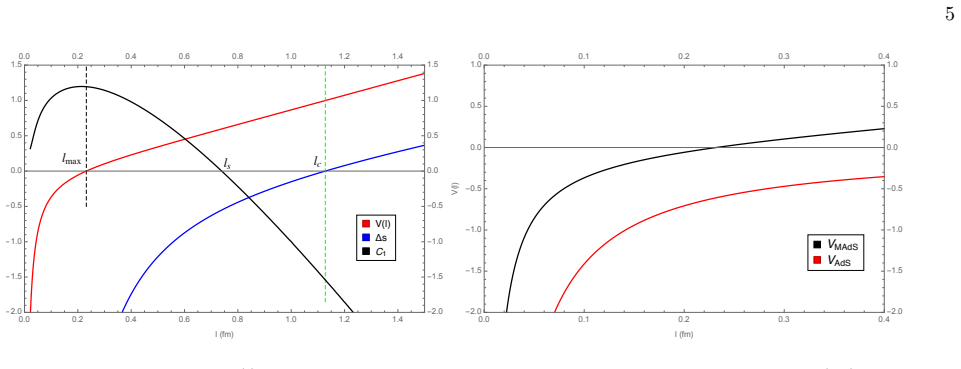
The central object is the holographic subregion complexity $C = V_{\gamma_A}/(8\pi R G_5)$, the volume enclosed by the Ryu-Takayanagi minimal surface $\gamma_A$ of a strip of length $l$ and infinite width, evaluated in the modified AdS (MAdS) metric $g(z)=e^{c z^2/2}$ and its black hole version; the normalization constants are divided out by forming the relative complexities $C_1$ and $C_2$. The argument is carried by comparing the sign of $C_1$ with the region where the linear ($\sigma r$) term in the Cornell-type potential dominates: the relative complexity decreases when the linear term dominates and increases when the $1/r$ term dominates, which is what produces the negative region near $l_c$.
What would settle it
Compute the quantum circuit complexity of a static quark-antiquark pair directly in lattice QCD across the confinement-deconfinement transition and compare its ratio between the non-conformal and conformal vacua with the sign of $C_1$; if the directly computed complexity does not show $C_1 < 0$ near $T_c$, the strip-to-meson identification fails.
Extended reading notes
Core claim
The paper claims that for a strip entangling region of length $l$ in the modified AdS background, the normalized subregion complexity $C_1$ changes sign at a length $l_s$ and stays negative up to and beyond the confinement-deconfinement scale $l_c \approx 1\,\mathrm{fm}$. Since $l < l_c$ is identified with the confined phase, the authors conclude that near the critical point $E = l^{-1} \lesssim T_c = 175\,\mathrm{MeV}$, less information is needed to specify a meson state in the non-conformal vacuum than in the conformal one, despite the non-conformal vacuum having larger energy and a less stable quark-antiquark pair. At finite temperature, the corresponding quantity $C_2 = C_{\mathrm{MBH}}/C_{\mathrm{BH}} - 1$ is always positive, which the authors interpret as stronger color screening in the thermal non-conformal vacuum requiring more information to specify the bound state.
Load-bearing premise
The load-bearing premise is that the holographic subregion complexity of an entanglement strip of length $l$ equals the complexity of a probe meson of separation $l$; if the strip is not a faithful model of the meson state, the physical conclusion about information cost does not follow.
Editorial extensions
If this is right
- The sign of the relative subregion complexity $C_1$ can serve as a witness that the system is in the confined phase, since $C_1 < 0$ connects the allowed $l < l_c$ region to the confinement regime.
- Near the critical point, the non-conformal vacuum is informationally cheaper for specifying a meson even though it is energetically more expensive, implying that energy and information cost need not rank vacua in the same order.
- At zero temperature the behavior of $C_1$ is governed by which term in the Cornell potential dominates: a dominant linear term drives $C_1$ down, while a dominant $1/r$ term drives it up.
- At finite temperature, $C_2 > 0$ means the meson in the non-conformal thermal vacuum requires more information than in the conformal thermal vacuum, consistent with stronger color screening at higher $T$ or $l$.
Reading between the lines
- A testable extension would be to repeat the same HSC computation in other holographic QCD backgrounds (hard wall, D3-D7 brane) to see whether the negative $C_1$ region near $T_c$ is a generic feature of confinement or an artifact of the modified AdS geometry.
- The paper's assignment of strip length $l$ to meson separation $r$ is an assumption; an independent lattice-QCD estimate of the circuit complexity of a static meson state near $T_c$ could validate or disprove the mapping.
- If the connection between potential-energy term dominance and the sign of $C_1$ is robust, subregion complexity could become a diagnostic for which term of the potential is active in a given energy regime, complementing Wilson-loop data.
- The stability-versus-information trade-off near the critical point suggests that near $T_c$ the vacuum selected by the dynamics may be the one requiring fewer computational resources to prepare, a criterion that could be explored in other phase transitions.
Editorial analysis
A structured set of objections, weighed in public.
Referee Report
Summary. This paper computes holographic subregion complexity (HSC) in the modified AdS (MAdS) background of Andreev and Zakharov and in the corresponding modified black hole (MBH) background, and compares the results with pure AdS and pure black hole backgrounds by forming the relative complexities C1 = C_MAdS/C_AdS − 1 and C2 = C_MBH/C_BH − 1. At zero temperature the authors find that C1 is positive for small strip length l, becomes negative for intermediate l, and remains negative for larger l; they identify the region l_s < l < l_c with the confined phase and interpret C1 < 0 as meaning that less information is needed to specify a meson in the non-conformal vacuum than in the conformal one. At finite temperature they find C2 > 0 and interpret this as stronger binding of the quark-antiquark pair in the non-conformal thermal vacuum. The paper concludes that HSC behavior is connected to the dominant term in the meson potential energy and that near the critical point the non-conformal vacuum is information-theoretically favored.
Significance. If the technical issues are repaired, the observation is potentially interesting: a parameter-free relative-complexity ratio is a clean way to cancel the leading UV divergence, and the sign change of C1 at a scale related to the confinement-deconfinement transition is a falsifiable diagnostic that could complement holographic entanglement entropy studies. The paper also makes an explicit qualitative connection between the behavior of HSC and the linear versus Coulombic term in the heavy-quark potential, which is a concrete and checkable claim within the model. However, the physical significance as stated rests on two load-bearing identifications that are not established: the identification of the entangling-strip length l with the meson separation r, and the identification of vacuum HSC for an interval with the preparation complexity of a meson state. In addition, Eq. (15) appears to contain a metric volume-factor error that affects the entire finite-temperature section. The central claims are therefore not yet supported by the manuscript in its current form.
major comments (2)
- [Subregion Holographic Complexity, Eq. (15)] Eq. (15) as printed places sqrt(f(z)) in the numerator of the integrand, but the volume form on a constant-time slice of the metric (4) gives a factor 1/sqrt(f(z)) relative to the zero-temperature integrand. Moreover, the minimal-surface profile x(z) used in Eq. (15) cannot be the same function as the one derived in Eq. (13) from the zero-temperature metric, because the area functional changes when f(z) ≠ 1. As written, Eq. (15) is not the HSC of metric (4), and the numerical results in Figs. 3 and 4 inherit this problem. The authors should derive the correct profile and volume integrand for the MBH background and recompute C2; the sign and magnitude of C2 could change.
- [Numerical results, zero temperature (Sec. 4.1)] The identification of C_MAdS with "the complexity of the probe meson" is asserted rather than derived. The quantity in Eq. (14) is the holographic subregion complexity of the vacuum reduced density matrix on an entangling strip of length l, whereas the meson potential V(r) in Eq. (5) is obtained from a Wilson loop evaluated with a string worldsheet. These are different observables, and no argument connects the volume inside the Ryu-Takayanagi surface to the preparation complexity of a quark-antiquark pair. Consequently the abstract's conclusion that "we need less information to specify a meson" does not follow from C1 < 0 unless the strip-meson identification is justified or the conclusions are restated as statements about strip HSC rather than meson states.
minor comments (4)
- [General] The paper contains numerous typos and misspellings that should be corrected: "Hubney" should be "Hubeny", "hollographically" should be "holographically", "spacified" should be "specified", "Mev" should be "MeV", "strong-week" should be "strong-weak", "Ryo" should be "Ryu", and "thses" should be "these".
- [Subregion Holographic Complexity, Eq. (14)-(16)] The volume integrals in Eqs. (14) and (15) are divergent and no regularization is specified. The authors should state that the integrals are regulated with a cutoff z > ε and explain explicitly that the leading divergence cancels in the ratios C1 and C2 because g(0) = 1; as written, the cancellation is only implicit.
- [Figures 2 and 3] The axis labels and legends in Figs. 2 and 3 are garbled in the preprint; for example, the curve corresponding to the potential energy V(l) in the left panel of Fig. 2 is not clearly identified. Please replace these with readable labels and distinguish the units of V(l) from the dimensionless quantities ΔS and C1.
- [References] Some references have formatting errors or duplication: Refs. [18] and [20] are the same paper, Ref. [24] and Ref. [28] both contain the leftover identifier "arXiv:0607026[hep-ph]", and Ref. [25] has a malformed identifier "0603170hep-th]]". These should be cleaned up.
Circularity Check
No significant circularity: the HSC curve is computed directly from the metric, with only a minor self-citation supplying the critical-point location.
-
other
[Section 'Numerical results', 'Zero temperature' (and Section 'Entanglement Entropy' where \Delta S is defined)]
"Based on results reported in [23], the QCD phase transition happens in the region with C1 < 0 and exactly at l = lc and Tc = l−1 c = 175 MeV."
The paper imports lc, Tc, and the classification of l < lc as the confined phase from its own earlier paper [23] by the same authors. This means the 'near the critical point' framing of the abstract is not derived in the present calculation; it is taken from a prior self-cited computation. The HSC curve C1(l) is nevertheless computed directly from the metric with no fit to lc, so the central numerical result is independent content and the self-citation is minor rather than definitionally circular.
full rationale
The derivation of C1 = C_MAdS/C_AdS - 1 is self-contained: it uses the background metric (3), the minimal-surface profile (13), the volume integral (14), and the normalization (16a), with the model parameter c taken from earlier work. No parameter in this paper is fitted to the complexity output, and no prediction is obtained by renaming an input. The identification of the strip HSC with 'complexity of the probe meson' is an interpretive dictionary choice; it is not used as a fitted input and does not make the numerical calculation circular. The only noteworthy circularity-adjacent feature is the use of the same authors' previous result [23] to locate the critical length and temperature, which frames the 'near critical point' conclusion. That is a minor self-citation, but the sign of C1 and its l-dependence are computed independently, so the paper's central technical result retains independent content.
Assumptions & free parameters
free parameters (1)
- c (modifier parameter) =
0.94 GeV^2
assumptions (5)
- domain assumption AdS/CFT duality and the holographic dictionary are valid for the modified AdS background.
- domain assumption Holographic subregion complexity equals the volume enclosed by the HRT surface (Alishahiha proposal).
- domain assumption The modified AdS metric (3) with g(z)=exp(c^2 z^2/2) correctly models confined QCD and produces the Cornell potential.
- domain assumption The confinement-deconfinement transition in this model occurs at l_c approximately 1 fm where Delta S(l) changes sign, as established in [23] by the same authors.
- ad hoc to paper The entangling strip length l can be identified with meson size and quark separation.
Cite this review
Pith. "Pith review of A note on holographic subregion complexity and QCD phase transition." pith.science (2026). https://pith.science/paper/7ORG6SYH
@misc{pith2026190801303,
  author       = {Pith},
  title        = {Pith review of: A note on holographic subregion complexity and QCD phase transition},
  year         = {2026},
  howpublished = {\url{https://pith.science/paper/7ORG6SYH}},
  note         = {Machine review of arXiv:1908.01303}
}
read the original abstract
Using holographic subregion complexity, we study the confinement-deconfinement phase transition of quantum chromodynamics. In the model we consider here, we observe a connection between the potential energy of probe meson and the behavior of its complexity. Moreover, near the critical point, at which the phase transition takes place, our numerical calculations indicate that we need less information to specify a meson in the non-conformal vacuum than in the conformal one, despite the fact that the non-conformal vacuum has larger energy!
Figures


Figures from the paper (1 more)

Forward citations
Cited by 2 Pith papers
-
Holographic Subregion Complexity in General Vaidya Geometry
Holographic subregion complexity in a general Vaidya geometry grows linearly at early and intermediate times, then decreases linearly at late time for continuous transitions, with growth rates below the Lloyd bound in...
-
Holographic subregion complexity in a moving strongly coupled plasma
For a boosted strongly coupled plasma in d=2,3,4, holographic subregion complexity increases with temperature, velocity, and region size, and diverges as the Lorentz factor squared, gamma^2, when velocity approaches l...
Reference graph
Works this paper leans on
-
[23]
AdS/QCD, Entanglement Entropy and Critical Temperature,
M. Ali-Akbari and M. Lezgi, “AdS/QCD, Entanglement Entropy and Critical Temperature,” Phys. Rev. D 96, 086014 (2017) [arXiv:1706.04335[hep-th]]
arXiv 2017
-
[1]
Gauge/String Duality, Hot QCD and Heavy Ion Collisions,
J. Casalderrey-Solana, H. Liu, D. Mateos, K. Rajagopal and U. A. Wiedemann, “Gauge/String Duality, Hot QCD and Heavy Ion Collisions,” [arXiv:1101.0618 [hep-th]]
-
[2]
M. Ammon and J. Erdmenger, Gauge/gravity duality: Foundations and Applications. Cambridge Univ. Pr., Cambridge, UK, 2015
work page 2015
-
[3]
Holographic Entanglement Entropy: An Overview,
T. Nishioka, S. Ryu and T. Takayanagi, “Holographic Entanglement Entropy: An Overview,” J. Phys. A42, 504008 (2009) arXiv:0905.0932[hep-th]
arXiv 2009
-
[4]
Holographic Entanglement Entropy,
Mukund Rangamani and Tadashi Takayanagi, “Holographic Entanglement Entropy,” arXiv:1609.01287[hep-th]
-
[5]
Leonard Susskind, “Entanglement is not enough,” [arXiv:1411.0690[hep-th]]
-
[6]
Circuit complexity in quantum field theory,
R. Jefferson and R. C. Myers, “Circuit complexity in quantum field theory,” [arXiv:1707.08570[hep-th]]
-
[7]
Complexity, action, and black holes,
A. R. Brown, D. A. Roberts, L. Susskind, B. Swingle and Y. Zhao, “Complexity, action, and black holes,” Phys. Rev. D 93, no. 8, 086006 (2016) [arXiv:1512.04993[hep-th]]
arXiv 2016
Show all 32 references
-
[8]
Holographic Complexity Equals Bulk Action?,
A. R. Brown, D. A. Roberts, L. Susskind, B. Swingle and Y. Zhao, “Holographic Complexity Equals Bulk Action?,” Phys. Rev. Lett. 116, no. 19, 191301 (2016) [arXiv:1509.07876[hep-th]]
2016 arXiv
-
[9]
Holographic complexity,
Mohsen Alishahiha, “Holographic complexity,” Phys. Rev. D. 92, 126009 (2015), [arXiv:1509.06614[hep-th]]
2015 arXiv
-
[10]
On Volumes of Subregions in Holography and Complexity,
Omer Ben-Ami, Dean Carmi, “On Volumes of Subregions in Holography and Complexity,” JHEP 1611, 129 (2016) [arXiv:1609.02514[hep-th]]
2016 arXiv
-
[11]
Comments on Holographic Complexity,
Dean Carmi, Robert C. Myers and Pratik Rath “Comments on Holographic Complexity,” JHEP 1703, 118 (2017) [arXiv:1612.00433[hep-th]]
2017 arXiv
-
[12]
Complexity and phase transitions in a holographic QCD model,
S. J. Zhang, “Complexity and phase transitions in a holographic QCD model,” Nucl. Phys. B 929, 243 (2018) [arXiv:1712.07583[hep-th]]
2018 arXiv
-
[13]
Subregion complexity in holographic thermalization with dS boundary,
S. J. Zhang, “Subregion complexity in holographic thermalization with dS boundary,” [arXiv:1905.10605[hep-th]]
1905 arXiv
-
[14]
Holographic subregion complexity under a thermal quench,
Bin Chen, Wen-Ming Li, Run-Qin Yang, Cheng-Yong Zhang, Shao-Jun Zhang, “Holographic subregion complexity under a thermal quench,” JHEP 1807, 034 (2018) [arXiv:1803.06680[hep-th]]
2018 arXiv
-
[15]
On subregion holographic complexity and renormalization group flows,
Pratim Roy, Tapobrata Sarkar, “On subregion holographic complexity and renormalization group flows,” Phys.Rev. D 97, 086018 (2018) [arXiv:1708.05313[hep-th]]
2018 arXiv
-
[16]
Complexity growth in flat spacetimes,
R Fareghbal and P Karimi, “Complexity growth in flat spacetimes,” Phys. Rev. D 98, no. 4, 046003 (2018) [arXiv:1806.07273[hep-th]]
2018 arXiv
-
[17]
Complexity Growth with Lifshitz Scaling and Hyperscaling Violation,
M.Alishahiha, A.Faraji Astaneh, M.R.Mohammadi Mozaffar and A.Mollabashi, “Complexity Growth with Lifshitz Scaling and Hyperscaling Violation,” JHEP 1807, 042 (2018) [arXiv:1802.06740 [hep-th]]
2018 arXiv
-
[19]
Holographic complexity of anisotropic black branes,
S. A. Hosseini Mansoori, V. Jahnke, M. M. Qaemmaqami and Y. D. Olivas, “Holographic complexity of anisotropic black branes,” [arXiv:1808.00067[hep-th]]
-
[20]
Subregion Action and Complexity,
M. Alishahiha, K. Babaei Velni and M. R. Mohammadi Mozaffar, “Subregion Action and Complexity,” [arXiv:1809.06031 [hep-th]]
-
[21]
Evolution of Holographic Complexity Near Critical Point,
H. Ebrahim, M. Asadi and M. Ali-Akbari, “Evolution of Holographic Complexity Near Critical Point,” arXiv:1811.12002 [hep-th]. [arXiv:1811.12002 [hep-th]]
-
[22]
Heavy-quark potentials and AdS/QCD,
O. Andreev and V. I. Zakharov, “Heavy-quark potentials and AdS/QCD,” Phys. Rev. D 74, 025023 (2006) [arXiv:hep- ph/0604204]
2006
-
[24]
The Spatial String Tension, Thermal Phase Transition, and AdS/QCD,
O. Andreev and V. I. Zakharov, “The Spatial String Tension, Thermal Phase Transition, and AdS/QCD,” Phys. Lett. B 645, 437 (2007) [arXiv:0607026[hep-ph]]
2007
-
[25]
1/q 2 Corrections and Gauge/String Duality,
O. Andreev, “1/q 2 Corrections and Gauge/String Duality,” [arXiv:0603170hep-th]]
-
[26]
Wilson loops in large N field theories,
J. M. Maldacena, “Wilson loops in large N field theories,” Phys. Rev. Lett. 80, 4859 (1998) [arXiv:hep-th/9803002]
1998 arXiv
-
[27]
Jonker, ”Entanglement entropy of coupled harmonic oscillators,” studenttheses.library.uu.nl Library Master’s / Bach- elor’s Theses Online
M. Jonker, ”Entanglement entropy of coupled harmonic oscillators,” studenttheses.library.uu.nl Library Master’s / Bach- elor’s Theses Online
-
[28]
Entanglement as a probe of confinement,
I. R. Klebanov, D. Kutasov and A. Murugan, “Entanglement as a probe of confinement,” Nucl. Phys. B 796, 274 (2008) arXiv:0709.2140[hep-th]. [arXiv:0607026[hep-ph]]
2008 arXiv
-
[29]
Toward a Definition of Complexity for Quantum Field Theory States,
S. Chapman, M. P. Heller, H. Marrochio and F. Pastawski, “Toward a Definition of Complexity for Quantum Field Theory States,” [arXiv:1707.08582[hep-th]]
-
[30]
Eternal black holes in anti-de Sitter,
J. M. Maldacena, “Eternal black holes in anti-de Sitter,” JHEP 0304, 021 (2003) [arXiv:0106112[hep-th]]. 8
2003
-
[31]
Complexity and Shock Wave Geometries,
D. Stanford and L. Susskind, “Complexity and Shock Wave Geometries,” Phys. Rev. D 90, no. 12, 126007 (2014) [arXiv:1406.2678[hep-th]]
2014 arXiv
-
[32]
Time Evolution of Entanglement Entropy from Black Hole Interiors,
T. Hartman and J. Maldacena, “Time Evolution of Entanglement Entropy from Black Hole Interiors,” JHEP 1305 (2013)
2013
-
[33]
[arXiv:1303.1080[hep-th]]
Reviewed August 14, 2026 · model on record in the stance chip above.
Discussion (0). Continue with ORCID to comment.