REVIEW 1 major objections 2 minor 2 cited by
A correspondence holds between conical space-times and faithful causal models, aligning their signalling constraints.
Reviewed by Pith at T0; open to challenge. T0 means a machine referee read the full paper against a public rubric. the ladder, T0–T4 →
T0 review · grok-4.3
2026-05-24 03:00 UTC pith:2UVEK2HP
load-bearing objection The paper defines conicality as an order-theoretic property and proves a correspondence between conical space-times and faithful causal models, extending the 2022 affects-relations framework. the 1 major comments →
Characterizing Signalling: Connections between Causal Inference and Space-time Geometry
The pith
A machine-rendered reading of the paper's core claim, the machinery that carries it, and where it could break.
Core claim
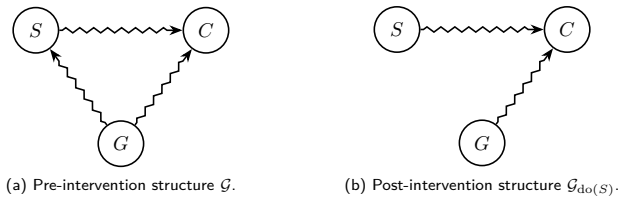
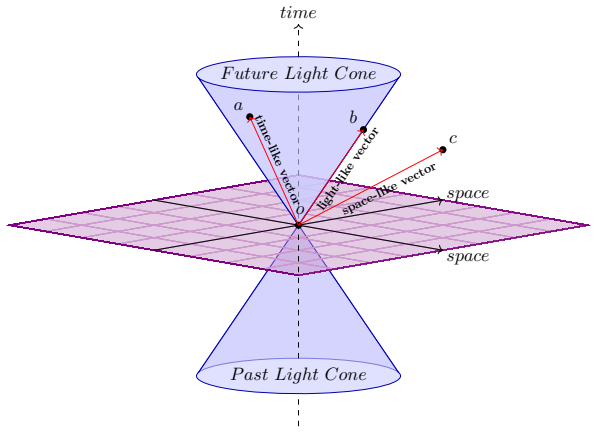
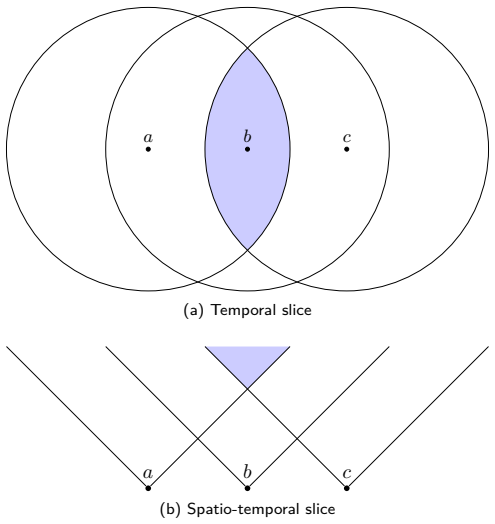
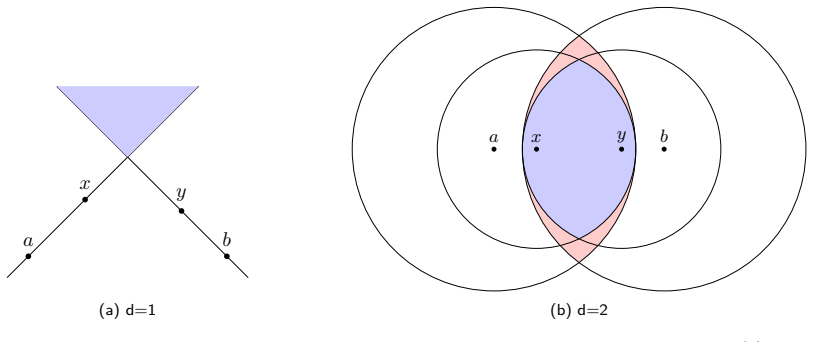
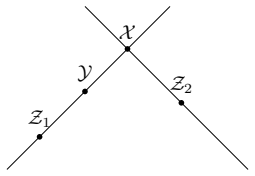
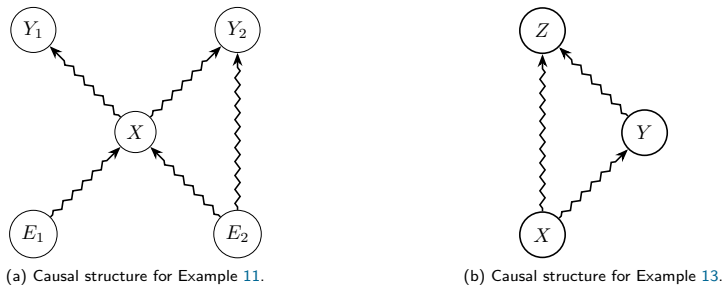
We improve the characterization of information-theoretic signalling through affects relations by giving conditions to identify redundancies, which enables causal inference even in unfaithful models using the absence of signalling. We define conicality and show it is satisfied by light cones in Minkowski space-times with d greater than 1 spatial dimensions but violated for d equals 1. We then prove a correspondence between conical space-times and faithful causal models under which the constraints imposed by no superluminal signalling align with those from purely information-theoretic causal inference.
What carries the argument
The proved correspondence between conical space-times (those satisfying the order-theoretic property of conicality) and faithful causal models (where observable data reflects underlying causal dependences), which makes no-superluminal-signalling constraints parallel the constraints from affects relations.
Load-bearing premise
The prior formal connection between affects relations in causal models and relativistic no-superluminal-signalling principles holds in general physical theories.
What would settle it
A concrete space-time that satisfies conicality yet allows an embedding of a faithful causal model that violates no superluminal signalling, or a faithful model whose affects relations fail to match the light-cone structure of a conical space-time.
If this is right
- Redundancies in affects relations can be detected, permitting causal inference from the absence of signalling between nodes.
- Conicality distinguishes light-cone structures across different dimensions of Minkowski space.
- Embedding causal models into space-time respects no-superluminal-signalling in general but produces matching constraints precisely in the conical-faithful case.
- The parallel between no-superluminal-signalling and no-causal-loops principles can be examined uniformly across different space-time geometries.
Where Pith is reading between the lines
- Experiments that measure signalling patterns in unfaithful settings could indirectly probe whether an underlying space-time is conical.
- The same correspondence might be tested in discrete or quantum causal models to see whether conicality still separates the constraint types.
- If the alignment extends to curved space-times, it could link information flow to local light-cone properties without global flatness assumptions.
Editorial analysis
A structured set of objections, weighed in public.
Referee Report
Summary. The paper leverages a 2022 PRA framework connecting information-theoretic causality (via affects relations) to relativistic no-superluminal signalling (NSS) in general theories. It improves the characterization of signalling by giving conditions to identify redundancies in affects relations, enabling causal inference techniques for unfaithful models. It defines an order-theoretic property 'conicality' and shows it holds for light cones in Minkowski spacetime with d>1 spatial dimensions but fails for d=1. It then examines embeddings of causal models into spacetime respecting NSS and proves a correspondence between conical spacetimes and faithful causal models, under which NSS constraints and information-theoretic constraints exhibit a parallel.
Significance. If the correspondence result holds, the work supplies a concrete bridge between causal-inference methods and spacetime geometry that could inform studies of signalling in curved or discrete spacetimes. The redundancy-identification techniques for unfaithful models constitute a usable addition to causal inference, while the conicality definition offers a geometric diagnostic that is falsifiable in low-dimensional Minkowski space. These elements are independent of the prior framework and would remain valuable even if the embedding correspondence requires further qualification.
major comments (1)
- [Abstract (final paragraph) and the section presenting the embedding and correspondence results] The central correspondence (abstract, final paragraph) between conical spacetimes and faithful causal models is stated to follow from the 2022 PRA framework's connection between affects relations and NSS. The manuscript does not re-derive or independently verify the key linking propositions of that framework; any gaps in the formalization of faithfulness or redundancy identification in the 2022 work therefore propagate directly into the claimed parallel. This is load-bearing for the embedding and correspondence claims.
minor comments (2)
- [Section introducing conicality] The definition of conicality is introduced without an explicit comparison to standard order-theoretic properties (e.g., interval orders or causal orders) already used in the relativistic causality literature; a short paragraph situating the new notion would improve readability.
- [Sections on affects relations and on embedding] Notation for affects relations and the redundancy conditions is introduced in the first technical section but is not cross-referenced when the same objects appear in the embedding discussion; consistent equation numbering or a short notation table would reduce ambiguity.
Simulated Author's Rebuttal
We thank the referee for their careful reading and for identifying this point about the manuscript's reliance on the 2022 PRA framework. We address the concern directly below.
read point-by-point responses
-
Referee: [Abstract (final paragraph) and the section presenting the embedding and correspondence results] The central correspondence (abstract, final paragraph) between conical spacetimes and faithful causal models is stated to follow from the 2022 PRA framework's connection between affects relations and NSS. The manuscript does not re-derive or independently verify the key linking propositions of that framework; any gaps in the formalization of faithfulness or redundancy identification in the 2022 work therefore propagate directly into the claimed parallel. This is load-bearing for the embedding and correspondence claims.
Authors: We agree that the correspondence between conical spacetimes and faithful causal models is an application of the connection between affects relations and NSS established in the 2022 PRA paper, and the present manuscript does not re-derive those foundational linking propositions. This is intentional, as the work is positioned as an extension. The independent contributions are (i) the new conditions for identifying redundancies within affects relations, which enable causal inference techniques specifically for unfaithful models, and (ii) the order-theoretic definition of conicality together with its verification that the property holds for light cones in Minkowski spacetime when the number of spatial dimensions d > 1 but fails for d = 1. The correspondence result then shows how these new elements interact with the prior framework to produce a parallel between NSS constraints and information-theoretic constraints. To make the logical dependence explicit and thereby address the referee's concern, we will revise the final paragraph of the abstract and the section on embeddings and correspondence to state clearly that the result leverages the 2022 framework without re-deriving its core propositions. We believe this clarification will render the structure of the argument transparent without requiring a full re-derivation, which would be outside the scope of the present paper. revision: partial
Circularity Check
No significant circularity; new results on conicality and signalling are independent
full rationale
The paper cites its own prior 2022 framework (PRA 106, 032204) to connect affects relations with NSS, but this citation supports background context rather than forcing the central results. The work introduces independent content: conditions for redundancies in affects relations, the conicality property (satisfied in Minkowski d>1 but not d=1), and a proof of correspondence between conical space-times and faithful causal models. No derivation step reduces by construction to the prior work or to fitted inputs; the self-citation is not load-bearing for the new theorems. The paper is self-contained against external benchmarks for its novel contributions.
Axiom & Free-Parameter Ledger
axioms (1)
- domain assumption The framework introduced in PRA, 106, 032204 (2022) formally connects information-theoretic causality (affects relations) and relativistic causality in general physical theories.
invented entities (1)
-
conicality
no independent evidence
read the original abstract
Causality is pivotal to our understanding of the world, presenting itself in different forms: information-theoretic and relativistic, the former linked to the flow of information, the latter to the structure of space-time. Leveraging a framework introduced in PRA, 106, 032204 (2022), which formally connects these two notions in general physical theories, we study their interplay. Here, information-theoretic causality is defined through a causal modelling approach. First, we improve the characterization of information-theoretic signalling as defined through so-called affects relations. Specifically, we provide conditions for identifying redundancies in different parts of such a relation, introducing techniques for causal inference in unfaithful causal models (where the observable data does not "faithfully" reflect the causal dependences). In particular, this demonstrates the possibility of causal inference using the absence of signalling between certain nodes. Second, we define an order-theoretic property called conicality, showing that it is satisfied for light cones in Minkowski space-times with $d>1$ spatial dimensions but violated for $d=1$. Finally, we study the embedding of information-theoretic causal models in space-time without violating relativistic principles such as no superluminal signalling (NSS). In general, we observe that constraints imposed by NSS in a space-time and those imposed by purely information-theoretic causal inference behave differently. We then prove a correspondence between conical space-times and faithful causal models: in both cases, there emerges a parallel between these two types of constraints. This indicates a connection between informational and geometric notions of causality, and offers new insights for studying the relations between the principles of NSS and no causal loops in different space-time geometries and theories of information processing.
Figures




Forward citations
Cited by 2 Pith papers
-
Impossibility of superluminal signalling rules out causal loops in conical spacetimes
In conical spacetimes with d>1, NSS prohibits operationally detectable causal loops across classical, quantum and post-quantum theories, unlike the (1+1) case.
-
On the Conicality of Causally Simple, Future Cohesive Spacetimes
Causally simple future cohesive spacetimes satisfy conicality in dimension at least 3, unlike those that are merely homotopy equivalent to Minkowski or globally hyperbolic.
discussion (0)
Sign in with ORCID, Apple, or X to comment. Anyone can read and Pith papers without signing in.