REVIEW 2 major objections 3 minor 2 cited by
Echoes and quasinormal modes of asymmetric black bounces
T0 review · 2 major / 3 minor · reviewed 2026-05-18 · grok-4.3
Pith's one-line read Asymmetric black bounces recover the Reissner-Nordström solution externally and generate no gravitational wave echoes.
desk verdict Asymmetric black bounces match RN outside with no echoes, while symmetric horizonless versions can produce parameter-sensitive echoes via multiple barriers. read the letter →
The pith
A machine-rendered reading of the paper's core claim, the machinery that carries it, and where it could break.
The reading
What carries the argument
Effective potential for massless scalar fields, constructed directly from the given black-bounce line elements and used to compute quasinormal-mode frequencies via WKB, Pöschl-Teller, and time-domain methods.
What would settle it
Observation of echoes or their absence in the ringdown of gravitational waves from a candidate that externally matches Reissner-Nordström but is suspected to be an asymmetric black bounce.
Extended reading notes
Core claim
Asymmetric black bounce solutions recover the Reissner-Nordström geometry in their external region. Depending on the sign of a parameter they are either bounded or unbounded inside, yet both variants display qualitatively the same wave-emission behavior as Reissner-Nordström black holes and produce no echoes, in contrast to certain symmetric horizonless bounces that generate echoes from multiple barriers.
Load-bearing premise
The effective potential follows from the black-bounce metrics for massless scalar fields without extra assumptions about the fluid or regularization that would reshape the barrier structure or echo formation.
Editorial extensions
If this is right
- Symmetric horizonless black bounces can produce echoes whose strength and timing depend on the fluid energy density and the minimal-radius parameter a.
- Asymmetric black bounces remain indistinguishable from Reissner-Nordström configurations by their quasinormal-mode spectra or echo signatures.
- Both bounded and unbounded asymmetric models share the same qualitative wave-emission properties.
- Echoes appear only when the effective potential develops multiple barriers, which occurs in certain symmetric but not asymmetric cases.
Reading between the lines
- Wave-based tests may miss deviations from standard black holes if the underlying model is an asymmetric bounce.
- Other perturbation channels or late-time tails could still reveal differences even when echoes are absent.
- The result motivates checking whether the same potential structure persists for higher-spin fields or in modified-gravity extensions.
Editorial analysis
A structured set of objections, weighed in public.
Referee Report
Summary. The manuscript studies quasinormal modes and echoes of symmetric and asymmetric black bounce spacetimes sourced by anisotropic fluids in general relativity. It derives the effective potential for massless scalar perturbations from the given metrics and computes the spectra via three independent techniques: sixth-order WKB, Pöschl-Teller fitting, and time-domain integration. The central results are that symmetric horizonless configurations can develop multiple barriers producing echoes, while asymmetric models recover the Reissner-Nordström exterior exactly, retain a horizon, and display only standard ringdown plus power-law tails with no echoes, rendering them difficult to distinguish from RN black holes via wave emission.
Significance. If the results hold, the work clarifies the observational distinguishability of black-bounce models, showing that asymmetric versions are effectively indistinguishable from RN in echo searches. The cross-validation across three numerical methods is a clear strength that bolsters reliability of the reported spectra and the no-echo conclusion for the asymmetric cases.
major comments (2)
- The time-domain evolution section does not report grid-resolution or time-step convergence tests, nor error estimates on the extracted waveforms. This is load-bearing for the central claim that asymmetric models produce no echoes, as small numerical artifacts could mimic or mask late-time signals.
- No explicit validation is performed against the known Schwarzschild or RN quasinormal frequencies in the limit a → 0 or vanishing fluid density. Without this check, the implementation of the effective potential and the three solvers cannot be fully trusted for the no-echo distinction asserted in the abstract.
minor comments (3)
- The abstract states that echoes are sensitive to fluid energy density and a but does not quote the specific parameter values used for the displayed potentials or waveforms.
- Figure captions for the effective-potential plots should explicitly list the metric parameters (a, fluid density, charge) corresponding to each curve.
- A short paragraph comparing the obtained RN-limit frequencies to tabulated values in the literature would improve clarity without altering the main results.
Simulated Author's Rebuttal
We thank the referee for the careful reading of our manuscript and for the constructive comments. We address each major comment below and will revise the manuscript accordingly to strengthen the presentation of our results.
read point-by-point responses
-
Referee: The time-domain evolution section does not report grid-resolution or time-step convergence tests, nor error estimates on the extracted waveforms. This is load-bearing for the central claim that asymmetric models produce no echoes, as small numerical artifacts could mimic or mask late-time signals.
Authors: We agree that explicit convergence tests and error estimates are important for the reliability of the time-domain results, particularly when asserting the absence of echoes. Although internal checks were performed during the development of the code to confirm stability of the waveforms under refinement, these details were omitted from the manuscript. In the revised version we will add a dedicated paragraph in the time-domain section reporting the grid resolutions and time steps employed, together with a brief discussion of the observed convergence and estimated numerical errors on the late-time signals. revision: yes
-
Referee: No explicit validation is performed against the known Schwarzschild or RN quasinormal frequencies in the limit a → 0 or vanishing fluid density. Without this check, the implementation of the effective potential and the three solvers cannot be fully trusted for the no-echo distinction asserted in the abstract.
Authors: We acknowledge the value of an explicit benchmark against the well-known Schwarzschild and Reissner-Nordström spectra. While the asymmetric metrics are constructed so that the exterior geometry reduces exactly to Reissner-Nordström (and the effective potential accordingly), we did not include a direct numerical comparison of the computed frequencies in the appropriate limits. In the revised manuscript we will add a short validation subsection (or appendix) that recovers the known Schwarzschild and RN quasinormal frequencies as a → 0 or the fluid density vanishes, thereby confirming the implementation of the potential and the three independent solvers. revision: yes
Circularity Check
No significant circularity detected
full rationale
The paper's derivation proceeds from given black-bounce metrics (with parameters a and fluid density as explicit inputs) to the effective potential via the standard GR reduction to a Schrödinger-like equation for massless scalars; quasinormal frequencies and echoes are then obtained by three independent external methods (6th-order WKB, Pöschl-Teller fit, time-domain integration) that do not feed back into the metric or potential. Asymmetric cases recover the RN exterior exactly, so the single-barrier potential and absence of echoes follow directly from the causal structure without any fitted outputs or self-referential definitions. No load-bearing step reduces to a self-citation chain or renames a known result as a new prediction; the computations remain self-contained against standard GR benchmarks.
Assumptions & free parameters
free parameters (2)
- regularizing parameter a
- fluid energy density
assumptions (2)
- domain assumption The spacetime is a solution of Einstein's equations sourced by an anisotropic fluid.
- standard math Massless scalar field perturbations obey the standard wave equation on the given background metric.
Cite this review
Pith. "Pith review of Echoes and quasinormal modes of asymmetric black bounces." pith.science (2026). https://pith.science/paper/2508.11096
@misc{pith2026250811096,
  author       = {Pith},
  title        = {Pith review of: Echoes and quasinormal modes of asymmetric black bounces},
  year         = {2026},
  howpublished = {\url{https://pith.science/paper/2508.11096}},
  note         = {Machine review of arXiv:2508.11096}
}
abstract
We study quasinormal modes and echoes of symmetric and asymmetric black bounce solutions generated by anisotropic fluids within the framework of general relativity. We derive the effective potential governing massless scalar fields and compute the corresponding quasinormal mode spectra using three independent methods: sixth-order WKB, P\"oschl-Teller and time-domain evolution. Our results show that symmetric black bounce configurations with horizons yield a standard single-barrier potential, while horizonless solutions may exhibit multiple potential barriers that generate gravitational wave echoes. These echoes are sensitive to model parameters such as the fluid energy density and the regularizing parameter $a$ that defines the minimal $2$-sphere. The asymmetric models considered recover the Reissner-Nordstr\"om solution in their external region but can be bounded or unbounded in the inside, depending on the sign of a parameter. Both cases have similar qualitative properties as far as wave emission is concerned but show no echoes. This makes it very difficult to distinguish them from standard Reissner-Nordstr\"om configurations.
Figures


Figures from the paper (6 more)
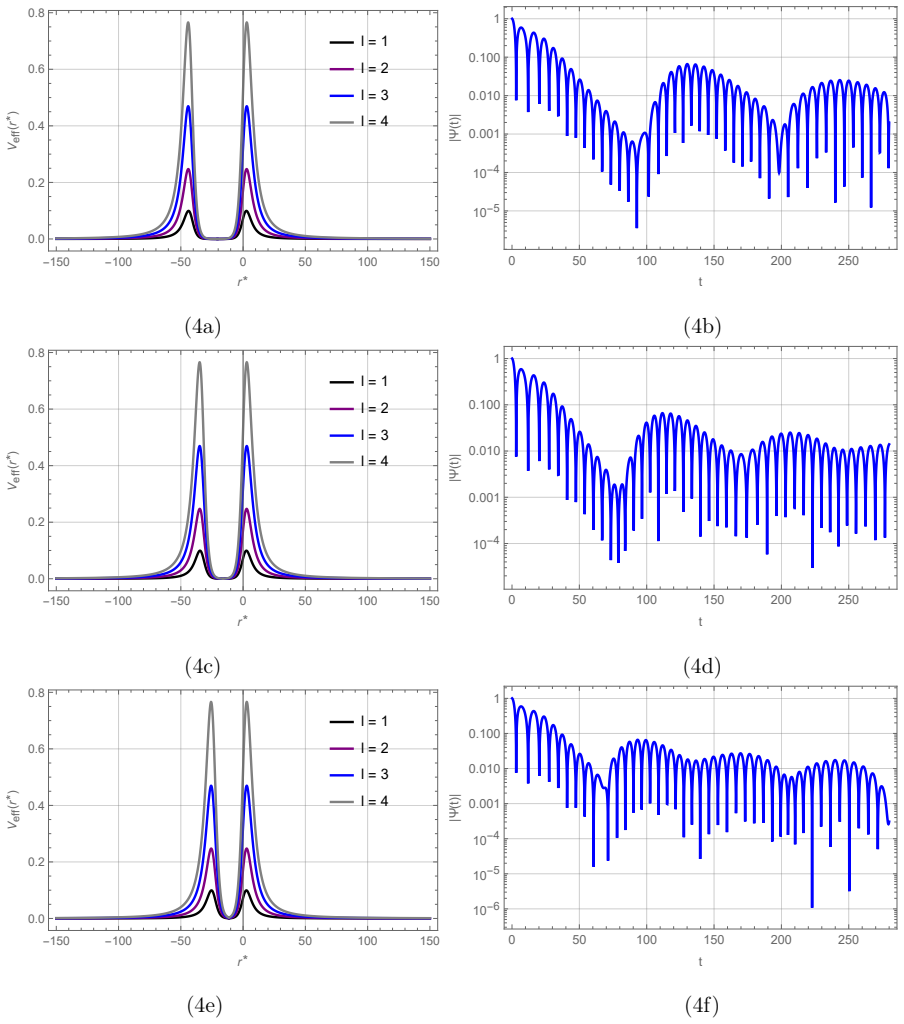


Lean theorems connected to this paper
-
IndisputableMonolith/Foundation/AlexanderDuality.leanalexander_duality_circle_linking unclear?
unclearRelation between the paper passage and the cited Recognition theorem.
We derive the effective potential governing massless scalar fields... V_eff = A'Σ'/2BΣ − ... + A l(l+1)/Σ²
-
IndisputableMonolith/Cost/FunctionalEquation.leanwashburn_uniqueness_aczel unclear?
unclearRelation between the paper passage and the cited Recognition theorem.
asymmetric models recover the Reissner-Nordström solution in their external region but... show no echoes
What do these tags mean?
- matches
- The paper's claim is directly supported by a theorem in the formal canon.
- supports
- The theorem supports part of the paper's argument, but the paper may add assumptions or extra steps.
- extends
- The paper goes beyond the formal theorem; the theorem is a base layer rather than the whole result.
- uses
- The paper appears to rely on the theorem as machinery.
- contradicts
- The paper's claim conflicts with a theorem or certificate in the canon.
- unclear
- Pith found a possible connection, but the passage is too broad, indirect, or ambiguous to say the theorem truly supports the claim.
Forward citations
Cited by 2 Pith papers
-
Black Bounce via Gravitational Tension Screening Acting as an Analogue of Schwinger Corrections
Gravitational tension screening, acting as an analogue of Schwinger corrections, generates regular black bounce spacetimes for spherical, planar, and hyperbolic sections without ad hoc cores.
-
On relativistic observables in black bounce spacetimes
Black bounce spacetimes with larger throat parameter α produce enhanced periastron precession, light deflection, and a larger critical impact parameter in the wormhole regime, offering potential observational signatures.
Reference graph
Works this paper leans on
-
[1]
C. M. Will, Living Rev. Rel.17 (2014), 4 doi:10.12942/lrr-2014-4 [arXiv:1403.7377 [gr-qc]]
-
[2]
Gravitational collapse and space-time singularities,
R. Penrose, Phys. Rev. Lett.14 (1965), 57-59 doi:10.1103/PhysRevLett.14.57
-
[3]
R. P. Geroch, Annals Phys.48 (1968), 526-540 doi:10.1016/0003-4916(68)90144-9
-
[4]
Classical collapse to black holes and quantum bounces: A review
D. Malafarina, Universe 3 (2017) no.2, 48 doi:10.3390/universe3020048 [arXiv:1703.04138 [gr-qc]]
work page Pith review arXiv doi:10.3390/universe3020048 2017
-
[5]
J. G. Kelly, R. Santacruz and E. Wilson-Ewing, Class. Quant. Grav.38 (2021) no.4, 04LT01 doi:10.1088/1361-6382/abd3e2 [arXiv:2006.09325 [gr-qc]]
-
[6]
Non-singular quantum-inspired gravitational collapse
C. Bambi, D. Malafarina and L. Modesto, Phys. Rev. D 88 (2013), 044009 doi:10.1103/PhysRevD.88.044009 [arXiv:1305.4790 [gr-qc]]
work page Pith review arXiv doi:10.1103/physrevd.88.044009 2013
-
[7]
Black-bounce to traversable wormhole
A. Simpson and M. Visser, JCAP 02 (2019), 042 doi:10.1088/1475-7516/2019/02/042 [arXiv:1812.07114 [gr-qc]]
work page Pith review arXiv doi:10.1088/1475-7516/2019/02/042 2019
-
[8]
C. R. Muniz, G. Alencar, M. S. Cunha and G. J. Olmo, Phys. Rev. D112 (2025) no.2, 024018 doi:10.1103/h7rn-4ht6 [arXiv:2408.08542 [gr-qc]]. 22
Show all 67 references
-
[9]
F. S. N. Lobo, M. E. Rodrigues, M. V. de Sousa Silva, A. Simpson and M. Visser, Phys. Rev. D 103 (2021) no.8, 084052 doi:10.1103/PhysRevD.103.084052 [arXiv:2009.12057 [gr-qc]]
2021 doi
-
[10]
Mazza, E
J. Mazza, E. Franzin and S. Liberati, JCAP04 (2021), 082 doi:10.1088/1475-7516/2021/04/082 [arXiv:2102.01105 [gr-qc]]
2021 doi
-
[11]
Carballo-Rubio, F
R. Carballo-Rubio, F. Di Filippo, S. Liberati and M. Visser, Phys. Rev. D101 (2020), 084047 doi:10.1103/PhysRevD.101.084047 [arXiv:1911.11200 [gr-qc]]
2020 doi
-
[12]
H. C. D. Lima, Junior, R. B. Magalhães, G. J. Olmo and D. Rubiera-Garcia, [arXiv:2506.17918 [gr-qc]]
-
[13]
K. A. Bronnikov and R. K. Walia, Phys. Rev. D 105 (2022) no.4, 044039 doi:10.1103/PhysRevD.105.044039 [arXiv:2112.13198 [gr-qc]]
2022 doi
-
[14]
Alencar, K
G. Alencar, K. A. Bronnikov, M. E. Rodrigues, D. Sáez-Chillón Gómez and M. V. de S. Silva, Eur. Phys. J. C84 (2024) no.7, 745 doi:10.1140/epjc/s10052-024-13119-4 [arXiv:2403.12897 [gr-qc]]
2024 doi
-
[15]
Alencar, M
G. Alencar, M. Nilton, M. E. Rodrigues and M. V. d. S. Silva, [arXiv:2409.12101 [gr-qc]]
-
[16]
J. T. S. S. Junior, F. S. N. Lobo and M. E. Rodrigues, Eur. Phys. J. C84 (2024) no.6, 557 doi:10.1140/epjc/s10052-024-12922-3 [arXiv:2405.09702 [gr-qc]]
2024 doi
-
[17]
E. L. B. Junior, J. T. S. S. Junior, F. S. N. Lobo, M. E. Rodrigues, D. Rubiera-Garcia, L. F. D. da Silva and H. A. Vieira, Eur. Phys. J. C84 (2024) no.11, 1190 doi:10.1140/epjc/s10052-024- 13568-x [arXiv:2407.21649 [gr-qc]]
2024 doi
-
[18]
Atazadeh and H
K. Atazadeh and H. Hadi, JCAP 01 (2024), 067 doi:10.1088/1475-7516/2024/01/067 [arXiv:2311.07637 [gr-qc]]
2024 doi
-
[19]
J. C. Fabris, E. L. B. Junior and M. E. Rodrigues, Eur. Phys. J. C83 (2023) no.10, 884 doi:10.1140/epjc/s10052-023-12022-8 [arXiv:2310.00714 [gr-qc]]
2023 doi
-
[20]
S. U. Islam, J. Kumar and S. G. Ghosh, JCAP 10 (2021), 013 doi:10.1088/1475- 7516/2021/10/013 [arXiv:2104.00696 [gr-qc]]
2021 doi
-
[21]
J. R. Nascimento, A. Y. Petrov, P. J. Porfirio and A. R. Soares, Phys. Rev. D102 (2020) no.4, 044021 doi:10.1103/PhysRevD.102.044021 [arXiv:2005.13096 [gr-qc]]
2020 doi
-
[22]
X. T. Cheng and Y. Xie, Phys. Rev. D 103 (2021) no.6, 064040 doi:10.1103/PhysRevD.103.064040
2021 doi
-
[23]
Ghosh and A
S. Ghosh and A. Bhattacharyya, JCAP11 (2022), 006 doi:10.1088/1475-7516/2022/11/006 [arXiv:2206.09954 [gr-qc]]. 23
2022 doi
-
[24]
Guerrero, G
M. Guerrero, G. J. Olmo, D. Rubiera-Garcia and D. S. C. Gómez, JCAP08 (2021), 036 doi:10.1088/1475-7516/2021/08/036 [arXiv:2105.15073 [gr-qc]]
2021 doi
-
[25]
G. J. Olmo, J. L. Rosa, D. Rubiera-Garcia and D. Saez-Chillon Gomez, Class. Quant. Grav. 40 (2023) no.17, 174002 doi:10.1088/1361-6382/aceacd [arXiv:2302.12064 [gr-qc]]
2023 doi
-
[26]
Guerrero, G
M. Guerrero, G. J. Olmo, D. Rubiera-Garcia and D. Gómez Sáez-Chillón, Phys. Rev. D105 (2022) no.8, 084057 doi:10.1103/PhysRevD.105.084057 [arXiv:2202.03809 [gr-qc]]
2022 doi
-
[27]
M. V. d. S. Silva and M. E. Rodrigues, Int. J. Theor. Phys. 63 (2024) no.4, 101 doi:10.1007/s10773-024-05644-5 [arXiv:2404.15792 [gr-qc]]
2024 doi
-
[28]
M. Y. Ou, M. Y. Lai and H. Huang, Eur. Phys. J. C82 (2022) no.5, 452 doi:10.1140/epjc/s10052- 022-10421-x [arXiv:2111.13890 [gr-qc]]
2022 doi
-
[29]
Y. Yang, D. Liu, Z. Xu, Y. Xing, S. Wu and Z. W. Long, Phys. Rev. D104 (2021) no.10, 104021 doi:10.1103/PhysRevD.104.104021 [arXiv:2107.06554 [gr-qc]]
2021 doi
-
[30]
Franzin, S
E. Franzin, S. Liberati, J. Mazza, R. Dey and S. Chakraborty, Phys. Rev. D105 (2022) no.12, 124051 doi:10.1103/PhysRevD.105.124051 [arXiv:2201.01650 [gr-qc]]
2022 doi
-
[31]
Zhang and Y
J. Zhang and Y. Xie, Eur. Phys. J. C82 (2022) no.10, 854 doi:10.1140/epjc/s10052-022-10846-4
2022 doi
-
[32]
L. F. D. da Silva, F. S. N. Lobo, G. J. Olmo and D. Rubiera-Garcia, Phys. Rev. D108 (2023) no.8, 084055 doi:10.1103/PhysRevD.108.084055 [arXiv:2307.06778 [gr-qc]]
2023 doi
-
[33]
Y. Yang, D. Liu, Z. Xu and Z. W. Long, Eur. Phys. J. C 83 (2023) no.3, 217 doi:10.1140/epjc/s10052-023-11382-5 [arXiv:2210.12641 [gr-qc]]
2023 doi
-
[34]
Javed, M
W. Javed, M. Atique, R. C. Pantig and A. Övgün, Symmetry 15 (2023) no.1, 148 doi:10.3390/sym15010148 [arXiv:2301.01855 [gr-qc]]
2023 doi
-
[35]
L. A. Lessa and G. J. Olmo, JCAP 03 (2025), 019 doi:10.1088/1475-7516/2025/03/019 [arXiv:2412.05378 [gr-qc]]
2025 doi
- [36]
- [37]
- [38]
- [39]
- [40]
- [41]
-
[42]
R. A. Konoplya and O. S. Stashko, Phys. Rev. D 111 (2025) no.8, 084031 doi:10.1103/PhysRevD.111.084031 [arXiv:2502.05689 [gr-qc]]
2025 doi
- [43]
-
[44]
R. B. Magalhães, A. S. Masó-Ferrando, F. Bombacigno, G. J. Olmo and L. C. B. Crispino, Phys. Rev. D110 (2024) no.4, 044058 doi:10.1103/PhysRevD.110.044058 [arXiv:2310.03727 [gr-qc]]
2024 doi
-
[45]
R. A. Konoplya, A. Khrabustovskyi, J. Kříž and A. Zhidenko, JCAP04 (2025), 062 doi:10.1088/1475-7516/2025/04/062 [arXiv:2501.16134 [gr-qc]]
2025 doi
-
[46]
Alfaro, P
S. Alfaro, P. A. González, D. Olmos, E. Papantonopoulos and Y. Vásquez, Phys. Rev. D109 (2024) no.10, 104009 doi:10.1103/PhysRevD.109.104009 [arXiv:2402.15575 [gr-qc]]
2024 doi
-
[47]
S. R. Wu, B. Q. Wang, D. Liu and Z. W. Long, Eur. Phys. J. C82 (2022) no.11, 998 doi:10.1140/epjc/s10052-022-10938-1 [arXiv:2201.08415 [gr-qc]]
2022 doi
-
[48]
Guo and Y
Y. Guo and Y. G. Miao, Nucl. Phys. B983 (2022), 115938 doi:10.1016/j.nuclphysb.2022.115938 [arXiv:2112.01747 [gr-qc]]
2022 doi
-
[49]
Bambi, R
C. Bambi, R. Brustein, V. Cardoso, A. Chael, U. Danielsson, S. Giri, A. Gupta, P. Heidmann, L. Lehner and S. Liebling,et al. [arXiv:2505.09014 [gr-qc]]
-
[50]
S. H. Völkel and A. Dhani, [arXiv:2507.22122 [gr-qc]]
-
[51]
Berti, V
E. Berti, V. Cardoso, G. Carullo, J. Abedi, N. Afshordi, S. Albanesi, V. Baibhav, S. Bhagwat, J. L. Blázquez-Salcedo and B. Bonga,et al. [arXiv:2505.23895 [gr-qc]]
-
[52]
L. K. S. Furuta, R. B. Magalhães, H. C. D. Lima, Junior. and L. C. B. Crispino, Phys. Rev. D 110, no.12, 124039 (2024) doi:10.1103/PhysRevD.110.124039
2024 doi
-
[53]
Z. S. Moreira, H. C. D. Lima, Junior, L. C. B. Crispino and C. A. R. Herdeiro, Phys. Rev. D 107, no.10, 104016 (2023) doi:10.1103/PhysRevD.107.104016 [arXiv:2302.14722 [gr-qc]]
2023 doi
- [54]
- [55]
- [56]
-
[57]
Visser, Class
M. Visser, Class. Quant. Grav. 37 (2020) no.4, 045001 doi:10.1088/1361-6382/ab60b8 [arXiv:1908.11058 [gr-qc]]
2020 doi
- [58]
- [59]
-
[60]
Iyer and C
S. Iyer and C. M. Will, Phys. Rev. D35 (1987), 3621 doi:10.1103/PhysRevD.35.3621
1987 doi
-
[61]
R. A. Konoplya, Phys. Rev. D68 (2003), 024018 doi:10.1103/PhysRevD.68.024018 [arXiv:gr- qc/0303052 [gr-qc]]
2003 doi
- [62]
-
[63]
Ferrari and B
V. Ferrari and B. Mashhoon, Phys. Rev. D30 (1984), 295-304 doi:10.1103/PhysRevD.30.295
1984 doi
- [64]
-
[65]
Duran-Cabacés, D
A. Duran-Cabacés, D. Rubiera-Garcia and D. Sáez-Chillón Gómez, [arXiv:2506.10814 [gr-qc]]
-
[66]
B. Koch, G. J. Olmo, A. Riahinia, Á. Rincón and D. Rubiera-Garcia, [arXiv:2506.15944 [gr-qc]]
- [67]
Reviewed May 18, 2026 · model on record in the stance chip above.
Discussion (0). Continue with ORCID to comment.