REVIEW 2 major objections 6 minor 2 cited by
Quantum latent distributions in deep generative models
T0 review · 2 major / 6 minor · reviewed 2026-08-05 · deepseek-v4-flash
Pith's one-line read Under a Lipschitz-invertibility condition, quantum latent distributions yield generated outputs that no classical latent distribution can efficiently approximate; the paper proves this and confirms it on QM9 with boson-sampling latents.
desk verdict Worth refereeing: a clean conditional separation result plus a well-controlled empirical study, but the theoretical guarantee does not transfer to the trained QM9 model and the empirical edge is hyperparameter-sensitive. read the letter →
The pith
A machine-rendered reading of the paper's core claim, the machinery that carries it, and where it could break.
The reading
What carries the argument
The load-bearing object is the pushforward distribution P_{g(z)}: the distribution over data produced by sending latent samples through the generator. The theorem's engine is complexity transfer by inversion: because g^{-1} is classically efficient and Lipschitz, any classical approximation of P_{g(z)} can be pulled back to a classical approximation of P_z, so if P_z is drawn from the quantum-hard class Q the pushforward cannot enter the classically approximable class C. The GAN-induced distance D_G(P_z, P_x) = inf_{g in G} D(P_{g(z)}, P_x)—the smallest data-space distance achievable by any generator in a bounded family G—is the metric that converts the complexity separation into a statement
What would settle it
Run the QM9 protocol twice: once with the boson-sampler latent and once with a distinguishable-photon latent engineered to match the boson distribution's one- and two-photon statistics (classically samplable). If the proxy matches the quantum latent's FCD, validity, and novelty scores, the observed improvement does not require quantum interference. Separately, check whether the trained generator is injective on the latent support; if two distinct latent vectors collide, Theorem 1's invertibility premise is violated and the theoretical guarantee does not cover the experiment.
Extended reading notes
Core claim
The central claim is Theorem 1: let the generators g_n be invertible, with an inverse that a classical algorithm can evaluate in polynomial time and that is Lipschitz continuous, and let the latent distributions P_{z_n} belong to the quantum-hard class Q. Then the pushforward distributions P_{g_n(z_n)} are not in C, the class of distributions approximable by polynomial-time classical sampling. The proof is a reduction in the contrapositive: if the pushforward were in C, sampling from it classically and then applying g^{-1} (with rounding, since the quantum latents are discrete) would produce samples within a constant factor of the allowed Wasserstein error of P_{z_n}, which would place P_{z_
Load-bearing premise
The proof requires the generator to be invertible with a classically computable, Lipschitz-continuous inverse; trained neural networks are not guaranteed to remain injective, so the theoretical separation applies to architectures meeting that condition and does not automatically transfer to every trained model.
Editorial extensions
If this is right
- For any generator satisfying the invertibility and Lipschitz conditions, replacing a classical latent with a Q-class quantum latent strictly enlarges the set of efficiently reachable output distributions: the GAN-induced Wasserstein distance from the quantum-latent output to every classical-latent pushforward is bounded below by some epsilon > 0.
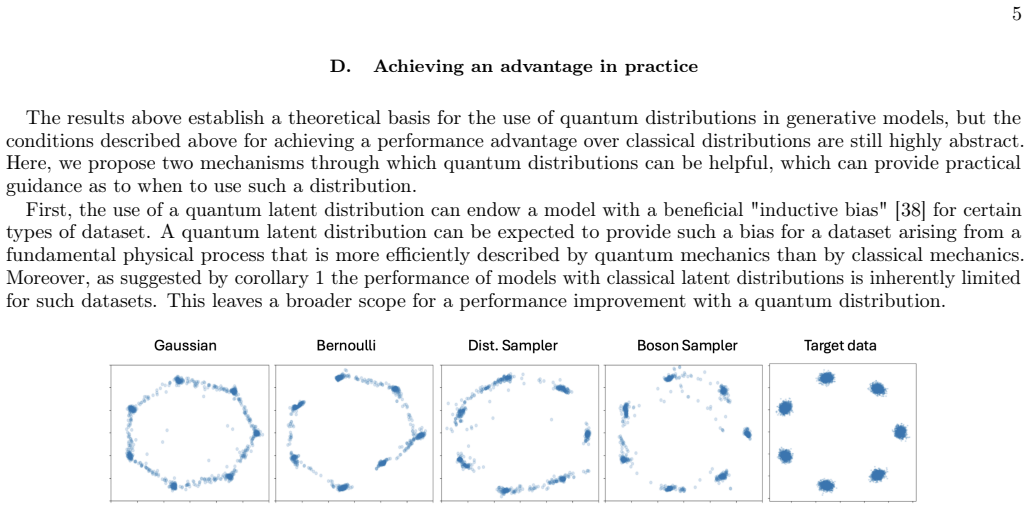
- On datasets whose underlying physics is quantum (QM9 is the paper's example), classical latents are provably at a disadvantage, giving a principled reason to expect quantum latents to improve coverage, validity, and novelty.
- The empirical gap between indistinguishable and distinguishable photons, under otherwise identical circuits, attributes the improvement specifically to quantum interference statistics rather than to discreteness or to a more exotic marginal distribution.
- The advantage is not universal: on StyleGAN with CIFAR-10 the latent choice made little difference, and small changes to the QM9 training regime shrank the gap, so the method is a targeted tool for suitable datasets and architectures rather than a blanket gain.
- A real photonic processor with loss and other imperfections reproduced the simulated-quantum advantage on QM9, so the effect survives hardware noise and should carry over to circuit sizes that cannot be classically simulated.
Reading between the lines
- Beyond the paper: the proof only needs the latent to lie in the class Q, not to be physically quantum; any classical source able to produce a distribution in Q would inherit the same guarantee, so the quantum device is one practical route to a resource that is defined purely by sampling hardness.
- Beyond the paper: because Theorem 1's guarantee is conditional on invertibility, checking the trained generator for injectivity (e.g., rank of its linear layers and collisions on the latent support) would tell a practitioner whether the theoretical gap actually applies to their model; the paper's architecture is only described as loosely matching the condition.
- Beyond the paper: the non-factorizability mechanism implies a direct test—on a dataset with many well-separated modes, quantum latents should systematically reduce interpolation between modes and improve mode coverage relative to Gaussian latents, measurable with a per-mode recall metric.
Signed reviews
Editorial analysis
A structured set of objections, weighed in public.
Referee Report
Summary. The paper studies the use of quantum-generated probability distributions as latent distributions in deep generative models. It defines complexity classes C (classically efficiently sampleable continuous distributions, with Wasserstein error) and Q (quantumly sampleable discrete distributions with total-variation error and no efficient classical sampler). The central theoretical result, Theorem 1, claims that if a generator g is invertible with a classically efficient and Lipschitz inverse, then a quantum latent distribution P_z ∈ Q is mapped to a pushforward distribution P_g(z) ∉ C. Corollary 1 translates this into a strictly positive GAN-induced distance between any classical latent pushforward and that quantum pushforward. The paper then benchmarks GANs on a toy quantum dataset and the QM9 molecular dataset, comparing boson-sampling latents against Gaussian, Bernoulli, and distinguishable-photon latents, using both simulated and real photonic processors. It reports improved performance for quantum latents in several settings, and additionally explores denoising diffusion GANs and flow matching. Negative results are collected in Appendix H.
Significance. If the theoretical claim is established under its assumptions, it provides a clean conditional separation between quantum and classical latent distributions in generative models, which is a valuable contribution to the growing literature on quantum machine learning. The empirical study is a genuine strength: the comparison is apples-to-apples across latent types, multiple seeds are used, a real quantum processor is included, and the paper honestly reports negative results (Appendix H) where the advantage disappears. The explicit use of distinguishable-photon controls helps attribute improvements to quantum interference. However, the theory as stated is narrower than the abstract suggests, because the assumptions of Theorem 1 are not satisfied by the paper's own architecture example or by the trained QM9 generator, and the paper does not verify them empirically. The empirical results are interesting but do not by themselves establish the theoretical separation.
major comments (2)
- [§III.B, Appendix A (Theorem 1 and its example)] Theorem 1 assumes g_n is invertible with g_n^{-1} efficiently computable and Lipschitz. The proof applies g^{-1} to samples from a classical approximation \hat P_{g_n(z_n)}; this requires g^{-1} to be defined on the support of that approximation. The paper's general setting allows d_z ≤ d, and the feedforward example explicitly uses layers of increasing width. Such a map is at most injective, not bijective; its inverse is a left inverse defined only on the image manifold. A classical approximation \hat P_g may have mass outside this image, and then g^{-1} is undefined on those samples. Moreover, the coupling equality used in the proof (inf over Γ(P_z,\hat P_z) of E|g(X)-g(Y)| = W(P_g,\hat P_g)) relies on the pushforward map between coupling spaces being bijective, which holds only for a bijection. Thus Theorem 1 as stated and proved applies to bijective generators, not to the d_z ≤ d set
- [§IV.B, QM9 experiments] The QM9 MolGAN generator is described as 'loosely based on the requirements of theorem 1' (Section IV.B). Its final layer outputs discrete molecular graph tensors and is not invertible, and no verification is provided that the trained generator is injective with a bounded-Lipschitz inverse. After training, linear layers can be rank-deficient or ill-conditioned, making the inverse Lipschitz constant unbounded. Consequently, the theoretical separation of Theorem 1 does not formally transfer to the trained models used in the main experiments. The empirical results may stand on their own, but the paper should either verify the invertibility/Lipschitz conditions for the trained generator, or position Theorem 1 explicitly as an idealized theoretical result that motivates, but does not explain, the QM9 benchmarks.
minor comments (6)
- [Appendix A, Definition of Q] The definition of Q contains confusing notation: 'sample from a distribution \hat P_{g_n(z_n)} such that ||P_{z_n} - \hat P_{g_n(z_n)}|| < ε' appears to mean \hat P_{z_n}. Also, 'there exists no classical algorithm that can do the same' is a conjecture for boson sampling and should be flagged as such in the main text, not only in the appendix.
- [§IV.B, Table II] The claim that 'for all 3 latent space sizes, the quantum distribution outperforms the classical distributions' is not supported at zdim=48: for FCD, Bernoulli (1.671 ± 0.08) is nominally better than the boson sampler (1.696 ± 0.08), and the valid/unique/novel metrics overlap within one standard error. Please soften this statement or add significance testing.
- [Appendix A, Remark 1 proof] The equality 'inf over Γ(P_g,\hat P_g) E|X-Y| = inf over Γ(P_z,\hat P_z) E|g(X)-g(Y)|' is only justified if g is injective on the relevant supports; the stated Lipschitz-only assumption does not suffice. The desired bound W(P_g,\hat P_g) ≤ c W(P_z,\hat P_z) follows directly by pushing forward couplings, and the proof should be rewritten in that way.
- [Appendix A, Corollary 1 proof] The phrase 'There exists ε ∈ R' should be 'ε ∈ R_{>0}', since negative epsilon is meaningless here.
- [Appendix B.1] In the permanent definition, the product index reads 'i=i'; it should be 'i=1'.
- [§IV.B.1] The phrase 'valid, unique and valid molecules' repeats 'valid'; presumably 'valid, unique and novel' is intended.
Circularity Check
No significant circularity: Theorem 1 is a conditional complexity reduction; experiments use untrained latents and external baselines; self-citations are auxiliary.
full rationale
The central theoretical claim (Theorem 1, Sec. III.B / Appendix A) is a conditional complexity-theoretic reduction: assuming P_z ∈ Q and g has an efficient Lipschitz inverse, the proof shows that if the pushforward P_g(z) were in C, then applying g^{-1} would yield a classical sampler for P_z, contradicting P_z ∈ Q. This is a standard contrapositive argument, not a fitted prediction or a self-referential definition: Q is defined as 'quantum sampleable and not classical sampleable,' so the conclusion follows from the definition of the complexity classes. No parameters are fitted to the target result. The empirical sections compare untrained, randomly sampled boson-sampling latents against Gaussian, Bernoulli, and distinguishable-photon baselines using external metrics (FCD, validity, uniqueness, FID); the quantum latent distributions are not trained or tuned to the benchmark datasets, and the paper explicitly notes that training the circuits could create an unfair advantage. Self-citations (Refs [43], [52], [57]) support auxiliary points — trainable circuits, loop-interferometer boundaries, and availability of quantum computers — and are not load-bearing for the main theorem or the core comparison. The acknowledged gap between Theorem 1's invertibility conditions and the QM9 architecture ('loosely based on the requirements of theorem 1') is a correctness/transfer limitation, not circularity, because the theorem is not defined in terms of the experiments and the experiments do not claim to instantiate the theorem's conditions. No specific circular step meets the quote-and-reduction standard.
Assumptions & free parameters
free parameters (3)
- QM9 learning rate =
1e-4
- QM9 permutation probability =
0.3
- QM9 training iterations =
20000
assumptions (4)
- domain assumption Quantum latent distributions Pz from boson sampling are in Q, i.e., approximately sampleable in polynomial time on a quantum device but not classically (Aaronson-Arkhipov conjecture).
- domain assumption The neural network generator g is invertible, its inverse is efficiently classically implementable, and g^{-1} is Lipschitz continuous.
- standard math Approximating W(Pg(z), Phat) < epsilon and then applying g^{-1} and rounding yields a classical sampler within O(epsilon) TVD of Pz.
- ad hoc to paper The experimental MolGAN generator is sufficiently close to the invertible-Lipschitz idealization of Theorem 1 for the theory to explain the empirical results.
Cite this review
Pith. "Pith review of Quantum latent distributions in deep generative models." pith.science (2026). https://pith.science/paper/BM57NHYL
@misc{pith2026250819857,
  author       = {Pith},
  title        = {Pith review of: Quantum latent distributions in deep generative models},
  year         = {2026},
  howpublished = {\url{https://pith.science/paper/BM57NHYL}},
  note         = {Machine review of arXiv:2508.19857}
}
read the original abstract
Many successful families of generative models leverage a low-dimensional latent distribution that is mapped to a data distribution. Though simple latent distributions are often used, the choice of distribution has a strong impact on model performance. Recent experiments have suggested that the probability distributions produced by quantum processors, which are typically highly correlated and classically intractable, can lead to improved performance on some datasets. However, when and why latent distributions produced by quantum processors can improve performance, and whether these improvements are connected to quantum properties of these distributions, are open questions that we investigate in this work. We show in theory that, under certain conditions, these "quantum latent distributions" enable generative models to produce data distributions that classical latent distributions cannot efficiently produce. We provide intuition as to the underlying mechanisms that could explain a performance advantage on real datasets. Based on this, we perform extensive benchmarking on a synthetic quantum dataset and the QM9 molecular dataset, using both simulated and real photonic quantum processors. We find that the statistics arising from quantum interference lead to improved generative performance compared to classical baselines, suggesting that quantum processors can play a role in expanding the capabilities of deep generative models.
Figures


Figures from the paper (5 more)


Forward citations
Cited by 2 Pith papers
-
Quantum Fourier Generative Models Trainable at Large Scale
Quantum Fourier generative models are trained classically at over 1000-qubit scale using log-likelihood loss from Parseval's identity and deployed on superconducting hardware for fast sampling that preserves multi-mod...
-
The trainability of photonic quantum circuits
Fixed-order photon-number polynomial observables make passive linear-optical variational circuits trainable with polynomially many samples, while output-probability and high-order observables are exponentially hard to train.
Reference graph
Works this paper leans on
-
[1]
Type and size of the latent distribution We first compare results over different latent distributions and different sizes: 16, 32 and 48. For the distinguishable and indistinguishable photon distributions, we consider unstructured optical circuits, with transfer matrices described by Haar-random unitary matrices, and with half as many input photons as opt...
work page 1954
-
[2]
1-1" configuration), and three delay lines in a
Type of quantum circuit To understand whether the results presented in the previous section are specific to Haar-random optical circuits or are due to more general properties of the statistics of photon interference, we also ran experiments with different types of optical circuits. We simulate two realizations of a boson sampling circuit based on optical ...
work page 1990
-
[3]
Experiments with a real quantum processor Realistic boson sampling systems are subject to a range of imperfections such as optical loss, limited photon number resolution, and imperfect indistinguishability. To assess the extent to which our previous results are transferrable to a real quantum processor, we performed experiments on a real boson sampling sy...
work page 1962
-
[4]
Generative adversarial nets,
I. J. Goodfellow, J. Pouget-Abadie, M. Mirza, B. Xu, D. Warde-Farley, S. Ozair, A. Courville, and Y. Bengio, “Generative adversarial nets,”Advances in neural information processing systems, vol. 27, 2014
2014
-
[5]
A style-based generator architecture for generative adversarial networks,
T. Karras, S. Laine, and T. Aila, “A style-based generator architecture for generative adversarial networks,” inProceedings of the IEEE/CVF conference on computer vision and pattern recognition, pp. 4401–4410, 2019
2019
-
[6]
High-resolution image synthesis with latent diffusion models,
R. Rombach, A. Blattmann, D. Lorenz, P. Esser, and B. Ommer, “High-resolution image synthesis with latent diffusion models,” in Proceedings of the IEEE/CVF conference on computer vision and pattern recognition, pp. 10684–10695, 2022
2022
-
[7]
Align your latents: High-resolution video synthesis with latent diffusion models,
A. Blattmann, R. Rombach, H. Ling, T. Dockhorn, S. W. Kim, S. Fidler, and K. Kreis, “Align your latents: High-resolution video synthesis with latent diffusion models,” inProceedings of the IEEE/CVF conference on computer vision and pattern recognition, pp. 22563–22575, 2023
work page 2023
-
[8]
Flow matching for generative modeling,
Y. Lipman, R. T. Chen, H. Ben-Hamu, M. Nickel, and M. Le, “Flow matching for generative modeling,”arXiv preprint arXiv:2210.02747, 2022
arXiv 2022
Show all 79 references
-
[9]
Building normalizing flows with stochastic interpolants,
M. S. Albergo and E. Vanden-Eijnden, “Building normalizing flows with stochastic interpolants,” arXiv preprint arXiv:2209.15571, 2022
2022 arXiv
-
[10]
Auto-encoding variational Bayes,
D. P. Kingma and M. Welling, “Auto-encoding variational Bayes,” 2022
2022
-
[11]
Neural discrete representation learning,
A. Van Den Oord, O. Vinyals,et al., “Neural discrete representation learning,”Advances in neural information processing systems, vol. 30, 2017
2017
-
[12]
Associative adversarial networks,
T. Arici and A. Celikyilmaz, “Associative adversarial networks,”NeurIPS 2016 Workshop on Adversarial Training, 2016
2016
-
[13]
Complexity matters: Rethinking the latent space for generative modeling,
T. Hu, F. Chen, H. Wang, J. Li, W. Wang, J. Sun, and Z. Li, “Complexity matters: Rethinking the latent space for generative modeling,” Advances in Neural Information Processing Systems, vol. 36, pp. 29558–29579, 2023
2023
-
[14]
The computational complexity of linear optics,
S. Aaronson and A. Arkhipov, “The computational complexity of linear optics,” inProceedings of the forty-third annual ACM symposium on Theory of computing, pp. 333–342, 2011
2011
-
[15]
Generation of high-resolution handwritten digits with an ion-trap quantum computer,
M. S. Rudolph, N. B. Toussaint, A. Katabarwa, S. Johri, B. Peropadre, and A. Perdomo-Ortiz, “Generation of high-resolution handwritten digits with an ion-trap quantum computer,”Physical Review X, vol. 12, no. 3, p. 031010, 2022
2022
-
[16]
Quantum supremacy using a programmable superconducting processor,
F. Arute, K. Arya, R. Babbush, D. Bacon, J. C. Bardin, R. Barends, R. Biswas, S. Boixo, F. G. Brandao, D. A. Buell,et al., “Quantum supremacy using a programmable superconducting processor,”Nature, vol. 574, no. 7779, pp. 505–510, 2019
2019
-
[17]
Quantum computational advantage with a programmable photonic processor,
L. S. Madsen, F. Laudenbach, M. F. Askarani, F. Rortais, T. Vincent, J. F. Bulmer, F. M. Miatto, L. Neuhaus, L. G. Helt, M. J. Collins,et al., “Quantum computational advantage with a programmable photonic processor,”Nature, vol. 606, no. 7912, pp. 75–81, 2022
2022
-
[18]
Computational advantage of quantum random sampling,
D. Hangleiter and J. Eisert, “Computational advantage of quantum random sampling,”arXiv preprint arXiv:2206.04079, 2022
2022 arXiv
-
[19]
Quantum-assisted associative adversarial network: Applying quantum annealing in deep learning,
M. Wilson, T. Vandal, T. Hogg, and E. G. Rieffel, “Quantum-assisted associative adversarial network: Applying quantum annealing in deep learning,”Quantum Machine Intelligence, vol. 3, no. 1, p. 19, 2021
2021
-
[20]
Quantum generative models for small molecule drug discovery,
J. Li, R. O. Topaloglu, and S. Ghosh, “Quantum generative models for small molecule drug discovery,”IEEE transactions on quantum engineering, vol. 2, pp. 1–8, 2021
2021
-
[21]
Exploring the advantages of quantum generative adversarial networks in generative chemistry,
P.-Y. Kao, Y.-C. Yang, W.-Y. Chiang, J.-Y. Hsiao, Y. Cao, A. Aliper, F. Ren, A. Aspuru-Guzik, A. Zhavoronkov, M.-H. Hsieh, et al., “Exploring the advantages of quantum generative adversarial networks in generative chemistry,”Journal of Chemical Information and Modeling, vol. 6...
2023
-
[22]
Quantum deep generative prior with programmable quantum circuits,
T. Xiao, X. Zhai, J. Huang, J. Fan, and G. Zeng, “Quantum deep generative prior with programmable quantum circuits,” Communications Physics, vol. 7, no. 1, p. 276, 2024
2024
-
[23]
Improving gans by leveraging the quantum noise from real hardware,
H. Jin and K. M. Merz Jr, “Improving gans by leveraging the quantum noise from real hardware,”arXiv preprint arXiv:2507.01886, 2025
2025 arXiv
-
[24]
Gaussian mixture generative adversarial networks for diverse datasets, and the unsupervised clustering of images,
M. Ben-Yosef and D. Weinshall, “Gaussian mixture generative adversarial networks for diverse datasets, and the unsupervised clustering of images,”arXiv preprint arXiv:1808.10356, 2018
2018 arXiv
-
[25]
Clustergan: Latent space clustering in generative adversarial networks,
S. Mukherjee, H. Asnani, E. Lin, and S. Kannan, “Clustergan: Latent space clustering in generative adversarial networks,” in Proceedings of the AAAI conference on artificial intelligence, vol. 33, pp. 4610–4617, 2019
2019
-
[26]
Large scale GAN training for high fidelity natural image synthesis,
A. Brock, J. Donahue, and K. Simonyan, “Large scale GAN training for high fidelity natural image synthesis,” inInternational Conference on Learning Representations, 2019
2019
-
[27]
BourGAN: Generative networks with metric embeddings,
C. Xiao, P. Zhong, and C. Zheng, “BourGAN: Generative networks with metric embeddings,”Advances in neural information processing systems, vol. 31, 2018
2018
-
[28]
Generalization properties of optimal transport GANs with latent distribution 12 learning,
G. Luise, M. Pontil, and C. Ciliberto, “Generalization properties of optimal transport GANs with latent distribution 12 learning,” arXiv preprint arXiv:2007.14641, 2020
2007 arXiv
-
[29]
Adversarial autoencoders,
A. Makhzani, J. Shlens, N. Jaitly, I. Goodfellow, and B. Frey, “Adversarial autoencoders,”arXiv preprint arXiv:1511.05644, 2015
2015 arXiv
-
[30]
Improving and generalizing flow-based generative models with minibatch optimal transport,
A. Tong, K. Fatras, N. Malkin, G. Huguet, Y. Zhang, J. Rector-Brooks, G. Wolf, and Y. Bengio, “Improving and generalizing flow-based generative models with minibatch optimal transport,”arXiv preprint arXiv:2302.00482, 2023
2023 arXiv
-
[31]
Quantum-computing-enhanced algorithm unveils potential KRAS inhibitors,
M. G. Vakili, C. Gorgulla, J. Snider, A. Nigam, D. Bezrukov, D. Varoli, A. Aliper, D. Polykovsky, K. M. P. Das, H. C. Iii, et al., “Quantum-computing-enhanced algorithm unveils potential KRAS inhibitors,”Nature biotechnology, 2025
2025
-
[32]
Quantum computational advantage using photons,
H.-S. Zhong, H. Wang, Y.-H. Deng, M.-C. Chen, L.-C. Peng, Y.-H. Luo, J. Qin, D. Wu, X. Ding, Y. Hu,et al., “Quantum computational advantage using photons,”Science, vol. 370, no. 6523, pp. 1460–1463, 2020
2020
-
[33]
The hardness of random quantum circuits,
R. Movassagh, “The hardness of random quantum circuits,”Nature Physics, vol. 19, no. 11, pp. 1719–1724, 2023
2023
-
[34]
BosonSampling is far from uniform,
S. Aaronson and A. Arkhipov, “BosonSampling is far from uniform,”arXiv preprint arXiv:1309.7460, 2013
2013 arXiv
-
[35]
Noise-induced barren plateaus in variational quantum algorithms,
S. Wang, E. Fontana, M. Cerezo, K. Sharma, A. Sone, L. Cincio, and P. J. Coles, “Noise-induced barren plateaus in variational quantum algorithms,”Nature communications, vol. 12, no. 1, p. 6961, 2021
2021
-
[36]
Large-scale quantum reservoir computing using a gaussian boson sampler,
V. Cimini, M. M. Sohoni, F. Presutti, B. K. Malia, S.-Y. Ma, R. Yanagimoto, T. Wang, T. Onodera, L. G. Wright, and P. L. McMahon, “Large-scale quantum reservoir computing using a gaussian boson sampler,”arXiv preprint arXiv:2505.13695, 2025
2025 arXiv
-
[37]
Experimental quantum-enhanced kernels on a photonic processor,
Z. Yin, I. Agresti, G. de Felice, D. Brown, A. Toumi, C. Pentangelo, S. Piacentini, A. Crespi, F. Ceccarelli, R. Osellame, et al., “Experimental quantum-enhanced kernels on a photonic processor,”arXiv preprint arXiv:2407.20364, 2024
2024 arXiv
-
[38]
Lipschitz regularity of deep neural networks: analysis and efficient estimation,
A. Virmaux and K. Scaman, “Lipschitz regularity of deep neural networks: analysis and efficient estimation,”Advances in Neural Information Processing Systems, vol. 31, 2018
2018
-
[39]
The lipschitz constant of self-attention,
H. Kim, G. Papamakarios, and A. Mnih, “The lipschitz constant of self-attention,” inInternational Conference on Machine Learning, pp. 5562–5571, PMLR, 2021
2021
-
[40]
Spectrally-normalized margin bounds for neural networks,
P. L. Bartlett, D. J. Foster, and M. J. Telgarsky, “Spectrally-normalized margin bounds for neural networks,”Advances in neural information processing systems, vol. 30, 2017
2017
-
[41]
Relational inductive biases, deep learning, and graph networks,
P. W. Battaglia, J. B. Hamrick, V. Bapst, A. Sanchez-Gonzalez, V. Zambaldi, M. Malinowski, A. Tacchetti, D. Ra- poso, A. Santoro, R. Faulkner,et al., “Relational inductive biases, deep learning, and graph networks,”arXiv preprint arXiv:1806.01261, 2018
2018 arXiv
-
[42]
Challenging common assumptions in the unsupervised learning of disentangled representations,
F. Locatello, S. Bauer, M. Lucic, G. Raetsch, S. Gelly, B. Schölkopf, and O. Bachem, “Challenging common assumptions in the unsupervised learning of disentangled representations,” ininternational conference on machine learning, pp. 4114–4124, PMLR, 2019
2019
-
[43]
Lost in latent space: Examining failures of disentangled models at combinatorial generalisation,
M. Montero, J. Bowers, R. Ponte Costa, C. Ludwig, and G. Malhotra, “Lost in latent space: Examining failures of disentangled models at combinatorial generalisation,”Advances in Neural Information Processing Systems, vol. 35, pp. 10136–10149, 2022
2022
-
[44]
Learning factorized multimodal representations,
Y.-H. H. Tsai, P. P. Liang, A. Zadeh, L.-P. Morency, and R. Salakhutdinov, “Learning factorized multimodal representations,” in International Conference on Learning Representations, 2019
2019
-
[45]
InfoGAN: Interpretable representation learning by information maximizing generative adversarial nets,
X. Chen, Y. Duan, R. Houthooft, J. Schulman, I. Sutskever, and P. Abbeel, “InfoGAN: Interpretable representation learning by information maximizing generative adversarial nets,”Advances in neural information processing systems, vol. 29, 2016
2016
-
[46]
Exact gradients for linear optics with single photons,
G. Facelli, D. D. Roberts, H. Wallner, A. Makarovskiy, Z. Holmes, and W. R. Clements, “Exact gradients for linear optics with single photons,”arXiv preprint arXiv:2409.16369, 2024
2024 arXiv
-
[47]
Barren plateaus in quantum neural network training landscapes,
J. R. McClean, S. Boixo, V. N. Smelyanskiy, R. Babbush, and H. Neven, “Barren plateaus in quantum neural network training landscapes,” Nature communications, vol. 9, no. 1, p. 4812, 2018
2018
-
[48]
The classical complexity of boson sampling,
P. Clifford and R. Clifford, “The classical complexity of boson sampling,” inProceedings of the Twenty-Ninth Annual ACM-SIAM Symposium on Discrete Algorithms, pp. 146–155, SIAM, 2018
2018
-
[49]
Quantum chemistry structures and properties of 134 kilo molecules,
R. Ramakrishnan, P. O. Dral, M. Rupp, and O. A. Von Lilienfeld, “Quantum chemistry structures and properties of 134 kilo molecules,” Scientific data, vol. 1, no. 1, pp. 1–7, 2014
2014
-
[50]
MolGAN:Animplicitgenerativemodelforsmallmoleculargraphs,
N.DeCaoandT.Kipf, “MolGAN:Animplicitgenerativemodelforsmallmoleculargraphs,” arXiv preprint arXiv:1805.11973, 2018
2018 arXiv
-
[51]
Objective-reinforced generative adversarial networks (ORGAN) for sequence generation models,
G. L. Guimaraes, B. Sanchez-Lengeling, C. Outeiral, P. L. C. Farias, and A. Aspuru-Guzik, “Objective-reinforced generative adversarial networks (ORGAN) for sequence generation models,”arXiv preprint arXiv:1705.10843, 2017
2017 arXiv
-
[52]
TenGAN: Pure transformer encoders make an efficient discrete gan for de novo molecular generation,
C. Li and Y. Yamanishi, “TenGAN: Pure transformer encoders make an efficient discrete gan for de novo molecular generation,” in International Conference on Artificial Intelligence and Statistics, pp. 361–369, PMLR, 2024
2024
-
[53]
Fréchet ChemNet distance: a metric for generative models for molecules in drug discovery,
K. Preuer, P. Renz, T. Unterthiner, S. Hochreiter, and G. Klambauer, “Fréchet ChemNet distance: a metric for generative models for molecules in drug discovery,”Journal of chemical information and modeling, vol. 58, no. 9, pp. 1736–1741, 2018
2018
-
[54]
Quantum computational advantage via high-dimensional Gaussian boson sampling,
A. Deshpande, A. Mehta, T. Vincent, N. Quesada, M. Hinsche, M. Ioannou, L. Madsen, J. Lavoie, H. Qi, J. Eisert, et al., “Quantum computational advantage via high-dimensional Gaussian boson sampling,”Science advances, vol. 8, no. 1, p. eabi7894, 2022
2022
-
[55]
Boundaries for quantum advantage with single photons and loop-based time-bin interferometers,
S. Novák, D. D. Roberts, A. Makarovskiy, R. García-Patrón, and W. R. Clements, “Boundaries for quantum advantage with single photons and loop-based time-bin interferometers,”arXiv preprint arXiv:2411.16873, 2024
2024
-
[56]
Diffusion models beat GANs on image synthesis,
P. Dhariwal and A. Nichol, “Diffusion models beat GANs on image synthesis,”Advances in neural information processing systems, vol. 34, pp. 8780–8794, 2021
2021
-
[57]
Accurate prediction of protein structures and interactions using a three-track neural network,
M. Baek, F. DiMaio, I. Anishchenko, J. Dauparas, S. Ovchinnikov, G. R. Lee, J. Wang, Q. Cong, L. N. Kinch, R. D. Schaeffer, et al., “Accurate prediction of protein structures and interactions using a three-track neural network,”Science, vol. 373, no. 6557, pp. 871–876, 2021
2021
-
[58]
Tackling the generative learning trilemma with denoising diffusion GANs,
Z. Xiao, K. Kreis, and A. Vahdat, “Tackling the generative learning trilemma with denoising diffusion GANs,”arXiv preprint 13 arXiv:2112.07804, 2021
2021 arXiv
-
[59]
Learning multiple layers of features from tiny images,
A. Krizhevsky, G. Hinton,et al., “Learning multiple layers of features from tiny images,” 2009
2009
-
[60]
Hybrid classical-quantum supercomputing: A demonstration of a multi-user, multi-qpu and multi-gpu environment,
M. Slysz, P. Rydlichowski, K. Kurowski, O. Bacarezza, E. C. Gomez, Z. Chandani, B. Heim, P. Khalate, W. R. Clements, and J. Fletcher, “Hybrid classical-quantum supercomputing: A demonstration of a multi-user, multi-qpu and multi-gpu environment,” 2025
2025
-
[61]
Efficient approximation of experimental Gaussian boson sampling,
B. Villalonga, M. Y. Niu, L. Li, H. Neven, J. C. Platt, V. N. Smelyanskiy, and S. Boixo, “Efficient approximation of experimental Gaussian boson sampling,”arXiv preprint arXiv:2109.11525, 2021
2021 arXiv
-
[62]
Classical algorithm for simulating experimental gaussian boson sampling,
C. Oh, M. Liu, Y. Alexeev, B. Fefferman, and L. Jiang, “Classical algorithm for simulating experimental gaussian boson sampling,” Nature Physics, vol. 20, no. 9, pp. 1461–1468, 2024
2024
-
[63]
W denotes the Wasserstein metric
-
[64]
As such we reach the same conclusions on complexity since Poly(n, 1/cϵ) ≡ Poly(n, 1/ϵ) for some constantc
The TVD error we achieve is a constant multiple ofϵ. As such we reach the same conclusions on complexity since Poly(n, 1/cϵ) ≡ Poly(n, 1/ϵ) for some constantc
-
[65]
Boson sampling on a photonic chip,
J. B. Spring, B. J. Metcalf, P. C. Humphreys, W. S. Kolthammer, X.-M. Jin, M. Barbieri, A. Datta, N. Thomas-Peter, N. K. Langford, D. Kundys,et al., “Boson sampling on a photonic chip,”Science, vol. 339, no. 6121, pp. 798–801, 2013
2013
-
[66]
Robust quantum computational advantage with programmable 3050-photon gaussian boson sampling,
H.-L. Liu, H. Su, S.-Q. Gong, Y.-C. Gu, H.-Y. Tang, M.-H. Jia, Q. Wei, Y. Song, D. Wang, M. Zheng,et al., “Robust quantum computational advantage with programmable 3050-photon gaussian boson sampling,”arXiv preprint arXiv:2508.09092, 2025
2025 arXiv
-
[67]
Improved training of Wasserstein GANs,
I. Gulrajani, F. Ahmed, M. Arjovsky, V. Dumoulin, and A. C. Courville, “Improved training of Wasserstein GANs,”Advances in neural information processing systems, vol. 30, 2017
2017
-
[68]
Analyzing and improving the image quality of stylegan,
T. Karras, S. Laine, M. Aittala, J. Hellsten, J. Lehtinen, and T. Aila, “Analyzing and improving the image quality of stylegan,” inProceedings of the IEEE/CVF conference on computer vision and pattern recognition, pp. 8110–8119, 2020
2020
-
[69]
Adam: A method for stochastic optimization,
D. P. Kingma and J. Ba, “Adam: A method for stochastic optimization,”arXiv preprint arXiv:1412.6980, 2014
2014 arXiv
-
[70]
Improved techniques for training GANs,
T. Salimans, I. Goodfellow, W. Zaremba, V. Cheung, A. Radford, and X. Chen, “Improved techniques for training GANs,” Advances in neural information processing systems, vol. 29, 2016. 14 Appendix A: Complexity Proofs Here we give precise definitions and complete proofs for the ...
2016
-
[71]
Boson sampling theory Boson sampling is a non-universal model of quantum computation proposed by [11], in which identical photons are sent into an interference circuit, and a measurement is performed to determine where the photons left the circuit. A 16 lossless interference c...
-
[72]
For instance, [29] performed a boson sampling experiment in which up to 76 photons were measured in 100 channels using a fixed interference circuit
Current state of the art Over the last few years, improvements in photon source, circuit and detector technology have led to several boson sampling experiments at a scale that is a challenge for classical computers. For instance, [29] performed a boson sampling experiment in w...
-
[73]
Boson samplers with delay lines Boson samplers based on optical delay lines have been proposed and demonstrated as an experimentally feasible route to large-scale boson sampling [14, 51, 52]. In these systems, illustrated in figure 5, a single photon source is used to produce ...
-
[74]
permutation probability
ORCA Computing PT-2 processor The boson sampling system used in our experiments is an ORCA Computing PT-2, which is a commercially available loop-based boson sampling system. It consists of a photon source based on parametric downconversion, two sequential optical delay lines ...
-
[75]
This is the case for all experiments with a toy dataset, and also for all size-16 and most size-32 latents on the QM9 dataset
Note on circuit randomization In general, to ensure that performance differences arise from general properties of the latent space distributions and not from specific circuit realizations, the optical circuits for both distinguishable and indistinguishable photons are re-sampl...
-
[76]
It took 40 minutes to collect 500k samples with an ORCA PT-2
Computational resources The computational resources used for our QM9 experiments can be divided into the time taken to collect the latent space samples, and the training time. It took 40 minutes to collect 500k samples with an ORCA PT-2. For the simulated boson sampler size-32...
-
[77]
Appendix G: Flow matching We build on the Optimal-Transport variant of Conditional Flow Matching from [27], as implemented inhttps:// github.com/atong01/conditional-flow-matching
Computational resources Each training run took around 23.2 hours each, running on four NVIDIA HGX™ A100 GPU 80GB. Appendix G: Flow matching We build on the Optimal-Transport variant of Conditional Flow Matching from [27], as implemented inhttps:// github.com/atong01/conditiona...
-
[78]
We used the inception score [67] as the metric for model performance
StyleGAN with CIFAR-10 We investigated the StyleGAN model [2] with the CIFAR-10 dataset and different types of latent distributions. We used the inception score [67] as the metric for model performance. Table VII shows the inception scores (IS) [67] achieved by the trained mod...
-
[79]
QM9 experiments We also found that small changes to the model and training regime used in our QM9 experiments could make a significant difference and erase a large part of the observed performance differences. Using the same model but with a higher learning rate of10−3 (instea...
1971
Reviewed August 5, 2026 · model on record in the stance chip above.
Discussion (0). Continue with ORCID to comment.