REVIEW 3 major objections 4 minor 3 cited by
This paper derives exact edge operators that commute with the Hamiltonian of any integrable spin-S chain, guaranteeing infinitely long edge coherence times even where locality is weak.
Reviewed by Pith at T0; open to challenge. T0 means a machine referee read the full paper against a public rubric. the ladder, T0–T4 →
T0 review · deepseek-v4-flash
2026-08-03 17:51 UTC pith:VNCUMAWT
load-bearing objection Solid arbitrary-spin ESZM construction with a real weak-locality story; the main gap is an unproved spectral assertion on the auxiliary transfer matrix. the 3 major comments →
Strong zero modes in integrable spin-S chains
The pith
A machine-rendered reading of the paper's core claim, the machinery that carries it, and where it could break.
Core claim
On the paper's own terms: for any spin S and real anisotropy η, the derivative of the auxiliary-spin-1/2 transfer matrix at the special value u* = iπ/2 yields a Hermitian operator Ψ that commutes exactly with the integrable open spin-S Hamiltonian. In the Hilbert-Schmidt norm, Ψ is normalized to 1 and squares to the identity up to corrections exponentially small in system size, and each local piece Ψ_j of its MPO decomposition decays exponentially in j; however, for S ≥ 1 the spectral norm of Ψ_j does not decay, so locality is strictly weaker than the spin-1/2 case. The authors explain this weakening as forced by the odd number of degenerate ground states for integer S, and show numerically
What carries the argument
The central object is the double-row transfer matrix T^{(S,1/2)}(u) built from quantum-group generators S^z, S^± and diagonal reflection matrices; it commutes with the Hamiltonian for all u. The special value u* = iπ/2 makes the L-operator satisfy L_j(u*) σ^z_a L_j(u*) = σ^z_a, which collapses the transfer matrix to zero and turns its derivative into a sum of local pieces Ψ_j. Writing Ψ as a matrix-product operator with a four-dimensional ancilla, the Hilbert-Schmidt norms are evaluated by a transfer matrix U = (1/(2S+1))Tr(A⊗A); the claim that U has a unique eigenvalue 1 with all others smaller in modulus is what makes the mode normalizable and almost idempotent.
Load-bearing premise
The entire normalizability and near-inversion of Ψ rests on an unproved spectral assertion: that the auxiliary transfer matrix U (and its fourth-power analogue V) has a unique eigenvalue of modulus 1 and a gap below it; the paper says this was 'verified by direct calculation' but gives no derivation.
What would settle it
Compute the spectrum of the four-dimensional transfer matrix U (or V) for a specific S and real η and find an eigenvalue of modulus greater than or equal to 1 other than the Perron eigenvalue; then the claimed exponential decay of ∥Ψ_j∥ and the limit ∥Ψ²−1∥²→0 fail. Alternatively, for the spin-1 chain with boundary conditions of Eq. (59), compute the edge autocorrelator plateau at larger L and show it decays to a value below |c_1|²+|c_2|², contradicting the claim that additional ESZMs exist.
If this is right
- For every S, the open integrable spin-S XXZ chain with appropriate boundary fields has an exactly conserved edge operator, so local observables overlapping it show nonzero infinite-temperature autocorrelation plateaus.
- The weaker locality for S≥1 is not a technical accident but forced by the odd number of degenerate ground states for integer S, so any attempt to construct a sharp SZM in those models must fail.
- The SZM (non-exact) version is recovered when both boundaries are set to the integrable spin-flip-invariant value, with commutator exponentially small in Hilbert-Schmidt norm but not spectral norm.
- In the spin-1/2 case, the ESZM's action on energy eigenstates is exactly characterized by the Bethe-ansatz boundary strings: eigenvalue -1 precisely on states containing the right-boundary string.
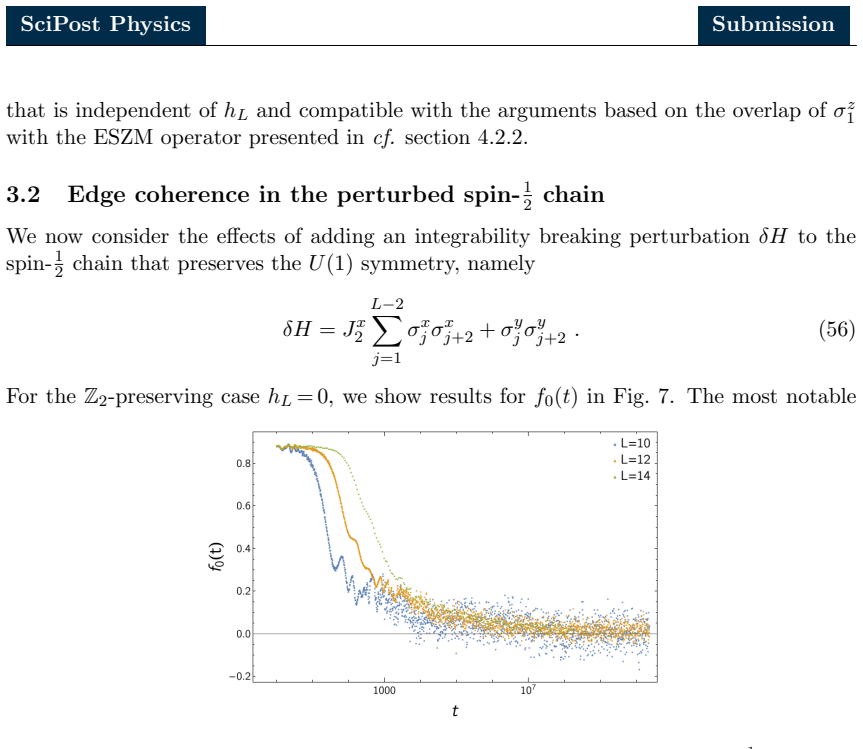
- Numerical edge-autocorrelator plateaus for the spin-1 chain require additional ESZMs beyond the single constructed Ψ, indicating a family of conserved edge operators.
Where Pith is reading between the lines
- If the spectral-gap assertion holds, the construction likely extends by fusion to higher auxiliary spins, and the paper's conjectured S=3/2 ESZM from T^{(3/2,3/2)}(iπ/2) would give a conventional strongly localized mode; a direct check of its full MPO would settle that.
- The 'weak locality but normalizable' pattern suggests a general principle: when the ground-state manifold has odd degeneracy, edge operators can still be exact conserved charges but must act nontrivially on an exponentially small (in Hilbert-Schmidt measure) fraction of the Hilbert space, so disorder-free prethermal-like plateaus survive.
- The boundary-string characterization for S=1/2 suggests a dictionary between ESZM eigenvalues and root structure that, if extended to higher S, would let one compute exact edge-coherence plateaus directly from Bethe ansatz data without diagonalizing.
- Perturbing away from integrability while keeping the U(1) symmetry, the plateau in edge autocorrelators appears robust at accessible sizes; a quantitative prediction is that the plateau height for large L is set by the sum of squares of overlaps with all ESZMs, which could be tested against exact numerics.
Editorial analysis
A structured set of objections, weighed in public.
Referee Report
Summary. The paper constructs, for integrable open spin-S XXZ chains with a Z2-invariant left boundary and generic right boundary, an operator Ψ obtained from the derivative of the transfer matrix T^{(S,1/2)}(u) at u=iπ/2. The authors show that Ψ commutes exactly with the Hamiltonian, has a Hilbert-Schmidt norm equal to 1 up to exponentially small corrections, nearly squares to the identity in the same norm, and is weakly localized near the left edge. They argue that these properties imply finite late-time plateaus in edge autocorrelation functions, present numerical evidence for S=1/2 and S=1, and discuss connections to boundary bound states in the Bethe ansatz for S=1/2.
Significance. If the construction is correct, it provides exact strong zero modes for arbitrary spin S in an integrable setting, extending the earlier MPO/transfer-matrix construction for S=1/2. The exact commutation with the Hamiltonian is a strong structural result, and the operator-norm formulation of locality is a useful generalization. The paper also gives a clear physical interpretation of the degenerate ground states as a first-order transition line and presents reproducible numerics for edge autocorrelators. The weakening of locality for S≥1 and the explanation in terms of an odd number of ground states for integer S is an interesting conceptual contribution. However, the central claims rely on a spectral-gap assertion that is stated but not proved, and for S=1 the constructed operator does not by itself explain the numerically observed plateau heights.
major comments (3)
- [§4.2.1, Eqs. (91)–(96)] The normalizability and near-inversion properties of Ψ rest on the assertion, made after Eq. (91), that the ancillary transfer matrix U (and similarly V in Eq. (95)) has a unique eigenvalue equal to 1 and all other eigenvalues strictly smaller in modulus for all S and η∈R. The text says this was 'verified by direct calculation', but no derivation or explicit computation is given. This is load-bearing: Eqs. (93) and (87), and hence the plateau argument leading to Eq. (102), all follow from the exponential decay of subleading eigenvalues. If a subleading eigenvalue had modulus 1, the exponentially small corrections would become O(1) and the ESZM would lose its normalizability and inversion properties. Please provide a proof, or at least a complete and reproducible algebraic verification, including a bound on the second-largest eigenvalue.
- [§4.2.2, Fig. 11 and Eq. (103)] For S=1 the overlap of s^z_1 with the constructed Ψ is |c1|²=0.2637 at η=1, whereas the numerical plateau in Fig. 11 is substantially larger. The paper correctly concludes that 'there must be additional ESZM operators', but none are constructed. This is not a cosmetic gap: the abstract and conclusion claim that the constructed ESZMs imply the observed infinite coherence times, but for S=1 the single explicitly constructed operator cannot account for the plateau. The argument needs either an explicit additional conserved edge operator, or a more careful statement that the plateau demonstrates the existence of additional ESZMs whose construction is left open.
- [§4.4, Eq. (116)] The claimed S=3/2 ESZM Ψ_{3/2}=T^{(3/2,3/2)}(iπ/2) is a conjecture: only the first two terms of its large-η expansion are matched with the perturbative construction. Since the paper uses this to argue that a 'conventional' ESZM exists for S=3/2, this part is not established. This does not affect the main T^{(S,1/2)} construction, but the text should clearly separate conjecture from proof, especially in the Conclusions where it is used as evidence.
minor comments (4)
- [Throughout] There are several typographical issues: 'spin-Schains' in the title line, 'cf.section' in §3.1, 'withre' in §4.2, and missing spaces around parentheses. These should be corrected.
- [§5, Eqs. (126)–(127)] The conjecture that the ESZM eigenvalue is +1 without a right-boundary string and −1 with one is supported by numerical results for L≤12, N≤6 in Appendix D. This is reasonable evidence, but the statement should explicitly note the limited system sizes, as the text already does implicitly in Table 1.
- [§4.2.2, Eq. (102)] The lower bound in Eq. (102) assumes that the only conserved edge-localized operators are the ESZMs. For S=1 the paper itself shows there must be more, so the inequality is not tight. This should be stated directly where the equation appears, not only later.
- [References] The construction relies on the companion papers [39,45,74], two of which are preprints. If the journal allows, it would help readers if the key MPO identities from [45] were summarized in an appendix, since the present paper's normalizability proof depends on them.
Circularity Check
No significant circularity: the ESZM construction is explicit and algebraic; the main caveat is an unproved spectral-gap assertion, which is a completeness risk rather than a circular step.
full rationale
The central construction defines Ψ as a derivative of the commuting transfer matrix T^{(S,1/2)}(u) at u*=iπ/2, so exact commutation [H,Ψ]=0 follows from the standard transfer-matrix commutation (63), which the paper explicitly uses via the L-operator (66), K-matrices (68), and the key identity (72). The locality and normalizability results, Eqs. (93) and (87), do rely on the assertion in §4.2.1 that U and V have a unique eigenvalue of modulus 1 and all others strictly smaller; the paper states this was 'verified by direct calculation' but gives no derivation. That is an unproved computational assumption and a genuine load-bearing gap, but it is not circular: the spectrum of U is not an input that is later renamed as the prediction. The overlap coefficients c1 in Eqs. (102)-(103) are computed from the constructed operator, not fitted to the numerical plateaus; indeed for S=1 the authors note that the observed plateaus exceed |c1|^2 and therefore require additional ESZM operators, which is an acknowledged incompleteness rather than a circular explanation. The self-citations to Refs. [39,45,74] point to earlier treatments of the S=1/2 case and to the plateau/overlap argument, but the present paper rederives the needed MPO form, recursion relations and norm computations explicitly, so those citations are not load-bearing. The unproved spectral assertion and the S=1 completeness issue should be counted as correctness/completeness risks, not as circularity.
Axiom & Free-Parameter Ledger
axioms (7)
- standard math U_q(sl2) quantum-group algebra (Eq. 67) underlies the L-operator and transfer-matrix commutation.
- domain assumption Transfer matrices T^{(S,S')}(u) commute for all u,v (Eq. 63).
- ad hoc to paper The ancillary transfer matrix U (and V) has a unique eigenvalue 1 and all others strictly smaller in modulus for η∈R.
- ad hoc to paper Additional ESZM operators exist for the integrable spin-1 chain with boundary conditions (59).
- ad hoc to paper For S=3/2, Ψ_{3/2}=T^{(3/2,3/2)}(iπ/2) is an ESZM with good locality.
- domain assumption The integrable spin-S XXZ chain has 2S+1 degenerate ground states along η>0, forming a first-order transition line.
- ad hoc to paper For S=1/2, the ESZM eigenvalue is +1 on Bethe states without a right-boundary string and −1 with one (Eqs. 126-127).
invented entities (2)
-
Additional ESZM operators for the S=1 integrable chain
no independent evidence
-
Conventional ESZM for S=3/2 from T^{(3/2,3/2)}(iπ/2)
no independent evidence
read the original abstract
We derive exact strong zero mode (ESZM) operators for integrable spin-S chains with open boundary conditions and a boundary field. Their locality properties are generally weaker than in the previously known cases, but they still imply infinite coherence times in the vicinity of the edges. We explain how such integrable chains possess multiple ground states describing a first-order quantum phase transition, and that the odd number of such states for integer S makes the weaker locality properties necessary. We make contact with more traditional approaches by showing how the ESZM for S=1/2 acts on energy eigenstates given by solutions of the Bethe equations.
Figures




Forward citations
Cited by 3 Pith papers
-
Exact strong zero modes are generic in integrable spin systems with large anisotropy
Exact strong zero modes arise generically in integrable spin systems with large anisotropy from quasi-periodicity of the R-matrix and tracelessness of the K-matrix.
-
Exact strong zero modes are generic in integrable spin systems with large anisotropy
Exact strong zero modes arise generically in integrable anisotropic spin models from quasi-periodicity of R-matrices and tracelessness of K-matrices, unifying known cases and predicting new ones.
-
Quasi-local Edge Mode in XXX Spin Chain/Circuit with Interaction Boundary Defect
Above a critical boundary interaction, the XXX spin chain/circuit hosts an explicit matrix-product quasi-local edge mode that yields a nonzero boundary Drude weight and a transition to ergodic boundary dynamics below ...
Reference graph
Works this paper leans on
-
[1]
A. B. Zamolodchikov and V. Fateev,Model factorized s-matrix and an integrable spin-1 heisenberg chain, Sov. J. Nucl. Phys.(Engl. Transl.);(United States)32(2) (1980)
1980
-
[2]
P. P. Kulish, N. Y. Reshetikhin and E. K. Sklyanin,Yang-baxter equation and repre- sentation theory: I, Letters in Mathematical Physics5, 393 (1981)
1981
-
[3]
Kulish and N
P. Kulish and N. Y. Reshetikhin,Generalized heisenberg ferromagnet and the gross- neveu model, Sov. Phys. JETP53(1), 108 (1981)
1981
-
[4]
Takhtajan,The picture of low-lying excitations in the isotropic heisenberg chain of arbitrary spins, Physics Letters A87(9), 479 (1982)
L. Takhtajan,The picture of low-lying excitations in the isotropic heisenberg chain of arbitrary spins, Physics Letters A87(9), 479 (1982)
1982
-
[5]
Babujian,Exact solution of the one-dimensional isotropic heisenberg chain with arbitrary spins s, Physics Letters A90(9), 479 (1982)
H. Babujian,Exact solution of the one-dimensional isotropic heisenberg chain with arbitrary spins s, Physics Letters A90(9), 479 (1982)
1982
-
[6]
Babujian,Exact solution of the isotropic heisenberg chain with arbitrary spins: thermodynamics of the model, Nuclear Physics B215(3), 317 (1983)
H. Babujian,Exact solution of the isotropic heisenberg chain with arbitrary spins: thermodynamics of the model, Nuclear Physics B215(3), 317 (1983)
1983
-
[7]
Sogo,Ground state and low-lying excitations in the heisenberg xxz chain of arbi- trary spin s, Physics Letters A104(1), 51 (1984)
K. Sogo,Ground state and low-lying excitations in the heisenberg xxz chain of arbi- trary spin s, Physics Letters A104(1), 51 (1984)
1984
-
[8]
A. N. Kirillov and N. Y. Reshetikhin,Exact solution of the heisenberg xxz model of spin s, Journal of Soviet Mathematics35, 2627 (1986)
1986
-
[9]
A. N. Kirillov and N. Y. Reshetikhin,Exact solution of the integrable xxz heisenberg model with arbitrary spin. i. the ground state and the excitation spectrum, Journal of Physics A: Mathematical and General20(6), 1565 (1987)
1987
-
[10]
Kirillov and N
A. Kirillov and N. Y. Reshetikhin,Exact solution of the integrable xxz heisenberg model with arbitrary spin. ii. thermodynamics of the system, Journal of Physics A: Mathematical and General20(6), 1587 (1987)
1987
-
[11]
Frahm, N.-C
H. Frahm, N.-C. Yu and M. Fowler,The integrable xxz heisenberg model with arbitrary spin: construction of the hamiltonian, the ground-state configuration and conformal properties, Nuclear Physics B336(3), 396 (1990)
1990
-
[12]
Suzuki,Excited state nonlinear integral equations for an integrable anisotropic spin-1 chain, Journal of Physics A: Mathematical and General37(50), 11957 (2004)
J. Suzuki,Excited state nonlinear integral equations for an integrable anisotropic spin-1 chain, Journal of Physics A: Mathematical and General37(50), 11957 (2004)
2004
-
[13]
Deguchi and C
T. Deguchi and C. Matsui,Correlation functions of the integrable higher-spin xxx and xxz spin chains through the fusion method, Nuclear Physics B831(3), 359 (2010)
2010
-
[14]
Mezincescu, R
L. Mezincescu, R. I. Nepomechie and V. Rittenberg,Bethe ansatz solution of the fateev-zamolodchikov quantum spin chain with boundary terms, Physics Letters A 147(1), 70 (1990)
1990
-
[15]
De Vega and A
H. De Vega and A. Gonzalez-Ruiz,Exact solution of the suq (n)-invariant quantum spin chains, Nuclear Physics B417(3), 553 (1994)
1994
-
[16]
Affleck and F
I. Affleck and F. Haldane,Critical theory of quantum spin chains, Physical Review B36(10), 5291 (1987). 44 SciPost Physics Submission
1987
-
[17]
A. L¨ auchli, G. Schmid and S. Trebst,Spin nematics correlations in bilinear-biquadratic spin chains, Physical Review B74(14) (2006), doi:10.1103/physrevb.74.144426
-
[18]
A. Y. Kitaev,Unpaired majorana fermions in quantum wires, Physics-uspekhi 44(10S), 131 (2001)
2001
-
[19]
Z.-C. Gu and X.-G. Wen,Tensor-entanglement-filtering renormalization approach and symmetry-protected topological order, Physical Review B80(15) (2009), doi:10.1103/physrevb.80.155131
-
[20]
F. Pollmann, E. Berg, A. M. Turner and M. Oshikawa,Symmetry protection of topological phases in one-dimensional quantum spin systems, Physical Review B 85(7) (2012), doi:10.1103/physrevb.85.075125
-
[21]
Fendley,Parafermionic edge zero modes in zn-invariant spin chains, Journal of Statistical Mechanics: Theory and Experiment2012(11), P11020 (2012)
P. Fendley,Parafermionic edge zero modes in zn-invariant spin chains, Journal of Statistical Mechanics: Theory and Experiment2012(11), P11020 (2012)
2012
-
[22]
Alicea and P
J. Alicea and P. Fendley,Topological phases with parafermions: theory and blueprints, Annual Review of Condensed Matter Physics7(1), 119 (2016)
2016
-
[23]
Fendley,Strong zero modes and eigenstate phase transitions in the xyz/interacting majorana chain, Journal of Physics A: Mathematical and Theoretical49(30), 30LT01 (2016)
P. Fendley,Strong zero modes and eigenstate phase transitions in the xyz/interacting majorana chain, Journal of Physics A: Mathematical and Theoretical49(30), 30LT01 (2016)
2016
-
[24]
Moran, D
N. Moran, D. Pellegrino, J. Slingerland and G. Kells,Parafermionic clock models and quantum resonance, Physical Review B95(23), 235127 (2017)
2017
-
[25]
L. M. Vasiloiu, F. Carollo, M. Marcuzzi and J. P. Garrahan,Strong zero modes in a class of generalized ising spin ladders with plaquette interactions, Physical Review B 100(2), 024309 (2019)
2019
-
[26]
J. Kemp, N. Y. Yao and C. R. Laumann,Symmetry-enhanced boundary qubits at infinite temperature, Physical Review Letters125(20), 200506 (2020)
2020
-
[27]
J. Kemp, N. Y. Yao, C. R. Laumann and P. Fendley,Long coherence times for edge spins, Journal of Statistical Mechanics: Theory and Experiment2017(6), 063105 (2017)
2017
-
[28]
D. V. Else, P. Fendley, J. Kemp and C. Nayak,Prethermal strong zero modes and topological qubits, Physical Review X7(4), 041062 (2017)
2017
-
[29]
F. Jinet al.,Topological prethermal strong zero modes on superconducting processors, Nature645(8081), 626 (2025), doi:10.1038/s41586-025-09476-z,2501.04688
Pith/arXiv arXiv 2025
-
[30]
M. Thakurathi, A. A. Patel, D. Sen and A. Dutta,Floquet generation of ma- jorana end modes and topological invariants, Phys. Rev. B88, 155133 (2013), doi:10.1103/PhysRevB.88.155133
-
[31]
A. Chandran, V. Khemani, C. R. Laumann and S. L. Sondhi,Many-body local- ization and symmetry-protected topological order, Phys. Rev. B89, 144201 (2014), doi:10.1103/PhysRevB.89.144201
-
[32]
Bahri, R
Y. Bahri, R. Ronen and E. Altman,Localization and topology protected quantum coherence at the edge of hot matter, Nature Communications6, 7341 (2015). 45 SciPost Physics Submission
2015
-
[33]
Iadecola, L
T. Iadecola, L. H. Santos and C. Chamon,Stroboscopic symmetry-protected topological phases, Physical Review B92(12), 125107 (2015)
2015
-
[34]
V. Khemani, A. Lazarides, R. Moessner and S. L. Sondhi,Phase struc- ture of driven quantum systems, Phys. Rev. Lett.116, 250401 (2016), doi:10.1103/PhysRevLett.116.250401
-
[35]
Sreejith, A
G. Sreejith, A. Lazarides and R. Moessner,Parafermion chain with 2π/k floquet edge modes, Physical Review B94(4), 045127 (2016)
2016
-
[36]
I.-D. Potirniche, A. C. Potter, M. Schleier-Smith, A. Vishwanath and N. Y. Yao, Floquet symmetry-protected topological phases in cold-atom systems, Phys. Rev. Lett. 119, 123601 (2017), doi:10.1103/PhysRevLett.119.123601
-
[37]
A. Kumar, P. T. Dumitrescu and A. C. Potter,String order parameters for one- dimensional floquet symmetry protected topological phases, Phys. Rev. B97, 224302 (2018), doi:10.1103/PhysRevB.97.224302
-
[38]
Mukherjee, R
B. Mukherjee, R. Melendrez, M. Szyniszewski, H. J. Changlani and A. Pal,Emergent strong zero mode through local floquet engineering, Physical Review B109(6), 064303 (2024)
2024
-
[39]
E. Vernier, H.-C. Yeh, L. Piroli and A. Mitra,Strong zero modes in integrable quantum circuits, Phys. Rev. Lett.133, 050606 (2024), doi:10.1103/PhysRevLett.133.050606
-
[40]
D. J. Yates, F. H. L. Essler and A. Mitra,Almost strong (0,π) edge modes in clean interacting one-dimensional floquet systems, Physical Review B99(20), 205419 (2019)
2019
-
[41]
D. J. Yates, A. G. Abanov and A. Mitra,Lifetime of almost strong edge-mode opera- tors in one-dimensional, interacting, symmetry protected topological phases, Physical Review Letters124(20), 206803 (2020)
2020
-
[42]
Klobas, P
K. Klobas, P. Fendley and J. P. Garrahan,Stochastic strong zero modes and their dynamical manifestations, Physical Review E107(4), L042104 (2023)
2023
-
[43]
C. T. Olund, N. Y. Yao and J. Kemp,Boundary strong zero modes, arXiv preprint arXiv:2305.16382 (2023)
Pith/arXiv arXiv 2023
-
[44]
R. J. Baxter,Exactly solved models in statistical mechanics, doi:https://physics.anu.edu.au/research/ftp/mpg/baxter book.php (1982)
1982
-
[45]
P. Fendley, S. Gehrmann, E. Vernier and F. Verstraete,XYZ integrability the easy way(2025),2511.04674
arXiv 2025
-
[46]
Hagendorf,Spin chains with dynamical lattice supersymmetry, Journal of Statis- tical Physics150(4), 609 (2013)
C. Hagendorf,Spin chains with dynamical lattice supersymmetry, Journal of Statis- tical Physics150(4), 609 (2013)
2013
-
[47]
Yang and P
X. Yang and P. Fendley,Non-local spacetime supersymmetry on the lattice, Journal of Physics A: Mathematical and General37(38), 8937 (2004)
2004
-
[48]
P. Fendley, K. Sengupta and S. Sachdev,Competing density-wave orders in a one-dimensional hard-boson model, Phys. Rev. B69(7), 075106 (2004), doi:10.1103/PhysRevB.69.075106
-
[49]
A. B. Zamolodchikov,Thermodynamic Bethe ansatz for RSOS scattering theories, Nucl. Phys. B358, 497 (1991), doi:10.1016/0550-3213(91)90422-T. 46 SciPost Physics Submission
-
[50]
E. O’Brien and P. Fendley,Lattice supersymmetry and order-disorder coexis- tence in the tricritical Ising model, Phys. Rev. Lett.120(20), 206403 (2018), doi:10.1103/PhysRevLett.120.206403,1712.06662
Pith/arXiv arXiv 2018
-
[51]
G. E. Andrews, R. J. Baxter and P. J. Forrester,Eight vertex SOS model and generalized Rogers-Ramanujan type identities, J. Statist. Phys.35, 193 (1984), doi:10.1007/BF01014383
-
[52]
D. A. Huse,Exact exponents for infinitely many new multicritical points, Phys. Rev. B30, 3908 (1984), doi:10.1103/PhysRevB.30.3908
-
[53]
E. Date, M. Jimbo, A. Kuniba, T. Miwa and M. Okado,One-dimensional Configu- ration Sums in Vertex Models and Affine Lie Algebra Characters, Lett. Math. Phys. 17, 69 (1989), doi:10.1007/BF00420017
-
[54]
Di Vecchia and S
P. Di Vecchia and S. Ferrara,Classical solutions in two-dimensional supersymmetric field theories, Nuclear Physics B130(1), 93 (1977)
1977
-
[55]
Ahn,Complete s-matrices of supersymmetric sine-gordon theory and perturbed superconformal minimal model, Nuclear Physics B354(1), 57 (1991)
C. Ahn,Complete s-matrices of supersymmetric sine-gordon theory and perturbed superconformal minimal model, Nuclear Physics B354(1), 57 (1991)
1991
-
[56]
C. Ahn, R. I. Nepomechie and J. Suzuki,Finite size effects in the spin-1 xxz and su- persymmetric sine-gordon models with dirichlet boundary conditions, Nuclear Physics B767(3), 250 (2007)
2007
-
[57]
Tsvelik,Field-theory treatment of the heisenberg spin-1 chain, Physical Review B 42(16), 10499 (1990)
A. Tsvelik,Field-theory treatment of the heisenberg spin-1 chain, Physical Review B 42(16), 10499 (1990)
1990
-
[58]
F. H. L. Essler and I. Affleck,Haldane-gap chains in a magnetic field, Journal of Statistical Mechanics: Theory and Experiment2004(12), P12006 (2004)
2004
-
[59]
A. O. Gogolin, A. A. Nersesyan and A. M. Tsvelik,Bosonization and strongly corre- lated systems, Cambridge university press (2004)
2004
-
[60]
N. Reshetikhin and F. Smirnov,Hidden Quantum Group Symmetry and Integrable Perturbations of Conformal Field Theories, Commun. Math. Phys.131, 157 (1990), doi:10.1007/BF02097683
-
[61]
P. H. Ginsparg,APPLIED CONFORMAL FIELD THEORY, InLes Houches Summer School in Theoretical Physics: Fields, Strings, Critical Phenomena(1988), hep-th/9108028
Pith/arXiv arXiv 1988
-
[62]
D. Bernard and A. Leclair,The Fractional supersymmetric Sine-Gordon models, Phys. Lett. B247, 309 (1990), doi:10.1016/0370-2693(90)90901-H
-
[63]
Dupont and J
M. Dupont and J. E. Moore,Universal spin dynamics in infinite-temperature one- dimensional quantum magnets, Physical Review B101(12), 121106 (2020)
2020
-
[64]
Y. kui Zhou,Fusion hierarchy and finite-size corrections of uq[sl(2)]-invariant vertex models with open boundaries, Nuclear Physics B453(3), 619 (1995), doi:https://doi.org/10.1016/0550-3213(95)00293-2
-
[65]
L. Mezincescu and R. I. Nepomechie,Fusion procedure for open chains, Journal of Physics A: Mathematical and General25(9), 2533 (1992), doi:10.1088/0305- 4470/25/9/024. 47 SciPost Physics Submission
doi:10.1088/0305- 1992
-
[66]
Yu-kui Zhou,Row transfer matrix functional relations for Baxter’s eight-vertex and six-vertex models with open boundaries via more general reflection matrices, Nuclear Physics B458(3), 504 (1996), doi:https://doi.org/10.1016/0550-3213(95)00553-6
-
[67]
E. K. Sklyanin,Boundary conditions for integrable quantum systems, Journal of Physics A: Mathematical and General21(10), 2375 (1988)
1988
-
[68]
I. V. Cherednik,Factorizing particles on a half-line and root systems, Teoreticheskaya i Matematicheskaya Fizika61(1), 35 (1984)
1984
-
[69]
De Vega and A
H. De Vega and A. Gonz´ alez-Ruiz,Boundary k-matrices for the xyz, xxz and xxx spin chains, Journal of Physics A: Mathematical and General27(18), 6129 (1994)
1994
-
[70]
L. Piroli, B. Pozsgay and E. Vernier,From the quantum transfer matrix to the quench action: the loschmidt echo in xxz heisenberg spin chains, Journal of Statisti- cal Mechanics: Theory and Experiment2017(2), 023106 (2017), doi:10.1088/1742- 5468/aa5d1e
doi:10.1088/1742- 2017
-
[71]
Ilievski, J
E. Ilievski, J. De Nardis, B. Wouters, J.-S. Caux, F. H. Essler and T. Prosen,Complete generalized gibbs ensembles in an interacting theory, Physical review letters115(15), 157201 (2015)
2015
-
[72]
Ilievski, M
E. Ilievski, M. Medenjak, T. Prosen and L. Zadnik,Quasilocal charges in integrable lattice systems, Journal of Statistical Mechanics: Theory and Experiment2016(6), 064008 (2016)
2016
-
[73]
Saleur and J.-B
H. Saleur and J.-B. Zuber,Integrable lattice models and quantum groups, Spring School on String Theory and Quantum Gravity Trieste, Italy23, 0001 (1990)
1990
-
[74]
S. Gehrmann and F. H. L. Essler,Exact strong zero modes in quantum circuits and spin chains with non-diagonal boundary conditions, arXiv preprint arXiv:2511.05490 (2025)
Pith/arXiv arXiv 2025
-
[75]
Kapustin and S
A. Kapustin and S. Skorik,Surface excitations and surface energy of the antiferro- magnetic xxz chain by the bethe ansatz approach, Journal of Physics A: Mathematical and General29(8), 1629 (1996)
1996
-
[76]
Asakawa and M
H. Asakawa and M. Suzuki,Finite-size corrections in the xxz model and the hubbard model with boundary fields, Journal of Physics A: Mathematical and General29(2), 225 (1996)
1996
-
[77]
F. H. Eßler and H. Frahm,X-ray edge singularity in integrable lattice models of correlated electrons, Physical Review B56(11), 6631 (1997)
1997
-
[78]
Bed¨ urftig and H
G. Bed¨ urftig and H. Frahm,Spectrum of boundary states in the open hubbard chain, Journal of Physics A: Mathematical and General30(12), 4139 (1997)
1997
-
[79]
Deguchi, R
T. Deguchi, R. Yue and K. Kusakabe,A gapless charge mode induced by the boundary states in the half-filled hubbard open chain, Journal of Physics A: Mathematical and General31(36), 7315 (1998)
1998
-
[80]
S. Grijalva, J. D. Nardis and V. Terras,Open XXZ chain and boundary modes at zero temperature, SciPost Phys.7, 023 (2019), doi:10.21468/SciPostPhys.7.2.023
discussion (0)
Sign in with ORCID, Apple, or X to comment. Anyone can read and Pith papers without signing in.