REVIEW 3 minor 1 cited by
Analyzing and Guiding Zero-Shot Posterior Sampling in Diffusion Models
T0 review · 0 major / 3 minor · reviewed 2026-05-21 · grok-4.3
Pith's one-line read Under a Gaussian prior assumption, both the ideal posterior sampler and diffusion-based reconstruction algorithms admit closed-form expressions in the spectral domain.
desk verdict Closed-form spectral expressions under Gaussian priors let them replace heuristics with a step-size-dependent parameter design for diffusion posterior sampling. read the letter →
The pith
A machine-rendered reading of the paper's core claim, the machinery that carries it, and where it could break.
The reading
What carries the argument
Closed-form spectral-domain expressions for the ideal posterior sampler and the diffusion-based reconstruction algorithms under the Gaussian prior assumption.
What would settle it
Running the diffusion sampler on synthetic data drawn exactly from a Gaussian prior and checking whether the observed spectral trajectories match the derived closed-form expressions at each step; clear mismatch would falsify the analysis.
Extended reading notes
Core claim
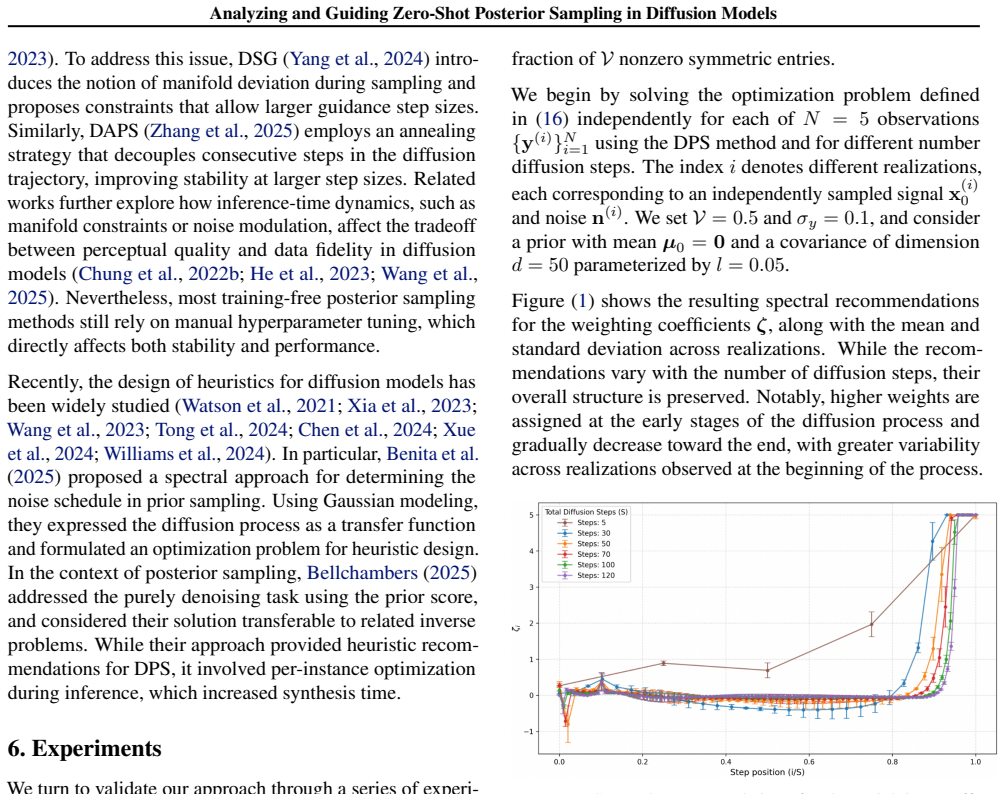
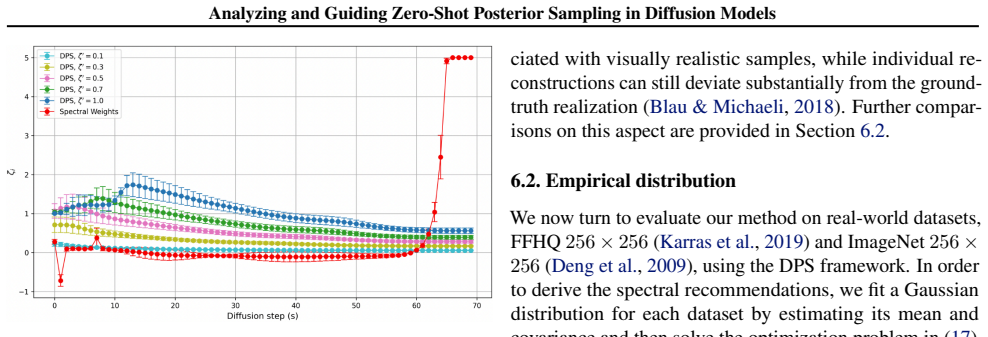
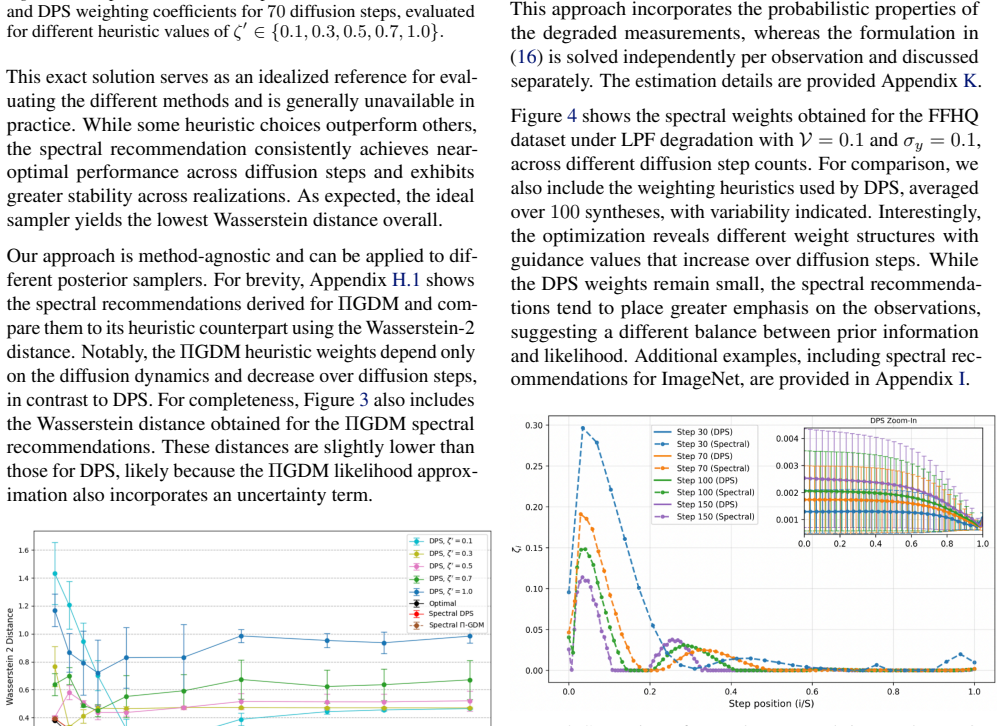
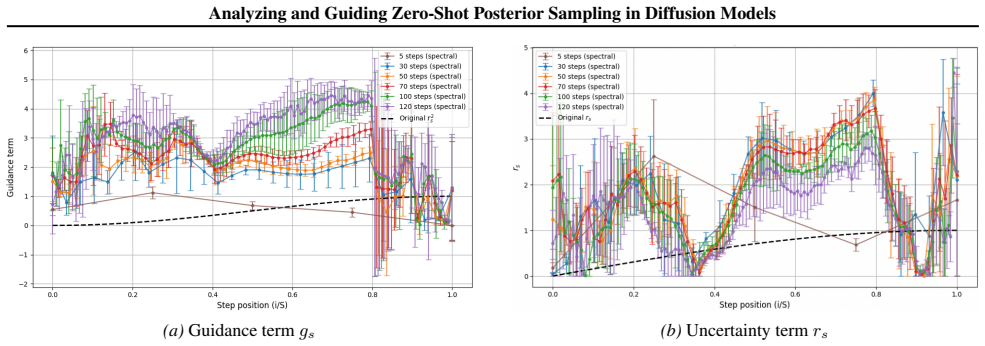
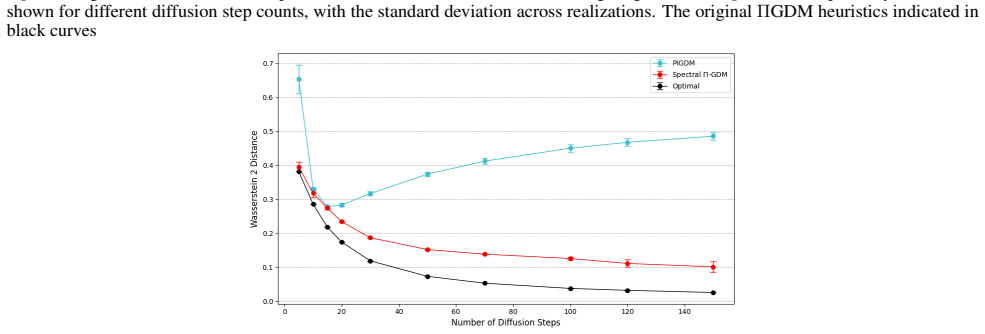
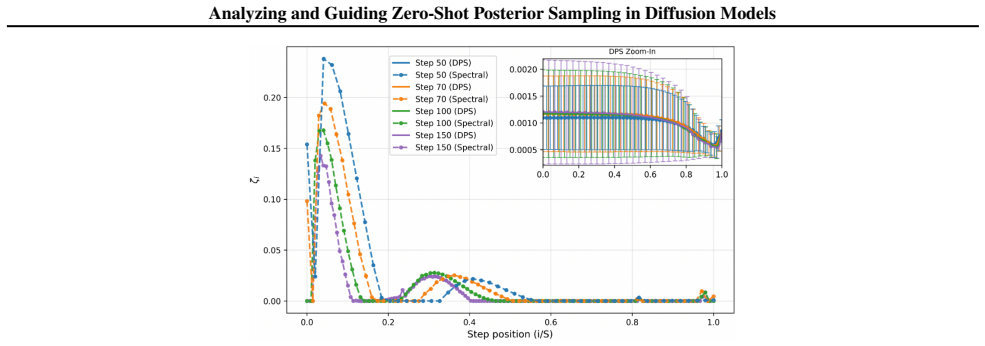
Under the Gaussianity assumption of the prior, both the ideal posterior sampler and diffusion-based reconstruction algorithms can be expressed in closed-form in the spectral domain. This enables their thorough analysis and comparisons, and supports a principled framework for parameter design that jointly accounts for the characteristics of the prior, the degraded signal, and the diffusion dynamics. The framework replaces heuristic selection and produces recommendations that differ structurally from standard approaches while varying with diffusion step size.
Load-bearing premise
The signal prior must be Gaussian; substantial deviation from Gaussian statistics removes the justification for the closed-form spectral expressions and the derived parameter recommendations.
Editorial extensions
If this is right
- Parameter selection can be made specific to the prior covariance, the measurement operator, and the current diffusion timestep instead of relying on fixed heuristics.
- The chosen parameters produce a more consistent balance between signal fidelity and perceptual quality across different degradation levels.
- The framework applies uniformly to any diffusion-based zero-shot reconstruction method once the spectral representations are available.
- Recommendations change explicitly with diffusion step size, so earlier and later steps receive different guidance.
Reading between the lines
- The same spectral analysis could serve as a diagnostic tool to detect when a real signal distribution deviates enough from Gaussian to require different handling.
- The closed-form expressions might be used to initialize or correct non-Gaussian samplers by matching low-order moments in the frequency domain.
- Traditional linear inverse-problem solvers could be re-derived as special cases of the same spectral framework to clarify their relation to diffusion methods.
Editorial analysis
A structured set of objections, weighed in public.
Referee Report
Summary. The paper analyzes zero-shot diffusion-based posterior sampling for inverse problems under an explicit Gaussian prior assumption. It derives closed-form spectral-domain expressions for both the ideal posterior sampler and approximate diffusion-based reconstruction algorithms, enabling direct comparisons. Building on these, it proposes a principled, method-agnostic framework for selecting parameters that jointly incorporate prior statistics, the degraded observation, and diffusion dynamics, with the goal of balancing perceptual quality and signal fidelity while replacing heuristic tuning.
Significance. If the Gaussian prior assumption is reasonable for the target signals, the closed-form spectral analysis provides a clear theoretical lens for understanding the behavior of diffusion-based samplers and for designing parameters in a non-heuristic way. The explicit incorporation of diffusion step size into the recommendations and the structural difference from standard heuristics are notable strengths. The work supplies reproducible derivations rather than purely empirical tuning, which supports its utility within the stated regime.
minor comments (3)
- The abstract states that the spectral recommendations 'differ structurally from standard heuristics and vary with the diffusion step size,' but the manuscript would benefit from a concise table or figure in the main text that directly contrasts the derived expressions against common heuristic choices (e.g., fixed guidance scales) for at least two representative step sizes.
- No error bars or sensitivity analysis with respect to the Gaussian covariance parameters or diffusion model training imperfections are described; adding a short robustness check (even under the maintained Gaussian assumption) would strengthen the practical claims without altering the central derivation.
- Notation for the spectral representations (e.g., definitions of the power spectra or the precise mapping from diffusion time to frequency-domain operators) should be collected in a single preliminary section or table to improve readability for readers outside the immediate subfield.
Simulated Author's Rebuttal
We thank the referee for their positive summary, recognition of the theoretical contributions under the Gaussian prior regime, and recommendation for minor revision. We appreciate the emphasis on the closed-form spectral analysis, method-agnostic parameter framework, and structural differences from heuristics. Since no specific major comments were raised in the report, we will use the minor revision to improve clarity, add minor clarifications on assumptions, and enhance reproducibility without altering the core claims.
Circularity Check
No significant circularity identified
full rationale
The paper's central derivations are explicitly scoped to the Gaussian prior regime and consist of closed-form spectral representations of the ideal posterior sampler and diffusion-based algorithms. These are obtained by direct mathematical manipulation under the stated assumption rather than by fitting parameters to data or by self-referential definitions. No load-bearing step reduces to a fitted input renamed as prediction, a self-citation chain, or an ansatz smuggled via prior work; the framework for parameter design follows from the derived expressions and is presented as method-agnostic within the Gaussian setting. The analysis therefore remains self-contained against the external ideal posterior benchmark and does not exhibit any of the enumerated circularity patterns.
Assumptions & free parameters
assumptions (1)
- domain assumption The unknown signal is drawn from a Gaussian distribution.
Cite this review
Pith. "Pith review of Analyzing and Guiding Zero-Shot Posterior Sampling in Diffusion Models." pith.science (2026). https://pith.science/paper/F3SAMOM4
@misc{pith2026260207715,
  author       = {Pith},
  title        = {Pith review of: Analyzing and Guiding Zero-Shot Posterior Sampling in Diffusion Models},
  year         = {2026},
  howpublished = {\url{https://pith.science/paper/F3SAMOM4}},
  note         = {Machine review of arXiv:2602.07715}
}
read the original abstract
Recovering a signal from its degraded measurements is a long standing challenge in science and engineering. Recently, zero-shot diffusion based methods have been proposed for such inverse problems, offering a posterior sampling based solution that leverages prior knowledge. Such algorithms incorporate the observations through inference, often leaning on manual tuning and heuristics. In this work we propose a rigorous analysis of these approximate posterior samplers, relying on a Gaussianity assumption of the prior. Under this regime, we show that both the ideal posterior sampler and diffusion-based reconstruction algorithms can be expressed in closed-form, enabling their thorough analysis and comparisons in the spectral domain. Building on these representations, we introduce a principled framework for parameter design, replacing heuristic selection strategies used to date. The proposed approach is method-agnostic and yields tailored parameter choices that jointly account for the characteristics of the prior, the degraded signal, and the diffusion dynamics. We show that our spectral recommendations differ structurally from standard heuristics and vary with the diffusion step size, resulting in a consistent balance between perceptual quality and signal fidelity.
Figures
Figures from the paper (8 more)
Lean theorems connected to this paper
-
IndisputableMonolith/Cost/FunctionalEquation.leanwashburn_uniqueness_aczel unclear?
unclearRelation between the paper passage and the cited Recognition theorem.
Under this regime, we show that both the ideal posterior sampler and diffusion-based reconstruction algorithms can be expressed in closed-form, enabling their thorough analysis and comparisons in the spectral domain.
-
IndisputableMonolith/Foundation/AlphaCoordinateFixation.leancostAlphaLog_high_calibrated_iff unclear?
unclearRelation between the paper passage and the cited Recognition theorem.
the optimal denoiser admits the following closed-form expression: x∗0=(α¯tΣ0+(1−α¯t)I)−1(√α¯tΣ0xt+(1−α¯t)μ0)
What do these tags mean?
- matches
- The paper's claim is directly supported by a theorem in the formal canon.
- supports
- The theorem supports part of the paper's argument, but the paper may add assumptions or extra steps.
- extends
- The paper goes beyond the formal theorem; the theorem is a base layer rather than the whole result.
- uses
- The paper appears to rely on the theorem as machinery.
- contradicts
- The paper's claim conflicts with a theorem or certificate in the canon.
- unclear
- Pith found a possible connection, but the passage is too broad, indirect, or ambiguous to say the theorem truly supports the claim.
Forward citations
Cited by 1 Pith paper
-
Mixture-of-Gaussians-Guided Schedule Design for Brownian Bridge Diffusion Models
Under a MoG prior, BBDM reverse dynamics admit tractable selected-label reconstruction laws that yield universal MSE- and Wasserstein-optimal bridge schedules independent of degradation.
Reference graph
Works this paper leans on
-
[1]
Bellchambers, G. Exploiting the exact denoising posterior score in training-free guidance of diffusion models.arXiv preprint arXiv:2506.13614,
-
[2]
Benita, R., Elad, M., and Keshet, J. Spectral analysis of dif- fusion models with application to schedule design.arXiv preprint arXiv:2502.00180,
-
[3]
On the trajectory regularity of ode-based diffusion sampling
Chen, D., Zhou, Z., Wang, C., Shen, C., and Lyu, S. On the trajectory regularity of ode-based diffusion sampling. arXiv preprint arXiv:2405.11326,
-
[4]
arXiv preprint arXiv:2108.02938 , year=
Choi, J., Kim, S., Jeong, Y ., Gwon, Y ., and Yoon, S. Ilvr: Conditioning method for denoising diffusion probabilistic models.arXiv preprint arXiv:2108.02938,
-
[5]
Diffusion Posterior Sampling for General Noisy Inverse Problems
Chung, H., Kim, J., Mccann, M. T., Klasky, M. L., and Ye, J. C. Diffusion posterior sampling for general noisy in- verse problems.arXiv preprint arXiv:2209.14687, 2022a. Chung, H., Sim, B., Ryu, D., and Ye, J. C. Improving diffusion models for inverse problems using manifold constraints.Advances in Neural Information Processing Systems, 35:25683–25696, 20...
-
[6]
Manifold preserv- ing guided diffusion.arXiv preprint arXiv:2311.16424, 2023
He, Y ., Murata, N., Lai, C.-H., Takida, Y ., Uesaka, T., Kim, D., Liao, W.-H., Mitsufuji, Y ., Kolter, J. Z., Salakhut- dinov, R., et al. Manifold preserving guided diffusion. arXiv preprint arXiv:2311.16424,
- [7]
-
[8]
Palette: Image-to-image diffusion models
Saharia, C., Chan, W., Chang, H., Lee, C., Ho, J., Salimans, T., Fleet, D., and Norouzi, M. Palette: Image-to-image diffusion models. InACM SIGGRAPH 2022 conference proceedings, pp. 1–10,
work page 2022
Show all 19 references
-
[9]
P., Kumar, A., Er- mon, S., and Poole, B
9 Analyzing and Guiding Zero-Shot Posterior Sampling in Diffusion Models Song, Y ., Sohl-Dickstein, J., Kingma, D. P., Kumar, A., Er- mon, S., and Poole, B. Score-based generative modeling through stochastic differential equations.arXiv preprint arXiv:2011.13456,
2011 arXiv
-
[10]
Tong, V ., Trung-Dung, H., Liu, A., Broeck, G. V . d., and Niepert, M. Learning to discretize denoising diffusion odes.arXiv preprint arXiv:2405.15506,
-
[11]
Zero-shot image restora- tion using denoising diffusion null-space model.arXiv preprint arXiv:2212.00490,
Wang, Y ., Yu, J., and Zhang, J. Zero-shot image restora- tion using denoising diffusion null-space model.arXiv preprint arXiv:2212.00490,
-
[12]
Towards more accurate diffusion model acceleration with a timestep aligner.arXiv preprint arXiv:2310.09469,
Xia, M., Shen, Y ., Lei, C., Zhou, Y ., Yi, R., Zhao, D., Wang, W., and Liu, Y .-j. Towards more accurate diffusion model acceleration with a timestep aligner.arXiv preprint arXiv:2310.09469,
-
[13]
Guidance with spherical gaussian constraint for condi- tional diffusion.arXiv preprint arXiv:2402.03201,
Yang, L., Ding, S., Cai, Y ., Yu, J., Wang, J., and Shi, Y . Guidance with spherical gaussian constraint for condi- tional diffusion.arXiv preprint arXiv:2402.03201,
-
[14]
The Reverse Process in the Time Domain Here, we present the reverse process in the time domain for the DDIM (Song et al., 2021)
= 0 Thus: (1−¯αt)Σ0HTH+σ 2 y ¯αtΣ0 +Iσ 2 y(1−¯αt) x0 = (1−¯αt)Σ0HTy+σ 2 y √¯αtΣ0xt +σ 2 y(1−¯αt)µ0 Finally: x∗ 0 = (1−¯αt)Σ0HTH+σ 2 y ¯αtΣ0 +Iσ 2 y(1−¯αt) −1 (27) (1−¯αt)Σ0HTy+σ 2 y √¯αtΣ0xt +σ 2 y(1−¯αt)µ0 B. The Reverse Process in the Time Domain Here, we present the reverse...
2021
-
[15]
While forK= 1the average Wasserstein distance trivially reduces to the standard Wasserstein distance, we consider here the regime of largeK. The mean of the true posterior from 44 can be written as: µxF |y =µ F 0 +A(y F −Λ H µF 0 ) =Ay F + (I−AΛ H)µ F 0 where: A=Λ 0ΛH T (ΛHΛ0Λ...
2020
-
[16]
xs−1 = √¯αt−1ˆx0 + p 1−¯αt−1 −σ 2s(η)ϵ θ(xs, s)−ζ i∇xt ∥y−H ˆx0∥2 2 +σ s(η)zs.(54) where: σs(η) =η r 1−¯αs−1 1−¯αs r 1− ¯αs ¯αs−1
framework under the Variance-Preserving (VP) parameterization (Song et al., 2020). xs−1 = √¯αt−1ˆx0 + p 1−¯αt−1 −σ 2s(η)ϵ θ(xs, s)−ζ i∇xt ∥y−H ˆx0∥2 2 +σ s(η)zs.(54) where: σs(η) =η r 1−¯αs−1 1−¯αs r 1− ¯αs ¯αs−1 . We consider the deterministic setting, corresponding toη=
2020
-
[17]
xs−1 = √¯αs−1ˆx0 + p 1−¯αs−1ϵθ(xs, s)−ζ i∇xt ∥y−H ˆx0∥2 2 Using the marginal property, ϵθ(xs, s) = xs − √¯αsˆx0√1−¯αs .(55) which, substituted into Equation 54, gives: xs−1 = √¯αs−1ˆx0 + p 1−¯αs−1 xs − √¯αsˆx0√1−¯αs −ζ i∇xt ∥y−H ˆx0∥2 2 xs−1 = √1−¯αs−1√1−¯αs xs + √¯αs−1 − √¯αs...
2025
-
[18]
where: σs(η) =η r 1−¯αs−1 1−¯αs r 1− ¯αs ¯αs−1
inference process and the Variance-Preserving (VP) framework, the inference procedure usingΠGDM is formulated as: xs−1 = √¯αs−1ˆx0 + p 1−¯αs−1 −σ 2s(η)ϵ θ(xs, s)(66) + √¯αs∇xs(ˆx0)THT ((r2 sHHT +σ 2 yI)−1)T (y−H ˆx0) +σ s(η)zs. where: σs(η) =η r 1−¯αs−1 1−¯αs r 1− ¯αs ¯αs−1 . ...
2025
-
[19]
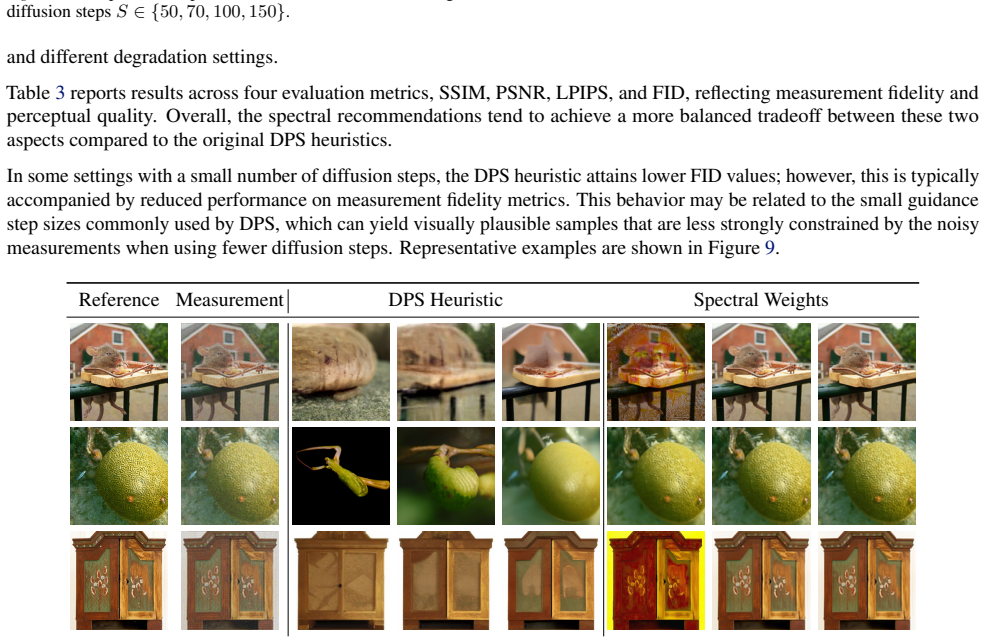
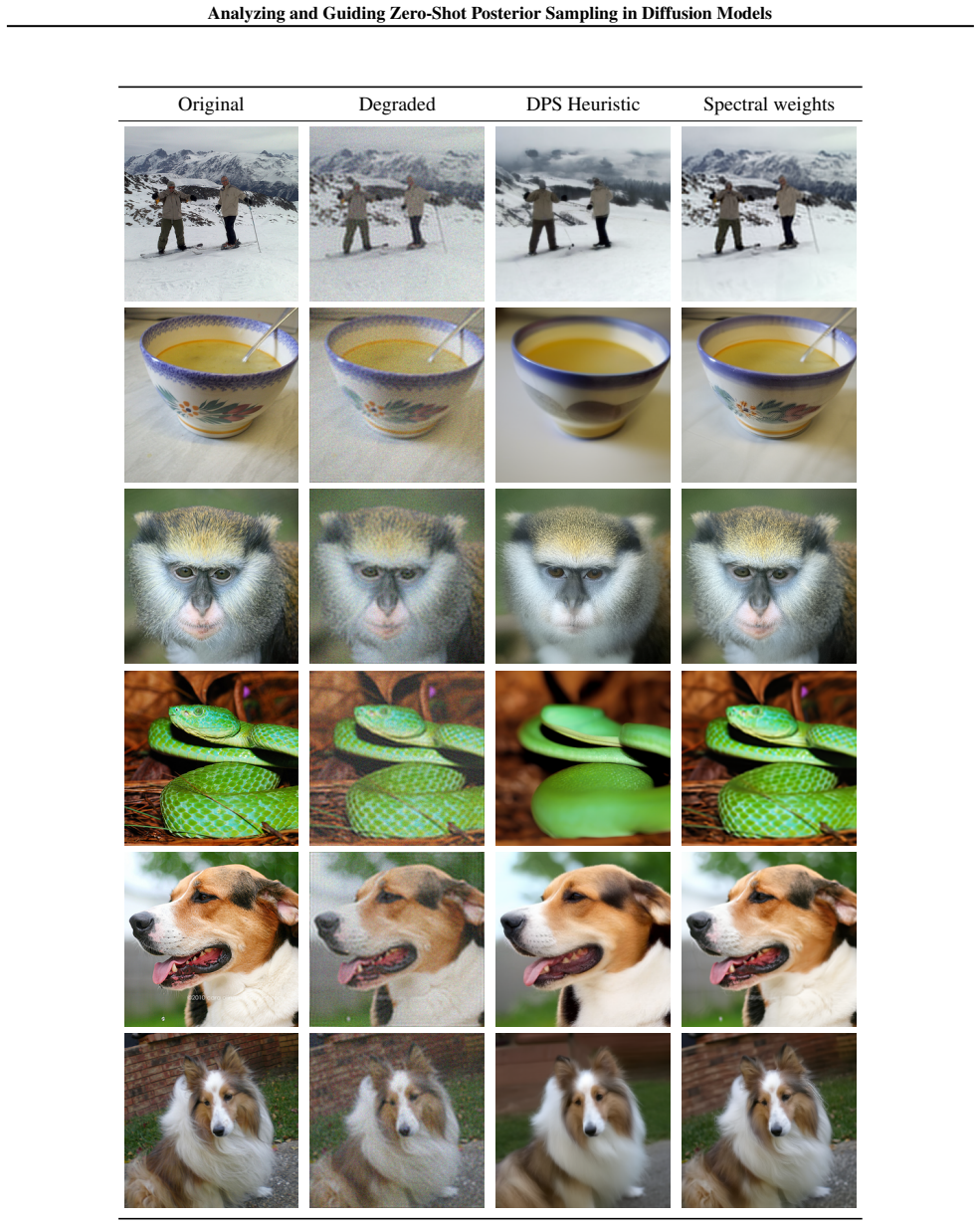
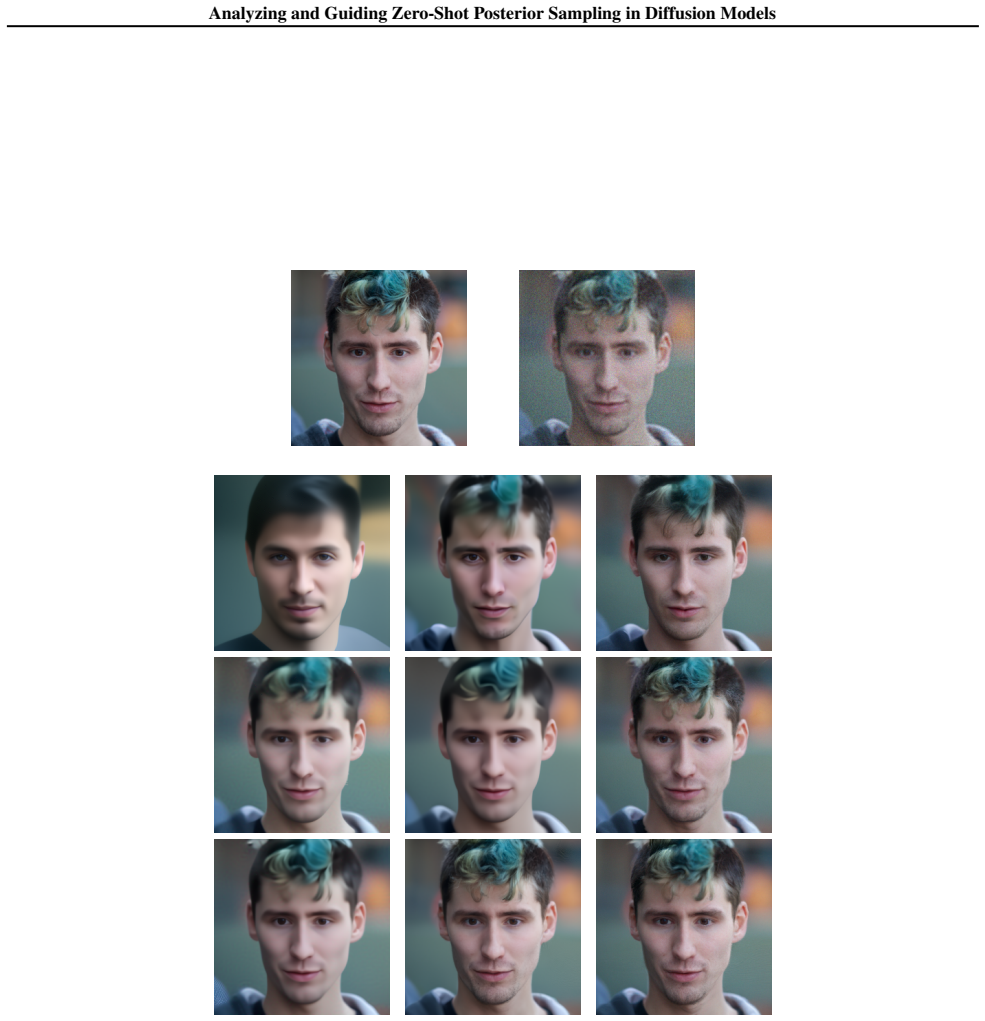
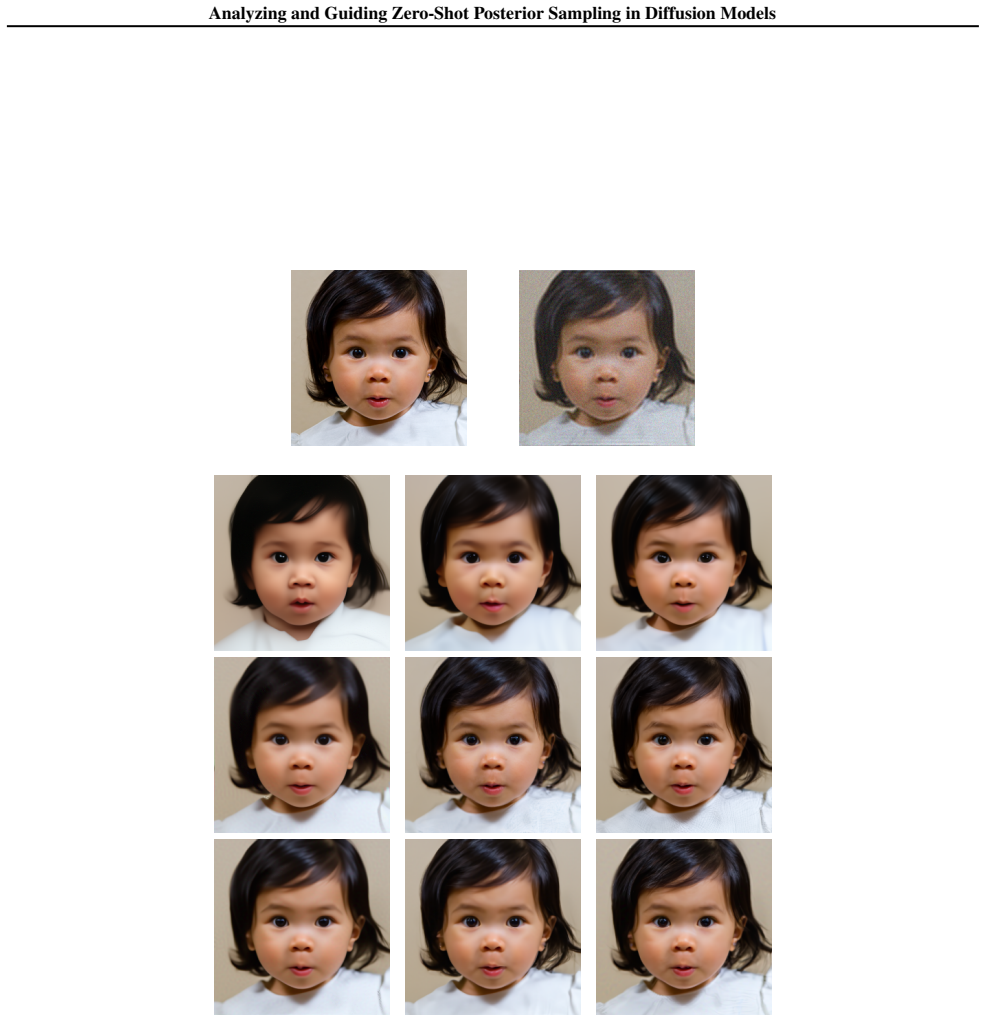
Reference Measurement DPS Heuristic Spectral Weights Figure 9.Qualitative comparison of visual results on ImageNet. Each row shows the reference image, the degraded measurement, samples obtained using the DPS heuristic at 100, 200, and 400 diffusion steps (from left to right),...
2025
Reviewed May 21, 2026 · model on record in the stance chip above.
Discussion (0). Continue with ORCID to comment.