REVIEW 2 major objections 2 minor 3 cited by
Quantum to classical relaxation dynamics of the dissipative Rydberg gas
T0 review · 2 major / 2 minor · reviewed 2026-05-10 · grok-4.3
Pith's one-line read Even in the weakly dissipative regime, Rydberg gases display slowed magnetization relaxation with transient signatures of quantum kinetically constrained dynamics in one and two dimensions.
desk verdict TWA numerics suggest kinetic constraints from Rydberg blockade survive into the weakly dissipative regime in 1D and 2D, producing slower magnetization relaxation from both polarized and scarred initial states. read the letter →
The pith
A machine-rendered reading of the paper's core claim, the machinery that carries it, and where it could break.
The reading
What carries the argument
The truncated Wigner approximation, a phase-space method that captures correlated many-body dynamics beyond classical rate equations, applied to the Rydberg blockade.
What would settle it
An exact many-body simulation on small two-dimensional lattices or a direct experimental measurement of magnetization decay times in Rydberg atom arrays that deviates from the truncated Wigner predictions would falsify the reported slowdown and constraint signatures.
Extended reading notes
Core claim
Using the truncated Wigner approximation, the relaxation of magnetization in a dissipative Rydberg gas starting from fully polarized or Néel initial states exhibits a pronounced slowdown toward the stationary state, accompanied by transient signatures of quantum kinetically constrained dynamics, in both one and two spatial dimensions.
Load-bearing premise
The truncated Wigner approximation remains quantitatively reliable for capturing the emergence of kinetic constraints on timescales where coherent and dissipative processes are comparable in two-dimensional geometries.
Editorial extensions
If this is right
- Kinetic constraints survive into the regime where coherent and dissipative rates are comparable.
- The slowdown in magnetization relaxation appears for both fully polarized and quantum-scar initial states.
- The effect is observable in two-dimensional geometries when system sizes are large.
- Transient quantum signatures precede the eventual classical glassy relaxation.
Reading between the lines
- Quantum coherence can temporarily reinforce the blockade-induced constraints before dissipation dominates.
- Similar slowdowns may appear in other open quantum many-body systems whose classical limits are kinetically constrained.
- The approach offers a route to study how quantum scars influence dissipative relaxation dynamics.
Editorial analysis
A structured set of objections, weighed in public.
Referee Report
Summary. The manuscript examines the relaxation dynamics of a dissipative Rydberg gas in the regime where coherent Rabi driving and dissipation compete, employing the truncated Wigner approximation (TWA) to access large system sizes in one and two dimensions. Starting from a fully polarized initial state and a Néel state (associated with quantum scars), the authors report a pronounced slowdown in the relaxation of magnetization toward the stationary state, together with transient signatures of quantum kinetically constrained dynamics induced by the Rydberg blockade.
Significance. If the TWA results are quantitatively reliable, the work provides numerical evidence that kinetic constraints and associated slowdowns persist into the weakly dissipative regime in 2D, extending known classical rate-equation behavior and offering a bridge between quantum scar physics and glassy relaxation in Rydberg systems. The use of TWA for correlated many-body dynamics beyond mean-field rate equations is a methodological strength for scaling to experimentally relevant sizes.
major comments (2)
- [Methods and Results sections (TWA implementation and 2D simulations)] The central claim that TWA captures transient quantum kinetically constrained dynamics in 2D on timescales where coherent and dissipative rates are comparable rests on the approximation's fidelity, yet no explicit benchmarks against exact diagonalization, quantum trajectory methods, or small-system exact results are provided to quantify errors from neglected higher-order correlations. This validation is load-bearing for the 2D results.
- [Numerical results for 2D lattices] The reported magnetization slowdown and constraint signatures in 2D could be sensitive to the truncation in the Wigner sampling; without convergence checks with respect to the number of trajectories or explicit comparison to the classical rate-equation limit in the same geometries, it remains unclear whether the observed transients are genuine quantum features or artifacts of the semiclassical approximation.
minor comments (2)
- [Model Hamiltonian] Clarify the precise definition of the blockade radius and its implementation in the TWA phase-space sampling, including any cutoff or smoothing used for long-range interactions.
- [Introduction] The abstract and introduction would benefit from a brief statement of the parameter regime (e.g., values of Rabi frequency versus decay rate) explored in the simulations.
Simulated Author's Rebuttal
We thank the referee for their positive evaluation of the work's potential significance and for the constructive major comments regarding the validation of the TWA and the numerical results. We provide point-by-point responses below and indicate the revisions we will make to strengthen the manuscript.
read point-by-point responses
-
Referee: The central claim that TWA captures transient quantum kinetically constrained dynamics in 2D on timescales where coherent and dissipative rates are comparable rests on the approximation's fidelity, yet no explicit benchmarks against exact diagonalization, quantum trajectory methods, or small-system exact results are provided to quantify errors from neglected higher-order correlations. This validation is load-bearing for the 2D results.
Authors: We agree that validating the TWA against exact methods is important to support the claims for 2D systems. While the manuscript focuses on large systems where exact methods are intractable, we will add in the revised version explicit benchmarks against exact diagonalization for small 1D chains in the relevant parameter regime to quantify the errors. We will also elaborate on the limitations of the TWA and why it is expected to capture the essential physics in 2D based on its performance in 1D and previous applications to Rydberg gases. For large 2D, full error quantification via exact methods remains beyond current computational capabilities. revision: partial
-
Referee: The reported magnetization slowdown and constraint signatures in 2D could be sensitive to the truncation in the Wigner sampling; without convergence checks with respect to the number of trajectories or explicit comparison to the classical rate-equation limit in the same geometries, it remains unclear whether the observed transients are genuine quantum features or artifacts of the semiclassical approximation.
Authors: We appreciate this suggestion. To address concerns about convergence and the distinction from classical behavior, we will include in the revised manuscript convergence checks with increasing number of trajectories for the 2D data, demonstrating that the reported slowdown and signatures are stable. Furthermore, we will add a comparison of the TWA dynamics to the classical rate-equation results in identical 2D geometries and parameters, which will highlight the quantum corrections responsible for the observed transients. revision: yes
Circularity Check
No circularity: claims rest on direct TWA simulation outputs
full rationale
The paper's central results are obtained by numerically evolving the truncated Wigner approximation on finite lattices for two explicit initial states (fully polarized and Néel). The observed magnetization slowdown and transient kinetic-constraint signatures are read off from these trajectories; no parameter is fitted to a subset of the data and then re-used as a prediction, no self-citation supplies a uniqueness theorem that forces the reported behavior, and the TWA itself is invoked as a standard phase-space method rather than being derived from the target observables. The analysis therefore remains self-contained against external benchmarks.
Assumptions & free parameters
assumptions (1)
- domain assumption The truncated Wigner approximation accurately captures correlated many-body dynamics on timescales where coherent and dissipative processes compete.
Cite this review
Pith. "Pith review of Quantum to classical relaxation dynamics of the dissipative Rydberg gas." pith.science (2026). https://pith.science/paper/2604.10538
@misc{pith2026260410538,
  author       = {Pith},
  title        = {Pith review of: Quantum to classical relaxation dynamics of the dissipative Rydberg gas},
  year         = {2026},
  howpublished = {\url{https://pith.science/paper/2604.10538}},
  note         = {Machine review of arXiv:2604.10538}
}
read the original abstract
We investigate the relaxation dynamics of a Rydberg gas in regimes where coherent processes and dissipation compete. In the strongly dissipative limit, the dynamics is known to be governed by an effective classical rate equation and to exhibit kinetically constrained, glassy relaxation towards a trivial stationary state. This behaviour originates from the Rydberg blockade, which prevents simultaneous excitations within a characteristic blockade radius. However, the fate of kinetic constraints in the weakly dissipative limit remains unexplored in large systems above one dimension. To access large system sizes and two-dimensional geometries, we employ the truncated Wigner approximation, a phase-space method that captures correlated many-body dynamics beyond classical rate equations. To probe the emergence of kinetic constraints on timescales where coherent and dissipative processes are comparable, we analyse the relaxation dynamics starting from two initial states: a fully polarised state and a N\'eel state, which belongs to a manifold of so-called quantum scars. In both cases, we observe a pronounced slowdown in the relaxation of the magnetisation towards the stationary state and identify transient signatures of quantum kinetically constrained dynamics in one and two dimensions.
Figures


Figures from the paper (6 more)


Forward citations
Cited by 3 Pith papers
-
Path integral approach to the truncated Wigner approximation of driven-dissipative spins
A Keldysh path-integral formulation of dissipative spin-1/2 TWA shows that SU(2) star-product corrections in the dissipative sector are essential and reproduces exact single-spin decay.
-
Don't truncate, decompose: mean-field dynamics of long-range quantum systems from strongly correlated states
Strongly correlated long-range open quantum systems can be solved exactly by decomposing the initial state into independent mean-field trajectories and averaging.
-
Truncated Wigner approximation for spins in continuous phase space
The truncated Wigner approximation for spins is systematically derived, extended to spectra and thermal states, and shown to be equivalent to a consistent path-integral treatment when dissipative operator products are...
Reference graph
Works this paper leans on
-
[1]
In this strongly dissipative limit, coherences decay rapidly and can be adiabatically eliminated
Coherent and classical relaxation regimes A particularly interesting regime arises when the de- phasing rate is much larger than the Rabi frequency, γ≫Ω. In this strongly dissipative limit, coherences decay rapidly and can be adiabatically eliminated. The dynamics is then described by an effective classical mas- ter equation [29] ∂tρ= X i Γi σ+ i ρσ− i +σ...
-
[2]
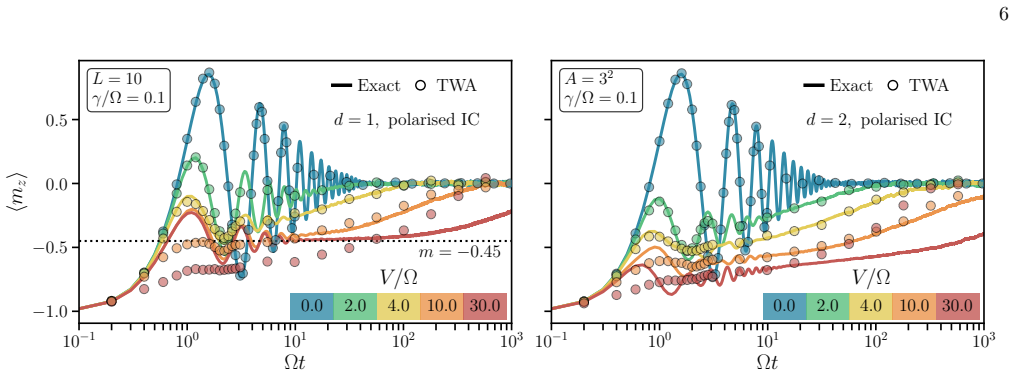
Emergence of kinetic constraints at weak dissipation Fig. 3 shows the relaxation of⟨m z(t)⟩for increas- ing interaction strengthV /Ω ind= 1,2 dimensions for the fully polarised initial state. For weak interac- tions,V /Ω≲5.0, TWA quantitatively reproduces the exact dynamics for all times, while for stronger interac- tions,V /Ω≲10.0, the amplitude of inter...
-
[3]
ind= 2. In the weakly dissipative case, coherent dynamics gives rise to this plateau, followed by a slower, dissipation-dominated relaxation. The N´ eel initial state ind= 2 suffers from finite-size effects for the small 3 2 lattice. To investigate this further, we apply TWA in the following to larger systems. B. Kinetic constraints in large systems A key...
-
[4]
4(a) at fixed interactionV /Ω = 10.0 ford= 1 (left) andd= 2 (right) for the polarised initial state
Magnetisation relaxation We consider different dephasing strengthsγ/Ω in Fig. 4(a) at fixed interactionV /Ω = 10.0 ford= 1 (left) andd= 2 (right) for the polarised initial state. As seen on the left of Fig. 4(a) for theL= 100 chain, the relax- ation approaches a plateau at⟨m z⟩ ≃ −0.48, consistent with the hard-dimer constraint discussed in Sec. IV A. We ...
-
[5]
Spatial correlations Spatial correlations provide additional insight into the emergence of collective behaviour during the dynamics. To quantify these, we introduce the MandelQ-parameter Q(t) = χ(t) χrnd(t) −1,(21) where χ(t) =N ⟨m2 z(t)⟩ − ⟨mz(t)⟩2 (22) denotes the variance of the magnetisation. As a refer- ence value for the upcoming analysis, we consid...
work page 2024
-
[6]
Keldysh path-integral formulation The Keldysh path integral is defined on a closed time contourCrunning fromt i tot f and back tot i [92, 93]. In the absence of dissipation, for the fieldsψ ± on the for- ward and backward branches, the generating functional reads Z= Z D[ψ±]P 0[ψ± 0 ]e iSKeldysh[ψ±],(A1) whereD[ψ ±]≡ D[ψ +, ψ−] is the functional integratio...
-
[7]
Keldysh rotation Introducing the Keldysh rotation, the fields can be written in terms of “classical” and “quantum” compo- nents, given by ψc = 1 2(ψ+ +ψ −), ψ q =ψ + −ψ −.(A6) In this basis, the action admits an expansion in powers ofψ q, where the linear term follows by expanding the coherent contribution (A2) inψ ± =ψ c ± 1 2 ψq, L(ψc + 1 2 ψq)− L(ψ c −...
-
[8]
The weighte iS in the path integral now reads eiS = exp i Z dt ψq αEα[ψc] exp i i 2 Z dt ψq αDαβψq β
Semiclassical approximation and emergence of the stochastic equations The truncated Wigner approximation consists of trun- cating the action (A13) at quadratic order in the quan- tum fieldsψ q. The weighte iS in the path integral now reads eiS = exp i Z dt ψq αEα[ψc] exp i i 2 Z dt ψq αDαβψq β . (A14) The quadratic term can be represented by a Gaussian id...
Show all 104 references
-
[9]
Application to the long-range interacting, dissipative Rydberg gas For spin-1/2 degrees of freedom, operators ˆσ α k are re- placed by classical vectors si = (sx i , sy i , sz i ),(A29) 13 with Poisson algebra {sα i , O}p = 2 X βγ ϵαβγ ∂O ∂sβ i sγ i ,(A30) whereϵ αβγ is the to...
-
[10]
Stochastic trajectories of spins In this appendix, we summarise the numerical imple- mentation used to simulate the dissipative spin dynam- ics discussed in the main text. The dynamics of each siteiin our lattice is represented by a classical spin vec- tors i(t) = (s x i , sy ...
-
[11]
As a conse- quence, the discrete update is not an orthogonal trans- formation and does not strictly preserve the constraint |si|=r 0
Rotation-based Stratonovich integrator In numerical implementations, conventional SDE solvers (such as Euler–Maruyama or Heun-type schemes) perform linear additive updates, sn+1 i ≈s n i +f n i ∆t+g n i ∆Wi (B8) rather than finite rotations on the sphere. As a conse- quence, t...
-
[12]
Weimer, A
H. Weimer, A. Kshetrimayum, and R. Or´ us, Simulation methods for open quantum many-body systems, Reviews of Modern Physics93, 10.1103/revmodphys.93.015008 (2021)
2021 doi
-
[13]
Fazio, J
R. Fazio, J. Keeling, L. Mazza, and M. Schir` o, Many- body open quantum systems, SciPost Physics Lecture Notes 10.21468/scipostphyslectnotes.99 (2025)
2025 doi
-
[14]
L. M. Sieberer, M. Buchhold, J. Marino, and S. Diehl, Universality in driven open quantum matter, Reviews of Modern Physics97, 10.1103/revmodphys.97.025004 (2025)
2025 doi
-
[15]
P. M. Harrington, E. J. Mueller, and K. W. Murch, Engi- neered dissipation for quantum information science, Na- ture Reviews Physics4, 660–671 (2022)
2022
-
[16]
Diehl, A
S. Diehl, A. Micheli, A. Kantian, B. Kraus, H. P. B¨ uchler, and P. Zoller, Quantum states and phases in driven open quantum systems with cold atoms, Nature Physics4, 878–883 (2008)
2008
-
[17]
X. e. a. Mi, Stable quantum-correlated many-body states through engineered dissipation, Science383, 1332–1337 (2024)
2024
-
[18]
Georgescu, S
I. Georgescu, S. Ashhab, and F. Nori, Quantum simula- tion, Reviews of Modern Physics86, 153–185 (2014)
2014
-
[19]
Gross and I
C. Gross and I. Bloch, Quantum simulations with ultra- cold atoms in optical lattices, Science357, 995 (2017)
2017
-
[20]
Bloch, J
I. Bloch, J. Dalibard, and S. Nascimbene, Quantum sim- ulations with ultracold quantum gases, Nature Physics 8, 267 (2012). 16
2012
-
[21]
Lewenstein, A
M. Lewenstein, A. Sanpera, V. Ahufinger, B. Damski, A. Sen(De), and U. Sen, Ultracold atomic gases in op- tical lattices: mimicking condensed matter physics and beyond, Advances in Physics56, 243–379 (2007)
2007
-
[22]
Blatt and C
R. Blatt and C. F. Roos, Quantum simulations with trapped ions, Nature Physics8, 277 (2012)
2012
-
[23]
Schneider, D
C. Schneider, D. Porras, and T. Schaetz, Experimental quantum simulations of many-body physics with trapped ions, Reports on Progress in Physics75, 024401 (2012)
2012
-
[24]
Monroe, W
C. Monroe, W. Campbell, L.-M. Duan, Z.-X. Gong, A. Gorshkov, P. Hess, R. Islam, K. Kim, N. Linke, G. Pagano, P. Richerme, C. Senko, and N. Yao, Programmable quantum simulations of spin systems with trapped ions, Reviews of Modern Physics93, 10.1103/revmodphys.93.025001 (2021)
2021 doi
-
[25]
Weimer, M
H. Weimer, M. M¨ uller, I. Lesanovsky, P. Zoller, and H. P. B¨ uchler, A Rydberg quantum simulator, Nature Physics 6, 382–388 (2010)
2010
-
[26]
Saffman, T
M. Saffman, T. G. Walker, and K. Mølmer, Quantum information with Rydberg atoms, Reviews of Modern Physics82, 2313–2363 (2010)
2010
-
[27]
L¨ ow, H
R. L¨ ow, H. Weimer, J. Nipper, J. B. Balewski, B. Butscher, H. P. B¨ uchler, and T. Pfau, An experimen- tal and theoretical guide to strongly interacting Rydberg gases, Journal of Physics B: Atomic, Molecular and Op- tical Physics45, 113001 (2012)
2012
-
[28]
Browaeys and T
A. Browaeys and T. Lahaye, Many-body physics with individually controlled Rydberg atoms, Nature Physics 16, 132–142 (2020)
2020
-
[29]
Urban, T
E. Urban, T. A. Johnson, T. Henage, L. Isenhower, D. Yavuz, T. Walker, and M. Saffman, Observation of Rydberg blockade between two atoms, Nature Physics5, 110 (2009)
2009
-
[30]
Ga¨ etan, Y
A. Ga¨ etan, Y. Miroshnychenko, T. Wilk, A. Chotia, M. Viteau, D. Comparat, P. Pillet, A. Browaeys, and P. Grangier, Observation of collective excitation of two individual atoms in the Rydberg blockade regime, Nature Physics5, 115 (2009)
2009
-
[32]
Jaksch, J
D. Jaksch, J. I. Cirac, P. Zoller, S. L. Rolston, R. Cˆ ot´ e, and M. D. Lukin, Fast quantum gates for neutral atoms, Physical Review Letters85, 2208–2211 (2000)
2000
-
[33]
Y. O. Dudin, L. Li, F. Bariani, and A. Kuzmich, Obser- vation of coherent many-body Rabi oscillations, Nature Physics8, 790–794 (2012)
2012
-
[34]
Schauß, M
P. Schauß, M. Cheneau, M. Endres, T. Fukuhara, S. Hild, A. Omran, T. Pohl, C. Gross, S. Kuhr, and I. Bloch, Observation of spatially ordered structures in a two- dimensional Rydberg gas, Nature491, 87–91 (2012)
2012
-
[35]
Barredo, S
D. Barredo, S. Ravets, H. Labuhn, L. B´ eguin, A. Vernier, F. Nogrette, T. Lahaye, and A. Browaeys, Demonstration of a strong Rydberg blockade in three-atom systems with anisotropic interactions, Physical Review Letters112, 10.1103/physrevlett.112.183002 (2014)
2014 doi
-
[36]
Binder and W
K. Binder and W. Kob,Glassy materials and disor- dered solids: An introduction to their statistical mechan- ics(World scientific, 2011)
2011
-
[37]
Sanders, M
J. Sanders, M. Jonckheere, and S. Kokkelmans, Sub- poissonian statistics of jamming limits in ultracold Ryd- berg gases, Physical review letters115, 043002 (2015)
2015
-
[38]
Ritort and P
F. Ritort and P. Sollich, Glassy dynamics of kinetically constrained models, Advances in physics52, 219 (2003)
2003
-
[39]
Aolita, F
L. Aolita, F. de Melo, and L. Davidovich, Open-system dynamics of entanglement:a key issues review, Reports on Progress in Physics78, 042001 (2015)
2015
-
[40]
Lesanovsky and J
I. Lesanovsky and J. P. Garrahan, Kinetic constraints, hierarchical relaxation, and onset of glassiness in strongly interacting and dissipative Rydberg gases, Phys- ical Review Letters111, 10.1103/physrevlett.111.215305 (2013)
2013 doi
-
[41]
Marcuzzi, J
M. Marcuzzi, J. Schick, B. Olmos, and I. Lesanovsky, Effective dynamics of strongly dissipative Rydberg gases, Journal of Physics A: Mathematical and Theoretical47, 482001 (2014)
2014
-
[42]
P´ erez-Espigares, I
C. P´ erez-Espigares, I. Lesanovsky, J. P. Garrahan, and R. Guti´ errez, Glassy dynamics due to a trajectory phase transition in dissipative Rydberg gases, Physical Review A98, 10.1103/physreva.98.021804 (2018)
2018 doi
-
[43]
Guti´ errez, J
R. Guti´ errez, J. P. Garrahan, and I. Lesanovsky, Self- similar nonequilibrium dynamics of a many-body sys- tem with power-law interactions, Physical Review E92, 10.1103/physreve.92.062144 (2015)
2015 doi
-
[45]
E. Levi, R. Guti´ errez, and I. Lesanovsky, Quantum non- equilibrium dynamics of Rydberg gases in the presence of dephasing noise of different strengths, Journal of Physics B: Atomic, Molecular and Optical Physics49, 184003 (2016)
2016
-
[46]
D. W. Sch¨ onleber, M. G¨ arttner, and J. Evers, Coher- ent versus incoherent excitation dynamics in dissipative many-body Rydberg systems, Physical Review A89, 10.1103/physreva.89.033421 (2014)
2014 doi
-
[47]
Mattioli, A
M. Mattioli, A. W. Gl¨ atzle, and W. Lechner, From clas- sical to quantum non-equilibrium dynamics of Rydberg excitations in optical lattices, New Journal of Physics17, 113039 (2015)
2015
-
[48]
C. Ates, B. Olmos, J. P. Garrahan, and I. Lesanovsky, Dynamical phases and intermittency of the dissipa- tive quantum ising model, Physical Review A85, 10.1103/physreva.85.043620 (2012)
2012 doi
-
[49]
Lesanovsky, M
I. Lesanovsky, M. van Horssen, M. Gut ¸˘ a, and J. P. Garrahan, Characterization of dynamical phase transi- tions in quantum jump trajectories beyond the proper- ties of the stationary state, Physical Review Letters110, 10.1103/physrevlett.110.150401 (2013)
2013 doi
-
[50]
van Horssen, E
M. van Horssen, E. Levi, and J. P. Garrahan, Dy- namics of many-body localization in a translation- invariant quantum glass model, Physical Review B92, 10.1103/physrevb.92.100305 (2015)
2015 doi
-
[51]
Z. Lan, M. van Horssen, S. Powell, and J. P. Garra- han, Quantum slow relaxation and metastability due to dynamical constraints, Physical Review Letters121, 10.1103/physrevlett.121.040603 (2018)
2018 doi
-
[52]
D. C. Rose, K. Macieszczak, I. Lesanovsky, and J. P. Garrahan, Hierarchical classical metastability in an open quantum east model (2020), arXiv:2010.15304 [cond- mat.stat-mech]
2020
-
[53]
Olmos, I
B. Olmos, I. Lesanovsky, and J. P. Garrahan, Out-of- equilibrium evolution of kinetically constrained many- body quantum systems under purely dissipative dynam- ics, Physical Review E90, 10.1103/physreve.90.042147 17 (2014)
2014 doi
-
[54]
M. Cech, M. Cea, M. C. Ba˜ nuls, I. Lesanovsky, and F. Carollo, Space-time correlations in monitored kineti- cally constrained discrete-time quantum dynamics, Phys- ical Review Letters134, 10.1103/2lxs-wccj (2025)
2025 doi
-
[55]
M. Cech, C. D. Fazio, M. Cea, M. C. Ba˜ nuls, I. Lesanovsky, and F. Carollo, Revealing emergent many-body phenomena by analyzing large-scale space- time records of monitored quantum systems (2025), arXiv:2507.00944 [quant-ph]
2025 arXiv
-
[56]
Klobas, C
K. Klobas, C. De Fazio, and J. P. Garrahan, Exact pre- transition effects in kinetically constrained circuits: Dy- namical fluctuations in the floquet-east model, Physical Review E110, 10.1103/physreve.110.l022101 (2024)
2024 doi
-
[57]
Causer, M
L. Causer, M. C. Ba˜ nuls, and J. P. Garrahan, Dy- namical heterogeneity and large deviations in the open quantum east glass model from tensor networks (2024), arXiv:2404.03750 [cond-mat.stat-mech]
2024
-
[58]
D. A. Hryniuk and M. H. Szyma´ nska, Variational approach to open quantum systems with long-range competing interactions, Communications Physics9, 10.1038/s42005-025-02479-2 (2026)
2026 doi
-
[59]
Mc Keever and M
C. Mc Keever and M. Szyma´ nska, Stable ipepo tensor- network algorithm for dynamics of two-dimensional open quantum lattice models, Physical Review X11, 021035 (2021)
2021
-
[60]
Kilda, A
D. Kilda, A. Biella, M. Schir` o, R. Fazio, and J. Keeling, On the stability of the infinite projected entangled pair operator ansatz for driven-dissipative 2D lattices, SciPost Physics Core4, 10.21468/scipostphyscore.4.1.005 (2021)
2021 doi
-
[61]
Dunham and M
J. Dunham and M. H. Szyma´ nska, Efficient time evolution of 2D open-quantum lattice models with long-range interactions using tensor networks (2025), arXiv:2512.01781 [quant-ph]
2025
-
[62]
Polkovnikov, Phase space representation of quantum dynamics, Annals of Physics325, 1790–1852 (2010)
A. Polkovnikov, Phase space representation of quantum dynamics, Annals of Physics325, 1790–1852 (2010)
2010
-
[63]
Polkovnikov, Quantum corrections to the dynamics of interacting bosons: Beyond the truncated Wigner ap- proximation, Physical Review A68, 053604 (2003)
A. Polkovnikov, Quantum corrections to the dynamics of interacting bosons: Beyond the truncated Wigner ap- proximation, Physical Review A68, 053604 (2003)
2003
-
[64]
P. B. Blakie, A. Bradley, M. Davis, R. Ballagh, and C. Gardiner, Dynamics and statistical mechanics of ultra- cold bose gases using c-field techniques, Advances in Physics57, 363 (2008)
2008
-
[65]
S. M. Davidson, D. Sels, and A. Polkovnikov, Semiclassi- cal approach to dynamics of interacting fermions, Annals of Physics384, 128 (2017)
2017
-
[66]
Schachenmayer, A
J. Schachenmayer, A. Pikovski, and A. Rey, Many- body quantum spin dynamics with Monte Carlo trajec- tories on a discrete phase space, Physical Review X5, 10.1103/physrevx.5.011022 (2015)
2015 doi
-
[67]
Qu and A
C. Qu and A. M. Rey, Spin squeezing and many-body dipolar dynamics in optical lattice clocks, Physical Re- view A100, 10.1103/physreva.100.041602 (2019)
2019 doi
-
[68]
H. Liu, S. B. J¨ ager, X. Yu, S. Touzard, A. Shankar, M. J. Holland, and T. L. Nicholson, Rugged mHz-linewidth su- perradiant laser driven by a hot atomic beam, Physi- cal Review Letters125, 10.1103/physrevlett.125.253602 (2020)
2020 doi
-
[69]
Huber, P
J. Huber, P. Kirton, and P. Rabl, Phase-space methods for simulating the dissipative many-body dynamics of collective spin systems, SciPost Physics10, 10.21468/sci- postphys.10.2.045 (2021)
2021 doi
-
[70]
Huber, A
J. Huber, A. M. Rey, and P. Rabl, Realistic simulations of spin squeezing and cooperative coupling effects in large ensembles of interacting two-level systems, Physical Re- view A105, 10.1103/physreva.105.013716 (2022)
2022 doi
-
[71]
C. D. Mink, D. Petrosyan, and M. Fleischhauer, Hybrid discrete-continuous truncated Wigner approximation for driven, dissipative spin systems, Physical Review Re- search4, 10.1103/physrevresearch.4.043136 (2022)
2022 doi
-
[73]
C. D. Mink and M. Fleischhauer, Collective radiative in- teractions in the discrete truncated Wigner approxima- tion, SciPost Physics15, 10.21468/scipostphys.15.6.233 (2023)
2023 doi
-
[74]
Tebbenjohanns, C
F. Tebbenjohanns, C. D. Mink, C. Bach, A. Rauschen- beutel, and M. Fleischhauer, Predicting correlations in superradiant emission from a cascaded quantum system, Physical Review A110, 10.1103/physreva.110.043713 (2024)
2024 doi
-
[75]
X. H. H. Zhang, D. Malz, and P. Rabl, Robust Super- radiance and Spontaneous Spin Ordering in Disordered Waveguide QED, arXiv:2510.13671 (2025)
2025 arXiv
-
[76]
Ruks, Semiclassical Simulation of Homogeneous Emit- ter Ensembles with Local Dissipation, arXiv:2602.14025 (2026)
L. Ruks, Semiclassical Simulation of Homogeneous Emit- ter Ensembles with Local Dissipation, arXiv:2602.14025 (2026)
2026
-
[77]
Mondal, L
D. Mondal, L. F. Santos, and S. Sinha, Dissipation as a Resource: Synchronization, Coherence Recovery, and Chaos Control, arXiv:2602.16817 (2026)
2026
-
[78]
Xiang, Z
Y.-X. Xiang, Z. Bai, and Y.-Q. Ma, Quantum predator- prey cycles in dissipative Rydberg lattices (2025), arXiv:2510.26295 [quant-ph]
2025
-
[79]
Hosseinabadi, O
H. Hosseinabadi, O. Chelpanova, and J. Marino, User- friendly TWA for dissipative spin dynamics, PRX Quan- tum6, 030344 (2025), arXiv:2503.17443 [quant-ph]
2025
-
[80]
Bernien, S
H. Bernien, S. Schwartz, A. Keesling, H. Levine, A. Om- ran, H. Pichler, S. Choi, A. S. Zibrov, M. Endres, M. Greiner, V. Vuleti´ c, and M. D. Lukin, Probing many- body dynamics on a 51-atom quantum simulator, Nature 551, 579–584 (2017)
2017
-
[81]
C. J. Turner, A. A. Michailidis, D. A. Abanin, M. Serbyn, and Z. Papi´ c, Weak ergodicity breaking from quantum many-body scars, Nature Physics14, 745–749 (2018)
2018
-
[82]
Serbyn, D
M. Serbyn, D. A. Abanin, and Z. Papi´ c, Quantum many- body scars and weak breaking of ergodicity, Nature Physics17, 675–685 (2021)
2021
-
[83]
W. K. Wootters, A Wigner-function formulation of finite- state quantum mechanics, Annals of Physics176, 1 (1987)
1987
-
[84]
Sundar, K
B. Sundar, K. C. Wang, and K. R. A. Hazzard, Anal- ysis of continuous and discrete Wigner approximations for spin dynamics, Physical Review A99, 10.1103/phys- reva.99.043627 (2019)
2019 doi
-
[85]
B. Zhu, A. M. Rey, and J. Schachenmayer, A generalized phase space approach for solving quantum spin dynamics, New Journal of Physics21, 082001 (2019)
2019
-
[86]
A. J. Daley, Quantum trajectories and open many- body quantum systems, Advances in Physics63, 77–149 (2014)
2014
-
[87]
Mercurio, Y.-T
A. Mercurio, Y.-T. Huang, L.-X. Cai, Y.-N. Chen, V. Savona, and F. Nori, Quantumtoolbox.jl: An efficient julia framework for simulating open quantum systems, Quantum9, 1866 (2025)
2025
-
[88]
Schempp, G
H. Schempp, G. G¨ unter, M. Robert-de Saint-Vincent, C. S. Hofmann, D. Breyel, A. Komnik, D. W. Sch¨ onleber, 18 M. G¨ arttner, J. Evers, S. Whitlock, and M. Weidem¨ uller, Full counting statistics of laser excited Rydberg aggre- gates in a one-dimensional geometry, Physical R...
2014 doi
-
[89]
Urvoy, F
A. Urvoy, F. Ripka, I. Lesanovsky, D. Booth, J. Shaffer, T. Pfau, and R. L¨ ow, Strongly correlated growth of Ryd- berg aggregates in a vapor cell, Physical Review Letters 114, 10.1103/physrevlett.114.203002 (2015)
2015 doi
-
[90]
M. M. Valado, C. Simonelli, M. D. Hoogerland, I. Lesanovsky, J. P. Garrahan, E. Arimondo, D. Ciampini, and O. Morsch, Experimental obser- vation of controllable kinetic constraints in a cold atomic gas, Physical Review A93, 10.1103/physreva.93.040701 (2016)
2016 doi
-
[91]
Lesanovsky, Many-body spin interactions and the ground state of a dense Rydberg lattice gas, Physi- cal Review Letters106, 10.1103/physrevlett.106.025301 (2011)
I. Lesanovsky, Many-body spin interactions and the ground state of a dense Rydberg lattice gas, Physi- cal Review Letters106, 10.1103/physrevlett.106.025301 (2011)
2011 doi
-
[92]
S. Ji, C. Ates, J. P. Garrahan, and I. Lesanovsky, Equili- bration of quantum hard rods in one dimension, Journal of Statistical Mechanics: Theory and Experiment2013, P02005 (2013)
2013
-
[93]
Olmos, M
B. Olmos, M. M¨ uller, and I. Lesanovsky, Thermaliza- tion of a strongly interacting 1d rydberg lattice gas, New Journal of Physics12, 013024 (2010)
2010
-
[94]
S. Ji, C. Ates, and I. Lesanovsky, Two-dimensional ryd- berg gases and the quantum hard-squares model, Physi- cal Review Letters107, 10.1103/physrevlett.107.060406 (2011)
2011 doi
-
[95]
V. D. Naik, F. Ballar Trigueros, and M. Heyl, Quan- tum hard disks on a lattice, Physical Review B110, 10.1103/physrevb.110.l220303 (2024)
2024 doi
-
[96]
Ballar Trigueros, V
F. Ballar Trigueros, V. D. Naik, and M. Heyl, Dynamics of defects and interfaces for interacting quantum hard disks, Physical Review B113, 10.1103/gnqx-fh59 (2026)
2026 doi
-
[97]
Pi˜ neiro Orioli, A
A. Pi˜ neiro Orioli, A. Safavi-Naini, M. L. Wall, and A. M. Rey, Nonequilibrium dynamics of spin-boson mod- els from phase-space methods, Physical Review A96, 10.1103/physreva.96.033607 (2017)
2017 doi
-
[98]
Wurtz, A
J. Wurtz, A. Polkovnikov, and D. Sels, Cluster truncated Wigner approximation in strongly interacting systems, Annals of Physics395, 341–365 (2018)
2018
-
[99]
W. S. Martins, M. Hennrich, F. Schmidt-Kaler, and I. Lesanovsky, Quantum simulation with Rydberg ions in a penning trap (2026), arXiv:2601.01626 [quant-ph]
2026
-
[100]
Quantum to classical relaxation dy- namics of the dissipative Rydberg gas
V. Noel, Data for “Quantum to classical relaxation dy- namics of the dissipative Rydberg gas” (2026)
2026
-
[101]
Noel, Rydberg-TWA: Discrete truncated Wigner ap- proximation for dissipative Rydberg spin models (2026)
V. Noel, Rydberg-TWA: Discrete truncated Wigner ap- proximation for dissipative Rydberg spin models (2026)
2026
-
[102]
L. M. Sieberer, M. Buchhold, and S. Diehl, Keldysh field theory for driven open quantum systems, Reports on Progress in Physics79, 096001 (2016)
2016
-
[103]
L. V. Keldysh, Diagram technique for nonequilibrium processes, inSelected Papers of Leonid V Keldysh(World Scientific, 2024) pp. 47–55
2024
-
[104]
Schwinger, Brownian motion of a quantum oscillator, Journal of Mathematical Physics2, 407 (1961)
J. Schwinger, Brownian motion of a quantum oscillator, Journal of Mathematical Physics2, 407 (1961)
1961
-
[105]
C. W. Gardineret al.,Handbook of stochastic methods, Vol. 3 (springer Verlag, Berlin, 2004) p. 415
2004
-
[106]
S. J. A. Malham and A. Wiese, Stochastic lie group in- tegrators (2007), arXiv:0704.0022 [math.NA]
2007
-
[107]
Ninomiya and N
S. Ninomiya and N. Victoir, Weak approximation of stochastic differential equations and application to derivative pricing, Applied Mathematical Finance15, 107 (2008)
2008
Reviewed May 10, 2026 · model on record in the stance chip above.
Discussion (0). Sign in to comment.