REVIEW 2 major objections 2 minor 1 cited by
Evaluating the Progression of Large Language Model Capabilities for Small-Molecule Drug Design
T0 review · 2 major / 2 minor · reviewed 2026-05-10 · grok-4.3
Pith's one-line read Post-training smaller LLMs on chemically grounded RL tasks makes them competitive with frontier models in small-molecule drug design.
desk verdict Post-training a smaller LLM on these new RL chemistry environments makes it competitive with frontier models on the benchmarks, but the tasks are all simulated with no experimental grounding. read the letter →
The pith
A machine-rendered reading of the paper's core claim, the machinery that carries it, and where it could break.
The reading
What carries the argument
A collection of RL environments built from tasks in molecular property prediction, representation transformations, and molecular design, serving both as evaluation benchmarks and as the basis for targeted post-training.
What would settle it
Apply the post-trained smaller model and an un-tuned frontier model to the same real-world drug design problem with limited data, then compare the quality of their molecular suggestions through laboratory testing.
Extended reading notes
Core claim
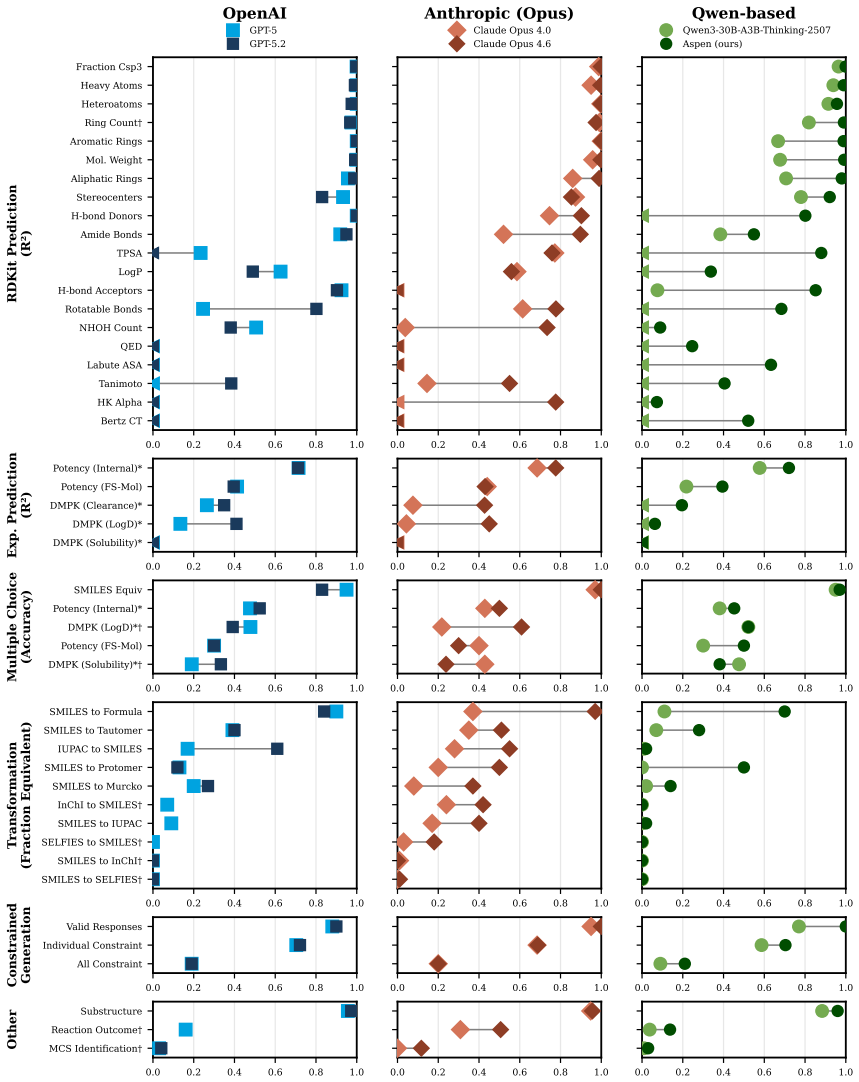
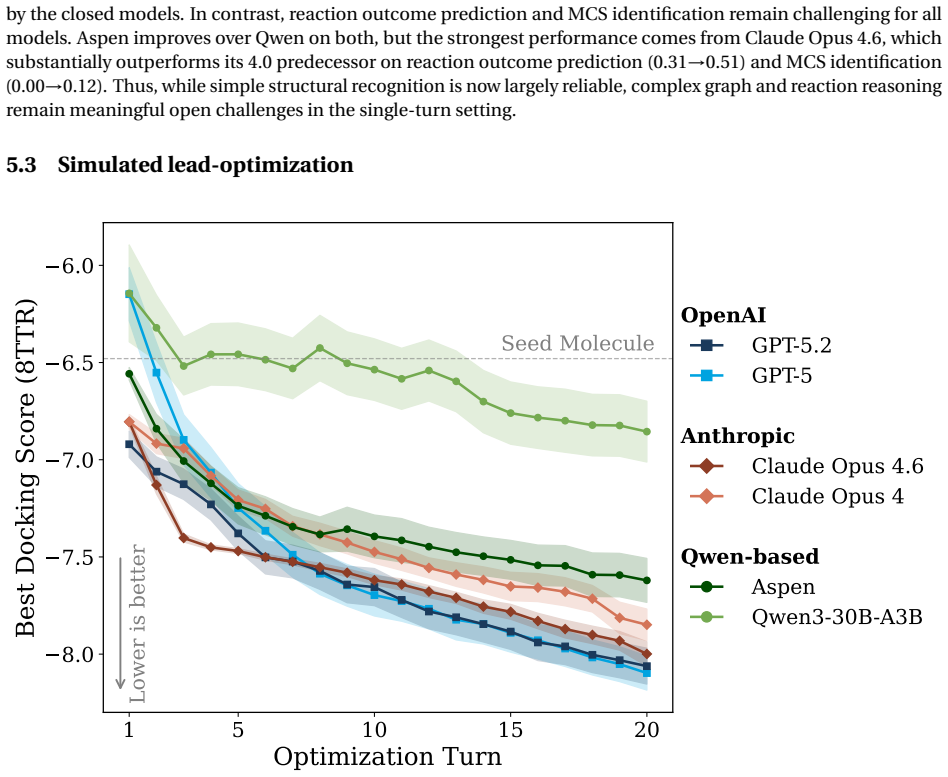
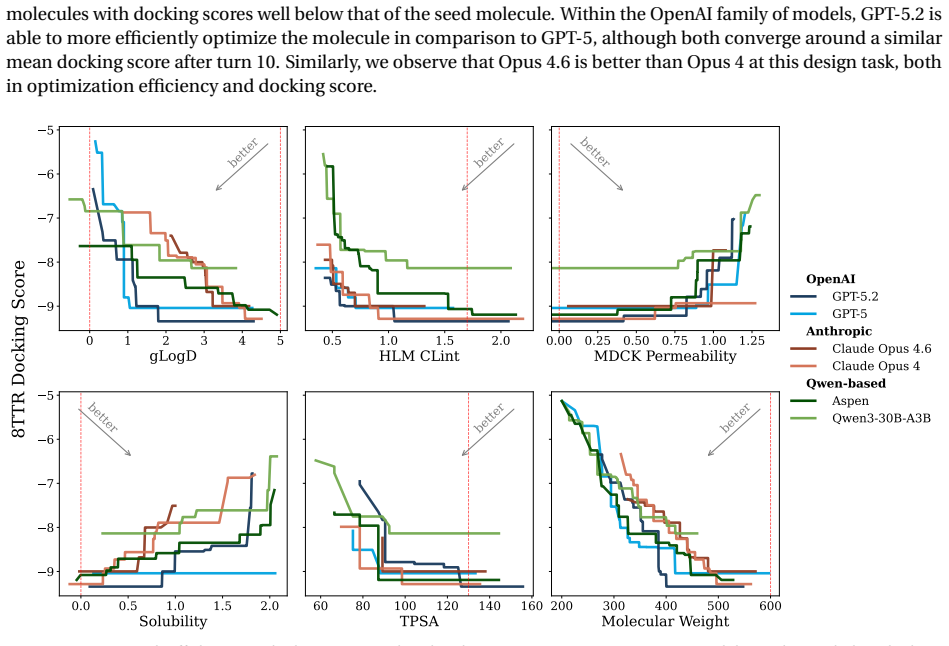
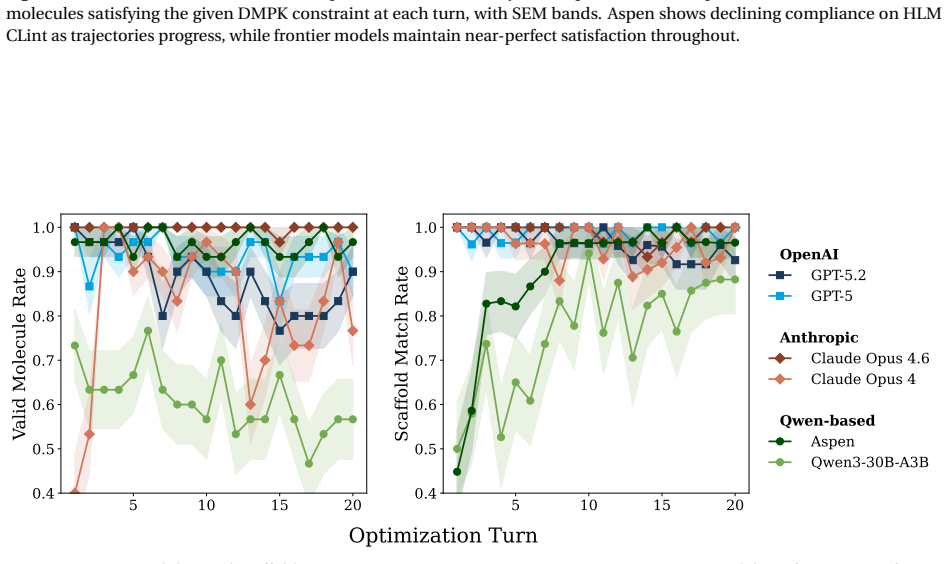
Frontier LLMs are becoming more proficient at chemically grounded tasks, yet substantial gaps remain in low-data experimental settings; RL-based post-training on the introduced environments allows a smaller model to reach competitive performance with state-of-the-art frontier models despite a significantly weaker starting point.
Load-bearing premise
The new RL tasks capture enough of the real challenges in small-molecule drug design that gains measured on these benchmarks will translate into useful improvements in actual low-data experimental work.
Editorial extensions
If this is right
- Frontier models continue to advance on chemical reasoning tasks but leave measurable gaps in low-data experimental regimes.
- RL post-training produces large performance gains on the defined tasks across model families.
- Smaller base models can be brought to frontier-level competence on these drug-design problems through the post-training process.
- The combination of task design and RL fine-tuning offers a direct route for making LLMs more practical in drug discovery workflows.
Reading between the lines
- The same pattern of RL post-training on domain-specific environments could be tested in other scientific fields that involve structured reasoning over limited data.
- If the approach scales, organizations could rely more on smaller, cheaper models tuned for narrow scientific applications rather than always using the largest available models.
- A next step would be to measure whether the benchmark improvements lead to faster or more successful outcomes when the models are inserted into actual experimental drug-design cycles.
Editorial analysis
A structured set of objections, weighed in public.
Referee Report
Summary. The paper introduces a suite of chemically-grounded reinforcement learning (RL) environments spanning molecular property prediction, representation transformations, and molecular design. It evaluates LLMs across three model families on these tasks, reports that frontier models show improving but incomplete proficiency (especially in low-data regimes), and demonstrates that RL post-training on the environments enables a smaller base model to reach performance competitive with state-of-the-art frontier models.
Significance. If the empirical results hold under scrutiny, the work supplies a unified RL-based benchmark and post-training recipe that could serve as a practical route for improving LLM utility in drug discovery. The explicit focus on low-data experimental settings and the demonstration of capability gains via post-training on in-house environments are constructive contributions to an area that currently lacks standardized, chemically meaningful evaluation protocols.
major comments (2)
- [§3] §3 (Task and Environment Definitions): All tasks remain fully in silico with rewards derived from predicted properties; the manuscript provides no retrospective validation against experimental assay data, known clinical candidates, or multi-objective trade-offs typical of real discovery campaigns. This directly undercuts the abstract's claim that the observed gains constitute a 'practical route' toward employing LLMs in drug discovery.
- [§5] §5 (Experimental Results and Tables): The central competitiveness result (smaller post-trained model matching frontier models) is stated without accompanying quantitative tables, exact metrics, data-split details, standard deviations, or ablation studies on post-training data composition. Without these, it is impossible to determine whether the reported gains reflect genuine chemical reasoning or benchmark-specific memorization.
minor comments (2)
- [Abstract] Abstract: Specify the three model families evaluated and the precise base-model sizes or capabilities referenced by 'significantly weaker base model'.
- [Throughout] Notation: Define all acronyms (RL, LLM, etc.) on first use and ensure consistent use of 'post-training' versus 'fine-tuning' throughout.
Circularity Check
No circularity: empirical evaluation of post-training gains on newly introduced RL environments
full rationale
The paper introduces a suite of RL-formulated tasks for molecular property prediction, representation transforms, and design, then reports empirical results showing that RL post-training on these environments improves performance and allows a smaller model to match frontier models on the same tasks. No derivation chain reduces a claimed result to its own inputs by construction, no parameters are fitted and then relabeled as predictions, and no load-bearing claims rest on self-citations or uniqueness theorems. The evaluation is self-contained within the defined benchmarks; any concern about real-world transfer is an external-validity issue, not circularity.
Assumptions & free parameters
Cite this review
Pith. "Pith review of Evaluating the Progression of Large Language Model Capabilities for Small-Molecule Drug Design." pith.science (2026). https://pith.science/paper/2604.16279
@misc{pith2026260416279,
  author       = {Pith},
  title        = {Pith review of: Evaluating the Progression of Large Language Model Capabilities for Small-Molecule Drug Design},
  year         = {2026},
  howpublished = {\url{https://pith.science/paper/2604.16279}},
  note         = {Machine review of arXiv:2604.16279}
}
read the original abstract
Large Language Models (LLMs) have the potential to accelerate small molecule drug design due to their ability to reason about information from diverse sources and formats. However, their practical utility remains unclear due to the lack of benchmarks that reflect real-world scenarios. In this work, we introduce a suite of chemically-grounded tasks spanning molecular property prediction, molecular representation transformations, and molecular design. Importantly, we formulate these tasks as reinforcement learning (RL) environments, enabling a unified approach for evaluation and post-training. Across three model families, we find that frontier models are increasingly proficient at chemical tasks, but that there is significant room for improvement, especially in experimental settings with low data. Critically, we show that RL-based post-training can substantially improve performance. A smaller model post-trained on our environments becomes competitive with state-of-the-art frontier models, despite a significantly weaker base model. This suggests a practical route toward employing LLMs in drug discovery; by combining carefully-designed evaluation tasks with targeted post-training, we can both elucidate and close critical capability gaps.
Figures

Figures from the paper (5 more)



Forward citations
Cited by 1 Pith paper
-
onepot-Bench 0: towards lab-aware in silico chemistry benchmarks
Frontier LLMs score well on basic chemistry questions but near chance on wet-lab reaction-outcome and catalyst-preference tasks in a new proprietary benchmark.
Reference graph
Works this paper leans on
-
[1]
**Simple alkyl chain** on the amide nitrogen (e.g., molecule 5: ‘CNC(=O)‘ instead of branched ‘C(C)NC‘)
-
[2]
**Heterocyclic substituents** on the amide-linked aromatic ring (e.g., molecule 6: thiazole, molecule 13: triazine-like). - Molecules with branched chains (e.g., molecule 1) or aryl groups (e.g., molecule 2) generally exhibit lower potency (5.0-5.4). Evaluating options: - **Option A**: Contains a cyanide-functionalized branched chain (‘C(CN)NC‘). Uncommon...
work page 2016
Reviewed May 10, 2026 · model on record in the stance chip above.
Discussion (0). Sign in to comment.