REVIEW 3 major objections 4 minor 1 cited by
Reciprocal symmetry of multiplicity data implies a tower of exact constraints at the mean; the second member survives locally but the symmetry fails globally at 13 TeV.
Reviewed by Pith at T0; open to challenge. T0 means a machine referee read the full paper against a public rubric. the ladder, T0–T4 →
T0 review · deepseek-v4-flash
2026-08-02 14:34 UTC pith:NHYVBOKM
load-bearing objection Formal tower and entropy formula are correct and worth preserving, but the δ3 test is interpolation-dominated and the abstract's closure test is missing from the body. the 3 major comments →
Higher-order local constraints from reciprocal symmetry and entanglement entropy of charged-particle multiplicity distributions in pp collisions
The pith
A machine-rendered reading of the paper's core claim, the machinery that carries it, and where it could break.
Core claim
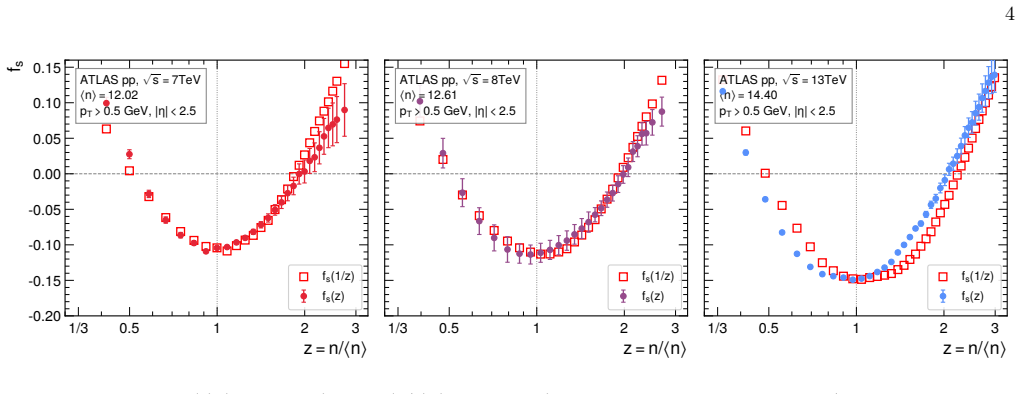
The central discovery is that the reciprocal symmetry f_s(z)=f_s(1/z) is an evenness condition on h(u)=f_s(e^u), so all odd derivatives h^{(2k+1)}(0) vanish. Using Stirling numbers of the second kind, the paper converts these conditions into algebraic constraints among P(⟨n⟩) and its derivatives; the first new member is ⟨n⟩³P'''(⟨n⟩)+6⟨n⟩²P''(⟨n⟩)=5P(⟨n⟩), equivalently δ₃≡1−2ρ₀+ρ₁=0. The paper tests δ₃ in proton-proton data at 7, 8 and 13 TeV, finding δ₃=−0.02±0.11 at 13 TeV with the widest fit window (consistent with zero) and less conclusive values at lower energies, while a global χ² test across 1/3<z<3 rejects the exact symmetry at 13 TeV. Independently, the paper derives S=ln⟨n⟩+I₀−½∫_S
What carries the argument
The key machinery is the change of variables u=ln z, which turns the reciprocal symmetry f_s(z)=f_s(1/z) into the evenness of h(u)=f_s(e^u). The vanishing of every odd derivative at u=0 generates the infinite tower of local constraints; the chain rule and Stirling numbers of the second kind translate these into linear algebraic relations among the dimensionless quantities ξ_j=⟨n⟩^j P^{(j)}(⟨n⟩)/P(⟨n⟩). For the entropy, the derivation expands ψ ln ψ in powers of f_s and uses the two identies ∫_S e^{-z}f_s dz=1−I₀ and ∫_S z e^{-z}f_s dz=1−I₁, which cancel the constant and linear terms, leaving only the quadratic correction −½∫_S e^{-z}f_s² dz.
Load-bearing premise
The tower of constraints stands on the assumption that f_s(z)=f_s(1/z) is exact, so that odd derivatives at z=1 truly vanish; the 13 TeV global test suggests this is only approximate, and the empirical extraction of δ₃ additionally depends on treating binned data as a smooth function near the non-integer mean.
What would settle it
A high-statistics measurement of charged-particle multiplicity distributions with fine binning around n=⟨n⟩ and full bin-bin covariances that yields δ₃ consistent with zero only in a narrow window but differing from zero by more than 5σ in a wide window, or a direct observation that f_s(z)−f_s(1/z) is systematically nonzero in another collision system, would falsify the exact reciprocal-symmetry tower.
If this is right
- Any cascade model that respects the reciprocal symmetry must satisfy the tower of constraints at n=⟨n⟩; multiplicative log-symmetric noise on the cascade rate, two-component geometric mixtures, and the negative binomial all fail the symmetry test and are therefore ruled out as its source.
- The second constraint provides a new, energy-dependent observable (ρ₁ or δ₃) that can be extracted locally near the mean; its strong fit-window dependence shows how sensitive higher-derivative tests are to interpolation choices.
- The entropy formula offers a model-independent way to compute the Shannon entropy from the KNO-scaled distribution, and it implies that any KNO violation reduces S below ln⟨n⟩+1.
- The global rejection at 13 TeV signals that the reciprocal symmetry is approximate rather than exact; testing the same constraints in other collision systems or with finer binning near the mean can decide whether it is universal or accidental.
Where Pith is reading between the lines
- Because the data show the symmetry holds near z=1 but fails globally, one could parameterise a symmetry-breaking term from the antisymmetric part of h(u); measuring its energy dependence would quantify how approximate the symmetry is and could reveal where the tower starts to fail.
- The entropy bound S≤ln⟨n⟩+1 could serve as an entanglement witness: a measured entropy noticeably above this bound would signal a breakdown of the continuum KNO description or of the proxy between hadronic and partonic entropy.
- The paper notes a suggestive but unproven link between the discrete Z₂ inversion and Möbius invariance in QCD evolution; if that connection holds, the antisymmetric part of f_s should have a specific functional form that a dedicated fit could test against alternative symmetry-breaking mechanisms.
Editorial analysis
A structured set of objections, weighed in public.
Referee Report
Summary. The paper formalizes the reciprocal symmetry f_s(z)=f_s(1/z) of the KNO-violating term by defining h(u)=f_s(e^u). It derives an infinite tower of local constraints from h^{(2k+1)}(0)=0, using Stirling numbers, and obtains the k=1 constraint ⟨n⟩^3 P'''(⟨n⟩)+6⟨n⟩^2 P''(⟨n⟩)=5P(⟨n⟩) (Eq. 14), together with the unconditional residual δ3≡1−2ρ0+ρ1 (Eq. 18). The constraint is tested on ATLAS data at 7, 8, and 13 TeV via local polynomial fits in windows |n−⟨n⟩|≤W. The paper also shows that multiplicative log-symmetric noise on Mueller's cascade yields f_s ∝ z^2−4z+2, which is not invariant under z→1/z, and derives an entropy formula S = ln⟨n⟩ + I0 − ½∫ e^{-z} f_s^2 dz + O(f_s^3) that is verified numerically at the 10^-3 level. The global reciprocal symmetry is reported as rejected at 13 TeV (χ²_sym/N_pairs=33/19).
Significance. The formal derivation of the tower of constraints is a clean, checkable result and, if the symmetry is accepted, provides a useful model-independent filter for cascade models. The entropy formula, with the cancellation of the linear-in-f_s term from normalization and unit mean, is an elegant and potentially useful model-independent statement, and the numerical consistency at the 10^-3 level is reassuring. The negative result for multiplicative noise is also a well-defined no-go for that particular extension. However, the empirical support for the symmetry is fragile: the higher-order local test is interpolation-dominated, the global test rejects the symmetry at 13 TeV, and a claimed closure test is absent from the text. The lasting contribution is the formal tower and the entropy identity, not the data verification as it stands.
major comments (3)
- [§III, Eq. (18), Table I] The extraction of δ3 ≡ 1−2ρ0+ρ1 is interpolation-dominated. The data are binned and ⟨n⟩ is non-integer, so P'''(⟨n⟩) is defined only by a local polynomial fit. The paper's own sweeps show the result is not stable: at 13 TeV δ3 varies from +0.79±0.38 (W=4) to −0.016±0.114 (W=6); at fixed W=6 it varies from +0.31±0.04 (N=3) to +0.87±0.39 (N=6), and 7 TeV gives −0.32±0.18 at the working point. Choosing N=4 by χ²/dof does not turn this spread into a controlled systematic, especially since bin-bin systematic correlations are treated as uncorrelated. The central empirical claim that the k=1 constraint is consistent with data is therefore not load-bearing. The authors should either provide a validated interpolation scheme whose bias is quantified (e.g., splines with covariance or a z-space interpolation) or clearly label the test as inconclusive.
- [Abstract and §III (after Eq. (21))] The abstract asserts that a closure test shows the 13 TeV rejection of the reciprocal symmetry (χ²_sym/N_pairs = 33/19) is not a binning artefact. However, no closure test is described anywhere in the body; only the χ²_sym values are given. This is an unsupported, load-bearing claim, because the nature of the 13 TeV discrepancy is central to the conclusion that the symmetry breaks globally. Add the closure-test procedure and its result, or remove the assertion from the abstract.
- [§II–III and §VII] The tower is derived from the reciprocal symmetry, which is taken as input from the authors' prior work [1] and not independently established here. The paper's own global test rejects the symmetry at 13 TeV. Meanwhile the k=0 test is weak (as the authors note in §VII, it is automatically passed by any distribution with an extremum near z=1), and the k=1 test is inconclusive or contradictory across energies and windows (e.g., 13 TeV W=6 gives −0.016±0.114, while 7 TeV gives −0.32±0.18 and the W/N dependence is large). Therefore the conclusion that the symmetry 'holds at the leading two non-trivial orders near z=1' is not supported by the presented evidence. The formal tower is unaffected, but the empirical status of the symmetry should be presented more cautiously, and the conclusion should be reworded to reflect that the higher-order test is not under control.
minor comments (4)
- [§VI, text after Eq. (35)] The sentence 'In the continuum limit S →(0,∞), I0 →1' is confusing: S denotes the support of the distribution in Eq. (35), not the entropy. Please write 'the support S tends to (0,∞)' or 'the measured range tends to the full positive axis'.
- [§III, Eq. (21)] Describing χ²_sym/N_pairs = 33/19 as a 'decisive' rejection is overstated: with 19 degrees of freedom, χ²=33 has p≈0.025. Give a precise p-value or use a goodness-of-fit test with its significance level.
- [Abstract and §VII] The abstract's closing statement that the symmetry 'holds at the leading two non-trivial orders near z=1' is too strong given that the k=1 test is reported as inconclusive for 7 and 8 TeV and only consistent with zero at 13 TeV W=6. Please qualify this conclusion with the interpolation systematic discussed in §III.
- [§III, first paragraph] The mean multiplicities are recomputed from binned distributions and differ slightly from the ATLAS tabulated values. This is reasonable, but the associated normalization shift and its effect on ρ0, ρ1, and δ3 should be commented on explicitly, since the same binning-consistent values are used in the entropy evaluation.
Circularity Check
No significant circularity: the tower constraints and entropy formula are conditional mathematical consequences, not fitted predictions; the self-cited reciprocal symmetry is transparently treated as input and independently tested here.
full rationale
The tower of local constraints (Eq. 9) follows purely mathematically from the assumed evenness of h(u)=f_s(e^u); the k=1 constraint (Eq. 14) is derived, not fitted, and the paper explicitly tests the unconditional residual δ3=1−2ρ0+ρ1, reporting values such as −0.016±0.114 (13 TeV, W=6) and −0.32±0.18 (7 TeV, W=6) that do not force agreement. The entropy formula (Eq. 35) is a Taylor expansion of the Shannon entropy in f_s about the exponential; its reproduction of S_dir at the 10^-3 level is a self-consistency check of the truncation, not an independent prediction, and the paper states that the linear term cancels by normalisation and ⟨z⟩=1 independently of the symmetry. The reciprocal symmetry itself is taken as input from the authors' prior paper [1], but it is not an unverified load-bearing self-citation: it is tested independently in this paper via χ²_sym, which is consistent at 7 and 8 TeV and rejects the global symmetry at 13 TeV, a result the authors acknowledge. Thus the central derivation does not reduce to its inputs by construction. Non-circular concerns remain: the abstract's asserted 'closure test' is not described in the body, and the δ3 extraction is sensitive to interpolation window and polynomial degree; these are robustness/reproducibility issues, not circularity.
Axiom & Free-Parameter Ledger
free parameters (2)
- σ²_η — variance of multiplicative noise on the cascade rate =
not fitted; amplitude matched to the data dip depth for Fig. 3
- Polynomial fit degree N and window W (central: N=4, W=6) =
N=4, W=6; sweeps N=3..6, W=4..6
axioms (7)
- domain assumption Reciprocal symmetry f_s(z)=f_s(1/z) of the KNO-violating term in ATLAS/CMS pp data (from the authors' own [1])
- standard math Stirling chain-rule identity (z d/dz)^n = Σ S(n,k) z^k d^k/dz^k
- standard math KNO continuum limit: Σ_n → ∫ dn, P_n = ⟨n⟩^-1 ψ(z), z = n/⟨n⟩
- domain assumption Shannon entropy of the hadronic multiplicity distribution as proxy for partonic entanglement entropy
- ad hoc to paper Local polynomial fit interpolates the discrete binned P_n and supplies valid derivatives at non-integer ⟨n⟩
- domain assumption ATLAS systematic uncertainties enter as uncorrelated per-bin quadrature
- domain assumption Mueller's geometric distribution as the noise-free cascade baseline
read the original abstract
The KNO-violating term $f_s$ of the charged-particle multiplicity distribution in $pp$ collisions measures the relative deviation of $\langle n\rangle P_n$ from $e^{-z}$, with $z=n/\langle n\rangle$, and is reported to obey the reciprocal symmetry $f_s(z)=f_s(1/z)$, taken here as input. Being an evenness condition in $\ln z$, it generates a tower of local constraints on the derivatives of $P_n$ at the mean. The lowest member holds for the ATLAS data at $7$, $8$ and $13$~TeV at the few-per-cent level, while the third-derivative residual testing the next member is not determined with a controlled uncertainty by the present binning and stays inconclusive. The global test is consistent at $7$ and $8$~TeV, while at $13$~TeV a residual deviation remains, which a closure test shows is not a binning artefact. Multiplicative noise in the Mueller colour-dipole cascade, the negative binomial and the dipole cascades with recombination each give an $f_s$ that is not invariant under $z\to1/z$, so none of them carries the symmetry. We further obtain a dynamics-independent entropy in the KNO continuum, $S=\ln\langle n\rangle+I_0-\tfrac12\int e^{-z}f_s^2\,dz$, with $I_0$ a support factor tending to unity in the continuum limit. The linear term cancels by normalisation and unit mean, independently of the symmetry, and the remaining correction is quadratic and negative. It reproduces the Shannon entropy of the ATLAS data at the $10^{-3}$ level.
Figures


Forward citations
Cited by 1 Pith paper
-
Deep inelastic scattering as a probe of entanglement: the complete QCD dipole cascade
The Shannon entropy of dipole multiplicities from the full Levin–Lublinsky equation in DIS reproduces the H1 hadron entropy, growing linearly with ln(1/x) and described by S = ln(2/3⟨n⟩) + 0.85.
Reference graph
Works this paper leans on
-
[1]
Reciprocal symmetry and KNO scaling violation in proton-proton collisions,
M. Ouchen and A. Prygarin, “Reciprocal symmetry and KNO scaling violation in proton-proton collisions,” arXiv:2605.00128 [hep-ph] (2026)
Pith/arXiv arXiv 2026
-
[2]
KNO scaling, memoryless- ness and maximal entanglement at universal fixed point,
M. Ouchen and A. Prygarin, “KNO scaling, memoryless- ness and maximal entanglement at universal fixed point,” arXiv:2511.18446 [hep-ph] (2025)
arXiv 2025
-
[3]
Soft gluons in the infinite-momentum wave function and the BFKL Pomeron,
A. H. Mueller, “Soft gluons in the infinite-momentum wave function and the BFKL Pomeron,” Nucl. Phys. B 415, 373 (1994)
1994
-
[4]
Deep inelastic scatter- ing as a probe of entanglement,
D. E. Kharzeev and E. M. Levin, “Deep inelastic scatter- ing as a probe of entanglement,” Phys. Rev. D95, no. 11, 114008 (2017) [arXiv:1702.03489 [hep-ph]]. 9
Pith/arXiv arXiv 2017
-
[5]
Deep inelastic scat- tering as a probe of entanglement: Confronting experi- mental data,
D. E. Kharzeev and E. M. Levin, “Deep inelastic scat- tering as a probe of entanglement: Confronting experi- mental data,” Phys. Rev. D104, no. 3, L031503 (2021) [arXiv:2102.09773 [hep-ph]]
Pith/arXiv arXiv 2021
-
[6]
Quantum information approach to high energy interactions,
D. E. Kharzeev, “Quantum information approach to high energy interactions,” Phil. Trans. Roy. Soc. A380, no. 2216, 20210063 (2022) [arXiv:2108.08792 [hep-ph]]
Pith/arXiv arXiv 2022
-
[7]
Einstein- Podolsky-Rosen paradox and quantum entanglement at subnucleonic scales,
Z. Tu, D. E. Kharzeev and T. Ullrich, “Einstein- Podolsky-Rosen paradox and quantum entanglement at subnucleonic scales,” Phys. Rev. Lett.124, no. 6, 062001 (2020) [arXiv:1904.11974 [hep-ph]]
Pith/arXiv arXiv 2020
-
[8]
V. Andreevet al.[H1 Collaboration], “Measurement of charged particle multiplicity distributions in DIS at HERA and its implication to entanglement en- tropy of partons,” Eur. Phys. J. C81, 212 (2021) [arXiv:2011.01812 [hep-ex]]
Pith/arXiv arXiv 2021
-
[9]
Evidence for the max- imally entangled low x proton in deep inelastic scat- tering from H1 data,
M. Hentschinski and K. Kutak, “Evidence for the max- imally entangled low x proton in deep inelastic scat- tering from H1 data,” Eur. Phys. J. C82, 111 (2022) [arXiv:2110.06156 [hep-ph]]
Pith/arXiv arXiv 2022
-
[10]
Maximally entangled proton and charged hadron multiplicity in deep inelastic scattering,
M. Hentschinski, K. Kutak and R. Straka, “Maximally entangled proton and charged hadron multiplicity in deep inelastic scattering,” Eur. Phys. J. C82, 1147 (2022) [arXiv:2207.09430 [hep-ph]]
Pith/arXiv arXiv 2022
-
[11]
M. Hentschinski, D. E. Kharzeev, K. Kutak and Z. Tu, “Probing the onset of maximal entanglement inside the proton in diffractive deep inelastic scattering,” Phys. Rev. Lett.131, 241901 (2023) [arXiv:2305.03069 [hep- ph]]
Pith/arXiv arXiv 2023
-
[12]
QCD evolution of entanglement entropy,
M. Hentschinski, D. E. Kharzeev, K. Kutak and Z. Tu, “QCD evolution of entanglement entropy,” Rep. Prog. Phys.87, no. 12, 120501 (2024) [arXiv:2408.01259 [hep- ph]]
Pith/arXiv arXiv 2024
-
[13]
Entanglement entropy, Monte Carlo event generators, and soft gluons DIScovery,
M. Hentschinski, H. Jung and K. Kutak, “Entanglement entropy, Monte Carlo event generators, and soft gluons DIScovery,” Phys. Rev. D113, no. 5, 054024 (2026) [arXiv:2509.03400 [hep-ph]]
Pith/arXiv arXiv 2026
-
[14]
Entropy, purity and gluon cascades at high energies with recombinations and transitions to vacuum,
K. Kutak and M. Praszalowicz, “Entropy, purity and gluon cascades at high energies with recombinations and transitions to vacuum,” Eur. Phys. J. C85, 1215 (2025) [arXiv:2508.13781 [hep-ph]]
arXiv 2025
-
[15]
Entropy and multiplicity of hadrons in the high energy limit within dipole cas- cade models,
K. Kutak and S. L¨ ok¨ os, “Entropy and multiplicity of hadrons in the high energy limit within dipole cas- cade models,” Phys. Rev. D112, no. 9, 096017 (2025) [arXiv:2509.07898 [hep-ph]]
arXiv 2025
-
[16]
Universality of scaling entropy in charged hadron mul- tiplicity distributions at the LHC,
L. S. Moriggi, F. S. Navarra and M. V. T. Machado, “Universality of scaling entropy in charged hadron mul- tiplicity distributions at the LHC,” Phys. Rev. D112, 074019 (2025) [arXiv:2506.09899 [hep-ph]]
arXiv 2025
-
[17]
Charged-particle multiplicities inppinteractions measured with the AT- LAS detector at the LHC,
G. Aadet al.[ATLAS Collaboration], “Charged-particle multiplicities inppinteractions measured with the AT- LAS detector at the LHC,” New J. Phys.13, 053033 (2011) [arXiv:1012.5104 [hep-ex]]
Pith/arXiv arXiv 2011
-
[18]
Charged-particle distributions in √s= 8 TeVppinteractions at the LHC,
G. Aadet al.[ATLAS Collaboration], “Charged-particle distributions in √s= 8 TeVppinteractions at the LHC,” Eur. Phys. J. C76, no. 7, 403 (2016) [arXiv:1603.02439 [hep-ex]]
Pith/arXiv arXiv 2016
-
[19]
G. Aadet al.[ATLAS Collaboration], “Charged-particle distributions in √s= 13 TeVppinteractions measured with the ATLAS detector at the LHC,” Phys. Lett. B 758, 67 (2016) [arXiv:1602.01633 [hep-ex]]
Pith/arXiv arXiv 2016
-
[20]
Y. Kulchitsky and P. Tsiareshka, “Study of the KNO scaling inppcollisions at √sfrom 0.9 to 13 TeV using results of the ATLAS at the LHC,” Eur. Phys. J. C82, no. 5, 462 (2022) [arXiv:2202.06697 [hep-ex]]
Pith/arXiv arXiv 2022
-
[21]
Charged particle multiplicities inppinteractions at √s= 0.9, 2.36, and 7 TeV,
V. Khachatryanet al.[CMS Collaboration], “Charged particle multiplicities inppinteractions at √s= 0.9, 2.36, and 7 TeV,” JHEP01, 079 (2011) [arXiv:1011.5531 [hep- ex]]
Pith/arXiv arXiv 2011
-
[22]
Pomeron evolution, entan- glement entropy and Abramovskii-Gribov-Kancheli cut- ting rules,
M. Ouchen and A. Prygarin, “Pomeron evolution, entan- glement entropy and Abramovskii-Gribov-Kancheli cut- ting rules,” Phys. Rev. D112, no. 9, 094027 (2025) [arXiv:2508.12102 [hep-ph]]
Pith/arXiv arXiv 2025
-
[23]
The bare pomeron in quantum chromo- dynamics,
L. N. Lipatov, “The bare pomeron in quantum chromo- dynamics,” Sov. Phys. JETP63, 904 (1986)
1986
-
[24]
High-energy asymptotics of multicolor QCD and two-dimensional conformal field theories,
L. N. Lipatov, “High-energy asymptotics of multicolor QCD and two-dimensional conformal field theories,” Phys. Lett. B309, 394 (1993)
1993
-
[25]
Spin-spin entanglement in diffractive heavy-quark production,
M. Fucilla and Y. Hatta, “Spin-spin entanglement in diffractive heavy-quark production,” Phys. Rev. D113, no. 3, L031504 (2026) [arXiv:2509.05267 [hep-ph]]
arXiv 2026
-
[26]
Probing quantum en- tanglement with Generalized Parton Distributions at the Electron-Ion Collider,
Y. Hatta and J. Schoenleber, “Probing quantum en- tanglement with Generalized Parton Distributions at the Electron-Ion Collider,” arXiv:2511.04537 [hep-ph] (2025)
arXiv 2025
-
[27]
M. Fucilla, Y. Hatta, and B.-W. Xiao, “Quantum entan- glement in electron-nucleus collisions: Role of the linearly polarized gluon distribution,” arXiv:2604.11697 [hep-ph] (2026)
Pith/arXiv arXiv 2026
discussion (0)
Sign in with ORCID, Apple, or X to comment. Anyone can read and Pith papers without signing in.