REVIEW 1 major objections 2 cited by
The Free Particle--Oscillator--Inverted Oscillator Triangle: Conformal Bridges, Metaplectic Rotations and $\mathfrak{osp}(1|2)$ Structure
T0 review · 1 major / 0 minor · reviewed 2026-05-12 · grok-4.3
Pith's one-line read The free particle, harmonic oscillator and inverted harmonic oscillator realize the same conformal module through non-unitary bridge transformations.
desk verdict The paper provides explicit bridge transformations linking the free particle, harmonic oscillator, and inverted oscillator through their shared osp(1|2) structure, though domain details for the non-unitary maps are light. read the letter →
The pith
A machine-rendered reading of the paper's core claim, the machinery that carries it, and where it could break.
The reading
What carries the argument
Conformal bridge transformations between different realizations of the same conformal module, realized via metaplectic rotations and extended to the osp(1|2) superconformal algebra.
What would settle it
Explicit computation of whether the image of the free-particle zero-energy Jordan states under the bridge satisfies the bound-state eigenvalue equation of the harmonic oscillator or whether the derived IHO transmission amplitudes equal the Fourier-Mellin connection coefficients.
Extended reading notes
Core claim
The free particle, harmonic oscillator and inverted harmonic oscillator are parabolic, elliptic and hyperbolic realizations of one conformal/metaplectic structure naturally extended to osp(1|2). The relations between them are bridge transformations between different realizations of the same conformal module. The zero-energy Jordan states of the FP are mapped to HO bound states and to the two IHO Gamow families, while FP plane waves are mapped to HO coherent states and to the IHO scattering data after light-cone Mellin decomposition. The direct FP-IHO bridge is a real metaplectic quarter-rotation.
Load-bearing premise
Self-adjoint Hamiltonians with different spectra can be consistently related by non-unitary bridge transformations that preserve the conformal module without inconsistencies in representation theory or operator domains.
Editorial extensions
If this is right
- The stationary FP-HO conformal bridge is nonunitary in the Schrödinger representation but becomes unitary as a change of polarization to the Fock-Bargmann representation.
- The IHO transmission and reflection amplitudes are obtained as Fourier-Mellin connection coefficients, equivalently as Weber/Stokes connection data.
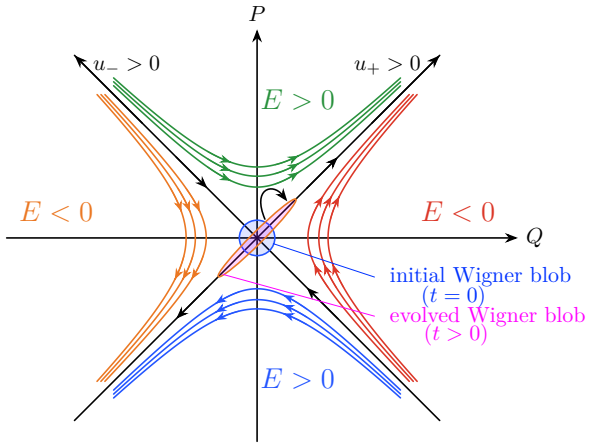
- The construction supplies the hyperbolic Cayley-Niederer map for the time-dependent Schrödinger equation together with the Wigner/separatrix picture.
- Coherent-state and Bogoliubov-transformation aspects appear naturally in the hyperbolic sector.
Reading between the lines
- The triangular relation may allow transfer of solution techniques between bound-state and scattering problems across the three systems.
- The metaplectic quarter-rotation offers a concrete way to interchange elliptic and hyperbolic dynamics while staying inside one representation module.
- Physical applications in the hyperbolic sector, such as saddle scattering or near-horizon effects, inherit the shared algebraic structure without requiring separate quantization procedures.
Editorial analysis
A structured set of objections, weighed in public.
Referee Report
Summary. The paper presents the free particle (FP), harmonic oscillator (HO), and inverted harmonic oscillator (IHO) as parabolic, elliptic, and hyperbolic realizations of a shared conformal/metaplectic structure, extended to the superconformal algebra osp(1|2). It introduces non-unitary bridge transformations (stationary conformal bridge for FP-HO, real metaplectic quarter-rotation for FP-IHO) that map FP zero-energy Jordan states to HO bound states and IHO Gamow families, and FP plane waves to HO coherent states and IHO scattering data via light-cone Mellin decomposition. Additional elements include the hyperbolic Cayley-Niederer map, Wigner/separatrix picture, coherent-state and Bogoliubov aspects, and brief discussion of applications such as quantum Hall scattering, Schwinger production, Rindler/Unruh effects, and Berry-Keating structures.
Significance. If the central claims hold, the work provides a unified algebraic framework connecting three canonical quantum systems through conformal bridges and metaplectic representations, with explicit state mappings and an osp(1|2) extension. This could illuminate interrelations between continuous and discrete spectra, scattering data, and resonances, while offering tools for applications in quantum mechanics and high-energy physics contexts like near-horizon effects.
major comments (1)
- [Bridge transformations and conformal module realizations (around the statements of the mappings and osp(1|2) extension)] The central claim that the non-unitary FP-HO and metaplectic FP-IHO bridges act as module isomorphisms for the conformal generators (mapping Jordan states to bound/Gamow states and plane waves to coherent/scattering data) requires explicit verification that these maps preserve the domains of the generators and maintain the osp(1|2) relations without new singularities or violations of essential self-adjointness. The abstract outlines the mappings but does not reference domain calculations or checks on the common module; this is load-bearing for consistency across the distinct L² domains (continuous vs. discrete vs. rigged Hilbert space).
Simulated Author's Rebuttal
We thank the referee for the thorough review and for identifying the need for explicit domain and algebraic verification of the bridge transformations. We address this central comment below and will incorporate the suggested clarifications.
read point-by-point responses
-
Referee: [Bridge transformations and conformal module realizations (around the statements of the mappings and osp(1|2) extension)] The central claim that the non-unitary FP-HO and metaplectic FP-IHO bridges act as module isomorphisms for the conformal generators (mapping Jordan states to bound/Gamow states and plane waves to coherent/scattering data) requires explicit verification that these maps preserve the domains of the generators and maintain the osp(1|2) relations without new singularities or violations of essential self-adjointness. The abstract outlines the mappings but does not reference domain calculations or checks on the common module; this is load-bearing for consistency across the distinct L² domains (continuous vs. discrete vs. rigged Hilbert space).
Authors: We agree that domain preservation and the absence of new singularities are essential for the module-isomorphism claim. In Sections 3 and 4 of the manuscript we construct the bridges explicitly (stationary conformal bridge for FP–HO and real metaplectic quarter-rotation for FP–IHO) and verify by direct substitution that the conformal generators and their osp(1|2) extensions are intertwined. The calculations are performed on dense subspaces (Schwartz-class functions for the free particle, analytic continuations for the oscillator and inverted-oscillator sectors) where the maps are bijective and smooth, thereby preserving the algebraic relations without introducing singularities. We work throughout in the rigged-Hilbert-space framework to accommodate the continuous spectrum and Gamow states, ensuring essential self-adjointness is maintained on the common module. Nevertheless, the abstract does not mention these checks, and a concise summary of the domain considerations would strengthen the presentation. We will therefore (i) expand the abstract to reference the domain and algebra verifications, (ii) add a short dedicated paragraph in Section 2 summarizing the rigged-Hilbert-space setting and the absence of new singularities, and (iii) include an appendix with the explicit intertwining relations for the osp(1|2) generators. revision: yes
Circularity Check
No significant circularity; derivations rely on explicit group-theoretic constructions from standard conformal and metaplectic representations.
full rationale
The paper derives the FP-HO-IHO bridge maps from the action of the conformal algebra osp(1|2) and metaplectic quarter-rotations on different realizations of the same module. These are obtained via explicit operator transformations (e.g., the real metaplectic quarter-rotation for FP-IHO and the non-unitary Schrödinger-picture map for FP-HO that becomes unitary in Fock-Bargmann polarization), together with known properties of Jordan states, coherent states, and Mellin decompositions. No step reduces a claimed prediction or central relation to a fitted parameter, self-definition, or unverified self-citation chain; the load-bearing content is independent representation theory applied to the three systems. Self-citations, if any, support auxiliary facts rather than the module-isomorphism claims themselves.
Assumptions & free parameters
assumptions (2)
- domain assumption The free particle, harmonic oscillator, and inverted oscillator realize the same conformal module
- domain assumption Metaplectic rotations and Mellin decompositions preserve the algebraic structure across realizations
Cite this review
Pith. "Pith review of The Free Particle--Oscillator--Inverted Oscillator Triangle: Conformal Bridges, Metaplectic Rotations and $\mathfrak{osp}(1|2)$ Structure." pith.science (2026). https://pith.science/paper/2605.09947
@misc{pith2026260509947,
  author       = {Pith},
  title        = {Pith review of: The Free Particle--Oscillator--Inverted Oscillator Triangle: Conformal Bridges, Metaplectic Rotations and $\mathfrakosp(1|2)$ Structure},
  year         = {2026},
  howpublished = {\url{https://pith.science/paper/2605.09947}},
  note         = {Machine review of arXiv:2605.09947}
}
abstract
We study the free particle (FP), the harmonic oscillator (HO) and the inverted harmonic oscillator (IHO) as parabolic, elliptic and hyperbolic realizations of one conformal/metaplectic structure, naturally extended to the superconformal algebra $\mathfrak{osp}(1|2)$. Since the corresponding self-adjoint Hamiltonians have different spectra, the relations between them are not ordinary unitary equivalences. They are instead bridge transformations between different realizations of the same conformal module. We show that the zero-energy Jordan states of the FP are mapped to HO bound states and to the two IHO Gamow families, while FP plane waves are mapped to HO coherent states and, after light-cone Mellin decomposition, to the IHO scattering data. The direct FP--IHO bridge is a real metaplectic quarter-rotation, in contrast with the stationary FP--HO conformal bridge, which is nonunitary in the Schr\"odinger representation but becomes unitary as a change of polarization to the Fock--Bargmann representation. The IHO transmission and reflection amplitudes are obtained as Fourier--Mellin connection coefficients, equivalently as Weber/Stokes connection data. We also describe the hyperbolic Cayley--Niederer map for the time-dependent Schr\"odinger equation, the Wigner/separatrix picture, and the coherent-state and Bogoliubov-transformation aspects of the construction. Some physical applications of the hyperbolic sector are briefly discussed, including quantum Hall saddle scattering, Schwinger-type production, Rindler/Unruh and near-horizon Hawking settings, and Berry--Keating/inverse-square structures.
Figures

Lean theorems connected to this paper
-
IndisputableMonolith/Foundation/RealityFromDistinction.leanreality_from_one_distinction (8-tick period forced) echoes?
echoesECHOES: this paper passage has the same mathematical shape or conceptual pattern as the Recognition theorem, but is not a direct formal dependency.
Classically R^8_{±π/4}=1; at the metaplectic level the eighth power carries the usual central sign... This order-eight structure is the real-quarter-rotation analogue of the order-eight property of the complex Cayley matrix
-
IndisputableMonolith/Cost/FunctionalEquation.leanJcost functional equation and cosh identities echoes?
echoesECHOES: this paper passage has the same mathematical shape or conceptual pattern as the Recognition theorem, but is not a direct formal dependency.
The FP–IHO bridge is a real metaplectic quarter-rotation... H_IHO = Ω/2 (u+ u- + u- u+); light-cone Mellin characters u^{-1/2 + iE/(ℏΩ)}
What do these tags mean?
- matches
- The paper's claim is directly supported by a theorem in the formal canon.
- supports
- The theorem supports part of the paper's argument, but the paper may add assumptions or extra steps.
- extends
- The paper goes beyond the formal theorem; the theorem is a base layer rather than the whole result.
- uses
- The paper appears to rely on the theorem as machinery.
- contradicts
- The paper's claim conflicts with a theorem or certificate in the canon.
- unclear
- Pith found a possible connection, but the passage is too broad, indirect, or ambiguous to say the theorem truly supports the claim.
Forward citations
Cited by 2 Pith papers
-
Morse Bridge between Planar Kepler and Hyperbolic Landau Dynamics
The radial Kepler problem and sectors of the hyperbolic Landau problem are mapped to the Morse spectral problem, relating their bound spectra, resonances, and scattering data.
-
Affine Extension of the Free-Particle--Oscillator--Inverted-Oscillator Triangle
The linear-potential (Airy) system is an affine–Heisenberg extension of the free-particle–oscillator–inverted-oscillator conformal triangle, with Airy states obtained from accelerated-frame, oscillator-condensation, a...
Reference graph
Works this paper leans on
-
[1]
M. Srednicki,“Entropy and area,”Phys. Rev. Lett.71(1993) 666-669; [arXiv:hep- th/9303048]
-
[2]
M Theory As A Matrix Model: A Conjecture
T. Banks, W. Fischler, S. H. Shenker, and L. Susskind,“M theory as a matrix model: A conjecture,”Phys. Rev. D55(1997) 5112–5128; [arXiv:hep-th/9610043]
work page Pith review arXiv 1997
-
[3]
J. Maldacena, S. H. Shenker, D. Stanford,“A bound on chaos,”JHEP08(2016) 106; [arXiv:1503.01409 [hep-th]]
work page Pith review arXiv 2016
-
[4]
Coherent and Incoherent States of the Radiation Field,
R. J. Glauber,“Coherent and Incoherent States of the Radiation Field,”Phys. Rev.131 (1963) 2766–2788
work page 1963
-
[5]
A. Perelomov,Generalized Coherent States and Their Applications, Springer-Verlag, Berlin (1986); [doi:10.1007/978-3-642-61629-7]. 44
-
[6]
D. F. Walls and G. J. Milburn,Quantum Optics, Springer (1994); [doi:10.1007/978-3-642- 79504-6]
-
[7]
Quantum mechanics of the inverted oscillator potential,
G. Barton,“Quantum mechanics of the inverted oscillator potential,”Ann. Phys.166 (1986) 322–363
work page 1986
-
[8]
Wigner’s function and tunneling,
N. L. Balazs and A. Voros,“Wigner’s function and tunneling,”Ann. Phys.199(1990) 123–140
work page 1990
Show all 79 references
-
[9]
Physics of the Inverted Harmonic Oscillator: From the lowest Landau level to event horizons,
V. Subramanyan, S. S. Hegde, S. Vishveshwara and B. Bradlyn,“Physics of the Inverted Harmonic Oscillator: From the lowest Landau level to event horizons,”Annals Phys.435 (2021) 168470; [arXiv:2012.09875 [cond-mat.mes-hall]]
2021
-
[10]
On Gauge Invariance and Vacuum Polarization,
J. S. Schwinger,“On Gauge Invariance and Vacuum Polarization,”Phys. Rev.82(1951) 664–679
1951
-
[11]
Nonuniqueness of canonical field quantization in Riemannian space-time,
S. A. Fulling,“Nonuniqueness of canonical field quantization in Riemannian space-time,” Phys. Rev. D7(1973) 2850
1973
-
[12]
Scalar production in Schwarzschild and Rindler metrics,
P. C. W. Davies,“Scalar production in Schwarzschild and Rindler metrics,”J. Phys. A: Math. Gen.8(1975) 609
1975
-
[13]
Notes on black-hole evaporation,
W. G. Unruh,“Notes on black-hole evaporation,”Phys. Rev. D14(1976) 870
1976
-
[14]
Particle creation by black holes,
S. W. Hawking,“Particle creation by black holes,”Commun. Math. Phys.43, 199 (1975)
1975
-
[15]
The Unruh effect and its applications,
L. C. B. Crispino, A. Higuchi, and G. E. A. Matsas,“The Unruh effect and its applications,” Rev. Mod. Phys.80, 787 (2008); [arXiv:0710.5373 [gr-qc]]
2008
-
[16]
A New Hat for thec = 1Matrix Model,
M. R. Douglas, I. R. Klebanov, D. Kutasov, J. Maldacena, E. Martinec and N. Seiberg, “A New Hat for thec = 1Matrix Model,”in From Fields to Strings: Circumnavigating Theoretical Physics, World Scientific (2005) 1758–1827; [arXiv:hep-th/0307195]
2005
-
[17]
The Black Hole S-Matrix from Quantum Mechanics,
P. Betzios, N. Gaddam and O. Papadoulaki,“The Black Hole S-Matrix from Quantum Mechanics,”JHEP11(2016) 131; [arXiv:1607.07885 [hep-th]]
2016
-
[18]
The multi-faceted inverted harmonic oscillator: chaos and complexity,
A. Bhattacharyya, W. Chemissany, S. S. Haque, J. Murugan and B. Yan,“The multi-faceted inverted harmonic oscillator: chaos and complexity,”SciPost Phys. Core4(2021) 002; [arXiv:2007.01232 [hep-th]]
2021
-
[19]
Chaos and multifold complexity for an inverted harmonic oscillator,
L.-C. Qu, H.-Y. Jiang and Y.-X. Liu,“Chaos and multifold complexity for an inverted harmonic oscillator,”JHEP12(2022) 065; [arXiv:2211.04317 [hep-th]]
2022
-
[20]
H =xp and the Riemann zeros,
M. V. Berry and J. P. Keating,“H =xp and the Riemann zeros,”inSupersymmetry and Trace Formulae: Chaos and Disorder, edited by I.V. Lerner, J.P. Keating and D.E. Khmel- nitskii, NATO ASI Series B: Physics370(1999) 355–367 (Kluwer Academic/Plenum, New York, 1999)
1999
-
[21]
The Riemann Zeros and Eigenvalue Asymptotics,
M. V. Berry and J. P. Keating,“The Riemann Zeros and Eigenvalue Asymptotics,”SIAM Review41(1999) 236–266
1999
-
[22]
Duality between the quantum in- verted harmonic oscillator and inverse square potentials,
S. Sundaram, C. P. Burgess and D. H. J. O’Dell,“Duality between the quantum in- verted harmonic oscillator and inverse square potentials,”New J. Phys.26(2024) 053023; [arXiv:2402.13909 [quant-ph]]
2024
-
[23]
Reflectionless transmission through dielectrics and scattering potentials,
I. Kay and H. E. Moses,“Reflectionless transmission through dielectrics and scattering potentials,”J. Appl. Phys.27(1956) 1503–1508. 45
1956
-
[24]
Method for solving the Korteweg–de Vries equation,
C. S. Gardner, J. M. Greene, M. D. Kruskal and R. M. Miura,“Method for solving the Korteweg–de Vries equation,”Phys. Rev. Lett.19(1967) 1095–1097
1967
-
[25]
Integrals of nonlinear equations of evolution and solitary waves,
P. D. Lax,“Integrals of nonlinear equations of evolution and solitary waves,”Commun. Pure Appl. Math.21(1968) 467–490
1968
-
[26]
S. P. Novikov, S. V. Manakov, L. P. Pitaevskii and V. E. Zakharov,Theory of Solitons: The Inverse Scattering Method, Plenum, New York (1984); Google Books
1984
-
[27]
L. D. Faddeev and L. A. Takhtajan,Hamiltonian Methods in the Theory of Solitons, Springer, Berlin (1987); [doi:10.1007/978-3-540-69969-9]
1987 doi
-
[28]
V. B. Matveev and M. A. Salle,Darboux Transformations and Solitons, Springer, Berlin (1991); [doi:10.1007/978-3-662-00922-2]
1991 doi
-
[29]
M. J. Ablowitz and P. A. Clarkson,Solitons, Nonlinear Evolution Equations and Inverse Scattering, Cambridge Univ. Press (1991); [doi:10.1017/CBO9780511623998]
1991 doi
-
[30]
E. D. Belokolos, A. I. Bobenko, V. Z. Enol’skii, A. R. Its and V. B. Matveev,Algebro- Geometric Approach to Nonlinear Integrable Equations,Springer, Berlin (1994); Google Books
1994
-
[31]
Conformal invariance in quantum mechanics,
V. de Alfaro, S. Fubini and G. Furlan,“Conformal invariance in quantum mechanics,” Nuovo Cim. A34(1976) 569–612
1976
-
[32]
Ueber einige Abbildungsaufgaben,
H. A. Schwarz,“Ueber einige Abbildungsaufgaben,”J. Reine Angew. Math.70(1869) 105–120
-
[33]
Euler equations on homogeneous spaces and Virasoro orbits,
B. Khesin and G. Misiolek,“Euler equations on homogeneous spaces and Virasoro orbits,” Adv. Math.176(2003) 116–144
2003
-
[34]
The large N limit of superconformal field theories and supergravity,
J. M. Maldacena,“The large N limit of superconformal field theories and supergravity,”Adv. Theor. Math. Phys.2(1998) 231–252; [arXiv:hep-th/9711200]
1998 arXiv
-
[35]
Gauge theory correlators from non-critical string theory,
S. S. Gubser, I. R. Klebanov and A. M. Polyakov,“Gauge theory correlators from non-critical string theory,”Phys. Lett. B428(1998) 105–114; [arXiv:hep-th/9802109]
1998 arXiv
-
[36]
Anti de Sitter space and holography,
E. Witten,“Anti de Sitter space and holography,”Adv. Theor. Math. Phys.2(1998) 253–291; [arXiv:hep-th/9802150]
1998 arXiv
-
[37]
Galilei Group and Nonrelativistic Quantum Mechanics,
J.-M. Lévy-Leblond,“Galilei Group and Nonrelativistic Quantum Mechanics,”J. Math. Phys.4(1963) 776–788
1963
-
[38]
The maximal kinematical invariance group of the free Schrödinger equation,
U. Niederer,“The maximal kinematical invariance group of the free Schrödinger equation,” Helv. Phys. Acta45(1972) 802–810
1972
-
[39]
Scale and conformal transformations in galilean-covariant field theory,
C. R. Hagen,“Scale and conformal transformations in galilean-covariant field theory,”Phys. Rev. D5(1972) 377–388
1972
-
[40]
Introducing scale symmetry,
R. Jackiw,“Introducing scale symmetry,”Phys. Today25(1972) 23–27
1972
-
[41]
The maximal kinematical invariance group of the harmonic oscillator,
U. Niederer,“The maximal kinematical invariance group of the harmonic oscillator,”Helv. Phys. Acta46(1973) 191–200
1973
-
[42]
Possible kinematics,
H. Bacry and J.-M. Lévy-Leblond,“Possible kinematics,”J. Math. Phys.9(1968) 1605– 1614
1968
-
[43]
Hooke’s symmetries and nonrelativistic cosmological kinematics — I,
J. R. Derome and J. G. Dubois,“Hooke’s symmetries and nonrelativistic cosmological kinematics — I,”Nuovo Cim. B9(1972) 351–376. 46
1972
-
[44]
Hooke’s symmetries and nonrelativistic cosmological kinematics — II: Irreducible projective representations,
J. G. Dubois,“Hooke’s symmetries and nonrelativistic cosmological kinematics — II: Irreducible projective representations,”Nuovo Cim. B15(1973) 1–17
1973
-
[45]
Non-relativistic conformal symmetries and Newton–Cartan structures,
C. Duval and P. A. Horvathy,“Non-relativistic conformal symmetries and Newton–Cartan structures,”J. Phys. A: Math. Theor.42(2009) 465206; [arXiv:0904.0531 [math-ph]]
2009
-
[46]
G. B. Folland,Harmonic Analysis in Phase Space, Annals of Mathematics Studies122, Princeton Univ. Press (1989); [doi:10.1515/9781400882427]
1989 doi
-
[47]
On a Hilbert space of analytic functions and an associated integral transform I,
V. Bargmann,“On a Hilbert space of analytic functions and an associated integral transform I,”Commun. Pure Appl. Math.14(1961) 187–214
1961
-
[48]
The Model of relativistic particle with torsion,
M. S. Plyushchay,“The Model of relativistic particle with torsion,”Nucl. Phys. B362 (1991) 54-72
1991
-
[49]
Quantization of the classical SL(2,R) system and representations of SL(2,R)group,
M. S. Plyushchay,“Quantization of the classical SL(2,R) system and representations of SL(2,R)group,”J. Math. Phys.34(1993) 3954-3963
1993
-
[50]
Hidden superconformal symmetry: Where does it come from?,
L. Inzunza and M. S. Plyushchay,“Hidden superconformal symmetry: Where does it come from?,”Phys. Rev. D97(2018) 4, 045002; [arXiv:1711.00616 [hep-th]]
2018
-
[51]
Conformal bridge between asymptotic freedom and confinement,
L. Inzunza, M. S. Plyushchay and A. Wipf,“Conformal bridge between asymptotic freedom and confinement,”Phys. Rev. D101(2020) 105019; [arXiv:1912.11752 [hep-th]]
2020
-
[52]
Hidden symmetry and (super)conformal mechanics in a monopole background,
L. Inzunza, M. S. Plyushchay and A. Wipf,“Hidden symmetry and (super)conformal mechanics in a monopole background,”JHEP04(2020) 028; [arXiv:2002.04341 [hep-th]]
2020
-
[53]
Dynamics, symmetries, anomaly and vortices in a rotating cosmic string background,
L. Inzunza and M. S. Plyushchay,“Dynamics, symmetries, anomaly and vortices in a rotating cosmic string background,”JHEP01(2022) 179; [arXiv:2109.05161 [hep-th]]
2022
-
[54]
Conformal bridge transformation and PT-symmetry,
L. Inzunza and M. S. Plyushchay,“Conformal bridge transformation and PT-symmetry,”J. Phys. Conf. Ser.2038(2021) 012014; [arXiv:2104.08351 [hep-th]]
-
[55]
Conformal bridge transformation, PT- and supersym- metry,
L. Inzunza and M. S. Plyushchay,“Conformal bridge transformation, PT- and supersym- metry,”JHEP08(2022) 228; [arXiv:2112.13455 [hep-th]]
2022
-
[56]
Projective Time, Cayley Transformations and the Schwarzian Geometry of the Free Particle–Oscillator Correspondence,
A. Alcala and M. S. Plyushchay,“Projective Time, Cayley Transformations and the Schwarzian Geometry of the Free Particle–Oscillator Correspondence,”Phys. Rev. D 113(2026) 086007; [arXiv:2602.06378 [hep-th]]
2026 arXiv
-
[57]
Symmetries and conformal bridge in Schwarzschild-(A)dS black hole mechanics,
J. B. Achour and E. R. Livine,“Symmetries and conformal bridge in Schwarzschild-(A)dS black hole mechanics,”JHEP12(2021) 152; [arXiv:2110.01455 [gr-qc]]
2021
-
[58]
Hidden symmetry of the static re- sponse of black holes: applications to Love numbers,
J. B. Achour, E. R. Livine, S. Mukohyama and J.-P. Uzan,“Hidden symmetry of the static re- sponse of black holes: applications to Love numbers,”JHEP07(2022) 112; [arXiv:2202.12828 [gr-qc]]
2022
-
[59]
Integrability in perturbed black holes: background hidden structures,
J. L. Jaramillo, M. Lenzi and C. F. Sopuerta,“Integrability in perturbed black holes: background hidden structures,”Phys. Rev. D110(2024) 104049; [arXiv:2407.14196 [gr-qc]]
2024
-
[60]
Dynamics of Carroll Particles,
E. Bergshoeff, J. Gomis and G. Longhi,“Dynamics of Carroll Particles,”Class. Quant. Grav.31(2014) 205009; [arXiv:1405.2264 [hep-th]]
2014
-
[61]
Planar Carrollean dynamics, and the Carroll quantum Hall effect,
L. Marsot,“Planar Carrollean dynamics, and the Carroll quantum Hall effect,”Annals Phys.447(2022) 168582; [arXiv:2110.08489 [hep-th]]
2022
-
[62]
Carroll/fracton particles and their correspondence,
J. Figueroa-O’Farrill, A. Pérez and S. Prohazka,“Carroll/fracton particles and their correspondence,”JHEP06(2023) 207; [arXiv:2305.06730 [hep-th]]. 47
2023
-
[63]
Carrollian physics and holography,
R. Ruzziconi,“Carrollian physics and holography,”Phys. Rept.1182(2026) 1-87; [arXiv:2602.02644 [hep-th]]
2026
-
[64]
Rigged Hilbert spaces and time-asymmetry: the case of the upside-down simple harmonic oscillator,
M. Castagnino, R. Diener, L. Lara, G. Puccini,“Rigged Hilbert spaces and time-asymmetry: the case of the upside-down simple harmonic oscillator,"Int. J. Theor. Phys.36(1997) 2349; [arXiv:quant-ph/0006011]
1997
-
[65]
Egorov’s theorem in the Weyl–Hörmander calculus,
A. Prouff,“Egorov’s theorem in the Weyl–Hörmander calculus,"[arXiv:2412.04320 [math.AP]]
-
[66]
Central charges in the canonical realization of asymptotic symmetries: an example from three-dimensional gravity,
J. D. Brown and M. Henneaux,“Central charges in the canonical realization of asymptotic symmetries: an example from three-dimensional gravity,”Commun. Math. Phys.104(1986) 207–226
1986
-
[67]
Quasinormal modes and the Hawking–Unruh effect in quantum Hall systems: Lessons from black-hole phenomena,
S. S. Hegde, V. R. Chandra, H. Shapourian, C. W. J. Beenakker, and S. Vishveshwara, “Quasinormal modes and the Hawking–Unruh effect in quantum Hall systems: Lessons from black-hole phenomena,”Phys. Rev. Lett.123(2019) 156802; [arXiv:1812.08803 [cond-mat]]
2019
-
[68]
Heisenberg–Euler effective Lagrangians: Basics and extensions,
G. V. Dunne,“Heisenberg–Euler effective Lagrangians: Basics and extensions,”in From Fields to Strings: Circumnavigating Theoretical Physics, World Scientific (2005) 445-522; [arXiv:hep-th/0406216]
2005
-
[69]
N. D. Birrell and P. C. W. Davies,Quantum Fields in Curved Space(Cambridge University Press, Cambridge, 1982)
1982
-
[70]
Universality in chaos of particle motion near black hole horizons,
K. Hashimoto and N. Tanahashi,“Universality in chaos of particle motion near black hole horizons,”Phys. Rev. D95(2017) 024007; [arXiv:1610.06070 [hep-th]]
2017
-
[71]
Renormalization of the inverse square potential,
H. E. Camblong, L. N. Epele, H. Fanchiotti, and C. A. Garcia Canal,“Renormalization of the inverse square potential,”Phys. Rev. Lett.85(2000) 1590–1593; [arXiv:hep-th/0003014]
2000
-
[72]
The renormalization group limit cycle for the1/r2 potential,
E. Braaten and D. Phillips,“The renormalization group limit cycle for the1/r2 potential,” Phys. Rev. A70(2004) 052111; [arXiv:hep-th/0403168]
2004
-
[73]
The singular inverse square potential, limit cycles and self-adjoint extensions,
M. Bawin and S. A. Coon,“The singular inverse square potential, limit cycles and self-adjoint extensions,”Phys. Rev. A67(2003) 042712; [arXiv:quant-ph/0302199]
2003
-
[74]
The Berry–Keating operator onL2(R+,dx )and on compact quantum graphs with general self-adjoint realizations,
S. Endres and F. Steiner,“The Berry–Keating operator onL2(R+,dx )and on compact quantum graphs with general self-adjoint realizations,”J. Phys. A: Math. Theor.43(2010) 095204; [arXiv:0912.3183 [math-ph]]
2010
-
[75]
Hamiltonian for the zeros of the Riemann zeta function,
C. M. Bender, D. C. Brody and M. P. Müller,“Hamiltonian for the zeros of the Riemann zeta function,”Phys. Rev. Lett.118(2017) 130201; [arXiv:1608.03679 [quant-ph]]
2017
-
[76]
Asymptotic analysis on a pseudo-Hermitian Riemann-zeta Hamiltonian,
C. M. Bender and D. C. Brody,“Asymptotic analysis on a pseudo-Hermitian Riemann-zeta Hamiltonian,”J. Phys. A51(2018) 135203; [arXiv:1710.04411 [math-ph]]
2018
-
[77]
(12.2.17).online (DLMF)
NIST Digital Library of Mathematical Functions,Chapter 12: Parabolic Cylinder Functions, §12.2(v) Connection formulas, Eq. (12.2.17).online (DLMF)
-
[78]
TheH =xp model revisited and the Riemann zeros,
G. Sierra and J. Rodríguez-Laguna,“TheH =xp model revisited and the Riemann zeros,” Phys. Rev. Lett.106(2011) 200201; [arXiv:1102.5356 [math-ph]]
2011
-
[79]
The Riemann zeros as spectrum and the Riemann hypothesis,
G. Sierra,“The Riemann zeros as spectrum and the Riemann hypothesis,”Symmetry11 (2019) 494; [arXiv:1601.01797 [math-ph]]. 48
2019
Reviewed May 12, 2026 · model on record in the stance chip above.
Discussion (0). Continue with ORCID to comment.