REVIEW 1 major objections 5 minor 5 cited by
Fermionic non-Gaussianity is efficiently testable: two-copy Bell measurements estimate FAF1 in O(n^2/ϵ^2) shots, and a purity-corrected witness certifies it under noise.
Reviewed by Pith at T0; open to challenge. T0 means a machine referee read the full paper against a public rubric. the ladder, T0–T4 →
T0 review · deepseek-v4-flash
2026-08-03 02:13 UTC pith:JFZDOME5
load-bearing objection Core testing and witness results are correct and worth citing; the Ω(n) gate-count claim needs a scope caveat. the 1 major comments →
Practical Tests and Witnesses of Fermionic non-Gaussianity
The pith
A machine-rendered reading of the paper's core claim, the machinery that carries it, and where it could break.
Core claim
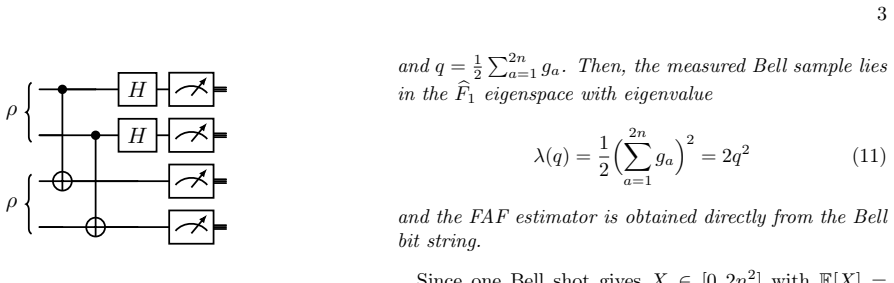
The central claim is the operator identity tr[ (1/2)(Σ_{a=1}^{2n} γ_a ⊗ γ_a)^2 ρ^{⊗2} ] = FAF1(ρ), where FAF1(ρ) = n − (1/2)||Γ_ρ||_F^2 and Γ_ρ is the covariance matrix. Because the two-copy operators G_a = γ_a ⊗ γ_a commute and square to the identity, a qubit-wise Bell measurement on two copies yields, in a single shot, the eigenvalue 2q^2 of the collective observable, with q an integer; averaging these outcomes gives FAF1 exactly. A pure Gaussian state has FAF1 = 0 and hence the deterministic outcome zero, so the Bell test is one-sided: any nonzero outcome rejects Gaussianity. Using the paper's Lemma 1, which bounds the trace distance to the Gaussian manifold by ϵ_G(ψ)^2 ≤ FAF1(ψ)/2, an (ϵ
What carries the argument
The central objects are the two-copy Majorana operators G_a = γ_a ⊗ γ_a, which commute and square to the identity, and the covariance functional FAF1(ρ) = n − (1/2)||Γ_ρ||_F^2. The identity tr[(1/2)(Σ_a G_a)^2 ρ^{⊗2}] = FAF1(ρ) is what makes a Bell basis change convert a single two-copy measurement into an unbiased FAF1 sample. The purity correction 2n(1 − tr(ρ^2)^{1/n}) then converts FAF1 into a mixed-state witness via the arithmetic-geometric mean inequality. For the pseudorandom part, the key mechanism is the Lipschitz bound that a unitary on m fermionic modes changes FAF1 by at most 4m.
Load-bearing premise
The Ω(n) lower bound for pseudorandom state preparation assumes circuits that start from a Gaussian state and interleave arbitrary Gaussian unitaries with non-Gaussian gates on O(1) fermionic modes; if pseudorandom states can be prepared with nonlocal non-Gaussian operations, large ancillas, or other shortcuts, the lower bound may fail, while the testing and witness theorems remain unaffected.
What would settle it
Search numerically over small n pure states for a violation of Lemma 1, namely any state with ϵ_G(ψ)^2 > FAF1(ψ)/2; because Lemma 1 is the bridge from the measurable FAF1 to the trace-distance promise, such a counterexample would invalidate the O(n^2/ϵ^2) Bell tester. The paper's own delocalized cat state saturates the other direction, so the search is a sharp check of the constant.
If this is right
- The two-copy Bell test certifies pure-state fermionic Gaussianity with O(n^2/ϵ^2 log 1/δ) measurements, a polynomial improvement over matchgate-shadow, covariance-tomography and convolution testers, using only Clifford operations native to fault-tolerant hardware.
- The single-copy protocol estimates FAF1 with O(n^3/ϵ^4 log 1/δ) shots, improving the best known single-copy bound by a factor of n.
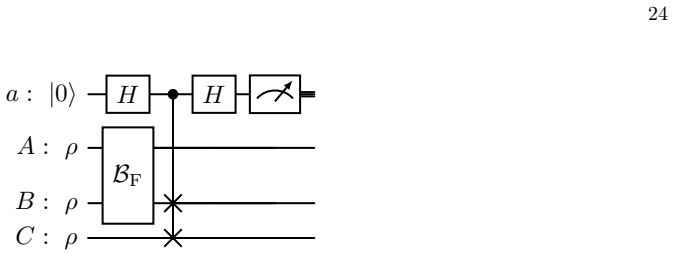
- The purity-corrected witness WF_AF certifies mixed-state non-Gaussianity from the same two-copy Bell data, without extra measurements, and remains positive under global depolarizing noise for every p < 1 whenever the pure seed is non-Gaussian.
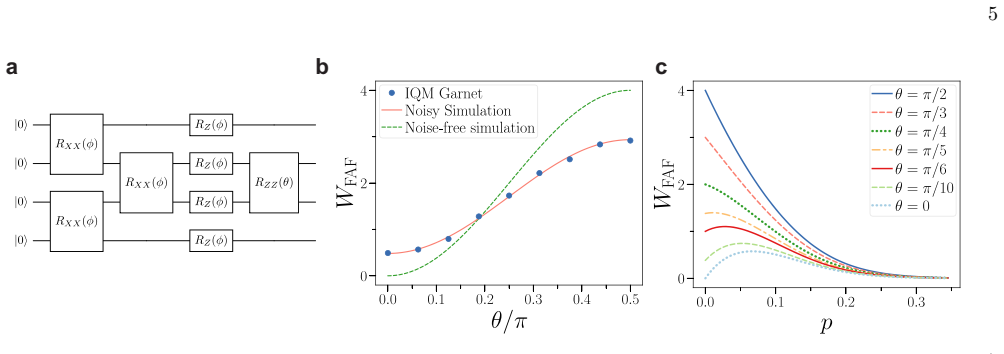
- Experimentally, on a noisy quantum processor, the witness is positive for a matchgate circuit doped with a non-Gaussian ZZ gate, and small noise strengths increase the witness for weakly non-Gaussian states, showing that hardware noise can itself generate fermionic non-Gaussianity.
- Pseudorandom fermionic states must have near-maximal FAF1, and in the standard circuit model with O(1)-mode non-Gaussian gates, preparing them requires Ω(n) non-Gaussian gates, so the pseudo-resource gap that exists for entanglement and magic does not exist for FAF1.
Where Pith is reading between the lines
- If the O(n^2/ϵ^2) Bell test is adopted on early fault-tolerant hardware, it gives a practical yardstick for 'non-Hartree–Fockness' of a many-body state—the variational error beyond the closest free-fermion ansatz—which could turn non-Gaussianity into a routine diagnostic for correlated materials and lattice gauge theories.
- The efficient estimability of FAF1 at extensive values suggests a general principle: resource measures that are low-degree functionals of the state and estimable in polynomial time will close pseudo-resource gaps, whereas entropic measures will not. A natural testable conjecture is that any such efficiently estimable resource rules out pseudo-resource shortcuts.
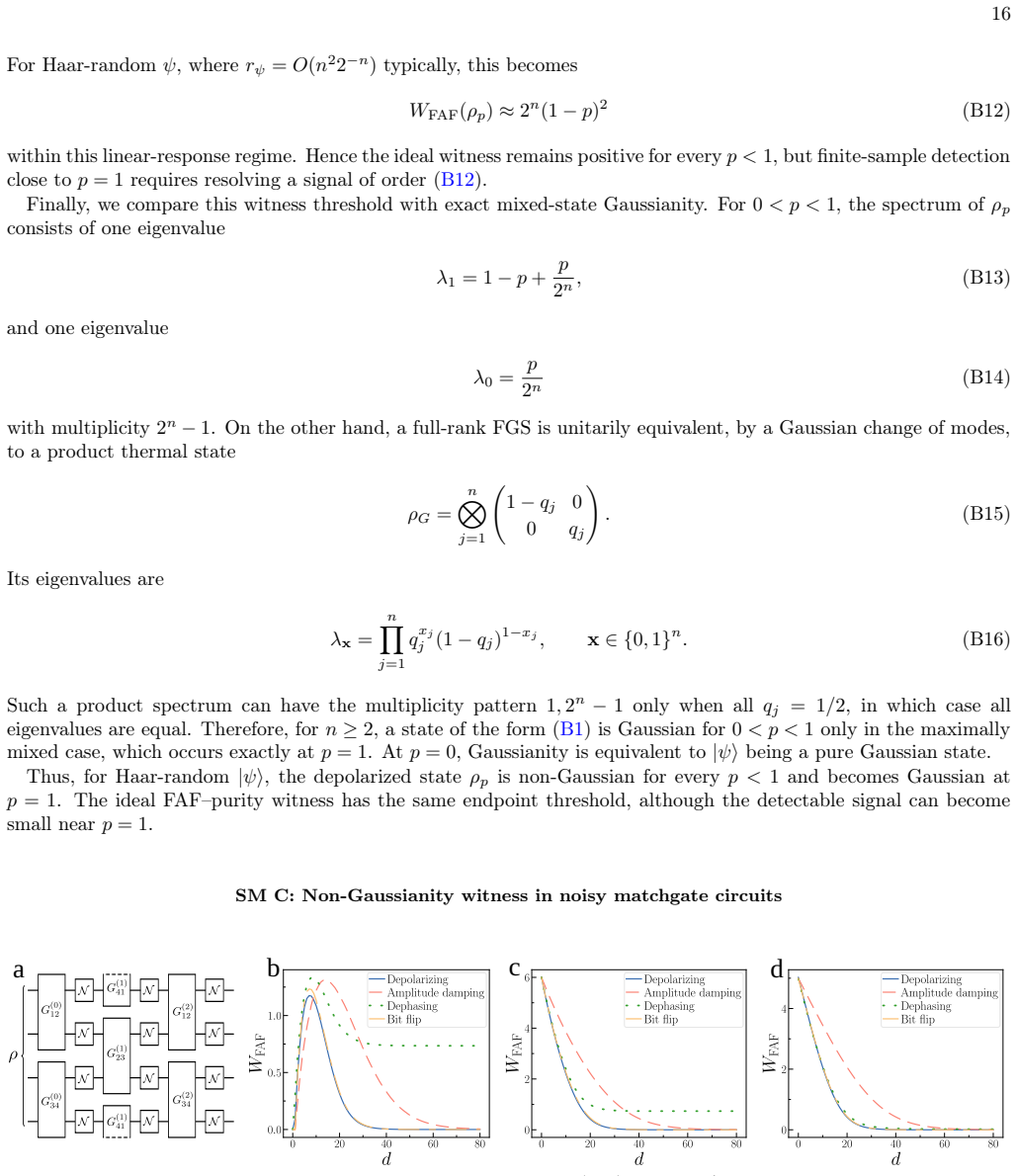
- The observation that dephasing can keep WF_AF positive in deep matchgate circuits hints that certain noise channels act as non-Gaussianity factories; one could systematically characterize which single-mode channels (unital vs non-unital, Pauli vs non-Pauli) generate positive WF_AF from Gaussian seeds, which would guide noise-tailored calibration of fermionic simulators.
- The paper leaves open whether the O(n^2/ϵ^2) bound is optimal; proving a matching lower bound for two-copy testers would settle whether the testing gap against stabilizer testing (O(1) samples) is intrinsic to free-fermion resource theory.
Editorial analysis
A structured set of objections, weighed in public.
Referee Report
Summary. The paper develops practical tests and witnesses for fermionic non-Gaussianity based on fermionic antiflatness (FAF). The main results are: (i) a two-copy Bell-measurement estimator for FAF1 whose expectation equals FAF1(rho) (Theorem 1), yielding an (epsilon,delta)-tester for pure Gaussianity with O(n^2/epsilon^2) two-copy Bell shots (Theorem 2); (ii) a single-copy estimator using commuting Majorana bilinears with O(n^3/epsilon^4) shot complexity for Gaussianity testing (Theorem 3); (iii) a purity-corrected witness W_FAF that certifies non-Gaussianity of mixed states and is robust to global depolarizing noise (Theorem 4); and (iv) an application to pseudorandom fermionic states, claiming that pseudorandom states require extensive non-Gaussianity and, in a local-gate model, Omega(n) non-Gaussian gates. The authors also report an implementation on the IQM Garnet quantum processor. The central proofs are contained in the main text and the Supplemental Material, and the code is publicly available.
Significance. If the main theorems hold, this is a significant advance in fermionic Gaussianity testing: the two-copy Bell protocol improves the sample complexity to O(n^2/epsilon^2), and the single-copy protocol to O(n^3/epsilon^4), both using only Clifford operations. The purity-corrected witness is a useful mixed-state certification tool, and the robustness under depolarizing noise is a notable feature. The pseudorandom application is intriguing and connects fermionic non-Gaussianity with pseudoresource theory. The proofs are mostly self-contained and clearly structured, and the inclusion of code and experimental data strengthens the work. However, one advertised consequence — the Omega(n) non-Gaussian-gate lower bound for pseudorandom states — is proven only in a restricted circuit model and is overstated in the abstract and Discussion.
major comments (1)
- [Pseudorandom non-Gaussianity / SM D.4] The main text and Discussion state an unqualified gate-count consequence: 'pseudorandom fermionic states require Omega(n) non-Gaussian gates' (Discussion) and the abstract says preparing such states 'requires extensive non-Gaussianity.' The only proof, in SM D.4, establishes a bound for a specific preparation model: start from a Gaussian state, apply arbitrary Gaussian unitaries interleaved with t non-Gaussian gates each supported on at most m modes. For this model, FAF1 increases by at most 4m per gate, giving t = Omega(n/m). This is correct but does not cover preparations that use ancillary registers, mid-circuit measurements, gate teleportation, or nonlocal non-Gaussian operations; the cited low-depth pseudorandom constructions [65] need not lie in this class. The FAF-based statement that pseudorandom ensembles have near-maximal FAF1 (n - negl(n)) is supported, but the Omega(n) gate-c
minor comments (5)
- [Table II and SM B] Table II gives f(n) = n - Theta(2^{-n}) for FAF1, but SM B, Eq. (B10), gives E[FAF1(psi_Haar)] = n - n(2n-1)/(2^n+1) = n - Theta(n^2 2^{-n}). The qualitative conclusion (a negligible gap) is unaffected, but the notation should be corrected for consistency.
- [Eq. (17) and SM D.1] The subset phase states use |S| = 2^q with S subset of {0,1}^n, so one should explicitly state that q is an integer with q <= n. The text only says q = omega(log n), which is not enough to guarantee such a subset exists.
- [Abstract and Eq. (12)] The abstract says FAF can be measured with O(n^3) sampling complexity, but Eq. (12) gives N = O(n^3/eta^2) for additive accuracy eta. Please specify 'for fixed additive precision' to avoid ambiguity.
- [Experimental section and Fig. 3] The noisy simulation in Fig. 3b uses p = 0.036 for single-qubit depolarizing noise. It would be helpful to state explicitly whether this value comes from device calibration or from a fit to the data, and to include uncertainty estimates for the experimental witness values.
- [SM C] The observation that dephasing can stabilize a positive W_FAF in matchgate circuits is interesting, but it is presented only as a numerical finding. A brief comment on the mechanism (e.g., non-convexity of the mixed Gaussian set) would improve readability.
Circularity Check
Core derivation chain is self-contained; FAF estimators, witnesses, and the pseudorandom argument are proved from the covariance matrix rather than assumed. The Ω(n) gate lower bound is restricted to a stated circuit model, but that is a scope limitation, not circularity.
full rationale
The central load-bearing identity tr[bF1 ρ^{⊗2}] = F_AF1(ρ) is derived in Methods from K^2 = 2nI + 2Σ_{a<b} γ_aγ_b ⊗ γ_aγ_b and the covariance-matrix identity ||Γ_ρ||_F^2 = 2Σ_{a<b} Γ_ab^2; it is not imported as an assumption. Lemma 1 (the distance-to-FAF bounds) is proven in SM A from canonical covariance form, occupation-projector inequalities, and the closest-Gaussian-state expansion. Theorems 1–3 follow from these proven identities plus variance bounds; Theorem 4 follows from the AM–GM inequality applied to the Gaussian purity formula tr(ρ^2)=Π_j(1+ν_j^2)/2, also derived in the text. The purity-corrected witness W_FAF is therefore a proven sufficient condition, not a fit. No fitted parameter is renamed as a prediction: the Bell estimator is unbiased with a closed-form spectrum and no calibrated constants. The pseudorandom argument uses the efficient FAF estimator as an explicit distinguisher; the Haar-random value F_AF1=n−Θ(2^{-n}) used there is derived in SM B Eq. (B10), not only cited. The measure FAF originates from Ref. [57] by overlapping authors, but the present paper rederives FAF1 from the covariance matrix and supplies independent proofs of all testing and witness results, so the self-citation is not load-bearing. The only notable gap is that the advertised Ω(n) non-Gaussian-gate lower bound is proven in SM D.4 for circuits that start from a Gaussian state and interleave Gaussian unitaries with non-Gaussian gates of support ≤m, giving t=Ω(n/m); the abstract and Discussion state the bound without this restriction. This is a scope mismatch between claim and proof, not a circular reduction: the proof bounds |FAF1(U_A ρ U_A†)−FAF1(ρ)|≤4m for m-mode gates and then combines it with the pseudorandom indistinguishability argument. Thus the central results are self-contained, and the pseudorandom consequence has a clearly stated but narrower theorem than the advertised conclusion.
Axiom & Free-Parameter Ledger
free parameters (1)
- depolarizing strength p in IQM noisy simulation =
p = 0.036
axioms (6)
- standard math Wick's theorem: for Gaussian ρ, all higher Majorana correlators are determined by Γρ and Pfaffians.
- standard math Fermionic Bloch-Messiah canonical form for pure Gaussian states and antisymmetric covariance matrices.
- standard math Arithmetic-geometric mean inequality applied to purity factors (1+ν_j²)/2.
- domain assumption Physical covariance matrices satisfy singular values 0≤ν_j≤1, so pure Gaussian means all ν_j=1.
- domain assumption IQM Garnet noise is approximated by local single-qubit depolarizing noise after each two-qubit gate with p=0.036.
- ad hoc to paper Pseudorandom lower bound restricts to circuits made of Gaussian unitaries plus non-Gaussian gates of support m=O(1), starting from a Gaussian state.
read the original abstract
Fermionic Gaussian states describe free fermions and underlie the mean-field picture of matter, from metals to superconductors; they are also efficiently simulable on classical computers. Departures from Gaussianity -- the correlations produced by interactions -- are therefore what make a fermionic system hard to simulate classically and useful for quantum computation, analogous to the role of magic in stabilizer-based quantum computation. Yet detecting and quantifying such non-Gaussianity at scale has remained challenging. Here we introduce practical tests and witnesses of fermionic non-Gaussianity built on fermionic antiflatness, a measure derived from the two-point covariance matrix. We estimate it with two protocols -- a two-copy Bell measurement and a single-copy scheme using commuting Majorana bilinears -- that determine whether a state is Gaussian or far from it at lower measurement cost than existing approaches, using only operations native to fault-tolerant hardware. For mixed states, a purity-corrected witness certifies non-Gaussianity and remains robust under strong noise; running it on the IQM quantum processor, we find that noise can both reduce and enhance non-Gaussianity. Finally, we show that preparing pseudorandom fermionic states requires extensive non-Gaussianity. Together, these tools enable the study and certification of non-Gaussian fermionic resources on present-day quantum devices.
Figures

Forward citations
Cited by 5 Pith papers
-
Unitary Designs from Doped Matchgate Circuits
Doped matchgate circuits achieve approximate parity-preserving 2-designs in polylogarithmic depth using a sparse number of non-Gaussian gates, with the design formation mapped exactly to a birth-death Markov chain.
-
Fermionic non-Gaussianity via Bell sampling: monotones and efficient quantum algorithms
Defines bridge degree monotone for fermionic non-Gaussianity from Bell-sampling eigenvalues of Lambda, shows non-increase under Gaussian protocols for stronger no-go theorems, and gives polynomial-sample tests for Gau...
-
Fermionic entropy: an efficiently measurable strong monotone for non-Gaussianity
Fermionic entropy is proven to be a strong, efficiently measurable monotone for fermionic non-Gaussianity, yielding a Theta(n) doping lower bound for matchgate-based approximate state designs.
-
Revealing Entanglement-Growth Mechanisms through the Magic Barrier
Relative timing of the entropy-growth-rate peak and the magic-barrier peak diagnoses whether bipartite entanglement grows by local build or by transport/redistribution.
-
Computable fermionic non-Gaussianity from the covariance matrix
Introduces occupation number entropies (Tsallis) and natural-orbital participation entropies (Renyi) as computable convex resource monotones for fermionic non-Gaussianity from the covariance matrix.
Reference graph
Works this paper leans on
-
[1]
Knill, Fermionic linear optics and matchgates (2001), arXiv:quant-ph/0108033 [quant-ph]
E. Knill, Fermionic linear optics and matchgates (2001), arXiv:quant-ph/0108033 [quant-ph]
Pith/arXiv arXiv 2001
-
[2]
Jozsa and A
R. Jozsa and A. Miyake, Matchgates and classical simu- lation of quantum circuits, Proc. R. Soc. A Math. Phys. Eng. Sci.464, 3089–3106 (2008)
2008
-
[3]
Bravyi, Lagrangian representation for fermionic lin- ear optics, Quantum Info
S. Bravyi, Lagrangian representation for fermionic lin- ear optics, Quantum Info. Comput.5, 216–238 (2005)
2005
-
[4]
J. W. Negele and H. Orland,Quantum many-particle systems, Frontiers in Physics (CRC Press, 2018)
2018
-
[5]
Peschel and V
I. Peschel and V. Eisler, Reduced density matrices and entanglement entropy in free lattice models, Journal of Physics A: Mathematical and Theoretical42, 504003 (2009)
2009
-
[6]
Amico, R
L. Amico, R. Fazio, A. Osterloh, and V. Vedral, Entan- glement in many-body systems, Rev. Mod. Phys.80, 517 (2008)
2008
-
[7]
J.SuraceandL.Tagliacozzo,FermionicGaussianstates: an introduction to numerical approaches, SciPost Phys. Lect. Notes , 54 (2022)
2022
-
[8]
P. Sala, T. Shi, S. Kühn, M. C. Bañuls, E. Demler, and J. I. Cirac, Variational study of u(1) and su(2) lattice gauge theories with gaussian states in1 + 1dimensions, Phys. Rev. D98, 034505 (2018)
2018
-
[9]
Zohar, M
E. Zohar, M. Burrello, T. B. Wahl, and J. I. Cirac, Fermionic projected entangled pair states and local u(1) gauge theories, Ann. Phys.363, 385 (2015)
2015
-
[10]
Kelman, U
A. Kelman, U. Borla, I. Gomelski, J. Elyovich, G. Roose, P. Emonts, and E. Zohar, Gauged gaussian projectedentangledpairstates: Ahighdimensionalten- sor network formulation for lattice gauge theories, Phys. Rev. D110, 054511 (2024)
2024
-
[11]
L. G. Valiant, Quantum computers that can be simu- lated classically in polynomial time, inProceedings of the Thirty-Third Annual ACM Symposium on Theory of Computing, STOC ’01 (Association for Computing Machinery, New York, NY, USA, 2001) p. 114–123
2001
-
[12]
B. M. Terhal and D. P. DiVincenzo, Classical simulation of noninteracting-fermion quantum circuits, Phys. Rev. A65, 032325 (2002)
2002
-
[13]
Gluza, M
M. Gluza, M. Kliesch, J. Eisert, and L. Aolita, Fidelity witnessesforfermionicquantumsimulations,Phys.Rev. Lett.120, 190501 (2018)
2018
-
[14]
K. Wan, W. J. Huggins, J. Lee, and R. Babbush, Match- gate shadows for fermionic quantum simulation, Com- mun. Math. Phys.404, 629–700 (2023)
2023
-
[15]
A. Zhao, N. C. Rubin, and A. Miyake, Fermionic partial tomography via classical shadows, Phys. Rev. Lett.127, 110504 (2021)
2021
-
[16]
Majsak, D
J. Majsak, D. McNulty, and M. Oszmaniec, A simple and efficient joint measurement strategy for estimating fermionic observables and hamiltonians, npj Quantum Info.11, 61 (2025)
2025
-
[17]
Heyraud, H
V. Heyraud, H. Chomet, and J. Tilly, Unified framework for matchgate classical shadows, npj Quantum Info.11, 65 (2025)
2025
-
[18]
P. Sierant, X. Turkeshi, and P. S. Tarabunga, Theory of the matchgate commutant (2026), arXiv:2603.12392 [quant-ph]
arXiv 2026
-
[19]
Denzler, A
J. Denzler, A. A. Mele, E. Derbyshire, T. Guaita, and J. Eisert, Learning fermionic correlations by evolv- ing with random translationally invariant hamiltonians, Phys. Rev. Lett.133, 240604 (2024)
2024
-
[20]
Bittel, A
L. Bittel, A. A. Mele, J. Eisert, and L. Leone, PAC- learning of free-fermionic states is NP-hard, Quantum 9, 1665 (2025)
2025
-
[21]
Oszmaniec, N
M. Oszmaniec, N. Dangniam, M. E. Morales, and Z. Zimborás, Fermion sampling: A robust quantum computational advantage scheme using fermionic linear optics and magic input states, PRX Quantum3, 020328 (2022)
2022
-
[22]
Hebenstreit, R
M. Hebenstreit, R. Jozsa, B. Kraus, S. Strelchuk, and M. Yoganathan, All pure fermionic non-gaussian states are magic states for matchgate computations, Phys. Rev. Lett.123, 080503 (2019)
2019
-
[23]
Hebenstreit, R
M. Hebenstreit, R. Jozsa, B. Kraus, and S. Strelchuk, Computational power of matchgates with supplemen- tary resources, Phys. Rev. A102, 052604 (2020)
2020
-
[24]
Lumia, E
L. Lumia, E. Tirrito, R. Fazio, and M. Collura, Measurement-induced transitions beyond gaussianity: A single particle description, Phys. Rev. Res.6, 023176 (2024)
2024
-
[25]
A. D. Gottlieb and N. J. Mauser, New measure of elec- tron correlation, Phys. Rev. Lett.95, 123003 (2005)
2005
-
[26]
O. Reardon-Smith, The fermionic linear optical extent is multiplicative for 4 qubit parity eigenstates (2024), arXiv:2407.20934 [quant-ph]
Pith/arXiv arXiv 2024
-
[27]
M. Debertolis, Natural super-orbitals representation of many-body operators (2025), arXiv:2507.10690 [cond- mat.str-el]
Pith/arXiv arXiv 2025
-
[28]
Bravyi and A
S. Bravyi and A. Kitaev, Universal quantum computa- tion with ideal Clifford gates and noisy ancillas, Phys. Rev. A71, 022316 (2005)
2005
-
[29]
Veitch, S
V. Veitch, S. A. H. Mousavian, D. Gottesman, and J. Emerson, The resource theory of stabilizer quantum computation, New J. Phys.16, 013009 (2014)
2014
-
[30]
Leone, S
L. Leone, S. F. E. Oliviero, and A. Hamma, Stabilizer rényi entropy, Phys. Rev. Lett.128, 050402 (2022)
2022
-
[31]
A. L. Fetter and J. D. Walecka,Quantum Theory of Many-Particle Systems(Dover Publications, Mineola, NY, 2003) original edition: McGraw-Hill, 1971
2003
-
[32]
Altland and B
A. Altland and B. D. Simons,Condensed Matter Field Theory, 2nd ed. (Cambridge University Press, Cam- bridge, 2010)
2010
-
[33]
de Gennes,Superconductivity of Metals and Alloys (Westview Press, Boulder, CO, 1999) original edition: W
P.-G. de Gennes,Superconductivity of Metals and Alloys (Westview Press, Boulder, CO, 1999) original edition: W. A. Benjamin, 1966
1999
-
[34]
Bardeen, L
J. Bardeen, L. N. Cooper, and J. R. Schrieffer, Theory of superconductivity, Phys. Rev.108, 1175 (1957). 8
1957
-
[35]
Weinberg,The Quantum Theory of Fields
S. Weinberg,The Quantum Theory of Fields. Vol. 1: Foundations(Cambridge University Press, Cambridge, 1995)
1995
-
[36]
Vollhardt, Normal 3He: an almost localized fermi liquid, Rev
D. Vollhardt, Normal 3He: an almost localized fermi liquid, Rev. Mod. Phys.56, 99 (1984)
1984
-
[37]
Bünemann, W
J. Bünemann, W. Weber, and F. Gebhard, Multiband gutzwiller wave functions for general on-site interac- tions, Phys. Rev. B57, 6896 (1998)
1998
-
[38]
Kotliar and A
G. Kotliar and A. E. Ruckenstein, New functional inte- gral approach to strongly correlated fermi systems: The gutzwiller approximation as a saddle point, Phys. Rev. Lett.57, 1362 (1986)
1986
-
[39]
Capello, F
M. Capello, F. Becca, M. Fabrizio, S. Sorella, and E. Tosatti, Variational description of mott insulators, Phys. Rev. Lett.94, 026406 (2005)
2005
-
[40]
Becca and S
F. Becca and S. Sorella,Quantum Monte Carlo Ap- proaches for Correlated Systems(Cambridge University Press, 2017)
2017
-
[41]
Georges, G
A. Georges, G. Kotliar, W. Krauth, and M. J. Rozen- berg, Dynamical mean-field theory of strongly corre- lated fermion systems and the limit of infinite dimen- sions, Rev. Mod. Phys.68, 13 (1996)
1996
-
[42]
T. Shi, E. Demler, and J. Ignacio Cirac, Variational study of fermionic and bosonic systems with non- gaussian states: Theory and applications, Ann. Phys. 390, 245–302 (2018)
2018
-
[43]
Hackl, T
L. Hackl, T. Guaita, T. Shi, J. Haegeman, E. Demler, and J. I. Cirac, Geometry of variational methods: dy- namics of closed quantum systems, SciPost Phys.9, 048 (2020)
2020
-
[44]
Buhrman, L
H. Buhrman, L. Fortnow, I. Newman, and H. Röhrig, Quantum property testing, SIAM Journal on Comput- ing37, 1387 (2008)
2008
-
[45]
Montanaro and R
A. Montanaro and R. de Wolf,A Survey of Quantum Property Testing, Graduate Surveys No. 7 (Theory of Computing Library, 2016) pp. 1–81
2016
-
[46]
Baumgratz, M
T. Baumgratz, M. Cramer, and M. B. Plenio, Quanti- fying coherence, Phys. Rev. Lett.113, 140401 (2014)
2014
-
[47]
Soleimanifar and J
M. Soleimanifar and J. Wright, Testing matrix product states, inProceedings of the 2022 Annual ACM-SIAM Symposium on Discrete Algorithms (SODA)(SIAM,
2022
-
[48]
Gross, S
D. Gross, S. Nezami, and M. Walter, Schur–weyl du- ality for the clifford group with applications: Property testing, a robust hudson theorem, and de finetti repre- sentations, Commun. Math. Phys.385, 1325 (2021)
2021
-
[49]
Haug and P
T. Haug and P. S. Tarabunga, Efficient witnessing and testing of magic in mixed quantum states, npj Quantum Info.12, 40 (2026)
2026
-
[50]
P. S. Tarabunga and T. Haug, Quantifying mixed-state entanglement via partial transpose and realignment mo- ments (2025), arXiv:2507.13840 [quant-ph]
Pith/arXiv arXiv 2025
-
[51]
Hinsche and J
M. Hinsche and J. Helsen, Single-copy stabilizer test- ing, inProceedings of the 57th Annual ACM Sympo- sium on Theory of Computing, STOC ’25 (Association for Computing Machinery, New York, NY, USA, 2025) p. 439–450
2025
-
[52]
Bittel, A
L. Bittel, A. A. Mele, J. Eisert, and L. Leone, Optimal trace-distance bounds for free-fermionic states: Testing and improved tomography, PRX Quantum6, 030341 (2025)
2025
-
[53]
A. A. Mele and Y. Herasymenko, Efficient learning of quantum states prepared with few fermionic non- gaussian gates, PRX Quantum6, 010319 (2025)
2025
-
[54]
X. Lyu and K. Bu, Fermionic gaussian testing and non-gaussian measures via convolution (2024), arXiv:2409.08180 [quant-ph]
Pith/arXiv arXiv 2024
-
[55]
L. Coffman, G. Smith, and X. Gao, Measuring non- gaussian magic in fermions: Convolution, entropy, and the violation of wick’s theorem and the matchgate iden- tity (2025), arXiv:2501.06179 [quant-ph]
Pith/arXiv arXiv 2025
-
[56]
M. Walter and F. Witteveen, A random purifica- tion channel for arbitrary symmetries with appli- cations to fermions and bosons, arXiv:2512.15690 10.48550/arXiv.2512.15690 (2025)
-
[57]
Sierant, P
P. Sierant, P. Stornati, and X. Turkeshi, Fermionic magic resources of quantum many-body systems, PRX Quantum7, 010302 (2026)
2026
-
[58]
Jordan and E
P. Jordan and E. Wigner, Über das paulische äquivalen- zverbot, Z. Phys.47, 631 (1928)
1928
-
[59]
Bendersky, J
A. Bendersky, J. P. Paz, and M. T. Cunha, General theory of measurement with two copies of a quantum state, Phys. Rev. Lett.103, 040404 (2009)
2009
-
[60]
J. C. Garcia-Escartin and P. Chamorro-Posada, swap test and hong-ou-mandel effect are equivalent, Phys. Rev. A87, 052330 (2013)
2013
-
[61]
Chitambar and G
E. Chitambar and G. Gour, Quantum resource theories, Rev. Mod. Phys.91, 025001 (2019)
2019
-
[62]
Knill, Approximation by quantum circuits (1995), arXiv:quant-ph/9508006 [quant-ph]
E. Knill, Approximation by quantum circuits (1995), arXiv:quant-ph/9508006 [quant-ph]
Pith/arXiv arXiv 1995
-
[63]
Ji, Y.-K
Z. Ji, Y.-K. Liu, and F. Song, Pseudorandom quan- tum states, inAdvances in Cryptology – CRYPTO 2018: 38th Annual International Cryptology Confer- ence, Santa Barbara, CA, USA, August 19–23, 2018, Proceedings, Part III(Springer-Verlag, Berlin, Heidel- berg, 2018) p. 126–152
2018
-
[64]
N.LaRacuenteandF.Leditzky,Approximateunitaryk- designsfromshallow, low-communicationcircuits,Com- mun. Math. Phys.407, 51 (2026)
2026
-
[65]
Schuster, J
T. Schuster, J. Haferkamp, and H.-Y. Huang, Ran- dom unitaries in extremely low depth, Science389, 92 (2025)
2025
-
[66]
S. Aaronson, A. Bouland, B. Fefferman, S. Ghosh, U. Vazirani, C. Zhang, and Z. Zhou, Quantum pseu- doentanglement (2023), arXiv:2211.00747 [quant-ph]
Pith/arXiv arXiv 2023
-
[67]
A. Gu, L. Leone, S. Ghosh, J. Eisert, S. F. Yelin, and Y.Quek,Pseudomagicquantumstates,Phys.Rev.Lett. 132, 210602 (2024)
2024
-
[68]
T. Haug, K. Bharti, and D. E. Koh, Pseudorandom uni- tariesareneitherrealnorsparsenornoise-robust,Quan- tum9, 1759 (2025)
2025
-
[69]
Zhandry, How to construct quantum random func- tions, J
M. Zhandry, How to construct quantum random func- tions, J. ACM68, 1 (2021)
2021
-
[70]
Turkeshi, A
X. Turkeshi, A. Dymarsky, and P. Sierant, Pauli spec- trum and nonstabilizerness of typical quantum many- body states, Phys. Rev. B111, 054301 (2025)
2025
-
[71]
Reardon-Smith, M
O. Reardon-Smith, M. Oszmaniec, and K. Korzekwa, Improved simulation of quantum circuits dominated by free fermionic operations, Quantum8, 1549 (2024)
2024
-
[72]
Dias and R
B. Dias and R. Koenig, Classical simulation of non- Gaussian fermionic circuits, Quantum8, 1350 (2024)
2024
-
[73]
Paviglianiti, L
A. Paviglianiti, L. Lumia, E. Tirrito, A. Silva, M. Col- lura, X. Turkeshi, and G. Lami, Emergence of generic entanglement structure in doped matchgate circuits, Phys. Rev. Lett.136, 020403 (2026)
2026
-
[74]
Grewal, V
S. Grewal, V. Iyer, W. Kretschmer, and D. Liang, Im- proved stabilizer estimation via bell difference sampling, inProceedings of the 56th Annual ACM Symposium 9 on Theory of Computing, STOC 2024 (Association for Computing Machinery, New York, NY, USA, 2024) p. 1352–1363
2024
-
[75]
J. K. Pachos and C. Vlachou, Quantifying fermionic in- teractions from the violation of Wick’s theorem, Quan- tum6, 840 (2022)
2022
-
[76]
Haug and M
T. Haug and M. Kim, Scalable measures of magic resource for quantum computers, PRX Quantum4, 010301 (2023)
2023
-
[77]
T. Haug, S. Lee, and M. S. Kim, Efficient quantum al- gorithms for stabilizer entropies, Phys. Rev. Lett.132, 240602 (2024)
2024
-
[78]
Streltsov, G
A. Streltsov, G. Adesso, and M. B. Plenio, Colloquium: Quantum coherence as a resource, Rev. Mod. Phys.89, 041003 (2017)
2017
-
[79]
F. Girardi, F. Witteveen, F. A. Mele, L. Bittel, S. F. Oliviero, D. Gross, and M. Walter, Is it gaus- sian? testing bosonic quantum states, arXiv preprint arXiv:2510.07305 10.48550/arXiv.2510.07305 (2025)
-
[80]
A. Montanaro, Learning stabilizer states by bell sampling, arXiv preprint arXiv:1707.04012 10.48550/arXiv.1707.04012 (2017)
discussion (0)
Sign in with ORCID, Apple, or X to comment. Anyone can read and Pith papers without signing in.