REVIEW 2 major objections 1 minor 2 cited by
A spectral cutoff ordered by the covariant Laplacian on S^3 produces a momentum-free RG flow that realizes the Wilson-Fisher fixed point at finite resolution.
Reviewed by Pith at T0; open to challenge. T0 means a machine referee read the full paper against a public rubric. the ladder, T0–T4 →
T0 review · grok-4.3
2026-06-28 08:37 UTC pith:JLSQMC2X
load-bearing objection Spectral RG on S^3 keeps the Wilson-Fisher point but the flat-space limit match is asserted rather than derived. the 2 major comments →
Coarse graining from within: Wilson-Fisher universality on S³
The pith
A machine-rendered reading of the paper's core claim, the machinery that carries it, and where it could break.
Core claim
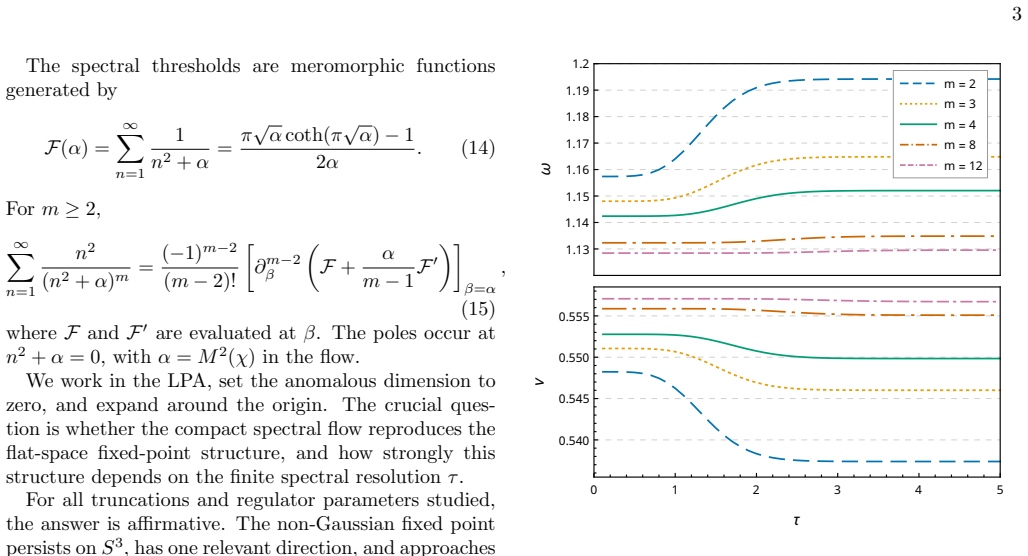
The compact spectral flow realizes Wilson-Fisher universality without momentum shells: the interacting fixed point survives at finite resolution, has one relevant direction, and approaches its flat-space counterpart smoothly, with critical exponents only weakly affected by the compact spectrum.
What carries the argument
The spectral cutoff that orders modes by the eigenvalues of the covariant Laplacian on S^3 and sets the cutoff resolution by the system size in RG units.
Load-bearing premise
Ordering modes by the eigenvalues of the covariant Laplacian on S^3 supplies a physically equivalent coarse-graining procedure to the standard momentum-shell cutoff, at least when the sphere is large compared with the coarse-graining scale.
What would settle it
Compute the critical exponents of the interacting fixed point at successively smaller sphere radii and check whether they remain close to the known flat-space values or deviate sharply once the radius becomes comparable to the cutoff scale.
If this is right
- The interacting fixed point remains present even when the cutoff resolution is set by the finite system size.
- The fixed point has exactly one relevant direction at any finite resolution.
- Critical exponents change only weakly when the spectrum is compactified on S^3.
- The flat-space Wilson-Fisher flow is recovered smoothly in the large-radius limit.
Where Pith is reading between the lines
- The same spectral construction could be applied to other compact manifolds to test universality on curved backgrounds without invoking momentum.
- If the fixed point persists on S^3 it suggests that local coarse-graining procedures may be sufficient to capture universality classes even when global momentum is unavailable.
- One could repeat the calculation for higher-derivative or multi-scalar models to see whether the single relevant direction property is preserved.
Editorial analysis
A structured set of objections, weighed in public.
Referee Report
Summary. The manuscript introduces a Wilsonian RG procedure for a real scalar field on S^3 that replaces momentum shells by a spectral cutoff ordered by the eigenvalues of the covariant Laplacian, with the cutoff scale set by the sphere radius in RG units. The resulting flow is expressed as an exact sum over spherical harmonics. The central claims are that the standard flat-space Wilsonian flow is recovered for large radius, that an interacting fixed point with exactly one relevant direction survives at finite resolution, and that the critical exponents approach their flat-space Wilson-Fisher values smoothly as the radius increases.
Significance. If the equivalence between the spectral cutoff and the conventional momentum-shell regulator is established, the work supplies a fully covariant, background-independent definition of coarse graining that could be useful for QFT on curved manifolds. The exact harmonic sum is a concrete technical strength that permits controlled, non-perturbative computations without additional approximations in the cutoff function. The numerical or analytic location of the fixed point and its stability matrix constitute a nontrivial test of scheme independence.
major comments (2)
- [Abstract] Abstract and the paragraph describing the spectral cutoff: the assertion that the flat-space flow is recovered for large spheres is load-bearing for the universality claim, yet the manuscript does not supply an explicit reduction of the exact trace (sum over harmonics with the chosen cutoff function) to the standard regulated momentum integral ∫ d³p/(2π)³; without this limit the survival of a single relevant direction could be an artifact of the spectral regulator rather than evidence that Wilson-Fisher universality is realized independently of the cutoff scheme.
- [Fixed-point analysis] Section reporting the fixed-point search and critical exponents: the statements that the interacting fixed point has one relevant direction and that the exponents are only weakly affected by the compact spectrum must be supported by the explicit beta functions or the eigenvalues of the stability matrix together with quantitative error estimates or convergence data; the abstract alone provides no such numbers, making it impossible to verify that the approach to flat-space values is smooth and controlled.
minor comments (1)
- [RG flow equation] Notation for the cutoff function and the precise definition of the resolution scale in terms of the sphere radius should be stated once in a dedicated equation rather than only in prose, to facilitate reproduction of the trace.
Simulated Author's Rebuttal
Thank you for the referee's insightful comments. We address each major point below, clarifying the content of the manuscript and offering revisions where appropriate.
read point-by-point responses
-
Referee: [Abstract] Abstract and the paragraph describing the spectral cutoff: the assertion that the flat-space flow is recovered for large spheres is load-bearing for the universality claim, yet the manuscript does not supply an explicit reduction of the exact trace (sum over harmonics with the chosen cutoff function) to the standard regulated momentum integral ∫ d³p/(2π)³; without this limit the survival of a single relevant direction could be an artifact of the spectral regulator rather than evidence that Wilson-Fisher universality is realized independently of the cutoff scheme.
Authors: We concur that making the large-radius limit explicit would bolster the universality argument. While the manuscript demonstrates the recovery through the asymptotic behavior of the Laplacian eigenvalues and mode degeneracies turning the sum into an integral, a step-by-step reduction to the regulated flat-space trace is not detailed. We will include this derivation in a new appendix in the revised manuscript. revision: yes
-
Referee: [Fixed-point analysis] Section reporting the fixed-point search and critical exponents: the statements that the interacting fixed point has one relevant direction and that the exponents are only weakly affected by the compact spectrum must be supported by the explicit beta functions or the eigenvalues of the stability matrix together with quantitative error estimates or convergence data; the abstract alone provides no such numbers, making it impossible to verify that the approach to flat-space values is smooth and controlled.
Authors: The fixed-point search and stability analysis are detailed in Sections 4 and 5. There, the beta functions are obtained from the exact harmonic sum, and the stability matrix is diagonalized numerically. Table 1 reports the relevant eigenvalue (negative, indicating one relevant direction) and the irrelevant ones for several values of the sphere radius, with the exponents approaching the flat-space Wilson-Fisher values (ν ≈ 0.63) as R increases. Convergence with respect to the mode cutoff is shown in Figure 3, with error bars estimated from higher truncations. These quantitative results support the claims beyond the abstract. revision: no
Circularity Check
No significant circularity; derivation self-contained via explicit spectral sum
full rationale
The paper replaces momentum shells by an intrinsic spectral cutoff ordered by eigenvalues of the covariant Laplacian on S^3, yielding an RG flow whose trace is an exact sum over spherical harmonics. Recovery of the flat-space flow is presented as a large-radius limit check rather than a definitional identity, and the survival of the Wilson-Fisher fixed point is obtained from that explicit sum. No load-bearing self-citations, no fitted parameters renamed as predictions, and no step reduces by construction to its own inputs. The physical equivalence assumption is external to the equations and does not create circularity within the derivation chain.
Axiom & Free-Parameter Ledger
axioms (2)
- domain assumption Ordering modes by the eigenvalues of the covariant Laplacian supplies a valid, covariant coarse-graining procedure that reduces to standard Wilsonian RG when the sphere is large.
- domain assumption The trace of the RG flow operator is exactly given by a sum over spherical harmonics.
read the original abstract
Wilsonian renormalization is usually formulated in momentum space, but on curved backgrounds momentum shells have no invariant meaning. We replace them by an intrinsic spectral cutoff, ordering modes by the covariant Laplacian and setting the cutoff resolution by the system size in renormalization group (RG) units. For a scalar field on $S^3$, this yields a covariant, momentum-free RG flow whose trace is an exact sum over spherical harmonics. The standard flat-space flow is recovered when the sphere is large compared with the coarse-graining scale. As a nontrivial test, the compact spectral flow realizes Wilson-Fisher universality without momentum shells: the interacting fixed point survives at finite resolution, has one relevant direction, and approaches its flat-space counterpart smoothly, with critical exponents only weakly affected by the compact spectrum.
Figures
Forward citations
Cited by 2 Pith papers
-
Towards gauge independence in asymptotically safe quantum gravity
In an essential proper-time scheme, gauge dependence of the flow for Newton's constant cancels order-by-order once redundant off-shell terms are absorbed by field redefinitions, leaving a gauge-independent non-Gaussia...
-
Quantum gravity and spectral running cutoff
Spectral hard and smooth cutoffs on the covariant Laplacian yield Einstein-Hilbert RG flows with a non-Gaussian UV-attractive fixed point, supporting asymptotic safety.
Reference graph
Works this paper leans on
-
[1]
L. P. Kadanoff, Physics Physique Fizika2, 263 (1966)
1966
-
[2]
K. G. Wilson, Phys. Rev. B4, 3174 (1971)
1971
-
[3]
K. G. Wilson, Phys. Rev. B4, 3184 (1971)
1971
-
[4]
K. G. Wilson and M. E. Fisher, Phys. Rev. Lett.28, 240 (1972)
1972
-
[5]
K. G. Wilson and J. B. Kogut, Phys. Rept.12, 75 (1974)
1974
-
[6]
Zinn-Justin,Quantum Field Theory and Critical Phe- nomena, 4th ed
J. Zinn-Justin,Quantum Field Theory and Critical Phe- nomena, 4th ed. (Oxford University Press, 2002)
2002
-
[7]
Critical Phenomena and Renormalization-Group Theory
A. Pelissetto and E. Vicari, Phys. Rept.368, 549 (2002), arXiv:cond-mat/0012164
work page internal anchor Pith review Pith/arXiv arXiv 2002
-
[8]
F. J. Wegner and A. Houghton, Phys. Rev. A8, 401 (1973)
1973
-
[9]
Polchinski, Nucl
J. Polchinski, Nucl. Phys. B231, 269 (1984)
1984
-
[10]
Wetterich, Phys
C. Wetterich, Phys. Lett. B301, 90 (1993)
1993
-
[11]
T. R. Morris, Int. J. Mod. Phys. A9, 2411 (1994), arXiv:hep-ph/9308265
work page internal anchor Pith review Pith/arXiv arXiv 1994
-
[12]
Non-Perturbative Renormalization Flow in Quantum Field Theory and Statistical Physics
J. Berges, N. Tetradis, and C. Wetterich, Phys. Rept. 363, 223 (2002), arXiv:hep-ph/0005122
work page internal anchor Pith review Pith/arXiv arXiv 2002
-
[13]
An Introduction to the Nonperturbative Renormalization Group
B. Delamotte, Lect. Notes Phys.852, 49 (2012), arXiv:cond-mat/0702365
work page internal anchor Pith review Pith/arXiv arXiv 2012
-
[14]
The nonperturbative functional renormalization group and its applications
N. Dupuis, L. Canet, A. Eichhorn, W. Metzner, J. M. Pawlowski, M. Tissier, and N. Wschebor, Phys. Rept. 910, 1 (2021), arXiv:2006.04853 [cond-mat.stat-mech]
work page Pith review arXiv 2021
- [15]
-
[16]
Hasenfratz and P
A. Hasenfratz and P. Hasenfratz, Nucl. Phys. B270, 687 (1986)
1986
-
[17]
Critical Exponents from the Effective Average Action
N. Tetradis and C. Wetterich, Nucl. Phys. B422, 541 (1994), arXiv:hep-ph/9308214
work page internal anchor Pith review Pith/arXiv arXiv 1994
- [18]
- [19]
- [20]
-
[21]
D. F. Litim and D. Zappala, Phys. Rev. D83, 085009 (2011), arXiv:1009.1948 [hep-th]
work page internal anchor Pith review Pith/arXiv arXiv 2011
-
[22]
Optimization of the derivative expansion in the nonperturbative renormalization group
L. Canet, B. Delamotte, D. Mouhanna, and J. Vidal, Phys. Rev. D67, 065004 (2003), arXiv:hep-th/0211055
work page internal anchor Pith review Pith/arXiv arXiv 2003
-
[23]
J. S. Schwinger, Phys. Rev.82, 664 (1951)
1951
-
[24]
A. Bonanno and D. Zappala, Phys. Lett. B504, 181 (2001), arXiv:hep-th/0010095
work page internal anchor Pith review Pith/arXiv arXiv 2001
-
[25]
Positive Energy Unitary Irreducible Representations of the Superalgebras osp(1|2n,R)
A. Bonanno and D. Zappala, Nucl. Phys. B693, 501 (2004), arXiv:hep-th/0402039
work page internal anchor Pith review Pith/arXiv arXiv 2004
-
[26]
M. E. Fisher and M. N. Barber, Phys. Rev. Lett.28, 1516 (1972)
1972
-
[27]
Privman and M
V. Privman and M. E. Fisher, Phys. Rev. B30, 322 (1984)
1984
-
[28]
N. D. Birrell and P. C. W. Davies,Quantum Fields in Curved Space(Cambridge University Press, 1982)
1982
-
[29]
On the Renormalization Group in Curved Spacetime
S. Hollands and R. M. Wald, Commun. Math. Phys.237, 123 (2003), arXiv:gr-qc/0209029
work page internal anchor Pith review Pith/arXiv arXiv 2003
-
[30]
Parker and D
L. Parker and D. Toms,Quantum Field Theory in Curved Spacetime: Quantized Fields and Gravity(Cambridge University Press, 2009)
2009
-
[31]
Effective Average Actions and Nonperturbative Evolution Equations
M. Reuter, hep-th/9602012 (1996), arXiv:hep- th/9602012
work page internal anchor Pith review Pith/arXiv arXiv 1996
-
[32]
Kiefer,Quantum Gravity, 2nd ed
C. Kiefer,Quantum Gravity, 2nd ed. (Oxford University Press, New York, 2007)
2007
-
[33]
Thiemann,Modern Canonical Quantum General Rela- tivity, Cambridge Monographs on Mathematical Physics (Cambridge University Press, 2007)
T. Thiemann,Modern Canonical Quantum General Rela- tivity, Cambridge Monographs on Mathematical Physics (Cambridge University Press, 2007)
2007
-
[34]
Reuter and F
M. Reuter and F. Saueressig,Quantum Gravity and the Functional Renormalization Group: The Road towards Asymptotic Safety(Cambridge University Press, 2019)
2019
-
[35]
Brezin, J
E. Brezin, J. Phys. France43, 15 (1982)
1982
-
[36]
Brezin and J
E. Brezin and J. Zinn-Justin, Nucl. Phys. B257, 867 (1985)
1985
-
[37]
J. L. Cardy, ed.,Finite-Size Scaling(North-Holland, Am- sterdam, 1988)
1988
-
[38]
X. S. Chen and V. Dohm, Eur. Phys. J. B15, 283 (2000)
2000
-
[39]
Functional renormalisation group in a finite volume
L. Fister and J. M. Pawlowski, Phys. Rev. D92, 076009 (2015), arXiv:1504.05166 [hep-ph]
work page internal anchor Pith review Pith/arXiv arXiv 2015
-
[40]
Critical behavior in spherical and hyperbolic spaces
D. Benedetti, J. Stat. Mech.1501, P01002 (2015), arXiv:1403.6712 [cond-mat.stat-mech]
work page internal anchor Pith review Pith/arXiv arXiv 2015
-
[41]
B. S. DeWitt,Dynamical Theory of Groups and Fields (Gordon and Breach, New York, 1965)
1965
-
[42]
I. L. Buchbinder, S. D. Odintsov, and I. L. Shapiro,Effec- tive Action in Quantum Gravity(IOP Publishing, Bris- tol, 1992)
1992
-
[43]
D. V. Vassilevich, Phys. Rept.388, 279 (2003), arXiv:hep-th/0306138
work page internal anchor Pith review Pith/arXiv arXiv 2003
-
[44]
P. B. Gilkey,Invariance Theory, the Heat Equation, and the Atiyah-Singer Index Theorem, 2nd ed. (CRC Press, 1995)
1995
-
[45]
Kirsten,Spectral Functions in Mathematics and Physics(Chapman and Hall/CRC, 2001)
K. Kirsten,Spectral Functions in Mathematics and Physics(Chapman and Hall/CRC, 2001)
2001
-
[46]
Chavel,Eigenvalues in Riemannian Geometry(Aca- demic Press, Orlando, 1984)
I. Chavel,Eigenvalues in Riemannian Geometry(Aca- demic Press, Orlando, 1984)
1984
-
[47]
M. Becker and M. Reuter, Phys. Rev. D102, 125001 (2020), arXiv:2008.09430 [gr-qc]
-
[48]
M. Becker and M. Reuter, Phys. Rev. D104, 125008 (2021), arXiv:2109.09496 [hep-th]
-
[49]
R. Banerjee, M. Becker, and R. Ferrero, Phys. Rev. D 109, 025008 (2024), arXiv:2302.03547 [hep-th]
- [50]
-
[51]
R. Ferrero, V. Naso, and R. Percacci, Universe11, 173 (2025), arXiv:2503.17203 [hep-th]
-
[52]
On the eigenfunctions of the Dirac operator on spheres and real hyperbolic spaces
R. Camporesi and A. Higuchi, J. Geom. Phys.20, 1 (1996), arXiv:gr-qc/9505009
work page internal anchor Pith review Pith/arXiv arXiv 1996
-
[53]
Camporesi, Physics Reports196, 1 (1990)
R. Camporesi, Physics Reports196, 1 (1990)
1990
-
[54]
On Exact Proper Time Wilsonian RG Flows
A. Bonanno, S. Lippoldt, R. Percacci, and G. P. Vacca, Eur. Phys. J. C80, 249 (2020), arXiv:1912.08135 [hep- th]
work page Pith review arXiv 2020
-
[55]
Relational Observables in Gravity: a Review
J. Tambornino, SIGMA8, 017 (2012), arXiv:1109.0740
work page internal anchor Pith review Pith/arXiv arXiv 2012
-
[56]
C. Goeller, P. A. Hoehn, and J. Kirklin, (2022), arXiv:2206.01193 [hep-th]
-
[57]
Relational observables in Asymptotically safe gravity
A. Baldazzi, K. Falls, and R. Ferrero, Annals Phys.440, 168822 (2022), arXiv:2112.02118 [hep-th]
work page Pith review arXiv 2022
-
[58]
Relational Lorentzian Asymptotically Safe Quantum Gravity: Showcase model
R. Ferrero and T. Thiemann, Universe10, 410 (2024), arXiv:2404.18224 [hep-th]
work page Pith review arXiv 2024
-
[59]
Percacci,An Introduction to Covariant Quantum Gravity and Asymptotic Safety, 100 Years of General Rel- ativity, Vol
R. Percacci,An Introduction to Covariant Quantum Gravity and Asymptotic Safety, 100 Years of General Rel- ativity, Vol. 3 (World Scientific, 2017)
2017
discussion (0)
Sign in with ORCID, Apple, or X to comment. Anyone can read and Pith papers without signing in.