REVIEW 3 major objections 4 minor 1 cited by
A graph neural network that reads the full 3D pattern of hadronic shower hits can recover most of the energy information lost by the non-compensating CRILIN crystal calorimeter, cutting the combined ECAL+HCAL stochastic resolution term from
Reviewed by Pith at T0; open to challenge. T0 means a machine referee read the full paper against a public rubric. the ladder, T0–T4 →
T0 review · deepseek-v4-flash
2026-08-04 04:50 UTC pith:L2AZ7BNP
load-bearing objection A solid, honestly-caveated simulation study showing that GNN-based software compensation can recover much of the non-compensating loss in a crystal ECAL, but the headline CRILIN-only numbers are properties of the idealized virtual-detector plus synthetic-HCAL construction, not of a real downstream calorimeter. the 3 major comments →
3D software compensation of hadronic showers in the CRILIN crystal calorimeter
The pith
A machine-rendered reading of the paper's core claim, the machinery that carries it, and where it could break.
Core claim
The central claim is that CRILIN's strongly non-compensating response does not destroy the information needed for hadronic energy measurement: it merely hides that information in the detailed 3D pattern of crystal hits. The authors demonstrate this by training a ParticleNet GNN to regress the true energy deposited in CRILIN, defined as beam energy minus the energy recorded by a virtual detector placed just downstream. After adding a Gaussian-smeared model of a hadronic calorimeter, the combined resolution's stochastic term drops from (71.5±7.0)% with a simple energy sum to (27.6±0.8)% with the GNN. Subtracting the assumed HCAL resolution in quadrature yields a CRILIN contribution of σ/E = 1.
What carries the argument
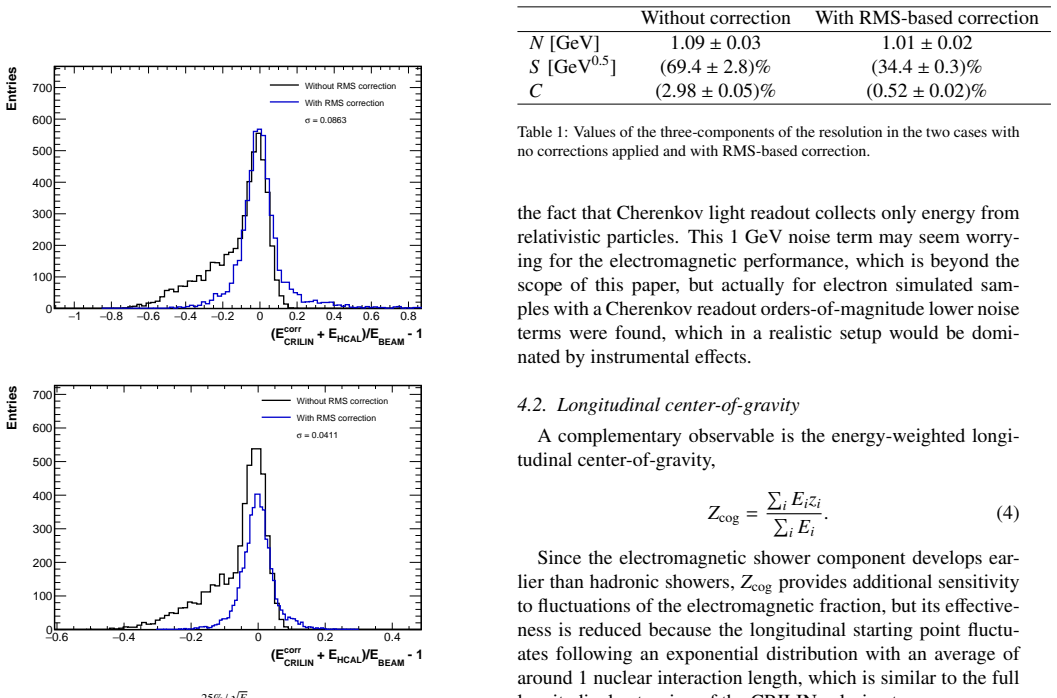
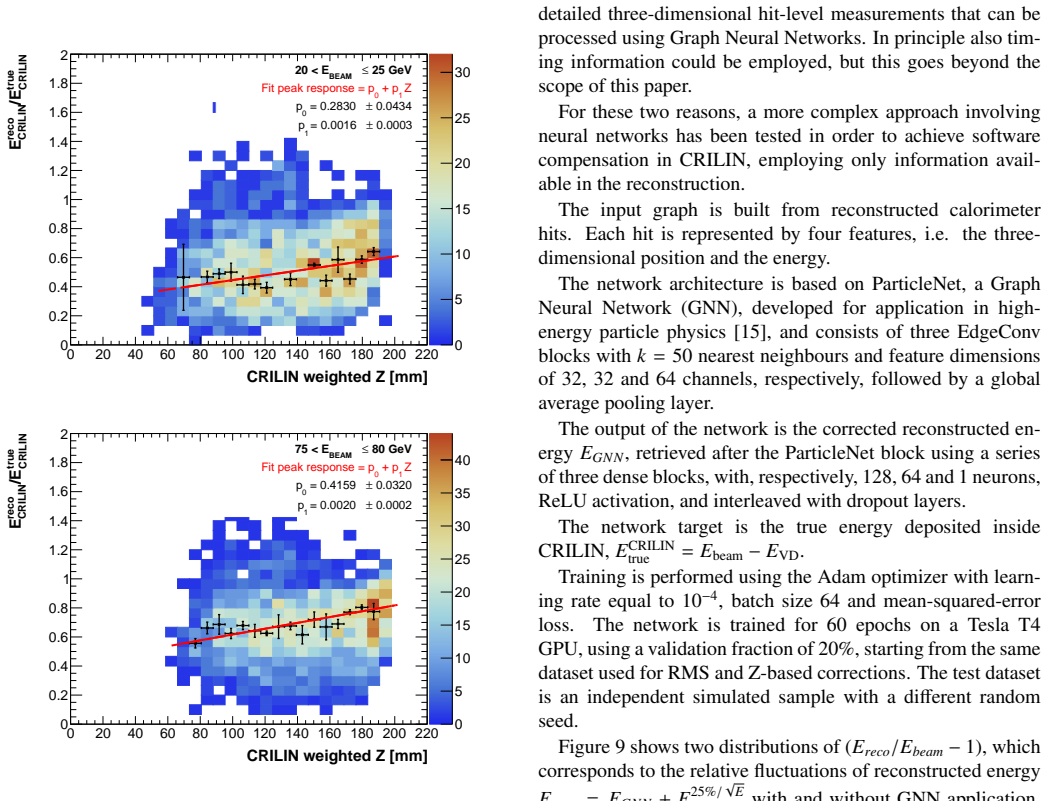
The central mechanism is a ParticleNet graph neural network applied to the raw hit cloud: each reconstructed crystal hit becomes a node with features (x, y, z, energy), and three EdgeConv blocks aggregate information over k=50 nearest neighbours before global pooling and dense layers output the corrected CRILIN energy. The training target is E_true = E_beam − E_VD, where E_VD is the energy collected by a virtual detector placed immediately downstream of CRILIN, which serves as a true-level stand-in for the actual hadronic calorimeter. Simpler one-dimensional corrections based on shower transverse RMS and longitudinal center-of-gravity establish the correlation between shower shape and the re
Load-bearing premise
The headline numbers assume that the energy leaving the crystal calorimeter is known exactly and that the real downstream hadron calorimeter smears that energy with a known, independent Gaussian resolution; if the real detector behaves differently, the quoted CRILIN contribution and combined resolution would change.
What would settle it
Train the same GNN on pion showers, but replace the virtual detector's Gaussian-smeared energies with a full simulation of a realistic downstream hadronic calorimeter that includes leakage, non-Gaussian tails, and calibration offsets. If the combined resolution's stochastic term no longer improves from roughly 71% to about 28%, or if the extracted CRILIN contribution shifts by more than the quoted uncertainties, the central claim is not robust.
If this is right
- A finely segmented crystal calorimeter can act as both an electromagnetic precision device and a hadronic energy measurement device, potentially removing the need for a dedicated dual-readout ECAL.
- The combined stochastic term of about 27.6%/√E approaches the ~30%/√E jet-energy-resolution target for future e+e− Higgs factories.
- The extracted CRILIN contribution of ~12.4%/√E implies that even a highly non-compensating active medium can be effectively compensated if the shower topology is sampled with sufficient granularity.
- The result is only weakly dependent on the assumed downstream HCAL resolution in the 25–50%/√E range, suggesting the method is robust to moderate uncertainty in the HCAL performance.
- The GNN uses only reconstruction-level information (hit positions and energies), making it directly applicable in a collider environment, unlike the beam-energy-binned one-dimensional corrections presented as proof of principle.
Where Pith is reading between the lines
- Because the downstream HCAL is modeled as an ideal Gaussian smear of the virtual-detector energy, the quoted CRILIN-only contribution is an effective number; a real hadronic calorimeter with non-Gaussian tails, leakage, or calibration offsets would change it. Training the GNN on combined ECAL+HCAL hits rather than subtracting the HCAL in quadrature would directly test this.
- The training set covers single pions from 15 to 100 GeV, while in a Higgs factory most jet constituents carry a few GeV, where the 1 GeV noise term dominates; the GNN's advantage at low energy is untested and is the natural follow-up.
- CRILIN's sub-40 ps timing capability is unused; adding per-hit time as a node feature could separate fast electromagnetic sub-showers from slow neutron deposits, potentially reducing the 2.5% constant term.
Editorial analysis
A structured set of objections, weighed in public.
Referee Report
Summary. The paper investigates software compensation for hadronic showers in the CRILIN, a longitudinally segmented PbF2 Cherenkov crystal calorimeter. Using Geant4 (QGSP_BERT) simulations of single charged pions (15–100 GeV), the authors apply two approaches: (i) simple event-by-event corrections based on transverse RMS and longitudinal center-of-gravity, and (ii) a ParticleNet GNN that uses the full 3D hit information to regress the true energy deposited in CRILIN. The combined CRILIN+HCAL resolution is evaluated by adding a Gaussian-smearing of the downstream leakage energy E_VD (the 'virtual detector') to the compensated CRILIN energy. The GNN is reported to reduce the combined stochastic term from (71.5±7.0)% to (27.6±0.8)%, and after subtracting the synthetic HCAL resolution in quadrature, the CRILIN-only contribution is fitted as σ/E = 1.01 GeV/E ⊕ 12.4%/√E ⊕ 2.5%. The authors conclude that software compensation can largely recover the information lost due to the non-compensating response and that the CRILIN contribution to a combined system is below 5% above ~30–40 GeV.
Significance. If the central quantitative claims are robust, the result is significant for future e+e− Higgs factories: it suggests that a highly non-compensating crystal calorimeter, when combined with a downstream HCAL, can achieve hadronic energy resolutions competitive with dual-readout or highly granular sampling calorimeters, provided the HCAL is good and the software compensation is effective. The paper has notable strengths: a detailed and realistic CRILIN geometry, a careful treatment of the Cherenkov response including a dedicated muon-based MIP correction (Appendix A), an independent test sample for the GNN evaluation, and explicit caveats about the single physics list. The GNN is evaluated out-of-sample, which is more credible than the in-sample one-dimensional corrections. However, the headline numbers rely on an idealized construction in which the exact downstream leakage E_VD is both the GNN target and the basis for a synthetic Gaussian HCAL. The external validity of the quantitative claims is therefore the main concern, and the manuscript needs to address this before publication.
major comments (3)
- [Sec. 3.1 and Sec. 6] The virtual detector E_VD is used in two roles: (i) as the GNN target via E_true = E_beam − E_VD, and (ii) as the basis for the synthetic HCAL, which is an independent Gaussian smear of E_VD. Under this construction the quadrature subtraction in Sec. 6 is internally self-consistent: if E_GNN = E_beam − E_VD + r and E_HCAL = E_VD + n with n independent, then the combined error is r + n and the extracted 'CRILIN contribution' is exactly Var(r). However, the claim that 'the contribution of CRILIN is below 5% for energies greater than 30 GeV' (Sec. 6, Fig. 12) is a property of this idealized closed loop, not of a physical ECAL+HCAL system. A real HCAL has non-Gaussian tails, miscalibration, dead material, and shower correlations with the ECAL; lateral and backward leakage is not represented by E_VD at all. The authors should either add a realistic HCAL simulation (even a full Geant4 simulati
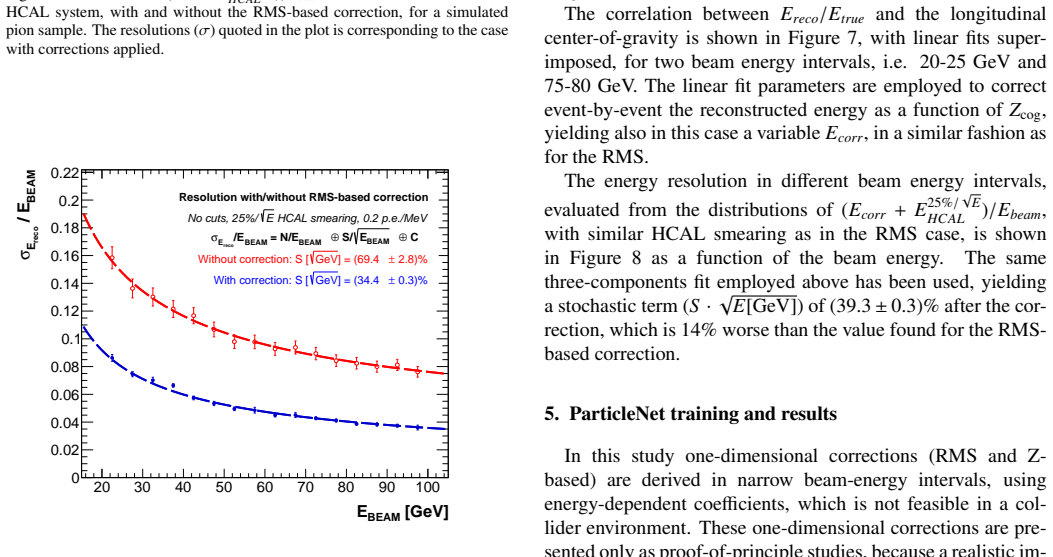
- [Sec. 4.1 and Sec. 6; Table 1] The RMS-based and Z_cog corrections are fitted in true beam-energy intervals and evaluated on the same events, so the reported improvements (34.4% and 39.3% stochastic terms) are in-sample. The GNN, by contrast, is tested on an independent sample. The comparison in Fig. 11 is therefore not a fair head-to-head: the GNN's advantage over the one-dimensional corrections is partly due to this methodological difference. The paper does state that the 1D corrections are proof-of-principle, but it should explicitly state that their quoted resolutions are in-sample and thus optimistic. Otherwise the reader may infer that the GNN is only modestly better than the RMS correction, when in fact the RMS correction would likely degrade in an out-of-sample test.
- [Sec. 3.2 and Sec. 7] The entire study uses a single Geant4 physics list (QGSP_BERT). The authors note this limitation and defer the dependence study to future work, which is honest, but it is still a major concern given that the central quantities (the 27.6% stochastic term and the extracted 12.4%) are governed by hadronic shower fluctuations. At least one additional physics list (e.g., FTFP_BERT) should be run for the GNN and the combined-resolution extraction to demonstrate that the ~28% stochastic term is not dominated by physics-list-specific modeling. Without such a check, the quantitative claims are not robust enough for a general statement about hadronic resolution in a real crystal calorimeter.
minor comments (4)
- [Abstract] The abstract says 'Under realistic assumptions for the downstream hadronic calorimeter,' but the HCAL is a Gaussian smear of a truth-level leakage variable. Suggest replacing 'realistic' with 'idealized' or 'simplified' to avoid overstatement.
- [Sec. 6 and Sec. 7] The threshold for the 'below 5%' claim is given as 'greater than 30 GeV' in Sec. 6 and 'above 40 GeV' in Sec. 7. Please make these consistent.
- [Fig. 12 and throughout] The legend in Fig. 12 reads '25%/E[GeV]' where it should be '25%/√E[GeV]'. Also check the axis label of Fig. 12 for the same issue.
- [Sec. 5, GNN input] The statement that the GNN uses 'only information available in the reconstruction' is slightly misleading because the training target uses the true E_VD; the input features themselves are reconstructed hits. Clarify that the GNN is trained on a truth-level target, which is standard for supervised learning, but should be stated explicitly.
Circularity Check
Section 6 'CRILIN contribution' is the GNN residual on its own training target by construction; the GNN combined-resolution result itself is an honest out-of-sample measurement.
specific steps
-
self definitional
[Section 6 (with target and HCAL definitions in Sections 3.1 and 5)]
"A virtual detector is placed immediately downstream of CRILIN and is used to estimate the true hadronic energy escaping the crystal calorimeter on the downstream side, EVD, working effectively as a true-level HCAL. ... The network target is the true energy deposited inside CRILIN, ECRILINtrue = Ebeam − EVD. ... the combined resolution has been subtracted, in quadrature, by the HCAL-only resolution. ... varying the HCAL stochastic term (S·√E[GeV]) between 25% and 50% ... is not found to be significant."
Because EVD is both the complement used to form the GNN target (Ebeam − EVD) and the variable that the synthetic HCAL smears, the GNN output estimates Ebeam − EVD and the HCAL reads EVD + n. Thus E_GNN + E_HCAL − Ebeam = r + n, where r is the GNN residual on Ebeam − EVD. Subtracting the HCAL-only variance in quadrature gives Var(r), i.e. exactly the loss the network was trained to minimize. The extracted 'CRILIN contribution' (12.4%/√E, below 5% above 30 GeV) is therefore the GNN's test residual relabeled as a physical contribution, and the claimed insensitivity of this contribution to the HCAL stochastic term (25–50%) is an algebraic identity of the quadrature subtraction rather than an empirical discovery.
full rationale
The core GNN performance is an honest out-of-sample regression: the test set is an independent simulated sample with a different random seed, and the combined CRILIN+HCAL stochastic term of (27.6±0.8)% is a fair evaluation of the trained model. No load-bearing self-citation chain is present; references [6,7,13] provide prior CRILIN characterization and a conservative light-yield assumption, which are supporting inputs rather than forbidden uniqueness theorems. The RMS/Z corrections are fitted and evaluated on the same beam-energy intervals, making those particular stochastic terms in-sample, but the paper explicitly labels these one-dimensional corrections as proof-of-principle not feasible in a collider environment, so I treat that as a statistical caveat rather than a circular prediction. The one definitional reduction is in Section 6: the 'CRILIN contribution' is obtained by subtracting the synthetic HCAL resolution in quadrature from the combined resolution, while the GNN target is exactly Ebeam − EVD and the synthetic HCAL smears the same EVD. Consequently the extracted CRILIN-only resolution equals the GNN's own residual on its training target, and the demonstrated insensitivity to the assumed HCAL stochastic term is a variance-decomposition identity. This makes the headline 'CRILIN contribution below 5% above 30 GeV' and the 12.4%/√E fit partially definitional, even though the underlying GNN improvement is real and independently demonstrated. External validity also depends on treating EVD as a truth-level proxy for a real downstream HCAL with only Gaussian tails; the paper acknowledges physics-list dependence but does not quantify how this target/HCAL construction affects the headline numbers. Overall, the central claim has independent content, but one headline derived quantity reduces by construction, giving a moderate circularity score.
Axiom & Free-Parameter Ledger
free parameters (8)
- Photon-to-energy conversion factor C/E_dep =
24.32 gamma/MeV (electron sample fit; 24.36 from linear fit)
- Light yield for Poisson smearing =
0.2 p.e./MeV (assumed)
- Hit reconstruction threshold =
40 MeV
- RMS correction parameters p0, p1 =
Per 5 GeV beam-energy interval; e.g. p0=1.114, p1=-0.0358 (global fit)
- Z_cog correction parameters p0, p1 =
Per interval; e.g. p0=0.283, p1=0.0016 (20-25 GeV)
- MIP conversion coefficients alpha, beta, gamma =
alpha~332.5, beta~24.54, gamma~4685 (muon/delta-ray fits)
- Assumed HCAL stochastic resolution =
25%/sqrt(E) baseline, scanned 25-50%
- ParticleNet hyperparameters =
k=50, channels 32/32/64, dense 128/64/1, lr=1e-4, batch 64, 60 epochs, dropout 30%
axioms (6)
- domain assumption QGSP_BERT physics list adequately models hadronic shower development in PbF2
- ad hoc to paper The virtual detector measures the escaping hadronic energy exactly, so E_true = E_beam - E_VD
- domain assumption The HCAL response is an independent Gaussian smear of E_VD with no tails, noise, or constant term
- domain assumption Frank-Tamm formula with 350-550 nm band and the electron-derived conversion factor applies to all showering hadron components
- domain assumption A GNN regressing the true CRILIN deposit from simulated hit patterns will transfer to a real combined detector
- domain assumption CRILIN and HCAL errors are independent for the quadrature subtraction in Section 6
invented entities (1)
-
Virtual detector (VD) downstream of CRILIN
no independent evidence
read the original abstract
Future electron-positron Higgs factories require excellent jet energy resolution to perform precision measurements of Higgs boson couplings to quarks and gluons. Although homogeneous crystal calorimeters provide remarkable electromagnetic energy resolution, their highly non-compensating response makes hadronic energy reconstruction particularly challenging. In this work, software compensation techniques are investigated for CRILIN, a longitudinally segmented Cherenkov crystal electromagnetic calorimeter based on PbF$_2$ crystals. Using Geant4 simulations of pion showers, it is shown that shower-shape observables are strongly correlated with the fraction of deposited energy reconstructed in a CRILIN module. Simple event-by-event corrections based on the shower transverse RMS and longitudinal center-of-gravity already yield a substantial improvement in hadronic energy reconstruction. A ParticleNet Graph Neural Network exploiting the full three-dimensional shower topology achieves significantly improved performance with respect to simple energy sum reconstruction. Under several different assumptions for the downstream hadronic calorimeter resolution, the GNN-based reconstruction significantly reduces the effective CRILIN contribution to the combined calorimetric resolution, therefore preserving an excellent combined ECAL+HCAL performance. The dependence of the result on the assumed HCAL resolution is also studied and found to be limited within the range considered. These results demonstrate that highly granular crystal calorimeters can recover a large fraction of the information lost because of their intrinsically non-compensating response through software-based compensation techniques, enabling excellent hadronic energy resolution in a combined ECAL+HCAL system and making such detectors promising candidates for future collider experiments.
Figures




Forward citations
Cited by 1 Pith paper
-
Design and beam-test characterization of the CRILIN semi-homogeneous crystal calorimeter
A large CRILIN PbF2/SiPM prototype reaches <50 ps timing above 10 GeV and energy resolution (6.58±0.04)%/√E ⊕ (0.23±0.02)% in SPS beam tests.
Reference graph
Works this paper leans on
-
[1]
W. Bartmann, J.-P. Burnet, C. Carli, A. Chance, P. Craievich, M. Giovannozzi, C. Grojean, J. Gutle- ber, K. Hanke, A. Henriques, P. Janot, C. Lourenco, M. Mangano, T. Otto, J. H. Poole, S. Rajagopalan, T. Raubenheimer, E. Todesco, T. P. Watson, G. Wilkinson, Future circular collider feasibility study report volume 1: Physics and experiments (2025).doi:10....
arXiv 2025
-
[2]
S. Lee, M. Livan, R. Wigmans, Dual-readout calorime- try, Reviews of Modern Physics 90 (2) (Apr. 2018). doi:10.1103/revmodphys.90.025002. URLhttp://dx.doi.org/10.1103/RevModPhys. 90.025002
-
[3]
N. Valle, Dual readout with capillary tubes – status and prospects, EPJ Web of Conferences 320 (2025) 00054. doi:10.1051/epjconf/202532000054. URLhttp://dx.doi.org/10.1051/epjconf/ 202532000054
arXiv 2025
-
[4]
S. Lai, J. Utehs, A. Wilhahn, O. Bach, E. Brianne, A. Ebrahimi, K. Gadow, P. Göttlicher, O. Hartbrich, D. Heuchel, A. Irles, K. Krüger, J. Kvasnicka, S. Lu, C. Neubüser, A. Provenza, M. Reinecke, F. Sefkow, S. Schuwalow, M. D. Silva, Y . Sudo, H. L. Tran, E. Buh- mann, E. Garutti, S. Huck, G. Kasieczka, S. Martens, J. Rolph, J. Wellhausen, G. C. Blazey, A...
Pith/arXiv arXiv 2024
-
[5]
N. Akchurin, C. Cowden, J. Damgov, A. Hussain, S. Kunori, The (un)reasonable effectiveness of neural net- work in cherenkov calorimetry, Instruments 6 (4) (2022). doi:10.3390/instruments6040043. URLhttps://www.mdpi.com/2410-390X/6/4/43
-
[6]
S. Ceravolo, F. Colao, C. Curatolo, E. Di Meco, E. Dio- ciaiuti, D. Lucchesi, D. Paesani, N. Pastrone, A. Saputi, I. Sarra, L. Sestini, D. Tagnani, Crilin: A crystal calorimeter with longitudinal information for a future muon collider, Journal of Instrumentation 17 (09) (2022) P09033.doi:10.1088/1748-0221/17/09/P09033. URLhttps://doi.org/10.1088/1748-0221...
-
[7]
C. Cantone, A. Cemmi, S. Ceravolo, V . Ciccarella, F. Co- lao, E. Di Meco, I. Di Sarcina, E. Diociaiuti, R. Gargiulo, P. Gianotti, C. Giraldin, E. Leonardi, D. Lucchesi, M. Moulson, D. Paesani, N. Pastrone, G. Pezzullo, A. Sa- puti, I. Sarra, J. Scifo, L. Sestini, M. Soldani, D. Tagnani, A. Verna, D. Zuliani, Developing an alternative calorime- ter soluti...
arXiv 2024
-
[8]
Gargiulo, C
R. Gargiulo, C. Cantone, A. Cemmi, S. Ceravolo, V . Ci- ccarella, F. Colao, E. D. Meco, E. Diociaiuti, I. D. Sarcina, P. Gianotti, C. Giraldin, E. Leonardi, D. Lucch- esi, M. Moulson, D. Paesani, N. Pastrone, G. Pezzullo, A. Saputi, I. Sarra, J. Scifo, L. Sestini, M. Soldani, D. Tag- nani, A. Verna, D. Zuliani, Crilin: a semi-homogeneous crystal calorimet...
2024
-
[9]
A. Pellecchia, et al., Design and optimization of a hadronic calorimeter based on micropattern gaseous de- tectors for a future experiment at the muon collider, Nu- clear Instruments and Methods in Physics Research Sec- tion A (2024).arXiv:2407.10261
Pith/arXiv arXiv 2024
-
[10]
T. Basaglia, Z. W. Bell, D. D’Agostino, P. V . Dressendor- fer, S. Giani, M. G. Pia, P. Saracco, Geant4: a game changer in high energy physics and related applicative fields (2024).arXiv:2405.12159. URLhttps://arxiv.org/abs/2405.12159
Pith/arXiv arXiv 2024
-
[11]
I. Frank, I. Tamm, Coherent Visible Radiation of Fast Electrons Passing Through Matter, Springer Berlin Heidelberg, Berlin, Heidelberg, 1991, pp. 29–35. doi:10.1007/978-3-642-74626-0_2. URLhttps://doi.org/10.1007/ 978-3-642-74626-0_2
-
[12]
J. E. Gaiser, Charmonium spectroscopy from radiative de- cays of thej/ψandψ ′, Tech. rep., SLAC National Ac- celerator Laboratory (SLAC), Menlo Park, CA (United States) (08 1982).doi:10.2172/1453988. URLhttps://www.osti.gov/biblio/1453988
arXiv 1982
-
[13]
I. Sarra, Development and test of the crilin calorime- ter for the muon collider: Status and perspectives, in: 2025 IEEE Nuclear Science Symposium (NSS), Medical Imaging Conference (MIC) and Room Temperature Semi- conductor Detector Conference (RTSD), 2025, pp. 1–1. doi:10.1109/NSS/MIC/RTSD57106.2025.11287199
arXiv 2025
- [14]
-
[15]
H. Qu, L. Gouskos, Jet tagging via particle clouds, Phys- ical Review D 101 (5) (Mar. 2020).doi:10.1103/ physrevd.101.056019. URLhttp://dx.doi.org/10.1103/PhysRevD.101. 056019 10
discussion (0)
Sign in with ORCID, Apple, or X to comment. Anyone can read and Pith papers without signing in.