REVIEW 2 major objections 5 minor 2 cited by
Charmonium's chromoelectric operator splits into a scalar anomaly branch and a spin-two EMT branch whose light-front forward ratio is ~0.15, with no boost artifact.
Reviewed by Pith at T0; open to challenge. T0 means a machine referee read the full paper against a public rubric. the ladder, T0–T4 →
T0 review · grok-4.5
2026-07-13 07:41 UTC pith:EDRICNKA
load-bearing objection Clean operator-matching note that pins down which EMT pieces near-threshold charmonium actually sees; modest novelty, solid algebra, no hidden flaw beyond the regime it already states. the 2 major comments →
Scalar and spin-two energy-momentum-tensor structure in near-threshold charmonium probes of the proton
The pith
A machine-rendered reading of the paper's core claim, the machinery that carries it, and where it could break.
Core claim
The compact-quarkonium chromoelectric operator admits a light-front scalar/non-scalar EMT decomposition whose forward diagnostic ratio is R_LF = [4πα_s (3/4) A_g(0)] / [(8π²/β_0)(1−b)] ≃ 0.15, matching the covariant EMT/OPE estimate with no boost artifact; off forward the non-scalar piece is the GFF combination G_nt(t) with leading coefficients c_A = 2ω², c_D = ζ² − τ/4, c_C = 1 (equivalently involving 3B−D or 6J−3A−D), not A(t) alone.
What carries the argument
The operator reorganization O_E(v) = g² v_μ v_ν T_g^{μν} − (g²/4) F², rewritten as a scalar anomaly channel plus the traceless projection v_μ v_ν T̄_g^{μν}; light-front good-component sum rule extracts A_g(0) without the 3/4 factor, while the threshold rest-frame projection of the same traceless structure supplies the 3/4 that recovers the normal gluon-energy term.
Load-bearing premise
The analysis assumes the heavy quarkonium is compact enough that its interaction with the proton is dominated by the single local chromoelectric operator, so that finite-size, higher-multipole, and process-dependent corrections can be ignored.
What would settle it
A direct comparison of the predicted off-forward shape G_nt(t)/G_nt(0) against high-precision near-threshold dσ/dt data, once the relative phase and process-specific GPD kernels are fixed independently; a clear mismatch in the t-dependence would falsify the claimed operator matching.
If this is right
- Forward near-threshold amplitudes receive a controlled ~15% non-scalar correction fixed by A_g(0) and the anomaly coefficient.
- Differential (off-forward) observables access the combination 3B_i(t)−D_i(t) (or 6J_i−3A_i−D_i), not A_i(t) alone.
- Measured form-factor slopes convert to light-front transverse radii by the purely kinematic factor √(2/3) and should not be quoted as model-independent static 3D mass radii.
- The light-front and covariant constructions of the non-scalar shape agree to floating-point precision once the coefficient map is imposed.
Where Pith is reading between the lines
- Future extractions of gluonic GFFs from J/ψ photoproduction should fit the full G_nt combination rather than a single A(t) or scalar radius.
- The same scalar/spin-two split can be applied to other compact heavy-quarkonium probes (Υ, χ_c) once the multipole regime is verified.
- Lattice evaluations of the off-forward matrix element of the chromoelectric operator could test the predicted coefficient map without relying on scattering data.
Editorial analysis
A structured set of objections, weighed in public.
Referee Report
Summary. The manuscript reformulates the leading chromoelectric operator of compact heavy quarkonium, OE(v)=g^{2}vμvν Tgμν-(g^{2}/4)F^{2}, as a scalar trace-anomaly piece plus a traceless gluon-EMT (spin-two) piece, and places that separation on the light front. The good-component sum rule yields Ag(0) without a 3/4 factor, while the threshold rest-frame projection of the traceless EMT produces (3/4)Ag(0)M; the resulting forward diagnostic ratio RLF≃0.15 matches the standard covariant EMT/OPE estimate with no spurious boost enhancement. Off forward, the same operator matching identifies the non-scalar GFF combination Gnt(t) with leading coefficients cA=2ω^{2}, cD=ζ^{2}-τ/4, cC=1 (not A(t) alone), and the associated Drell–Yan transverse densities are constructed within the established light-front framework. The paper does not extract a new mass radius or a process-ready dσ/dt formula; it supplies an operator-level consistency bridge between the multipole OPE, the QCD mass decomposition, and light-front GFF densities.
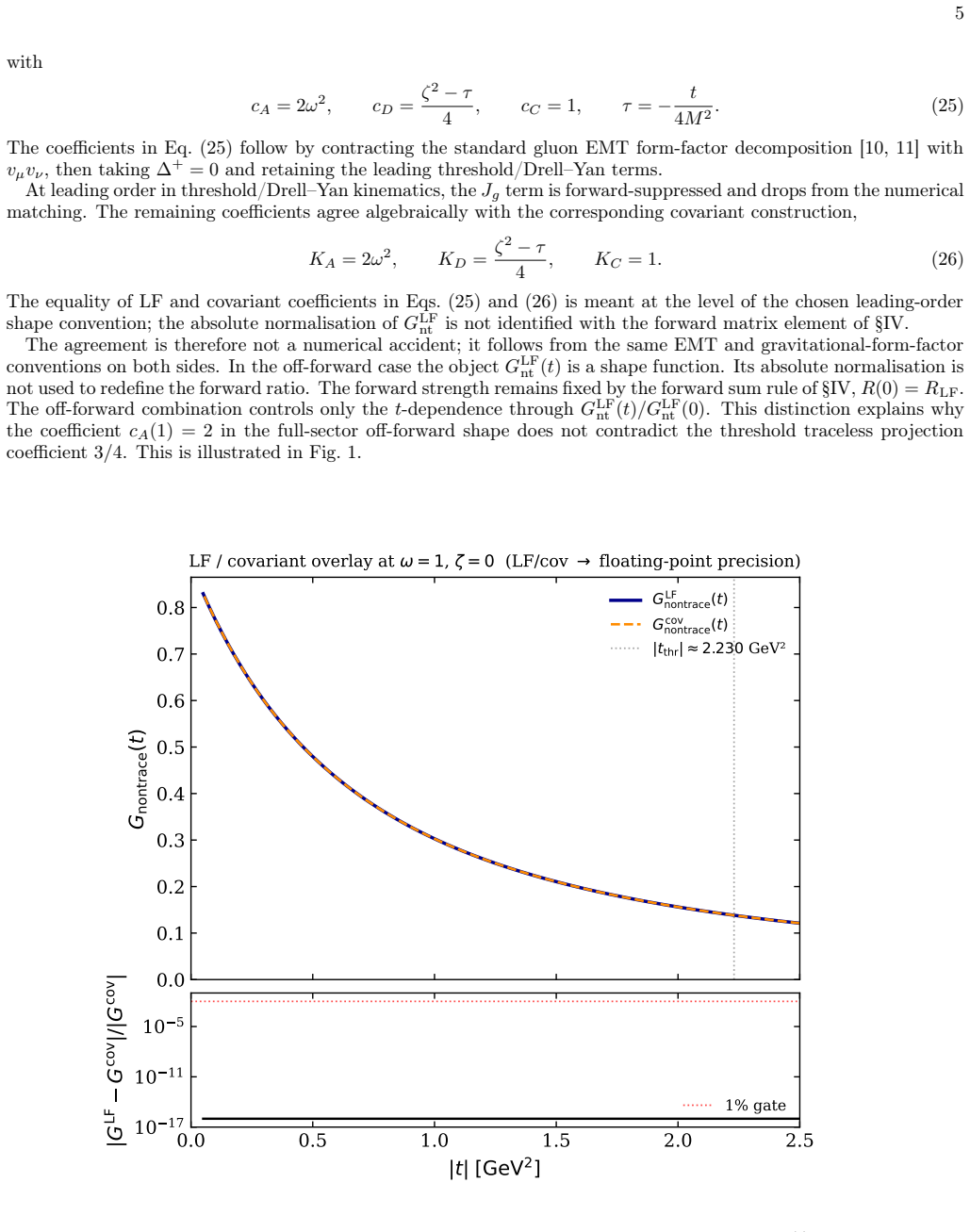
Significance. If the operator matching is accepted, the work clarifies which EMT structures near-threshold charmonium actually probes: a controlled O(0.15) spin-two correction to scalar dominance in the forward limit, and a specific combination involving A, D (and related J, B) rather than A(t) alone off forward. That distinction is useful for ongoing GlueX/JLab analyses that convert slopes into gluonic radii, and it correctly cautions against reading those slopes as model-independent static 3D mass radii. Strengths include the clean isolation of the 3/4 factor as a rest-frame traceless projection (not a light-front artifact), the algebraic LF/covariant coefficient map verified to floating-point precision in Fig. 1, and the explicit statement of regime limitations. The result is a consistency/operator-foundation paper rather than a new extraction; its value is therefore incremental but real for the GFF/near-threshold community.
major comments (2)
- The abstract and title emphasize that the off-forward chromoelectric spin-two contraction contains 3Bi(t)-Di(t) (equivalently 6Ji-3Ai-Di), yet §V works exclusively with the Ag, Dg, C̄g, Jg basis and never writes the B-form-factor combination or the algebraic map between the two conventions. A short paragraph (or appendix identity) relating the paper’s Gnt coefficients to the Bi language of the abstract is needed so that the central claim is self-contained.
- §IV and Eq. (20) present RLF as a diagnostic ratio assembled from external inputs (αs, Ag(0), b, β0). The numerical value ≃0.15 is order-of-magnitude only; the manuscript should state the renormalization-scale and PDF-set sensitivity more explicitly (or show a short table) so that readers do not treat 0.15 as a fixed prediction when using the result in phenomenology.
minor comments (5)
- Notation for the non-scalar piece oscillates between “non-trace,” “non-scalar,” and “spin-two”; a single preferred term after the first definition would improve readability.
- Fig. 1 caption and body text correctly stress that only the t-shape is compared, yet the absolute-normalization disclaimer could be repeated once in the main text near Eq. (24) for readers who skip the figure.
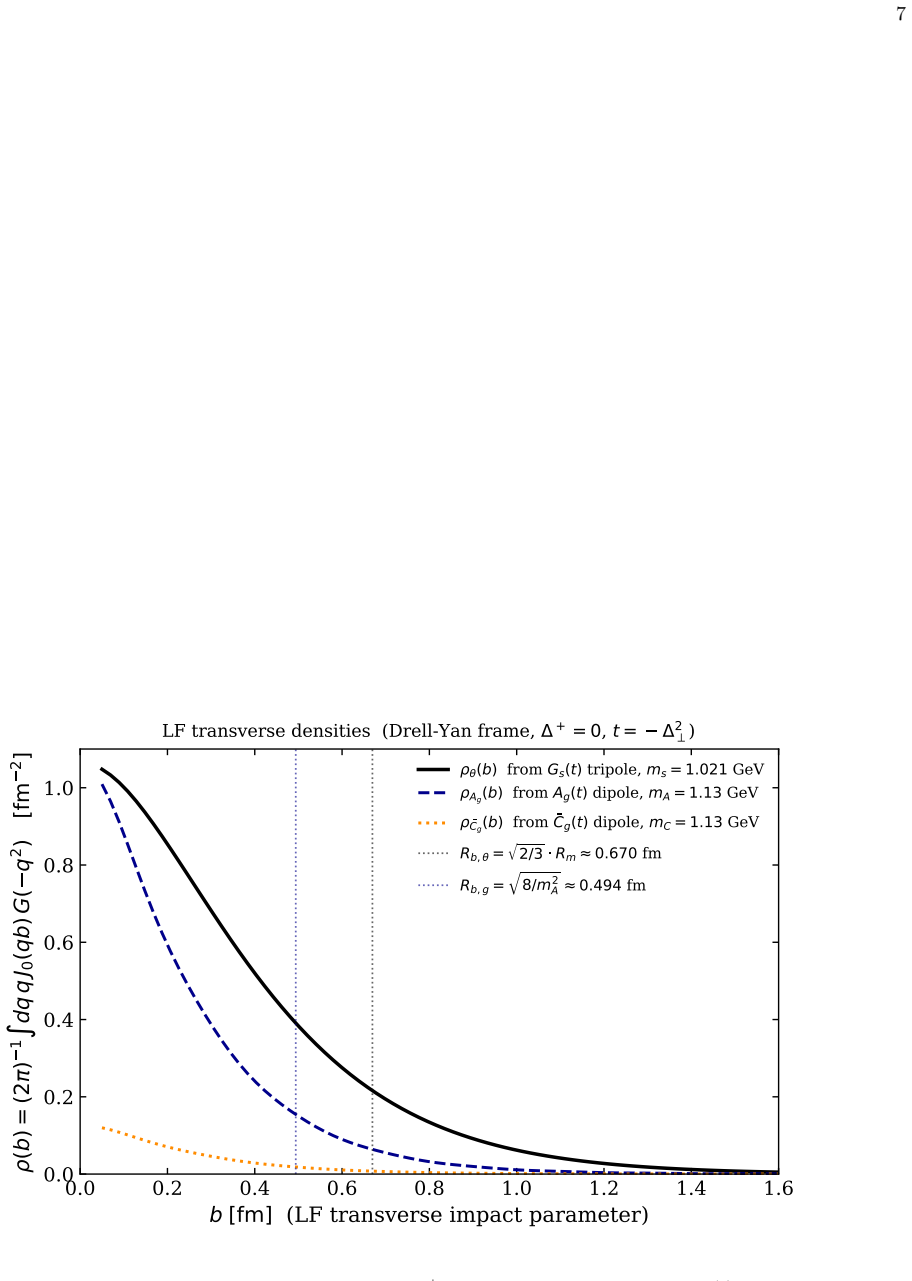
- The illustrative tripole Rm=0.82 fm versus the GlueX dipole fit Rm≃0.55 fm is mentioned only in a footnote; moving that remark into the main text of §V would better flag parametrization dependence.
- A few typographical inconsistencies appear (e.g., “F ACTOR” and “FOR W ARD” in section headings, missing spaces after some equation numbers).
- Reference [5] is used both for the mass-radius discussion and for the GlueX dipole illustration; a clearer separation of the theoretical proposal from the experimental fit would help.
Circularity Check
No significant circularity: forward ratio and off-forward GFF coefficients are assembled from external inputs and standard EMT algebra, with self-citation only for process motivation.
specific steps
-
self citation load bearing
[Introduction / Ref. [4]]
"its use in near-threshold J/ψ photoproduction was developed by Kharzeev and collaborators [4]."
The author is a co-author of the cited process paper that motivates applying the chromoelectric operator to near-threshold J/ψ. This is ordinary self-citation for historical context and is not used to justify the algebraic EMT split, the 3/4 projection, or the numerical value of RLF; those rest on external PDFs and standard GFF conventions. Minor and non-load-bearing.
full rationale
The paper's central claim is an operator-matching consistency result, not a fitted prediction. The diagnostic ratio RLF is built from external PDF averages for Ag(0), a standard eta0/eta-function coefficient, and a representative b, then checked against the known covariant EMT/OPE estimate; nothing is fitted to the target near-threshold observable. The factor 3/4 is isolated as a rest-frame traceless projection of the Ag tensor structure (Eqs. 14–16), distinct from the light-front good-component sum rule that carries no 3/4. Off-forward coefficients cA, cD, cC follow by contracting the standard GFF decomposition of Refs. [12,13] and are verified to floating-point precision against the covariant construction (Fig. 1). Self-citation to the author's earlier Kharzeev–Satz–Syamtomov–Zinovjev work [4] supplies the process motivation for the chromoelectric operator but is not load-bearing for the algebraic separation or the numerical ratio. The paper itself flags the compact-multipole regime as an assumption (§VI) and does not claim a new radius extraction. No step reduces by construction to its own inputs.
Axiom & Free-Parameter Ledger
free parameters (6)
- αs(μ=2 GeV) =
0.298
- Ag(0) at μ=2 GeV =
0.421
- b (quark-mass fraction of the trace) =
0.101
- β0 =
9
- Rm (illustrative scalar mass radius) =
0.82 fm
- dipole masses mA, mC for Ag and C̄g =
1.13 GeV
axioms (6)
- domain assumption Leading compact-quarkonium interaction is the local chromoelectric multipole operator OE ∝ E² / vμvν Tgμν − F²/4.
- domain assumption QCD EMT trace anomaly relation Tμμ = (β(g)/2g)F² + Σ mq(1+γm)q̄q, with F² converted at leading beta-function order.
- domain assumption Standard gluon GFF decomposition of the off-forward EMT matrix element in terms of Ag, Dg, C̄g, Jg.
- domain assumption Drell–Yan-frame light-front transverse densities from Fourier transforms of form factors are the appropriate relativistic density interpretation.
- standard math Mostly-minus metric and the separated gluon EMT definition Tgμν = −Fμαa Fνaα + (1/4)gμν F².
- standard math Forward good-component sum rule ⟨P|T++g|P⟩ = 2(P+)² Ag(0) with g++=0 so T++ = T̄++.
invented entities (1)
-
Diagnostic ratio RLF = NLF/DLF
no independent evidence
read the original abstract
I analyze the energy-momentum-tensor (EMT) content of the chromoelectric operator that governs the leading interaction of compact charmonium with soft gluonic fields. In the renormalized MS operator basis this interaction separates into a scalar anomaly/sigma branch and a traceless spin-two branch. The forward light-front spin-two term is fixed by partonic plus-momentum fractions and gives a controlled correction to scalar dominance. Off forward, however, the chromoelectric spin-two contraction is not governed by $A_i(t)$ alone; it also contains the combination $3B_i(t)-D_i(t)$, equivalently $6J_i(t)-3A_i(t)-D_i(t)$. This identifies which EMT structures charmonium can access in forward and differential observables, without interpreting the measured slope as a model-independent static three-dimensional mass radius.
Figures

Forward citations
Cited by 2 Pith papers
-
Chromoelectric and chromomagnetic matching to scalar and spin-two nucleon structure
A consistent matching framework shows the chromomagnetic-to-chromoelectric ratio rescales the gluonic spin-two/scalar response by (1+rho)/(1-rho) in aligned quarkonium-nucleon scattering.
-
Light-front transverse profiles of scalar and spin-two chromoelectric EMT responses in near-threshold charmonium probes
Scalar and spin-two chromoelectric EMT responses of the proton admit distinct light-front transverse profiles whose integrated ratio recovers the forward threshold strength ~0.15 while finite-b behavior tracks relativ...
Reference graph
Works this paper leans on
-
[1]
A QCD analysis of the mass structure of the nucleon,
X.-D. Ji, “A QCD analysis of the mass structure of the nucleon,” Phys. Rev. Lett.74, 1071 (1995), arXiv:hep-ph/9410274
Pith/arXiv arXiv 1995
-
[2]
Short-distance analysis for heavy quark systems. I. Diagrammatics,
M. E. Peskin, “Short-distance analysis for heavy quark systems. I. Diagrammatics,” Nucl. Phys. B156, 365 (1979)
1979
-
[3]
Short-distance analysis for heavy quark systems. II. Applications,
G. Bhanot and M. E. Peskin, “Short-distance analysis for heavy quark systems. II. Applications,” Nucl. Phys. B156, 391 (1979)
1979
-
[4]
J/ψphotoproduction and the gluon structure of the nucleon,
D. Kharzeev, H. Satz, A. Syamtomov, and G. Zinovjev, “J/ψphotoproduction and the gluon structure of the nucleon,” Eur. Phys. J. C9, 459 (1999), arXiv:hep-ph/9901375
Pith/arXiv arXiv 1999
-
[5]
The mass radius of the proton,
D. E. Kharzeev, “The mass radius of the proton,” Phys. Rev. D104, 054015 (2021), arXiv:2102.00110
Pith/arXiv arXiv 2021
-
[6]
Determining the proton’s gluonic gravitational form factors,
B. Duran et al., “Determining the proton’s gluonic gravitational form factors,” Nature615, 813 (2023), arXiv:2207.05212
Pith/arXiv arXiv 2023
-
[7]
Revisiting the mechanical properties of the nucleon,
C. Lorcé, H. Moutarde, and A. P. Trawiński, “Revisiting the mechanical properties of the nucleon,” Eur. Phys. J. C79, 89 (2019), arXiv:1810.09837
Pith/arXiv arXiv 2019
-
[8]
Colloquium: Gravitational Form Factors of the Proton,
V. D. Burkert, L. Elouadrhiri, F. X. Girod, C. Lorcé, P. Schweitzer, and P. E. Shanahan, “Colloquium: Gravitational Form Factors of the Proton,” Rev. Mod. Phys.95, 041002 (2023), arXiv:2303.08347
Pith/arXiv arXiv 2023
-
[9]
Forces within hadrons on the light front,
A. Freese and G. A. Miller, “Forces within hadrons on the light front,” Phys. Rev. D103, 094023 (2021), arXiv:2102.01683
Pith/arXiv arXiv 2021
-
[10]
Light-front synchronization and rest-frame densities of the proton: Electromagnetic densities,
A. Freese and G. A. Miller, “Light-front synchronization and rest-frame densities of the proton: Electromagnetic densities,” Phys. Rev. D107, 074036 (2023), arXiv:2302.09171. 8
Pith/arXiv arXiv 2023
-
[11]
Quark and gluon contributions to the QCD trace anomaly,
Y. Hatta, A. Rajan, and K. Tanaka, “Quark and gluon contributions to the QCD trace anomaly,” JHEP12, 008 (2018), arXiv:1810.05116
Pith/arXiv arXiv 2018
-
[12]
Forces inside hadrons: pressure, surface tension, mechanical radius, and all that,
M. V. Polyakov and P. Schweitzer, “Forces inside hadrons: pressure, surface tension, mechanical radius, and all that,” Int. J. Mod. Phys. A33, 1830025 (2018), arXiv:1805.06596
Pith/arXiv arXiv 2018
-
[13]
Gluon gravitational structure of hadrons of different spin,
D. A. Pefkou, D. C. Hackett, and P. E. Shanahan, “Gluon gravitational structure of hadrons of different spin,” Phys. Rev. D105, 054509 (2022), arXiv:2107.10368
Pith/arXiv arXiv 2022
-
[14]
Parton distribution functions,αs, and heavy-quark masses for LHC Run II,
S. Alekhin, J. Blümlein, S. Moch, and R. Placčakyt˙ e, “Parton distribution functions,αs, and heavy-quark masses for LHC Run II,” Phys. Rev. D96, 014011 (2017), arXiv:1701.05838
Pith/arXiv arXiv 2017
-
[15]
New CTEQ global analysis of quantum chromodynamics with high-precision data from the LHC,
T.-J. Hou et al., “New CTEQ global analysis of quantum chromodynamics with high-precision data from the LHC,” Phys. Rev. D103, 014013 (2021), arXiv:1912.10053
Pith/arXiv arXiv 2021
-
[16]
Parton distributions from LHC, HERA, Tevatron and fixed target data: MSHT20 PDFs,
S. Bailey, T. Cridge, L. A. Harland-Lang, A. D. Martin, and R. S. Thorne, “Parton distributions from LHC, HERA, Tevatron and fixed target data: MSHT20 PDFs,” Eur. Phys. J. C81, 341 (2021), arXiv:2012.04684
Pith/arXiv arXiv 2021
-
[17]
The path to proton structure at 1% accuracy,
R. D. Ball et al. (NNPDF Collaboration), “The path to proton structure at 1% accuracy,” Eur. Phys. J. C82, 428 (2022), arXiv:2109.02653
Pith/arXiv arXiv 2022
discussion (0)
Sign in with ORCID, Apple, or X to comment. Anyone can read and Pith papers without signing in.