REVIEW 3 major objections 4 minor 4 cited by
Exact solutions now cover the full coupling–mass plane of two-field inflation, giving analytic control over the strong-mixing regime for the first time.
Reviewed by Pith at T0; open to challenge. T0 means a machine referee read the full paper against a public rubric. the ladder, T0–T4 →
T0 review · deepseek-v4-flash
2026-08-02 10:59 UTC pith:XAC3YKTT
load-bearing objection Fresh claim, plausible limiting checks, but the central exact solutions are not proven in the paper and the operator defining them may not be well-defined. the 3 major comments →
Pushing the Primordial Frontier: Exact Linear Solutions in Multifield Inflation
The pith
A machine-rendered reading of the paper's core claim, the machinery that carries it, and where it could break.
Core claim
The central result of this Letter is the set of four exact solutions (26)–(29) to the fourth-order differential equation (25) for the Bogoliubov coefficient ζ+. These solutions—constructed from Tricomi's U and Kummer's M confluent hypergeometric functions acted upon by the differential operator defined in (30)—form a fundamental system for any nonzero coupling λ, with the remaining Bogoliubov coefficients reconstructed from the original first-order system. From these, the paper obtains exact closed-form expressions for the superhorizon dimensionless power spectrum: equation (42) for a massless isocurvature mode, equation (46) for light modes, and equation (48) for heavy modes, with the heavy
What carries the argument
The central object is the fourth-order differential equation (25) for the Bogoliubov coefficient ζ+, which the authors obtain by eliminating the other three coefficients from the first-order system (19). Its fundamental solution set consists of four functions f1–f4, each being a confluent hypergeometric function (Tricomi U or Kummer M) with argument −2iz, multiplied by a differential operator bDν,± defined as a Gauss hypergeometric series in (i/2)d/dz. That operator, which encodes both the interaction strength λ and the entropy-mass index ν, is the machinery that packages the full mixing structure; for ν=1/2 it reduces to the identity and yields a simple sinh(πλ)/(πλ) spectrum.
Load-bearing premise
The paper's central claim rests on the asserted equivalence between the original first-order Bogoliubov system (19) and the fourth-order equation (25), together with the assertion that the four hypergeometric functions (26)–(29) form a complete independent solution set—but the derivation is not shown and is deferred to a companion article.
What would settle it
For a chosen λ and ν, substitute the explicit f_i(z) from (26)–(29) into the ODE (25) and evaluate the residual at several z values; or integrate the original first-order system (19) numerically from a deep-horizon start z0 = 100 with initial conditions (22)–(23) and compare |ζ+1 − ζ−1| and the power spectrum at z ≪ 1 against the closed-form expressions (39)–(40) and (46). A mismatch beyond the stated O(z0⁻¹) corrections would invalidate the exactness claim.
If this is right
- The closed-form power spectra (42), (46), and (48) allow analytic predictions for the amplitude of the curvature perturbation in rapid-turn and other strong-mixing inflationary models, bypassing numerical integration.
- The solutions provide mode-function building blocks for calculating non-Gaussianity, particle production, primordial black hole formation, and loop corrections in the strongly coupled regime where λ-expansion is unreliable.
- Matching constant-turn solutions across intervals enables a controlled analytic treatment of finite-duration turns in the inflationary trajectory.
- The heavy-mass expansion (49) reproduces and systematically corrects the effective single-field decoupling result, giving a benchmark for how heavy isocurvature modes alter the spectrum.
- The massless limit exhibits secular superhorizon growth and reduces to known perturbative results for small λ, providing a consistency check on the entire construction.
Where Pith is reading between the lines
- The hypergeometric structure of the solutions suggests an underlying symmetry of the de Sitter mode functions that could generalize the method to systems with multiple isocurvature fields, replacing the scalar hypergeometric equation with a matrix analogue.
- The analytic continuation ν→iρ across the threshold μ²/H² = 9/4 maps the light-field expressions onto the heavy-field ones, hinting that the suppression in the heavy regime can be read from the poles of gamma functions in (48), giving a spectral interpretation of decoupling.
- The closed-form spectra could be used as a strict numerical benchmark to test the accuracy of slow-turn or 'sidetracked' approximations in regimes where λ is of order one, a regime often claimed to require full numerical treatment.
- A model-independent bound on the isocurvature mass could be derived by comparing the exact spectra (42)–(48) with observed limits on the primordial power spectrum amplitude in the strong-mixing scenario.
Editorial analysis
A structured set of objections, weighed in public.
Referee Report
Summary. This Letter claims exact analytic solutions for the linear dynamics of a two-field inflationary system in which the curvature perturbation is coupled to an isocurvature perturbation. After rewriting the coupled equations (8)-(9) as a first-order system of Bogoliubov coefficients (19), the authors state that eliminating three coefficients yields the fourth-order ODE (25), whose four independent solutions are the hypergeometric-type functions (26)-(29). The paper then derives closed-form expressions for the superhorizon power spectrum in the massless case (42), the light-field case (46), and the heavy-field case (48), with expansions and checks against known limits. The central claim is that these are exact solutions valid for arbitrary interaction strength \lambda and entropy mass \mu/H.
Significance. If the central mathematical claim is correct, this is a substantial advance: exact analytic control over the strongly coupled, light-isocurvature regime would open up studies of non-Gaussianity, particle production, and higher-point correlators without recourse to perturbative expansions. The paper contains no fitting and no data, and it includes several nontrivial consistency checks: the \lambda=0 limit reduces to the standard single-field result; the heavy-mass expansion (49) matches the leading effective-field-theory result; and the massless result reduces to a previously known perturbative expression in the slow-turn limit. These checks lend credibility to the final spectra. However, the derivation that actually produces the exact solution basis is not contained in the manuscript, and the key infinite-order operator is not given a rigorous definition. Those gaps are load-bearing for the central claim, so the paper is not yet in a publishable form.
major comments (3)
- [Fourth-order formulation and exact solutions] Eq. (25) and the fundamental solution set (26)-(29) are asserted, not derived. The text explicitly says 'A detailed derivation will be presented in the companion article [82]', but [82] is listed as 'To appear'. The paper also calls itself 'self-contained' in the Introduction. Since every subsequent result depends on these solutions, the reduction (19)->(25), the proof that (26)-(29) solve (25), and the claimed linear independence for \lambda\neq0 must either be shown in the Letter or made verifiable in an available reference. This is the central load-bearing step and cannot be deferred to an unpublished companion.
- [Fourth-order formulation and exact solutions, Eqs. (30)-(31)] The operator \hat{D}_{\nu,\pm} is defined as an infinite-order differential operator through the formal series (31). No convergence domain, distributional interpretation, or resummation rule is given. The coefficients decay only as n^{-1} at large n, while derivatives of U(a,1,-2iz) at fixed nonzero z grow factorially because U has a logarithmic branch point. Thus pointwise convergence of the series is nontrivial and may fail. This is not a cosmetic issue: the power spectra (42), (46), and (48) are obtained precisely by acting with \hat{D}_{\nu,\pm} and resumming in the z\to 0 limit. The manuscript must specify the function space in which \hat{D}_{\nu,\pm} acts and justify the manipulations leading to (43)-(45).
- [Initial conditions] The reconstruction of \zeta^-_b, \sigma^+_b, \sigma^-_b from \zeta^+_b via (19) is not shown, and the matching that fixes A^{(b)}_i is only reported 'to leading order' in Eqs. (35)-(38). The omitted M-generated coefficients A^{(1)}_3, A^{(1)}_4, A^{(2)}_3, A^{(2)}_4 are O(z_0^{-1}), but the reader is not told why their contributions to the superhorizon spectra vanish after acting with \hat{D}_{\nu,\pm}. Since the final formulas (42), (46), (48) are claimed as exact, the matching procedure needs to be done or at least justified in enough detail to check that the leading-order constants and the neglect of subleading terms do not affect the z_0\to\infty limit.
minor comments (4)
- [Eq. (42)] The massless power spectrum depends explicitly on z_end through ln(2/z_end). The definition of z_end and the precise sense in which this is the z\to 0 limit should be stated. Also, the secular growth with ln(1/z) is a physical effect, but the cutoff dependence should be clarified.
- [Ref. [82]] Reference [82] is essential to the paper's central derivation, but it is listed only as 'To appear'. Please provide a preprint number or an extended appendix in the Letter.
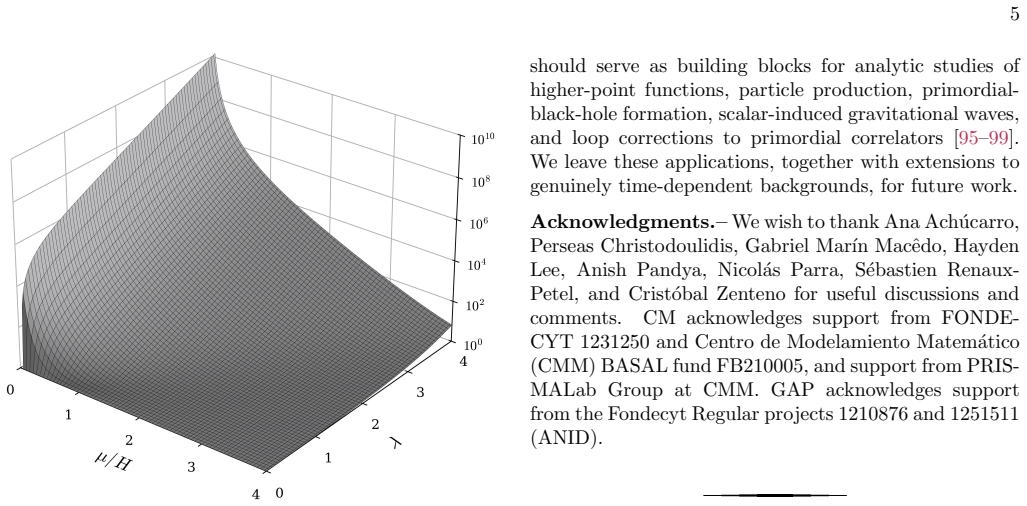
- [Figures] Figure 1 uses logarithmic scaling on the horizontal axis but the caption does not state this. Figure 2 would benefit from a caption statement of the precise slices or projection shown.
- [Eq. (45)] The sentence 'These amplitudes are obtained by acting with \hat{D}_{\nu,\pm} on the standard series representation ... and resumming' is too terse to be checked. Even after the convergence issue in the major comments is resolved, this sentence should be expanded or replaced by an explicit finite intermediate expression.
Circularity Check
No fitted parameters or data; the new spectra pass independent limiting checks. The load-bearing self-citation is the deferred derivation of the central reduction and solution basis to the authors' own companion [82].
specific steps
-
self citation load bearing
[Section 'Fourth-order formulation and exact solutions', around Eqs. (25)-(29)]
"A detailed derivation will be presented in the companion article [82]. Starting from (19), and assuming λ≠0, one may eliminate three of the four Bogoliubov coefficients to obtain a fourth-order differential equation for any one of them. ... Its four independent solutions can be written as f1(z) = bDν,+U(iλ/2,1,−2iz), f2(z) = bDν,−U(−iλ/2,1,−2iz), f3(z) = bDν,+M(iλ/2,1,−2iz), f4(z) = bDν,−M(−iλ/2,1,−2iz)."
The Letter's central mathematical claim—that (19) reduces to (25) and that (26)–(29) form a fundamental solution set—is asserted without proof; the only justification is 'A detailed derivation will be presented in the companion article [82]', by the same authors and 'to appear'. Reconstructing ζ−, σ± from ζ+ and performing the z→0 resummation of Dν,± are likewise asserted. Since [82] is neither external nor verified, the load-bearing step is carried by a self-citation. This is not a fit or definitional circularity, and the final spectra pass independent limiting checks, so the score is moderate.
full rationale
The paper uses no data and fits no parameters, so none of the predictions are statistically forced. The starting action and Bogoliubov system are standard (refs. [47,50,51,52]) and not restated as results. The closed-form power spectra are checked against external limits: Δζ/Δ0→1 as λ→0, Eq. (49) reproduces the heavy-mass effective-field-theory expansion, and Eq. (42) agrees with previous weak-coupling perturbative results. These checks support the content of the solutions but do not supply the missing derivation of Eq. (25) or of the solution basis (26)–(29). The only circularity-adjacent element is the deferral of that derivation to the authors' own companion [82], which is load-bearing for the central claim. The separate concern that the infinite-order operator Dν,± defined in (30)–(31) lacks a stated convergence/interpretation prescription, and that the z→0 resummation is asserted, is a correctness/completeness risk rather than a circularity, and is not scored as such.
Axiom & Free-Parameter Ledger
axioms (5)
- domain assumption Quasi-de Sitter, approximately constant-turn background with slowly varying ε and λ, and constant μ/H.
- domain assumption Slow-roll suppressed corrections from time dependence of ε are neglected when defining canonical normalization and commutators.
- domain assumption Bunch-Davies vacuum initial conditions imposed at fiducial z0 ≫1; subleading O(1/z0) corrections to integration constants are dropped.
- ad hoc to paper The first-order Bogoliubov system (19) is equivalent to the fourth-order ODE (25), and the four functions (26)-(29) form a fundamental solution set for λ ≠ 0.
- standard math Hankel function recurrence relations used in eliminating Bogoliubov coefficients.
read the original abstract
We present exact analytic solutions for the linear dynamics of a two-field inflationary system in which the primordial curvature perturbation $\zeta$ is coupled to an isocurvature perturbation $\sigma$ of entropy mass $\mu$. The solutions are valid for arbitrary values of $\mu$ and the dimensionless interaction strength $\lambda$, within a quasi-de Sitter background. They therefore provide analytic control over the strong mixing regime in which $\zeta$ interacts with light isocurvature fields, commonly associated with rapid-turn inflation. As a first application, we derive the amplitude of the primordial power spectrum in closed form, obtaining an expression that interpolates between the weakly mixed, strongly mixed, light-field, and heavy-field regimes. These results open the way to analytic studies of multifield observables beyond the power spectrum, including non-Gaussianity, particle production, and loop corrections.
Figures

Forward citations
Cited by 4 Pith papers
-
New exact bispectrum shapes in multifield inflation
Exact analytic bispectrum shapes are derived for multifield inflation at arbitrary quadratic mixing strength, showing a strong-mixing collider signal with frequency μ_eff = sqrt(m²/H² + λ² − 9/4).
-
Dissecting the Scalar Cosmological Collider with the Cosmic Microwave Background
A joint Bayesian fit of the multi-field inflationary Lagrangian to Planck bispectrum data finds no cosmological collider signal (max Δχ²=5.3) and shows weak-mixing template searches are invalid except at the smallest masses.
-
Pushing the Primordial Frontier: Cosmological Collider Signatures at Strong Mixing
Exact analytic squeezed-limit bispectra for strongly mixed two-field inflation, nonperturbative in the curvature-isocurvature mixing λ.
-
Cosmological Collider Signals at Strong Mixing
The squeezed-limit cosmological collider signal is computed nonperturbatively in the mixing strength as an absolutely convergent series, with a JWKB expansion of the oscillation phase.
Reference graph
Works this paper leans on
-
[1]
The Inflationary Universe: A Possible Solu- tion to the Horizon and Flatness Problems,
A. H. Guth, “The Inflationary Universe: A Possible Solu- tion to the Horizon and Flatness Problems,” Phys. Rev. D23, 347-356 (1981)
1981
-
[2]
A New Type of Isotropic Cosmo- logical Models Without Singularity,
A. A. Starobinsky, “A New Type of Isotropic Cosmo- logical Models Without Singularity,” Phys. Lett. B91, 99-102 (1980)
1980
-
[3]
A New Inflationary Universe Scenario: A Possible Solution of the Horizon, Flatness, Homogene- ity, Isotropy and Primordial Monopole Problems,
A. D. Linde, “A New Inflationary Universe Scenario: A Possible Solution of the Horizon, Flatness, Homogene- ity, Isotropy and Primordial Monopole Problems,” Phys. Lett. B108, 389-393 (1982)
1982
-
[4]
Cosmology for Grand Unified Theories with Radiatively Induced Symmetry Breaking,
A. Albrecht and P. J. Steinhardt, “Cosmology for Grand Unified Theories with Radiatively Induced Symmetry Breaking,” Phys. Rev. Lett.48, 1220-1223 (1982)
1982
-
[5]
Inflation: Theory and Observations,
A. Ach´ ucarro, M. Biagetti, M. Braglia, G. Cabass, R. Caldwell, E. Castorina, X. Chen, W. Coulton, R. Flauger and J. Fumagalli,et al.“Inflation: Theory and Observations,” [arXiv:2203.08128 [astro-ph.CO]]
-
[6]
Candidates for the In- flaton Field in Superstring Models,
P. Bin´ etruy and M. K. Gaillard, “Candidates for the In- flaton Field in Superstring Models,” Phys. Rev. D34, 3069-3083 (1986)
1986
-
[7]
T. Banks, M. Berkooz, S. H. Shenker, G. W. Moore and P. J. Steinhardt, “Modular cosmology,” Phys. Rev. D52, 3548-3562 (1995) [arXiv:hep-th/9503114 [hep-th]]
Pith/arXiv arXiv 1995
-
[8]
Challenges for super- string cosmology,
R. Brustein and P. J. Steinhardt, “Challenges for super- string cosmology,” Phys. Lett. B302, 196-201 (1993) [arXiv:hep-th/9212049 [hep-th]]
Pith/arXiv arXiv 1993
-
[9]
Towards inflation in string theory,
S. Kachru, R. Kallosh, A. D. Linde, J. M. Maldacena, L. P. McAllister and S. P. Trivedi, “Towards inflation in string theory,” JCAP10, 013 (2003) [arXiv:hep- th/0308055 [hep-th]]
arXiv 2003
-
[10]
J. J. Blanco-Pillado, C. P. Burgess, J. M. Cline, C. Es- coda, M. Gomez-Reino, R. Kallosh, A. D. Linde and F. Quevedo, “Racetrack inflation,” JHEP11, 063 (2004) [arXiv:hep-th/0406230 [hep-th]]
Pith/arXiv arXiv 2004
-
[11]
Racetrack inflation and assisted moduli stabilisation,
Z. Lalak, G. G. Ross and S. Sarkar, “Racetrack inflation and assisted moduli stabilisation,” Nucl. Phys. B766, 1-20 (2007) [arXiv:hep-th/0503178 [hep-th]]
Pith/arXiv arXiv 2007
-
[12]
S. Dimopoulos, S. Kachru, J. McGreevy and J. G. Wacker, “N-flation,” JCAP08, 003 (2008) [arXiv:hep-th/0507205 [hep-th]]
Pith/arXiv arXiv 2008
-
[13]
J. P. Conlon and F. Quevedo, “Kahler moduli inflation,” 6 JHEP01, 146 (2006) [arXiv:hep-th/0509012 [hep-th]]
Pith/arXiv arXiv 2006
-
[14]
Roulette inflation with Kahler moduli and their axions,
J. R. Bond, L. Kofman, S. Prokushkin and P. M. Vau- drevange, “Roulette inflation with Kahler moduli and their axions,” Phys. Rev. D75, 123511 (2007) [arXiv:hep-th/0612197 [hep-th]]
Pith/arXiv arXiv 2007
-
[15]
Axion inflation in type II string theory,
T. W. Grimm, “Axion inflation in type II string theory,” Phys. Rev. D77, 126007 (2008) [arXiv:0710.3883 [hep- th]]
Pith/arXiv arXiv 2008
-
[16]
Constraints on mod- ular inflation in supergravity and string theory,
L. Covi, M. Gomez-Reino, C. Gross, J. Louis, G. A. Palma and C. A. Scrucca, “Constraints on mod- ular inflation in supergravity and string theory,” JHEP 08, 055 (2008) [arXiv:0805.3290 [hep-th]]
Pith/arXiv arXiv 2008
-
[17]
No-Scale Supergravity Realization of the Starobinsky Model of Inflation,
J. Ellis, D. V. Nanopoulos and K. A. Olive, “No-Scale Supergravity Realization of the Starobinsky Model of Inflation,” Phys. Rev. Lett.111, 111301 (2013) [er- ratum: Phys. Rev. Lett.111, no.12, 129902 (2013)] [arXiv:1305.1247 [hep-th]]
Pith/arXiv arXiv 2013
-
[18]
Cosmo- logical Attractors and Initial Conditions for Inflation,
J. J. M. Carrasco, R. Kallosh and A. Linde, “Cosmo- logical Attractors and Initial Conditions for Inflation,” Phys. Rev. D92, no.6, 063519 (2015) [arXiv:1506.00936 [hep-th]]
Pith/arXiv arXiv 2015
-
[19]
Sound Speed of Primordial Fluctuations in Supergravity Inflation,
A. Hetz and G. A. Palma, “Sound Speed of Primordial Fluctuations in Supergravity Inflation,” Phys. Rev. Lett. 117, no.10, 101301 (2016) [arXiv:1601.05457 [hep-th]]
Pith/arXiv arXiv 2016
-
[20]
Features of heavy physics in the CMB power spectrum,
A. Ach´ ucarro, J. O. Gong, S. Hardeman, G. A. Palma and S. P. Patil, “Features of heavy physics in the CMB power spectrum,” JCAP01, 030 (2011) [arXiv:1010.3693 [hep-ph]]
Pith/arXiv arXiv 2011
-
[21]
Influence of heavy modes on perturbations in multiple field inflation,
X. Gao, D. Langlois and S. Mizuno, “Influence of heavy modes on perturbations in multiple field inflation,” JCAP10, 040 (2012) [arXiv:1205.5275 [hep-th]]
Pith/arXiv arXiv 2012
-
[22]
Correlating features in the primordial spectra,
A. Ach´ ucarro, J. O. Gong, G. A. Palma and S. P. Patil, “Correlating features in the primordial spectra,” Phys. Rev. D87, 121301 (2013) [arXiv:1211.5619 [astro- ph.CO]]
Pith/arXiv arXiv 2013
-
[23]
X. Gao, D. Langlois and S. Mizuno, “Oscillatory fea- tures in the curvature power spectrum after a sudden turn of the inflationary trajectory,” JCAP10, 023 (2013) [arXiv:1306.5680 [hep-th]]
Pith/arXiv arXiv 2013
-
[24]
Primordial spectra from sudden turning trajectory,
T. Noumi and M. Yamaguchi, “Primordial spectra from sudden turning trajectory,” JCAP12, 038 (2013) [arXiv:1307.7110 [hep-th]]
Pith/arXiv arXiv 2013
-
[25]
A. Ach´ ucarro, V. Atal, P. Ortiz and J. Torrado, “Lo- calized correlated features in the CMB power spectrum and primordial bispectrum from a transient reduction in the speed of sound,” Phys. Rev. D89, 103006 (2014) [arXiv:1311.2552 [astro-ph.CO]]
Pith/arXiv arXiv 2014
-
[26]
Combined fea- tures in the primordial spectra induced by a sudden turn in two-field DBI inflation,
S. Mizuno, R. Saito and D. Langlois, “Combined fea- tures in the primordial spectra induced by a sudden turn in two-field DBI inflation,” JCAP11, 032 (2014) [arXiv:1405.4257 [hep-th]]
Pith/arXiv arXiv 2014
-
[27]
A. Ach´ ucarro, V. Atal, B. Hu, P. Ortiz and J. Tor- rado, “Inflation with moderately sharp features in the speed of sound: Generalized slow roll and in-in formal- ism for power spectrum and bispectrum,” Phys. Rev. D 90, 023511 (2014) [arXiv:1404.7522 [astro-ph.CO]]
Pith/arXiv arXiv 2014
-
[28]
Towards general patterns of features in multi-field inflation,
X. Gao and J. O. Gong, “Towards general patterns of features in multi-field inflation,” JHEP08, 115 (2015) [arXiv:1506.08894 [astro-ph.CO]]
Pith/arXiv arXiv 2015
-
[29]
The effect of multiple features on the power spec- trum in two-field inflation,
K. Boutivas, I. Dalianis, G. P. Kodaxis and N. Tetradis, “The effect of multiple features on the power spec- trum in two-field inflation,” JCAP08, 021 (2022) [arXiv:2203.15605 [astro-ph.CO]]
Pith/arXiv arXiv 2022
-
[30]
Primordial non-Gaussianities from multiple-field inflation,
D. Seery and J. E. Lidsey, “Primordial non-Gaussianities from multiple-field inflation,” JCAP09, 011 (2005) [arXiv:astro-ph/0506056 [astro-ph]]
Pith/arXiv arXiv 2005
-
[31]
Large non-Gaussianity in multiple-field inflation,
G. I. Rigopoulos, E. P. S. Shellard and B. J. W. van Tent, “Large non-Gaussianity in multiple-field inflation,” Phys. Rev. D73, 083522 (2006) [arXiv:astro-ph/0506704 [astro-ph]]
Pith/arXiv arXiv 2006
-
[32]
Non-Gaussianities in two- field inflation,
F. Vernizzi and D. Wands, “Non-Gaussianities in two- field inflation,” JCAP05, 019 (2006) [arXiv:astro- ph/0603799 [astro-ph]]
arXiv 2006
-
[33]
Conditions for large non-Gaussianity in two-field slow-roll inflation,
C. T. Byrnes, K.-Y. Choi and L. M. H. Hall, “Conditions for large non-Gaussianity in two-field slow-roll inflation,” JCAP10, 008 (2008) [arXiv:0807.1101 [astro-ph]]
Pith/arXiv arXiv 2008
-
[34]
S. Garcia-Saenz and S. Renaux-Petel, “Flattened non- Gaussianities from the effective field theory of inflation with imaginary speed of sound,” JCAP11, 005 (2018) [arXiv:1805.12563 [hep-th]]
Pith/arXiv arXiv 2018
-
[35]
Reconstructing the Inflationary Landscape with Cosmological Data,
X. Chen, G. A. Palma, B. Scheihing Hitschfeld and S. Sypsas, “Reconstructing the Inflationary Landscape with Cosmological Data,” Phys. Rev. Lett.121, no.16, 161302 (2018) [arXiv:1806.05202 [astro-ph.CO]]
Pith/arXiv arXiv 2018
-
[36]
Hyper-Non-Gaussianities in Inflation with Strongly Nongeodesic Motion,
J. Fumagalli, S. Garcia-Saenz, L. Pinol, S. Renaux-Petel and J. Ronayne, “Hyper-Non-Gaussianities in Inflation with Strongly Nongeodesic Motion,” Phys. Rev. Lett. 123, no.20, 201302 (2019) [arXiv:1902.03221 [hep-th]]
Pith/arXiv arXiv 2019
-
[37]
Mild Non-Gaussianities under Perturbative Control from Rapid-Turn Inflation Models,
T. Bjorkmo, R. Z. Ferreira and M. C. D. Marsh, “Mild Non-Gaussianities under Perturbative Control from Rapid-Turn Inflation Models,” JCAP12, 036 (2019) [arXiv:1908.11316 [hep-th]]
Pith/arXiv arXiv 2019
-
[38]
Revisit- ing non-Gaussianity in multifield inflation with curved field space,
S. Garcia-Saenz, L. Pinol and S. Renaux-Petel, “Revisit- ing non-Gaussianity in multifield inflation with curved field space,” JHEP01, 073 (2020) [arXiv:1907.10403 [hep-th]]
Pith/arXiv arXiv 2020
-
[39]
The hand-made tail: non-perturbative tails from multi- field inflation,
A. Ach´ ucarro, S. Cespedes, A. C. Davis and G. A. Palma, “The hand-made tail: non-perturbative tails from multi- field inflation,” JHEP05, 052 (2022) [arXiv:2112.14712 [hep-th]]
Pith/arXiv arXiv 2022
-
[40]
Bootstrapping multi-field inflation: non-Gaussianities from light scalars revisited,
D. G. Wang, G. L. Pimentel and A. Ach´ ucarro, “Bootstrapping multi-field inflation: non-Gaussianities from light scalars revisited,” JCAP05, 043 (2023) [arXiv:2212.14035 [astro-ph.CO]]
Pith/arXiv arXiv 2023
-
[41]
Non- Gaussianity in rapid-turn multi-field inflation,
O. Iarygina, M. C. D. Marsh and G. Salinas, “Non- Gaussianity in rapid-turn multi-field inflation,” JCAP 03, 014 (2024) [arXiv:2303.14156 [astro-ph.CO]]
Pith/arXiv arXiv 2024
-
[42]
Universal Non- Gaussian Signatures from Transient Instabilities,
S. Aoki, D. Roest and D. Werth, “Universal Non- Gaussian Signatures from Transient Instabilities,” [arXiv:2604.01035 [astro-ph.CO]]
-
[43]
Curvature and isocurvature perturbations in two-field inflation,
Z. Lalak, D. Langlois, S. Pokorski and K. Turzy´ nski, “Curvature and isocurvature perturbations in two-field inflation,” JCAP07, 014 (2007) [arXiv:0704.0212 [hep- th]]
Pith/arXiv arXiv 2007
-
[44]
Effective Field Theory and De- coupling in Multi-field Inflation: An Illustrative Case Study,
G. Shiu and J. Xu, “Effective Field Theory and De- coupling in Multi-field Inflation: An Illustrative Case Study,” Phys. Rev. D84, 103509 (2011) [arXiv:1108.0981 [hep-th]]
Pith/arXiv arXiv 2011
-
[45]
The effects of a fast-turning trajectory in multiple-field in- flation,
M. Konieczka, R. H. Ribeiro and K. Turzy´ nski, “The effects of a fast-turning trajectory in multiple-field in- flation,” JCAP07, 030 (2014) [arXiv:1401.6163 [astro- ph.CO]]
Pith/arXiv arXiv 2014
-
[46]
Orbital Inflation: in- flating along an angular isometry of field space,
A. Ach´ ucarro and Y. Welling, “Orbital Inflation: in- flating along an angular isometry of field space,” [arXiv:1907.02020 [hep-th]]
Pith/arXiv arXiv 1907
-
[47]
Origin of ultra-light fields during inflation and their suppressed non-Gaussianity,
A. Ach´ ucarro, G. A. Palma, D. G. Wang and Y. Welling, “Origin of ultra-light fields during inflation and their suppressed non-Gaussianity,” JCAP10, 018 (2020) 7 [arXiv:1908.06956 [hep-th]]
Pith/arXiv arXiv 2020
-
[48]
J. Fumagalli, S. Renaux-Petel and L. T. Witkowski, “Os- cillations in the stochastic gravitational wave background from sharp features and particle production during in- flation,” JCAP08, 030 (2021) [arXiv:2012.02761 [astro- ph.CO]]
Pith/arXiv arXiv 2021
-
[49]
Dark matter from entropy perturbations in curved field space,
H. Firouzjahi, M. A. Gorji, S. Mukohyama and A. Talebian, “Dark matter from entropy perturbations in curved field space,” Phys. Rev. D105, no.4, 043501 (2022) [arXiv:2110.09538 [gr-qc]]
Pith/arXiv arXiv 2022
-
[50]
Primordial gravita- tional waves from excited states,
J. Fumagalli, G. A. Palma, S. Renaux-Petel, S. Sypsas, L. T. Witkowski and C. Zenteno, “Primordial gravita- tional waves from excited states,” JHEP03, 196 (2022) [arXiv:2111.14664 [astro-ph.CO]]
Pith/arXiv arXiv 2022
-
[51]
Cumulative effects in inflation with ultra-light entropy modes,
A. Ach´ ucarro, V. Atal, C. Germani and G. A. Palma, “Cumulative effects in inflation with ultra-light entropy modes,” JCAP02, 013 (2017) [arXiv:1607.08609 [astro- ph.CO]]
Pith/arXiv arXiv 2017
-
[52]
Par- ticle creation from non-geodesic trajectories in multifield inflation,
N. Parra, S. Sypsas, G. A. Palma and C. Zenteno, “Par- ticle creation from non-geodesic trajectories in multifield inflation,” JCAP04, 028 (2025) [arXiv:2410.13843 [hep- th]]
Pith/arXiv arXiv 2025
-
[53]
A. Ach´ ucarro, P. Christodoulidis, J. O. Gong and O. Iarygina, “Ultra slow-turn inflation,” [arXiv:2603.03204 [hep-th]]
-
[54]
Den- sity perturbations and black hole formation in hy- brid inflation,
J. Garcia-Bellido, A. D. Linde and D. Wands, “Den- sity perturbations and black hole formation in hy- brid inflation,” Phys. Rev. D54, 6040-6058 (1996) doi:10.1103/PhysRevD.54.6040 [arXiv:astro-ph/9605094 [astro-ph]]
Pith/arXiv arXiv 1996
-
[55]
Seeding pri- mordial black holes in multifield inflation,
G. A. Palma, S. Sypsas and C. Zenteno, “Seeding pri- mordial black holes in multifield inflation,” Phys. Rev. Lett.125, no.12, 121301 (2020) [arXiv:2004.06106 [astro- ph.CO]]
Pith/arXiv arXiv 2020
-
[56]
Turning in the landscape: A new mechanism for generating primordial black holes,
J. Fumagalli, S. Renaux-Petel, J. W. Ronayne and L. T. Witkowski, “Turning in the landscape: A new mechanism for generating primordial black holes,” Phys. Lett. B841, 137921 (2023) [arXiv:2004.08369 [hep-th]]
Pith/arXiv arXiv 2023
-
[57]
Generating PBHs and small-scale GWs in two-field models of inflation,
M. Braglia, D. K. Hazra, F. Finelli, G. F. Smoot, L. Sri- ramkumar and A. A. Starobinsky, “Generating PBHs and small-scale GWs in two-field models of inflation,” JCAP08, 001 (2020) [arXiv:2005.02895 [astro-ph.CO]]
Pith/arXiv arXiv 2020
-
[58]
On Primordial Black Holes from Rapid Turns in Two-field Models,
L. Anguelova, “On Primordial Black Holes from Rapid Turns in Two-field Models,” JCAP06, 004 (2021) [arXiv:2012.03705 [hep-th]]
Pith/arXiv arXiv 2021
-
[59]
Primordial black holes from multifield inflation with nonminimal couplings,
S. R. Geller, W. Qin, E. McDonough and D. I. Kaiser, “Primordial black holes from multifield inflation with nonminimal couplings,” Phys. Rev. D106, no.6, 063535 (2022) [arXiv:2205.04471 [hep-th]]
Pith/arXiv arXiv 2022
-
[60]
Light Scalar Fields Foster Production of Primordial Black Holes,
D. L. Lorenzoni, S. R. Geller, Z. Ireland, D. I. Kaiser, E. McDonough and K. A. Wittmeier, “Light Scalar Fields Foster Production of Primordial Black Holes,” [arXiv:2504.13251 [astro-ph.CO]]
-
[61]
Non-Gaussianity Consistency Relation for Multi-field Inflation,
N. S. Sugiyama, E. Komatsu and T. Futamase, “Non-Gaussianity Consistency Relation for Multi-field Inflation,” Phys. Rev. Lett.106, 251301 (2011) [arXiv:1101.3636 [gr-qc]]
Pith/arXiv arXiv 2011
-
[62]
Multifield Inflation af- ter Planck: The Case for Nonminimal Couplings,
D. I. Kaiser and E. I. Sfakianakis, “Multifield Inflation af- ter Planck: The Case for Nonminimal Couplings,” Phys. Rev. Lett.112, no.1, 011302 (2014) [arXiv:1304.0363 [astro-ph.CO]]
Pith/arXiv arXiv 2014
-
[63]
A. R. Brown, “Hyperbolic Inflation,” Phys. Rev. Lett. 121, no.25, 251601 (2018) [arXiv:1705.03023 [hep-th]]
Pith/arXiv arXiv 2018
-
[64]
Primordial perturbations from inflation with a hyperbolic field-space,
S. Mizuno and S. Mukohyama, “Primordial perturbations from inflation with a hyperbolic field-space,” Phys. Rev. D96, no.10, 103533 (2017) [arXiv:1707.05125 [hep-th]]
Pith/arXiv arXiv 2017
-
[65]
Constraints on Holographic Multifield Inflation and Models Based on the Hamilton-Jacobi Formalism,
A. Ach´ ucarro, S. C´ espedes, A. C. Davis and G. A. Palma, “Constraints on Holographic Multifield Inflation and Models Based on the Hamilton-Jacobi Formalism,” Phys. Rev. Lett.122, no.19, 191301 (2019) [arXiv:1809.05341 [hep-th]]
Pith/arXiv arXiv 2019
-
[66]
Nonlinear Dynamics of Preheat- ing after Multifield Inflation with Nonminimal Cou- plings,
R. Nguyen, J. van de Vis, E. I. Sfakianakis, J. T. Gib- lin and D. I. Kaiser, “Nonlinear Dynamics of Preheat- ing after Multifield Inflation with Nonminimal Cou- plings,” Phys. Rev. Lett.123, no.17, 171301 (2019) [arXiv:1905.12562 [hep-ph]]
Pith/arXiv arXiv 2019
-
[67]
Adiabatic and entropy perturbations from inflation,
C. Gordon, D. Wands, B. A. Bassett and R. Maartens, “Adiabatic and entropy perturbations from inflation,” Phys. Rev. D63, 023506 (2001) [arXiv:astro-ph/0009131 [astro-ph]]
Pith/arXiv arXiv 2001
-
[68]
Scalar perturbations during multiple field slow-roll inflation,
S. Groot Nibbelink and B. J. W. van Tent, “Scalar perturbations during multiple field slow-roll inflation,” Class. Quant. Grav.19, 613-640 (2002) [arXiv:hep- ph/0107272 [hep-ph]]
arXiv 2002
-
[69]
Perturbations in gen- eralized multi-field inflation,
D. Langlois and S. Renaux-Petel, “Perturbations in gen- eralized multi-field inflation,” JCAP04, 017 (2008) [arXiv:0801.1085 [hep-th]]
Pith/arXiv arXiv 2008
-
[70]
Large non-Gaussianities with Intermediate Shapes from Quasi-Single Field Inflation,
X. Chen and Y. Wang, “Large non-Gaussianities with Intermediate Shapes from Quasi-Single Field Inflation,” Phys. Rev. D81, 063511 (2010) [arXiv:0909.0496 [astro- ph.CO]]
Pith/arXiv arXiv 2010
-
[71]
The Gelaton Scenario: Equilateral non-Gaussianity from multi-field dynamics,
A. J. Tolley and M. Wyman, “The Gelaton Scenario: Equilateral non-Gaussianity from multi-field dynamics,” Phys. Rev. D81, 043502 (2010) [arXiv:0910.1853 [hep- th]]
Pith/arXiv arXiv 2010
-
[72]
Quasi-Single Field Infla- tion and Non-Gaussianities,
X. Chen and Y. Wang, “Quasi-Single Field Infla- tion and Non-Gaussianities,” JCAP04, 027 (2010) [arXiv:0911.3380 [hep-th]]
Pith/arXiv arXiv 2010
-
[73]
Strongly Cou- pled Perturbations in Two-Field Inflationary Models,
S. Cremonini, Z. Lalak and K. Turzy´ nski, “Strongly Cou- pled Perturbations in Two-Field Inflationary Models,” JCAP03, 016 (2011) [arXiv:1010.3021 [hep-th]]
Pith/arXiv arXiv 2011
-
[74]
Signatures of Supersymme- try from the Early Universe,
D. Baumann and D. Green, “Signatures of Supersymme- try from the Early Universe,” Phys. Rev. D85, 103520 (2012) [arXiv:1109.0292 [hep-th]]
Pith/arXiv arXiv 2012
-
[75]
On the impor- tance of heavy fields during inflation,
S. Cespedes, V. Atal and G. A. Palma, “On the impor- tance of heavy fields during inflation,” JCAP05, 008 (2012) [arXiv:1201.4848 [hep-th]]
Pith/arXiv arXiv 2012
-
[76]
Effective theories of single field infla- tion when heavy fields matter,
A. Ach´ ucarro, J. O. Gong, S. Hardeman, G. A. Palma and S. P. Patil, “Effective theories of single field infla- tion when heavy fields matter,” JHEP05, 066 (2012) [arXiv:1201.6342 [hep-th]]
Pith/arXiv arXiv 2012
-
[77]
Quasi-Single Field Inflation with Large Mass,
X. Chen and Y. Wang, “Quasi-Single Field Inflation with Large Mass,” JCAP09, 021 (2012) [arXiv:1205.0160 [hep-th]]
Pith/arXiv arXiv 2012
-
[78]
Heavy fields, reduced speeds of sound and decoupling during inflation,
A. Ach´ ucarro, V. Atal, S. Cespedes, J. O. Gong, G. A. Palma and S. P. Patil, “Heavy fields, reduced speeds of sound and decoupling during inflation,” Phys. Rev. D86, 121301 (2012) [arXiv:1205.0710 [hep-th]]
Pith/arXiv arXiv 2012
-
[79]
Effec- tive field theory approach to quasi-single field infla- tion and effects of heavy fields,
T. Noumi, M. Yamaguchi and D. Yokoyama, “Effec- tive field theory approach to quasi-single field infla- tion and effects of heavy fields,” JHEP06, 051 (2013) [arXiv:1211.1624 [hep-th]]
Pith/arXiv arXiv 2013
-
[80]
Quasi Single Field Inflation in the non-perturbative regime,
H. An, M. McAneny, A. K. Ridgway and M. B. Wise, “Quasi Single Field Inflation in the non-perturbative regime,” JHEP06, 105 (2018) [arXiv:1706.09971 [hep- ph]]
Pith/arXiv arXiv 2018
discussion (0)
Sign in with ORCID, Apple, or X to comment. Anyone can read and Pith papers without signing in.