REVIEW 3 major objections 5 minor 2 cited by
JUNO's mild preference for nonzero Majorana-phase running hints neutrinos are Majorana, while near-detector TAO restores mass-ordering sensitivity that RG running would otherwise degrade.
Reviewed by Pith at T0; open to challenge. T0 means a machine referee read the full paper against a public rubric. the ladder, T0–T4 →
T0 review · grok-4.5
2026-07-12 12:30 UTC pith:A4B4SM26
load-bearing objection Solid first application of RG betas to real JUNO spectra that cleanly separates slow/fast modes and quantifies MO degradation + TAO recovery; the Majorana "hint" is a mild ~1–2σ preference over-sold in the abstract. the 3 major comments →
Disentangle RG Running Parameters with Medium-Baseline Reactor Experiments
The pith
A machine-rendered reading of the paper's core claim, the machinery that carries it, and where it could break.
Core claim
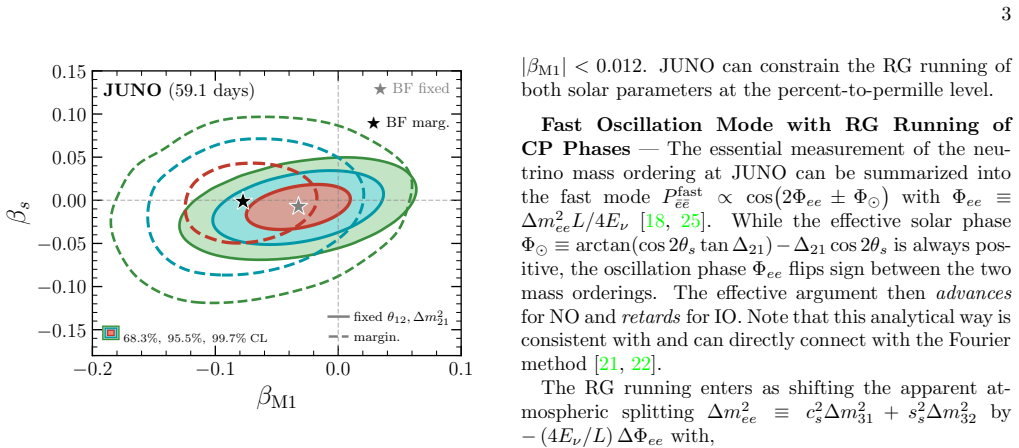
The first JUNO data releases mildly prefer a nonzero beta function for the first Majorana rephasing phase (best-fit near -0.078, Δχ² ≈ 3.8 relative to zero; second release confines it to roughly [-0.073, -0.010] at 90 % CL). Because that beta is physical only for Majorana neutrinos, the preference constitutes a hint of Majorana nature. Concurrently the combination of Dirac and third-Majorana betas can reduce full-JUNO mass-ordering sensitivity from Δχ²_IO = 8.9 to 2.5, an effect that the TAO near detector largely cancels.
What carries the argument
The RG-corrected electron-antineutrino survival probability that splits into a slow solar term controlled by β_s and β_M1 and a fast atmospheric term controlled by β_D - β_M3/2; the same phase combination appears as a residual zero-distance deficit measurable by TAO.
Load-bearing premise
That the mild preference for nonzero Majorana-phase running is not an artifact of residual flux, energy-scale or background systematics, and that reactor-angle running remains negligible compared with solar-angle running.
What would settle it
A joint fit of the full JUNO far-detector spectrum plus TAO zero-distance data that returns β_M1 consistent with zero at high significance, or that finds the ordering sensitivity remains degraded even after TAO is included.
If this is right
- Full 2400-day JUNO exposure will constrain both solar betas at the percent-to-permille level.
- TAO's measurement of the zero-distance deficit restores most of the mass-ordering reach that RG running would otherwise erase.
- A confirmed nonzero β_M1 would constitute oscillation evidence for Majorana neutrinos.
- Slow and fast modes together with the near detector give three independent handles on the same set of RG parameters.
Where Pith is reading between the lines
- If the preference for nonzero β_M1 survives, reactor data alone could settle the Dirac/Majorana question without waiting for neutrinoless double-beta decay.
- The same zero-distance deficit that TAO measures could be searched for at any short-baseline reactor or radioactive-source experiment, offering a cross-check independent of JUNO.
- Once the solar betas are pinned, the residual freedom in the fast-mode combination becomes a pure probe of the Dirac CP phase running, potentially linking reactor and long-baseline CP measurements.
Editorial analysis
A structured set of objections, weighed in public.
Referee Report
Summary. The manuscript derives how renormalization-group (RG) beta functions of the solar mixing angle and of the leptonic CP phases (Dirac and rephasing/Majorana) enter the electron-antineutrino survival probability at medium baseline. Expanding the mismatched production/detection PMNS matrices yields amplitude corrections controlled by β_s and phase shifts controlled by β_M1 in the slow (solar) mode, and a combination β_D − β_M3/2 that shifts the effective atmospheric phase Φ_ee (and therefore the apparent |Δm²_ee|) in the fast mode. The authors fit the published JUNO 59.1-day and 207.2-day spectra, report a mild preference for nonzero β_M1, project percent-to-permille bounds with full exposure, show that the same combination can degrade the mass-ordering (MO) Δχ² from 8.9 to ~2.5, and argue that the JUNO-TAO near detector restores most of the MO sensitivity via the zero-distance residual. Because rephasing-phase running is physical only for Majorana neutrinos, the mild β_M1 preference is interpreted as a hint of Majorana nature.
Significance. If the mapping of RG betas onto slow/fast modes and the TAO restoration of MO sensitivity hold, the work usefully enlarges the physics program of reactor experiments beyond the standard three-flavor parameters. The analytic factorization of amplitude versus phase corrections (Eqs. 3–8 and the supplementary derivation of Φ̂_ee and Φ̂_⊙), the complementary use of slow and fast modes, and the concrete demonstration that a near detector can break the Φ_ee–β degeneracy are solid and falsifiable contributions. The numerical pipeline that re-analyzes the released JUNO spectra with the collaboration’s CNP statistic and standard systematics is a strength. The interpretive leap from a ~1–2σ preference for β_M1 to a Majorana-nature hint is, however, weaker and does not yet rise to the same level of robustness.
major comments (3)
- Abstract and final paragraph of the Conclusion: the statement that the mild preference for nonzero β_M1 “hints the Majorana nature of neutrinos” overstates the statistical and systematic status of the result. Along the β_s = 0 slice the first release gives Δχ²_std−RG ≈ 3.8 (roughly 1.9σ for 1 d.o.f.); the second-release 90 % CL interval still includes values near zero once the full two-parameter contour is considered. Because the rephasing phases are unphysical for Dirac neutrinos only after a vector-like redefinition, a robust nonzero β_M1 would indeed be interesting, but the present preference is too mild and too systematics-sensitive to support that language. Either demonstrate that the preference survives a more flexible energy-dependent nuisance set (flux-shape polynomials, free energy-scale non-linearity, alternate background shapes) or rephrase the claim to a model-independent con
- After Eq. (4) and in the zero-distance limit Eq. (9): the hierarchical omission of Δθ_r (and of β_r) is justified by the rough scaling β_r/β_s ∝ Δm²_21/Δm²_31 ≈ 3 %. This is plausible in many models but is not guaranteed once the full radiative correction to the mass matrix is considered. Because an amplitude correction from Δθ_r can partially mimic the spectral distortion attributed to β_s (and, through the slow-mode feed-down, affect the extracted β_M1), the paper should either (i) float a small Δθ_r and show that the preferred β_M1 and the MO degradation remain stable, or (ii) quantify the residual bias under a conservative prior |β_r| ≲ 0.05 |β_s|.
- Fig. 2 and the associated text: the 1σ preference for β_M1 ≈ −0.078 is shown both with solar parameters fixed to NuFIT 6.1 and marginalized over pre-JUNO NuFIT 6.0. The two contours differ visibly, and the second-release interval [−0.073, −0.010] at 90 % CL is quoted only after the solar parameters have been constrained by the same data. A short table or additional panel that isolates the pull of the solar-parameter priors (and of the 25 flux-shape uncertainties already included) would make clear how much of the preference is data-driven versus prior-driven; without it the Majorana-oriented reading remains fragile.
minor comments (5)
- Abstract, last sentence: “In consolidated” is a typographical error for “In conclusion” (or similar).
- Eq. (2) and surrounding text: the definition β_XI ≡ ∂XI/∂ln µ² is standard, but the sign convention for ΔXI = β_XI ln|Q_d²/Q_p²| should be stated once explicitly so that positive β_s corresponds to the red curve in Fig. 1.
- Fig. 1 lower panel and Fig. 3 lower panel: the residual bands are useful; adding the pull of the dominant systematic (energy scale or flux) as a shaded envelope would help the reader judge whether the β_M1 and β_D−β_M3/2 distortions are distinguishable from those systematics by eye.
- Supplementary Material, energy-resolution formula: a = 3.3 %, b = 1.0 % is quoted from the collaboration; a one-sentence cross-check that the same resolution is used for both the real-data and Asimov analyses would remove any ambiguity.
- References [26] and [27]: the second data release is cited via a conference talk; once the corresponding paper appears, the arXiv identifier should be updated for permanence.
Circularity Check
Modest self-citation of the authors' prior RG-running framework and TAO constraints; JUNO spectral fits and Asimov MO projections remain independent of those normalizations.
specific steps
-
self citation load bearing
[Introduction (paragraph beginning “The whole neutrino oscillation process…”)]
"If the two mixing matrices differ from each other, for example, due to the renormalization group (RG) running, the leptonic Dirac CP phase can have phenomenological consequences [28, 29] even in the reactor neutrino oscillation experiments [30]."
The claim that mismatched production/detection mixing matrices allow CP-phase (and rephasing-phase) betas to appear in reactor P_ee is justified by citations whose author lists overlap with the present paper. While the subsequent expansions are re-derived, the physical premise that such effects are experimentally relevant rests on that self-citation chain.
-
self citation load bearing
[Guarantee MO Sensitivity with JUNO-TAO (and Fig. 4 caption)]
"Adding the 6.5-year TAO constraints [30] recovers most of this loss. In the idealized limit of a perfectly known normalization (red dotted), the degeneracy is fully broken and the sensitivity recovers to Δχ^{2}_IO = 6.8 (≃2.6σ)."
The quantitative statement that TAO restores the mass-ordering sensitivity (from Δχ^{2}_IO = 2.5 back to 4.9–6.8) is taken directly from the authors’ prior calculation of TAO’s reach on eta_D – eta_M3/2; the present paper does not recompute the near-detector constraint.
full rationale
The paper re-expands the vacuum survival probability (Eqs. 1–5 and the full fast-mode derivation in the Supplementary Material) from the standard mismatched-U_p/U_d amplitude, so the mapping of β_s, β_M1 onto the slow mode and of β_D – β_M3/2 onto the fast mode is self-contained. The numerical preference for nonzero β_M1 and the projected MO degradation are obtained by fitting public JUNO event spectra (and NuFIT priors) or by Asimov generation under standard NO; neither quantity is forced by a prior fit of the same authors. The only load-bearing self-citations are the enabling premise that RG running makes rephasing-phase betas visible in reactor P_ee and the quantitative TAO constraint strength used to restore MO sensitivity. These raise the score only to 2; they do not reduce the central claims to tautologies or to unverified self-definitions.
Axiom & Free-Parameter Ledger
free parameters (4)
- β_s =
90 % CL [-0.036,+0.020] (59 d, fixed solar); projected |β_s|<0.0066 (2400 d)
- β_M1 =
best-fit -0.078 (59 d); 90 % CL [-0.073,-0.010] (207 d)
- β_D - β_M3/2 =
example values ±0.2 used for sensitivity plots
- solar parameters (θ_s, Δm^{2}_21) =
NuFIT best-fit values
axioms (4)
- domain assumption Three-flavor PMNS oscillation probability with two distinct mixing matrices U(Q_p^{2}) and U(Q_d^{2})
- domain assumption eta_r / eta_s ∝ Δm^{2}_21 / Δm^{2}_31 ≈ 3 % so reactor-angle running can be dropped
- domain assumption Rephasing phases δ_M1, δ_M3 are unphysical for Dirac neutrinos, hence their beta functions are physical only in the Majorana case
- domain assumption Zero-distance residual P_ee(L o0) depends only on (Δδ_D - ½ Δδ_M3)^{2}
read the original abstract
We study how the renormalization group running beta functions of mixing angles and leptonic CP phases affect the slow and fast oscillation modes at JUNO. While the slow mode is modulated by the solar parameters, its amplitude can also be affected by the solar angle beta function $\beta_s$ and its phase by the Majorana CP phase counterpart $\beta_{\rm M1}$. On the other hand, the fast mode also receives corrections from the beta functions of the Dirac CP phase $\delta_D$ and the Majorana CP phase $\delta_{\rm M3}$. Since the fast mode is essentially the one measuring the neutrino mass ordering, the RG running effect can then interfere to deteriorate the sensitivity. Fortunately, the JUNO-TAO near detector can provide supplementary measurements of the RG running parameters to restore the mass ordering sensitivity. Since the rephasing phases $\delta_{\rm M1}$ and $\delta_{\rm M3}$ can be shifted by a vector-like rephasing for Dirac neutrinos, their running is physical only in the Majorana case. In consolidated, the mild preference for a nonzero $\beta_{\rm M1}$ by the current JUNO data thus hints the Majorana nature of neutrinos.
Figures


Forward citations
Cited by 2 Pith papers
-
Neutrino cuboid for normal mass ordering and tribimaximal flavor mixing
A cuboid mass ansatz that sets mass angles equal to mixing angles predicts a nearly degenerate normal spectrum whose deviations from tribimaximal mixing are fixed by the observed mass-squared ratio.
-
Neutrino cuboid for normal mass ordering and tribimaximal flavor mixing
A geometric 'flavor cuboid' ansatz conjectures that neutrino mixing angles equal mass-parametrization angles, predicting a nearly degenerate normal mass ordering and a testable correlation among mixing angles and mass...
Reference graph
Works this paper leans on
-
[1]
Looking ahead to the projected exposure, we repeat the analysis on an Asimov data set for the full JUNO
(207.2 days), the corresponding limits improve to βs ∈[−0.016,+0.025] andβ M1 ∈[−0.073,−0.010] at 90% C.L.. Looking ahead to the projected exposure, we repeat the analysis on an Asimov data set for the full JUNO
-
[2]
Review of particle physics,
generated under the normal ordering (NO) with the NuFIT 6.1 best-fit parameters [33] for the standard os- cillation scenario. After 2400 effective detector days, the projected 90% C.L. bounds improve to|β s|<0.0066 and |βM1|<0.012. JUNO can constrain the RG running of both solar parameters at the percent-to-permille level. F ast Oscillation Mode with RG R...
2024
-
[3]
NuFit-6.0: updated global analysis of three-flavor neutrino oscillations,
Ivan Esteban, M. C. Gonzalez-Garcia, Michele Maltoni, Ivan Martinez-Soler, Jo˜ ao Paulo Pinheiro, and Thomas Schwetz, “NuFit-6.0: updated global analysis of three-flavor neutrino oscillations,” JHEP12(2024) 216, [arXiv:2410.05380[hep-ph]]
Pith/arXiv arXiv 2024
-
[4]
Neutrino masses and mixing: Entering the era of subpercent precision,
Francesco Capozzi, William Giar` e, Eligio Lisi, Antonio Marrone, Alessandro Melchiorri, and Antonio Palazzo, “Neutrino masses and mixing: Entering the era of subpercent precision,” Phys. Rev. D111no. 9, (2025) 093006, [arXiv:2503.07752[hep-ph]]
Pith/arXiv arXiv 2025
-
[5]
2020 global reassessment of the neutrino oscillation picture,
P. F. de Salas, D. V. Forero, S. Gariazzo, P. Mart´ ınez-Mirav´ e, O. Mena, C. A. Ternes, M. T´ ortola, and J. W. F. Valle, “2020 global reassessment of the neutrino oscillation picture,” JHEP 02(2021) 071, [arXiv:2006.11237[hep-ph]]
Pith/arXiv arXiv 2020
-
[6]
Neutrinoless Double beta Decay in SU(2)×U(1) Theories,
J. Schechter and J. W. F. Valle, “Neutrinoless Double beta Decay in SU(2)×U(1) Theories,” Phys. Rev. D 25(1982) 2951
1982
-
[7]
Neutrinoless Double-Beta Decay: Status and Prospects,
Michelle J. Dolinski, Alan W. P. Poon, and Werner Rodejohann, “Neutrinoless Double-Beta Decay: Status and Prospects,” Ann. Rev. Nucl. Part. Sci.69(2019) 219–251, [arXiv:1902.04097[nucl-ex]]
Pith/arXiv arXiv 2019
-
[8]
Toward the discovery of matter creation with neutrinolessββ decay,
Matteo Agostini, Giovanni Benato, Jason A. Detwiler, Javier Men´ endez, and Francesco Vissani, “Toward the discovery of matter creation with neutrinolessββ decay,” Rev. Mod. Phys.95no. 2, (2023) 025002, [arXiv:2202.01787[hep-ex]]
Pith/arXiv arXiv 2023
-
[9]
Neutrinoless Double-Beta Decay: A Roadmap for Matching Theory to Experiment,
Vincenzo Cirigliano et al., “Neutrinoless Double-Beta Decay: A Roadmap for Matching Theory to Experiment,” [arXiv:2203.12169[hep-ph]]
-
[10]
Mass hierarchy, 2-3 mixing and CP-phase with Huge Atmospheric Neutrino Detectors,
E. Kh. Akhmedov, Soebur Razzaque, and A. Yu. Smirnov, “Mass hierarchy, 2-3 mixing and CP-phase with Huge Atmospheric Neutrino Detectors,” JHEP02 (2013) 082, [arXiv:1205.7071[hep-ph]]. [Erratum: JHEP 07, 026 (2013)]
Pith/arXiv arXiv 2013
-
[11]
Mathieu Ribordy and Alexei Yu Smirnov, “Improving the neutrino mass hierarchy identification with inelasticity measurement in PINGU and ORCA,” Phys. Rev. D87no. 11, (2013) 113007, [arXiv:1303.0758 [hep-ph]]
Pith/arXiv arXiv 2013
-
[12]
A Novel Approach to Study Atmospheric Neutrino Oscillation,
Shao-Feng Ge, Kaoru Hagiwara, and Carsten Rott, “A Novel Approach to Study Atmospheric Neutrino Oscillation,” JHEP06(2014) 150, [arXiv:1309.3176 [hep-ph]]
Pith/arXiv arXiv 2014
-
[13]
Physics Reach of Atmospheric Neutrino Measurements at PINGU,
Shao-Feng Ge and Kaoru Hagiwara, “Physics Reach of Atmospheric Neutrino Measurements at PINGU,” JHEP09(2014) 024, [arXiv:1312.0457[hep-ph]]. [13](IceCube Collaboration)*, IceCubeCollaboration, R. Abbasi et al., “Measurement of atmospheric neutrino mixing with improved IceCube DeepCore calibration and data processing,” Phys. Rev. D108no. 1, (2023) 012014, ...
Pith/arXiv arXiv 2014
-
[14]
S. T. Petcov and M. Piai, “The LMA MSW solution of the solar neutrino problem, inverted neutrino mass hierarchy and reactor neutrino experiments,” Phys. Lett. B533(2002) 94–106, [arXiv:hep-ph/0112074]
Pith/arXiv arXiv 2002
-
[15]
Precision neutrino oscillation physics with an intermediate baseline reactor neutrino experiment,
Sandhya Choubey, S. T. Petcov, and M. Piai, “Precision neutrino oscillation physics with an intermediate baseline reactor neutrino experiment,” Phys. Rev. D68 (2003) 113006, [arXiv:hep-ph/0306017]
Pith/arXiv arXiv 2003
-
[16]
Another possible way to determine the neutrino mass hierarchy,
Hiroshi Nunokawa, Stephen J. Parke, and Renata Zukanovich Funchal, “Another possible way to determine the neutrino mass hierarchy,” Phys. Rev. D 72(2005) 013009, [arXiv:hep-ph/0503283]
Pith/arXiv arXiv 2005
-
[17]
H. Minakata, H. Nunokawa, Stephen J. Parke, and R. Zukanovich Funchal, “Determining neutrino mass hierarchy by precision measurements in electron and muon neutrino disappearance experiments,” Phys. Rev. D74(2006) 053008, [arXiv:hep-ph/0607284]
Pith/arXiv arXiv 2006
-
[18]
Hisakazu Minakata, Hiroshi Nunokawa, Stephen J. Parke, and Renata Zukanovich Funchal, “Determination of the Neutrino Mass Hierarchy via the Phase of the Disappearance Oscillation Probability with a Monochromatic¯νe Source,” Phys. Rev. D76(2007) 053004, [arXiv:hep-ph/0701151]. [Erratum: Phys.Rev.D 76, 079901 (2007)]
Pith/arXiv arXiv 2007
-
[19]
Quantifying the sensitivity of oscillation experiments to the neutrino mass ordering,
Mattias Blennow, Pilar Coloma, Patrick Huber, and Thomas Schwetz, “Quantifying the sensitivity of oscillation experiments to the neutrino mass ordering,” JHEP03(2014) 028, [arXiv:1311.1822[hep-ph]]
Pith/arXiv arXiv 2014
-
[20]
Mass ordering sum rule for the neutrino disappearance channels in T2K, NOvA, and JUNO,
Stephen J. Parke and Renata Zukanovich-Funchal, “Mass ordering sum rule for the neutrino disappearance channels in T2K, NOvA, and JUNO,” Phys. Rev. D 111no. 1, (2025) 013008, [arXiv:2404.08733[hep-ph]]
Pith/arXiv arXiv 2025
-
[21]
Determination of the Neutrino Mass Hierarchy at an Intermediate Baseline,
Liang Zhan, Yifang Wang, Jun Cao, and Liangjian Wen, “Determination of the Neutrino Mass Hierarchy at an Intermediate Baseline,” Phys. Rev. D78(2008) 111103, [arXiv:0807.3203[hep-ex]]
Pith/arXiv arXiv 2008
-
[22]
Experimental Requirements to Determine the Neutrino Mass Hierarchy Using Reactor Neutrinos,
Liang Zhan, Yifang Wang, Jun Cao, and Liangjian Wen, “Experimental Requirements to Determine the Neutrino Mass Hierarchy Using Reactor Neutrinos,” Phys. Rev. D79(2009) 073007, [arXiv:0901.2976[hep-ex]]
Pith/arXiv arXiv 2009
-
[23]
X. Qian, D. A. Dwyer, R. D. McKeown, P. Vogel, W. Wang, and C. Zhang, “Mass Hierarchy Resolution in Reactor Anti-neutrino Experiments: Parameter Degeneracies and Detector Energy Response,” Phys. Rev. D87no. 3, (2013) 033005, [arXiv:1208.1551 [physics.ins-det]]
Pith/arXiv arXiv 2013
-
[24]
Determination of mass hierarchy with medium baseline reactor neutrino experiments,
Shao-Feng Ge, Kaoru Hagiwara, Naotoshi Okamura, and Yoshitaro Takaesu, “Determination of mass hierarchy with medium baseline reactor neutrino experiments,” JHEP05(2013) 131, [arXiv:1210.8141 6 [hep-ph]]. [25]JUNOCollaboration, Fengpeng An et al., “Neutrino Physics with JUNO,” J. Phys. G43no. 3, (2016) 030401, [arXiv:1507.05613[physics.ins-det]]. [26]JUNOC...
Pith/arXiv arXiv 2013
-
[25]
Energy-dependent neutrino mixing parameters at oscillation experiments,
K. S. Babu, Vedran Brdar, Andr´ e de Gouvˆ ea, and Pedro A. N. Machado, “Energy-dependent neutrino mixing parameters at oscillation experiments,” Phys. Rev. D105no. 11, (2022) 115014, [arXiv:2108.11961 [hep-ph]]
Pith/arXiv arXiv 2022
-
[26]
Neutrino CP measurement in the presence of RG running with mismatched momentum transfers,
Shao-Feng Ge, Chui-Fan Kong, and Pedro Pasquini, “Neutrino CP measurement in the presence of RG running with mismatched momentum transfers,” Phys. Rev. D110no. 1, (2024) 015003, [arXiv:2310.04077 [hep-ph]]
Pith/arXiv arXiv 2024
-
[27]
Testing the RG running of the leptonic Dirac CP phase with reactor neutrinos,
Shao-Feng Ge, Chui-Fan Kong, and Pedro Pasquini, “Testing the RG running of the leptonic Dirac CP phase with reactor neutrinos,” Phys. Rev. D111no. 11, (2025) 115031, [arXiv:2411.18251[hep-ph]]
Pith/arXiv arXiv 2025
-
[28]
Renormalization group running of neutrino parameters,
Tommy Ohlsson and Shun Zhou, “Renormalization group running of neutrino parameters,” Nature Commun.5(2014) 5153, [arXiv:1311.3846[hep-ph]]
Pith/arXiv arXiv 2014
-
[29]
JUNO’s prospects for determining the neutrino mass ordering,
David V. Forero, Stephen J. Parke, Christoph A. Ternes, and Renata Zukanovich Funchal, “JUNO’s prospects for determining the neutrino mass ordering,” Phys. Rev. D104no. 11, (2021) 113004, [arXiv:2107.12410[hep-ph]]
Pith/arXiv arXiv 2021
-
[30]
NuFIT 6.1 (2025), Global Analysis of Neutrino Oscillation Data
Ivan Esteban, Concha Gonzalez Garcia, Michele Maltoni, Ivan Martinez Soler, Jo˜ ao Paulo Pinheiro, and Thomas Schwetz, “NuFIT 6.1 (2025), Global Analysis of Neutrino Oscillation Data.”www.nu-fit.org, 2025. Accessed in June of 2026. [34]JUNOCollaboration, Angel Abusleme et al., “TAO Conceptual Design Report: A Precision Measurement of the Reactor Antineutr...
arXiv 2025
-
[31]
Lessons from the first JUNO results,
Ivan Esteban, M. C. Gonzalez-Garcia, Michele Maltoni, Ivan Martinez-Soler, Joao Paulo Pinheiro, and Thomas Schwetz, “Lessons from the first JUNO results,” JHEP 04(2026) 089, [arXiv:2601.09791[hep-ph]]
Pith/arXiv arXiv 2026
-
[32]
Angular distribution of neutron inverse beta decay, anti-neutrino(e) + p —> e+ + n,
P. Vogel and John F. Beacom, “Angular distribution of neutron inverse beta decay, anti-neutrino(e) + p —> e+ + n,” Phys. Rev. D60(1999) 053003, [arXiv:hep-ph/9903554]. [38]Daya BayCollaboration, F. P. An et al., “Comprehensive Measurement of the Reactor Antineutrino Spectrum and Flux at Daya Bay,” Phys. Rev. Lett.134no. 20, (2025) 201802, [arXiv:2501.0074...
Pith/arXiv arXiv 1999
-
[33]
On the determination of anti-neutrino spectra from nuclear reactors,
Patrick Huber, “On the determination of anti-neutrino spectra from nuclear reactors,” Phys. Rev. C84(2011) 024617, [arXiv:1106.0687[hep-ph]]. [Erratum: Phys.Rev.C 85, 029901 (2012)]
Pith/arXiv arXiv 2011
-
[34]
Improved Predictions of Reactor Antineutrino Spectra,
Th. A. Mueller et al., “Improved Predictions of Reactor Antineutrino Spectra,” Phys. Rev. C83(2011) 054615, [arXiv:1101.2663[hep-ex]]. [41]JUNOCollaboration, Angel Abusleme et al., “Initial performance results of the JUNO detector*,” Chin. Phys. C50no. 4, (2026) 043001, [arXiv:2511.14590 [hep-ex]]. [42]Daya BayCollaboration, F. P. An et al., “Antineutrino...
Pith/arXiv arXiv 2011
-
[35]
Combined Neyman–Pearson chi-square: An improved approximation to the Poisson-likelihood chi-square,
Xiangpan Ji, Wenqiang Gu, Xin Qian, Hanyu Wei, and Chao Zhang, “Combined Neyman–Pearson chi-square: An improved approximation to the Poisson-likelihood chi-square,” Nucl. Instrum. Meth. A961(2020) 163677, [arXiv:1903.07185[physics.data-an]]. 7 Supplementary Material JUNO Analysis The reactor antineutrino signal is detected through the inverse beta decay (...
Pith/arXiv arXiv 2020
discussion (0)
Sign in with ORCID, Apple, or X to comment. Anyone can read and Pith papers without signing in.