REVIEW 3 major objections 7 minor 3 cited by
Universal two-zero texture in SO(10) fits JUNO-era flavor data with seven parameters and arises from Z3 gauging of Z7.
Reviewed by Pith at T0; open to challenge. T0 means a machine referee read the full paper against a public rubric. the ladder, T0–T4 →
T0 review · grok-4.5
2026-07-12 12:30 UTC pith:HTORNXRU
load-bearing objection Solid JUNO-updated fit of prior UTZT-SO(10) plus a clean minimal NIS origin for the zeros; predictive and internally consistent within its stated assumptions. the 3 major comments →
Universal two-zero texture in SO(10): implications of JUNO and realization from non-invertible symmetries
The pith
A machine-rendered reading of the paper's core claim, the machinery that carries it, and where it could break.
Core claim
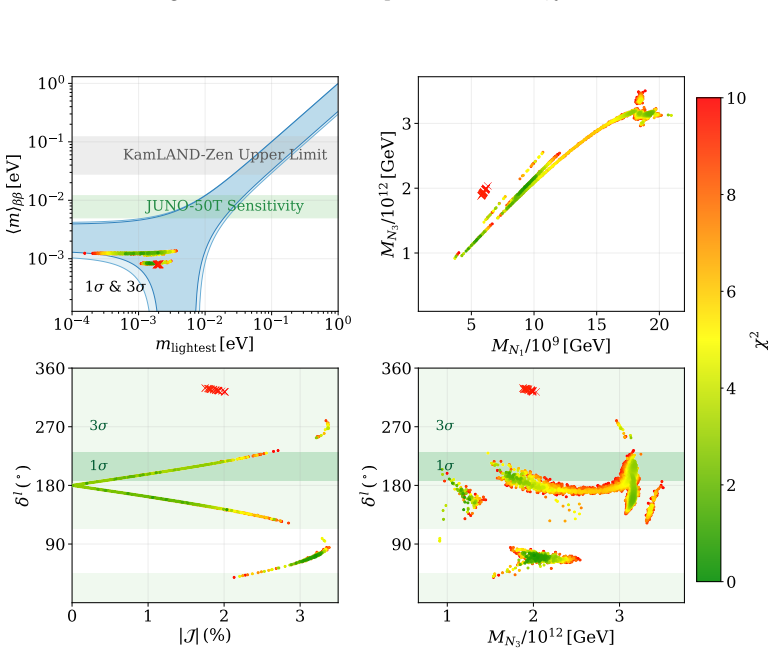
With charged-fermion Yukawas fixed at GUT-scale best-fit values, the universal two-zero texture imposed on all SO(10) Yukawa matrices A, B and C yields a seven-parameter model that fits the nine current flavor observables under normal ordering at chi-squared less than 10, predicts the Dirac CP phase mainly in the intervals (122°,233°) and (39°,85°), and forces m_ββ into two meV bands, while the same texture is generated by the conjugacy-class fusion rules of the Z3 gauging of Z7.
What carries the argument
The universal two-zero texture (UTZT): every fermion mass matrix, including the light-neutrino matrix generated by Type-I+II seesaw, is forced into the form with vanishing (1,1) and (1,3) entries; once this pattern is shared by the three SO(10) Yukawa matrices, quark–lepton unification automatically correlates all low-energy observables and reduces them to seven free parameters.
Load-bearing premise
That the identical two-zero pattern can be imposed simultaneously on the three SO(10) Yukawa matrices at the GUT scale and is preserved by the subsequent intermediate-scale breaking and seesaw.
What would settle it
A future global fit that excludes both predicted Dirac-phase windows (roughly 39°–85° and 122°–233°) at high significance, or a positive 0νββ signal above a few meV, would rule out the viable parameter space found in the scan.
If this is right
- The leptonic Dirac phase is predicted to lie in one of two narrow intervals, one of which already agrees with present global fits.
- m_ββ is forced into two meV-scale bands well below the sensitivity of planned 0νββ experiments.
- Right-handed neutrino masses are constrained to a hierarchical spectrum with the lightest around 10^9–10^10 GeV and the heaviest around 10^12 GeV.
- The same texture can be engineered without extra light Higgs copies, thereby automatically protecting gauge-coupling unification and proton-decay bounds.
Where Pith is reading between the lines
- Because the non-invertible construction introduces no extra light states, any future tension between SO(10) proton-decay limits and flavor data would have to be resolved by the intermediate-scale spectrum rather than by additional scalars.
- If the second, presently disfavored Dirac-phase window is eventually excluded, the model still retains a single viable island whose m_ββ prediction remains testable only by next-to-next-generation 0νββ experiments.
- The same conjugacy-class assignment that produces the UTZT may be reusable for other two-zero patterns once more than one Higgs generation is allowed.
Editorial analysis
A structured set of objections, weighed in public.
Referee Report
Summary. The paper embeds a universal two-zero texture (UTZT) for all fermion mass matrices into a non-supersymmetric SO(10) framework with Type-I+II seesaw, so that the SO(10) Yukawa matrices A, B, C (and hence all low-energy Y_f and M_ν) share vanishing (1,1) and (1,3) entries. With charged-fermion Yukawa eigenvalues fixed at GUT-scale best-fit values, seven continuous parameters plus discrete signs are used to fit nine observables (four CKM parameters, three PMNS angles, two Δm^{2}). An updated χ^{2} scan motivated by JUNO’s normal-ordering indication finds viable points with χ^{2}_tot < 10, predicts the Dirac phase mainly in two bands δ_l ≃ (122°, 233°) and (39°, 85°), and yields narrow meV-scale m_ββ intervals together with hierarchical RHN masses. The same texture is then realized by non-invertible selection rules from the Z_3 gauging of Z_N, with a minimal conjugacy-class assignment for N = 7 that requires no extra low-energy degrees of freedom.
Significance. If the GUT-scale UTZT premise and the numerical fit hold, the work supplies a tightly constrained SO(10) flavor scenario whose residual predictions (δ_l regions, meV m_ββ bands, RHN spectrum) are concrete and in principle falsifiable by oscillation and 0 uββ data. The non-invertible-symmetry construction is a genuine strength: it generates the zeros without additional light Higgs copies, thereby avoiding the Landau-pole and proton-decay issues that accompany conventional discrete-flavor embeddings of the same texture. The combination of an overconstrained seven-parameter fit with an economical NIS origin is of clear interest to the GUT and flavor communities, even though the zeros themselves remain an input rather than a dynamical output of the gauge sector.
major comments (3)
- [Abstract and §3] Abstract and §3 claim that the texture “exhibits an enhanced preference for normal ordering,” yet the numerical analysis explicitly restricts itself to normal ordering only (“we will consider only normal ordering,” §3) and never reports an inverted-ordering scan or a χ^{2} comparison. The preference statement is therefore not established by the present work; it should be removed or replaced by a clear reference to prior IO analyses, or an IO scan should be added so that the claim is quantitative.
- [§3, Eq. (26) and Figs. 1–2] The acceptance cut χ^{2}_tot < 10 for nine observables (seven continuous parameters) is soft and is not accompanied by the minimum χ^{2}, the distribution of pulls, or a statement of how many points lie within, e.g., χ^{2}/dof ≲ 1. Without these diagnostics it is hard to judge whether the viable regions in Figs. 1–2 are genuine good fits or merely points that pass a loose threshold. Report min χ^{2}_q, min χ^{2}_l and the pulls of the nine observables for the best points (or for representative points in each δ_l branch).
- [§2.2 and §3] The central predictivity rests on the assumption that the two-zero pattern is imposed simultaneously on A, B and C at the GUT scale and is inherited by every low-energy Y_f and by M_ν via Eqs. (7)–(11) and the Type-I+II formula (§2.2). The manuscript does not discuss whether renormalization-group evolution from M_GUT to the electroweak scale preserves the zeros to the accuracy needed for the quoted meV m_ββ bands. A short estimate of the size of RG-induced fill-ins (or a statement that the analysis is performed entirely at the GUT scale with low-energy data used only as boundary conditions) is needed to make the residual predictions robust.
minor comments (7)
- [§4 title] Section 4 title reads “non-invertable symmetries”; correct to “non-invertible” (also check the same misspelling elsewhere).
- [§5] Conclusions: “It this work, we presented…” → “In this work…”.
- [Abstract] Abstract: “future neutrinoless double beta decay measurement” → “measurements” (plural); also align the wording with the body, which cites JUNO-50T sensitivity rather than a generic future bound.
- [Figs. 1–2] Figs. 1–2: the color scale for χ^{2} is hard to read in grayscale; add a labeled color bar and, if possible, mark the best-fit point(s) explicitly.
- [Table 1] Table 1 lists parameter ranges but not the discrete signs {η_u, η_d, η_e, ζ_d}; a one-line note that all four signs are scanned would help the reader reproduce the count of free parameters.
- [§2.2] The statement that M_ν “has been proven” to inherit the two-zero texture (§2.2) should cite the explicit reference (presumably [24] or an appendix derivation) so that the inheritance is checkable.
- [References] A few references appear with incomplete or non-standard formatting (e.g., arXiv-only entries without journal data where available); a quick consistency pass would improve polish.
Circularity Check
Standard UTZT ansatz + 7-parameter scan against 9 external observables yields residual (not fitted) predictions for δ_l and m_ββ; NIS construction is independent. No reduction of any claimed prediction to its inputs by construction.
full rationale
The paper states the UTZT as an assumption on the SO(10) Yukawa matrices A, B, C at the GUT scale (Sec. 2.2), shows that the GUT relations (7) and Type-I+II seesaw (9) then force every low-energy Y_f and M_ u to inherit the same two zeros, and reparameterizes the Hermitian matrices in terms of the fixed charged-fermion Yukawa eigenvalues plus seven free parameters {A_u, A_d, φ_1, φ_2, m_L, m_R, c_ u} (plus discrete signs). These seven parameters are scanned against nine external observables (four CKM quantities + three leptonic angles + two u mass-squared differences from NuFIT/JUNO); δ_l and m_ββ are deliberately omitted from χ^{2} and appear only as residual outputs of the successful points (χ^{2}_tot < 10). The narrow m_ββ bands follow from the two texture zeros in M_ u together with the quark-sector constraint on A_e (Eq. 11), which is a genuine model prediction, not a tautology. The non-invertible realization (Sec. 4) is an independent bottom-up construction: conjugacy-class assignments under Z_3 times Z_7 (Table 3) plus the fusion rules (Table 2) forbid precisely the (1,1) and (1,3) entries without introducing extra low-energy fields. Self-citations to the authors’ prior UTZT-SO(10) paper supply the model setup and the earlier numerical preference for normal ordering, but the present scan is an update with new JUNO inputs and the NIS construction is new; neither step reduces a claimed prediction to an input by definition. The analysis is therefore self-contained against external data and free of the six circularity patterns.
Axiom & Free-Parameter Ledger
free parameters (7)
- Au/yt =
viable branches near ~0.18 and ~0.36
- Ad/yb =
viable branches near ~2.3e-3 and ~4.7e-3 (in Ad units of 1e-2 scale in Fig. 1)
- ϕ1, ϕ2
- mL =
most points near 13–15.5 eV (with tails)
- mR =
most points near 0.50–0.67 eV
- cν =
broad range (0.016, 15), preference for large cν
- discrete signs {ηu, ηd, ηe, ζd} =
ηe = −1 for all viable points; both ηd = ±1 appear
axioms (7)
- domain assumption SO(10) breaks along the non-supersymmetric chain SO(10) → G422^C → G3221 → GSM with 54H, 45H, 126H as stated in Eq. (2).
- domain assumption A generalized CP symmetry above the GUT scale forces A, B real symmetric and C purely imaginary antisymmetric, yielding Hermitian low-energy Yukawas when 10H/126H VEVs are real and 120H VEVs imaginary.
- ad hoc to paper The universal two-zero texture is imposed on the SO(10) Yukawa matrices A, B, and C at the GUT scale, so all Yf and Mν inherit the same zeros.
- domain assumption Light neutrino masses are generated by the Type-I+II seesaw formula Mν = mL F − mR Yν F^{−1} Yν^T with F proportional to the 126H coupling.
- domain assumption Charged-fermion Yukawa eigenvalues may be fixed exactly to external GUT-scale best-fit values (Eq. 22) while scanning only the texture parameters.
- domain assumption Non-invertible selection rules from conjugacy-class fusion in ZN ⋊ Z3 allow a Yukawa coupling iff the product of classes contains the identity class C1.
- ad hoc to paper Only normal ordering of light neutrinos is considered, motivated by JUNO’s 2.3σ indication and prior GUT preference.
invented entities (1)
-
Conjugacy-class assignment of 16_F^i and Higgs multiplets under Z7 ⋊ Z3 (Table 3)
no independent evidence
read the original abstract
We apply the universal two-zero texture (UTZT) to all quark and lepton mass matrices in the SO(10) grand unified framework. With charged fermion masses fixed at their best-fit values, this texture contains only seven free parameters to account for nine flavor observables, rendering it highly predictive. Motivated by the recent JUNO indication in favor of the normal ordering of light neutrino masses, we perform an updated analysis of the UTZT in SO(10). The texture remains fully compatible with all current flavor data and exhibits an enhanced preference for normal ordering. The Dirac phase is predicted mainly in two regions, one of which matches very well with current data. A meV-scale $m_{\beta\beta}$ is predicted, beyond the sensitivity bound of future neutrinoless double beta decay measurements. We further explore the origin of the UTZT from non-invertible symmetries, without introducing additional low-energy degrees of freedom. We show that the UTZT can be realized through non-invertible selection rules arising from the $Z_3$ gauging of $Z_N$, with a minimal realization corresponding to $N=7$.
Figures

Forward citations
Cited by 3 Pith papers
-
Revisiting One-Zero and Two-Zero Neutrino Mass Textures in Light of Recent Oscillation and Cosmological Data
With CMB+BAO mass-sum bounds only A1/A2 two-zero textures survive; viable one-zero textures (via flow matching) predict distinct Σmi, ⟨mee⟩, and δCP patterns, realizable by non-invertible selection rules.
-
Neutrino cuboid for normal mass ordering and tribimaximal flavor mixing
A cuboid mass ansatz that sets mass angles equal to mixing angles predicts a nearly degenerate normal spectrum whose deviations from tribimaximal mixing are fixed by the observed mass-squared ratio.
-
Neutrino cuboid for normal mass ordering and tribimaximal flavor mixing
A geometric 'flavor cuboid' ansatz conjectures that neutrino mixing angles equal mass-parametrization angles, predicting a nearly degenerate normal mass ordering and a testable correlation among mixing angles and mass...
Reference graph
Works this paper leans on
-
[1]
H. Fritzsch, Phys. Lett. B70, 436-440 (1977) doi:10.1016/0370-2693(77)90408-7
-
[2]
S. Weinberg, Trans. New York Acad. Sci. 38, 185-201 (1977) doi:10.1111/j.2164- 0947.1977.tb02958.x
doi:10.1111/j.2164- 1977
-
[3]
F. Wilczek and A. Zee, Phys. Lett. B70, 418 (1977) [erratum: Phys. Lett. B72, 504 (1978)] doi:10.1016/0370-2693(77)90403-8
-
[4]
H. Fritzsch, Phys. Lett. B73, 317-322 (1978) doi:10.1016/0370-2693(78)90524-5
-
[5]
H. Fritzsch, Nucl. Phys. B155, 189-207 (1979) doi:10.1016/0550-3213(79)90362-6
-
[6]
D. s. Du and Z. z. Xing, Phys. Rev. D48, 2349-2352 (1993) doi:10.1103/PhysRevD.48.2349
-
[7]
H. Fritzsch and Z. z. Xing, Phys. Lett. B 353, 114-118 (1995) doi:10.1016/0370- 2693(95)00545-V [arXiv:hep-ph/9502297 [hep-ph]]
-
[8]
Z. z. Xing, J. Phys. G23, 1563-1578 (1997) doi:10.1088/0954-3899/23/11/006 [arXiv:hep- ph/9609204 [hep-ph]]
-
[9]
H. Fritzsch and Z. z. Xing, Phys. Lett. B 555, 63-70 (2003) doi:10.1016/S0370- 2693(03)00048-0 [arXiv:hep-ph/0212195 [hep-ph]]
-
[10]
Z. z. Xing and H. Zhang, J. Phys. G30, 129-136 (2004) doi:10.1088/0954-3899/30/2/011 [arXiv:hep-ph/0309112 [hep-ph]]
-
[11]
Z. z. Xing and Z. h. Zhao, Nucl. Phys. B 897, 302-325 (2015) doi:10.1016/j.nuclphysb.2015.05.027 [arXiv:1501.06346 [hep-ph]]
-
[12]
H. Fritzsch, Z. z. Xing and D. Zhang, Nucl. Phys. B 974, 115634 (2022) doi:10.1016/j.nuclphysb.2021.115634 [arXiv:2111.06727 [hep-ph]]
-
[13]
P. H. Frampton, S. L. Glashow and D. Marfatia, Phys. Lett. B 536, 79-82 (2002) doi:10.1016/S0370-2693(02)01817-8 [arXiv:hep-ph/0201008 [hep-ph]]
-
[14]
Z. z. Xing, Phys. Lett. B 530, 159-166 (2002) doi:10.1016/S0370-2693(02)01354-0 [arXiv:hep-ph/0201151 [hep-ph]]
-
[15]
Z. z. Xing, Phys. Lett. B539, 85-90 (2002) doi:10.1016/S0370-2693(02)02062-2 [arXiv:hep- ph/0205032 [hep-ph]]. 12
-
[16]
H. Fritzsch, Z. z. Xing and S. Zhou, JHEP09, 083 (2011) doi:10.1007/JHEP09(2011)083 [arXiv:1108.4534 [hep-ph]]
-
[17]
Z.z.XingandH.Zhang, Phys.Lett.B 569, 30-40(2003)doi:10.1016/j.physletb.2003.07.008 [arXiv:hep-ph/0304234 [hep-ph]]
-
[18]
Y. L. Zhou, Phys. Rev. D 86, 093011 (2012) doi:10.1103/PhysRevD.86.093011 [arXiv:1205.2303 [hep-ph]]
-
[19]
J. Barranco, D. Delepine and L. Lopez-Lozano, Phys. Rev. D 86, 053012 (2012) doi:10.1103/PhysRevD.86.053012 [arXiv:1205.0859 [hep-ph]]
-
[20]
H. Fritzsch and S. Zhou, Phys. Lett. B 718, 1457-1464 (2013) doi:10.1016/j.physletb.2012.12.071 [arXiv:1212.0411 [hep-ph]]
-
[21]
J. Liao, D. Marfatia and K. Whisnant, Phys. Rev. D 87, 073013 (2013) doi:10.1103/PhysRevD.87.073013 [arXiv:1302.2372 [hep-ph]]
-
[22]
M. J. S. Yang, Phys. Lett. B 806, 135483 (2020) doi:10.1016/j.physletb.2020.135483 [arXiv:2002.09152 [hep-ph]]
-
[23]
M. J. S. Yang, PTEP 2022, no.1, 013B12 (2022) doi:10.1093/ptep/ptab162 [arXiv:2104.12063 [hep-ph]]
work page internal anchor Pith review Pith/arXiv arXiv doi:10.1093/ptep/ptab162 2022
-
[24]
G. X. Fang and Y. L. Zhou, Chin. Phys. C49, no.10, 103107 (2025) doi:10.1088/1674- 1137/ade6d7 [arXiv:2410.18743 [hep-ph]]
-
[25]
G. Altarelli and D. Meloni, JHEP 08, 021 (2013) doi:10.1007/JHEP08(2013)021 [arXiv:1305.1001 [hep-ph]]
-
[26]
K. S. Babu, B. Bajc and S. Saad, JHEP 02, 136 (2017) doi:10.1007/JHEP02(2017)136 [arXiv:1612.04329 [hep-ph]]
-
[27]
K. S. Babu, T. Fukuyama, S. Khan and S. Saad, JHEP 06, 045 (2019) doi:10.1007/JHEP06(2019)045 [arXiv:1812.11695 [hep-ph]]
-
[28]
T. Ohlsson and M. Pernow, JHEP 06, 085 (2019) doi:10.1007/JHEP06(2019)085 [arXiv:1903.08241 [hep-ph]]
-
[29]
V. S. Mummidi and K. M. Patel, JHEP 12, 042 (2021) doi:10.1007/JHEP12(2021)042 [arXiv:2109.04050 [hep-ph]]
-
[30]
B. Fu, S. F. King, L. Marsili, S. Pascoli, J. Turner and Y. L. Zhou, JHEP11, 072 (2022) doi:10.1007/JHEP11(2022)072 [arXiv:2209.00021 [hep-ph]]
-
[31]
B. Fu, S. F. King, L. Marsili, S. Pascoli, J. Turner and Y. L. Zhou, Phys. Rev. D109, no.5, 5 (2024) doi:10.1103/PhysRevD.109.055025 [arXiv:2308.05799 [hep-ph]]
-
[32]
K. S. Babu, C. S. Fong and S. Saad, JHEP11, 151 (2025) doi:10.1007/JHEP11(2025)151 [arXiv:2508.14969 [hep-ph]]
-
[33]
A. Dueck and W. Rodejohann, JHEP 09, 024 (2013) doi:10.1007/JHEP09(2013)024 [arXiv:1306.4468 [hep-ph]]
-
[34]
Saad, JHEP04, 058 (2023) doi:10.1007/JHEP04(2023)058 [arXiv:2212.05291 [hep-ph]]
S. Saad, JHEP04, 058 (2023) doi:10.1007/JHEP04(2023)058 [arXiv:2212.05291 [hep-ph]]
-
[35]
K. S. Babu, P. Di Bari, C. S. Fong and S. Saad, JHEP 10, 190 (2024) doi:10.1007/JHEP10(2024)190 [arXiv:2409.03840 [hep-ph]]. 13
- [36]
-
[37]
Z. Q. Chen, G. X. Fang and Y. L. Zhou, Phys. Rev. D 113, no.11, 115024 (2026) doi:10.1103/lwmz-2y6c [arXiv:2511.16196 [hep-ph]]
-
[38]
Y. F. Wang,JUNO Experiment, Talk presented in Neutrino 2026, Ivrine, June 2026
2026
-
[39]
W. Grimus, A. S. Joshipura, L. Lavoura and M. Tanimoto, Eur. Phys. J. C36, 227-232 (2004) doi:10.1140/epjc/s2004-01896-y [arXiv:hep-ph/0405016 [hep-ph]]
-
[40]
F. Gonzalez Canales, A. Mondragon and M. Mondragon, Fortsch. Phys.61, 546-570 (2013) doi:10.1002/prop.201200121 [arXiv:1205.4755 [hep-ph]]
-
[41]
P. M. Ferreira, W. Grimus, D. Jurčiukonis and L. Lavoura, Nucl. Phys. B906, 289-320 (2016) doi:10.1016/j.nuclphysb.2016.03.011 [arXiv:1510.02641 [hep-ph]]
-
[42]
I. P. Ivanov and L. Lavoura, J. Phys. G 43, no.10, 105005 (2016) doi:10.1088/0954- 3899/43/10/105005 [arXiv:1511.02720 [hep-ph]]
-
[43]
T. Ohlsson and M. Pernow, JHEP 09, 111 (2021) doi:10.1007/JHEP09(2021)111 [arXiv:2107.08771 [hep-ph]]
work page internal anchor Pith review Pith/arXiv arXiv doi:10.1007/jhep09(2021)111 2021
-
[44]
Flavor Symmetries in an SU(5) Model of Grand Unification
M. Lindestam, T. Ohlsson and M. Pernow, JHEP 01, 009 (2022) doi:10.1007/JHEP01(2022)009 [arXiv:2110.09533 [hep-ph]]
work page internal anchor Pith review Pith/arXiv arXiv doi:10.1007/jhep01(2022)009 2022
-
[45]
D. Zhang, Nucl. Phys. B 952, 114935 (2020) doi:10.1016/j.nuclphysb.2020.114935 [arXiv:1910.07869 [hep-ph]]
-
[46]
J. N. Lu, X. G. Liu and G. J. Ding, Phys. Rev. D 101, no.11, 115020 (2020) doi:10.1103/PhysRevD.101.115020 [arXiv:1912.07573 [hep-ph]]
work page internal anchor Pith review Pith/arXiv arXiv doi:10.1103/physrevd.101.115020 2020
-
[47]
Y. Choi, H. T. Lam and S. H. Shao, Phys. Rev. Lett. 129, no.16, 161601 (2022) doi:10.1103/PhysRevLett.129.161601 [arXiv:2205.05086 [hep-th]]
-
[48]
C. Cordova and K. Ohmori, Phys. Rev. X 13, no.1, 011034 (2023) doi:10.1103/PhysRevX.13.011034 [arXiv:2205.06243 [hep-th]]
-
[49]
C. Cordova, S. Hong, S. Koren and K. Ohmori, Phys. Rev. X14, no.3, 031033 (2024) doi:10.1103/PhysRevX.14.031033 [arXiv:2211.07639 [hep-ph]]
-
[50]
C. Cordova, S. Hong and S. Koren, Phys. Rev. X 15, no.3, 031011 (2025) doi:10.1103/PhysRevX.15.031011 [arXiv:2402.12453 [hep-ph]]
-
[51]
T. Kobayashi, H. Otsuka and M. Tanimoto, JHEP 12, 117 (2024) doi:10.1007/JHEP12(2024)117 [arXiv:2409.05270 [hep-ph]]
-
[52]
G. C. Branco, L. Lavoura and F. Mota, Phys. Rev. D 39, 3443 (1989) doi:10.1103/PhysRevD.39.3443
-
[53]
Z. Jiang, B. Y. Qu and G. J. Ding, Phys. Rev. D 112, no.11, 115029 (2025) doi:10.1103/d29s-cw34 [arXiv:2510.07236 [hep-ph]]
-
[54]
T. Kobayashi, H. Otsuka, M. Tanimoto and H. Uchida, JHEP 08, 189 (2025) doi:10.1007/JHEP08(2025)189 [arXiv:2505.07262 [hep-ph]]
-
[55]
T. Kobayashi, H. Otsuka and T. T. Yanagida, Phys. Rev. D113, no.5, 055016 (2026) doi:10.1103/vbd5-5cp3 [arXiv:2508.12287 [hep-ph]]
-
[56]
B. Y. Qu, Z. Jiang and G. J. Ding, [arXiv:2602.24214 [hep-ph]]. 14
-
[57]
S. Bertolini, L. Di Luzio and M. Malinsky, Phys. Rev. D 80, 015013 (2009) doi:10.1103/PhysRevD.80.015013 [arXiv:0903.4049 [hep-ph]]
-
[58]
S. F. King, S. Pascoli, J. Turner and Y. L. Zhou, JHEP 10, 225 (2021) doi:10.1007/JHEP10(2021)225 [arXiv:2106.15634 [hep-ph]]
-
[59]
B. Dutta, Y. Mimura and R. N. Mohapatra, Phys. Rev. Lett. 94, 091804 (2005) doi:10.1103/PhysRevLett.94.091804 [arXiv:hep-ph/0412105 [hep-ph]]
-
[60]
B. Dutta, Y. Mimura and R. N. Mohapatra, Phys. Rev. D 72, 075009 (2005) doi:10.1103/PhysRevD.72.075009 [arXiv:hep-ph/0507319 [hep-ph]]
-
[61]
G. Altarelli and G. Blankenburg, JHEP 03, 133 (2011) doi:10.1007/JHEP03(2011)133 [arXiv:1012.2697 [hep-ph]]
-
[62]
B. Dutta, Y. Mimura and R. N. Mohapatra, Phys. Rev. D 80, 095021 (2009) doi:10.1103/PhysRevD.80.095021 [arXiv:0910.1043 [hep-ph]]
-
[63]
I. Esteban, M. C. Gonzalez-Garcia, M. Maltoni, I. Martinez-Soler, J. P. Pinheiro and T. Schwetz, JHEP 12, 216 (2024) doi:10.1007/JHEP12(2024)216 [arXiv:2410.05380 [hep- ph]]
- [64]
discussion (0)
Sign in with ORCID, Apple, or X to comment. Anyone can read and Pith papers without signing in.