REVIEW 1 cited by
A six-dimensional gravitational index saddle for the D1-D5-P black string is built and decoupled to a BTZ×S^3 saddle for the D1-D5 CFT index.
Reviewed by Pith at T0; open to challenge. T0 means a machine referee read the full paper against a public rubric. the ladder, T0–T4 →
2026-08-04 01:44 UTC pith:CPJZFEZO
load-bearing objection The 6D D1-D5-P index saddle and its BTZ×S^3 decoupling limit are real, but the index-counting claim rests on an untracked EM duality that the authors themselves flag.
Index saddle for the D1-D5-P black string and its decoupling limit
The pith
A machine-rendered reading of the paper's core claim, the machinery that carries it, and where it could break.
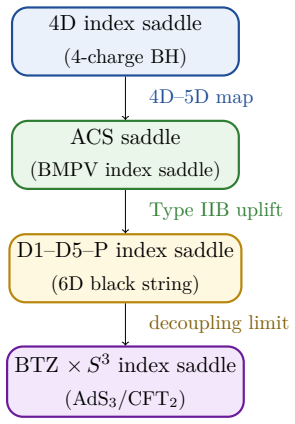
The authors start in four dimensions, take a 'BPS limit' of a known non-extremal rotating four-charge black hole in the STU supergravity model, and rewrite the result in the two-center Bates-Denef form. They verify that the two centers carry charges fixed by the 'new attractor mechanism,' which makes the on-shell action temperature-independent. They then uplift this solution to five dimensions, identifying it with the known ACS saddle for the BMPV black hole, and from there to six-dimensional Type IIB supergravity, obtaining the D1-D5-P index saddle. Finally, they take a systematic large-circle decoupling limit in which the geometry develops a long throat and becomes a product of a rotating BTZ black hole and a three-sphere — the geometry dual to the D1-D5 CFT.
The authors record two gaps: the four-to-five dimensional charge matching is shown only when one angular momentum vanishes, and the temperature-independence of the six-dimensional action relies on an untracked electromagnetic duality. Independent work by Larsen and Sharma has reached closely related AdS_3×S^3 saddles by other routes.
Core claim
The central claim: the six-dimensional solution (3.69)–(3.71) "is the gravitational index saddle for the D1-D5 black string," and its large-radius decoupling limit is a rotating BTZ×S^3 saddle (4.27)/(4.32) that "computes the index of the D1-D5 CFT." If the paper is correct, there exists a smooth, complex, supersymmetric, finite-temperature Euclidean black-string saddle in Type IIB whose near-horizon limit is the BTZ×S^3 geometry dual to the D1-D5 CFT, with the new attractor mechanism fixing the pole charges and hence the action's temperature independence.
Load-bearing premise
The claim that this saddle "computes the index" requires the six-dimensional on-shell action to be β-independent (or to reproduce the 5D index). That step is not derived: Section 3.5 states that relating the 6D action to the 5D ACS action "requires an electromagnetic duality on one of the field strengths, whose effect on the on-shell action we have not tracked"; the Conclusions repeat that "we have not verified this explicitly." If that duality changes the action, the BTZ×S^3 saddle's weight could be β-dependent and the index-counting claim would fail, even though the geometry is correct. A second fragile premise, acknowledged by the authors, is that the 4D→5D charge matching is established only at J_3L=0 (§3.4).
Editorial analysis
A structured set of objections, weighed in public.
Axiom & Free-Parameter Ledger
axioms (8)
- domain assumption STU prepotential F = -X1X2X3/X0 defines N=2 supergravity with three vector multiplets
- domain assumption The Chow–Compère non-extremal 4-charge rotating solution is a bona fide solution of the STU model
- ad hoc to paper The BPS limit (m→0, γ_I→∞ with charges fixed) yields a smooth supersymmetric finite-temperature saddle
- domain assumption The new attractor mechanism of [5] governs the two-centered split of charges
- ad hoc to paper The ACS saddle [7] for BMPV is the 5D uplift of the 4D saddle at J_3L=0
- domain assumption Type IIB uplift formulas (3.14)–(3.15) map 5D U(1)^3 solutions to D1-D5-P systems and preserve supersymmetry and regularity
- ad hoc to paper The large-R decoupling scalings (Q3→Q3/Λ^2, J→J/Λ, ρ^2→ρ^2/Λ^2) produce a finite smooth limiting geometry with AdS_3×S^3 throat
- ad hoc to paper Electromagnetic duality on one field strength acts trivially on the 6D on-shell action
Cite this review
Pith. "Pith review of Index saddle for the D1-D5-P black string and its decoupling limit." pith.science (2026). https://pith.science/paper/CPJZFEZO
@misc{pith2026260627093,
  author       = {Pith},
  title        = {Pith review of: Index saddle for the D1-D5-P black string and its decoupling limit},
  year         = {2026},
  howpublished = {\url{https://pith.science/paper/CPJZFEZO}},
  note         = {Machine review of arXiv:2606.27093}
}
read the original abstract
Boruch, Emparan, Iliesiu, and Murthy recently discussed index saddles for 5d black strings, showing that the black string saddle admits a decoupling limit to a complex, finite-temperature BTZ \times S^2 saddle that computes the index of the dual CFT. In this paper, we pursue an analogous construction for the D1-D5-P black string. We construct a four-charge index saddle in the four-dimensional STU model as the BPS limit of the non-extremal four-charge black hole, and show that it exhibits the new form of attraction. We then uplift it successively to five and six dimensions, via the 4D-5D connection and a chain of string dualities, to obtain the gravitational index saddle for the D1-D5-P black string. We take a systematic decoupling limit of this index saddle and obtain the BTZ \times S^3 saddle that computes the index of the D1-D5 CFT.
Figures
Forward citations
Cited by 1 Pith paper
-
Gravitational index of the D1-D5-P black string
Complex, supersymmetric, non-extremal Euclidean saddles for the D1-D5-P black string realize the gravitational index and match the Cardy formula of the dual elliptic genus.
Reference graph
Works this paper leans on
-
[1]
Microscopic origin of the Bekenstein-Hawking entropy,
A. Strominger and C. Vafa, “Microscopic origin of the Bekenstein-Hawking entropy,” Phys. Lett. B379, 99-104 (1996) doi:10.1016/0370-2693(96)00345-0 [arXiv:hep-th/9601029 [hep- th]]
Pith/arXiv arXiv 1996
-
[2]
Black Hole Entropy Function, Attractors and Precision Counting of Microstates,
A. Sen, “Black Hole Entropy Function, Attractors and Precision Counting of Microstates,” Gen. Rel. Grav.40, 2249-2431 (2008) doi:10.1007/s10714-008-0626-4 [arXiv:0708.1270 [hep- th]]
Pith/arXiv arXiv 2008
-
[3]
Microscopic origin of the Bekenstein-Hawking entropy of supersymmetric AdS 5 black holes,
A. Cabo-Bizet, D. Cassani, D. Martelli and S. Murthy, “Microscopic origin of the Bekenstein-Hawking entropy of supersymmetric AdS 5 black holes,” JHEP10(2019), 062 doi:10.1007/JHEP10(2019)062 [arXiv:1810.11442 [hep-th]]
Pith/arXiv arXiv 2019
-
[4]
Supersymmetric indices factorize,
L. V. Iliesiu, M. Kologlu and G. J. Turiaci, “Supersymmetric indices factorize,” JHEP05 (2023), 032 doi:10.1007/JHEP05(2023)032 [arXiv:2107.09062 [hep-th]]
Pith/arXiv arXiv 2023
-
[5]
New forms of attraction: Attractor saddles for the black hole index,
J. Boruch, L. V. Iliesiu, S. Murthy and G. J. Turiaci, “New forms of attraction: Attractor saddles for the black hole index,” [arXiv:2310.07763 [hep-th]]
-
[6]
The gravitational index of 5d black holes and black strings,
J. Boruch, R. Emparan, L. V. Iliesiu and S. Murthy, “The gravitational index of 5d black holes and black strings,” JHEP06, 145 (2025) doi:10.1007/JHEP06(2025)145 [arXiv:2501.17909 [hep-th]]. 40
Pith/arXiv arXiv 2025
-
[7]
Revisiting logarithmic correction to five di- mensional BPS black hole entropy,
A. H. Anupam, C. Chowdhury and A. Sen, “Revisiting logarithmic correction to five di- mensional BPS black hole entropy,” JHEP05, 070 (2024) doi:10.1007/JHEP05(2024)070 [arXiv:2308.00038 [hep-th]]
arXiv 2024
-
[8]
Killing spinors for finite temperature Euclidean solutions at the BPS bound,
S. Hegde and A. Virmani, “Killing spinors for finite temperature Euclidean solutions at the BPS bound,” JHEP02, 203 (2024) doi:10.1007/JHEP02(2024)203 [arXiv:2311.09427 [hep-th]]
Pith/arXiv arXiv 2024
-
[9]
Attractor saddle for 5D black hole index,
S. Adhikari, P. Dharanipragada, K. Goswami and A. Virmani, “Attractor saddle for 5D black hole index,” JHEP03, 180 (2025) doi:10.1007/JHEP03(2025)180 [arXiv:2411.12413 [hep-th]]
Pith/arXiv arXiv 2025
-
[10]
Localization of the 5D supergravity action and Euclidean saddles for the black hole index,
D. Cassani, A. Ruip´ erez and E. Turetta, “Localization of the 5D supergravity action and Euclidean saddles for the black hole index,” JHEP12, 086 (2024) doi:10.1007/JHEP12(2024)086 [arXiv:2409.01332 [hep-th]]
Pith/arXiv arXiv 2024
-
[11]
Supersymmetric index for half BPS black holes in N=2 supergravity with higher curvature corrections,
S. Hegde, A. Sen, P. Shanmugapriya and A. Virmani, “Supersymmetric index for half BPS black holes in N=2 supergravity with higher curvature corrections,” JHEP02, 131 (2025) doi:10.1007/JHEP02(2025)131 [arXiv:2411.08260 [hep-th]]
Pith/arXiv arXiv 2025
-
[12]
BPS solutions of 4d Euclidean N= 2 supergravity with higher derivative interactions,
S. Adhikari, A. Bhattacharjee and A. Virmani, “BPS solutions of 4d Euclidean N= 2 supergravity with higher derivative interactions,” JHEP03, 136 (2026) doi:10.1007/JHEP03(2026)136 [arXiv:2511.18771 [hep-th]]
arXiv 2026
-
[13]
Bubbling saddles of the gravitational index,
D. Cassani, A. Ruip´ erez and E. Turetta, “Bubbling saddles of the gravitational index,” SciPost Phys.19, no.5, 134 (2025) doi:10.21468/SciPostPhys.19.5.134 [arXiv:2507.12650 [hep-th]]
arXiv 2025
-
[14]
The gravita- tional index of a small black ring,
S. Bandyopadhyay, G. S. Punia, Y. K. Srivastava and A. Virmani, “The gravita- tional index of a small black ring,” JHEP07, 200 (2025) doi:10.1007/JHEP07(2025)200 [arXiv:2504.09982 [hep-th]]
Pith/arXiv arXiv 2025
-
[15]
Novel black saddles for 5d gravitational indices and the index enigma,
J. Boruch, R. Emparan, L. V. Iliesiu and S. Murthy, “Novel black saddles for 5d gravitational indices and the index enigma,” [arXiv:2510.23699 [hep-th]]
-
[16]
Multicentered black hole saddles for supersymmetric indices,
J. Boruch, L. V. Iliesiu, S. Murthy and G. J. Turiaci, “Multicentered black hole saddles for supersymmetric indices,” [arXiv:2507.07166 [hep-th]]
-
[17]
Index saddle for supersymmetric F1-P black ring,
P. Dharanipragada, G. S. Punia and A. Virmani, “Index saddle for supersymmetric F1-P black ring,” JHEP05, 190 (2026) doi:10.1007/JHEP05(2026)190 [arXiv:2601.04624 [hep- th]]. 41
Pith/arXiv arXiv 2026
-
[18]
Quantum black holes: supersymmetry and exact results,
D. Cassani and S. Murthy, “Quantum black holes: supersymmetry and exact results,” [arXiv:2502.15360 [hep-th]]
-
[19]
New connections between 4-D and 5-D black holes,
D. Gaiotto, A. Strominger and X. Yin, “New connections between 4-D and 5-D black holes,” JHEP02, 024 (2006) doi:10.1088/1126-6708/2006/02/024 [arXiv:hep-th/0503217 [hep-th]]
Pith/arXiv arXiv 2006
-
[20]
Black hole entropy in M theory,
J. M. Maldacena, A. Strominger and E. Witten, “Black hole entropy in M theory,” JHEP 12, 002 (1997) doi:10.1088/1126-6708/1997/12/002 [arXiv:hep-th/9711053 [hep-th]]
Pith/arXiv arXiv 1997
-
[21]
Complex BPS Black Holes in AdS 3×S 3,
F. Larsen and K. Sharma, “Complex BPS Black Holes in AdS 3×S 3,” [arXiv:2605.28737 [hep-th]]
-
[22]
Statistical description of rotating Kaluza-Klein black holes
R. Emparan and A. Maccarrone, “Statistical description of rotating Kaluza-Klein black holes”, Phys. Rev D75(2007) 084006 doi:10.1103/PhysRevD.75.084006 [arXiv:hep- th/0701150 [hep-th]]
arXiv 2007
-
[23]
Seed for general rotating non-extremal black holes ofN= 8 supergravity,
D. D. K. Chow and G. Comp` ere, “Seed for general rotating non-extremal black holes ofN= 8 supergravity,” Class. Quant. Grav.31(2014), 022001 doi:10.1088/0264-9381/31/2/022001 [arXiv:1310.1925 [hep-th]]
Pith/arXiv arXiv 2014
-
[24]
Black holes in N=8 supergravity from SO(4,4) hid- den symmetries,
D. D. K. Chow and G. Comp` ere, “Black holes in N=8 supergravity from SO(4,4) hid- den symmetries,” Phys. Rev. D90(2014) no.2, 025029 doi:10.1103/PhysRevD.90.025029 [arXiv:1404.2602 [hep-th]]
Pith/arXiv arXiv 2014
-
[25]
Entropy of nonextreme charged rotating black holes in string theory,
M. Cvetic and D. Youm, “Entropy of nonextreme charged rotating black holes in string theory,” Phys. Rev. D54, 2612-2620 (1996) doi:10.1103/PhysRevD.54.2612 [arXiv:hep- th/9603147 [hep-th]]
arXiv 1996
-
[26]
Charged rotating black holes in four- dimensional gauged and ungauged supergravities,
Z. W. Chong, M. Cvetic, H. Lu and C. N. Pope, “Charged rotating black holes in four- dimensional gauged and ungauged supergravities,” Nucl. Phys. B717, 246-271 (2005) doi:10.1016/j.nuclphysb.2005.03.034 [arXiv:hep-th/0411045 [hep-th]]
Pith/arXiv arXiv 2005
-
[27]
Stationary solutions of N=2 supergravity,
K. Behrndt, D. Lust and W. A. Sabra, “Stationary solutions of N=2 supergravity,” Nucl. Phys. B510(1998), 264-288 doi:10.1016/S0550-3213(97)00633-0 [arXiv:hep-th/9705169 [hep-th]]
Pith/arXiv arXiv 1998
-
[28]
Exact solutions for supersymmetric stationary black hole compos- ites,
B. Bates and F. Denef, “Exact solutions for supersymmetric stationary black hole compos- ites,” JHEP11, 127 (2011) doi:10.1007/JHEP11(2011)127 [arXiv:hep-th/0304094 [hep-th]]
Pith/arXiv arXiv 2011
-
[29]
Gravitational index of the heterotic string,
Y. Chen, S. Murthy and G. J. Turiaci, “Gravitational index of the heterotic string,” JHEP 09(2024), 041 doi:10.1007/JHEP09(2024)041 [arXiv:2402.03297 [hep-th]]. 42
Pith/arXiv arXiv 2024
-
[30]
Black hole entropy, special geometry and strings,
T. Mohaupt, “Black hole entropy, special geometry and strings,” Fortsch. Phys.49, 3- 161 (2001) doi:10.1002/1521-3978(200102)49:1/3<3::AID-PROP3>3.0.CO;2-# [arXiv:hep- th/0007195 [hep-th]]
arXiv 2001
-
[31]
Stationary BPS solutions in N=2 supergravity with R**2 interactions,
G. Lopes Cardoso, B. de Wit, J. Kappeli and T. Mohaupt, “Stationary BPS solutions in N=2 supergravity with R**2 interactions,” JHEP12(2000), 019 doi:10.1088/1126- 6708/2000/12/019 [arXiv:hep-th/0009234 [hep-th]]
Pith/arXiv arXiv 2000
-
[32]
Bubbling supertubes and foaming black holes,
I. Bena and N. P. Warner, “Bubbling supertubes and foaming black holes,” Phys. Rev. D 74, 066001 (2006) doi:10.1103/PhysRevD.74.066001 [arXiv:hep-th/0505166 [hep-th]]
Pith/arXiv arXiv 2006
-
[33]
Black holes, black rings and their microstates,
I. Bena and N. P. Warner, “Black holes, black rings and their microstates,” Lect. Notes Phys.755, 1-92 (2008) doi:10.1007/978-3-540-79523-0 1 [arXiv:hep-th/0701216 [hep-th]]
Pith/arXiv arXiv 2008
-
[34]
R. Emparan and H. S. Reall, “Black Rings,” Class. Quant. Grav.23, R169 (2006) doi:10.1088/0264-9381/23/20/R01 [arXiv:hep-th/0608012 [hep-th]]
Pith/arXiv arXiv 2006
-
[35]
One ring to rule them all ... and in the darkness bind them?,
I. Bena and N. P. Warner, “One ring to rule them all ... and in the darkness bind them?,” Adv. Theor. Math. Phys.9, no.5, 667-701 (2005) doi:10.4310/ATMP.2005.v9.n5.a1 [arXiv:hep-th/0408106 [hep-th]]
Pith/arXiv arXiv 2005
-
[36]
Black rings, supertubes, and a stringy resolution of black hole nonuniqueness,
H. Elvang and R. Emparan, “Black rings, supertubes, and a stringy resolution of black hole nonuniqueness,” JHEP11, 035 (2003) doi:10.1088/1126-6708/2003/11/035 [arXiv:hep- th/0310008 [hep-th]]
arXiv 2003
-
[37]
The Rotating dyonic black holes of Kaluza-Klein theory,
D. Rasheed, “The Rotating dyonic black holes of Kaluza-Klein theory,” Nucl. Phys. B454, 379-401 (1995) doi:10.1016/0550-3213(95)00396-A [arXiv:hep-th/9505038 [hep-th]]
Pith/arXiv arXiv 1995
-
[38]
Rotating Kaluza-Klein black holes,
F. Larsen, “Rotating Kaluza-Klein black holes,” Nucl. Phys. B575, 211-230 (2000) doi:10.1016/S0550-3213(00)00064-X [arXiv:hep-th/9909102 [hep-th]]
Pith/arXiv arXiv 2000
-
[39]
A General Black String and its Microscopics,
G. Compere, S. de Buyl, S. Stotyn and A. Virmani, “A General Black String and its Microscopics,” JHEP11, 133 (2010) doi:10.1007/JHEP11(2010)133 [arXiv:1006.5464 [hep- th]]
Pith/arXiv arXiv 2010
-
[40]
Holographic description of non-supersymmetric orbifolded D1-D5-P solutions,
B. Chakrabarty, D. Turton and A. Virmani, “Holographic description of non-supersymmetric orbifolded D1-D5-P solutions,” JHEP11, 063 (2015) doi:10.1007/JHEP11(2015)063 [arXiv:1508.01231 [hep-th]]
Pith/arXiv arXiv 2015
-
[41]
J. M. Maldacena, “Black holes in string theory,” [arXiv:hep-th/9607235 [hep-th]]. 43
-
[42]
Near horizon geometry of rotating black holes in five- dimensions,
M. Cvetic and F. Larsen, “Near horizon geometry of rotating black holes in five- dimensions,” Nucl. Phys. B531, 239-255 (1998) doi:10.1016/S0550-3213(98)00604-X [arXiv:hep-th/9805097 [hep-th]]
Pith/arXiv arXiv 1998
-
[43]
Microscopic entropy of AdS 3 black holes revisited,
F. Larsen and S. Lee, “Microscopic entropy of AdS 3 black holes revisited,” JHEP07, 038 (2021) doi:10.1007/JHEP07(2021)038 [arXiv:2101.08497 [hep-th]]
Pith/arXiv arXiv 2021
-
[44]
Instability of black holes inAdS 3×S 3,
F. Larsen and S. Lee, “Instability of black holes inAdS 3×S 3,” Nucl. Phys. B1024, 117370 (2026) doi:10.1016/j.nuclphysb.2026.117370 [arXiv:2507.04131 [hep-th]]
arXiv 2026
-
[45]
Wick Rotation and the Positivity of Energy in Quantum Field Theory,
M. Kontsevich and G. Segal, “Wick Rotation and the Positivity of Energy in Quantum Field Theory,” Quart. J. Math. Oxford Ser.72, no.1-2, 673-699 (2021) doi:10.1093/qmath/haab027 [arXiv:2105.10161 [hep-th]]
Pith/arXiv arXiv 2021
-
[46]
A Note On Complex Spacetime Metrics,
E. Witten, “A Note On Complex Spacetime Metrics,” [arXiv:2111.06514 [hep-th]]
-
[47]
How to tame your (black hole) saddles: Lessons from the Lorentzian Gravitational Path Integral,
M. Kolanowski and D. Marolf, “How to tame your (black hole) saddles: Lessons from the Lorentzian Gravitational Path Integral,” [arXiv:2603.24681 [hep-th]]
-
[48]
A brief note on complex AdS-Schwarzschild black holes,
R. Mahajan and K. Singhi, “A brief note on complex AdS-Schwarzschild black holes,” JHEP 11, 164 (2025) doi:10.1007/JHEP11(2025)164 [arXiv:2509.08883 [hep-th]]
Pith/arXiv arXiv 2025
-
[49]
K. Singhi, “Complex Kerr-AdS black holes,” JHEP02, 138 (2026) doi:10.1007/JHEP02(2026)138 [arXiv:2510.01313 [hep-th]]
arXiv 2026
-
[50]
Complex saddles of charged-AdS gravitational partition function,
M. Ailiga, S. Mallik and G. Narain, “Complex saddles of charged-AdS gravitational partition function,” JHEP02, 054 (2026) doi:10.1007/JHEP02(2026)054 [arXiv:2510.25396 [hep-th]]
arXiv 2026
-
[51]
Non-supersymmetric smooth geometries and D1-D5-P bound states,
V. Jejjala, O. Madden, S. F. Ross and G. Titchener, “Non-supersymmetric smooth geometries and D1-D5-P bound states,” Phys. Rev. D71, 124030 (2005) doi:10.1103/PhysRevD.71.124030 [arXiv:hep-th/0504181 [hep-th]]
Pith/arXiv arXiv 2005
-
[52]
General rotating five-dimensional black holes of toroidally compactified heterotic string,
M. Cvetic and D. Youm, “General rotating five-dimensional black holes of toroidally compactified heterotic string,” Nucl. Phys. B476, 118-132 (1996) doi:10.1016/0550- 3213(96)00355-0 [arXiv:hep-th/9603100 [hep-th]]. 44
Pith/arXiv arXiv 1996
This paper was first reviewed by deepseek-v4-flash on August 4, 2026.
discussion (0)
Sign in with ORCID, Apple, or X to comment. Anyone can read and Pith papers without signing in.