REVIEW 3 major objections 5 minor 2 cited by
Allowing dark energy to cluster changes the inferred sum of neutrino masses and revives the tension between cosmological bounds and oscillation experiments.
Reviewed by Pith at T0; open to challenge. T0 means a machine referee read the full paper against a public rubric. the ladder, T0–T4 →
T0 review · deepseek-v4-flash
2026-08-02 09:49 UTC pith:THM6C54L
load-bearing objection Plausible, honest model-dependence study; the qualitative degeneracy holds up, but the headline shift is built on scale-averaged RSD data and fixed sound-speed extremes, so the quantitative claim is illustrative rather than established. the 3 major comments →
Dark energy perturbations and the robustness of cosmological neutrino-mass constraints
The pith
A machine-rendered reading of the paper's core claim, the machinery that carries it, and where it could break.
Core claim
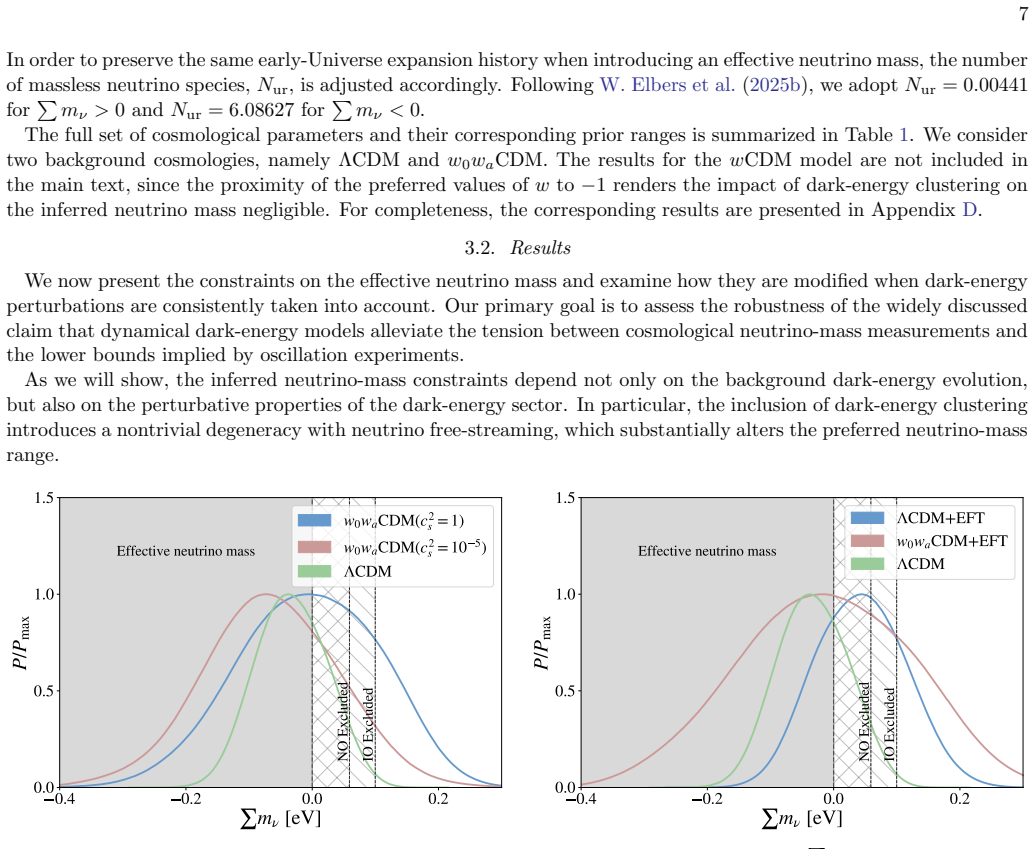
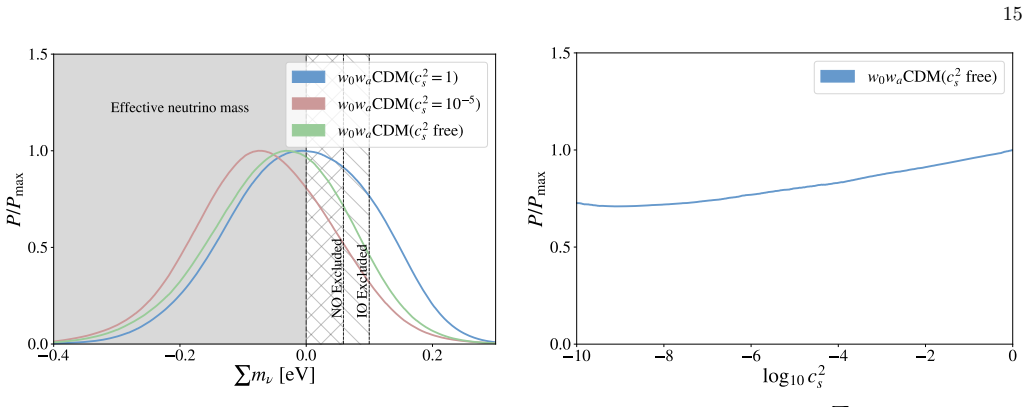
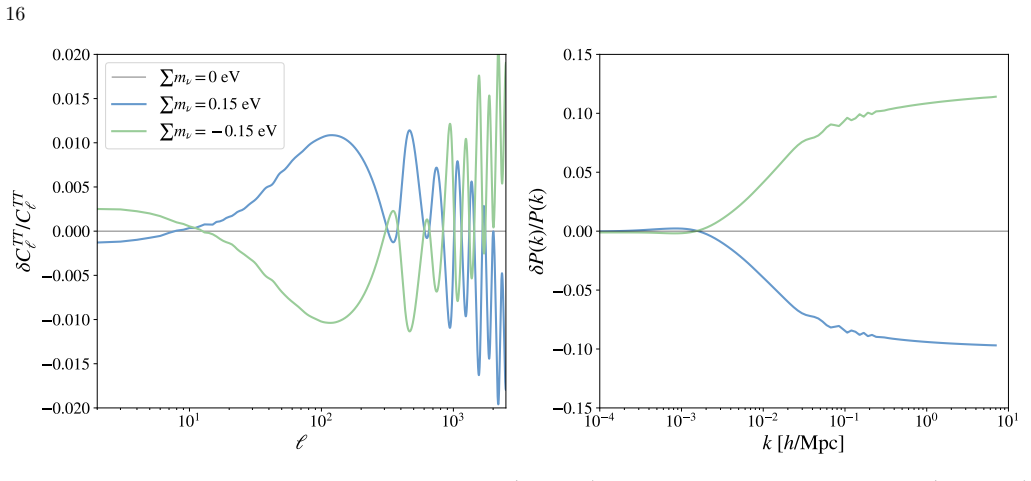
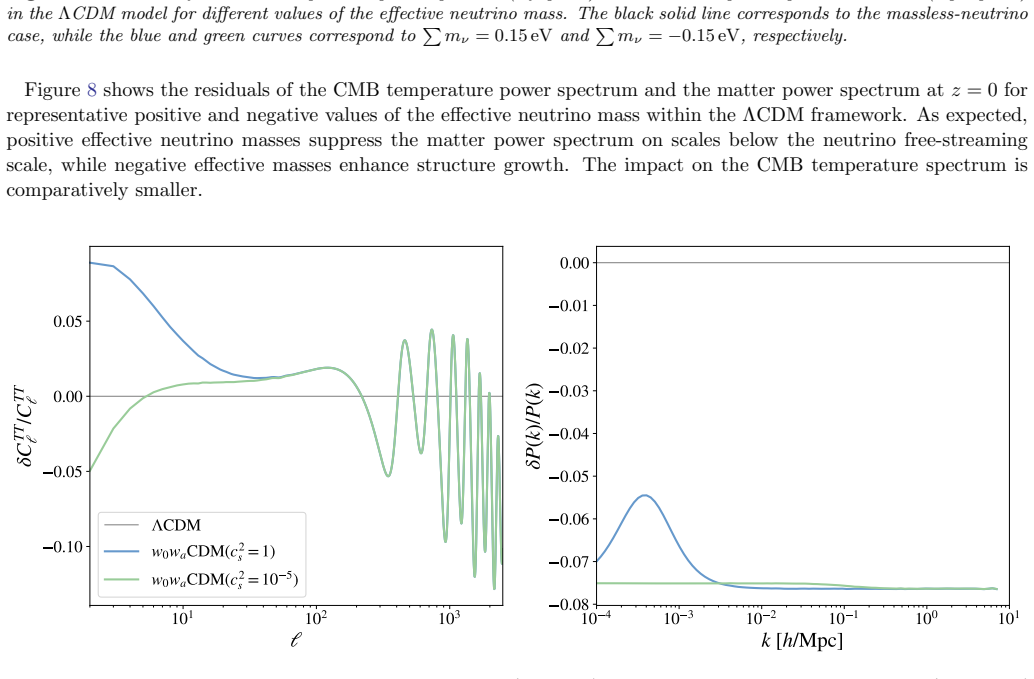
The paper's central claim is that the alleviation of the neutrino-mass tension in dynamical dark-energy models is not generic. In the w0waCDM parameterization, treating dark energy as smooth (sound speed squared cs2=1) gives a 95% upper limit on the sum of neutrino masses of 0.1696 eV, consistent with oscillation lower bounds; allowing dark energy to cluster (cs2=1e-5) tightens the limit to 0.1125 eV and shifts the posterior toward negative effective masses, partially restoring the preference already present in ΛCDM (0.0634 eV). The authors attribute this to a perturbation-level degeneracy between neutrino free-streaming and dark-energy clustering in growth observables, and show that an effe
What carries the argument
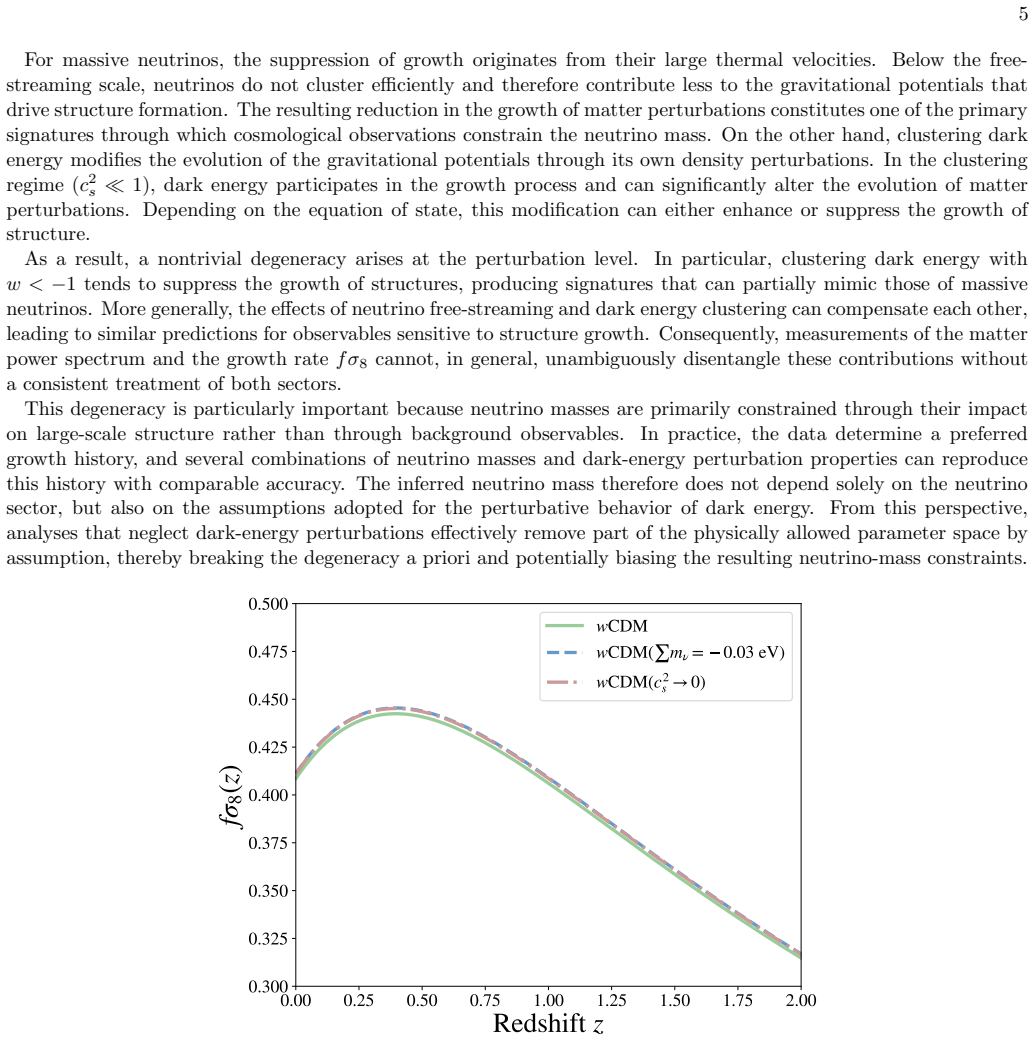
The central mechanism is the perturbation-level degeneracy between neutrino free-streaming and dark-energy clustering. Massive neutrinos suppress matter-power-spectrum growth below their free-streaming scale; clustering dark energy (sound speed squared cs2 << 1) modifies the evolution of gravitational potentials and, for equation-of-state parameter w < -1, suppresses structure growth. In the clustering limit the dark-energy density contrast tracks the matter contrast through δ_de = (1+w)/(1-3w) δ_m, so the two effects can compensate each other in observables such as the growth rate fσ8 and the matter power spectrum, producing nearly identical fits for very different neutrino masses.
Load-bearing premise
The analysis uses redshift-space-distortion measurements treated as scale-averaged fσ8 points, discarding the scale-dependent growth information that could in principle separate neutrino free-streaming from dark-energy clustering.
What would settle it
A full-shape galaxy-clustering analysis that measures the growth rate as a function of scale could break the degeneracy; if the inferred neutrino mass no longer shifted when the dark-energy sound speed was changed from smooth to clustering, the central claim would be falsified.
If this is right
- Smooth-dark-energy assumptions can bias upper limits on Σmν by roughly a third (0.170 eV vs 0.113 eV), so published bounds derived that way are not robust determinations.
- Claims that dynamical dark energy resolves the neutrino-mass tension are specific to the smooth case; allowing clustering restores a preference for negative effective masses.
- The agreement of Bayesian and profile-likelihood analyses shows the shift is a real feature of the likelihood, not a prior-volume artifact.
- Because an effective-field-theory treatment can ease the tension even in ΛCDM, the inferred neutrino mass depends as much on the assumed perturbative content of the dark sector as on the background.
- Any forecast of neutrino-mass sensitivity from future surveys must include dark-energy perturbations, or it will overstate the constraining power of growth data.
Where Pith is reading between the lines
- If full-shape galaxy-clustering data with scale-resolved growth were used, the degeneracy might be partially broken; the predicted shift in Σmν could shrink, providing a direct test of the paper's mechanism.
- The same neutrino–dark-energy growth degeneracy should show up in weak-lensing and cluster observables, so combined probes could separate the two effects more cleanly than the current data combination.
- The reappearing negative effective-mass preference could be a symptom of systematics in growth data rather than new physics; comparing constraints from CMB-only and growth-only data would help isolate its origin.
- Allowing the sound speed to vary continuously (as in the paper's appendix) suggests the neutrino-mass posterior should interpolate smoothly between the smooth and clustering limits, a feature a future analysis with a free sound speed could verify.
Editorial analysis
A structured set of objections, weighed in public.
Referee Report
Summary. This paper investigates whether the apparent alleviation of the neutrino-mass tension in dynamical dark-energy models survives when dark-energy perturbations are self-consistently included. Using Planck CMB, BAO, RSD, and DES-SNe data, the authors perform MCMC analyses of ΛCDM, w0waCDM, and EFTofDE variants, allowing an effective (possibly negative) neutrino mass as a diagnostic. In the effective-fluid w0waCDM model, switching the dark-energy sound speed from cs2=1 (smooth) to cs2=1e-5 (clustering) changes the 95% upper limit on Σmν from 0.1696 eV to 0.1125 eV and shifts the posterior mean from −0.01 to −0.07 eV (overlapping 68% intervals). The authors interpret this as showing that the dynamical-DE alleviation is not a generic consequence of the background, but depends on the perturbative treatment of dark energy. They corroborate the Bayesian result with profile likelihoods and show that EFT degrees of freedom can alleviate the tension even in a ΛCDM background, which they present as a demonstration of model dependence. The paper explicitly frames the negative effective mass as a diagnostic, acknowledges that RSD data are treated as scale-averaged over the observed k-range, and restricts the analysis to linear perturbations.
Significance. If the result holds, it is a useful cautionary result for interpreting DESI-favored dynamical dark energy in the context of cosmological neutrino-mass constraints. The paper's strengths include the combined Bayesian/profile-likelihood analysis, which mitigates prior-volume concerns; the explicit effective-mass diagnostic with the sgn prescription; the free-cs2 appendix; and the honest statement of the scale-averaged RSD approximation and the linear-regime limitation. The central qualitative point—that neutrino-mass inference is model dependent in the growth sector—is plausible and well motivated. However, the quantitative strength of the claimed shift and the validity of the scale-averaged RSD treatment are load-bearing and need further support before the result is fully established.
major comments (3)
- [Sec. 3.2 / Table 2] The central quantitative claim is a shift in the preferred Σmν between smooth (cs2=1) and clustering (cs2=1e-5) w0waCDM. But the quoted marginalized means are −0.01 ± 0.11 eV and −0.07 ± 0.11 eV; these 68% intervals overlap substantially. The difference is 0.06 eV, about half of the quoted 1σ error. Thus the statement that clustering 'shifts the preferred neutrino mass toward smaller, and even more negative, effective values' is not significant at the 68% level. The 95% upper limits (0.1696 vs 0.1125 eV) do differ, but upper limits are tail- and prior-sensitive. The profile likelihood (Fig. 6) is cited as confirmation, but no Δχ2 values or best-fit χ2 values are reported. Please report the profile-likelihood peak shift and its significance (e.g., Δχ2 between the two models at their best-fit Σmν), or soften the claim accordingly.
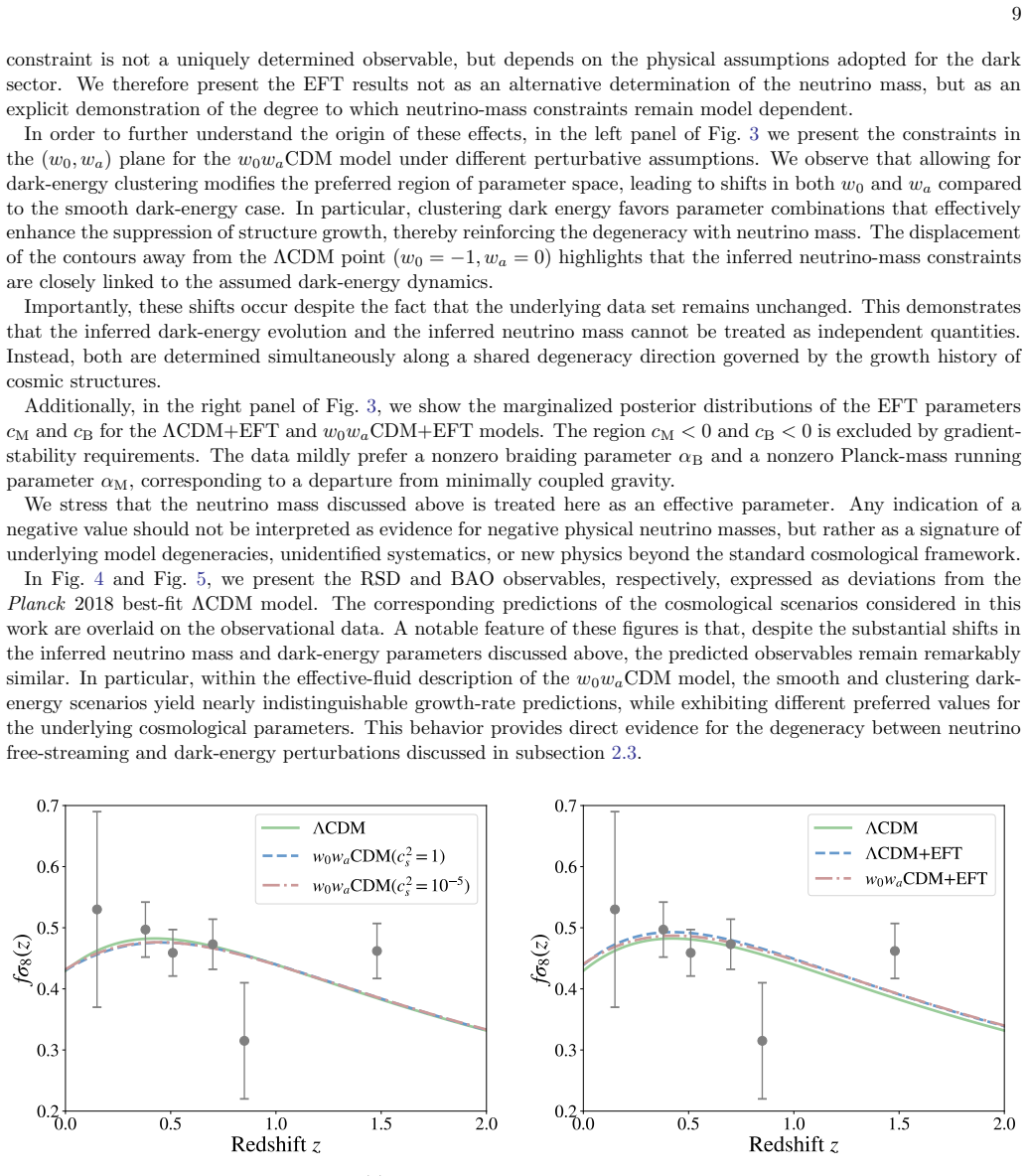
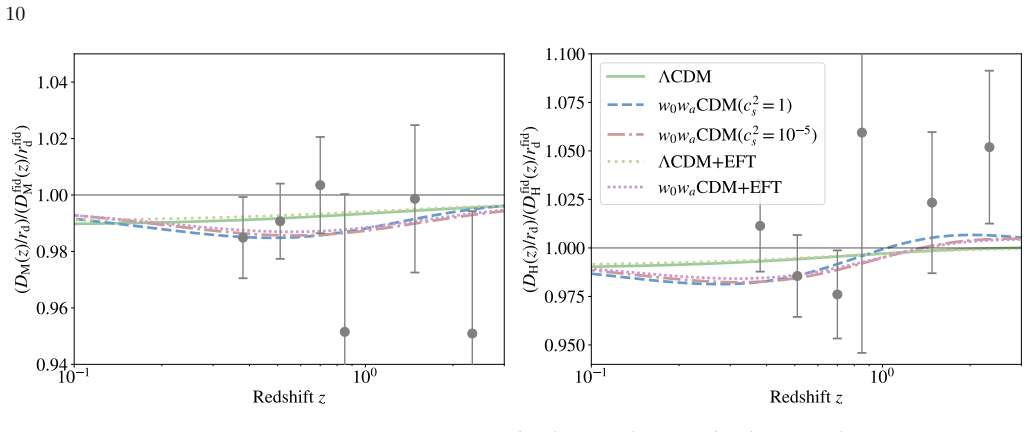
- [Sec. 3 (RSD treatment)] The analysis explicitly treats RSD data as 'measurements which are scale-averaged over the observed k-range' even though fσ8 is scale-dependent in exactly the models considered: massive-neutrino free-streaming and clustering dark energy both introduce k-dependent growth. Fig. 4 shows only the compressed fσ8(z) predictions. If the RSD likelihood is constructed by comparing these scale-averaged measurements to a scale-independent prediction, the k-dependent information—which is what could distinguish neutrino free-streaming from DE clustering—is discarded. The 0.057 eV shift in the 95% upper limit, and hence the conclusion that the alleviation is non-generic, depends on this approximation. Please either construct a per-k/full-shape RSD likelihood or demonstrate (e.g., with a validation test or forecast) that the scale-averaged treatment is unbiased for the parameter ranges explored.
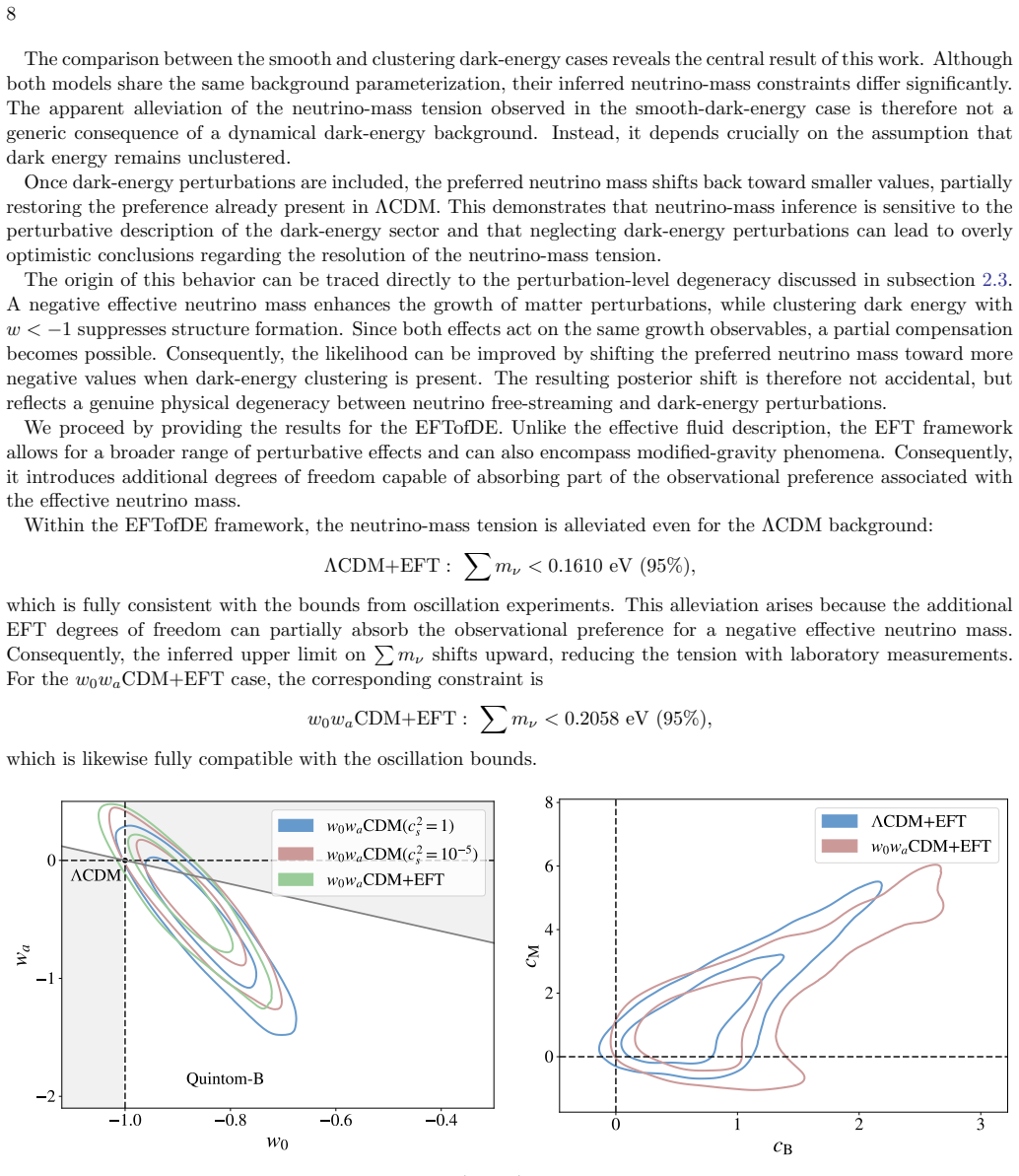
- [Appendix B / Eq. (B21)] The free-cs2 analysis reports a weak correlation between Σmν and log10 cs2 (R = 0.179), while the main argument attributes the shift to changing cs2 from 1 to 1e-5. This weak direct correlation suggests that the shift may instead be driven by the joint reconfiguration of w0 and wa (the reported correlation of Σmν with wa is −0.725) or by prior-volume/tail effects, rather than by the physical cs2–Σmν degeneracy emphasized in Sec. 2.3. The authors should quantify the relative role of the sound speed versus the equation-of-state degeneracy, and explain why fixing cs2 to two extreme values produces a large shift when the marginalized correlation is weak.
minor comments (5)
- [Appendix A] The sentence 'We denote the conformal Hubble parameter by H and the physical Hubble parameter by H' is self-contradictory; one symbol should be a different script (e.g., script H for conformal).
- [Fig. 2, left panel] The label 'c^2_s = 10 5' appears to be missing the minus sign in the exponent; it should read '10^{-5}' to match the text.
- [References] The entry 'Sapone, D., Kunz, M., & Kunz, M. 2009' duplicates the second author; this should be corrected.
- [Sec. 4] The paper appropriately notes the restriction to the linear regime. It would be helpful to state explicitly how nonlinear corrections might affect the degeneracy, even if only qualitatively.
- [Sec. 1] The novelty statement 'for the first time, a systematic and quantitative demonstration' is strong given the existing literature on dark-energy perturbations and neutrino-mass degeneracy (e.g., Takada 2006; Ballesteros & Lesgourgues 2010). Consider softening or situating the novelty more precisely.
Circularity Check
No significant circularity: the central claim is a model-comparison sensitivity analysis against external data, not a fitted input renamed as a prediction.
full rationale
This paper is a forward-model parameter-estimation exercise using external cosmological data (Planck/ACT/DES, BAO/RSD, supernovae). The central result—that the inferred neutrino-mass upper limit shifts from 0.1696 eV (smooth DE, cs2=1) to 0.1125 eV (clustering DE, cs2=1e-5) in w0waCDM—is obtained by running distinct MCMC likelihood analyses for each model and comparing the resulting posteriors. This is a sensitivity test of a model assumption, not a fit-then-predict cycle: the data are fixed and the model is changed, so the shift is not a quantity that was fitted and then re-announced as a prediction. The perturbation-level degeneracy is supported by an explicit analytic derivation in Appendix A (Eq. 5, δde = (1+w)/(1-3w) δm), which follows from the fluid perturbation equations; it is a theoretical input, not a hidden restatement of the neutrino-mass result. The EFT section is explicitly framed as a demonstration of model dependence rather than as a measurement: 'We therefore present the EFT results not as an alternative determination of the neutrino mass, but as an explicit demonstration of the degree to which neutrino-mass constraints remain model dependent,' and the paper directly attributes the ΛCDM+EFT alleviation to 'additional EFT degrees of freedom' absorbing the preference for negative effective mass. That is transparent, not circular. There is no load-bearing self-citation: none of the cited works used to justify the central premises are by the present authors; the negative-effective-mass diagnostic and the Nur adjustment are attributed to external groups (Craig et al. 2024; Green & Meyers 2025; Elbers et al. 2025a,b). The paper's statement that 'The RSD data should be understood as the measurements which are scale-averaged over the observed k-range' is a data-modeling assumption that may be a correctness risk—because both massive neutrinos and clustering DE make fσ8 scale-dependent—but it is not a circular reduction: the paper does not define the observable to equal its own prediction, and the claim is checked against independent measurements. Similarly, the restriction to linear scales is a stated limitation, not a circular step. Overall, the derivation chain does not reduce to its inputs by construction.
Axiom & Free-Parameter Ledger
free parameters (5)
- Sum m_nu (effective neutrino mass sum) =
-0.032 +/- 0.057 eV (LambdaCDM); -0.07 +/- 0.11 eV (w0wa, cs2=1e-5)
- w0, wa =
w0=-0.850 +/- 0.075, wa=-0.54 +/- 0.41 (smooth); w0=-0.870 +/- 0.068, wa=-0.37 +/- 0.38 (clustering)
- cB, cM (EFT braiding and Planck-mass running) =
cB=0.75 +/- 0.51, cM=1.44 +/- 1.60 (LambdaCDM+EFT)
- log10 cs2 (free sound-speed run) =
Broad posterior over U[-10,0], weak constraint
- N_ur (number of massless neutrino species) =
0.00441 for Sum m_nu > 0; 6.08627 for Sum m_nu < 0
axioms (6)
- domain assumption Linear perturbation equations for a dark-energy fluid with effective sound speed cs2 and non-adiabatic pressure, Eq. (3).
- domain assumption Matter-dominated, constant-w, cs2=0 limit giving delta_de = (1+w)/(1-3w) delta_m, Eq. (5) and Appendix A.
- domain assumption EFT-of-DE parametrization alpha_i(a) = c_i Omega_de(a) with alpha_T=0, c_K=1e-2, and stability conditions.
- domain assumption Degenerate neutrino mass approximation Sum m_nu = 3m_nu and N_eff = 3.044.
- ad hoc to paper Negative effective neutrino mass via epsilon_eff = sgn(m) sqrt(p^2 + a^2 m^2), with N_ur adjusted.
- domain assumption RSD data are treated as scale-averaged f-sigma-8 measurements despite scale-dependent growth.
invented entities (1)
-
Effective negative neutrino mass (sgn prescription)
no independent evidence
read the original abstract
Cosmological observations are placing increasingly stringent bounds on the sum of neutrino masses, approaching the lower limits implied by neutrino oscillation experiments. Recent studies have suggested that dynamical dark energy may alleviate this apparent tension. However, these conclusions generally rely on the assumption that dark energy remains smooth, neglecting its perturbations. In this work we investigate the robustness of cosmological neutrino-mass constraints by consistently incorporating dark-energy perturbations. Using CMB, BAO, RSD, and supernova data, we show that the commonly reported alleviation of the neutrino-mass tension in dynamical dark-energy models is not generic. While smooth dark energy substantially relaxes the neutrino-mass bounds, allowing dark energy to cluster shifts the preferred neutrino mass toward smaller, and even more negative, effective values. We demonstrate that this behavior originates from a degeneracy between neutrino free-streaming and dark-energy perturbations in structure-growth observables. Different combinations of neutrino mass and dark-energy clustering can provide similarly good fits to current data while yielding significantly different neutrino-mass constraints. Our results show that cosmological neutrino-mass measurements are inherently model dependent and that reliable neutrino-mass inference requires a consistent treatment of dark-energy perturbations.
Figures


Forward citations
Cited by 2 Pith papers
-
Measuring Cosmic Neutrino Masses Independently of Dark Energy
Two dark-energy-robust cosmological routes bound ∑mν to <0.152 eV (marginalized) and <0.41 eV (late-Universe-free), with the latter independent of tested w(a) models by construction.
-
Neutrino mass constraints in the Schwarzschild-de Sitter black-hole dark energy model with ACT DR6 and DESI DR2 data
SdSDE dark energy yields a ~0.16–0.21 eV positive neutrino-mass preference with DESI+ACT data, but χ² strongly favors extended ΛCDM and the shift is likely compensation.
Reference graph
Works this paper leans on
-
[1]
Abbott, B. P., et al. 2017, Astrophys. J. Lett., 848, L13, doi: 10.3847/2041-8213/aa920c Abdul Karim, M., et al. 2025, Phys. Rev. D, 112, 083515, doi: 10.1103/tr6y-kpc6
-
[2]
Abramo, L. R., Batista, R. C., Liberato, L., & Rosenfeld, R. 2009, Phys. Rev. D, 79, 023516, doi: 10.1103/PhysRevD.79.023516
-
[3]
Ade, P. A. R., et al. 2016, Astron. Astrophys., 594, A14, doi: 10.1051/0004-6361/201525814
-
[4]
Aghanim, N., et al. 2020, Astron. Astrophys., 641, A6, doi: 10.1051/0004-6361/201833910
-
[5]
Aker, M., et al. 2019, Phys. Rev. Lett., 123, 221802, doi: 10.1103/PhysRevLett.123.221802
-
[6]
2025, Science, 388, adq9592, doi: 10.1126/science.adq9592
Aker, M., et al. 2025, Science, 388, adq9592, doi: 10.1126/science.adq9592
-
[7]
Alam, S., et al. 2017, Mon. Not. Roy. Astron. Soc., 470, 2617, doi: 10.1093/mnras/stx721
-
[8]
Alpher, R. A., Follin, J. W., & Herman, R. C. 1953, Phys. Rev., 92, 1347, doi: 10.1103/PhysRev.92.1347 18
-
[9]
2020, JCAP, 09, 021, doi: 10.1088/1475-7516/2020/09/021
Archidiacono, M., Hannestad, S., & Lesgourgues, J. 2020, JCAP, 09, 021, doi: 10.1088/1475-7516/2020/09/021
-
[10]
2013, JCAP, 1302, 001, doi: 10.1088/1475-7516/2013/02/001
Audren, B., Lesgourgues, J., Benabed, K., & Prunet, S. 2013, JCAP, 1302, 001, doi: 10.1088/1475-7516/2013/02/001
-
[11]
2010, JCAP, 10, 014, doi: 10.1088/1475-7516/2010/10/014
Ballesteros, G., & Lesgourgues, J. 2010, JCAP, 10, 014, doi: 10.1088/1475-7516/2010/10/014
-
[12]
2014, JCAP, 08, 059, doi: 10.1088/1475-7516/2014/08/059
Barreira, A., Li, B., Baugh, C., & Pascoli, S. 2014, JCAP, 08, 059, doi: 10.1088/1475-7516/2014/08/059
-
[13]
Basse, T., Bjaelde, O. E., Hannestad, S., & Wong, Y. Y. Y. 2012, https://arxiv.org/abs/1205.0548
Pith/arXiv arXiv 2012
-
[14]
Batista, R. C. 2014, Phys. Rev. D, 89, 123508, doi: 10.1103/PhysRevD.89.123508
-
[15]
Batista, R. C. 2021, Universe, 8, 22, doi: 10.3390/universe8010022
-
[16]
Bautista, J. E., et al. 2020, Mon. Not. Roy. Astron. Soc., 500, 736, doi: 10.1093/mnras/staa2800
-
[17]
Bellini, E., Cuesta, A. J., Jimenez, R., & Verde, L. 2016, JCAP, 02, 053, doi: 10.1088/1475-7516/2016/06/E01
-
[18]
2014, JCAP, 07, 050, doi: 10.1088/1475-7516/2014/07/050
Bellini, E., & Sawicki, I. 2014, JCAP, 07, 050, doi: 10.1088/1475-7516/2014/07/050
-
[19]
2020, JCAP, 02, 008, doi: 10.1088/1475-7516/2020/02/008
Bellini, E., Sawicki, I., & Zumalac´ arregui, M. 2020, JCAP, 02, 008, doi: 10.1088/1475-7516/2020/02/008
-
[20]
Bellini, E., & Zumalacarregui, M. 2015, Phys. Rev. D, 92, 063522, doi: 10.1103/PhysRevD.92.063522
-
[21]
Bennett, J. J., Buldgen, G., De Salas, P. F., et al. 2021, JCAP, 04, 073, doi: 10.1088/1475-7516/2021/04/073
-
[22]
2011, Journal of Cosmology and Astroparticle Physics, 2011, 034
Blas, D., Lesgourgues, J., & Tram, T. 2011, Journal of Cosmology and Astroparticle Physics, 2011, 034 . https://api.semanticscholar.org/CorpusID:53490516
2011
-
[23]
Bloomfield, J. K., Flanagan, E. E., Park, M., & Watson, S. 2013, JCAP, 08, 010, doi: 10.1088/1475-7516/2013/08/010
-
[24]
2018, https://arxiv.org/abs/1804.07261
Brinckmann, T., & Lesgourgues, J. 2018, https://arxiv.org/abs/1804.07261
Pith/arXiv arXiv 2018
-
[25]
Capozzi, F., Di Valentino, E., Lisi, E., et al. 2021, Phys. Rev. D, 104, 083031, doi: 10.1103/PhysRevD.104.083031
-
[26]
2022, JCAP, 09, 039, doi: 10.1088/1475-7516/2022/09/039
Carron, J., Mirmelstein, M., & Lewis, A. 2022, JCAP, 09, 039, doi: 10.1088/1475-7516/2022/09/039
-
[27]
2026, JCAP, 01, 041, doi: 10.1088/1475-7516/2026/01/041
Chebat, D., et al. 2026, JCAP, 01, 041, doi: 10.1088/1475-7516/2026/01/041
-
[28]
Chevallier, M., & Polarski, D. 2001, Int. J. Mod. Phys. D, 10, 213, doi: 10.1142/S0218271801000822
-
[29]
2024, JHEP, 09, 097, doi: 10.1007/JHEP09(2024)097
Craig, N., Green, D., Meyers, J., & Rajendran, S. 2024, JHEP, 09, 097, doi: 10.1007/JHEP09(2024)097
-
[30]
2009, JCAP, 02, 018, doi: 10.1088/1475-7516/2009/02/018 de Mattia, A., et al
Creminelli, P., D’Amico, G., Norena, J., & Vernizzi, F. 2009, JCAP, 02, 018, doi: 10.1088/1475-7516/2009/02/018 de Mattia, A., et al. 2021, Mon. Not. Roy. Astron. Soc., 501, 5616, doi: 10.1093/mnras/staa3891 de Salas, P. F., Forero, D. V., Gariazzo, S., et al. 2021, JHEP, 02, 071, doi: 10.1007/JHEP02(2021)071
-
[31]
Dirian, Y. 2017, Phys. Rev. D, 96, 083513, doi: 10.1103/PhysRevD.96.083513
-
[32]
Wong, Y. Y. Y. 2024, JCAP, 06, 032, doi: 10.1088/1475-7516/2024/06/032
-
[33]
2019, doi: 10.21105/astro.1910.00483
Efstathiou, G., & Gratton, S. 2019, doi: 10.21105/astro.1910.00483
Pith/arXiv arXiv 2019
-
[34]
S., Jenkins, A., Li, B., & Pascoli, S
Elbers, W., Frenk, C. S., Jenkins, A., Li, B., & Pascoli, S. 2025a, Phys. Rev. D, 111, 063534, doi: 10.1103/PhysRevD.111.063534
-
[35]
Elbers, W., et al. 2025b, Phys. Rev. D, 112, 083513, doi: 10.1103/w9pk-xsk7
-
[36]
Esteban, I., Gonzalez-Garcia, M. C., Maltoni, M., et al. 2024, JHEP, 12, 216, doi: 10.1007/JHEP12(2024)216
-
[37]
Feldman, G. J., & Cousins, R. D. 1998, Phys. Rev. D, 57, 3873, doi: 10.1103/PhysRevD.57.3873
-
[38]
2026, https://arxiv.org/abs/2603.10787
Feng, L., Li, T.-N., Du, G.-H., Zhang, J.-F., & Zhang, X. 2026, https://arxiv.org/abs/2603.10787
Pith/arXiv arXiv 2026
-
[39]
Froustey, J., Pitrou, C., & Volpe, M. C. 2020, JCAP, 12, 015, doi: 10.1088/1475-7516/2020/12/015 Giar` e, W., Mena, O., Specogna, E., & Di Valentino, E. 2025, Phys. Rev. D, 112, 103520, doi: 10.1103/njfc-pd1w
-
[40]
Gil-Marin, H., et al. 2020, Mon. Not. Roy. Astron. Soc., 498, 2492, doi: 10.1093/mnras/staa2455
-
[41]
2013, JCAP, 08, 025, doi: 10.1088/1475-7516/2013/08/025
Gleyzes, J., Langlois, D., Piazza, F., & Vernizzi, F. 2013, JCAP, 08, 025, doi: 10.1088/1475-7516/2013/08/025
-
[42]
2026, https://arxiv.org/abs/2601.16277
Gorbunov, D., & Nedelko, N. 2026, https://arxiv.org/abs/2601.16277
arXiv 2026
-
[43]
Green, D., & Meyers, J. 2025, Phys. Rev. D, 111, 083507, doi: 10.1103/PhysRevD.111.083507
-
[44]
2013, JCAP, 02, 032, doi: 10.1088/1475-7516/2013/02/032
Gubitosi, G., Piazza, F., & Vernizzi, F. 2013, JCAP, 02, 032, doi: 10.1088/1475-7516/2013/02/032
-
[45]
Hannestad, S. 2005, Phys. Rev. Lett., 95, 221301, doi: 10.1103/PhysRevLett.95.221301
-
[46]
Herold, L., Ferreira, E. G. M., & Heinrich, L. 2025, Phys. Rev. D, 111, 083504, doi: 10.1103/PhysRevD.111.083504
-
[47]
2025, https://arxiv.org/abs/2506.12004
Herold, L., & Karwal, T. 2025, https://arxiv.org/abs/2506.12004
Pith/arXiv arXiv 2025
-
[48]
Hou, J., et al. 2020, Mon. Not. Roy. Astron. Soc., 500, 1201, doi: 10.1093/mnras/staa3234
-
[49]
Manera, M. 2015, Mon. Not. Roy. Astron. Soc., 449, 848, doi: 10.1093/mnras/stu2693
-
[50]
2014, https://arxiv.org/abs/1405.3590
Hu, B., Raveri, M., Frusciante, N., & Silvestri, A. 2014, https://arxiv.org/abs/1405.3590
Pith/arXiv arXiv 2014
-
[51]
2025, JCAP, 01, 153, doi: 10.1088/1475-7516/2025/01/153 19
Jiang, J.-Q., Giar` e, W., Gariazzo, S., et al. 2025, JCAP, 01, 153, doi: 10.1088/1475-7516/2025/01/153 19
-
[52]
2024, https://arxiv.org/abs/2401.14225
Karwal, T., Patel, Y., Bartlett, A., et al. 2024, https://arxiv.org/abs/2401.14225
Pith/arXiv arXiv 2024
-
[53]
Kunz, M., Nesseris, S., & Sawicki, I. 2015, Phys. Rev. D, 92, 063006, doi: 10.1103/PhysRevD.92.063006
-
[54]
Lesgourgues, J., & Pastor, S. 2006, Phys. Rept., 429, 307, doi: 10.1016/j.physrep.2006.04.001
-
[55]
Linder, E. V. 2003, Phys. Rev. Lett., 90, 091301, doi: 10.1103/PhysRevLett.90.091301
-
[56]
2025, JCAP, 11, 062, doi: 10.1088/1475-7516/2025/11/062
Louis, T., et al. 2025, JCAP, 11, 062, doi: 10.1088/1475-7516/2025/11/062
-
[57]
Lynch, G. P., & Knox, L. 2025, Phys. Rev. D, 112, 083543, doi: 10.1103/613p-pph2
-
[58]
Mehrabi, A., Basilakos, S., & Pace, F. 2015a, Mon. Not. Roy. Astron. Soc., 452, 2930, doi: 10.1093/mnras/stv1478
-
[59]
Mehrabi, A., Malekjani, M., & Pace, F. 2015b, Astrophys. Space Sci., 356, 129, doi: 10.1007/s10509-014-2185-3
-
[60]
2026, https://arxiv.org/abs/2603.03284
Montandon, T., Poulin, V., Rink, T., & Schwetz, T. 2026, https://arxiv.org/abs/2603.03284
Pith/arXiv arXiv 2026
-
[61]
Navas, S., et al. 2024, Phys. Rev. D, 110, 030001, doi: 10.1103/PhysRevD.110.030001
-
[62]
Neveux, R., et al. 2020, Mon. Not. Roy. Astron. Soc., 499, 210, doi: 10.1093/mnras/staa2780
-
[63]
2026, doi: 10.5281/zenodo.19099550
Novell-Masot, S., et al. 2026, doi: 10.5281/zenodo.19099550
-
[64]
2025, https://arxiv.org/abs/2511.07517
Popovic, B., et al. 2025, https://arxiv.org/abs/2511.07517
Pith/arXiv arXiv 2025
-
[65]
2011, JHEP, 11, 156, doi: 10.1007/JHEP11(2011)156 Pulido-Hern´ andez, H., & Cervantes-Cota, J
Pujolas, O., Sawicki, I., & Vikman, A. 2011, JHEP, 11, 156, doi: 10.1007/JHEP11(2011)156 Pulido-Hern´ andez, H., & Cervantes-Cota, J. L. 2026, https://arxiv.org/abs/2603.13208
arXiv 2011
-
[66]
Raichoor, A., et al. 2020, Mon. Not. Roy. Astron. Soc., 500, 3254, doi: 10.1093/mnras/staa3336
-
[67]
Reischke, R., Spurio Mancini, A., Sch¨ afer, B. M., & Merkel, P. M. 2019, Mon. Not. Roy. Astron. Soc., 482, 3274, doi: 10.1093/mnras/sty2919
-
[68]
Rosenberg, E., Gratton, S., & Efstathiou, G. 2022, Mon. Not. Roy. Astron. Soc., 517, 4620, doi: 10.1093/mnras/stac2744
-
[69]
J., Samushia, L., Howlett, C., et al
Ross, A. J., Samushia, L., Howlett, C., et al. 2015, Mon. Not. Roy. Astron. Soc., 449, 835, doi: 10.1093/mnras/stv154 Roy Choudhury, S., & Hannestad, S. 2020, JCAP, 07, 037, doi: 10.1088/1475-7516/2020/07/037 Roy Choudhury, S., & Okumura, T. 2024, Astrophys. J. Lett., 976, L11, doi: 10.3847/2041-8213/ad8c26
-
[70]
Sapone, D., Kunz, M., & Kunz, M. 2009, Phys. Rev. D, 80, 083519, doi: 10.1103/PhysRevD.80.083519
-
[71]
Takada, M. 2006, Phys. Rev. D, 74, 043505, doi: 10.1103/PhysRevD.74.043505
-
[72]
Takada, M., Komatsu, E., & Futamase, T. 2006, Phys. Rev. D, 73, 083520, doi: 10.1103/PhysRevD.73.083520
-
[73]
Tamone, A., et al. 2020, Mon. Not. Roy. Astron. Soc., 499, 5527, doi: 10.1093/mnras/staa3050
-
[74]
2019, JCAP, 05, 041, doi: 10.1088/1475-7516/2019/05/041
Upadhye, A. 2019, JCAP, 05, 041, doi: 10.1088/1475-7516/2019/05/041
-
[75]
Vagnozzi, S., Dhawan, S., Gerbino, M., et al. 2018, Phys. Rev. D, 98, 083501, doi: 10.1103/PhysRevD.98.083501
-
[76]
Vagnozzi, S., Giusarma, E., Mena, O., et al. 2017, Phys. Rev. D, 96, 123503, doi: 10.1103/PhysRevD.96.123503
-
[77]
Pan, S. 2026, https://arxiv.org/abs/2603.15422 Zumalac´ arregui, M., Bellini, E., Sawicki, I., Lesgourgues, J., & Ferreira, P. G. 2017, JCAP, 08, 019, doi: 10.1088/1475-7516/2017/08/019
arXiv 2026
discussion (0)
Sign in with ORCID, Apple, or X to comment. Anyone can read and Pith papers without signing in.