REVIEW 1 major objections 4 minor 2 cited by
The paper derives a formula that computes each double-twist thermal OPE coefficient individually from a regulated momentum-space integral of the thermal response function, and uses it to obtain the first spin-resolved holographic values.
Reviewed by Pith at T0; open to challenge. T0 means a machine referee read the full paper against a public rubric. the ladder, T0–T4 →
T0 review · deepseek-v4-flash
2026-08-02 09:24 UTC pith:TDXCYPSX
load-bearing objection The first individual spin-resolved double-twist thermal coefficients, from a new momentum-space integral formula; the paper deserves a careful referee, with one load-bearing assumption needing scrutiny. the 1 major comments →
Thermal Double-Twist Data in Holography
The pith
A machine-rendered reading of the paper's core claim, the machinery that carries it, and where it could break.
Core claim
The central claim is a master formula expressing each double-twist thermal OPE coefficient a_{s,J} as a regulated momentum-space integral of the thermal response function G_T(ω_n,k). The formula is derived two independent ways: first, by deforming the boundary theory with the corresponding double-trace operator and differentiating the one-loop generating functional; second, by point-splitting the operator, acting on the thermal two-point function with the differential operator □^s D^J, and isolating the target block in the coincidence limit. The only theory-dependent input is G_T itself, which for the AdS5 black-brane dual follows from a radial ODE reduction of the bulk Klein-Gordon equation
What carries the argument
The central object is the point-splitting projection: acting on the thermal two-point function with □^s D^J, the Laplacian power and traceless-symmetric derivative that defines [OO]_{s,J}, then averaging over the sphere and taking the coincidence limit, isolates the target double-twist block because the derivatives annihilate all other double-twist blocks while the identity and multi-stress-tensor divergences remain as a finite computable remainder. The same projection evaluated in momentum space yields a regulated integral over G_T. The regularization relies on the property that double-twist blocks have exponentially small large-momentum tails, so all power-law UV divergences come from the
Load-bearing premise
The whole scheme rests on the imported property that the large-momentum Fourier transform of every double-twist thermal block decays exponentially, so that the power-law UV divergences in the momentum integrals come only from the identity and multi-stress-tensor sectors; if a double-twist block had a power-law tail, the subtract-and-add-back regularization would mis-subtract and every extracted a_{s,J} would be shifted.
What would settle it
Compute the large-momentum transform of a single double-twist thermal block (for instance [OO]_{0,2}) directly from its real-space form: the scheme predicts exponential decay in k. A power-law tail at any order would falsify the subtraction. Alternatively, determine a_{1,0} and a_{0,2} from an independent nonzero-separation thermal bootstrap and check against 0.489(1) and 2.399(1); a disagreement beyond the quoted ~10^{-3} uncertainties would falsify the method.
If this is right
- Each double-twist coefficient a_{s,J} can now be determined individually from gravity, not just the KMS combination a_{1,0}+3a_{0,2} accessible to earlier methods.
- The computational task reduces to solving a radial ODE and evaluating regulated integrals, avoiding the difficult PDE fitting used in previous holographic approaches.
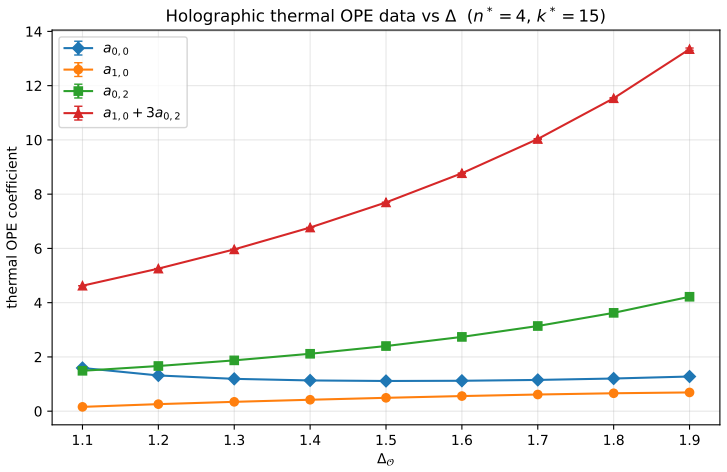
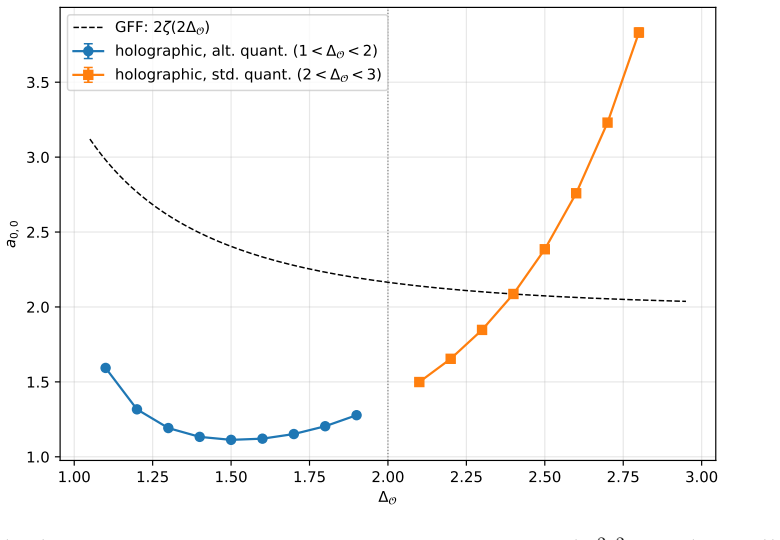
- The scalar coefficient a0,0 is refined to seven significant figures, and the spin-resolved a1,0 and a0,2 are new determinations that can serve as targets for future bootstrap or lattice checks.
- The KMS combination agrees with the bootstrap value, providing a nontrivial cross-check of both the holographic and bootstrap computations.
- The same formula extends in principle to heavier double-twist operators and to other geometries, with numerical cost growing as more multi-stress-tensor subtractions are needed.
Where Pith is reading between the lines
- The exponential-tail property of double-twist blocks is load-bearing; an independent derivation or direct numerical check of this property would strengthen confidence in the subtraction scheme.
- The same integral-over-response strategy might apply to other thermal data, such as spinning external operators or fermionic double-twists, though the paper does not pursue those cases.
- Because individual spin-resolved coefficients are now available, a nonzero-separation thermal bootstrap could be used as an independent cross-check, potentially closing the loop between holographic and bootstrap approaches.
- The observed μ-independence suggests a gauge-like freedom in the choice of subtraction window; optimizing the dressing function could accelerate convergence for heavier double-twist operators.
Editorial analysis
A structured set of objections, weighed in public.
Referee Report
Summary. The paper proposes a method to extract thermal OPE coefficients a_{s,J} of double-twist operators [OO]_{s,J} in the scalar two-point function on S^1_β×R^3 of a large-N holographic CFT. The main result, Eqs. (4.9) and (5.8), expresses each a_{s,J} as a regulated momentum-space integral of the thermal response function G_T(ω_n,k), with the only theory-dependent input being G_T obtained from a radial ODE reduction of the bulk Klein-Gordon equation in the AdS5 black brane. The authors derive the formula twice (double-trace deformation and point-splitting projection), implement a window-subtraction regularization with analytic add-backs, and present numerical results at ΔO=3/2: a0,0=1.113079(1), a1,0=0.489(1), a0,2=2.399(1), and the KMS combination a1,0+3a0,2=7.686(2), which matches the bootstrap value. Some of the spin-resolved data, in particular a1,0 and a0,2, are new.
Significance. If correct, the paper fills a concrete gap: it provides the first individual (spin-resolved) thermal double-twist coefficients a1,0 and a0,2, and refines a0,0. The method is general for d≥3 and avoids solving a bulk PDE, requiring only a radial ODE plus a regularized momentum-space integral. The independent derivation from the double-trace generating functional and from point-splitting gives strong internal consistency, and the agreement with the KMS bootstrap combination is an important external check. The paper also clearly identifies the limitations of the numerical approach and gives diagnostics (μ-independence and analyticity in ΔO) that support the scheme. The main weakness is that a load-bearing analytic property, the exponential smallness of double-twist momentum tails, is quoted from Ref. [19] rather than derived or numerically verified in this paper.
major comments (1)
- [Appendix B.2, Eq. (B.8)] The subtraction scheme of Section 5.1, Eq. (5.8), relies on the statement that every double-twist thermal block has an exponentially decaying momentum-space image, so that all power-law UV tails of G_T come from the identity and multi-stress-tensor sectors. If a double-twist block had a power-law tail, the subtract-and-add-back scheme would misattribute that tail to the finite part and shift the extracted a_{s,J}. The paper states Eq. (B.8) on the basis of the quoted formula (B.6) from Ref. [19], but it does not show the cancellation that makes the algebraic term vanish at Δ=2ΔO+2s+J, nor does it provide a direct numerical check. The residue is 1/Γ(c_j) with c_j = −s−j for double-twist dimensions, so the result is likely correct; nevertheless, this is the load-bearing point of the central extraction formula. Please spell out the Gamma-function argument or add a short numerical verificati
minor comments (4)
- [Section 5.4] The quoted uncertainties in Eq. (5.40) account for the k* and n* truncations but not for the ODE solver tolerances or the sensitivity to the matching window (ϵ_h, ϵ_bdr, Frobenius truncation order). Please report the solver tolerances and a convergence check over these numerical parameters, since the claimed 10^{-6} accuracy for a0,0 is at a level where ODE integration error could matter.
- [Section 5.1, Eqs. (5.5)-(5.8)] The scheme-independence of the result with respect to the dressing functions w_m(μ,p) is only tested by varying μ for a fixed functional form. A comment on shape-independence, or a cross-check with a different w_m satisfying (5.5), would strengthen the claim that the finite part is not an artifact of the dressing choice.
- [Appendix B.2, Eq. (B.6)] The 2F1 expression in Eq. (B.6) is central to the regularization argument, but its domain of validity (d, ΔO, and the precise meaning of the O(e^{-βk}) term) is not stated. Adding a sentence on the derivation or the regime of validity would make the paper more self-contained.
- [Equations (4.14) and (5.30)] The relation between the 'third line' in Eq. (5.30), the factor 8, and the GFF value a0,2^{GFF} is stated rather tersely. A brief comment explaining why that line is finite and equal to 8 times the GFF coefficient would help the reader follow the assembly of Eq. (5.38).
Circularity Check
No significant circularity: target coefficients are not inputs; the thermal response is computed from an independent bulk ODE and the subtractions use only external or analytic data.
full rationale
The paper's central claim is a formula expressing each double-twist thermal OPE coefficient a_{s,J} as a regulated momentum-space integral of the thermal response function G_T(n,k). The target coefficients a_{s,J} are never used as inputs anywhere in the derivation. G_T(n,k) is obtained by numerically solving the radial Klein-Gordon ODE in the AdS5 black-brane background, which is independent of the double-twist data. The derivation of the master formula proceeds first through the generating functional of double-trace deformations and then through a point-splitting projection onto the target conformal block; since the coefficients are defined by the OPE expansion of the same two-point function, extracting them from the correlator via a projector is an exact identity rather than a circular reduction. The subtraction scheme subtracts only the identity contribution, the universal stress-tensor term a_2^{(1)} from the external reference [3], and the analytically known free-field (GFF) integrals; none of these are the a_{s,J} being computed. The agreement of the KMS combination a_{1,0}+3a_{0,2} with the independent bootstrap result [4,9] is a consistency check, not a fitted constraint. The only potentially load-bearing imported assumption is the exponential-decay property (B.8) for double-twist momentum-space blocks, taken from the external reference [19]; while this is a correctness risk if false, it is not a circularity because it is not equivalent to the paper's own inputs or outputs. The only self-citation [12] is contextual and does not carry the derivation. Therefore no step reduces to its inputs by construction, and the paper is not circular.
Axiom & Free-Parameter Ledger
free parameters (4)
- μ (subtraction scale) =
1 for quoted results; tests at 0.5 and 2
- dressing functions w_m(μ,p) =
N/A (functional forms chosen for integrability)
- cutoffs (n*, k*) =
(15, 20)
- M_{s,J} (number of asymptotic subtractions) =
minimal required; additional terms optionally added
axioms (6)
- domain assumption Standard AdS/CFT dictionary: bulk scalar with m^2ℓ^2 = Δ(Δ-4) dual to boundary scalar operator; thermal response G_T = B/A from horizon-regular solution.
- domain assumption Large-N decomposition (3.4): at leading order in 1/c, thermal two-point function decomposes into identity, double-twist tower, and multi-stress tower; one-loop generating functional (3.10) captures leading double-trace physics.
- domain assumption Non-integer ΔO assumption to avoid logarithmic branch ambiguities.
- domain assumption External inputs: universal stress-tensor thermal one-point coefficient a_2^{(1)} = ΔO π^4/120 from [3], and free-field GFF coefficients such as a_{0,0}^{GFF}=2ζ(2ΔO).
- domain assumption Double-twist block momentum tails are exponentially small (B.8), so UV power-law divergences of the momentum integrals come only from identity and multi-stress sectors.
- standard math Gegenbauer/hyperspherical projection identities, Rayleigh expansion, and zonal harmonic identities.
read the original abstract
We explain how to extract thermal OPE coefficients of double-twist operators in scalar two-point functions at infinite spatial volume from suitably regularized integrals of thermal response functions in momentum space. As a specific application, we implement the proposed approach to four-dimensional holographic CFTs with an Einstein bulk action, where the finite-temperature state is captured by an AdS$_5$ black-brane geometry. In that case, the thermal response function can be computed on the gravitational side by solving numerically a radial ODE reduction of the Klein-Gordon equation. We obtain accurate values of double-twist data from this solution, completing previous holographic and bootstrap studies of thermal two-point functions. Some of the reported spin-resolved data that we compute are new.
Figures


Forward citations
Cited by 2 Pith papers
-
Analytic thermal bootstrap in momentum space: From thermal OPE to QNMs
KMS-symmetric thermal Polyakov blocks Fourier-transform into asymptotic retarded correlators, yielding inversion formulae that express thermal OPE coefficients in terms of quasinormal-mode frequencies under meromorphicity.
-
Spin-resolved double-trace thermal coefficients in holography
Zero-frequency bulk Heun solutions fix the residual spatial ambiguity left by KMS, yielding spin-resolved holographic double-trace thermal coefficients and canceling complex bulk-cone singularities.
Reference graph
Works this paper leans on
-
[1]
L. Iliesiu, M. Koloğlu, R. Mahajan, E. Perlmutter and D. Simmons-Duffin,The Conformal Bootstrap at Finite Temperature,JHEP10(2018) 070 [1802.10266]
Pith/arXiv arXiv 2018
-
[2]
L. Fidkowski, V. Hubeny, M. Kleban and S. Shenker,The Black hole singularity in AdS / CFT,JHEP02(2004) 014 [ hep-th/0306170]. ✦ G. Festuccia and H. Liu,Excursions beyond the horizon: Black hole singularities in Yang-Mills theories. I.,JHEP04(2006) 044 [hep-th/0506202].✦G. Festuccia and H. Liu,A Bohr-Sommerfeld quantization formula for quasinormal frequenc...
Pith/arXiv arXiv 2004
-
[3]
A.L. Fitzpatrick and K.-W. Huang,Universal Lowest-Twist in CFTs from Holography, JHEP08(2019) 138 [1903.05306]
Pith/arXiv arXiv 2019
- [4]
-
[5]
R. Karlsson, M. Kulaxizi, A. Parnachev and P. Tadić,Leading Multi-Stress Tensors and Conformal Bootstrap,JHEP01(2020) 076 [ 1909.05775]. ✦ R. Karlsson, A. Parnachev, V. Prilepina and S. Valach,Thermal stress tensor correlators, OPE and holography, JHEP09(2022) 234 [2206.05544]
Pith/arXiv arXiv 2020
-
[6]
A.L. Fitzpatrick, K.-W. Huang, D. Meltzer, E. Perlmutter and D. Simmons-Duffin, Model-dependence of minimal-twist OPEs in d>2 holographic CFTs,JHEP11(2020) 060 [2007.07382].✦K.-W. Huang,Toward null-state equations in d>2,JHEP11 (2023) 203 [2308.03229]. ✦ K.-W. Huang,Resummation of multistress tensors in higher dimensions,Phys. Rev. D111(2025) 046016 [2406...
Pith/arXiv arXiv 2020
-
[7]
E. Parisini, K. Skenderis and B. Withers,The ambient space formalism,JHEP05(2024) 296 [2312.03820]. 39
Pith/arXiv arXiv 2024
-
[8]
P. Arnaudo and B. Withers,Analytic structure of holographic thermal correlators from Fourier series,2603.13469
-
[9]
I. Burić, I. Gusev and A. Parnachev,Thermal holographic correlators and KMS condition,JHEP09(2025) 053 [2505.10277]
Pith/arXiv arXiv 2025
-
[10]
J. Barrat, D.N. Bozkurt, E. Marchetto, A. Miscioscia and E. Pomoni,The analytic bootstrap at finite temperature,JHEP05(2026) 104 [2506.06422]
Pith/arXiv arXiv 2026
-
[11]
J. Barrat, D.N. Bozkurt, E. Marchetto, A. Miscioscia and E. Pomoni,Analytic thermal bootstrap meets holography,JHEP05(2026) 180 [2510.20894]
arXiv 2026
-
[12]
V. Niarchos, C. Papageorgakis, A. Stratoudakis and M. Woolley,Deep finite temperature bootstrap,Phys. Rev. D112(2025) 126012 [2508.08560]
arXiv 2025
-
[13]
Witten,Multitrace operators, boundary conditions, and AdS / CFT correspondence, hep-th/0112258.✦S.S
E. Witten,Multitrace operators, boundary conditions, and AdS / CFT correspondence, hep-th/0112258.✦S.S. Gubser and I. Mitra,Double trace operators and one loop vacuum energy in AdS / CFT,Phys. Rev. D67(2003) 064018 [hep-th/0210093]. ✦ S.S. Gubser and I.R. Klebanov,A Universal result on central charges in the presence of double trace deformations,Nucl. Phy...
Pith/arXiv arXiv 2003
-
[14]
T. Hartman and L. Rastelli,Double-trace deformations, mixed boundary conditions and functional determinants in AdS/CFT,JHEP01(2008) 019 [hep-th/0602106]. ✦D.E. Diaz and H. Dorn,Partition functions and double-trace deformations in AdS/CFT,JHEP05(2007) 046 [hep-th/0702163]
Pith/arXiv arXiv 2008
-
[15]
I. Buric, F. Russo, V. Schomerus and A. Vichi,Thermal one-point functions and their partial wave decomposition,JHEP12(2024) 021 [2408.02747].✦J.R. David and S. Kumar,The large N vector model on S1 ×S 2,JHEP03(2025) 169 [2411.18509]. ✦ J.R. David and S. Kumar,High to low temperature: O(N) model at large N,JHEP02 (2026) 194 [2508.14872]
Pith/arXiv arXiv 2024
-
[16]
I. Burić, F. Mangialardi, F. Russo, V. Schomerus and A. Vichi,Thermal One-point Functions and Asymptotic CFT Data: QFT in AdS,2606.17167. 40
-
[17]
S. de Haro, K. Skenderis and S.N. Solodukhin,Holographic reconstruction of space-time and renormalization in the AdS / CFT correspondence,Commun. Math. Phys.217 (2001) 595 [hep-th/0002230]
Pith/arXiv arXiv 2001
-
[18]
S.S. Gubser, I.R. Klebanov and A.M. Polyakov,Gauge theory correlators from noncritical string theory,Phys. Lett. B428(1998) 105 [hep-th/9802109]. ✦ E. Witten, Anti-de Sitter space and holography,Adv. Theor. Math. Phys.2(1998) 253 [hep-th/9802150]
Pith/arXiv arXiv 1998
-
[19]
Manenti,Thermal CFTs in momentum space,JHEP01(2020) 009 [1905.01355]
A. Manenti,Thermal CFTs in momentum space,JHEP01(2020) 009 [1905.01355]. 41
Pith/arXiv arXiv 2020
discussion (0)
Sign in with ORCID, Apple, or X to comment. Anyone can read and Pith papers without signing in.