REVIEW 2 minor 1 cited by
Subensemble Acceptance Method 3.0: General Corrections to Cumulants from Exact Conservation Constraints
T0 review · 0 major / 2 minor · reviewed 2026-07-03 · grok-4.3
Pith's one-line read SAM-3.0 corrects cumulants for exact global conservation of multiple charges via algebraic recursion.
desk verdict SAM-3.0 supplies a closed algebraic recursion via multivariate Bell polynomials that maps joint GC cumulants to canonical ones for arbitrary charges and observables, with direct MC validation. read the letter →
The pith
A machine-rendered reading of the paper's core claim, the machinery that carries it, and where it could break.
The reading
What carries the argument
The SAM-3.0 recursion based on multivariate partial exponential Bell polynomials, which maps the required joint grand-canonical cumulants to the canonical cumulants.
What would settle it
Direct Monte Carlo sampling with exact simultaneous conservation of baryon number, electric charge, and strangeness that produces cumulants differing from the recursion output.
Extended reading notes
Core claim
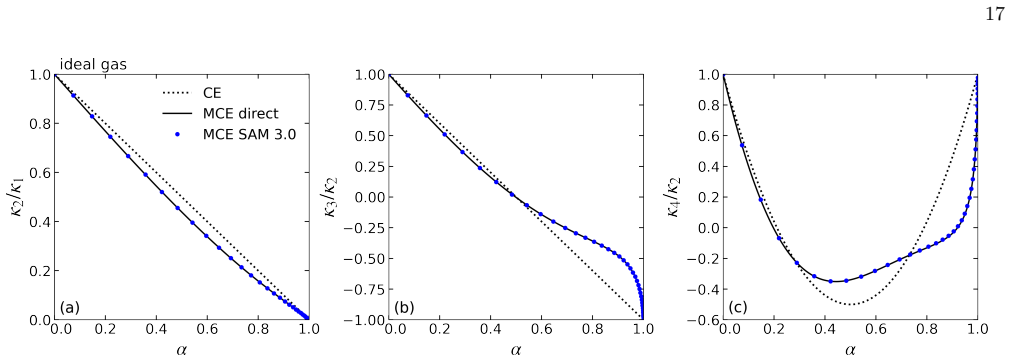
The central claim is that the canonical cumulants follow algebraically from the joint grand-canonical cumulants of the acceptance observable with the total event charges through a closed recursion based on multivariate partial exponential Bell polynomials, accommodating any number of conserved charges and observables while reproducing the exact binomial-acceptance limit and containing prior versions as special cases.
Load-bearing premise
The joint grand-canonical cumulants of the acceptance observable with the total event charges must be accurately known or independently computable as input.
Editorial extensions
If this is right
- The method applies to any number of observables and any number of simultaneously conserved charges, including total energy.
- It reproduces the exact binomial-acceptance limit and contains SAM-1.0 and SAM-2.0 as special cases.
- Leading finite-size corrections follow from the saddle-point expansion.
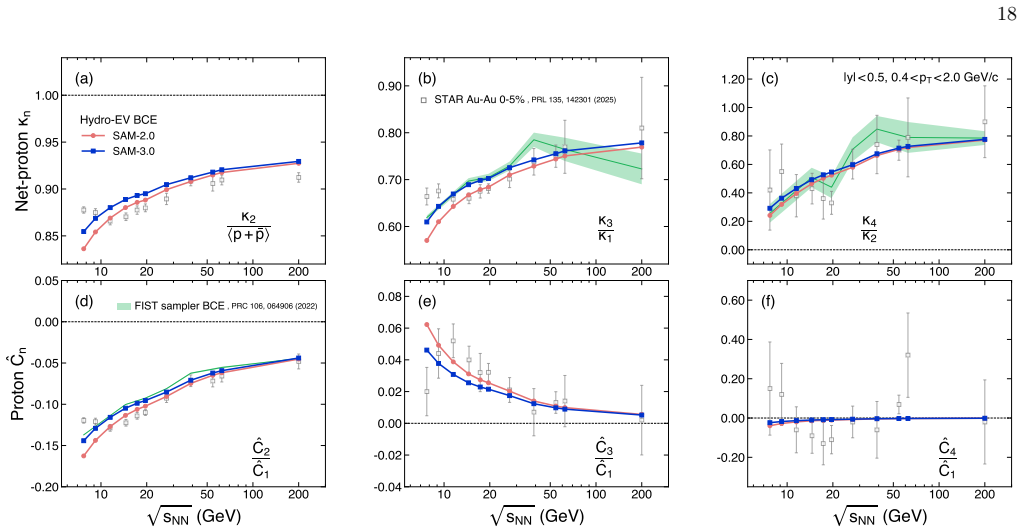
- The updated hydrodynamics-based baseline for net-proton cumulants at RHIC-BES energies agrees with direct canonical Monte Carlo sampling.
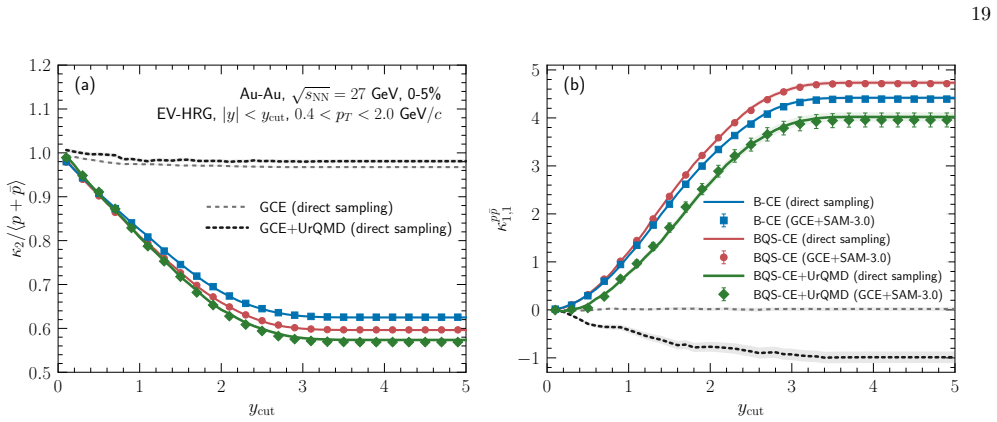
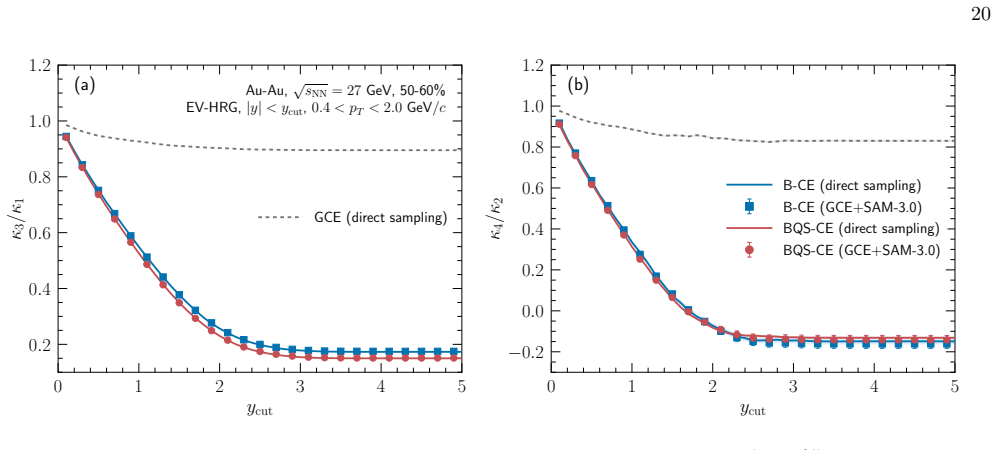
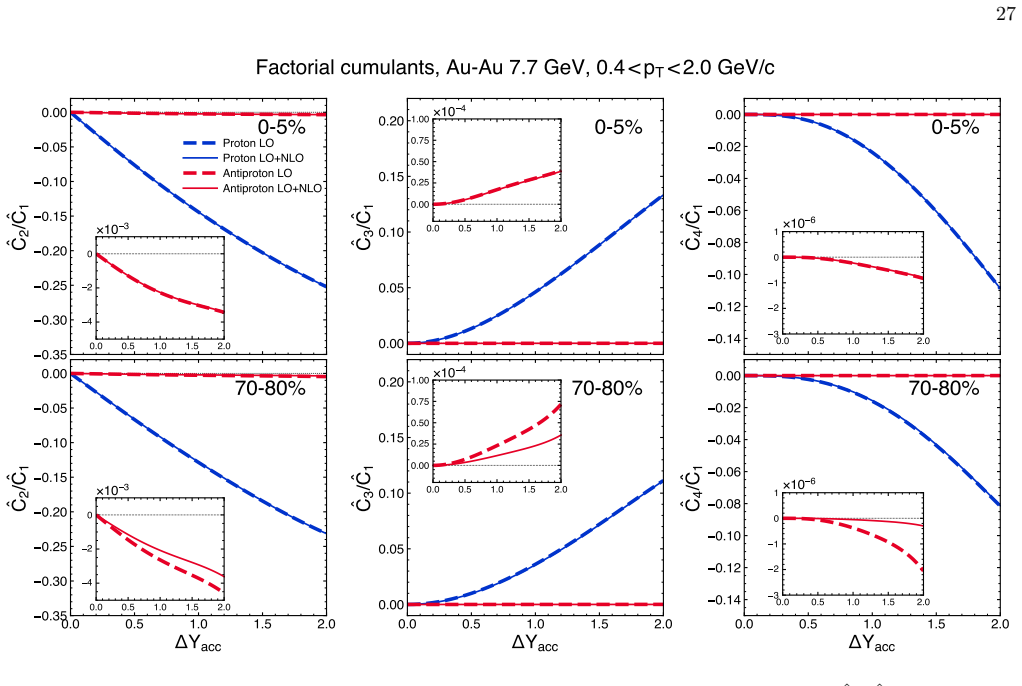
- The formalism is validated against Monte Carlo sampling that includes hadronic-afterburner effects.
Reading between the lines
- The algebraic structure may allow direct incorporation of exact conservation into existing grand-canonical model calculations without full canonical resampling.
- Refined baselines from this method could sharpen searches for non-monotonic cumulant behavior in heavy-ion data.
- The recursion might be combined with other expansion techniques to handle additional dynamical correlations beyond the ensembles considered.
Editorial analysis
A structured set of objections, weighed in public.
Referee Report
Summary. The manuscript presents the Subensemble Acceptance Method 3.0 (SAM-3.0) for correcting cumulants of observables measured in a subsystem to account for exact global conservation of multiple charges. The required inputs are the joint grand-canonical cumulants of the acceptance observable with the total event charges; the canonical cumulants are then obtained algebraically via a closed recursion based on multivariate partial exponential Bell polynomials. The framework generalizes SAM-1.0 and SAM-2.0, reproduces the exact binomial-acceptance limit, accommodates arbitrary numbers of observables and charges (including energy for the microcanonical ensemble), derives leading finite-size corrections from the saddle-point expansion, updates the Hydro-EV non-critical baseline for net-proton cumulants at RHIC-BES energies, and validates the results against direct Monte Carlo sampling with exact simultaneous conservation of baryon number, electric charge, and strangeness, including afterburner effects.
Significance. If the algebraic mapping holds, the work supplies an exact, general, and parameter-free tool for conservation corrections in cumulant measurements. This is valuable for establishing reliable non-critical baselines in heavy-ion collision fluctuation studies. The closed recursion on standard combinatorial objects (multivariate partial exponential Bell polynomials) together with direct Monte Carlo validation against exact sampling constitutes a clear methodological advance over prior versions.
minor comments (2)
- [Introduction / Methods] The abstract states that the mapping contains SAM-1.0 and SAM-2.0 as special cases; the main text should include an explicit paragraph or appendix showing the reduction conditions for each prior version to aid readers.
- [Formalism] Notation for the multivariate partial exponential Bell polynomials should be cross-referenced to a standard reference (e.g., the original Bell or Comtet) at first appearance to ensure reproducibility.
Simulated Author's Rebuttal
We thank the referee for the positive assessment, accurate summary of the SAM-3.0 framework, and the recommendation to accept. No major comments were raised that require clarification or revision.
Circularity Check
No significant circularity identified
full rationale
The central derivation is an exact algebraic recursion expressing canonical cumulants in terms of supplied joint grand-canonical cumulants via multivariate partial exponential Bell polynomials. This mapping is self-contained combinatorial mathematics, contains earlier SAM versions only as special cases, reproduces the binomial limit by direct substitution, and is validated by independent Monte Carlo sampling with exact conservation. No parameter is fitted to the target observable, no uniqueness theorem is imported from self-citation to force the result, and the hydrodynamics baseline is an external application rather than an internal input. The derivation therefore stands on its own equations without reduction to its inputs by construction.
Assumptions & free parameters
assumptions (1)
- standard math Canonical cumulants follow algebraically from grand-canonical joint cumulants via a closed recursion based on multivariate partial exponential Bell polynomials
Cite this review
Pith. "Pith review of Subensemble Acceptance Method 3.0: General Corrections to Cumulants from Exact Conservation Constraints." pith.science (2026). https://pith.science/paper/QREP7A6O
@misc{pith2026260701783,
  author       = {Pith},
  title        = {Pith review of: Subensemble Acceptance Method 3.0: General Corrections to Cumulants from Exact Conservation Constraints},
  year         = {2026},
  howpublished = {\url{https://pith.science/paper/QREP7A6O}},
  note         = {Machine review of arXiv:2607.01783}
}
read the original abstract
We present the subensemble acceptance method 3.0 (SAM-3.0), which corrects cumulants of an observable measured in a subsystem of a large system for the effect of exact global conservation of multiple charges. The required input is the set of joint grand-canonical cumulants of the acceptance observable with the total event charges, from which the canonical cumulants follow algebraically via a closed recursion based on (multivariate) partial exponential Bell polynomials. The framework accommodates any number of observables, including non-conserved quantities such as net protons, and any number of simultaneously conserved charges, including the total energy, which yields the microcanonical ensemble. The mapping contains SAM-1.0 and SAM-2.0 as special cases and, unlike SAM-2.0, reproduces the exact binomial-acceptance limit. We also derive the leading finite-size corrections from the saddle-point expansion. We apply the method to update the hydrodynamics-based non-critical baseline (Hydro-EV) for net-proton cumulants at RHIC-BES energies, finding a refined baseline that agrees with direct canonical Monte Carlo sampling and stays close to the earlier SAM-2.0 result. We further validate the formalism against direct Monte Carlo sampling with exact simultaneous conservation of baryon number, electric charge, and strangeness, including hadronic-afterburner effects.
Figures
Figures from the paper (2 more)
Forward citations
Cited by 1 Pith paper
-
Theoretical Review of Critical Point Predictions
A review of QCD critical point theory structured around the maximum entropy freeze-out framework for connecting hydrodynamic fluctuations to proton factorial cumulants, plus the dynamics of critical fluctuations.
Reference graph
Works this paper leans on
-
[1]
Single observable and single conserved charge In the one-dimensional setting of Sec. II (d=1,s=1), with an arbitrary observableXin the acceptance and a single conserved chargeB tot, assumption (ii) impliesκ n,m(Xin, Btot) =κ n,m(Xin, Bin) forn≥1, since all cross- correlations withB out vanish upon expandingB tot =B in +B out. The right-hand side is a pure...
-
[2]
Multiple observables and conserved charges In the multidimensional setting of Sec. III (dobservables,scharges), the SAM-1.0 assumptions generalize, forn̸=0, to κXB n m (Xin,B tot) =α κ XB n m (Xtot,B tot).(77) For a single observableX, the second-order diagonal canonical cumulant (60) becomes κX|B 2 =α β κ Xtot 2 +α 2 κXtot 2 −κ(X tot, Ba) (K−1)ab κ(Xtot,...
-
[3]
Single conserved particle number A useful analytic benchmark is provided by the binomial acceptance limit, where an observed conserved charge inside the acceptance is obtained by independent Bernoulli sampling from the corresponding total charge carriers in the full event [43]. In the present setup, we assume that the single charge corresponds to a conser...
-
[4]
Multiple conserved charges The multidimensional binomial-acceptance framework, with species-dependent acceptance probabilities and arbi- trary observables, is derived in Appendix C. There we obtain the canonical multi-charge binomial cumulants without deriving the constrained multivariate distribution: we compute the unconstrained grand-canonical binomial...
work page 2025
-
[5]
M. A. Stephanov, K. Rajagopal, and E. V. Shuryak, Signatures of the tricritical point in QCD, Phys. Rev. Lett.81, 4816 (1998), arXiv:hep-ph/9806219 [hep-ph]
work page Pith review arXiv 1998
-
[6]
M. A. Stephanov, K. Rajagopal, and E. V. Shuryak, Event-by-event fluctuations in heavy ion collisions and the QCD critical point, Phys. Rev. D60, 114028 (1999), arXiv:hep-ph/9903292 [hep-ph]
work page Pith review arXiv 1999
-
[7]
M. A. Stephanov, Non-Gaussian Fluctuations near the QCD Critical Point, Phys. Rev. Lett.102, 032301 (2009), arXiv:0809.3450 [hep-ph]
work page Pith review arXiv 2009
-
[8]
M. A. Stephanov, Sign of Kurtosis near the QCD Critical Point, Phys. Rev. Lett.107, 052301 (2011), arXiv:1104.1627 [hep-ph]
work page Pith review arXiv 2011
Show all 67 references
-
[9]
Bazavovet al., The QCD Equation of State toO(µ 6 B) from Lattice QCD, Phys
A. Bazavovet al., The QCD Equation of State toO(µ 6 B) from Lattice QCD, Phys. Rev. D95, 054504 (2017), arXiv:1701.04325 [hep-lat]
2017 arXiv
-
[10]
Borsanyi, Z
S. Borsanyi, Z. Fodor, J. N. Guenther, S. K. Katz, K. K. Szabo, A. Pasztor, I. Portillo, and C. Ratti, Higher order fluctuations and correlations of conserved charges from lattice QCD, JHEP10, 205, arXiv:1805.04445 [hep-lat]
-
[11]
Adamczyket al.(STAR), Energy Dependence of Moments of Net-proton Multiplicity Distributions at RHIC, Phys
L. Adamczyket al.(STAR), Energy Dependence of Moments of Net-proton Multiplicity Distributions at RHIC, Phys. Rev. Lett.112, 032302 (2014), arXiv:1309.5681 [nucl-ex]
2014 arXiv
-
[12]
Adamet al.(STAR), Nonmonotonic Energy Dependence of Net-Proton Number Fluctuations, Phys
J. Adamet al.(STAR), Nonmonotonic Energy Dependence of Net-Proton Number Fluctuations, Phys. Rev. Lett.126, 092301 (2021), arXiv:2001.02852 [nucl-ex]
2021
-
[13]
M. S. Abdallahet al.(STAR), Cumulants and correlation functions of net-proton, proton, and antiproton multiplicity distributions in Au+Au collisions at energies available at the BNL Relativistic Heavy Ion Collider, Phys. Rev. C104, 024902 (2021), arXiv:2101.12413 [nucl-ex]
2021
-
[14]
B. E. Aboonaet al.(STAR), Precision Measurement of Net-Proton-Number Fluctuations in Au+Au Collisions at RHIC, Phys. Rev. Lett.135, 142301 (2025), arXiv:2504.00817 [nucl-ex]
2025
-
[15]
Adamczewski-Muschet al.(HADES), Proton-number fluctuations in √sNN = 2.4 GeV Au+Au collisions studied with the High-Acceptance DiElectron Spectrometer (HADES), Phys
J. Adamczewski-Muschet al.(HADES), Proton-number fluctuations in √sNN = 2.4 GeV Au+Au collisions studied with the High-Acceptance DiElectron Spectrometer (HADES), Phys. Rev. C102, 024914 (2020), arXiv:2002.08701 [nucl-ex]
2020
-
[16]
Acharyaet al.(ALICE), Global baryon number conservation encoded in net-proton fluctuations measured in Pb-Pb collisions at √sNN = 2.76 TeV, Phys
S. Acharyaet al.(ALICE), Global baryon number conservation encoded in net-proton fluctuations measured in Pb-Pb collisions at √sNN = 2.76 TeV, Phys. Lett. B807, 135564 (2020), arXiv:1910.14396 [nucl-ex]
2020
-
[17]
Acharyaet al.(ALICE), Closing in on critical net-baryon fluctuations at LHC energies: cumulants up to third order in Pb-Pb collisions, Phys
S. Acharyaet al.(ALICE), Closing in on critical net-baryon fluctuations at LHC energies: cumulants up to third order in Pb-Pb collisions, Phys. Lett. B844, 137545 (2023), arXiv:2206.03343 [nucl-ex]
2023
-
[18]
Isserstedt, M
P. Isserstedt, M. Buballa, C. S. Fischer, and P. J. Gunkel, Baryon number fluctuations in the QCD phase diagram from Dyson-Schwinger equations, Phys. Rev. D100, 074011 (2019), arXiv:1906.11644 [hep-ph]
2019
-
[19]
W.-j. Fu, J. M. Pawlowski, and F. Rennecke, QCD phase structure at finite temperature and density, Phys. Rev. D101, 054032 (2020), arXiv:1909.02991 [hep-ph]
2020
-
[20]
Gao and J
F. Gao and J. M. Pawlowski, QCD phase structure from functional methods, Phys. Rev. D102, 034027 (2020), arXiv:2002.07500 [hep-ph]
2020
-
[21]
M. P. Pradeep, J. Karthein, K. Rajagopal, M. Stephanov, and Y. Yin, Freezing out fluctuations in Hydro+ near the QCD critical point, Phys. Rev. Lett.130, 162301 (2023), arXiv:2211.09142 [hep-ph]
2023
-
[22]
J. M. Karthein, M. S. Pradeep, K. Rajagopal, M. Stephanov, and Y. Yin, Quantifying fluctuation signatures of the QCD critical point using maximum entropy freeze-out, Phys. Rev. D113, 074010 (2026), arXiv:2508.19237 [nucl-th]
2026
-
[23]
Schwarz, D
C. Schwarz, D. Oliinychenko, L. G. Pang, S. Ryu, and H. Petersen, Different realizations of Cooper–Frye sampling with conservation laws, J. Phys. G45, 015001 (2018), arXiv:1707.07026 [hep-ph]
2018 arXiv
-
[24]
Oliinychenko and V
D. Oliinychenko and V. Koch, Microcanonical Particlization with Local Conservation Laws, Phys. Rev. Lett.123, 182302 (2019), arXiv:1902.09775 [hep-ph]
2019
-
[25]
Vovchenko and V
V. Vovchenko and V. Koch, Particlization of an interacting hadron resonance gas with global conservation laws for event- by-event fluctuations in heavy-ion collisions, Phys. Rev. C103, 044903 (2021), arXiv:2012.09954 [hep-ph]. 23
2021
-
[26]
Koch, Hadronic Fluctuations and Correlations, inRelativistic Heavy Ion Physics, edited by R
V. Koch, Hadronic Fluctuations and Correlations, inRelativistic Heavy Ion Physics, edited by R. Stock (2010) pp. 626–652, arXiv:0810.2520 [nucl-th]
2010 arXiv
-
[27]
V. V. Begun, M. Gazdzicki, M. I. Gorenstein, and O. S. Zozulya, Particle number fluctuations in canonical ensemble, Phys. Rev. C70, 034901 (2004), arXiv:nucl-th/0404056
2004 arXiv
-
[28]
Bzdak, V
A. Bzdak, V. Koch, and V. Skokov, Baryon number conservation and the cumulants of the net proton distribution, Phys. Rev. C87, 014901 (2013), arXiv:1203.4529 [hep-ph]
2013 arXiv
-
[29]
Braun-Munzinger, A
P. Braun-Munzinger, A. Rustamov, and J. Stachel, Bridging the gap between event-by-event fluctuation measurements and theory predictions in relativistic nuclear collisions, Nucl. Phys. A960, 114 (2017), arXiv:1612.00702 [nucl-th]
2017 arXiv
-
[30]
Braun-Munzinger, B
P. Braun-Munzinger, B. Friman, K. Redlich, A. Rustamov, and J. Stachel, Relativistic nuclear collisions: Establishing a non-critical baseline for fluctuation measurements, Nucl. Phys. A1008, 122141 (2021), arXiv:2007.02463 [nucl-th]
2021
-
[31]
Savchuk and S
O. Savchuk and S. Pratt, Correlations of conserved quantities at finite baryon density, Phys. Rev. C109, 024910 (2024), arXiv:2311.02046 [nucl-th]
2024
-
[32]
Jaiswal and A
S. Jaiswal and A. Jaiswal, Equilibrium Statistics as Conditional Laws and Conservation-Induced Correlations, (2026), arXiv:2606.29050 [hep-ph]
2026 arXiv
-
[33]
Vovchenko, O
V. Vovchenko, O. Savchuk, R. V. Poberezhnyuk, M. I. Gorenstein, and V. Koch, Connecting fluctuation measurements in heavy-ion collisions with the grand-canonical susceptibilities, Phys. Lett. B811, 135868 (2020), arXiv:2003.13905 [hep-ph]
2020
-
[34]
R. V. Poberezhnyuk, O. Savchuk, M. I. Gorenstein, V. Vovchenko, K. Taradiy, V. V. Begun, L. Satarov, J. Steinheimer, and H. Stoecker, Critical point fluctuations: Finite size and global charge conservation effects, Phys. Rev. C102, 024908 (2020), arXiv:2004.14358 [nucl-th]
2020
-
[35]
Vovchenko, R
V. Vovchenko, R. V. Poberezhnyuk, and V. Koch, Cumulants of multiple conserved charges and global conservation laws, JHEP10, 089, arXiv:2007.03850 [hep-ph]
2007
-
[36]
Barej and A
M. Barej and A. Bzdak, Factorial cumulants from short-range correlations and global baryon number conservation, Phys. Rev. C106, 024904 (2022), arXiv:2205.05497 [hep-ph]
2022
-
[37]
Barej and A
M. Barej and A. Bzdak, Cumulants from short-range correlations and baryon number conservation at next-to-leading order, Phys. Rev. C107, 034914 (2023), arXiv:2210.15394 [hep-ph]
2023
-
[38]
Vovchenko, Correcting event-by-event fluctuations in heavy-ion collisions for exact global conservation laws with the generalized subensemble acceptance method, Phys
V. Vovchenko, Correcting event-by-event fluctuations in heavy-ion collisions for exact global conservation laws with the generalized subensemble acceptance method, Phys. Rev. C105, 014903 (2022), arXiv:2106.13775 [hep-ph]
2022
-
[39]
Vovchenko, V
V. Vovchenko, V. Koch, and C. Shen, Proton number cumulants and correlation functions in Au-Au collisions at sNN=7.7–200 GeV from hydrodynamics, Phys. Rev. C105, 014904 (2022), arXiv:2107.00163 [hep-ph]
2022
-
[40]
R. B. Leipnik and C. E. Pearce, The multivariate faa di bruno formula and multivariate taylor expansions with explicit integral remainder term, The ANZIAM Journal48, 327 (2007)
2007
-
[41]
Poberezhniuk, V
R. Poberezhniuk, V. A. Kuznietsov, G. Pihan, and V. Vovchenko, SAM-3.0:Mathematicaand C++ implementation, https://github.com/UH-Physics-NuclearTheory/SAM3(2026)
2026
-
[42]
Constantine and T
G. Constantine and T. Savits, A multivariate faa di bruno formula with applications, Transactions of the American Mathematical Society348, 503 (1996)
1996
-
[43]
Comtet,Advanced Combinatorics(D
L. Comtet,Advanced Combinatorics(D. Reidel Publishing Company, Dordrecht, 1974)
1974
-
[44]
C. S. Withers and S. Nadarajah, Multivariate Bell polynomials and their applications to powers and fractionary iterates of vector power series and to partial derivatives of composite vector functions, Appl. Math. Comput.206, 997 (2008)
2008
-
[45]
Schumann, Multivariate Bell Polynomials and Derivatives of Composed Functions, (2019), arXiv:1903.03899 [math.CA]
A. Schumann, Multivariate Bell Polynomials and Derivatives of Composed Functions, (2019), arXiv:1903.03899 [math.CA]
2019 arXiv
-
[46]
Haiman and W
M. Haiman and W. Schmitt, Incidence algebra antipodes and lagrange inversion in one and several variables, Journal of Combinatorial Theory, Series A50, 172 (1989)
1989
-
[47]
Savchuk, R
O. Savchuk, R. V. Poberezhnyuk, V. Vovchenko, and M. I. Gorenstein, Binomial acceptance corrections for particle number distributions in high-energy reactions, Phys. Rev. C101, 024917 (2020), arXiv:1911.03426 [nucl-th]
2020
-
[48]
V. A. Kuznietsov, O. Savchuk, M. I. Gorenstein, V. Koch, and V. Vovchenko, Critical point particle number fluctuations from molecular dynamics, Phys. Rev. C105, 044903 (2022), arXiv:2201.08486 [hep-ph]
2022
-
[49]
V. A. Kuznietsov, R. Poberezhniuk, M. I. Gorenstein, V. Koch, and V. Vovchenko, High-order cumulants and correlation functions near the critical point from molecular dynamics, Phys. Rev. C113, 045209 (2026), arXiv:2511.00755 [nucl-th]
2026
-
[50]
Kitazawa, Efficient formulas for efficiency correction of cumulants, Phys
M. Kitazawa, Efficient formulas for efficiency correction of cumulants, Phys. Rev. C93, 044911 (2016), arXiv:1602.01234 [nucl-th]
2016 arXiv
-
[51]
Kitazawa and M
M. Kitazawa and M. Asakawa, Revealing baryon number fluctuations from proton number fluctuations in relativistic heavy ion collisions, Phys. Rev. C85, 021901 (2012), arXiv:1107.2755 [nucl-th]
2012 arXiv
-
[52]
Kitazawa and M
M. Kitazawa and M. Asakawa, Relation between baryon number fluctuations and experimentally observed proton number fluctuations in relativistic heavy ion collisions, Phys. Rev. C86, 024904 (2012), arXiv:1205.3292 [nucl-th]
2012 arXiv
-
[53]
Savchuk, R
O. Savchuk, R. V. Poberezhnyuk, and M. I. Gorenstein, Possible origin of HADES data on proton number fluctuations in Au+Au collisions, Phys. Lett. B835, 137540 (2022), arXiv:2209.01883 [nucl-th]
2022
-
[54]
Vovchenko and H
V. Vovchenko and H. Stoecker, Thermal-FIST: A package for heavy-ion collisions and hadronic equation of state, Comput. Phys. Commun.244, 295 (2019), arXiv:1901.05249 [nucl-th]
2019
-
[55]
Vovchenko, Cooper-Frye sampling with short-range repulsion, Phys
V. Vovchenko, Cooper-Frye sampling with short-range repulsion, Phys. Rev. C106, 064906 (2022), arXiv:2208.13693 [nucl-th]
2022
-
[56]
Schenke, S
B. Schenke, S. Jeon, and C. Gale, (3+1)D hydrodynamic simulation of relativistic heavy-ion collisions, Phys. Rev. C82, 014903 (2010), arXiv:1004.1408 [hep-ph]
2010 arXiv
-
[57]
Schenke, S
B. Schenke, S. Jeon, and C. Gale, Elliptic and triangular flow in event-by-event (3+1)D viscous hydrodynamics, Phys. Rev. Lett.106, 042301 (2011), arXiv:1009.3244 [hep-ph]
2011 arXiv
-
[58]
Paquet, C
J.-F. Paquet, C. Shen, G. S. Denicol, M. Luzum, B. Schenke, S. Jeon, and C. Gale, Production of photons in relativistic 24 heavy-ion collisions, Phys. Rev. C93, 044906 (2016), arXiv:1509.06738 [hep-ph]
2016 arXiv
-
[59]
Huovinen and H
P. Huovinen and H. Petersen, Particlization in hybrid models, Eur. Phys. J. A48, 171 (2012), arXiv:1206.3371 [nucl-th]
2012 arXiv
-
[60]
S. A. Basset al., Microscopic models for ultrarelativistic heavy ion collisions, Prog. Part. Nucl. Phys.41, 255 (1998), arXiv:nucl-th/9803035
1998 arXiv
-
[61]
Bleicheret al., Relativistic hadron hadron collisions in the ultrarelativistic quantum molecular dynamics model, J
M. Bleicheret al., Relativistic hadron hadron collisions in the ultrarelativistic quantum molecular dynamics model, J. Phys. G25, 1859 (1999), arXiv:hep-ph/9909407
1999 arXiv
-
[62]
Bernhard, UrQMD tailored for use as a hadronic afterburner (2020), https://github.com/jbernhard/urqmd-afterburner [Online; accessed 09-May-2021]
J. Bernhard, UrQMD tailored for use as a hadronic afterburner (2020), https://github.com/jbernhard/urqmd-afterburner [Online; accessed 09-May-2021]
2020
-
[63]
Bozek and W
P. Bozek and W. Broniowski, Charge conservation and the shape of the ridge of two-particle correlations in relativistic heavy-ion collisions, Phys. Rev. Lett.109, 062301 (2012), arXiv:1204.3580 [nucl-th]
2012 arXiv
-
[64]
Sakaida, M
M. Sakaida, M. Asakawa, and M. Kitazawa, Effects of global charge conservation on time evolution of cumulants of conserved charges in relativistic heavy ion collisions, Phys. Rev. C90, 064911 (2014), arXiv:1409.6866 [nucl-th]
2014 arXiv
-
[65]
Vovchenko, Density correlations under global and local charge conservation, Phys
V. Vovchenko, Density correlations under global and local charge conservation, Phys. Rev. C110, L061902 (2024), arXiv:2409.01397 [hep-ph]
2024
-
[66]
Ciacco, S
M. Ciacco, S. Kundu, V. A. Kuznietsov, M. Puccio, and V. Vovchenko, Canonical statistical hadronization with local baryon conservation for higher-order cumulants, (2026), arXiv:2605.30710 [hep-ph]
2026 arXiv
-
[67]
Y b∈π V(|b|) ib;a b #
G. Basar, M. Pradeep, and M. Stephanov, Equation of state and cumulants of proton multiplicity in equilibrium near critical point from Pade estimates, (2026), arXiv:2603.23635 [nucl-th]. Appendix A: Finite-size effects In Sec. II we approximated lnI(t)≃F 0(t) by neglecting the...
2026
Reviewed July 3, 2026 · model on record in the stance chip above.
Discussion (0). Continue with ORCID to comment.