Effect of elastic anisotropy on phase separation in ternary alloys: A phase-field study
Pith reviewed 2026-05-25 17:42 UTC · model grok-4.3
The pith
Anisotropy in elastic moduli controls precipitate shape and alignment in ternary alloys by changing elastic interaction energies according to the sign and magnitude of relative misfits.
A machine-rendered reading of the paper's core claim, the machinery that carries it, and where it could break.
Core claim
The degree of anisotropy in elastic moduli modifies the elastic interaction energy between the precipitates depending on the sign and magnitude of relative misfits, and thus determines the shape and alignment of the inclusions in the microstructure. The spatiotemporal evolution of the composition field variables is governed by solving a set of coupled Cahn-Hilliard equations numerically using a semi-implicit Fourier spectral technique while incorporating elastic interaction energy between the misfitting phases.
What carries the argument
Phase-field model that adds elastic interaction energy (computed under linear anisotropic elasticity with coherent interfaces) to the Cahn-Hilliard equations, solved via semi-implicit Fourier spectral method, to evolve composition fields and track domain morphology.
If this is right
- Coherency strains between phases and alloy composition change the coherent phase equilibria and the decomposition pathways.
- Different levels of elastic anisotropy produce distinct domain morphologies and alignments along elastically soft directions.
- The sign and magnitude of relative misfits interact with anisotropy to select whether precipitates remain equiaxed or become elongated and oriented.
- Microstructural evolution depends on the combined influence of misfit strains, chemistry, and anisotropy rather than any single factor alone.
Where Pith is reading between the lines
- The results imply that materials designers could select alloy compositions or processing routes to exploit anisotropy for desired precipitate arrangements without changing the base chemistry.
- The same elastic-interaction mechanism might extend to predict coarsening rates or stability of modulated structures in related multi-phase systems.
- Quantitative mapping of anisotropy thresholds for alignment transitions could guide targeted experiments that vary temperature or strain to test the predicted morphology changes.
Load-bearing premise
The phase-field formulation that adds elastic interaction energy to the Cahn-Hilliard equations under linear elasticity and coherent interfaces is sufficient to represent the physics of real ternary alloy systems.
What would settle it
Direct comparison of simulated precipitate shapes and alignments with experimental microstructures (such as TEM images) in a ternary alloy of known elastic anisotropy and measured misfit strains, where mismatch in morphology for given misfit signs and magnitudes would disprove the claimed control by anisotropy.
Figures


read the original abstract
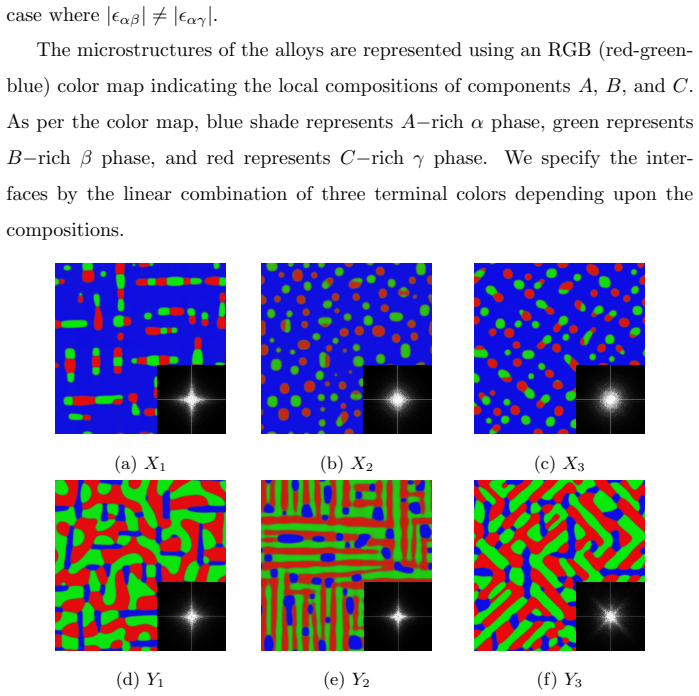
The precipitate shape, size and distribution are crucial factors which determine the properties of several technologically important alloys. Elastic interactions between the inclusions modify their morphology and align them along elastically favourable crystallographic directions. Among the several factors contributing to the elastic interaction energy between precipitating phases, anisotropy in elastic moduli is decisive in the emergence of modulated structures during phase separation in elastically coherent alloy systems. We employ a phase-field model incorporating elastic interaction energy between the misfitting phases to study microstructural evolution in ternary three-phase alloy systems when the elastic moduli are anisotropic. The spatiotemporal evolution of the composition field variables is governed by solving a set of coupled Cahn-Hilliard equations numerically using a semi-implicit Fourier spectral technique. We methodically vary the misfit strains, alloy chemistry and elastic anisotropy to investigate their influence on domain morphology during phase separation. The coherency strains between the phases and alloy composition alter the coherent phase equilibria and decomposition pathways. The degree of anisotropy in elastic moduli modifies the elastic interaction energy between the precipitates depending on the sign and magnitude of relative misfits, and thus determines the shape and alignment of the inclusions in the microstructure.
Editorial analysis
A structured set of objections, weighed in public.
Referee Report
Summary. The manuscript claims that elastic anisotropy in ternary alloys modifies the elastic interaction energy between misfitting precipitates (depending on the sign and magnitude of relative misfits), thereby controlling precipitate shape and alignment during phase separation. This is investigated via a phase-field model that augments the Cahn-Hilliard equations with elastic energy under linear (isotropic or anisotropic) elasticity and coherent interfaces; the coupled equations are integrated numerically with a semi-implicit Fourier spectral method while systematically varying misfit strains, overall composition, and anisotropy ratios.
Significance. If the reported morphologies are robust, the work supplies a useful parameter-space map of how anisotropy interacts with misfit sign/magnitude and composition to select aligned or modulated microstructures. The forward numerical construction (independent input parameters, no post-hoc fitting) and use of a standard spectral solver constitute clear strengths for reproducibility within the phase-field literature.
minor comments (3)
- [Abstract] The abstract states that 'the coherency strains between the phases and alloy composition alter the coherent phase equilibria,' but the manuscript should explicitly show (e.g., via a supplementary plot or table) how the common-tangent construction or effective free-energy minima shift with the elastic term.
- Section describing the elastic-energy implementation should include the explicit form of the anisotropic stiffness tensor (or the Voigt notation used) and confirm that the Fourier-space solution of the mechanical equilibrium equation is performed at every time step or via the Khachaturyan approximation.
- Figure captions and text should state the precise values of the anisotropy ratios (e.g., C11/C44 or the Zener ratio) and the three independent misfit components employed in each simulation set.
Simulated Author's Rebuttal
We thank the referee for the positive summary of our phase-field study on elastic anisotropy effects in ternary alloys and for recommending minor revision. No specific major comments were provided in the report.
Circularity Check
No significant circularity; results from independent forward simulation
full rationale
The paper reports outcomes of numerical solution of coupled Cahn-Hilliard equations with an added elastic interaction energy term evaluated under linear anisotropic elasticity and coherent-interface assumptions. Input parameters (misfit strains, anisotropy ratios, compositions) are selected independently and swept systematically; morphologies emerge as direct consequences of the forward integration. No equation reduces to its own inputs by construction, no fitted parameter is relabeled as a prediction, and no load-bearing premise rests on a self-citation chain. The derivation chain is therefore self-contained against external benchmarks.
Axiom & Free-Parameter Ledger
free parameters (3)
- misfit strains
- elastic anisotropy ratios
- overall alloy composition
axioms (2)
- domain assumption Elastic interaction energy between misfitting coherent phases can be added to the total free energy functional of the Cahn-Hilliard model.
- domain assumption The semi-implicit Fourier spectral method accurately integrates the coupled Cahn-Hilliard equations without introducing numerical artifacts that alter morphology.
Lean theorems connected to this paper
-
IndisputableMonolith/Foundation/RealityFromDistinction.leanreality_from_one_distinction unclear?
unclearRelation between the paper passage and the cited Recognition theorem.
We employ a phase-field model incorporating elastic interaction energy between the misfitting phases... governed by solving a set of coupled Cahn-Hilliard equations numerically using a semi-implicit Fourier spectral technique.
-
IndisputableMonolith/Cost/FunctionalEquation.leanwashburn_uniqueness_aczel unclear?
unclearRelation between the paper passage and the cited Recognition theorem.
The elastic interaction energy contribution... Bpq(n) = λijkl ϵ(p)ij ϵ(q)kl − ni σ̂ij(p) ωjk(n) σ̂kl(q) nl
What do these tags mean?
- matches
- The paper's claim is directly supported by a theorem in the formal canon.
- supports
- The theorem supports part of the paper's argument, but the paper may add assumptions or extra steps.
- extends
- The paper goes beyond the formal theorem; the theorem is a base layer rather than the whole result.
- uses
- The paper appears to rely on the theorem as machinery.
- contradicts
- The paper's claim conflicts with a theorem or certificate in the canon.
- unclear
- Pith found a possible connection, but the passage is too broad, indirect, or ambiguous to say the theorem truly supports the claim.
Reference graph
Works this paper leans on
-
[1]
A. G. Khachaturyan, Theory of structural transformations in solids, Courier Corporation, 2013
work page 2013
-
[2]
Mura, Micromechanics of defects in solids, Springer Science & Business Media, 2013
T. Mura, Micromechanics of defects in solids, Springer Science & Business Media, 2013
work page 2013
-
[3]
J. W. Cahn, On spinodal decomposition in cubic crystals, Acta metallurgica 10 (3) (1962) 179–183
work page 1962
-
[4]
A. J. Ardell, R. B. Nicholson, On the modulated structure of aged Ni-Al alloys: with an Appendix On the elastic interaction between inclusions by JD Eshelby, Acta metallurgica 14 (10) (1966) 1295–1309. 11
work page 1966
-
[5]
K. J. De Vos, Microstructure of alnico alloys, Journal of Applied Physics 37 (3) (1966) 1100–1100
work page 1966
-
[6]
E. P. Butler, G. Thomas, Structure and properties of spinodally decom- posed Cu-Ni-Fe alloys, Acta metallurgica 18 (3) (1970) 347–365
work page 1970
-
[7]
R. J. Livak, G. Thomas, Spinodally decomposed Cu-Ni-Fe alloys of asym- metrical compositions, Acta Metallurgica 19 (6) (1971) 497–505
work page 1971
-
[8]
J. Higgins, R. B. Nicholson, P. Wilkes, Precipitation in the iron-beryllium system, Acta Metallurgica 22 (2) (1974) 201–217
work page 1974
-
[9]
H. Kubo, M. Wayman, Spinodal decomposition of beta brass, Metallurgical Transactions A 10 (5) (1979) 633–643
work page 1979
-
[10]
Y. U. D. Tyapkin, I. V. Gongadze, E. I. Malienko, Structural mechanism of coalescence of ageing Ni-Cu-Si alloys, Phys. Met. Metallogr.(USSR) 66 (3) (1988) 160–168
work page 1988
-
[11]
Y. U. D. Tyapkin, E. I. Malienko, I. V. Gongadze, I. S. Kalashinko, S. M. Komarov, Coalescence in alloy Fe-Mn-Al-C at the stage of a fragmentary regular structure, Phys. Met. Metallogr.(USSR) 68 (3) (1989) 121–128
work page 1989
-
[12]
T. Miyazaki, M. Doi, Shape bifurcations in the coarsening of precipitates in elastically constrained systems, Materials Science and Engineering: A 110 (1989) 175–185
work page 1989
-
[13]
A. D. Sequeira, H. A. Calderon, G. Kostorz, Shape and growth anomalies of γ’precipitates in Ni-Al-Mo alloys induced by elastic interaction, Scripta metallurgica et materialia 30 (1) (1994) 7–12
work page 1994
-
[14]
M. F¨ ahrmann, P. Fratzl, O. Paris, E. F¨ ahrmann, W. C. Johnson, Influence of coherency stress on microstructural evolution in model Ni-Al-Mo alloys, Acta Metallurgica et Materialia 43 (3) (1995) 1007–1022. 12
work page 1995
-
[15]
Y. Inuzuka, S. Ito, T. Kozakai, et al., TEM observations of precipitation of coherent L12 and D022 ordered phases in Ni-V-Ge alloys, in: Materials Science Forum, Vol. 561, Trans Tech Publications, 2007, pp. 2365–2368
work page 2007
-
[16]
T. Kozakai, D. Sakurai, et al., Substitution effect of the third element X on the morphology of A1/L12/D022 three-phase microstructure in Ni-VX (X= Si, Al) alloy, in: Solid State Phenomena, Vol. 172, Trans Tech Publications, 2011, pp. 236–241
work page 2011
-
[17]
P. W. Voorhees, G. B. McFadden, W. C. Johnson, On the morphological development of second-phase particles in elastically-stressed solids, Acta Metallurgica et Materialia 40 (11) (1992) 2979–2992
work page 1992
-
[18]
M. E. Thompson, C. S. Su, P. W. Voorhees, The equilibrium shape of a misfitting precipitate, Acta metallurgica et materialia 42 (6) (1994) 2107– 2122
work page 1994
-
[19]
C. H. Su, P. W. Voorhees, The dynamics of precipitate evolution in elas- tically stressed solids-I. Inverse coarsening, Acta materialia 44 (5) (1996) 1987–1999
work page 1996
-
[20]
C. H. Su, P. W. Voorhees, The dynamics of precipitate evolution in elas- tically stressed solids-II. Particle alignment, Acta materialia 44 (5) (1996) 2001–2016
work page 1996
-
[21]
Y. Wang, L. Q. Chen, A. G. Khachaturyan, Particle translational motion and reverse coarsening phenomena in multiparticle systems induced by a long-range elastic interaction, Physical Review B 46 (17) (1992) 11194
work page 1992
-
[22]
H. Nishimori, A. Onuki, Pattern formation in phase-separating alloys with cubic symmetry, Physical Review B 42 (1) (1990) 980
work page 1990
-
[23]
Y. Wang, L. Q. Chen, A. G. Khachaturyan, Strain-induced modulated structures in two-phase cubic alloys, Scripta Metallurgica et Materiala 25 (8) (1991) 1969–1974. 13
work page 1991
-
[24]
Y. Wang, L. Q. Chen, A. G. Khachaturyan, Kinetics of strain-induced morphological transformation in cubic alloys with a miscibility gap, Acta Metallurgica et Materialia 41 (1) (1993) 279–296
work page 1993
- [25]
-
[26]
S. Y. Hu, L. Q. Chen, A phase-field model for evolving microstructures with strong elastic inhomogeneity, Acta materialia 49 (11) (2001) 1879–1890
work page 2001
-
[27]
D. J. Eyre, Systems of Cahn-Hilliard equations, SIAM Journal on Applied Mathematics 53 (6) (1993) 1686–1712
work page 1993
-
[28]
S. Bhattacharyya, T. A. Abinandanan, A study of phase separation in ternary alloys, Bull. Mater. Sci 26 (1) (2003) 193–197
work page 2003
- [29]
-
[30]
A. R. Allnatt, A. B. Lidiard, Atomic Transport in Solids, Cambridge Uni- versity Press, 2003
work page 2003
-
[31]
L. Q. Chen, J. Shen, Applications of semi-implicit Fourier-spectral method to phase field equations, Computer Physics Communications 108 (2-3) (1998) 147–158
work page 1998
-
[32]
J. Zhu, L. Q. Chen, J. Shen, V. Tikare, Coarsening kinetics from a variable- mobility Cahn-Hilliard equation: Application of a semi-implicit Fourier spectral method, Phys. Rev. E 60 (4) (1999) 3564–3572. 14
work page 1999
discussion (0)
Sign in with ORCID, Apple, or X to comment. Anyone can read and Pith papers without signing in.