Conclusive nonlinear phase sensitivity limit for a Mach-Zehnder interferometer with single-mode non-vacuum inputs
Pith reviewed 2026-05-25 16:13 UTC · model grok-4.3
The pith
Nonlinear Mach-Zehnder interferometers with single-mode non-vacuum inputs lose the shot-noise sensitivity bound under second-order phase shifts.
A machine-rendered reading of the paper's core claim, the machinery that carries it, and where it could break.
Core claim
Within the reach of second-order nonlinear phase shifts, the shot-noise-style sensitivity limit is no longer available for a nonlinear Mach-Zehnder interferometer with single-mode non-vacuum inputs; squeezed vacuum is the ideal candidate.
What carries the argument
Phase-averaging approach to quantum Fisher information, applied to three classes of single-mode non-vacuum inputs.
Load-bearing premise
The phase-averaging method used to compute quantum Fisher information fully captures the sensitivity without additional restrictions from detection or interaction details.
What would settle it
An explicit calculation or measurement of quantum Fisher information for squeezed vacuum input that recovers a 1/sqrt(N) scaling under second-order nonlinear phase shifts would falsify the central claim.
Figures


read the original abstract
Many works have stated that nonlinear interactions can improve phase sensitivity beyond the Heisenberg limit scaling of $1/N$ with $N$ being the mean photon number. This raises some open questions---among them the conclusive sensitivity limits with respect to single-mode inputs. Namely, when one of two inputs is vacuum, is there a shot-noise-style sensitivity bound on a nonlinear Mach-Zehnder interferometer? Within the reach of second-order nonlinear phase shifts, we make an attempt to provide an answer to this question. Based upon phase-averaging approach, this puzzle is partially resolved with careful calculations of the quantum Fisher information regarding three kinds of common inputs: Gaussian states, squeezed number states, and Schr\"odinger cat states. The results suggest that shot-noise-style sensitivity limit is no longer available, and the ideal candidate is squeezed vacuum.
Editorial analysis
A structured set of objections, weighed in public.
Referee Report
Summary. The paper examines conclusive sensitivity limits for a nonlinear Mach-Zehnder interferometer with one vacuum port and second-order nonlinear phase shifts. Using a phase-averaging procedure to evaluate the quantum Fisher information for Gaussian states, squeezed-number states, and Schrödinger cat states, it concludes that the conventional shot-noise-style bound is unavailable and that squeezed vacuum is the optimal single-mode input.
Significance. If the phase-averaging QFI calculation is valid and corresponds to achievable precision in the physical interferometer, the result would remove the standard shot-noise scaling for this class of nonlinear metrology problems and identify squeezed vacuum as the preferred input. This would be a substantive clarification for quantum metrology with nonlinear phase shifts.
major comments (2)
- [Abstract / phase-averaging method] Abstract and methods (phase-averaging approach): the manuscript applies uniform phase averaging to obtain the QFI for the nonlinear unitary generated by n². Standard pure-state QFI for fixed φ is 4 Var(n²); the averaged mixed-state expression is used instead, yet no derivation is supplied showing why this averaged quantity supplies a valid lower bound on the sensitivity of the MZ interferometer with one vacuum port. This step is load-bearing for the central claim that the shot-noise limit is unavailable.
- [Abstract] Abstract: the conclusion that 'shot-noise-style sensitivity limit is no longer available' rests entirely on the numerical QFI values obtained via the averaging procedure for the three input classes. Without an explicit relation between the averaged QFI and the actual estimation precision attainable with standard MZ detection (or an error analysis of the averaging approximation), the claim that the bound is removed cannot be assessed.
minor comments (1)
- [Abstract] Abstract: the phrase 'within the reach of second-order nonlinear phase shifts' is used without a quantitative definition of the regime (e.g., range of mean photon number or nonlinearity strength) in which the reported QFI values apply.
Simulated Author's Rebuttal
We thank the referee for the careful reading and constructive comments. We respond point-by-point to the major comments below.
read point-by-point responses
-
Referee: [Abstract / phase-averaging method] Abstract and methods (phase-averaging approach): the manuscript applies uniform phase averaging to obtain the QFI for the nonlinear unitary generated by n². Standard pure-state QFI for fixed φ is 4 Var(n²); the averaged mixed-state expression is used instead, yet no derivation is supplied showing why this averaged quantity supplies a valid lower bound on the sensitivity of the MZ interferometer with one vacuum port. This step is load-bearing for the central claim that the shot-noise limit is unavailable.
Authors: The phase-averaging is introduced to model the absence of prior phase information, converting the problem to QFI of a mixed state. We agree that the manuscript lacks an explicit derivation establishing why this averaged QFI lower-bounds the sensitivity of the one-vacuum-port MZ interferometer. In revision we will insert a dedicated derivation section that starts from the nonlinear unitary, applies the uniform average over φ, and shows that the resulting QFI remains a valid quantum limit for the interferometer geometry under consideration. revision: yes
-
Referee: [Abstract] Abstract: the conclusion that 'shot-noise-style sensitivity limit is no longer available' rests entirely on the numerical QFI values obtained via the averaging procedure for the three input classes. Without an explicit relation between the averaged QFI and the actual estimation precision attainable with standard MZ detection (or an error analysis of the averaging approximation), the claim that the bound is removed cannot be assessed.
Authors: Because the (averaged) QFI supplies the ultimate quantum Cramér-Rao bound, any scaling better than shot noise already demonstrates that a shot-noise-style limit is not fundamental. Nevertheless, we accept that the manuscript should explicitly connect the numerical QFI values to attainable precision and should quantify the approximation error of the averaging procedure. The revised text will add a paragraph relating the QFI to the MZ output statistics and will include a brief error analysis of the phase average. revision: yes
Circularity Check
No circularity: QFI calculations use standard phase-averaging on input states without reduction by construction
full rationale
The paper's results follow from direct application of the phase-averaging method to compute QFI for the listed input states (Gaussian, squeezed-number, cat) under second-order nonlinear phase shifts. No quoted equations reduce a claimed prediction to a fitted parameter, no self-citation chain justifies a uniqueness theorem, and no ansatz is smuggled in. The derivation chain is therefore self-contained and independent of its own outputs.
Axiom & Free-Parameter Ledger
Reference graph
Works this paper leans on
-
[1]
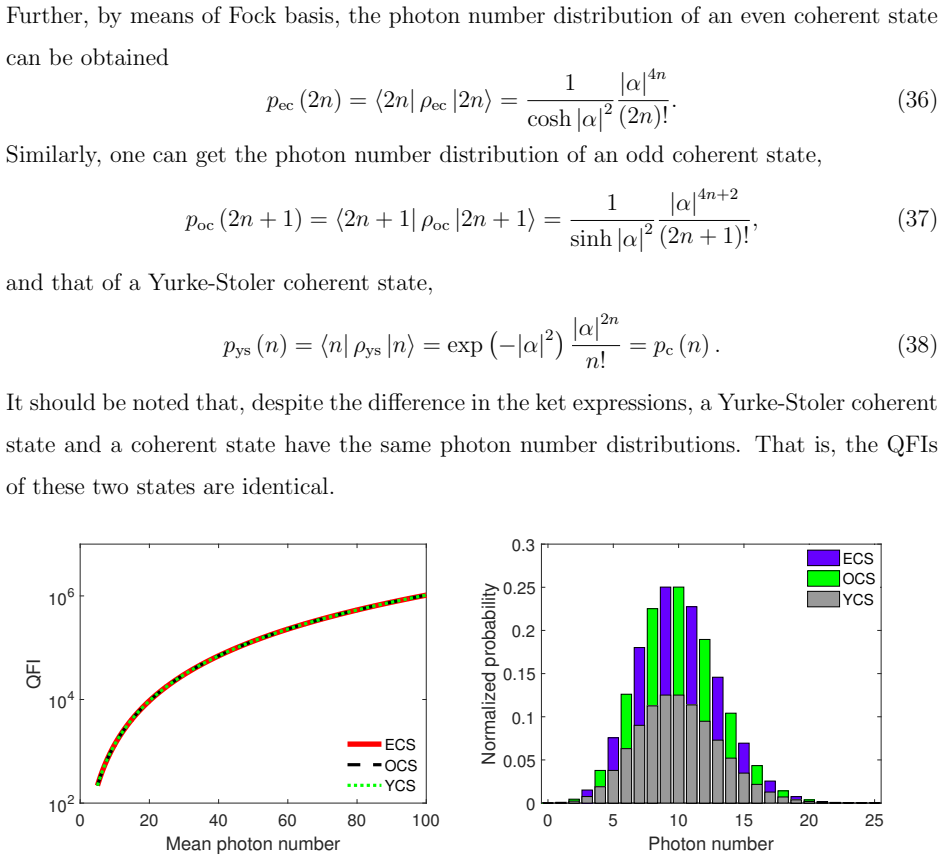
Figure legends: ECS, even coherent states; OCS, odd coherent states; YCS, Yurke-Stoler coherent states. In Fig. 6(a), the QFIs of these cat states are plotted. The result manifests that all states approximately exhibit the same QFI. To interpret this phenomenon, we give the photon number distributions of them in Fig. 6(b). As can be seen from the figure, t...
-
[2]
V. Giovannetti, S. Lloyd, and L. Maccone, Phys. Rev. Lett. 96, 010401 (2006)
work page 2006
- [3]
-
[4]
A. W. Chin, S. F. Huelga, and M. B. Plenio, Phys. Rev. Lett. 109, 233601 (2012)
work page 2012
-
[5]
C. L. Degen, F. Reinhard, and P. Cappellaro, Rev. Mod. Phys. 89, 035002 (2017)
work page 2017
- [6]
- [7]
-
[8]
C. C. Gerry, A. Benmoussa, and R. A. Campos, Phys. Rev. A 66, 013804 (2002)
work page 2002
- [9]
-
[10]
C. M. Caves, Phys. Rev. D 23, 1693 (1981)
work page 1981
-
[11]
S. L. Braunstein and C. M. Caves, Phys. Rev. Lett. 72, 3439 (1994)
work page 1994
-
[12]
M. Jarzyna and R. Demkowicz-Dobrza´ nski, Phys. Rev. A 85, 011801 (2012)
work page 2012
-
[13]
M. Takeoka, K. P. Seshadreesan, C. You, S. Izumi, and J. P. Dowling, Phys. Rev. A 96, 052118 (2017)
work page 2017
-
[14]
C. You, S. Adhikari, X. Ma, M. Sasaki, M. Takeoka, and J. P. Dowling, Phys. Rev. A 99, 042122 (2019)
work page 2019
-
[15]
M. D. Lang and C. M. Caves, Phys. Rev. Lett. 111, 173601 (2013)
work page 2013
-
[16]
P. M. Anisimov, G. M. Raterman, A. Chiruvelli, W. N. Plick, S. D. Huver, H. Lee, and J. P. Dowling, Phys. Rev. Lett. 104, 103602 (2010)
work page 2010
-
[17]
C. Weedbrook, S. Pirandola, R. Garc´ ıa-Patr´ on, N. J. Cerf, T. C. Ralph, J. H. Shapiro, and S. Lloyd, Rev. Mod. Phys. 84, 621 (2012)
work page 2012
- [18]
-
[19]
M. Abramowitz and I. A. Stegun, Handbook of mathematical functions: with formulas, graphs, 15 and mathematical tables , Vol. 55 (Dover, 1965)
work page 1965
-
[20]
C. C. Gerry, J. Mod. Opt. 40, 1053 (1993)
work page 1993
-
[21]
H. P. Yuen, Phys. Rev. A 13, 2226 (1976)
work page 1976
-
[22]
M. S. Kim, F. A. M. de Oliveira, and P. L. Knight, Phys. Rev. A 40, 2494 (1989)
work page 1989
- [23]
- [24]
discussion (0)
Sign in with ORCID, Apple, or X to comment. Anyone can read and Pith papers without signing in.